Your basket is currently empty!
Author: David Bodapati
-
I dreamt, but you never really think it is going to happen: Hamilton
DRIVERS
1 – Lewis HAMILTON (Mercedes)
2 – Sebastian VETTEL (Red Bull Racing)
3 – Daniel RICCIARDO (Red Bull Racing)
PODIUM INTERVIEWS
(Conducted by Eddie Jordan)
Lewis, did or dream or think this would be the result today?
Lewis HAMILTON: Of course, I was dreaming it last night but you never really think it’s going to happen. I just want to say a huge thanks to my team. What they’ve done this year is absolutely incredible and to be able to arrive here knowing that we have a car we can fight with, and just the feeling I had through the race, it’s… I couldn’t do it without them. Thank you guys.
We know you’ve won seven races this year but the talking point is how big a pressure was on you in that last pit stop? That’s what we wanted to know.
LH: Ah, it wasn’t that bad.
Well you sounded totally paranoid up there I have to tell you!
LH: No, I think at the time it was just not really knowing what the situation was. I knew I had a big gap but if a safety car comes out, what does that mean, but then when I came in and knew that I had to fight the guys on a long, long, run-down tyre, I knew that we would have chance to get by, so I felt kind of comfortable.
Well, we’ll come back to you because we have lots more questions but ladies and gentlemen, Sebastian Vettel, four times world champion, his best result of the year! Sebastian, what is it with Singapore and you? You seem to be a night raider or something like that. Every time there’s a night race you do remarkably well. Obviously on the podium again this year.
Sebastian VETTEL: Yeah, kid did well! It’s a circuit that I really enjoy, I really like. The atmosphere is great. You know, on the drivers’ parade there are already so many people in for the race. It’s great. It’s a tough one, it’s two hours and again we went to the full two hours. I had a good start, got past Daniel and then I think we had a decent race. We played a little bit with strategy and then the safety car came in the worst possible moment for us. So we tried to obviously stay out with the last set of tyres and make them work, which was very, very much borderline. I had a lot of pressure from Daniel and also from Fernando behind, but very happy obviously to make it P2.
A lot of red faces up here – the dehydration, the heat, the temperature. A huge race here is it? Is it very, very difficult?
SV: Yeah, it’s quite hot. The cars are sliding a lot, so you have to focus quite hard. It’s definitely a race we all enjoy as drivers because it’s such a big challenge and to stand up here and get a cool glass or bottle of champagne is quite nice.
Well, your best race of the season, your best result and we know what you’ve done here before. Now, ladies and gentlemen, the pride of Australia, Daniel Ricciardo! Almost like a home race really?
Daniel RICCIARDO: Yeah, feels like a home race. Singapore to Perth is pretty much as close as Melbourne to Perth, so for West Australia it’s like another home race.
I need to ask you the question: do you think that when Fernando gave up the place to Sebastian, do you think he should have given up the place to you?
DR: To be honest, I’ll have to have a look. Obviously he went off, that was clear. I knew he would give it back to Seb [but] whether he had to give it back to me, I’ll have a look at that. I was just sort of focused on regrouping from the start really. To get on the podium I guess is not a bad result, good for the team and at least we’ve got some Aussie flags.
We see a lot of Aussie flag, you’re the pride of Australia. Lewis, things have changed, really, haven’t they, for you?
LH: Absolutely.
Big smile on your face.
LH: Yeah, I was so excited to have… I was looking for that clean weekend and this has been it. It’s been fantastic. It’s not perfect for the team because Nico didn’t finish and we’re always striving to get both cars finishing 1-2. I don’t think anyone has finished one-two before and that was our goal. So there are things we can still work on. I also want to say a big thanks to all the fans. Incredible support today, so thank you guys.
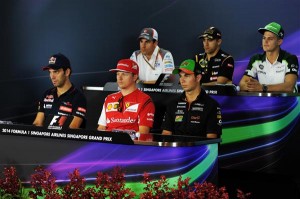
PRESS CONFERENCE
Q: Lewis, your second victory in Singapore, your seventh of the season and a very popular win, it would seem, with the crowd – but there was clearly a tense moment for you after the safety car when you knew you had to stop again and it was clear the four or five cars behind you didn’t – but the strategy team stayed calm, you stayed calm and you’re now leading the Drivers’ Championship. Just tell us about the rollercoaster of emotions and the way you feel leaving Singapore tonight.
LH: Coming here and to the last six races with a great race in Monza, knowing that we had a car to compete here, obviously yesterday in qualifying it was very close between everyone so I didn’t really know what to expect today – but got off cleanly. Of course it would have been a hardcore race if Nico was in the race with me as the car was feeling very good and we would have been very strong. But, yeah, later on in the race, I think for me I was a bit unaware of what I needed to do. That second-to-last stint, I extended it as long as I could and then they said “we need 27s.” And that was still six seconds I needed more, and my tyres were dropping off, so I didn’t really understand why. And I was also nervous that, if the Safety Car came out, would that cause me big problems? So anyway, fortunately we got to where I needed to go and we pitted. I came out, and I saw Sebastian going past but straight away I knew they would be on… they were obviously doing a two-stop, I would have good pace. So, took it easy the first lap. It was actually a bit of a tight gap, maybe I should have overtaken him somewhere else but fortunately Sebastian was very fair and I got by. After that it was quite straightforward. Amazing job from the team and the guys back at the factory. The car was really spectacular in the race.
Q: Sebastian, clearly the start was decisive for you. A fantastic initial getaway up into second place, you got the place back from Fernando. You were also a little bit sceptical when it came to the strategy, saying “that’s not my plan,” to go to the finish. So, tell us about the thinking at that point and how the race played out from your mind.
SV: As you mentioned, the start obviously was good for me. Quite weird to stop with no car ahead but not being on the first row. But it helped, obviously, because I had no car in front and I could get side by side and get straight into second place. After that I think we had a good race. Not ideal, in terms of timing with the safety car. Obviously, before that we lost a position to Fernando because we stopped too late – but we decided to go on the primes and we were hoping for no safety car to come out, which came out, so not ideal! But yeah, after that, obviously after the restart, we knew it was difficult with 27 seconds to make up on older tyres than everyone behind – it’s probably impossible. So, obviously to get the best result we knew we have to get to the end. I wasn’t very confident that we can do it, simply because of the wear we had the sets before. Obviously for one lap I was in the lead. As Lewis touched on, the overtaking manoeuvre, I wasn’t quite sure what he was doing. I thought that I give him all the space to pass me on the inside for the next corner but it seemed like he couldn’t wait to get back in the lead. It was quite tight but I saw him, obviously, so I had to back-off and let him through. There was no point fighting him at that stage because I didn’t have the tyres to match him. Nevertheless, to finish P2 obviously was the best we could do. We had the oldest set of tyres in the last stint, so it was quite tricky managing those to the finish line with not much tread left. Obviously very good result for the team.
Q: Daniel, I guess the opposite for you. Not a great initial getaway, you lost the initiative to Sebastian there, which is why you finished behind him in the end. Tell us whether you expected the attack from Alonso at the end because obviously he had pitted under the safety car, was on much fresher tyres than you . Were you surprised the attack didn’t come? What was going through your mind?
DR: Yeah, I think the closing stages, I could see after the restart for the safety car, he wasn’t attacking as much as I thought with a new set of primes, so I thought he was holding back and was going to make a late charge at the end. I think we all just piled up. I caught the back of Sebastian, he caught the back of me and we were all in a train and not really any real opportunities arose for any of us. So, it was what it was. I probably did expect him to come on a get stronger at the end but I think once you start following and trying to get the pedal down a bit harder to set up a pass, then you start hurting the rears and you all fall into each others’ pace. The start initially wasn’t too bad but just before Turn One we had a bit of an issue and I think we lost a bit of power. Whether we could have held on or not… who knows? But then yeah, Fernando went wide and then gave the place back to Seb and the race from there was fairly straightforward. Encountered a few other issues and bits and pieces here and there – so we’ll have to look into that. See how much it cost us in the end. But obviously it was nice to get on the back of Seb and try to put him under a bit of pressure but I think for all of us here it was follow-the-leader a bit and not much else to do.
QUESTIONS FROM THE FLOOR
Q: (Lennart Wermke – Bild) Lewis, is there anyone you dedicate your victory to?
LH: I’ve not really thought of it. There are only a few of the race wins which I’ve really dedicated to anyone. Maybe to my fans, I think. I met a couple of really special people last week – they’ll know who they are – and just generally to all the fans. They’re sending me messages and all that, really just saying that we win or we lose together and also being here with all the British flags, it lifts you up so much that probably they don’t even realise, so this is for them.
Q: (Dan Knutson – Auto Action and National Speedsport News) Daniel, you were on the radio during the race saying that you were losing power and I believe gears. What was happening and was the team able to help you correct those matters?
DR: Yeah, we had quite a bit going on during the race so yeah, power was coming and going and from the safety car onwards it was pretty consistently down on power and basically, coming up through gears, I would get a bit of power and then it would drop and then it would come again. So we definitely had a few issues and we tried fixing them but to be honest we didn’t quite clear it all up. I guess it did cost us a bit today but obviously we still got it to the end but obviously we will definitely look at what the cause was and if we can fix it. Normally, if we have those glitches after a couple of laps we clear it but this one pretty much carried through all race. I guess I was a bit frustrated, bit concerned as well that we wouldn’t get it to the flag but luckily it held on and as I said, we’ll just look at it and I’m sure we’ll fix it for Japan.
Q: (Michael Schmidt – Auto, Motor und Sport) To Seb and Daniel, what was the plan to have the harder tyre, the prime tyre, in the third stint rather than at the end, because at that moment, I don’t think you could know that the safety car would come out?
SB: I guess in my case Fernando undercut us, it was quite obvious, and then I think it was pretty pointless to do the same as him so we tried to do opposite and then get him back obviously, in the last stint of the race, I think that was the plan. With hindsight, we should have obviously stopped earlier, tyres were at the end of their wear life anyway so I think that was the plan. It was obviously high risk because of the safety car. In the end, we got lucky because the tyres held up but at that stage it didn’t look like it.
Q: (Don Kennedy – Hawke’s Bay Today) Lewis, you said on the podium that Mercedes were hoping for a one-two finish but in terms of the championship, can you say, in all honesty, that you’re sorry that Nico didn’t finish?
LH: Well, of course the points are something… I came here hoping to really gain those seven points and anything more than that was just a bonus, so today, of course, those extra points are a huge help. That’s several DNFs we’ve had now on either car and we want to continue getting those one-twos still. I know that the team will not be 100 percent happy today because we want to win collectively, we want to get those one-twos, we want to be the dominant team all together, so by not getting that result, they’ll be going back to the drawing board trying to figure out what happened. They’re constantly coming up to things and perhaps other people are starting to be a bit more reliable than us so that’s an area that we can still definitely improve on.
eom/FIA transcript of the Press Conference
-
Hamilton beats Rosberg to Singapore pole by tiny margin

Hamilton (centre) takes pole position from teammate Nico Rosberg in Singapore. Daniel Ricciardo in a Red Bull (left) took P3. An AMG Mercedes Petronas image Mercedes drivers separated by seven thousandths of a second at Marina Bay Street Circuit. Ricciardo third ahead of Vettel.
Lewis Hamilton claimed his sixth pole position of the season by the tiniest of margins today, beating team-mate Nico Rosberg to the top spot on the grid for the Singapore Grand Prix by seven thousandths of a second.
It was the tightest margin for pole position since Sebastian Vettel beat Fernando Alonso to the front of the grid for the 2010 German Grand Prix in Hockenheim by just 0.002s.
Third on the grid will be Red Bull Racing’s Daniel Ricciardo who finished just under two tenths adrift of Hamilton’s pole time and five hundredths of a second clear of team-mate Sebastian Vettel in fourth place. Fernando Alonso will start from fifth for the fifth time in 14 races.
In the opening Q1 segment, Ferrari set the early pace, with Alonso (1:48.203) topping the times, ahead of Kimi Raikkonen, who posted a lap of 1:48.583.
Rosberg had a nervous moment when he outbraked himself and was forced to take an escape road. His first clean lap of the session put him fourth, as Hamilton jumped to the top of the time sheet.
It had been predicted that Mercedes might attempt to make it through to Q2 on the prime tyre, but with the performance gap between the soft and the option supersoft at over two seconds, even they switched to the supersoft as the session wore on
The Red Bulls only emerged after 10 minutes, straightaway choosing the option tyres. Vettel’s first run wasn’t plain sailing, however, with the German coming across the slow Toro Rosso of Daniil Kvyat, which prompted the Red Bull man to gesticulate furiously at the Russian youngster.
At the end of the opening 18-minute session it was Kimi Raikkonen who emerged with the fastest lap, a time of 1:46.685. That was two tenths better than team-mate Alonso, and 0.136s clear of third-placed Hamilton.
Jenson Button was fourth for McLaren, with Valtteri Bottas fifth for Williams with a lap of 1:47.196. The Red Bulls eased through to Q2 with Vettel in ninth and Ricciardo in 10th.
There were few surprises in the knockout zone. Eliminated, in order, were Sauber’s Adrian Sutil, Lotus’ Pastor Maldonado, Marussia’s Jules, Caterham’s Kamui Kobayashi, the second Marussia of Max Chilton andthe second Caterham of Marcus Ericsson. Of some note, however, was the lap of Bianchi. The Marussia driver might not have made it through to Q2, but his lap of 1:49.440 was a full second quicker than that of his team-mate and those of his Caterham rivals.
When Q2 got underway, Raikkonen again jumped to the top of the timesheet with a lap of 1:46.359. That was soon eclipsed by Alonso, who went 0.031s than his team-mate.
Rosberg’s first lap left him third, two tenths down on the Ferraris, but then Hamilton pushed Mercedes to the top of the pile with a lap four hundredths of a second clear of Alonso’s. With the final runs in the offing, the order at the top was Hamilton followed by Alonso, Raikkonen and Ricciardo.
Those three didn’t change order but Rosberg’s final lap of the session saw him steal P1. Fifth place went to Massa, followed by the twin Red Bulls. Bottas finished eighth, with Kevin Magnussen putting in an excellent final lap to claim ninth.
Daniil Kvyat took the last place in Q3, beating Jenson Button to the place in the final shootout but just under two hundredths of a second.
Also eliminated was Toro Rosso’s Jean-Eric Vergne who finished in 11th place, just six hundredths of a second off team-mate Kvyat’s time. Vergne was followed by Force India’s Nico Hulkenberg, Sauber’s Esteban Gutierrez, the second Force India of Sergio Perez and Lotus’ Romain Grosjean.
After the first runs in Q3 it was Massa who sat at the top of the list, with a time of 1:46.007. The Williams driver was followed by Ricciardo, six hundredths back, and Alonso, who was a tenth down on his former team-mate. Raikkonen was fourth ahead of Bottas, while Hamilton was the fastest of the Mercedes, with a time of 1:46.230. Rosberg was seventh, five hundredths down on his team-mate.
Midway through his final run, disaster struck for Raikkonen. The Finn reported that he had no power and was forced to return to the pits where he abandoned the session.
Ricciardo was the first to make his move on pole and he immediately ousted Massa with a lap of 1:45.854. Rosberg was the next up, the German knocking Ricciardo off with his fastest lap of 1:45.688.
Hamilton, though, had still to cross the line and despite a lock-up in turn one at the start of his lap, he continued to improve throughout and when he crossed the line he was ahead by an incredibly fine margin. Rosberg’s response? A barked “damn it” down the radio to his pit wall.
Afterwards, the title leader said that he was still happy with second place and that it was a good platform, the fact is that four from six races here have been won from pole and Hamilton will very much go into tomorrow’s battle with the upper hand.
2014 Singapore Grand Prix – Qualifying
1 Lewis Hamilton Mercedes 1:46.921 1:46.287 1:45.681 17
2 Nico Rosberg Mercedes 1:47.244 1:45.825 1:45.688 19
3 Daniel Ricciardo Red Bull Racing 1:47.488 1:46.493 1:45.854 12
4 Sebastian Vettel Red Bull Racing 1:47.476 1:46.586 1:45.902 15
5 Fernando Alonso Ferrari 1:46.889 1:46.328 1:45.907 16
6 Felipe Massa Williams 1:47.615 1:46.472 1:46.000 20
7 Kimi Räikkönen Ferrari 1:46.685 1:46.359 1:46.170 14
8 Valtteri Bottas Williams 1:47.196 1:46.622 1:46.187 18
9 Kevin Magnussen McLaren 1:47.976 1:46.700 1:46.250 18
10 Daniil Kvyat Toro Rosso 1:47.656 1:46.926 1:47.362 21
11 Jenson Button McLaren 1:47.161 1:46.943 12
12 Jean-Eric Vergne Toro Rosso 1:47.407 1:46.989 14
13 Nico Hulkenberg Force India 1:47.370 1:47.308 13
14 Esteban Gutierrez Sauber 1:47.970 1:47.333 9
15 Sergio Perez Force India 1:48.143 1:47.575 13
16 Romain Grosjean Lotus 1:47.862 1:47.812 14
17 Adrian Sutil Sauber 1:48.324 6
18 Pastor Maldonado Lotus 1:49.063 8
19 Jules Bianchi Marussia 1:49.440 7
20 Kamui Kobayashi Caterham 1:50.405 8
21 Max Chilton Marussia 1:50.473 7
22 Marcus Ericsson Caterham 1:52.287 5eom
-
It’s `hammer-time’ for Charlie Whiting; Time to let the Dashboards talk
QUESTIONS FROM THE FLOOR
Q: (Marc Surer – Sky Germany) The first session was quite confusing. What is driving advice? What is technical advice? What is allowed and what not?
Charlie WHITING: First of all, have you seen the Technical Directive that I sent?
MS: No.
CW: Well then you’re at a bit of a disadvantage! On that particularly question Marc, it’s quite straightforward really. If a team informs a driver to change his brake balance, that’s absolutely fine, provided it’s not for a specific part of the circuit. So, in other words, one click forward for turn five and two clicks backward for turn 10, those are the sort of things we consider to be driver coaching, assisting the driver, whereas, a global change to the brake balance, or any other similar parameter on the car, would be for overall performance, which is fine. It’s just the driver coaching element of it that we want to stop first of all.
Q: (Jonathan Noble – Autosport) Can you say what prompted the decision to impose this radio clampdown for this weekend? What were the specific things that were discussed with the teams yesterday that made you realise you couldn’t go as far as you’d wished to in the build-up to this weekend?
CW: What prompted it in the first place? A culmination of things really. It was becoming apparent that more and more was being done for the drivers and quite simply that is at odds with Article 20.1 of the regulations. We felt that this should extend to both car performance and driver-related parameters but when one looks into it in more detail it became quite clear that some teams would be at a serious disadvantage compared to others, not just in their know-how or in their ability to react in the short term, but also with hardware choices that were made a year ago. I think you’re familiar with the two types of dashboard that are available to the teams. One will simply show a great deal more than the other. In the interests of fairness, we felt that with hindsight it would be better to introduce it in two stages and that’s what we’ve done now.
Q: (Ian Parkes – Press Association) Why did you do it now though? Why didn’t you wait until the start of the next season? Wouldn’t that have been far easier than introducing this with six races remaining?
CW: Yes, it would have been easier, but I think when it comes to enforcing a rule then things have to be done. It’s as simple as that. Yes, of course it would have been easier but I think if you see or hear something that you uncomfortable with, with regard to whether it conforms to the rules or not, you have to do something about it. That’s our job.
Q: (Dieter Rencken – Racing Lines) Charlie, following on from John asked. Who initially instigated this? Was it an FIA or a commercial rights issue? Because we believe that the commercial rights holder said he had something to do with it as well.
CW: It was an issue that came up in the Strategy Group meeting in Monza.
DR: From the commercial rights holder?
CW: I think it’s not for me to say what goes on in those meetings. It was something that emerged from that meeting in Monza.
Q: (Mathias Brunner – Speedweek.com) Charlie, did you hear anything in free practice one which was questionable to you, (a), and (b) what would the possible fine be if a team does something wrong?
CW: First of all, no, we didn’t hear anything that was remotely questionable. Teams were playing it very, very carefully, I think because they didn’t want to step over the mark. I think it’s not for me to actually say what the penalty might be because it’s a matter for the stewards of course. All I would do is report to the stewards a possible contravention of Article 20.1 and they would then decide what the penalty would be. I think it would have to be a sporting penalty rather than a monetary one, however. I would imagine it would be something along those lines. If it happened in a race I think it might be – I emphasise might be – a five-second time penalty for example. If it happened in practice it might be a grid position or something. But I think a sporting penalty as opposed to a monetary one.
Q: (Jonathan McEvoy – Daily Mail) Might it be that we spend a long time after the race resolving these things? Is that a danger you’re worried about?
CW: No. We listen to these things in real time and if we hear anything… Don’t forget that teams listen to each other intently. We’ll hear, don’t worry, and we won’t have to trawl through hours of radio conversation to find out if there’s anything wrong.
JM: Just for example, if six of these land on the stewards’ desk at one go that there might be backlog as they go through them.
CW: Well, unfortunately that would always be the case if there were any six enquiries that the stewards had to look into but it’s rare, though, I think you’ll admit.
Q: (Ben Anderson – Autosport) Is there a plan to simplify regulating radio communication going forward for next season and maybe go further, rather than having this complicated ‘some things are allowed, some things aren’t’?
CW: The plan is to make it more far reaching, to take in the technical elements of it as well, the technical assistance that the driver is getting about the performance of the car as well. It will inevitable become more complex but unfortunately I think that is how the sport is. I think it’s going to be very hard to make it simpler, unless of course one was to remove radios from the car, for example, but I think that might not be very well received.
Inaudible follow-up question
CW: But the teams have still go to use it. I don’t think a standard radio system would help. The teams will still use and obviously we are faced with all manner of complications, such as coded messages for example, and those are the sorts of things we’ll have to deal with between now and the start of next season.
Q: (David Croft – Sky Sport UK) Couple of points Charlie: 22 drivers, 11 teams, how many people have you got monitoring the radio traffic during each session?
CW: In total, probably about eight, but it’s quite straightforward to listen to three or four. They don’t normally all talk at the same time but it’s being recorded, so if we were to miss something we could easily go back and find it very quickly.
Q: (David Croft – Sky Sport UK) And based on what fans were saying to us this morning: practice sessions are practice sessions. Why do you have to rigorously enforce this during what is a training session for qualifying and the race?
CW: Well, we believe that a driver should driver he car alone and unaided. He shouldn’t be told he’s going a bit too deep into this corner or should take a tighter apex on that corner. It’s for him to decide, not for his team to tell him how he is comparing with his team-mate for example.
Q: (Anne Giuntini – l’Equipe) Could it be imaginable to have modern Formula One without radio at all?
CW: I could imagine it, but I think the teams might find it unpalatable, shall we say?
Q: (Heiko Wasser – RTL TV) So for TV, at the moment, as I understand, we don’t get each and every radio so far. It’s taped and we don’t get everything. Now, in the future, it can happen that somebody gets a penalty for a radio that we didn’t hear on the television? Or will it be making sure each and everything will be broadcast so that the audience worldwide can follow that something went wrong?
CW: First of all, it’s impossible for you to hear everything that’s said, that’s quite clear. The television broadcasters decide what to broadcast. I suspect that if a team was accused of saying something that it shouldn’t have been saying, that would be available to the broadcasters in the fullness of time. I’m sure you would hear that, but whether you’d hear it live is, I think, a matter of chance more than anything else.
Q: (Daniel Johnson – Daily Telegraph) With phrases like ‘driver technique in general’, is there not a danger that we’ll just get into a situation where teams are making complaints and counter-complaints, because that seems like it could cover a whole range of things and could be quite easily argued one way or the other?
CW: You’ve obviously seen the list. That’s at the bottom of the list and the idea is that that should capture anything that’s not actually listed. I think it’s a fairly exhaustive list, so I think it’s quite unlikely. And teams have a tendency to make sure that they are absolutely clear on things. So, if they look at the list and think ‘I wonder if this driving technique in general’, they would probably ask before they decided to use it, so I don’t envisage any big issues over that. It’s a kind of a catch-all, just in case.
Q: (James Allen – Financial Times) When you last gave us one of these briefings in Silverstone, you talked about complication and you’ve mentioned complication again. Isn’t there not a risk that this whole debate has once again added something that is very complicated, with a long lost of very complicated thing, when it’s actually a question of perception to the public. Wouldn’t it have easier to just give the world feed TV director a list of radio messages that would suitable to air to the public, because the public doesn’t know all the other coaching that goes on between races and all the other things that happen between teams and drivers, so wouldn’t that have been a much more simple solution?
CW: Yes, it would have been simple, well, simpler. But the fact of the matter is when the driver is on the track he should be driving the car himself. That’s the fundamental essence of the regulation in question isn’t it really? Whether he receives coaching outside an event, he’s perfectly at liberty to do that of course. But once he’s out on that track, he should be doing it himself. That’s the reason for the rule and that’s the reason why we believe we have to enforce it. It is a complicated sport and this is an area that hadn’t really come into the spotlight previously, but it just shows that every single area in Formula One is complex. There are very few simple ones. That’s the nature of the beast, as we say.
Q: (Andrew Benson – BBC) Charlie, I have seen the directive that you sent out but radio beeps for gear changes aren’t mentioned on that. What side of the line do they fit on?
CW: It’s the same as a rev counter. That’s all. Instead of looking at a rev counter, you can hear one and that’s not a driver aid as far as we’re concerned.
Q: (Ian Parkes – Press Association) Charlie, we obviously have Article 20.1 but we’re constantly being told at the end of the day that F1, at the end of the day, is a team sport. While we appreciate that drivers are out there on the track, why is there any need to have article 20.1 in the first place?
CW: Well, it’s been there for, I think, over 20 years and it was originally there to capture things like traction control, as you probably know. It is also a safeguard against any other driver aid which hadn’t been thought of at the time and it has been used a number of time in its lifetime. And this is just one of those times, I believe. Things had got, I believe… the teams have become so sophisticated at being able to analyse exactly what a driver is doing on the track and be able to compare it to other cars – more often than not their team-mate – and to be able to give that driver that information so that he can then drive the car differently is fundamentally incorrect in our view.
Q: (Michael Schmidt – Auto, Motor und Sport) Is the radio ban as it planned for next year, is it maybe a first step to ban telemetry? Because if telemetry was banned the whole radio discussion probably would be finished, because if the teams don’t know in what condition the car is, then it doesn’t make sense to coach the driver or to tell him what’s going on.
CW: No, it’s not planned as a step in that direction at all. In fact, it’s not been discussed at all. This is purely to do with the application of article 20.1 at this stage.
Q: (Abhishek Takle – Miday) Charlie, you mentioned that coded messages are obviously banned but then how do you police that? Because there could be prearranged coded messages to get around the ban on coded messages as well. It’s hard to police isn’t it?
CW: Yes, I agree with you. It won’t be straightforward. We will have a little bit of time to think about that because the list that the teams have been given today is quite straightforward, whereas I think if you have a more complex, longer, more technical list, there will be greater opportunities for that sort of thing. It was put to me yesterday, for example, that if something oil transfer is allowed as a message it could be coded in such a way that oil transfer when told to a driver in turn one means something different to if it’s told to them in turn 10. It’s going to be a little difficult but I’m fairly confident we can get over that one, with enough time.
Q: (David Croft – Sky Sport) Will that be the end of ‘hammer time’?
CW: You never know.
DC: Is hammer time allowed? Is that a coded message?
CW: I think that’s push hard isn’t it.
DC: But surely it requires the adjustment of settings?
CW: To be discussed. That’s not for this current crop of rules but I think now we have a little bit more time we can discuss these things with the teams and hammer time might come into it!
-
It was quite an exciting qualifying session and great effort by team: Hamilton
DRIVERS
1 – Lewis HAMILTON (Mercedes)
2 – Nico ROSBERG (Mercedes)
3 – Daniel RICCIARDO (Red Bull Racing)
TV UNILATERAL
Lewis, pole position once again for Singapore and you saved the best until last it seems?
Lewis HAMILTON: Yeah, that’s always the plan. It doesn’t always go to plan but yeah, quite an exciting qualifying session. I wasn’t expecting… I guess no one was really expecting to see so much difference and how close everyone was. I did some good laps in the first and second qualifying sessions and saw the Ferraris were very, very close and then obviously for it to end up the way it did is good obviously for our team. My last lap, I locked up into turn one and lost a bit of time but still managed to pull it back later on in the lap. So, at that point I honestly thought that perhaps it was… I lost over a tenth and a half or was two tenths down but I just kept going and it just got better and better throughout the lap.
Were you surprised when you saw Felipe Massa on provisional pole after the first runs?
LH: I wasn’t really trying to look at it too much because there was so much happening. I don’t know what it ended up as but obviously it was very close. But a great effort by the team. To come here at very much a downforce and engine dependent circuit to have the performance we have I think it’s a fantastic performance by them.
Very well done. Nico you missed out by the smallest of margins, I think seven one thousandths of a second. Your radio message at the end on the cool down lap there said it all: “Damn it!”
Nico ROSBERG: Yeah, because seven thousandths, you know, when I think back at the lap, seven thousandths it’s nothing, a little bit here or there, you know, like “come on!” I could have done it. But OK, that’s the way it is. Lewis did a good job to get pole, fair play. And second place is OK, obviously first would be better but it’s a long race ahead and, yeah, it’s fine.
Tell us about the Q2 session? You were in sixth place in the closing stages there and you obviously felt you needed to run again so you did an extra lap?
NR: Yeah, because we changed brakes going into qualifying and I got into a rhythm with the other brakes and so that was a challenge. I mean we expected it to be, but it always is a bit of a challenge. So it took me some time to get into qualifying. And the balance was also very different because the track had cooled down relative to the session before qualifying, which was hotter. There was a lot more understeer now, in the rear we had a lot more grip, so had to complete adapt settings and it just took us some time to get into the qualifying. That’s why I’m pleased that in the end I was able to push flat out and put in a good lap time.
Daniel, a tenth-and-a-half behind the Mercedes; can you race them from here?
Daniel RICCIARDO: It’s definitely encouraging. Coming into the weekend I thought if we could be within two or three tenths it should give us a bit more optimistic chance in the race to stay with them, so, yeah, I think we ended up a bit closer than we thought we would, particularly after yesterday. So I think it was a good day. Yeah, it was good fun out there. The track was really improving so you had to adapt a lot during the session. Street circuits normally tend to be like that, so it keeps you on your toes. Yeah, good fun.
There was a big roar from the grandstands when you took provisional pole. Have you brought a few thousand of your closest friends from Perth?
DR: I’ve got a few mates here this weekend and there’s probably a few more here that I don’t know about. Yeah, it’s close to home and it’s nice to see a few Aussie flags. Yeah, hopefully keep it up there tomorrow and try and see a better view from the podium.
Q: Lewis, tyres have obviously been a big part of the story throughout this weekend, particularly today and it’s obviously going to have an impact on tomorrow’s race. What kind of race can we expect tomorrow?
LH: I think coming into the weekend we had a certain opinion about how the tyres would behave, and obviously when we got into the long runs yesterday we saw quite a big difference from what we had though was going to happen. So, I think tomorrow’s going to be a really interesting race. Looking after these tyres is not easy but I think it will be a great race to watch for the fans. I think there’s going to be a lot going on.
PRESS CONFERENCE
Q: Lewis, one of the things I think is interesting about how today has evolved, that might surprise a few people, is that Mercedes hasn’t really shown too much. FP3, then you weren’t really at the top of the timesheets throughout qualifying. You mentioned “that’s the plan”, about saving the best to last. So, what was the strategy today?
LH: I just mean that, as a driver through the weekend you plan to have the last lap as your fastest lap because that’s when the track is at its best. That’s when you’ve got the configurations as close to perfect. That’s really the lap you want to do it on. The others have just obviously taken a step. It’s a real, real surprise. I’m sure the team are surprised, I’m sure we are just as surprised to see Ferrari really competing on a lap, which is great to see. Also with Williams, also with Red Bull. I think for racing it’s great. It makes it… that’s probably the most exciting qualifying session I’ve had for a long time, where there’s a lot of people really in the mix and you have to be spot on. I was almost there with that.
Q: Nico, there was a radio message for you: “look after these, these are the race tyres.” Obviously there is a consideration there: you have to take some performance out of them because you need the lap time but you’ve also got to use them tomorrow. How do you see the use of them tomorrow playing out?
NR: Tomorrow is going to be a tough race in terms of tyres. They have a lot of degradation but I’m confident because I had some really good long runs on Friday, so I’m well prepared for the race and feeling good about it.
Q: Daniel, are you fully able to recharge the energy system around this lap? One or two drivers are saying it’s been a bit of a struggle. Are you completely on top of that side of things with Red Bull?
DR: Yeah. Yes we are. We’re not having any issues there. I think for such a long lap, a little bit on what Lewis touched on, it’s amazing how close we are, y’know. Monaco is a street circuit but it’s a lot shorter lap so you can expect us to be closer but this one, yeah, it’s pretty cool how many cars are within half a second or a second. So, it’s going to be a fun race tomorrow definitely. I think tyres will be key, as always, but particularly here. It’s not going to be as straightforward as Monza with a one-stop. So, it should be fun.
QUESTIONS FROM THE FLOOR
Q: (Silvia Arias – Parabrisas) Daniel, we saw you doing a wonderful lap, it was unbelievable watching it on TV. Do you have the same feeling when you’re going to the limit? Your feelings about this lap please?
DR: Yeah, street circuits are fun. I think all us drivers enjoy them. You jump across kerbs, you brush near the wall, it’s a little bit like the closer you get the more you want to risk and I guess that’s why we race, we love that rush, that adrenalin. It’s like speed, we wish we could go faster. It’s a bit like that when you come to a street circuit, you just really enjoy handling the car, playing with fire, so to speak. It’s not always the quickest way when it’s sliding around but I think you’ve got to take hold on a street circuit so that’s where I get the enjoyment.
Q: (Michael Schmidt – Auto, Motor und Sport) Lewis, Nico just explained why, on the last lap, he was quick enough to be on the front row. How was it with you because you also did your fast lap only on the last lap? I guess you didn’t go slowly beforehand intentionally. Did you have any problems before?
LH: I just didn’t really have a clean lap through the whole of qualifying. The last one was the cleanest. When you do the first lap, you get your lap time. The next time you go out you have a delta so you know whether you’re up or down on that lap. I locked up into turn one and missed the apex and so I was down 0.18/two tenths by the time I got to turn five. At that point, I was thinking this is going to be almost impossible to regain that but the previous lap there were a couple of corners where I lost out as well so I fixed those and got back the time. It’s great that there’s still potential there and with a perfect lap it’s a good place to be.
Q: (Don Kennedy – Hawke’s Bay Today) Lewis and Nico, if I understand the restrictions on radio use, how important is that going to be in terms of this race and information about how each other is doing in terms of your position on the track and what tyres you’re on and so on? Do you think it’s going to affect your battle for the championship?
NR: I don’t think it’s actually going to make too much of a difference tomorrow. There’s just a few bits and pieces… you know they can’t tell me ‘OK, work on turn seven because that’s where you’re losing some time’ or something like that or ‘turn twenty is good, keep doing what you’re doing.’ That’s the main difference, so actually for tomorrow’s race really, I don’t think it’s going to be too much of a thing.
Q: Lewis, anything to add? The starts, obviously, you’re going to be able to be talked through all the things you need to do still, that’s still permitted.
LH: Yeah, obviously coming into the weekend there was a plan of zero being able to say to us but I think there’s a just a few things (that are banned). We’re all in the same boat so I’m quite excited about that.
eom/FIA transcript of the Press Conference
-
Alonso quickest in final practice in Singapore
Ferrari driver fastest at Marina Bay Street Circuit ahead of Red Bull’s Ricciardo and Mercedes’ Rosberg.
Singapore, 20 Sept 2014: Fernando Alonso went quickest in the final practice session ahead of qualifying for the Singapore Grand Prix, edging out Red Bull Racing’s Daniel Ricciardo by just five hundredths of a second. Nico Rosberg was third for Mercedes, just under two tenths of a second behind Alonso.
The session ran to the usual programme of prime tyre runs followed by a quick flurry on the option tyres at the end, and on the soft tyre at the beginning of the hour it was Red Bull Racing’s drivers who set the pace. Sebastian Vettel, seeking to make up the time lost in FP2 when he sat out most of the session due to a power unit failure in the first Friday outing, jumped to the top of the timesheets with a lap of 1:50.393. That was quickly beaten by team-mate Daniel Ricciardo, who became the first driver of the evening to dip into the 1min49s bracket.
Mercedes, Ferrari and Williams had yet to show their hand however, with their drivers only having completed installs at the start of the session. Rosberg and Kimi Raikkonen were the first from those outfits to appear, both heading out for their first runs just after the 20-minute mark. And after Raikkonen had jumped to third place, Rosberg emphatically claimed P1 with a lap of 1:49.575, over a second quicker than Ricciardo’s best at the point. Hamilton soon joined his team-mate at the sharp end of the timesheet, slotting into second place, though he was seven tenths down on the German, with Ricciardo now third.
Hamilton had a wild moment at the start of his first run, however, the Englishman losing control of his Mercedes at turn five and slewing sideways. He regained control and then reported that his engine had mysteriously stalled and then restarted, causing him to spin.
Williams’ Felipe Massa and Valtteri Bottas soon also took to the track and they slotted into P4 and P5 respectively as the hour mark approached.
Alonso was the last to set a time in the session, the Ferrari driver emerging with 30 minutes remaining and he was soon in the mix, the Spaniard ousting Bottas from P4 with a time of 1:49.614, still a second adrift of Rosberg’s benchmark.
Ricciardo, though, was making gains and on his next run moved ahead of Hamilton to claim P2 and narrow the deficit to Rosberg to 0.6s. After admitting to his team over the radio that he had overdriven that lap, he close further to 0.543 behind Mercedes’ pacesetter.
He was joined in the effort by Vettel, whose final run on the soft tyre yielded a fastest final sector. His time of 1:49.180 was good enough for P3, six tenths down on Rosberg, a tenth clear of Hamilton and four ahead of Alonso.
With the move to option tyres in the offing, the top-10 order on the prime tyre was: Rosberg, Ricciardo, Vettel, Hamilton, Alonso, Bottas, Massa, Raikkonen, Jean-Eric Vergne and Daniil Kvyat.
With just over 15 minutes to go, Rosberg became the first to make the switch to supersofts. His first flyer was more than a second quicker than his best soft tyre time, the German establishing a new benchmark of 1:47.488.
Alonso, though, bounced the Mercedes man to P2 with his first flyer on the options, his 1:47.299, beating the German by almost two tenths. Ricciardo too eclipsed the Mercedes, taking P2 with a lap just five hundredths of a second slower than Alonso’s.
And that was how the top three remained. Behind Alonso, Ricciardo and Rosberg, Vergne popped up with a good run on the options tyre to claim fourth sport with a time of 1:47.693, just under four tenths slower than Alonso’s P1 time. Vettel finished the session on fifth place, ahead of Hamilton, Massa, Bottas and Kimi Raikkonen. Sauber’s Esteban Gutierrez completed the top 10 order.
2014 Singapore Grand Prix – Free Practice 3 Times
1 Fernando Alonso Ferrari 1:47.299
2 Daniel Ricciardo Red Bull Racing 1:47.350 0.051
3 Nico Rosberg Mercedes 1:47.488 0.189
4 Jean-Eric Vergne Toro Rosso 1:47.693 0.394
5 Sebastian Vettel Red Bull Racing 1:47.711 0.412
6 Lewis Hamilton Mercedes 1:47.738 0.439
7 Felipe Massa Williams 1:47.909 0.610
8 Valtteri Bottas Williams 1:48.205 0.906
9 Kimi Räikkönen Ferrari 1:48.226 0.927
10 Esteban Gutierrez Sauber 1:48.422 1.123
11 Nico Hulkenberg Force India 1:48.450 1.151
12 Kevin Magnussen McLaren 1:48.577 1.278
13 Jenson Button McLaren 1:48.599 1.300
14 Daniil Kvyat Toro Rosso 1:48.637 1.338
15 Sergio Perez Force India 1:49.078 1.779
16 Adrian Sutil Sauber 1:49.115 1.816
17 Romain Grosjean Lotus 1:49.485 2.186
18 Pastor Maldonado Lotus 1:50.149 2.850
19 Jules Bianchi Marussia 1:50.376 3.077
20 Kamui Kobayashi Caterham 1:50.939 3.640
21 Max Chilton Marussia 1:51.221 3.922
22 Marcus Ericsson Caterham 1:51.598 4.299
eom -
The actual influence of Pit-wall communication on the Driver is debatable: Vijay Mallya
TEAM REPRESENTATIVES – Franz TOST (Toro Rosso), Vijay MALLYA (Force India), Manfredi RAVETTO (Caterham), Monisha KALTENBORN (Sauber), Eric BOULLIER (McLaren), Claire WILLIAMS (Williams)
PRESS CONFERENCE
If I could I begin with a question to all of you? Obviously there have been changes today to the team radio ban. The FIA met with the media earlier today but I wonder if we could get a perspective from the teams: why the changes were needed and what it was like today to manage the relationship between the pits and the drivers? Monisha, maybe you would start?
Monisha KALTENBORN: The change comes from complaints that were raised by the fans that the drivers receive too many instructions and are just, in a way, carrying out whatever instructions they have been given. That’s something we as teams of course understand and that that’s not exciting for the event and for the show. So I think it was the right decision to say that we should try to stop these type of instructions and that the drivers do more on their own. As a team, we were a bit surprised to see what extremes the first clarification went to, because we felt that it went into areas that could have raised other concerns as well. So we’re quite happy that the FIA has now taken this position to really just cover areas that were meant to be covered, performance of the driver and not, as such, the entire car.
Franz, can I ask you, because obviously you’ve got a 20-year-old in your car and next year you’ve got a 17-year-old. So to what extent is it a disadvantage not being able to quote-unquote ‘coach them’?
Franz TOST: The changes are absolutely not necessary and I still don’t understand why because all these information are also entertainment for the people in front of TV, to hear a little about the communication between the team and the driver. And for us, of course the more inexperienced a driver is the more information you have to give him and it requires a lot of work during the week to work out the programme and we still have the possibility within the regulations to communicate in a proper. For me it’s absolutely nonsense what we are discussing here, because in all the other kinds of sport a coach gives some information, instructions to a footballer player on the sidelines or whatever. This does not mean that the sportsman is not able to do his job. He can do his job, he does do his job, but maybe he can do it in a better way. It’s just a performance improvement, therefore I don’t understand it.
Manfredi, what’s your view on this? You too have got a rookie in your car. Do you share Franz’s view?
Manfredi RAVETTO: First of all, I have to say, it’s remembers us a little bit of the good old days. I think so many nice pages of motor sport history have been written without pit to car communication. Having said this, we take it easy. It’s a decision from FIA and we have to accept and respect it.
Vijay, you’re active in many sports, you car a lot about the show. What do you think about this?
Vijay MALLYA: You know, the FIA rule has always existed: that the driver should drive unaided. But despite that rule being in existence, teams have taken pit wall to car communication to a certain level and now we have been asked to pull back. It’s as if we have been abusing the regulation in one form or another. This is not Playstation. Whatever you may say from the pit wall, the amount of influence it actually has on the driver and the excitement of the race and the race result is something that is highly debatable. But then, the FIA makes the rules and it’s the obligation of every team to abide the rules. So I guess we will abide by the rules that were fortunately clarified to a more practical extent this morning.
Claire, you’ve got one of the more experienced drivers in the field, how has it been for you?
Claire WILLIAMS: I think it’s been OK. I think it’s an adjustment for everybody, but as Vijay said, they are the new regulations, they have been put forward in an effort to make the show more exciting. But I’m pleased that the new directive that came out this morning has adjusted what is and what isn’t allowed to be said and it has clarified that. From our perspective, as long as we are able to communicate messages around safety and reliability to our drivers, that’s the most important thing. But we’re racers at heart and we want our drivers to be going out there and driving the cars.
And Eric, your feelings? You’ve obviously always been very involved in this side of things, do you have any concerns about what is and what isn’t allowed?
Eric BOULLIER: Yeah, obviously we had some different messages internally during both free practices, like ‘shall we say this’ or ‘shall we not say that’. So we had to police a little bit, or monitor what we wanted to say. In the end I think most has been said by my colleagues. The only thing which was worrying a little bit is to change the regulations during the course of the season, which is never a nice thing to do, even if we obviously listen to the fans and obviously respect the decision of the FIA. Happy as well that they clarified a little bit what can be said and not. And obviously happy that we can still say or deliver some message about safety or reliability of the cars.
Coming back to you Monisha. Can you give us an insight at the heart of the team at the moment? Do you need to shake the tree to break this cycle that you have got into this season? And also, can you tell us what the latest is about Sergey Sirotkin and whether he’ll run in free practice one?
MK: Well, we’re probably having the worst season we have had in the history of the team so far. We know the reasons for it. We’ve been trying to make changes, which not easy when you have certain limitations that you have work within. We’re step by step coming out of it. The steps in my view could be bigger sometimes, that they are a bit more measurable. But the direction is right. So, we have to be patient, focus on the right things and hopefully get out of it. Coming to Sergey, we have announced that he will be driving FP1 in Sochi. That’s one of the milestones we have agreed with him and then we’ll see where we go from there.
Thanks for that. Vijay, coming back to you, you’re neck-and-neck with McLaren for fifth in the Constructors’ Championship. How do you deploy the resources then from here for the rest of the season. Do you want to develop hard this year and try to beat or have you also got one eye also on 2015?
VM: As you rightly said, McLaren is just one point ahead – literally as well, as we sit. Having said that, it is my intention to reverse that. We will do everything possible to achieve that by the end of the season. I’m sure they are developing their car and so are we. Unlike previous years I think all developments done this year will, in fact, carry over to next year’s car. So whatever investment is made I think it’s not lost on 2014 alone. But we enjoy tough racing – I’m sure McLaren do too – and we’ll have some fun and let’s see in Abu Dhabi who’s ahead of whom.
Coming to you Manfredi. Changes again in the management structure at Caterham, the third different team boss in the course of the season. Can you tell us a bit about Christijan’s departure, the structure as it is now and your plans for the development of the team?
MR: First of all, I must say thank you to Christijan Albers, because he supported us, coming on board in a very crucial stage. His decision is a very private and personal one, but it is kind of a natural cut-off with the end of the European season, because he wanted to stay closer to his family and the flyaways are not the best option in this case. Having said that, there is a new structure in place. The main goal is to stabilise the company, on the financial side as well as on the technical side. We are very much focused on getting the best out of the current 2014 car but we are also working very hard on 2015. We are enjoying an excellent co-operation with Toyota and its wind tunnel in Cologne, where our next year’s car is already testing. Unfortunately we inherited… when I say we, I refer to new ownership and new management… a quite difficult situation. The situation was difficult to such an extent that previous ownership decided to pull the plug and therefore whatever we do we see it as an achievement.
Franz, last time you were with us in one of these Friday press conferences you were on a good roll of top-10 qualifying and race results. It seems to have thinned out a bit. I think you’ve had two top-10 finishes in the last four races. What’s been going on to cause that, and also can you give us an update on Max Verstappen’s development?
FT: I think here this weekend I expect a good performance and I expect that both cars are in qualifying three and I expect that we score points. Max Verstappen did, last week, a test in Adria. He finished by doing 396km without any problem. People were really impressed with his performance and now it’s in the hands of the FIA whether he gets a Superlicence to do the Friday P1 session in Suzuka and then we will see. We will prepare him step by step and I am convinced that he is the correct driver for us for 2015.
Do you know when you will get answer on the Superlicence?
FT: It must be soon as the next race is already in Suzuka.
Q: Claire, obviously now third in the Constructors’ Championship after that result in Monza, can you catch Red Bull, do you think, for second? And can you tell us what this renaissance for Williams has meant for the spirit inside the team?
CW: It would be lovely to catch Red Bull but as I was told by my team when I last said ‘we’re after Red Bull’ I got into a lot of trouble. I think now the position for us is very much to consolidate where we are in the Championship – which is obviously in P3 – to build hopefully that gap between us and Ferrari, I think. From where we were last year, obviously we finished in P9, it’s a really great turnaround for everybody at Williams. Probably not one, if you’d said to us last year, this is where you’re going to be this time next year, we would have believed you – but a lot of hard work has gone into that turnaround from changing our power unit, bringing in new personnel, bringing in Felipe Massa and obviously some new commercial partners to support us as well. That’s all contributed to a great new atmosphere at Williams. I think if you just come to our motorhome, you get a sense of revival and a refreshed spirit about what we’re doing. We’ve always been here to race. Obviously the past few years have been really challenging for us. It hasn’t necessarily dampened the spirit but there is a real galvanised effort now within the team. Everyone believes that we can win and we can go on to fight for a seventeenth world championship.
Q: Eric, in a little over four months from now by my calculations, you’ll be hitting the track with a McLaren-Honda in pre-season testing. It doesn’t sound like very long when you say it. Where are you in the development programme for that? And is it looking like the current drivers will be the ones driving that car.
EB: There is obviously a lot of work behind the scenes with our new partner for next year. We have not exactly defined when and where we will test first, to be clear about some discussions and rumours. There is a lot of work going through and, to be honest, as per the original schedule, everything is fine so far. Regarding the driver line-up, wait for the decision and the announcement.
QUESTIONS FROM THE FLOOR
Q: (Abhishek Takle – Midday) Bernie Ecclestone has once again raised the possibility of three car teams, perhaps as soon as next year. I wanted to ask you, how real is the danger that we might lose three teams before the start of next season and, specific to Monisha and Manfredi, how confident are you that your teams will be on the grid in Melbourne next year?
MK: Well, as I said, we are having the worst season of our history, of our team, and yet at the same time, we are more than 21 years in Formula One and we do get that question often and every time we say, ‘well we’ll be around’. I’m going to answer the same way, we’ll be around next year as well.
Manfredi, do you share Monisha’s confidence?
MR: All I can say is that we are very relaxed in this respect. I mean, everybody knows the situation in which we found this team, in which state it was and, well, we are just trying to keep it alive to improve and we are working, as I said before, also providing you with some details on the programme for next year. This is what we are targeting. Of course we want to be on the grid in Melbourne next year – that is definitely our goal.
Vijay, I guess you’re in the part of the grid that doesn’t like the idea of three-car teams too much?
VM: No. I’m a firm believer, as I’ve always said, that every effort should be made to make sure all teams, big and small, survive and race. That’s part of the DNA of Formula One. But the regulations and the agreements do provide that, if the grid is less than 20 cars, then participating teams will race a third car. That’s something everybody signed up to as well. I hope it never comes to that. As I said, I think the DNA of Formula One should be preserved. I will repeat once again that I will try to persuade the decision makers – the commercial rights holders – that they should look very seriously at a more fair and equitable revenue-share model so that we don’t have to answer such questions all the time.
Eric, I guess you would be one of the teams that would be looked at to provide a third car. What are you your thoughts on this situation?
EB: Well, it’s a little bit like Vijay said. We obviously all look for what will keep all the teams onboard. That’s the first priority. There are some mechanisms that, effectively, if some teams were not on the grid, we would maybe run three cars to keep the grid at a decent number. But I don’t think we are there yet, as I said before.
Claire, your views.
CW: Yeah, I agree with what everybody has said. I think that to be having this conversation now shows where we are as a sport. We need to be working harder to ensure that we protect the teams that we have on our grid to ensure that competition that I don’t necessarily think having three-car teams brings. I think we want to have a healthy grid of ten teams all fielding two cars. Not four teams fielding three cars. For Williams, that’s not the DNA of our sport.
Franz, what would it mean for you?
FT: I hope that all the teams which are now taking part in the Formula One World Championship will be on the starting grid next year in Melbourne, and then it’s not necessary to discuss a third car.
Q: (Ralf Bach – Sport-Bild) A question to Mr Ravetto. Can you give us some background to your financial situation at the moment, starting maybe from Silverstone to now, and the status quo now?
MR: Yeah. Thanks for asking this question. In reality I believe our team was not set-up to race in Silverstone. This is the truth. Since new ownership came on-board, since new management has been established, I think we managed not only to race in Silverstone but also to arrive to Singapore. I must say it’s not a very easy task. The financial situation is not one of the easiest. I only have to repeat myself when I said even before, we inherited a situation which was more than critical. I do not know what the reasons are for this, maybe you should ask the previous owners.
Q: (Dieter Rencken – Racing Lines) Another topic that’s reared its head this weekend is the possibility of an engine un-freeze for next year. I believe it was discussed this morning in the team bosses’ meeting. None of you produce your own engines. Accordingly you’re either customers or partners. Where do you stand on this issue, particularly where potential cost increases are concerned?
MK: If we look at this year’s season we’re seeing that there’s such a big disparity between the different engines. And Formula One is not just about different engines, engines do play a role there but the gap should not be that big. We do support the idea that development of an engine is allowed within certain given parameters but it not necessarily leads to the fact that we, as customers, should actually bear the costs for that. Because that’s something that is always taken for granted, that the moment we talk about engine development it’s just a logical step next to say ‘it’ll get more expensive’. As a customer we say ‘why should it?’ because actually the supplier is doing it first of all for his own team. Not for us. We are benefitting from it, of course. We are also paying a lot for the engines. Yes, we as a customer, support that – within the parameters. But we should be getting the same spec at the same cost.
Do you share that Vijay?
VM: Well, you know the engines for 2014 are already a lot more expensive than in previous years and if unlimited engine development in-season is allowed, I agree with Monisha, that that the teams, those sat around this table, shouldn’t be burdened with these additional costs. But on principle, maybe I would agree to support maybe one in-season update of the engine in a very controlled and limited way but I think it would not be appropriate to allow unfettered in-season development.
Claire, it’s one of the secrets of your 2014 success. Would you welcome teams being able to upgrade their engines?
CW: No! Because, as you say, we’ve got the Mercedes power unit and fortunately they’ve done a great job this year. I look back over history in Formula One when we have these kinds of conversations and, you have to enter the season with your race car and, if you haven’t done a good enough job, then why change the regulations? Why should teams be allowed to do that? However, if it is part of the conversation, then fine, we’ll be involved in that conversation and we’ll support it – but only based around what Monisha has already said: as a supplied team, we don’t believe those costs should be passed on to us. If the manufacturers want to spend that money developing their engines, then fine – but as a customer team we want to receive the same specification that the manufacturers provide, and at the same cost that we have now. The cost of changing to this year’s spec engine have been considerable. We’re paying about £20 million for our engine in a period when we’re trying to control costs in Formula One. We’re now looking at a period where engine development costs are going to increase significantly – and I’m not sure that’s the conversation this sport should be having.
What about you, Eric, because next year you go back to being a works engine team again, but it will be a first generation Honda hybrid turbo versus second generation Renaults, Ferraris and Mercedes, so where do you stand? Presumably you would like to be able to upgrade.
EB: No, we would like obviously to make sure there is a… I like to use as reference that first comment of Monisha, a regulation which makes the possibility for all engine manufacturers to have a fair, let’s say, trade, to make sure we can be as equal as possible. I think that’s very important for the show, obviously as well, as there was a lot of stories written about the engine since a long time, a lot of complaints as well about the fans, a lot of positive as well because the racing was good and it’s just a normal discussion, let’s say, going forward to make sure there is more equity between the engine powers.
MR: Regarding a lift of engine freeze, I believe that generally speaking everybody deserves a second chance in life so why not applying this to engine manufacturers? Having said this, I have to emphasise that the most important thing for a small team like Caterham is to keep costs under control. I remember times when we were using 60/70 engines per year instead of the number we are using now and the bill was very similar, so there must be something to readdress.
Q: Franz, you remember those times as well? Where do you stand on this?
FT: No, first of all I must say that the parity of the performance of the engines is fundamental to increase the show. It cannot be that two cars are one-to-two seconds ahead of the rest of the field. Fortunately and nevertheless we’ve had some very interesting races but the engine manufacturers should have the possibility – if they want – to come up with modifications but only if the additional costs will not come to the customers, because this is unacceptable, but generally, I think it’s good that Ferrari and Renault can come up with new modifications for next year.
Q: (Kate Walker – crash.net) I’ve got a question for Claire and Eric as members of the F1 Strategy Group. I know you can’t give us too much information about the meetings that you have; however, Charlie’s said that the radio decision was made at the Strategy Group meeting in Monza. What kind of pushback did the teams present give with regard to the rules, and why was it such a surprise that the recently-cancelled radio rules were quite so strict as they were?
CW: I think the conversation came out of a need to improve the show as we talked about earlier but I think our concerns were around the reliability and safety and so Charlie was asked to go away and have a look at that and obviously that’s what’s come out this week and the directive that came out this morning addressed and clarified what we were and weren’t allowed to say. So that was as much of the conversation as I would want to talk about.
EB: Yup, nothing to add. Just a discussion which we obviously had in Monza and as you say, it was raised and just based on the regulation, there was some adjustment that was proposed and just to make sure that in such a short term there was back and forth discussion.
Q: (Ian Parkes – Press Association) Vijay, over the past couple of months, we’ve read a lot about your financial troubles in India, court issues etc. How much is that impacting on you personally, at a personal level? How much is that impacting on your personal running of the team and is there any carry-over financially for the team? And secondly, Roy Sahara has his own personal issues; does he still play an active role with the team or are you now looking for other investors to take over from him?
VM: Sahara Group have problems relating to funds raised from the public which the Securities and Exchange Board of India have determined were not raised as per regulations and need to be refunded. Sahara claims that the investors have been refunded and claims to have provided the necessary proof of refund to the Securities and Exchange Board of India. They don’t seem to be able to verify the facts provided by Sahara, therefore the current situation. As far as my situation is concerned, I’m not a borrower, I have not borrowed any money from any bank and therefore all that you read about may contain my name but has to do with one of our companies which is Kingfisher Airlines but of course, if you continue to refer to me in my personal capacity, it conveys the wrong impression that I’m a debtor in a sense, which I’m not. The agreement between Sahara and myself is that they’re shareholders in the team, they continue to be shareholders in the team. I have asked them if they would like to change the situation and they said no, they want to stay in. I’ve always run and managed the team which is doing better than it ever has in its history and we’re going forward from here.
Q: (Chris Lyons – AP) It seems that the ban on messages about car performance – not driver coaching but car performance – will come in at the start of 2015. Is that your impression or is this something that is going to be argued and debated more between now and then?
EB: I think it’s going to be discussed further. There’s clearly been a pushback on part of the allowance for the messaging which has been postponed for now and the article 20.1 of the sporting regulations is quite clear, even if there is always some room for interpretation, so that’s why there will be some more debate.
Q: (Graham Harris – Motorsport Monday) Monisha, without going into the politics about whether we should or shouldn’t be going to Sochi, obviously Sergei is being backed by Russian money. Are any of the new sanctions that have been put in place by the EU and the US affecting that money coming into you or do you expect it to be affecting you, and any general questions about that?
MK: It’s not affecting it.
Q: (Graham Harris – Motorsport Monday) So it’s not Russian money coming to you.
MK: I never said that. You asked me if it’s affecting it and I said no.
Q: (Graham Harris – Motorsport Monday) And do you expect it to affect you in the future as sanctions get tighter?
MK: If you look at the sanctions which at least apply to Switzerland, it wouldn’t really affect us so we wouldn’t fall within that ambit. What happens in the future we don’t know.
Q: (Stuart Codling – F1 Racing) Manfredi, just to follow up from Ralf’s earlier question, there seems to be a new name on the nosecone of your car this weekend. Could you clarify whether that’s a change of your operating company or whether there’s a new company?
MR: No, no, no, definitely not, this has nothing to do… Basically, it’s not there is a new name. The team has always been identified by the abbreviation of CF1. You write it also in your comments. By the way, the entrant is and stays One Malaysia Racing team and One Malaysia Racing team is a conglomerate of companies which are working on different tasks and it stays like this.
Q: (Dieter Rencken – Racing Lines) Another question to you Manfredi, particularly about the structure of your team. I’d like to give you a second chance of answering this question: your investors, the Swiss-Middle Eastern investors, your team has consistently refused to identify them. In this paddock, one gets suspicious so is there a reason why they are keeping such a low profile?
MR: It’s impolite to answer with a question but who’s the beneficial owner or ownership of an investment fund? Who’s the owner of Blackstone, just to make an example? So the ownership behind our team is a group of investors, it’s a club of investors. They just want to make the best out of their investment and they don’t need to have any kind of personal visibility or publicity. By the way, it’s something they refuse. They are very much business-driven and investment-orientated. I hope it helps.
Q: (Kate Walker – crash.net) Another question for you, Manfredi. If you’re not able to tell us who the investors are, could you please tell us what other items might be in their investment portfolio?

File photo of Vijay Mallya courtesy Sahara Force India F1 team. MR: I’m not supposed to know this in detail. It’s a group of wealthy individuals and I’m just trying to make my best in running this team, together with a very nice group of people. That’s my main concern. All the rest, I’m really not supposed to go more in detail.
eom/FIA transcript of the Press Conference
-
Hamilton logs fastest time of the Day in Singapore: FP2
Lewis Hamilton logged the fastest time of day in Singapore, his lap of 1:47.490 good enough to see of a challenge from the fastest man of FP1, Fernando Alonso, by just over a tenth of a second. Daniel Ricciardo was third fastest in FP2 with a lap of 1:47.790.
Nico Rosberg, meanwhile, ended the second session down in 13th place after failing to complete a performance run on the supersoft tyre.
Rosberg had begun a run but it was halted when Pastor Maldonado lost control of his Lotus at the exit of Turn 10 and hit the wall hard. The smash brought out the red flags and when the action resumed Rosberg went straight into a long run. Thus his best time of the session was set on soft tyres, with the result that he finished one and a half seconds off his team-mate’s option tyre pace.
When the red flags appeared, only Hamilton and Alonso, who had pipped the Englishman for P1 in the morning by a tenth of a second, had yet to make a performance run, with Ricciardo sitting atop the timesheet.
Hamilton was the first to try his luck and he quickly pushed the Red Bull driver to second spot by three tenths of a second. Alonso cut that gap in half to displace Ricciardo further and the Spaniard ended the session 0.133s down on Hamilton’s time.
Kimi Raikkonen put a good gloss on Ferrari’s day by finishing in fourth place, four tenths of a second down on his team-mate. It was a less difficult session for the Finn’s than the morning’s, when on his way to seventh he stopped in the pit lane with his front brakes on fire.
In the morning it was Sebastian Vettel who had occupied that fourth spot but at the end of a productive first session for the German he was forced to stop in the pit lane with a suspected power unit failure.
Replacing that meant that Vettel missed almost all of the second session. The winner of the past three Singapore GPs only emerged for the final seven minutes of the session, but still he managed to guide his supersoft-shod RB10 to fifth spot, ahead of McLaren’s Kevin Magnussen, who was followed by team-mate Jenson Button.
The final top 10 places went, respectively, to the Force Indias of Sergio Perez and Nico Hulkenberg, with Toro Rosso’s Daniil Kvyat tenth.
Whither Williams though? The team has built up a profile of late of making slow starts to race weekends but today the Grove team seemed to more than usual on a circuit that is not expected to play to the strengths of their car. Felipe Massa and Valtteri Bottas ended up right down in 17th and 18th.
Singapore Grand Prix – Free Practice 2 Times
1 Lewis Hamilton Mercedes 1:47.490 25
2 Fernando Alonso Ferrari 1:47.623 0.133 28
3 Daniel Ricciardo Red Bull Racing 1:47.790 0.300 28
4 Kimi Räikkönen Ferrari 1:48.031 0.541 29
5 Sebastian Vettel Red Bull Racing 1:48.041 0.551 5
6 Kevin Magnussen McLaren 1:48.358 0.868 33
7 Jenson Button McLaren 1:48.435 0.945 30
8 Sergio Perez Force India 1:48.653 1.163 30
9 Nico Hulkenberg Force India 1:48.751 1.261 31
10 Daniil Kvyat Toro Rosso 1:48.770 1.280 31
11 Jean-Eric Vergne Toro Rosso 1:48.800 1.a310 33
12 Romain Grosjean Lotus 1:49.062 1.572 33
13 Nico Rosberg Mercedes 1:49.075 1.585 30
14 Pastor Maldonado Lotus 1:49.139 1.649 13
15 Adrian Sutil Sauber 1:49.170 1.680 34
16 Esteban Gutierrez Sauber 1:49.290 1.800 37
17 Felipe Massa Williams 1:49.361 1.871 29
18 Valtteri Bottas Williams 1:49.971 2.481 28
19 Jules Bianchi Marussia 1:50.612 3.122 24
20 Max Chilton Marussia 1:51.558 4.068 21
21 Kamui Kobayashi Caterham 1:52.075 4.585 33
22 Marcus Ericsson Caterham 1:52.936 5.446 -
Alonso leads the way in Singapore: Free Practice 1
Fernando Alonso edged Lewis Hamilton to claim the fastest time of the first practice session of the Singapore Grand Prix weekend, with Nico Rosberg third.
The Ferrari driver’s lap of 1m49.056s was good enough to beat Hamilton by 0.122 seconds, two hundredths of a second further back.
Rosberg topped the times in the early parts of the opening P130 tyre phase but his time was soon beaten by Red Bull Racing’s Sebastian Vettel and Alonso. Once the extra set of primes had been handed back, Rosberg once more leapt to the top of the table, this time two seconds than his previous best.
It wasn’t good enough to keep him there, however, and first he was beaten by his Mercedes team-mate, who remained the faster of the two Mercedes for the remainder of the session. Hamilton, too, was demoted when, with 30 minutes remaining in the session, Alonso found an extra reservoir of pace to jump ahead of the Mercedes.
Behind the top three, Vettel took fourth spot, ahead of the team-mate Daniel Ricciardo. The Renault-powered team are expected to mount a challenge around the streets of Singapore thanks to the better downforce of the RB10, but Vettel ended the first session eight tenths of a second adrift of Alonso’s benchmark. Ricciardo was juts over a tenth of a second further back. Vettel also suffered a suspected power unit failure at the end of the session.
The sixth fastest time was recorded by Toro Rosso’s Jean-Eric Vergne, the Frenchman finishing over 0.2s ahead of Kimi Raikkonen, who hit trouble at the end of the session when his front brakes caught fire in pit lane.
Jenson Button finished eight for McLaren ahead of the second Toro Rosso of Daniil Kvyat and 10th-placed Sergio Perez of Force India.
2014 Singapore Grand Prix – Practice 1 Times
1 Fernando Alonso Ferrari 1:49.056 16
2 Lewis Hamilton Mercedes 1:49.178 0.122 23
3 Nico Rosberg Mercedes 1:49.205 0.149 24
4 Sebastian Vettel Red Bull Racing 1:49.874 0.818 27
5 Daniel Ricciardo Red Bull Racing 1:50.122 1.066 21
6 Jean-Eric Vergne Toro Rosso 1:50.539 1.483 11
7 Kimi Räikkönen Ferrari 1:50.783 1.727 19
8 Jenson Button McLaren 1:50.922 1.866 21
9 Daniil Kvyat Toro Rosso 1:50.990 1.934 26
10 Sergio Perez Force India 1:51.131 2.075 23
11 Kevin Magnussen McLaren 1:51.217 2.161 24
12 Nico Hulkenberg Force India 1:51.604 2.548 23
13 Felipe Massa Williams 1:51.953 2.897 20
14 Pastor Maldonado Lotus 1:52.125 3.069 25
15 Valtteri Bottas Williams 1:52.146 3.090 19
16 Esteban Gutierrez Sauber 1:52.171 3.115 15
17 Adrian Sutil Sauber 1:52.237 3.181 22
18 Romain Grosjean Lotus 1:52.906 3.850 26
19 Jules Bianchi Marussia 1:54.113 5.057 15
20 Marcus Ericsson Caterham 1:54.475 5.419 26
21 Kamui Kobayashi Caterham 1:54.607 5.551 21
22 Max Chilton Marussia 1:55.170 6.114 17 -
Ban on certain Radio calls is a dramatic change: Perez, it’s a part of the game, so its ok: Kimi Raikkonen
Sergio Perez: Image courtesy Sahara Force India Drivers – Marcus ERICSSON (Caterham), Pastor MALDONADO (Lotus), Sergio PÉREZ (Force India), Kimi RÄIKKÖNEN (Ferrari) Adrian SUTIL (Sauber), Jean-Eric VERGNE (Toro Rosso)
PRESS CONFERENCE
Q: First of all, a question to all of you about the ban on large amounts of radio traffic between the team and the driver. What’s your reaction to this? Sergio, perhaps you could start.
Sergio PÉREZ: Hi everyone. I don’t think it’s ideal that they, suddenly from one race to another, they change it dramatically that you cannot get certain calls. But it doesn’t influence it much. I don’t see it as a big deal, it’s something that we as drivers need to get more used to. We will have, definitely, more information and we’re going to be a bit more busy throughout the race to basically try to keep everything under control – fuel loads and engine modes, all that kind of stuff. I don’t see a problem to get used to, it’s just a dramatic change from the last race to this one.
Kimi, you famously told the team “leave me alone, I know what I’m doing.” Does that mean you welcome this change?
Kimi RÄIKKÖNEN: Well, obviously we don’t speak a lot on the radio in my case usually, when there are no issues – but obviously it might get quite complicated if there are some problems with the car and you have to change certain things to try to finish the race. I don’t know how the rule goes at those times. Obviously it makes it more complicated for us but it’s part of the game so it’s OK.
Pastor, your thoughts on it.
Pastor MALDONADO: For sure it’s not a great thing, especially with all the complex systems we have at the moment – but it’s the same for everyone so it doesn’t matter.
What about from a rookie perspective. Presumably there’s been quite a lot of coaching going on over the radio Marcus, so far this season. Are you going to miss it? Particularly on the approach to the start, getting everything prepared for a start, for example?
Marcus ERICSSON: No, I think… I like the idea, to be honest. I think it’s good to get the drivers more in focus. I think it’s good. But for us as a small team I think it’s a bit more trickier because our steering wheel, we don’t have a big display. A lot of the other teams, I think they have a big display, so they can show a lot of stuff on this, whereas we have a very small one. So it’ll be a bit more tricky – but yeah, like I said, I like the idea and I think it’s good to make us drivers a bit more in focus.
Jean-Eric, are you supportive as well?
Jean-Eric VERGNE: I don’t mind it. I think it will be more or less the same as before. I like to do things by my own and many times this year I changed the settings before my engineer told me, so yeah, I will be a bit more lonely on the radio – but it should be fine.
Adrian?
Adrian SUTIL: No problem really. I think all manageable. It’s a bit more work but we’ll handle it.
Q: Kimi, coming back to you, obviously this season hasn’t been quite what you expected it to be – but did you expect to have your problems sorted out by now? And what’s your focus for the remaining six races or so?
KR: Obviously to do as well as we can and have good results for the team and for myself. I expect it to be difficult. Probably the team didn’t expect to have such difficulties over all. We expected to be more stronger overall. It’s part of the game and we have to try to sort things out. I think we have done pretty good improvements – compared to where we started – as a team and obviously then I’m getting more happy with things but obviously still not where we want to be in the end. Still a lot of work to do.
Q: Pastor, front row qualifier here two years ago with Williams, it’s always been a strong Lotus track – so is there some optimism there for a top ten result maybe this weekend?
PM: I hope. For sure, the qualifying pace is always a bit tricky for us but during the race, for any reason we are able to recover the pace and sometimes we are much more competitive. So hopefully here we can be a bit more competitive than Monza for sure but it’s difficult to say something before we get in the car.
Q: Sergio, you’ve scored points in all three of your appearances here at Singapore and you’ve come off the back of two strong results, so your thoughts on this race and also how close you are to committing to Force India for another season?
SP: I think things are settling down and I think we should be very close to committing for next year with the team but you never know; I have experience from the past so you never know what’s going to happen. Yeah, we are really optimistic for this weekend. We have a good upgrade package and I believe we can be competitive and definitely our target is the McLarens which we are fighting with really closely and hopefully we can score more points than them this weekend with both cars and the upgrade package gives us some boost.
Q: Adrian, like Sergio you’ve scored points in your last three races here in Singapore but there’s no getting away from the fact that Sauber is yet to get into Q3 this season, so what’s the rescue package and what lies ahead for the rest of the season?
AS: We have a good package here, the last one, but it should give us a little bit more speed. We have to try it out on Friday. We’re not so far away – especially in qualifying – from the group in front and it’s just missing a little bit to the top ten normally but Monza was quite tricky, especially in the race. We were losing a bit too much time and our performance was a bit slower but this track is very special and very different so I hope it suits our car. There’s a lot of work, we need some points and this is the main target for the moment.
Q: Marcus, since the last round, obviously the team principal has moved on so can you tell us a bit about the structure now at the team and the plan for upgrades and so on?
ME: We’re still pushing hard like we’ve done the last couple of races and bringing some more updates for here, so not much has changed. Obviously Christijan left which is a shame, we got along very well, but still I think the team is pushing on quite a lot and it’s a positive atmosphere from everyone. We just have to wait and see this weekend, see how it suits our car but in general I have a good feeling. I had a really strong race last time out on a street track so I think hopefully we can try and repeat something similar to that.
Q: Jean-Eric, still six races to go but you’ve already scored points more times this year than you did last year so what’s the plan now for you for the rest of this season and what about next season? Have you made any progress yet with your plans for 2015?
J-EV: Yuh, talking about this weekend and the race and the season, I really want to end the season strongly. I think we should have had a lot more points with our team if we didn’t have so much bad luck but I think now that’s behind. I really want to make the best out of the last six races with Toro Rosso and then find a good option for next year.
QUESTION FROM THE FLOOR
Q: (Heikki Kulta –Turun Sanomat) Kimi, it’s two hours in very humid conditions; Nico Rosberg said that the last laps are always very painful here because it’s physically so demanding. How painful are they for you?
KR: I don’t know. Everybody has their own feelings so I can’t know how they feel like but in the past it hasn’t been a problem. It doesn’t feel as hot or humid in the last years unless the course has slowed in the race, so I don’t see why it should suddenly be a problem.
Ends
-
Daruvala into the lead after Kerpen dominance: German Karting Championship
Jehan Daruvala. Image courtesy Sahara Force India Academy Kerpen, 18 Sept 2014: Sahara Force India Academy driver Jehan Daruvala jumped into the lead of the German Karting Championship standings with a commanding performance in Kerpen. He came third twice and won the last race. (Centre in pic)
The fourth round of the calendar, running on the track that saw Formula One World Champions Michael Schumacher and Sebastian Vettel hone their skills as young drivers, marked an excellent weekend for the Indian racer, who was quick from the get-go, qualifying third in a very competitive field of 32 drivers.
Starting on the dirty side of the track alongside Championship leader and main rival Martijn van Leeuwen, Jehan dropped some position at the start of the first heats, but a solid display of racing saw him move all the way up to third by the flag. Our Academy driver’s recovery drive was even more aggressive in the second race of the weekend, when he had to claw his way from 10th after the first corner to claim another third spot at the line. This was crucial as it guaranteed Jehan a good position on the grid for the first final – third and on the ideal side of the track.
With van Leeuwen able to get off cleanly at the start, Jehan took the first few laps of Final 1 to clear all other opponents and throw himself in the leader’s pursuit. Despite the large gap, the Indian racer clawed away second after second and managed to put a move for the lead by the halfway mark. A fierce, but clean, fight ensued, with the two Championship protagonists exchanging positions several times; finally, with three laps to go in the 23-rounds race, Jehan claimed the lead and took good defensive lines to hold back his rival until the chequered flag. In a post-race interview, the One From A Billion graduate stated he felt it was one of the best races he had ever driven.
Final 2 promised to be another tight battle between the two drivers, but fate had other plans. With most of the field, unlike Jehan, on fresh tyres, the race appeared to be very close for the top seven; on lap three, as Jehan was leading and van Leeuwen was trailing in third place, the Dutchman’s kart ground to a halt. The remainder of the event, however, wasn’t going to be straightforward for the Sahara Force India Academy racer either, as he fell to sixth, behind drivers mounting fresh tyres. As that advantage faded, Jehan set out to relentlessly close the gap and, one overtake after the other, he regained the lead of the drivers eligible to score points and crossed the line in second overall.
With a full 50-points loot for the weekend, Jehan rises to 147 points, 12 ahead of his Dutch rival with one round left in the Championship. The two worst results for each driver will be dropped, meaning the gap between the two remains small: all is set for a grand finale showdown in Genk (Belgium) on October 3-5.
Jehan will return to action in the CIK FIA World Championship in Essay (France) next weekend.
eom/Press Release from Jehan’s Manager