Your basket is currently empty!
Author: David Bodapati
-
Rossi to fight with teammate Lorenzo for second place at the season-ending Spanish GP
 Gerno di Lesmo (Italy), 5th November 2014
Movistar Yamaha MotoGP returns to Spain to wrap up the 2014 MotoGP season this weekend at the Gran Premio de la Comunitat Valenciana.With just 12 points separating Valentino Rossi and Jorge Lorenzo in their battle for second in the championship, the Comunitat Valenciana Ricardo Tormo Circuit sets the scene for an intense battle on Sunday. However, the teammates won’t only be battling for their own glory: also the Team’s Title is still up for grabs for Movistar Yamaha MotoGP.
After three successful weekends overseas Valentino Rossi arrives in Spain with the intention to defend his second place in the championship by claiming another podium finish. The very experienced nine-time world champion has taken two premier class wins at Valencia in 2003 and 2004 and claimed multiple other podiums there, with a second place in 2002 and 2009 and third places in 2005, 2008 and 2010.
Having won a phenomenal race at the Valencia track last year, teammate Lorenzo arrives in his home country with confidence. He looks forward to the support of the passionate Spanish crowd as he aims to finish the season with another thrilling battle for victory. So far Lorenzo has claimed two premier class victories at this circuit in 2010 and 2013 and a third place podium position in 2009.
The final showdown at the Ricardo Tormo circuit is always enjoyable for the riders, thanks to its unique atmosphere. Valencia became the traditional closing stage of the MotoGP calendar in 2002 and is known to draw record crowds. Its layout ensures all parts of the circuit can be seen from every stand, so fans won’t miss any of the final racing action. Completed in 1999, the 4.005 m MotoGP track is run anti-clockwise, with five right and eight left hand corners and a 650 meters straight.
Quotes: Valentino Rossi:

“It won’t be an easy race! I’m second in the championship and being 12 points ahead is good, but this gap is not sufficient enough to play a passive role this weekend. Jorge is in a good moment. During the second part of the season Jorge was very fast and he wants to win in Spain and try to take the second place from me. We must focus on finishing the season with a victory just like we aim to do at all races! My team and I will do our best, as usual. Valencia isn’t one of my favorite tracks, but that doesn’t bother me. In this season we were strong also in the tracks that aren’t favorable to me. The three races in a row went well, I won another race, and for this reason I think that we can do a good race in Valencia! I am confident!” Jorge Lorenzo said: Finally we face the last race of the championship and it’s always exciting to come back to Spain to close the season. We have already saved third position in the championship after the race in Sepang and I hope to fight for the win again in Valencia. I think this is a better track for our Yamaha M1 than Sepang. I won here last year and hopefully we get to try this again this year. The second position of the championship is still a possibility, but I need to get the victory and wait to see what Valentino’s result will be like. I would like to close the championship in a better way than I started it, especially in front of the big crowd that always visits us in Valencia!
-
Pramod Joshua emerges as most sought-after biker
Pune, 3 Nov 2014: In what could be dubbed as the first auctioning ceremony of a Supercross tournament, Ceat Pune Invitational Supercross League saw fierce level of competition amongst the bidders to get the best riders in their team. Pramod Joshua from Bangalore emerged as the most sought after rider with an auction fee of Rs. 1,10,000 (one lakh ten thousand) in the MX 1 category.
DSK Racing team is owned by leading business conglomerate DSK Group bagged Pramod Joshua. The leading biker from Bangalore rides the Honda CRF 250cc bike. Pramod was crowned as the National Champion in Indian Experts Class (upto 165cc) for the year 2011.
Pramod Joshua Meanwhile, Ishan Dasanayake from Sri Lanka emerged as the second costlier biker for Rs. 1,06,000 (one lakh six thousand). The biker from Sri Lanka was bagged by SAN RACING team owned by RB Group. Gaurav Khatri emerged as the third costliest rider at Rs. 1,02,000 (one lakh two thousand) by PB Racing team owned by S Balan Group. Harith Noah also ended up in the lakh rupees bracket as he was sold to Aranha Racing Team for Rs. 1,00,000 (one lakh). All the riders mentioned above will fight against each other in the MX 1 category.
Altogether 35 riders went under the hammer and were fiercely bid for by owners of the seven participating teams. Seven riders from Pune went under the hammer, out of which Vishal Barguje emerged as the costliest rider. He was successfully bid for by San Racing for Rs. 68,000 (sixty-eight thousand).
Meanwhile, seven international riders (riders from outside the Indian sub-continent) have confirmed their participation. The riders were not part of the pool auction and were allotted to the respective teams through open lots held after the auction. All the international riders will be seen in action in the SX1 Category.
In a bid to give the junior riders a chance to be part of a professional team, the organizers Vilo Events came out with a unique concept of ‘Junior Rider Adoption Program’. According to this concept, all the teams will have junior riders as part of the team. The riders were adopted by the teams based through open lots.
INTERNATIONAL RIDERS LIST
Sr. No. Rider Name Country Team 1 Ricky Yorks USA PB Racing 2 Anthony Raynard South Africa SAN Racing 3 Dennis Stapleton USA Pashankar Racing 4 Jared Hicks USA SKP Highrollers Racing 5 Andrien Lopes France DSK Racing 6 Jake Shipton United Kingdom Team Bhalla Royale 7 Alexander Ivanyutin Russia Aranha Racing Team ‘Junior Rider Adoption Program’
Sr. No. Rider Name Team 1 Avaan Kohok Aranha Racing Team 2 Karan Karle & Sarthak Chavan Team Bhalla Royale 3 Ashwinder Singh & Shiana Kaur Virdi SKP Highrollers Racing 4 Yuvraj Kondhe Pashankar Racing 5 Farhan Khan& Abhimanyu Dantale SAN Racing 6 Rugved Barguje PB Racing 7 Kayan Patel DSK Racing Note: Updated from archives/old press releases on 14Sep2020 -
Hamilton extends title lead with third career US GP win
The Victor and the Vanquished: Hamilton celebrated after extending the championship lead while Nico Rosberg (background) ponders in Austin on Sunday. A Mercedes AMG Petronas team image Briton now 24 points clear of Mercedes team-mate Rosberg with three races to go. Ricciardo third in Austin.
Austin, 2 Nov 2014 (IST Monday morning): Lewis Hamilton extended his title lead over team-mate Nico Rosberg to 24 points, as he took a comfortable third career US Grand Prix win after passing the German for the lead as the race approached its midpoint. Daniel Ricciardo finished third for Red Bull Racing.
Having claimed his ninth pole position of the season on Saturday, Rosberg led the race through the opening stint, but when the Mercedes duo made their first visit to the pit lane for medium tyres, Hamilton found more pace than his team-mate on the prime rubber and on lap 24 completed a bold move on the German into Turn 12 to steal the lead. Rosberg fought back but Hamilton always had a reserve of pace in hand to eventually take a comfortable 10th win of the season.
At the race start, behind the Mercedes pair, Felipe Massa passed team-mate Valtteri Bottas to claim third position. the Finn was then forced to defend hard as Ferrari’s Fernando Alonso attempted to pass but managed to kept hold of fourth.
Ricciardo, meanwhile, had made a poor getaway. He dropped to seventh behind McLaren’s Kevin Magnussen but soon claimed a place back, easing past Magnussen as the Dane was too cautious into Turn 12.
Behind them, Sergio Perez overcooked his entry into the corner and hit Kimi Raikkonen’s Ferrari. He then cannoned into the Sauber of Adrian Sutil, ending the German’s race. It was bitterly disappointing for Sauber, who had yesterday seen Sutil claim their first top 10 qualifying position of the season and put the team in a good position to claim its first points of the year.
The safety car came out and many cars pitted to change tyres. Sebastian Vettel was one of those, pitting twice and eventually emerging on medium tyres.
When the safety car peeled off track at the end of lap four, Rosberg kept his lead ahead of Hamilton and the Williams duo of Massa and Bottas. Ricciardo, meanwhile, muscled his way past Alonso on the outside of Turn Two to steal back fifth place. Behind Alonso, team-mate Raikkonen was seventh ahead of Lotus’ Pastor Maldonado, Toro Rosso’s Jean-Eric Vergne and Romain Grosjean in the second Lotus in 10th place.
Maldonado, though, was in trouble. Placed under investigation by the stewards for speeding under the safety car – along with a clutch of other drivers – the Venezuelan was handed a five-second stop and go penalty, as were Vergne and Gutierrez.
The first round of planned pit stops began on lap 15 as Massa and Ricciardo dived toward the pit lane. Massa took on more softs, while Ricciardo opted for mediums. Rosberg made his stop on the next lap, taking on medium tyres. He was followed by Valtteri Bottas.
The single lap extra that Bottas had to put in over Ricciardo cost him, however, as the Red Bull driver used the undercut to sneak ahead as Bottas rejoined. Hamilton, meanwhile, pitted on lap 16 and like his team-mate took on medium tyres. Elsewhere, Maldonado and Vergne took their penalties during their pit stops and that allowed Grosjean to move ahead of the pair.
At the front, on lap 21, Rosberg was just 1.4 seconds ahead of Hamilton and by the time the pair crossed the line at the end of the tour, the championship leader had narrowed the gap to one second and was inside DRS range. Seven seconds further back, Massa continued in third, two seconds ahead of Ricciardo who had now built a three-second lead over Bottas.
Magnussen was now fifth for McLaren, ahead of team-mate Button who was being heavily pressured by a hard-charging Alonso. The Spaniard probed and pressed and eventually found a way through at Turn One on lap 24 to steal eighth.
A bigger change of position was taking place at further up the track, however. As Rosberg and Hamilton headed for Turn 12, the Briton spotted a gap and dived down the inside. He made the move stick and took the race lead.
At the edge of the top 10 Vettel was struggling badly. The champion, who was running considerably slower than his team-mate, had already complained about the mysteriously poor pace of his car and now was suffering with bad understeer. On lap 25 he was brushed aside through Turn One by Grosjean and then, almost immediately by Vergne, who was now 10th.
As the front-runners’ second stops began, Ricciardo, in fourth, visited the pits for more medium tyres on lap 32. Massa, in third, came in a lap later but a slow halt as his team fitted medium tyres allowed the Red Bull driver to steal third as Massa exited the pits and the pair ran up to Turn One.
Hamilton and Rosberg, meanwhile, made their final stops, with both taking on medium tyres. Rosberg had been told to push hard while Hamilton pitted ahead of him, but he could find no gain and a slightly slower stop than Hamilton’s left him in second place, 3.6s down on his team-mate.
Rosberg wasn’t defeated, however. On lap 36 he put in a race fastest lap, a 1:42.381 to run almost a second quicker than his title rival and the gap dropped to 2.7s. Hamilton was immediately informed of the fact by his race engineer and upped his pace, setting a personal best for the race of 1:42.618. Rosberg was pushing too, however, and maintained his assault by logging a 1:42.718. The duo continued to trade fastest laps, but with Hamilton seemingly able to respond at will the gap eventually began to stabilise at 2.5s.
Alonso, in sixth, was the last man to make a scheduled stop, on lap 44 but when he emerged he was beaten into Turn One by Vettel. The German, on older medium tyres, couldn’t hold out for long against the soft tyre-shot Ferrari driver and Alonso soon stole back the position on lap 46.
With 10 laps left Hamilton led Rosberg by 2.4s, with Ricciardo third. Massa was now fourth in front of team-mate Bottas, with Alonso sixth ahead of Vettel. Then came the McLarens of Magnussen and Button, while the final points position was occupied by Grosjean, who had Vergne in close attendance.
That order wouldn’t hold, however. Vettel briefly dropped out of the top 10 on lap 49 to make a fourth pit stop, during which he took on soft tyres. He was soon scything through the pack as further ahead Vergne also attempted to climb the order.
The Frenchman put a late, strong-arm move on Grosjean to claim ninth, which drew the attention of the stewards for investigation after the race, and then overtook Button for eighth.
Vettel though was marching on and soon brushed passed Grosjean, Maldonado, Vergne, and Magnussen to rise back to seventh place. Maldonado passed Vergne for in the final corners but the Venezuelan had to take a five-second penalty for speeding in the pit lane during an earlier stop.
The flurry of action meant that Hamilton won, 4.3s ahead of Rosberg, with Ricciardo taking his eighth podium finish of the season.
Massa finished fourth ahead of team-mate Bottas, while Alonso was sixth, just half a second ahead of Vettel who spent the final lap desperately trying to pass the Ferrari. Magnussen was eighth with Vergne ninth when Maldonado’s penalty was applied as he crossed the line. The Lotus man still held on to a point, however.
2014 United States Grand Prix – Race
1 44 Lewis Hamilton Mercedes 56 Winner 2 25
2 6 Nico Rosberg Mercedes 56 +4.3 secs 1 18
3 3 Daniel Ricciardo Red Bull Racing 56 +25.5 secs 5 15
4 19 Felipe Massa Williams 56 +26.9 secs 4 12
5 77 Valtteri Bottas Williams 56 +30.9 secs 3 10
6 14 Fernando Alonso Ferrari 56 +95.2 secs 6 8
7 1 Sebastian Vettel Red Bull Racing 56 +95.7 secs 18 6
8 20 Kevin Magnussen McLaren 56 + secs 7 4
9 25 Jean-Eric Vergne Toro Rosso 56 + secs 14 2
10 13 Pastor Maldonado Lotus 56 + secs 10 1
11 8 Romain Grosjean Lotus +1 Lap 16
12 22 Jenson Button McLaren +1 Lap 12
13 7 Kimi Räikkönen Ferrari +1 Lap 8
14 21 Esteban Gutierrez Sauber +1 Lap 15
15 26 Daniil Kvyat Toro Rosso +1 Lap 17
Ret 27 Nico Hulkenberg Force India +40 Laps 13
Ret 11 Sergio Perez Force India +55 Laps 11
Ret 99 Adrian Sutil Sauber + secs 9
eom/FIA transcript -
It has been an incredible place, a big thank you to the American fans, says Hamilton
DRIVERS
1 – Lewis HAMILTON (Mercedes)
2 – Nico ROSBERG (Mercedes)
3 – Daniel RICCIARDO (Red Bull Racing)
PODIUM INTERVIEWS
(Conducted by Mario Andretti)
Hello Austin, another exciting and beautiful race in the record books. Amazing, guys. All my deputies here. Lewis, if my math is correct it’s your tenth win this season, a 24-point lead in the championship. Oh my gosh. Three races, two wins and a second, is there anything you can tell me about your secret here?
Lewis HAMILTON: You know, this is an incredible place. I’ve got such great support here, so a big, huge thank you to the fans here. Again, I’ve been so fortunate – I’ve got an incredible team, an incredible and I had a great competitor today and I’m really grateful to be up front. I’m really excited. It’s such a privilege to be representing my country and to be at the top of the driver wins is really quite special.
A beautiful job, obviously. You had work to do. You’ve done that in the past. You made a beautiful pass on your friend here Nico and I think you might have caught him by surprise a little bit but after that in clear air it looked like clear sailing, because it looked like the car just worked perfectly for you?
LH: The car was great today, but you know what, where’s the Stetson? Can I use your hat?
MA: In a minute… I’m still on official duty.
LH: Oh yeah, you’re the sheriff.
Nico, great start, brilliant pole. It looks to me like you were caught a little bit by surprise on that overtake early on in the race and once Lewis got into clear air it seemed like you had a tough time. Nevertheless a one-two, many times this year, a brilliant performance by both of you and kudos to Mercedes.
Nico ROSBERG: yeah, it definitely kind of sucks to me today, but that’s the way it is (inaudible). It took too long for me to find my rhythm. Once Lewis got by I found my rhythm, but it was too late, so that kind of sucked. But anyways, thank you to all of you; you’ve been fantastic today. As I see, you’ve had a great time, that’s important and it’s great that F1 is in Texas.
Seventy-five points still available before the end of the season, so the fight is still open right. Daniel, wow! Eight podiums this season, you’re just right there aren’t there aren’t you? Keeping these two pretty honest aren’t you? That’s fabulous to see.
Daniel RICCIARDO: Yeah we’re doing what we can. We all had a great weekend. So, firstly, thanks to all the fans. It’s honestly a pleasure to come out here. Austin’s great – the circuit, the facilities, the town, everything’s good. So thanks to Red Bull for giving me the package to fight for the podium today and I’m really happy with third place.
That was brilliant obviously as I said. Some of your overtakes are textbook. As a young man it’s amazing. It’s fun to watch, honestly.
DR: Thanks. This place is great. You can overtake here, there are a lot of opportunities. I got Magnussen on lap one and then Fernando on the restart, so it wasn’t too boring out there.
PRESS CONFERENCE
Q: Lewis, well done, what an amazing run of races you’ve had, these five victories, absolutely fantastic. How have you felt about those?
LH: It’s been an incredible run. This whole season has been incredible really. Just an unbelievable job done by the team. Nico was very quick in qualifying yesterday. Obviously I said I had a couple of problems and I corrected them today and, never know how the race is going to go but I pushed as hard as I could, particularly in the first stint. And the second stint I seemed to be even quicker on that stint. Once I got past Nico it was really just about controlling it. Coming here today, just having that same determination and hunger to get that win. And, as I said, there’s not a better crowd really to do that in front of.
Q: Tell us about that overtake. How did that happen? How did you feel about that? Was it all DRS? How did it actually happen?
LH: It’s obviously a very good circuit to be able to follow but it’s not easy and it was very hard through the middle sector to try to stay as close to him as possible and get as close as I could to the DRS zone. And I was quite a bit back, I would say, but I felt very confident, there was a big headwind into 12, and I just felt like I was waiting for the moment really, to just be just close enough to throw it up the inside. And that’s what I did. There’s a kind of… you have to decide how much of a risk you’re willing to take. Nico wasn’t defending there really so almost caught him unaware. And after that, really I was just trying to maintain it. But what an incredible achievement. I’m so grateful. Big thank you to all my team and to my family because the results that I’ve had and the amount of wins that I’ve had wouldn’t have been possible without those people.
Q: You talked yesterday about brakes and also a little bit about a flat-spot. There was no sign of that during the opening laps?
LH: No, there was no problem. Fortunately it was a small one. But when the Safety Car came out I did have that big difference of around 100°C between the left front brake and the right front, so was trying very hard to keep it as high as possible but fortunately once we got going again it started to rebalance itself and I didn’t have too many problems. Locking was still there but it didn’t seem to hinder me.
Q: Nico, great start again the overtake saw you back in second place. What happened there?
NR: Yeah, the start was good so thanks to the team for that, that worked out really well. It’s pretty simple that I didn’t find my rhythm early on. It took a long time, like all the way until after Lewis passed me. In the overtake, I knew there was a chance. Maybe he would try or not, so I went kinda, halfway defensive but Lewis just did a good job and that’s it. Five or ten laps later I started to find a better rhythm and then I felt OK – but it was unfortunately just way too late.
Q: At one point, for something like five laps in succession, you were lapping so close, the two of you, within thousandths of a second of one another, I guess that when you’d found the rhythm.
NR: Yes. That’s the period went I started to feel more comfortable. I never gave up in this race, of course, I was just fully determined all the way to try and put the pressure onto Lewis, try and get a bit closer, but it just wasn’t possible today.
Q: And you radioed in that you hit a kerb at some point. Was there any lasting effect from that?
NR: No, it’s just that with these kerbs around the back there, if you take a little bit too much, they’re quite high and it was a little bit of a thump but everything was OK. Again, they’ve built a good car. Robust.
Q: Daniel, fantastic pace to get past both of the Williams. It looked like the car really came into its own in the middle of the race.
DR: Yeah. I think we had good pace. Williams were strong. I think we used good strategy to get ahead of them basically, and that paid off. But yeah, the first few laps were fun. We dropped a few places on the start but then got Magnussen into 12 and then Alonso on the restart so, couldn’t really hang with the Williams at first but it seemed like the longer the stint went, the more pace we had. Really happy with third. As we know, Mercedes are a bit out of reach, so third I think was the best we could do today.
Q: And when you had the Williams behind you, within the DRS capability as it were, a slippery Williams with a Mercedes engine, you must have thought it was all over.
DR: Yeah, Felipe was coming on strong at the end. I could see him. At the beginning of the stint I pulled but then he came back stronger than he expected. I don’t know if he had DRS or not but I was trying to do a little bit down the straights so he couldn’t get too much in my tow. But anyways, I think we held on pretty comfortably in the end but they had good pace and kept me honest until the last lap.
Q: So really happy to be on the podium.
DR: You betcha!
QUESTIONS FROM THE FLOOR
Q: (Sef Harding – Zero Zone News) Lewis, you’ve been focused out there like a Jedi knight this season. Big numbers for you: this makes five in a row and ten wins through the season. Did everything just come together for you today, once you had the car hooked up?
LH: I like the Jedi knight reference! That’s cool. Yeah, today, just really doing my homework. Before the race there’s a lot you can do to really understand what opportunities could come up and in different scenarios, how you approach it and I felt very much on top of that as I have done for quite some time. Just went into the race with the belief that I could win it. Incredible support from my fans, even from when I was in New York this week. The support from my fans and the tons of flags out there and team tops and team caps, I really am so grateful for that support that I have here in the US. It’s amazing. I hope it continues to grow over the years. Great weather, the circuit’s just fantastic. I went into the race thinking I need another race just like 2012 and it was just like that. I was catching him through exactly the same points at which I was catching Sebastian. There wasn’t a moment in the race when I didn’t think that I would get him. Once I was past, as I said, I was able to relax for a second and really try to manage the tyres, because I knew that perhaps he would push at some other point. And so I was always having to respond. It’s such a great feeling when you have a race like that, it just feels great that you’ve really done it as best as you can.
Q: (Dan Knutson – Auto Action/National Speed Sport News) Daniel, as you said, a slow start. What happened at the start and also, looking forward to next weekend, the Red Bull is second best here, how will it be in Interlagos?
DR: I don’t really want to talk about the start! We’ll see. I feel that it was my fault today. It just didn’t feel like I got the procedure right but I will have to look back and see the ins and outs. But I think it was… for getting off the line poorly, I think we had good damage limitation. Yes. Think I picked a better line in turn one and then, as I said, got Kevin back in turn 12 so in the end we only lost one spot. I think it could have been a lot worse. Yeah, we’ll work on that and then Brazil, hopefully we’re strong. In the past, it has definitely been a good track for Red Bull but I think, again, it’s going to be that last step on the podium that we’re going to fight for. I don’t know. I would like to say that I could catch these two but I think I will be happy with third but let’s see how we go.
Q: (Livio Oricchio – Universo OnLine) Nico, now there are 24 points difference to Lewis; do you go to the two last races with the same approach until now, or emotionally inevitable that it affects you? And Daniel, can you describe the manoeuvre to overtake Alonso and then Massa in the operation of pit stops?
NR: Same approach from me: fully committed, full attack, try and be on pole in qualifying and then win Interlagos and that’s it. There are still many points to be had and a lot can still happen. Same as all the time.
DR: Fernando on the restart; I don’t think that, from memory, the two Williamses didn’t get a great restart so it sort of bunched us all up. We were close and I saw Fernando cover a bit but it’s so wide at turn one, I knew there was a bit more room on the inside. I guess I committed to that, already out of the last corner when I knew I was close enough and that worked, so that was good but then Massa or Valtteri cut in late. I was very shallow on the apex and I nearly actually collected the Williams but I’m sure Fernando was watching me and saying ‘it’s all over here. He braked too late. Silly boy.’ It was close but that worked well and then I think just the undercut worked to our advantage. I don’t know if Felipe had a slow pit stop or not but yeah, that probably helped us out and I think our pit stop was pretty quick so that was the story there.
Q: (David Estrada – The Port Arthur News) Lewis and Nico, you guys had a very similar tyre- changing strategy today. Do you think it was done intentionally, to level the playing field between you two? And do you guys see that continuing in the future races?
LH: It wasn’t because of that. It was because if you look at some of the races, you have been able to offset. Usually the first driver will have the optimum strategy, but then the second driver usually has… say it’s option, prime, prime, the second driver would have a chance of doing option, prime, option but the option’s quite weak here so you had to run option, prime, prime. It was much much slower to run an option, so then we were both on that strategy and that’s why I had to push so hard to make sure I got by as soon as possible because I wouldn’t have that opportunity later on.
Q: (Matthew Walter – Bleacher Report) Lewis, now if you were to finish second in the next two races, no matter what Nico did, you would still be World Champion, so does this change your approach at all, in terms of maybe being a little bit more conservative, taking fewer chances or is it the same for you?
LH: It doesn’t really change, same as for Nico really, because we’re hunting for those points. I think during the year you have to be balanced in the risks you take and I think that so far I’ve not been taking too many risks. I’ve done what I’ve needed to do to get by in the safest way, in the cleanest way, which has worked all year, so I should just continue to do the same. Even in this race, I was looking after the car, trying to nurse it home and make sure that it had no problems, and I think really you’ve just got to keep going until the last chequered flag.
Q: (Steve Aibel – Drafting the circuits) Daniel, the atmosphere here in Austin and Texas, you seem to really have embraced. You’ve talked about Sixth Street, wore a cowboy hat but the thing that I think really embraces you to the State is that number on your hat. Is there any way you can talk about the three and the influence of Dale Earnhardt in picking that number?
DR: Yes, you’re absolutely right. I love this place. I’m definitely not alone but yeah, it is special, it’s cool. And then yeah, the three. I was a big fan of Dale Earnhardt. I’m a fan of motorsports but I’ve followed NASCAR since I was very young. It was follow Dale and it was my first go-kart number as well. When Formula One said you can pick your numbers this year, it was a no-brainer for me to chose the three and then once they agreed I could run it, I thought what better way to have the style of Dale on my helmet. Yeah, it’s been pretty cool. Dale Junior has seen that we’ve spoken via social media a little bit and it’s really nice that he’s supportive of that. So really quite honoured, obviously, to represent that in Formula One.
Q: (Graham Harris – Motorsport Monday) Lewis and Nico, no matter what the result is at the next race, the Abu Dhabi race will be the determining who wins. There’s fifty points on offer, various scenarios and mathematical computations can be played out. Any views on this, how you approach it?
LH: I think I just said I would do exactly the same. There isn’t much more to add to it, just going to be exactly the same as I approached this weekend and previous races: I want to win.
NR: For me, that’s great to hear of course, because then there’s a definite shot at the championship this year, even with the points that I’m now behind and anyways, there’s still Brazil to come so in Brazil it’s even possible to completely turn it around. You never know what will happen there so I’m sure it will be an exciting end to the season. I hope it’s going to be exciting for the fans, that’s the most important thing also, that we put on a good show which I think we managed to do today. I look forward to the last two races. With the car that we have, it’s awesome, it really is.
Hamilton celebrates and thanks fans after winning the US GP in Austin on Sunday (Monday morning IST). A Mercedes AMG Petronas image -
Rosberg claims US Grand Prix pole
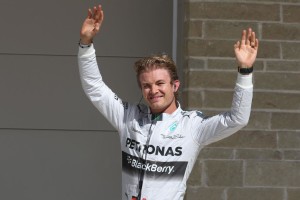
Nico Roseberg after taking pole position in Austin on Saturday. An AMG Mercedes Petronas image German takes ninth pole position of season as second-placed Hamilton suffers brake problems
Nico Rosberg launched himself back into the 2014 Formula One title fight by claiming pole position ahead of championship-leading team-mate Lewis Hamilton as the Briton suffered brake problems.
Both Mercedes drivers have complained of braking issues in the build up to tomorrow race at the Circuit of the Americas, but while Rosberg suffered in final practice, it was Hamilton who was set back in qualifying. The title leader finished at the top of the timesheet in the opening segment of the hour-long session but thereafter he slipped back, with Rosberg taking the honours in Q2 and the crucially running faster and faster in the final 12-minute shoot-out. He eventually finished four tenths clear of his team-mate, who leads the championship battle by 17 points.
Behind the Mercedes pair, Valtteri Bottas took his sixth third place qualifying position of the year, the Finn finishing three tenths ahead of team-mate Felipe Massa.
With 18 cars contesting qualifying, the decision had been taken to alter the qualifying format, with just four cars being eliminated from each of the opening two segments.
With last year’s US GP winner Sebastian Vettel set to start from the pitlane having changed both his power unit and his gearbox, his Red Bull team opted for a single run in Q1. By the end of that run the champion was in ninth, but as the times began to improve he slid back to a finishing position of 17th. Only Lotus’ Romain Grosjean went slower in the opening phase. The Frenchman struggled with balance and on his final run he slid wide at Turn 12, thus ruining his chances of making the cut. He duly apologised over the team radio saying that the car was “not the same one as this morning”.
The battle then was for P15 and P16 and as the final runs began the men in those slots were Toro Rosso’s Jean-Eric Vergne and Sauber’s Esteban Gutierrez. Neither could find the necessary improvement, however. In the end, Gutierrez was well wide of the mark, finished over three tenths off the P14 time of Force India’s Sergio Perez. Vergne was more unfortunate, finishing just five hundredths of a second behind the Mexican.
At the front, Hamilton finished ahead of the Williams due of Massa and Bottas, with Rosberg fourth ahead of Fernando Alonso and the McLarens of Kevin Magnussen and Jenson Button.
After the first runs in Q2 the drop zone saw Nico Hulkenberg in P11, with Sauber’s Adrian Sutil, Lotus’ Pastor Maldonado and Perez backing up the German.
And surprisingly, it was Sutil who made the leap forward, the German giving Sauber its first top-10 start of the season with a lap of 1:38.378, just under a tenth clear of Maldonado in P11. The Venezuelan finished ahead of Perez, Hulkenberg and Toro Rosso’s Daniil Kvyat in P14. The Russian was also facing a 10-place grid drop due to a change of ICE prior to the session, the seventh such unit used by the rookie so far this season.
Ahead, Rosberg topped the Q2 timesheet, finishing almost a second clear of Hamilton with a time of 1:36.290. It might have been only a segment of the session overall but it was the first time all weekend that the German had ended a timing phase ahead of the championship leader. Third place went to Massa, with team-mate Bottas fourth. The remaining Q3 slots were taken by Ricciardo, Alonso, Button, Magnussen, Kimi Raikkonen and the impressive Sutil. Button, though, is also facing a grid penalty, of five places, for an unscheduled gearbox change.
Rosberg was again the pacesetter in the first runs of final 12-minute segment. The German’s opening effort of 1:36.282 was 0.161 quicker than Hamilton and 0.7s clear of Bottas., with Massa fourth ahead of Button. Sutil, meanwhile, elected to remain in the Sauber garage during the opening exchanges.
And Rosberg maintained his ascendancy in the final run. The German, second out on track after Daniel Ricciardo, lit up the timing screen with three purple sectors to log a lap of 1:36.067. Hamilton, meanwhile, was clearing the first sector with a personal best time but some way shy of Rosberg’s time. Matters worsened with a scrappy second sector of 38.4 seconds and despite putting in a session best third sector he finished almost four tenths down on the German. Afterwards, the title leader admitted that he had struggled with brake problems throughout the session.
Behind them Bottas finished third ahead of Massa. Ricciardo took fifth place ahead of Alonso, with Button seventh, though facing a grid drop. His McLaren team-mate Magnussen finished eighth, with the final top 10 places going to Raikkonen and Sutil.
2014 United States Grand Prix – Qualifying Result
1 Nico Rosberg Mercedes 1:38.303 1:36.290 1:36.067 20
2 Lewis Hamilton Mercedes 1:37.196 1:37.287 1:36.443 16
3 Valtteri Bottas Williams 1:38.249 1:37.499 1:36.906 19
4 Felipe Massa Williams 1:37.877 1:37.347 1:37.205 20
5 Daniel Ricciardo Red Bull Racing 1:38.814 1:37.873 1:37.244 17
6 Fernando Alonso Ferrari 1:38.349 1:38.010 1:37.610 16
7 Jenson Button McLaren 1:38.574 1:38.024 1:37.655 17
8 Kevin Magnussen McLaren 1:38.557 1:38.047 1:37.706 16
9 Kimi Räikkönen Ferrari 1:38.669 1:38.263 1:37.804 22
10 Adrian Sutil Sauber 1:38.855 1:38.378 1:38.810 15
11 Pastor Maldonado Lotus 1:38.608 1:38.467 16
12 Sergio Perez Force India 1:39.200 1:38.554 16
13 Nico Hulkenberg Force India 1:38.931 1:38.598 16
14 Daniil Kvyat Toro Rosso 1:38.936 1:38.699 17
15 Jean-Eric Vergne Toro Rosso 1:39.250 10
16 Esteban Gutierrez Sauber 1:39.555 10
17 Sebastian Vettel Red Bull Racing 1:39.621 3
18 Romain Grosjean Lotus 1:39.679 8 -
The race is what counts, I need to focus: Poleman Nico Roseberg
DRIVERS
1 – Nico ROSBERG (Mercedes)
2 – Lewis HAMILTON (Mercedes)
3 – Valtteri BOTTAS (Williams)
TV UNILATERAL
Nico, a very strong pole position, a big margin for you. How do you feel about that? And hings are really hotting up, I guess now, with just three races to go?
Nico ROSBERG: Yeah, great day, very happy. It worked out really well, you know. Together with my engineers I really arrived at a car in the end in qualifying that I was happy with, the balance was good. Because it was quite a challenge, because the wind was changing and then this morning the conditions were quite different, a lot colder, so the track was changing all the time and it wasn’t that easy to get everything right but in the end we got to a great set-up, a great car, so I’m pleased with that. So first place of course today is awesome but you know the race is what counts, so I still need to focus fully on tomorrow and to to bring it home.
Well done. Coming to you Lewis, fastest in practice, fastest in Q1, but from Q2 onwards it seemed to be a bit of a troubled session for you, particularly with braking, in Q2 and again in Q3 I think?
Lewis HAMILTON: Yeah, absolutely. Obviously, Nico did a great job today. I really struggled with braking, yeah. When you look at the brake temperatures, the left brake was always around 100 degrees less than the right front brake. It just kept catching. No matter what I did, even if I braked earlier and tried to save it, it would still lock. So that was perhaps where I was losing a lot of the time. But even if that wasn’t the case I think Nico was perhaps too quick today.
Is that an issue for you for the race, with that set of tyres?
LH: Potentially, yeah, so I need to try to see… maybe they can scrub them down or something and try to fix it overnight.
OK, thank you for that. Coming to you Valtteri: your sixth time in the last eight grands prix that you’ve qualified in the top three. That’s some run of form.
Valtteri BOTTAS: yeah, a pretty god qualifying again. I’m really pleased with the couple of good laps I got in Q3 today actually. It’s been a difficult weekend from my side for some reason, to get to a good rhythm and then finally during the qualifying I could really trust the car, like you should do. Really happy for us as a team, again, we locked the second row. It’s a good starting position for tomorrow’s race because we have still important three races to try to keep a good position in the constructors’ championship.
Very well done. Coming back to you again Nico, this track, particularly from the start, one of the characteristics here at the Circuit of the Americas has been the difference between the clean side and the dirty side off the grid. You must be pleased you’re on the right side of that tomorrow?
NR: I haven’t thought that far yet, but if you say it then yes, that’s great, another extra advantage for the clean side of the grid, you know, starting first. Of course the start is going to be important, need to make the most of that and stay ahead.
PRESS CONFERENCE
Q: So Nico, that, I think, is the sixth Mercedes front row lock-out in a row, which is certainly a statement about the dominance you’ve got in the car and the way you continue to stay ahead of everybody. Margin of nine-tenths to Valtteri today, it was four-tenths in Sochi – but you too haven’t been immune from brake problems this weekend, have you? Is this something worrying you at all going into the race?
NR: We’ve had a few issues in general on the car this weekend, on both cars and so yeah, we need to try to get it all right for tomorrow – but personally I’m not worried about that at all because if I would start worrying about that, it’s not going to be good for performance. So I’m very confident the team’s going to get the job done and just concentrate on what I can influence on my driving. I’m not worried.
Q: Lewis, I don’t know if you know but tomorrow is six years to the day since you won your world championship: November 2nd 2008. So I’m sure you’ll be hoping to channel the Interlagos spirit into tomorrow’s grand prix – but how much is that vibration on those tyres going to cause you a problem? Can you drill down a little bit more into that for us?
LH: Well the vibration isn’t that bad. It’s a minor flat spot. They’ll rebalance it and hopefully won’t feel too much with it. The issue is just locking. If I can’t fix that left brake, then that will be a continuing issue throughout the race. And obviously flat spots lead to blistering so I’ve got try and make sure we can fix that this evening.
Q: Coming to you Valtteri, you got your first points in Formula One here 12 months ago. Tell us about the race in prospect for you and also why you were behind Felipe pretty much the whole of today and how you managed to nail him when it got to the business end of qualifying.
VB: Yeah, it should be an interesting race. I think especially the guys behind us are going to be really quick and we’re now in a good position in the team’s championship and it’s going to be an important race for us to get good points with both cars. It’s not going to be easy. So we will really need to try to get everything right tomorrow. Really look forward to the race here, it’s always good fun. In qualifying and in general from the practice, I managed to improve myself a lot during every session and really got the car to a good setup only just before the qualifying and for the qualifying – so I could really trust the car a bit better in the qualifying and get those lines right and get every corner right. I knew that Q3 is the one which is going to matter, and I needed to get everything right and be on the limit and then that’s when I tried to squeeze everything that there was – and I feel I managed to do so.
QUESTIONS FROM THE FLOOR
Q: (Paolo Ianieri – La Gazzetta dello Sport) Nico, where did you also find those tenths that you found in your Q3? Quite impressive pace after always being behind Lewis during the practice.
NR: What was the reason? I finally got there on setup, together with my team. We just continued to improve the car all the time and just got it right and I felt comfortable in the end. I was able to push and it felt good balance. Nailed the lap, got the lap really well, so it all worked out.
Q: (Dan Knutson – Auto Action / National Speedsport News) To the two Mercedes guys, when you have troubles like you did today, little troubles, does it frustrate you or does it motivate you in a way, to say ‘I’m going to beat this and get on top of it and go even faster’.?
NR: Neither of the two really. It’s always a bit frustrating to have something like that in the moment but then, I’ve learned to move on to just accept and concentrate on the things that I can influence and just keep on it. That’s what I tried to do today and it worked out well.
Lewis?
LH: The same.
Q: (Ian Parkes – Press Association) To all three of you, you may or may not be aware that there is a very real threat tomorrow – It’s not speculation, it’s not hearsay – of three teams, Force India, Sauber and Lotus, opting to boycott this race. What impact do you feel that would have on Formula One?
Nico?
NR: No comment. Because I have not heard anything about this and it would not be the right thing for me to even comment on something like that.
Lewis?
LH: Same.
Valtteri?
VB: Same. No comment really. I don’t know anything about this situation so I can’t really say much.
Nico Roseberg of Mercedes takes pole and is flanked by Hamilton on his right (P2) and Bottas in Austin on Saturday. An AMG Mercedes Petronas team photo -
FIA and the commercial rights holder must both work closely to ensure F1 is viable and sustainable: Vijay Mallya
TEAM REPRESENTATIVES – Eric BOULLIER (McLaren), Monisha KALTENBORN (Sauber), Toto WOLFF (Mercedes), Vijay MALLYA (Force India), Gerard LOPEZ (Lotus)
PRESS CONFERENCE
Let me start with a general question to all of you if I may, about Formula One and the United States. Many of your teams have been involved in activities in the build up to this event. How do you assess the growth of Formula One here and what’s the potential for Formula One in the USA? Eric, maybe you would start?
Eric BOULLIER: Well, good question. We have seen, obviously, after the first year, which was very well attended and crowded, you could see the interest in Austin went through the roof. We obviously have some American partners on our shirts but it is true that all the fans here… I mean, it’s been fully crowded. You can see the activation and the activities as well in the city. It’s just unbelievable how the weekend is built around F1 and it became one of the major events in the F1 season. It’s very promising to see the interest massively growing around this race in Austin and obviously we all know that F1 is maybe looking at having another race in the US. It’s very promising for F1, for the fans and I think F1 needs the US market.
Thank you for that. Toto, your thoughts on that and the possibility of other races here in the US?
Toto WOLFF: It’s a great place and it feels almost like it has been on the calendar, at least for me, since a long time. It’s part of Formula One. They’ve done a really awesome job over here. We’ve had some events before coming to Austin. We’ve had Lewis and the Formula One car in New York. We’ve been with NBC and you can see there is a momentum in the US behind Formula One and that’s great. Next year… 2016, we have an American team joining us and the interest in the US has grown. We have a new shareholder in Williams, who is an American entrepreneur and it’s nice to see that Formula One is starting to make an impact in the US.
Vijay, your thoughts?
Vijay MALLYA: Well, you know the United States is a large continent and could have more than one Formula One race. The motor racing culture and passion exists in this country, in terms of NASCAR, in terms of Daytona, in terms of the Indy 500, I mean motor sport is basically a very, very popular sport here in the United States and there is no reason why Formula One should not be equally entertaining and gather a lot of fans in this continent. I mean, if we can have as many races [as we do] in the geographical region of Europe then one or maybe even two races in the United States would hardly be enough. But more significantly given the overall financial situation of Formula One, I mean a market as huge as the United States can help revenues on one side and help those teams that need more and more sponsorships on the other hand.
What about you Monisha? Do you think that more races in this region would be the secret to growth?
Monisha KALTENBORN: Well, definitely that’s something we are going to have to have a look at. If you look at the race here, the first race we had here was an excellent event and then we were concerned if next year is going to stay like this or maybe it will decline but the opposite happened and you still see it’s a fantastic atmosphere, so many fans coming over. You look at the synergies which you can create with the race coming up in Mexico as well, so you see it’s starting to grow on the continent itself. It’s interesting to see when we came here earlier on, you landed usually at some other airport when you came in and then when they asked you why you were here and you said Formula One, people didn’t really know much about it. This time when I landed the person said “well, that’s taking place in Austin isn’t it?” That tells you how it is expanding and the interest is growing in this country.
Gerard, a final words on this?
Gerard LOPEZ: I think everything has been said, but I would just say the US is the largest professional sports market in general and any sport that succeeds here tends to be economically viable, so I think it’s a key market and indeed having one or two more races wouldn’t be bad.
Okay, secondly, again to all of you, with the events of the last two weeks, with two teams going into administration, where should the initiative come from for controlling costs and is there a sense now amongst your peer group that this time effective measures must be achieved? Toto maybe you’d like to start with that?
TW: Why don’t you start with Gerard – the other way round this time?
Okay, we’ll start with Vijay in fact!
VM: I have been very vocal about this. I have said that you can’t have Formula One with only manufacturer teams. You need smaller teams, it’s part of the DNA of Formula One for several decades and the
going forwards. We’ve talked about cost caps a number of times and finally I think the large teams or the manufacturer teams were opposed to it. But I think that was a good initiative that didn’t quite see the light of day to make any meaningful difference. On the other hand, as far as the revenue share is concerned, I think it’s probably a unique sport, where the participating teams get the least amount of revenue as compared to the income. When you compare it to any other sporting activity globally, we unfortunately are at the rough end. I am very sad that two teams are no longer with us on the grid here in Austin and I think such a thing should not be allowed to happen and that’s my firm view.Gerard?
GL: Toto mentioned, because I tend to have a pretty brutal view on things, but I think the disappearance of two teams is pretty unfortunate but it actually… probably now is the time to say things as they are. Number one: the distribution model of revenues is completely wrong. Whether the size of what is distributed or not is right or wrong is debatable and Vijay has mentioned one side of the thing. But then, you know, when you’ve got teams showing up to the championship that get more money just for showing up than teams spending a whole season then something is entirely wrong with the whole system and so that cannot be allowed to happen, number one. And now is the time to not be talking about it but the time to be acting about it, so we will see what’s going to happen in the next couple of weeks. The second thing is the cost cap. We always find excuses not to have a cost cap. There are reasons why certain areas should not be capped but there are also reasons why certain areas should be. And, again, now is the time to be acting rather than talking about it. And finally, this is an odd sport. We say things and then we tend to do the opposite. I’ll just give one example. The birth of the new engines happened when we started talking about cutting costs and so forth. The fact is that the new engine, which from a technology perspective is a great thing, the costs were passed on to all the teams. In our case this year, between the engine and development we probably spent something like US$50-60 million. That’s not cost cutting in our books, that’s essentially throwing money out the window. So we tend to also do completely the wrong things in terms of… if we unfreeze the engines now, which is the next topic that is coming up. All we are going to do is again essentially force everybody to keep developing and so on and so forth. At the end of the day, the revenue split, the capping of costs, have an immediate impact on the sport and not taking decisions has had an immediate impact on the sport in the last couple of weeks with two teams disappearing. So, as far as I am concerned… it’s really interesting to have the press conference but it’s going to be really interesting to find out what’s going to happen in the next couple of weeks around this topic.
Okay, thanks. Monisha?
MK: Well, I mean, if we don’t act now together then you have to ask yourself what else needs to still happen? You look at simply the facts: we are sport here, in my view still one of the best global sporting platforms, we have turnovers of billions of dollars and the sport as such, together with the stakeholders, are not in a position to actually maintain 11 teams. And we’ve often enough discussed what it means to have a third car, where that can go to, and we could probably sit very long, arguing the pros and cons about it but that’s not what we should do in this sport. It’s time that we focus on reducing the costs. We’ve discussed that enough times, what we can do. Like Gerard has said, if you don’t want to do something, you’ll never get to a point where you agree. But you really have to ask yourself what is being done to the sport here? We are sending out messages where fans are being involved in topics they really don’t want to talk about. They should be talking about the excellent races we have, what a great experience it is to come here but yet they are discussing financials, costs, teams going into administration. That is a very bad image we are creating to the outside where new partners are going out and saying “do we really want to enter this kind of a sport with all these troubles, which are normally not meant to be in sport but into other economic areas”. So we really need to react, look at that, we need to look at the equitable sharing of the income we have, so that you can really maintain more teams than just the big ones. We also need to see on the technical side that there is a certain stability and continuity there, because you often hear from bigger teams that whatever we have agreed has always led to more cost but you should first of all see who has agreed to it – it’s usually the high end. So everything is lying there but it is high time we take some action now.
Well, there you go Toto, you’ve heard the views. Is it time to act or is it just two of 135 teams that have come and gone in the history of the sport?
TW: It’s probably a longer answer now! You know I read an article in the Financial Times two months where they had exactly the same topic in the English Premier League. How can you – and they have the Financial Fair Play – how can you bridge the gap between the very top and the very bottom and if you look at the budgets of Marussia and then you compare the highest spender, whoever it is, Ferrari or Red Bull, you are talking about a gap from US$70 million to US$250 million, so if you want to start with a cost cap, how do that? Where do you cap it? And if you cap it on the lower end, well, do you make two thirds of the people redundant in the big teams. How does it function? That’s one point. The other point is: how do you control it? The competition is so fierce at the very top that the cost cap… the cost cap was never implemented because there was no way of policing it and controlling it. Some of the teams have various set-ups, various companies all around the world, multi-nationals behind them in Japan, in Germany, in Italy. If you look at Ferrari, they have a severe issue of being transparent enough to cope with a cost cap. If you have everything in one entity and you are building road car and you are building engines and you are building race cars, various race cars from GT to Formula One, well, how does it function? Because it is so competitive, we need to have clarity, how do you control that. So this is the problem I see on the cost cutting side. Obviously two teams disappearing, I have an emotional and a pragmatic view. The emotional view is that there is personal drama behind it. There are families who need to pay mortgages, there are kids going to school and these people don’t have any jobs today anymore and that is a drama and it is painful and I am sorry for that. The rational side of things is that we have seen in the past that teams come and go. We have seen great teams who have folded, went into liquidation or administration. Great names: Brabham, Arrows, Ligier, Prost, Larousse, Leyton House… I mean there are 20 others. That was part of Formula One. Now, is that something that should happen? No, of course it shouldn’t. But when Formula One was opened up for new teams to join, you can’t compare the agenda of the teams. You know in our case we are representing a multi-national car company. This is a branding exercise, we are showcasing our technology. And on the other side if you look at Marussia and Caterham when they joined the sport it was an entrepreneur deciding to join Formula One and maybe underestimating what it meant joining that field. You have other examples, such as Vijay, who is extremely successful in his business and who had stamina and size enough to cope with the challenges until today. I have great respect for what Tony Fernandes and Andrey Cheglakov have done in their businesses but maybe Formula One is just a different ball game, because you have these various agendas. So I think it is time to sit down and reflect and think what can we do? Because the remaining nine teams are part of the DNA of Formula One, they are heart and soul, names like Sauber, Force India and Lotus need to stay in the business. I think we all need to sit down, not with our own little narrow agenda of wanting to win the championship – and this is why I am paid, and why Eric is paid – but by looking at the whole of Formula One. But I think there are… like in any other sport, like in any other industry, this is the pinnacle. This is the pinnacle of motor racing and if you want to complete at the pinnacle of motor racing then you need to have the resources of competing there. This is a high entry barrier sport. I’m getting overboard now, but if you want to set up an airline tomorrow, it’s going to be difficult, because Lufthansa is going to eat you up. If you want to go motor racing and you want to do Formula One like the new teams decided four or five years ago, you need to understand that this is the very top. So it’s a very difficult topic, I could go on for another two hours.
Well, I’m sure we’ll be here for a little while longer. Eric, you’ve gone from a team that very much supports the idea of a cost cap to one of the grandee teams – McLaren. Do you feel you have a responsibility to ensure the sustainability and the depth of the grid or do you have a different perspective now that you are in the situation you are in?
EB: Definitely maybe a different perspective, yes! But back to the comments that have been said before. Obviously we are all sad to not see our colleagues in the paddock this weekend. I think there is a common sense to say, yes, we need maybe to definitely get to actions now to make sure the sustainability of the existing teams in the pit lane is assured or guaranteed in the future. At the same time, talking about the cost cap, yes my perspective has changed a little bit, for the same reason Toto said. Marussia and Caterham were joining as part of an entrepreneur scenario and was told in these days that there would be a US$40m or something like this budget cap in these days. So their business model was built around, I guess, these kind of figures. But when you see teams, especially teams like McLaren, that have been in Formula One more than 50 years, invested heavily in terms of image and whatever technology there is and participating to make Formula One is today, you can’t accept to run such a budget cap. As you said we lost two teams today and this is very sad for the families and the people working there because they were all friends but if you start to cut by two thirds in the top teams it’s going to hurt Formula One much more. We need to be emotionless but we need to be rational in what we need to do. Is it a question of how the money is shared? Is it a question of how the business is growing, fast or not? There are many questions that still need to be answered. What is sure today is I think we all have a common sense to regroup and to make sure we want a sustainable business, even for the teams.
QUESTIONS FROM THE FLOOR
Q: (Ian Parkes – PA) I think I’d politely like to suggest that we’ve just witnessed over the past few minutes the perfect example of where Formula One stands at the moment. We have three teams on the back row pleading for cost cuts, pleading for any kind of restrictions. We have two teams on the front row ready to argue against it. How on Earth do you ever propose to ever come together when over the past few minutes we can see that you don’t agree at the moment?
EB: It’s a very good question but, once again, I guess this is the wrong forum. Each of us wants to beat everybody. We are competitors. If we compete with a bottle of water, if we compete with a Formula One team, we want to beat the others – and we will do it by any means. So, this is normal. Even, actually, as you say in the back row, they want to still compete and actually beat everybody. So, this is not… we can… I’m pretty sure we can sit down and agree drastic decisions altogether – but this has to be led by the governance body and by the people who are running the show. Not the competitors. Do you ask football players about the Fair Play problems in Premier League? No. Ask the clubs or ask the people who own or who run Premier League.
Vijay – you were smiling…
VM: Well, if you work for a team, you have a different view, if you own a team you have a radically different view. That’s also pretty obvious. If you own a team, you’re writing the cheque. If you run a team, you’re receiving a cheque so… there’s got to be a divergence of opinion. I respectfully disagree with what Toto said about a cost-cap leading to redundancies of workman of the big teams. The same thing applies if small teams shut down. The same redundancies occur then as well. I don’t think there’s rocket science involved in people sitting down together to find a mechanism. It doesn’t necessarily have to be policing. It can be self-certification of what they spend. I agree that when one team spends $60million or less and another team spends $250million or more, then it’s perhaps difficult to bridge the gap. We have to find some viable medium here – but what is actually compounding the problem is that the revenue-share model is skewed completely towards the teams who can afford to race at the pinnacle of sport at the direct expense of those who perhaps are marginal. And that’s why two of the smaller teams have disappeared. I would also like to take this opportunity of saying that sustainability in F1 is necessary for the sport but when large corporations like Toyota and Honda decide, for corporate reasons, that they want to walk out, they go. At the end of the day there has to be a fine balance. The DNA of F1 – I repeat myself – is to include big and small teams and to provide as level a playing field as is practically possible. I think that if all the stakeholder sit together we can find a solution. It doesn’t have to be a radical solution that would dent the hopes, aspirations and passion of the big teams – but equally it could make sure that everybody survives and the sport continues to be enjoyed with the same level and a growing fan following globally as well.
Gerard?
GL: I’d like to comment on the numbers a little bit because they tend to give some fun reading, y’know? Because people in F1 actually do care about racing, some of them forget some economic realities – and there’s something called the Law of Diminishing Returns. I take a GP2 team, or a GP2 car, and I make it race around this track. It’s not going to be ridiculous. It’s going to be down by a couple of seconds, four, five, six, maybe seven seconds. The whole GP2 team for the whole season is going to cost €4million. Are we really that much better? I mean are we really better to the point that a team needs to spend €300 million to be six seconds faster? We’re not. I wouldn’t accept that argument from anybody. We’re not €300 million better if you take the top teams compared to a GP2 team. So it’s a bit ridiculous to say that you need to spend that kind of money to have that kind of performance – because that makes us the worst managers in the world. If I took a financial view of this sport, comparing GP2 to F1, and the so-called Law of Diminishing Returns, we are most probably the worst managers there are. And we pride ourselves of not being. So, if we’re not, we really need to think about… and I’m not saying that suddenly Mercedes needs to cut down because I understand that for Mercedes it’s a small portion of their overall budget but a very important budget in terms of image. So, nobody’s saying Mercedes suddenly need to spend 20 per cent more than the cheapest team in F1, if I may say so, but what we’re saying is, where the money goes – which is essentially developing the cars and so on and so forth, if we need to spend €300 million more than a GP2 team to make the car go six or seven seconds faster, that’s not a very efficient use of capital – and so that’s where the issue is. So nobody – certainly I am not saying – that we should take the budgets down to a fixed amount. What I’m saying is we should take the budgets down to an amount where everybody can spend whatever they want on whatever they want – as long as the technological development, the development of the car [unintelligible] is done within a framework that makes financial sense – and that can be measured. Because it doesn’t have to be measured in dollars, euros or pounds, but it can be measured in wind tunnel, number of packages, updates, so on and so forth. That’s the difference. I’m not going to argue with… and I love Eric to bits, so I’m not going to argue with his joining the dark forces but the fact is that there is a certain issue with the way we see money in F1, compared to the performance we’re getting out of that capital – and it’s not very efficient.
Monisha, do you have a comment on this? And perhaps where the initiative is going to come from, getting back to that point.
MK: Well, first maybe saying a few things about what’s been said earlier. We’ve been around in times when nobody really spoke about costs. You had at that time private teams, you had manufacturers in there but this was never really a topic because the whole setting was so different. And that’s what we need to realise, that today we don’t live in those times. Through manufacturers coming in, bigger companies coming in, costs have just gone sky-high. We experienced that ourselves not too long ago when we were a manufacturer team ourselves. This is where, like Gerard says, we have to start right there and bring it down to decent levels. We can endlessly argue about if you can control it or not – and I could probably give you five reasons you could – but it’s not really going to get us anywhere. We have to realise that the sport has gone into a direction that can no longer be kept up like this for the entire group of participants, not just for single ones out there. The other thing which was asked earlier was how you think we can agree. I don’t think there’s any basis at all. And that’s again a big difference to not too long ago. We had more manufacturers in the sport not too long ago and yet I do remember and incident from that time where there was a team which was in a difficult situation and the manufacturers got together to support that team. They were willing to even support that team financially. I’m not saying now that we expect this – not at all – but this is just to tell you what the thinking was at that time, even from five or six teams which could easily have afforded to spend double the amount they were at that time – which didn’t even need money probably from the commercial rights holder because it took long ‘til we got it when we signed our deals. Even there, we realised that you do have to have all teams in there. And this kind of common basis is not there at the moment because, if as a small team you go and say something out there you immediately get the response that we’re just scrabbling around because we’re not getting enough. And that thinking is so wrong. We have a right to be in the sport. We are not expecting that we get that much that we can be a world champion, we know we have to do that on our merits like Mercedes has done. But at least we should be getting enough share that we should be to live decently and not to always think ‘are we going to make it to the next season or not’. In our case, we’ve been now more than 22 years in the sport and there’s nothing you can just wipe out because things have gone in the wrong direction. And about the initiative, I think it doesn’t really get us very far if we start pinpointing at each other and saying ‘it’s this side or that side’. We really have to all sit together. We teams sent a letter to the FIA as our federation, which should be in charge of the sport, the reputation of the sport and the FIA had actually agreed that they will take measures to reduce the costs – so I don’t know what more it takes for them to react that two teams are now not also on the grid.
Final word on this question Toto. Would you accept the idea of Gerard, of a framework of a reduced number of packages, things that can be audited, things that can be controlled?
TW: I think many of the arguments we have heard are valid arguments. For us, again, you could probably reduce it to a very brutal reality. Gerard mentioned the words ‘economic reality.’ If today you run a team, it’s like running a company. And this shouldn’t be sounding arrogant in any way – but you’re not obliged to spend more than you have. There are different agendas. If you run a company today and you own it, you should probably run it in a sensible way. And that means spending what you have. And if you decide to invest or to go into debt because you believe that there is a sound business case behind it, this is what you should do. Now, I find it disturbing as well that you need to spend one hundred million, or you want to spend one hundred million if your income is only 60 or 70 million. In my time back at Williams that was the philosophy. You spent what you have. And if you decide to follow a more aggressive strategy, you need to know what happens tomorrow. I have a lot of respect for everybody sitting on the stage, from an entrepreneurial view, but that is the economic reality and the economic reality is valid for any company out there and for any sports team.
Q: (Kate Walker – Crash.net) I have a general question for everybody. The one thing that you do seem to agree upon is the fact that you can’t agree. You all have competing interests. Given that it’s impossible for your competing interests to see you all on the same page, would any of you, particularly you two in the front row, support the disbanding of the F1 Strategy Group? Because you shouldn’t really have a say in the regulations. And also, would either of you be interested in refusing any constructors’ bonus payments that you receive before you even start racing – just to level-up the playing field and give everyone else a chance?
EB: No.
Toto?
TW: We laugh about Eric’s answer but this is why he’s paid. He’s paid to bring performance to the team, sporting performance and financial performance. And, again, this is like it is out there in any other businesses. Now, I think we are all… and here we are having good relationships and we understand that we need to look at Formula One in total and overall… but would you… I wouldn’t know any entrepreneur out there – and I’m getting a cheque and I’m writing one actually so I’m in a different role – any entrepreneur giving up on an upside… would you let a client go, would you not accept the income. The answer is no. None of us, none of the five of use would.
Gerard would like to make a point…
GL: I would like to make a point, which is very simple. If you take… I take the example of Marussia, of Caterham. I kinda guess what they must have paid for the engine this year and what they have paid for developing around that engine and I guarantee that in the budgets that they have, there was not a whole lot left – so it’s not like they had a choice. And the choice of the engine was not made by these guys – and this is one of the examples I gave before. It’s all good and fun and so on to say that you shouldn’t spend more than what you what you have or not. But at the end of the day, certain decisions on budget are forced up on you. Just by the fact that that’s what the market is giving you. If I went to Pastor or Romain, I told them that next year they’re pedalling their car, they’re not going to be particularly excited. It would be way cheaper for us, and financially for me, as an entrepreneur it makes a lot of sense for me ‘cos I might actually make money – but it’s not going to be very competitive. So if you want to stay competitive at a minimum level, you are forced to spend at a certain level. And again, nobody is sat here – and Monisha made a point that we should get the same amount of money, that, y’know whatever other teams get – and I’ve said it before, there are teams that get 160-170 million just for showing up – but what I have said is that the amounts need to be given should allow a team to perform at a basic level, given the costs that are forced onto that team which have nothing to do with any luxury. I mean, taking an engine today, I guarantee you that of the teams, let’s say the back row teams, if there was an engine manufacturer out there that could offer an engine for five million, or six or seven, that would have decent performance, I guarantee you that everybody would take that engine. Now, we’ve in the lucky position, we took a Mercedes engine for next year. Seems to be the better engine – it clearly is – but the fact is we still have to pay. And I’m not finger-pointing because they’re the same price, all of them, but the fact is there’s a minimum budget that is required today to even exist in Formula One. And that minimum budget has actually killed two teams. And they did not decide to spend their money on the kind of things that they had to spend it on.
Monisha?
MK: Well, most of it has already been said, before we start repeating ourselves there. But, it’s been mentioned often that entrepreneurship and thinking like that and ideas coming from there… and entrepreneur should also think a bit long term at least. If you do that, it would be interesting where that strategy leads to. We just go on the way we are and too bad for some teams that can’t make it because they’re not investing enough and it’s such a high motorsport level that you really have to have maybe three-digit million figures of budget that then in F1 are normal, for the outside world, not really. Let’s see where that will lead us to. Eventually you’ll have four – probably – participants with endless amount of cars. Let’s see where that show will gets you. How much of income you have there. And amongst the four participants, you probably all have big names, so you’ll have three losers every year. So, it’ll result into that. As a big name – and we’ve experienced that again – if you lose, you have to invest more. But a big corporation does that maybe for one year, for two years but the third year, it definitely gets too much for them. Because, surprisingly, those corporations do have budgets they control, they can control, and they have ways to measure what they are doing – and that system will just collapse at some point in time. So, I think, we probably could, most of us, agree on that kind of development happening. I don’t think anybody can say this could change Formula One in such a way that it would be far more exciting than it is with the nine or the 11 teams today. And that’s where I think we really should realise that we have to change something in the system now. Which is about all what’s been said before.
Vijay, anything to add?
VM: No, I think it’s all been said.
Q: (Daniel Ortelli – Agence France Presse) Since the cost cap is impossible to put in place – obviously, since there is a very big gap between the small teams and the big teams – do you think the sport is now ready to face a change in its organisation with two leagues instead of one: one for the manufacturers who wish to spend as much money as possible and one for the smaller teams who are likely to agree on the cost cap or all of them? And these two leagues would participate in the same races, on the same tracks as opposed to other major sports where you have a Pro A and Pro B or league one, league two. Do you think the time is right to now make that decision all together? And the second question is: do you think it’s about time, since the Concorde Agreement has not been validated in its new version, to decide on a radical change about the revenue share, which is at the core of the problem, because you have been discussing it for ages?
So that’s two questions: two leagues instead of one, and revenue share modified radically to allow the smaller teams to survive?
TW: I think it (two leagues) could be a concept which needs to be explored. It’s the first time I’ve heard about it. You see that in sports car racing and other series. Is that the way forward for Formula One? I think Formula One should stick to its roots somehow. That’s my gut feeling. Obviously if that doesn’t get us any further and you see more teams leaving the sport, then maybe it’s one of the paths to explore. I don’t know.
MK: I would like to say that if you compare to another championship, for example you have three big car manufacturers like in DTM. We see where that’s led to. They have similar problems in competitiveness. They don’t have the problem of money which some teams have here in Formula One and we’re seeing where that concept is going to. DTM also had to react, because there was suddenly a big gap and if one of those big names, like I told you before, is not doing so well, then you have to find other ways so maybe look at the technical side there because again, money is no issue. So I don’t think that that’s the way Formula One should go. It would totally distort the sport.
Q: About the Concorde Agreement revenues? Is it contractually bound for the future? Is that it?
GL: Yeah, it is. A lot of people like to criticise CVC for instance and unfortunately sometimes I have to take their side because in my real life that’s where I work, that’s the type of business I do, and the fact is that close after taking over the business, I think the sport was distributing about around $300m to the teams, something like that – three, three-forty. Today it’s almost $900m but it’s not distributed equally otherwise we would all be smiling here and saying there is no issue. So the amount might be an issue but certainly the distribution is a huge issue because – I’m not going to say it’s pareto rule, it’s not like 80% goes to 20% but close enough. A lot of the money goes to the top teams and it’s almost like – how can I say this? – it’s a self-fulfilling prophecy, essentially, that the ones that have more, get more and as a result want more and want to spend more and so on, and the ones that have less, get less. There is something entirely wrong with the distribution model right now.
Q: (Dieter Rencken – Racing Lines) A question primarily aimed at Eric and Toto: were there to be a more equitable distribution of wealth, of income, then one of your major concerns is the fact that your employees would actually have to be reduced but is it not logical that if the teams in the back row, they could afford to pay more people and therefore whatever people you would lose would actually still be employed and therefore the sport wouldn’t lose anyone whatsoever, if there was an equal distribution of wealth?
TW: I think that is a nice idea but it doesn’t work in reality. As I said before, I think the gaps and the agenda are completely different. The gaps are huge, the agenda is different. I think it is very difficult to close that gap and you see us arguing, discussing, there is lots of frustration in the room. I don’t know how to solve it.
EB: Well it’s a discussion we’ve had since the beginning. The real problem, in fact, is nothing as… to be competitive, you need to spend a minimum amount of money and today this level of money spent is too high with the economic. You can blame the distribution model, you can blame the revenue, you can blame anything, but the reality is that to be competitive, you have to spend a minimum. Because we are all competitors, we all want to spend this money to be competitive. We all want to be competitive and we have to spend this money. At the end, there is so much emotion this weekend because of the absence of these two teams. It’s true that maybe by making the revenue higher for the poorer teams, yes, the first thing they will do is to hire people, they will be going to big numbers because they want to be competitive. You don’t fix the problem by doing this. So yes, you save jobs but nothing else.
Q: (Michael Schmidt – Auto, Moto und Sport) Question mainly to Toto and Eric Boullier: we now have only nine teams, so P8 and P9 are last and last but one. Three weeks ago it was P10 and P11. Next year it might be P6 and P7, last and last but one. If only big teams are left, are you not afraid that one day you might be among them and then your whole business model doesn’t pay off any more because you’ve spent much more money to lose than the current teams are spending to lose, which are at the bottom of the field?
TW: We are nine teams today, 18 cars and we have lost two teams which is not nice and I’ve said that before. I think the teams who are in Formula One today should stay in Formula One and we should all look at the situation and come up with a short term plan: how to have a healthy grid, and a long term plan. We are talking about money distribution that is an issue for the commercial rights holder, and I don’t have a solution. I can come up with many ideas which can be short term solutions but it comes back to the principle and what’s been said before: whatever you give to the teams, they are going to spend it.
EB: Not much to add, to be honest. It’s always the same story: either you get more revenue or you spend less, so at the end it’s a question of… as you said, distribution should be discussed with the commercial rights holder and then, as we also said before, I think there is a wake-up call maybe, for everybody, to make sure we can act all together. We will try in the best effort for Formula One.
Q: ( Agustino Fontevecchia – Forbes Magazine) The sport generated an estimated $1.7bn in revenue in 2013. We said distribution was something like $900m. Maybe isn’t the problem that not enough is being distributed and then there should be the issue of – speaking of distribution – shouldn’t maybe that increase?
VM: I’ve always said that the model has to be more equitable. The commercial rights holder is entitled to make its profit by owning the commercial rights for the sport, and as far as the distribution is concerned, I think Gerard very clearly explained that it was skewed mainly towards the big teams which is basically what is causing the problem with the smaller teams. I think what I’ve heard in the last few minutes is that if the smaller teams got more by way of income, that they would necessarily spend a lot more. I disagree with that completely because I think that the three of us sat here in the back row are smart enough to know how much to spend without going the Marussia and Caterham way. And as Toto said, if I can use his expressions as an indicator of how the big teams think, well if you can afford to be in Formula One, you’re welcome. If you can’t, get out. Fine. I think the FIA must decide this, not the participants because after all it is the FIA Formula One World Championship and if it is to be designed to be affordable to those big boys in the business, who of course benefit hugely in terms of their regular core businesses. That’s one way of looking at it and if it is meant to be racing in sportsmanlike terms, with big teams, small teams that compete with each other… Look at Williams: I’m sure Williams doesn’t spend a fraction of what the big teams are spending and look at their performance this year. Until the last race, Force India and McLaren were competing head-to-head. So money doesn’t necessarily buy performance. Equally, spending is discretionary and if the big teams want to spend $300m, it’s discretionary. That cannot be used against the smaller teams. The smaller teams must get a revenue share that makes it financially viable or sustainable. That’s the point.
Q: (Pablo Juanarena – Marca) I want to ask about sport but I don’t know if it’s the day. In this building we are talking about money and Eric, Toto, don’t you think it’s a mistake for all the sport to talk about money for one hour in this room? Money, the drivers have to pay, the tracks are losing money, small teams disappear, big teams lose money too. Do you think it’s a big mistake for this sport to talk so much time about money?
EB: If you ask me… obviously we are sitting here and we have to answer your questions so we are not leading the show, if I may say this. So if you ask questions about money it’s because there is obviously some concern and we know why, this weekend. As we always say, I guess, there was too much negative said about the sport and I think this is another wake-up call we should all have, to stop being negative about our sport because there are also some positives. We don’t want to hide, obviously, we have to raise and to act and to fix all the issues but we also need to be positive about our sport and we have spent one hour, as you’ve said, talking about money where we should have talked about the big show which has been set up outside and what happened on the track today.
TW: Yes, I agree, it’s an absolutely valid question. We haven’t heard the names of Hamilton, Ricciardo, Vettel, Rosberg – none of the drivers today. We haven’t talked about McLaren’s performance today. What we are talking… we are using this as a panel to express our frustration and how everything is bad and we are talking the whole thing down. It’s like a vicious circle, so I tend to agree with your question.
Q: (Graham Harris – Motorsport Monday) On the question of drivers, Eric, have you made a decision yet for next year? What’s going to happen? You’re the only leading team yet to announce some definitive plans for either driver.
EB: No. Sorry, no, I’m just joking. Your first question: no, we have not made our decision yet so obviously we have nothing to announce or to decide.
Q: (Graham Harris – Motorsport Monday) When do you plan to?
EB: Before the end of the season, as we said.
Q: (Daniel Ortelli – Agence France Presse) Toto, there’s a big debate about third cars. You said recently that a third car would cost twenty or thirty million dollars or euros per year.. Don’t you think it could be exciting for the fans if the third car in the big teams, allowed by the budget, was given to a younger driver and whether it scores points or not, do you think it would be more exciting to see a guy – it could have Jules Bianchi in a Ferrari or anybody else – and we in this room are also moved because of what happened to Jules, so that’s why everybody is so emotional – but don’t you think it would be more exciting for the fans to see a promising talent in a third Ferrari or a third Mercedes instead of in a Caterham or Marussia that goes as fast as a GP2 car?
TW: I think, first of all, I’m not a big fan of third cars. I think if there is money left over, it should be distributed to the smaller teams to secure the grid. That’s my personal opinion. If a third car is needed, because the level of cars on the grid drops to a critical number, now we could discuss what the critical number is, and the big teams are being asked to fill in a third car then we should make it exciting and the ideas which have been discussed is giving it to a young driver like you say, to somebody who hasn’t had an awful lot of experience in Formula One. It would be exciting to see how he performs against the superstars. Definitely some interesting ideas around that, making it a rookie championship.
Q: (Dieter Rencken – Racing Lines) A question to the three at the back: much has been made now and I fully understand your concerns about the distribution of income etc, but why did you people then sign contracts that allowed this situation to happen?
GL: As I’ve said before: there’s a number of things that have changed, even in a very short period of time. I’m one of those who complains about the distribution of amount. I wish the pot was bigger but I’m not necessarily complaining about that but we haven’t seen in the last 24 months, we haven’t seen any major sponsors trying this sport. We’ve said that 135 teams have come and gone. Well, I can tell with the current cost hurdle to enter Formula One, you’ve got to have a lot of courage to come and try to compete at whatever level, even to be dead last. That’s why, when there was an opening for teams to actually participate there wasn’t a whole lot of teams that appeared. It was not that there was a waiting line of teams to actually enter the sport, so what might have been true, what seemed OK on an individual basis a couple of years ago is not OK today. The other thing is the leverage that we would have, for instance, compared to other teams that received much more, is very limited, so that at the end of the day, that if your leverage is no big amount, smaller amount of nothing, guess which one you’re going to take, right? So there are a number of components there, it’s not just black and white, there’s a lot of greys in there. As I said, one of them is… the world has probably not developed in the way we all expected but secondly, I’ll be very frank, there wasn’t a whole lot of leverage to get a whole lot more. At the end of the day, if I had gone to Bernie, for instance, and said you know what, I just don’t want to do this any more, he might have been sad – maybe – to see me go, but he might have thought OK, that’s the way it is. If somebody wearing red had done the same thing, that’s a whole different leverage effect.
MK: I think that’s exactly the point. You have to make sure that your team is going to be there, that you can have stability from that perspective and then you simply have so much that you can do and you just have to accept things. Of course, all of us expected other things to happen. When you look at the last Concorde, it even said teams have to actually sign up to cost control. That’s no longer there today. So much changed but at the end of the day, you have the responsibility towards your team and your employees.
VM: I think I agree with what Monisha and Gerard said. There’s been many game changes that have happened in the last two years but nevertheless, as every sensible organisation or any group of stakeholders must necessarily do every so often, is review and update the situation and to make it workable and pragmatic for all stakeholders involved. Just because we signed something, based on a certain set of assumptions and things have changed, doesn’t mean that we’re stuck in the sands of time. We need to move on, we need to review, we need to correct things so that the show can become bigger and better.
eom
-
Hamilton dominates day one at COTA
Mercedes driver continues to set the pace in practice ahead of US Grand Prix
Lewis Hamilton edged team-mate Nico Rosberg by the slenderest of margins to remain at the top of the timesheets at Austin’s Circuit of the Americas.
Hamilton had eclipsed his title rival team-mate by almost three tenths of a second in the opening practice session but in the afternoon Rosberg managed to close the gap to just three thousandths of a second. Third place in the session went to Ferrari’s Fernando Alonso.
It was Rosberg who went quickest in the opening part of the session on the medium tyre before the teams switched to the soft compound tyres with about 50 minutes to go. Rosberg again initially had the upper hand with Hamilton slotting into second place but with his second lap Hamilton stole into P1 by a tiny but significant margin.
With third-placed Fernando Alonso over a second down on Hamilton’s best lap, the Mercedes duo were in a class of their own in the session. They didn’t have it all their own way, however, though their chief adversaries were technical gremlins. Both complained of gear shift issues before Hamilton was told to make his way to the pits with a hydraulics problem.
After a tough morning session in which he was sidelined by an ERS issue after just five laps, Daniel Ricciardo bounced back in the afternoon to finish in fourth place with a lap of 1:40.390, some 1.3s down on Hamilton’s benchmark.
The Red Bull Racing driver’s team-mate, Sebastian Vettel meanwhile, was in trouble. With his team having already announced that he will start Sunday’s race from the pit lane due to a power unit change, Vettel encountered more problems with his team needing to change his car’s gearbox during FP2. He later took to the track for high fuel runs, which left him 18th at the end of the session.
Behind Ricciardo, Kimi Raikkonen was sixth in the second Ferrari, with Toro Rosso’s Daniil Kvyat seventh and Kevin Magnussen eighth for McLaren.
The Dane’s team-mate Jenson Button, who had been third in the opening session, dropped to eighth place in the afternoon. In FP1 he had finished nine tenths adrift of P1 but in the afternoon the gap to Hamilton drifted out to 1.6s. The top ten order was completed by Nico Hulkenberg for Force India.
2014 United States Grand Prix – Free Practice 2 Result
1 Lewis Hamilton Mercedes 1:39.085 18
2 Nico Rosberg Mercedes 1:39.088 0.003 34
3 Fernando Alonso Ferrari 1:40.189 1.104 29
4 Daniel Ricciardo Red Bull Racing 1:40.390 1.305 30
5 Felipe Massa Williams 1:40.457 1.372 36
6 Kimi Räikkönen Ferrari 1:40.543 1.458 32
7 Daniil Kvyat Toro Rosso 1:40.631 1.546 34
8 Kevin Magnussen McLaren 1:40.641 1.556 38
9 Jenson Button McLaren 1:40.698 1.613 36
10 Nico Hulkenberg Force India 1:40.800 1.715 25
11 Valtteri Bottas Williams 1:40.828 1.743 37
12 Romain Grosjean Lotus 1:41.054 1.969 31
13 Jean-Eric Vergne Toro Rosso 1:41.110 2.025 36
14 Sergio Perez Force India 1:41.123 2.038 35
15 Pastor Maldonado Lotus 1:41.158 2.073 37
16 Adrian Sutil Sauber 1:41.332 2.247 33
17 Esteban Gutierrez Sauber 1:41.420 2.335 34
18 Sebastian Vettel Red Bull Racing 1:43.980 4.895 -
I want to do a second year with Sahara Force India: Sergio Perez
Let’s start with the world championship leader. Lewis, 17 points ahead, the biggest lead you’ve had this year so far, which poses the greater threat do you think: Nico or reliability from here on?
Lewis HAMILTON: It’s a good question. I don’t know, I think they are both relatively de cent threats. But the guys have worked very hard to eradicate those through the year so I hope that we can all go through these next races together as a tea, without any of those issues.
Do you feel a bit more in control of things now, though?
LH: It doesn’t really feel any different to several races ago really. As I keep saying: just fighting and chasing the ultimate goal.
You’ve won twice here in the US, once in Indianapolis and then the first race here at COTA. You have a great affinity for this country, how do you see the potential for Formula One here in the US?
LH: I think there is a huge market for Formula One. I think if you watch all the different sports here the people in this country are so passionate about sports in general, whether it be basketball, baseball or NFL or even NASCAR and IndyCar, so they are extremely enthusiastic about competition and wheel-to-wheel racing or just real out and out heart racing or competition. Whilst we only have one race here, there’s lots of opportunity here for it to grow. I’ve just definitely seen from 2007, even though we missed out quite a few years, there’s still quite a lot of growth here. I was in New York yesterday for example and there were people waiting outside this building, with signs and just Formula One fans with our team tops on, which was huge.
Thank you for that. Daniel, coming to you, nice look you’re sporting this weekend. Third in the drivers’ championship, you’re 10-6 against Sebastian in qualifying, which means that whatever happens from here to the end of the season in the head-to-head he can’t beat you. How does that feel?
Daniel RICCIARDO: Yeah, I’ve said it I think before that I’ve been really happy with the season. Yeah, I guess it’s exceeded my expectations and probably everyone else’s as well. A few more races left, I would love to get another… or ar least a few more top results. I think Austin is a good chance for us. A circuit I’ve personally enjoyed a lot the last few years. I think it’s not only fun to drive but for racing it provides… I honestly think it’s the best circuit on the calendar for overtaking. I think there are more spots around the lap here for overtaking opportunities than any other, so that’s always exciting. Yeah, so we’ll see how we go. I think we should be alright here.
Well, the Red Bull boss has obviously spelled out that you’re the new team leader of Red Bull Racing for 2015. The target then is now on your back. How big a threat do you see Kvyat being to you, to do to you what you have done to Sebastian this year?
DR: I feel a bit still young to the team but yeah I guess I will be the old guy next year. But yeah, I know Dani, I know him pretty well from a few years already. I definitely won’t take him lightly. I know he’s very quick and just because he’s still inexperienced in Formula One I’m sure he’s going to bring a lot to the team and a lot to the table. I’ll keep working on myself, try to keep improving. I feel I’m not at my peak yet, so I’ll try and get there personally first and then see where Dani fits in. I’m sure we’ll have a good working relationship, we joke around a bit already now, so I think that light sort of humour will remain in the team.
Valtteri, coming to you, you scored your first ever Formula One points here at the Circuit of the Americas 12 months ago, and what a 12 months it’s been since then for you, five podiums and now you’re fourth in the drivers’ championship. Is it realistic to think that you can improve on this for next year, which are the areas?
Valtteri BOTTAS: Yeah, I have really good memories from here, it’s so good to be back. It’s a nice circuit, everyone really likes to drive here. The atmosphere, everything is great. And like you said: what a 12 months it’s been. It’s been really good for us, we’ve been improving step by step, we made a big step in the winter and now we are in a really good position. But I do think we can still improve next year; that’s the goal. We aim to do better than this season and I’m sure it is possible.
Looking at the characteristics of this Austin circuit, it looks like a track that should suit the Williams, like a number of places we’ve been this year. Is that the way you guys are reading it too? Do you think you can be a bit of a threat this weekend?
VB: Yeah, I think it should be not bad. I think we can be strong here. It could be difficult to be close to the Mercedes as we were in Sochi but still I think it should be good and we’re going to have a good fight with Red Bull and Ferrari for sure.
Romain, coming to you, you finished second here last year, great memories there, but you’ve only had two points finishes since that fantastic result. Are you committing your future to Lotus? Can you tell us any more about that and whether Lotus is the right team for you?
Romain GROSJEAN: Yeah, very good memories from last year, not so good to remind me that I only scored two times this year. For a long time I’ve said that Lotus will be much better next year than they are this year, for a few reasons. There’s been a lot of work at the factory and the fact that the team brings a new nose here just to try to prepare for 2015 is a strong sign. I have a contract with the team. I have the option to leave if I want to – this is from some performance clause. So far there are still places available at top teams or they haven’t been confirmed and that’s there where I want to be in the near future and that’s what we try to do.
It sounds like the ball is in your court. In terms of news, of course you’ve got some good news. I understand you’re going to have another. So at the end of a difficult year a nice bit of news for you and your wife.
RG: At least that worked! So, pretty good timing as well for next year. I think personally I had a tough season with the results but outside the track I lost four people that were very close to me, the next one being the boss of Total, Christophe de Margerie, last week or the week before. So I thought it was important to announce good news. We have support in tough times but now we have support in good times and I am glad to be the father of a family of almost four people.
Many congratulations to you. Staying on the theme of next year, Sergio, if we could come to you, your team-mate, Nico Hulkenberg, has confirmed for 2015 with Force India, where are you with the process? Is the deal almost done?
Sergio PEREZ: Yes, it’s getting very close. Obviously it’s getting close to the end of the season, so things are getting very close to sort out the deal for the team. I definitely want to stay longer in the team. I want to establish myself in the team. I’m four years in Formula One and I’ve been moving around probably too many times. So I want to do a second year with the team and that’s my target. So hopefully everything goes right and we can announce things soon.
Obviously we’re very close to Mexico here and presumably you’ve been back home in the past couple of weeks or so. Can you give us any updates on how the track is coming on, what the mood is like, what the expectation is for next year?
SP: It’s really high. There are a lot of enthusiasts back home and the people are really excited to have the grand prix back home. I know the circuit is getting rebuilt; there was an event a couple of weeks ago. So, yeah, things are moving on very quick and Mexico is very excited to have all of you, all the drivers, all the teams all together, so it will be a very nice event.
Staying on that theme, Esteban, obviously next year the US Grand Prix will be paired with Mexico on the calendar. What do you think that will do for the development of Formula One in this region?
Esteban GUTIERREZ: I think it’s very positive in many ways to have more and more races in America. So I think now complimented with the Mexican Grand Prix and to have all the Mexican energy and also the American energy, in combination to that, it’s, I think, very positive to all of that.
A quick thought on your championship position with Sauber. You’re still behind Marussia in the constructors’ championship, but they aren’t here. How hopeful are you that you will come out ahead at the end in the constructors’ championship?
EG: Well, we are fighting all weekend. We’ve been doing that in the second half of the season, we have been very close to score the points on many occasions. We’ve had some technical issues which made it very difficult to consolidate those results but we still have three more chances and probably out of those three maybe only one or two! So we have to get the most out of what comes up as an opportunity and we are fighting all the way and, yeah, let’s hope we get the points that we want.
QUESTIONS FROM THE FLOOR
Q: (Dan Knutson – Auto Action / National Speedsport News) A question for Lewis and Romain: Lewis, guys like Lauda and Prost took a year or two off, came back, won races and championships. Given how intense F1 is these days, the lack of testing, how much momentum would you lose if you took a year off. And Romain, you did take a year or so off, how much momentum did you lose?
LH: It’s not something I’m thinking about. I would imagine, yeah, naturally you would definitely lose some traction and then coming back into testing, you don’t have a lot before the season, and particularly with all the controls, the new updates every single year, the technology’s constantly evolving, so to be on top of that, I imagine that would definitely take a while to come back into. So it wouldn’t be helpful. But perhaps back in the day, there was more running and testing, so perhaps… Niki could tell you more. But I’m sure, perhaps, it was a little bit easier for them to come back in.
Romain?
RG: Yeah, I think there it two ways of seeing things. Of course you do lose some of the confidence that you had in the car and the stuff you could do – but on the other hand, you learn in a tough time. And when your car is not so nice to drive, you learn some new tricks and learn to do around. And the day you jump back in a good car, it may feel very easy and quick.
Q: (Dieter Rencken – Racing Lines) With the demise of the two teams, there’s been a lot of talk about third cars and teams. For the front running teams that obviously means it could dilute your efforts if the team is running three cars instead of two. And for the mid-grid teams it means you’re inevitably going to finish further down the order than you would at the moment. How do you drivers feel about third cars and teams?
DR: I think from our position it’s something, if we’re requested to have a third car, I think we’ll definitely look into it and try to make it happen. From my side, let’s say, having another team-mate, I wouldn’t see any negatives. I remember 2008, I think I had six team-mates in Formula Renault, so it was like being in a school classroom. I wouldn’t see any downside from a driver’s point of view.
Lewis?
LH: I haven’t really thought about it to be honest but I think, as you said, we would have to expand the team to make sure the efforts aren’t diluted, as you said. But yeah, if it’s a position for a younger driver, it could be quite good. Especially bringing then on, giving them the best experience and especially putting them alongside top drivers who have the experience. Perhaps they will come along a lot more than they ever have in the past. When I think about the two teams that have dropped out, my biggest concern really is just for all the employees in those teams that have to provide for their families that perhaps don’t have a job now. If we do do this perhaps they still have space in other teams.
Valtteri?
VB: Not too much to add really. Just I really think it’s an interesting topic. Everyone wants to see more cars on the grid and the more is better, so we just need to find out how soon that would be possible for the teams to make it happen. I think it would be quite interesting. I don’t see, as a driver, any downside in it really.
Esteban, does it create opportunities as well?
EG: Yeah, it could bring more opportunities for the drivers and also I think it would be good for the level of competition overall, so, yeah, all in all, it’s a positive.
Romain – I’m sure you’ve thought about this.
RG: Yeah. It really depends where you are. If you are one of the smaller teams, you see it as a non-chance of scoring points and showing what you’re capable of. On the other side, if you put it on a good team and you’re racing in the same cars as what we call the superstars, then it gives you an opportunity to show how strong you and then get called one of those superstars. I think whoever is doing a good job as a driver, bringing them to the good team, like Daniel, showing that he’s capable of winning races. A third car would certainly help some of us to have a good reputation.
Sergio, your thoughts.
SG: I think it will definitely help the opportunities of the drivers. Obviously there will be a bit more of a chance. Formula One is really limited. The spaces where you can go and where you can actually win during a year, so it can create a bit more opportunity to the drivers, as a driver point of view. I think it’s also sad to not have so many people set out from Marussia and Caterham – so hopefully they can be in a better position for the future and, if it’s good for the sport, why not? I think we should all help this sport to get better.
Q: (Paolo Ianieri – La Gazzetta dello Sport) Very probably we’re going to have Sebastian Vettel, who is the World Champion, not taking part in the qualifying on Saturday because of the change of the power unit. Don’t you think this is quite bad of the sport to promote? To have the World Champion not taking part, or any of you not be able to take part in a qualifying session just to preserve the engine?
Daniel, can you clarify this? Hasn’t there been a question raised about this?DR: Yeah, he’s been asked quite a bit and I don’t think anything’s 100 per cent yet. I think it’s… if he qualifies on pole he still has to start from pitlane so its… why would you put miles on the engine? It’s not 100 per cent but that’s the though behind everything. It’s… yeah… not ideal for him and for everyone, for the fans if that is the case. You want to be out there. You want to drive. For yourself, you want to learn more, you want to be on track, and yeah, you want to give the fans what they came for, so, yeah, we’ll obviously see what happens but that’s the rules and the regs for this year, and unfortunately that’s a negative from it – if that is the case.
Lewis, do you have a view?
LH: I agree with Daniel.
Q: (Sef Harding – Zero Zone News) This questions for Lewis. Lewis, what is it about new tracks that you enjoy so much, being that you won here back in 2012 for the inaugural race, and you won the inaugural race in Sochi three weeks ago?
LH: I like the fact it’s just a new challenge for us, y’know? We get every year… I’ve been in Formula One now eight years and every year you go to those tracks and you’ve experience them before. You’re always trying to better yourself at the tracks you know but the new circuits, you want to be the one that masters it before everyone else, that kind of thing. Of course, when you get a car that you’re able to do that, it’s even more exciting. One of the most exciting races for me was here in 2012. Being about to follow… it’s very, very difficult to follow in one of these cars but, as Daniel mentioned, this is one of the circuits that enables you to. For whatever reason, it’s just the way the corners are laid out, you can follow a Formula One car. And when I was able to follow Sebastian and actually attack a Red Bull – which was the dominant car that year. And also, the amount of people that were here for that race. Sochi, that was a great new circuit again, and to have a car that I was able to fight and obviously be ahead of. In ten years time you’ll look back and know that Hamilton was at the forefront of those debut races – that’s quite cool for me. I look back at history and at Michael who’s got the world record on all the laps on all these previous circuits and also won the first time. Hopefully in the future I’ll have a couple of these.
Q: (Livio Oricchio – Universo OnLine) Lewis, your numbers, your statistics are the best this year and maybe, in the last race of the championship something bad happens to you and you lose the World title because of the double points in the last race. First, is it fair for you and do you think it should be re-thought for next year?
LH: I think the question is ‘what is fair?’ This is the rule that they have brought in for the first time; do I really agree with it? I don’t know if any of us agree with it or do not agree with it, but it is the way it is and you just have to deal with it and just hope for the best really. It would suck if that was the case – big time – but I’m not even going to put that negative energy out there. I’m just going to try and do the best job I can with the car that I have and what will be will be, I guess.
For the future, I wouldn’t perhaps advise it for the following years but…
Q: (Ian Parkes – Press Association) Lewis, you touched earlier on your trip to New York yesterday. What do appearances like that do for Formula One, when you appear on a major American TV programme? And secondly, you’re wearing quite an interesting item around your neck, could you give us an insight as to what exactly that is, whether it’s got any significance, any special meaning?
LH: New York was just very… it was incredible really. I just remember growing up watching all these movies and you see it in New York, all the cool taxis and then to be in the middle of New York, in the street with the Formula One car and actually people had arrived at 5.30 in the morning for the 8.30 show. There were fans there with team tops and it’s just something I just wouldn’t have perhaps expected over here. It really was a great buzz these guys had. There’s more and more excitement growing here in the States and as I said, they are massive sports fans over here. I really hope that it continues to grow, and obviously with this race, they did such an amazing job from 2012 until now and I hope that continues to grow. Over here, they have a good recipe for good shows. When you go and watch an NBA game you know you’re excited the whole way through. Same with NFL and the same with baseball and so they have a good recipe for entertaining fans and we can perhaps take a bit of that and add it into this race and maybe others and make it even more attractive.
And then just my piece; I’m really into art. I couldn’t afford the real Andy Warhol painting so I thought I would get it on a miniature scale so that’s what I have, it’s the Mercedes 300SL cars.
Q: (Greg Creamer – COTA PA) To all of you – perhaps Lewis, as a former winner here, you will take this first – with the changes this season with less downforce, more weight on the cars, more torque, in the past couple of years you’ve been able to do this with one stop. You’ve got these sections from (turns) three to nine and then from 12 through 15, are you seeing anything on the simulator, any kind of indication as to what the toll is going to be on the tyres this year and how they will work?
LH: I personally haven’t yet, but I’m going to speak to my engineers shortly after this but I hope that we’re doing more than one stop. One stop is not really particularly exciting and I think it’s good for the fans to see it all changing. To have degradation… I know in the past we maybe complained about too much degradation but having at least two stops I think would maybe be good for the fans to see. Otherwise it becomes a bit of a procession.
VB: I think it’s definitely going to be more difficult to do one stop just because with all the changes from last year and also we have one step softer set of tyres here so I think it’s definitely going to be more difficult. Let’s hope there’s… for the fans more than one is better so we will see.
EG: I agree with both of them. I hope that we can get more than one stop to play a bit more with the strategy and to make it more interesting for everybody.
Q: Sergio, you’ve done a few strategy things in your time and got good results. Do you see any opportunities here this weekend?
SP: To be honest not. I think it will quite likely be a one stop. The tyres are just too hard. Most probably we will see one stop for many people.
Q: (Dieter Rencken – Racing Lines) Sticking to the topic of tyres; since Sochi, Pirelli have announced that they’ve come softer a grade each for Brazil after two drivers had voiced their concerns. Did you people have similar concerns about the choice of tyres for Brazil and are there any other choices in the past where you’ve had particular concerns?
RG: I think there have been a few places where we knew we could race softer tyres, especially when you have to remember that this year everything is… tyres are one step harder than they were last year. So it just makes things harder and even the rear we have soft and medium whereas last year was medium and hard. At the end of the story, they’re exactly the same tyres. Yeah, a few places we knew they were too hard. I think Brazil used to be supersoft, I wasn’t racing in Formula One then, it was before I came, it was supersoft down there so when hard and medium came, they were a bit too hard.
DR: Nothing further.
Q: Valtteri, you’ve been caught out a few times this year.
VB: Yeah, well, not much to add really. I think sometimes there have been races where they could have been a bit more aggressive but now at least I think Pirelli’s reacting, making changes for the rest of the year, so that’s a good thing so I think everyone is learning more and more all the time about new compounds and we will see in the future. Possibly there are some things which could have been done better but it’s always easy to say afterwards.
Q: Final thoughts on this, Lewis, because the Mercedes has always been able to make the harder tyres work this year, hasn’t it?
LH: Yeah, I think I agree with what was just said. I think it’s important to remember that Pirelli have actually done a really solid job this year, and OK, whilst the tyres are sometimes a little bit too hard for us, it’s what we’ve asked for and they’re learning and they’re improving and hopefully these next steps will be… but you know, safety has not been an issue this year which is huge because this last year it was sometimes a concern. Yeah, it would be good to move forward with a tyre that does (not) allow anything worse to happen. A few more problems in terms of pit stops would not be too bad.
Q: (Carlos E. Jalife – Fast Mag, Mexico) You’re going to be racing in Mexico in 2015 and Azerbaijan in 2016, yet we do not have a French Grand Prix. What do you think about losing all these traditional sites and yet racing in a place like Azerbaijan – I’m not saying Mexico because Mexico started in 1962 and it’s older than everything else except for seven of the other locations, it has an older tradition. What do you think, starting maybe with Romain, about not racing in France which had the first Grand Prix in 1906?
RG: I’ve missed racing in France; I’ve never raced Formula One in my own country. I’m sure it’s something special so I wish it would come back one day, but there are different… I think it’s quite good as well that we discover new places, for example, Austin. Indianapolis was not a very good end and then we came here the first year and I was very surprised to see how many fans came so it’s good to see new countries, it’s good to see new tracks and it’s good to see that fans love it. I think it goes on and off and things change.
DR: I think it’s definitely nice having some traditional places. It would definitely be a shame to lose some of the iconic – let’s say European – circuits but with that, I also love coming to new places as well. I’ve been very vocal about Austin, my love for this place, my love for the venue, the circuit, everything. I think it’s definitely been one of the (best) if not the best of the new generation circuits in Grand Prix for us. I’m also really excited for Mexico next year. I know Esteban and Sergio are pretty crazy people so I’m sure we’ll get a good following there. We definitely have to keep some of the iconic ones in Europe. It would definitely be a shame to lose those. As for moving further away from those and exploring new places, I think that’s also great for the sport.
LH: I think it’s probably already been said but the old circuits… growing up and seeing the history of Formula One, I remember when I was younger, watching a lap of Senna’s, for example, around Monaco and then dreaming of one day driving that track and knowing the history of it, even way before and then driving it for the first time, that feeling was just unreal, I can’t really describe it. Obviously you’re into a new circuit, there is none of that history, so there is that difference but we’re coming to a new age where in fifty years’ time people will be talking about these circuits which are at the beginning of the history here. Inevitably, things are going to change a bit. Something in Paris would be cool.
SP: Obviously I’m a big fan of Formula One for a long time so I love the historical circuits: when we go to Spa, Monza, Silverstone, those kind of races are very special for a driver to live the tradition that those places have but also when we go to new places, for example when we came to Austin, it was great and every time we come here it’s fantastic. When we go to Mexico, there are really some special venues coming up but obviously the traditional ones must remain in Formula One, I think.
EG: Yeah, I like exploring new places. I’ve been enjoying racing on new tracks a lot, ever since I came into Formula One. To get to know a new track is very exciting and as long as the fans love it, I think we’re going to be very happy anyway.
VB: Yeah, I also like discovering new places, new tracks, I think it’s nice but it’s also really good to have the history of Formula One as part of the calendar so it’s important to have a good combination of both, I think, which I think, at the moment we more or less have.
eom
-
Fifth place is not that far and we are not giving up: Vijay Mallya
File photo of Vijay Mallya courtesy Sahara Force India F1 team. Ahead of the American Grand Prix , the 17th of the 19 races of Formula One World Championship, Sahara Force India team Principal and Indian liquor baron Vijay Mallya and drivers Nico Hulkenberg and Sergio Perez talk in an interview. Excerpts:
Vijay Mallya sums up the mood ahead of the United States Grand Prix.Let’s look back on the race in Russia – what did you think of the event?“It’s a very nice track. It looked very impressive on television and the drivers seemed to like it. I think the organisers did a fantastic job and I would rate it as one of the best new tracks we’ve seen. Turn Three, in particular, stands out as one of the great corners in Formula One.”The team is now sixth in the championship with three races to go…“It’s been a ding-dong battle all season. Fifth place is not that far ahead so it’s certainly not out of reach. As I said before Russia, we’re not giving up, whether it’s Austin, Sao Paulo, or Abu Dhabi we’ll give it everything we have! The final races of the season traditionally can deliver surprises and we must be ready to take any opportunity that comes up.”Do you enjoy the race in Austin?“It’s a lovely race in a fantastic city. The USA has a long history in Formula One and it seems Austin as a city has continued the tradition of embracing the United States Grand Prix. The grandstands are full, the supporters are passionate and knowledgeable, and there is a party atmosphere in town for the whole week. It’s one of my favourite events in the calendar.”Driver’s View: Nico HülkenbergNico Hülkenberg looks forward to returning to Austin for the United States Grand Prix.Nico: “I remember that as soon as I drove in Austin my first thought was that it was an amazing circuit. It’s fun to drive, with lots of different kinds of corners, and it’s one of the best tracks from the new generation of circuits. It’s very easy to find a rhythm and the tarmac is very smooth, which makes it very nice to drive. Away from the track, Austin is a venue everybody enjoys visiting. It’s not the biggest city, but there is a good atmosphere and they love Formula One.”“I’ve had good results in Austin [P8 in 2012 and P6 in 2013] so I am feeling upbeat about this weekend. It’s clear that some teams ahead of us have made a step forward recently, but we know that we can race well. I think it’s realistic to target points again this weekend and try to close the gap to fifth place.”Driver’s View: Sergio PerezSergio Perez gets ready for racing at the Circuit of the Americas.Sergio: “Austin is a great race and because it’s so close to Mexico it feels like my ‘home’ race. There are usually a lot of Mexican fans and you feel a lot of support because the grandstands are full and there are always a lot of Mexican flags. I enjoy the track, especially the first sector and the uphill turn one, which is quite unusual. You can brake extremely late for this corner and it’s a good overtaking opportunity. From there you go into the quick corners: turns three, four and five, which are a lot of fun to drive.”“I arrive in Austin feeling positive. I’ve scored points in every race since the summer break – five races in a row – and I think we’ve maximised what we could get out of those races. We’ve been racing hard, taking some chances, and making some excellent decisions with the strategy so hopefully we can continue to do so in the next few races.”