Your basket is currently empty!
Tag: Sauber F1 team
-
FIA Press Conference: Hamilton scotches talks about move to Ferrari next season
Monaco, May 23: Lewis Hamilton (Mercedes) and Sebastien Vettel (Ferrari) played it coy when asked about the two becoming team-mates at Ferrari next season considering that the British ace is still to renew his contract with Mercedes for 2019. Hamilton said he was not in a rush to sign the contract nor was there any thought to joining any other team.
On persistent questioning during the FIA Press Conference here today, Hamilton said: “There’s no rush to do it and I would do it in my own time. There’s no discussion with anybody else, there’s no consideration for anybody else, it’s just taking my time. I just don’t see any need to rush. I still have a contract in place, I’m enjoying racing, it’s nice to keep you guys guessing what’s happening.”
Excerpts from the Press Conference – Drivers attending: Charles Leclerc (Sauber), Sebastian Vettel (Ferrari), Lewis Hamilton (Mercedes) and Romain Grosjean (Haas).
Q: Charles, if we can start with you: you’re the home town hero and the first Monegasque to race here in Formula 1 since Olivier Beretta in 1994. How excited are you about the weekend ahead?
Charles LECLERC: I am very excited. I mean, I have been waiting for this moment since [I was a] child. I remember watching the grand prix when I was four years old, in the exit of the first corner. I was in my best friend’s apartment, watching down the Formula 1, dreaming one day of being part of it and this day has finally happened, so I definitely can’t wait to be driving tomorrow here.
Q: What can we expect from you this weekend? You’ve had points in consecutive races. Just how good is the car and what can you do?
CL: To be honest, I’m a little bit confused with my expectations at the moment, because we expected a very difficult weekend in Barcelona and actually we had a second Q2 in a row, with one point then in the race. So, Baku, we expected to be competitive and of course there has been quite a bit of crashes in the race and we managed to have a good position thanks to that also, but in Barcelona we did not expect that type of performance, so it was definitely good to see that and it was a nice surprise. Hopefully we are also wrong on expectations here. It seems that it might be a little bit of a difficult circuit for us here because we need high downforce and this is a little bit of our weakness at the moment but we’ll work on that and hopefully we can get a good result.
Q: Thank you. Romain, clearly you’ve had a rough start to 2018 and Spain was another example of that. Can you just give us some insight into where you’re at the moment, what you’re thinking, what you feel you need to do break this run of bad luck?
Romain GROSJEAN: I think you’re making a bit bigger a mountain out of a mole… thing, I can’t remember the saying. Yeah, the last two races didn’t go quite to plan. It happens that sometimes you go through tough times. What happened in Barcelona was just unfortunate that I lost the rear end avoiding a contact with my team-mate and that was it. The performance is there, the car is doing great and the team is doing an amazing job. Yeah, we don’t have any points on the board but I’m not too worried.
Q: Tell us a little bit more about the car. Do you feel it suits your driving style as well as you team-mate’s for example?
RG: I think it’s getting better and better. We’ve been qualifying, very often, in front of the midfield. It’s super tight, so a tenth or two of a second, which doesn’t make much different on the first few rows can lose you two or three positions. You need to get it perfect. I think it’s getting there; we’re working well, and I think it should be quite nice here and hopefully the next updates coming are going to be pretty competitive.
Q: Best of luck. Thank you Romain. Lewis, we heard from Charles how excited he is to be racing in Monaco. You’ve won here a couple of times, you’ve been on pole position, can you just start by giving us an insight into what it is like to race around these tight streets, how crazy it is, how unique this track is?
Lewis HAMILTON: Well firstly I feel like the people who might be watching need to understand why we all had our glasses on. It’s so bright. These lights are… when I look at you now, all I see are lights, I can’t actually see your face. That’s why I’ve got these on; it’s too bright. But, yeah, Monaco, it’s such a dream to drive here. Every single year… I’m very fortunate to live here, but the wait you have from one year to the next… it’s a shame that we only have one race here, because it’s that spectacular to drive. But it’s very intense. You have to be more diligent than your perhaps have to be anywhere else. It’s the most technical and mentally challenging circuit of the whole season. There’s also the heightened aspect of just wanting to shine at a track like this. Sometimes I’m running around or driving around this city in the off-season and it’s hard to believe the speeds that we do – up the hill and to Turn 1 and out of the tunnel… Just yesterday I was running through the tunnel and telling my friend who has never been before and saying ‘usually we’re doing 200mph out of this tunnel’, and he was like ‘that’s crazy’. It’s hard for people to get even close to the imagination of what it’s like, but it’s really something quite special.
Q: You’ve won the last two races, you’re on a roll, but what can we expect from you and Mercedes this weekend, because it wasn’t a good race for the team last year, so are you confident that you’ve ironed out the issues with this year’s car?
LH: I think we learned a lot from last year. I think we are confident with our preparation. I think it’s definitely been better than ever before. We came from the last race knowing that this is going to be one of the tougher races for us. If you look at the last race and the testing in February and then even in the tests the other day, the Red Bulls were particularly quick in the last sector – that’s where they’re always very, very strong – and so you can imagine that they will be incredibly quick here this weekend. Which is actually a surprise on previous years, because Ferrari were very strong here last year and for whatever reason Red Bull didn’t get it together, but maybe this weekend they will. I do anticipate it’s going to be a difficult weekend. Not one that is impossible but it’s a lot closer and we may not have the pace of the others but we will find out tomorrow the true pace and identity of what we arrive here with. But I’m excited for that challenge either way. If you look at last year there were overcuts and undercuts, so everything is still possible.
Q: Thank you. Sebastian, thanks for waiting. Can we just reflect on two weeks ago to start with. It was a slightly frustrating weekend for you in Spain. You’ve tested at Barcelona since the race. How much progress did you make with the car?
Sebastian VETTEL: I think it’s fair to summarise that Barcelona was not a strong race for us. I think Saturday was actually pretty good, qualifying was very close, but in the race we fell a little bit behind. It was good that we had the opportunity on Tuesday and Wednesday to get into the race situation again and understand a little bit better with more time and more laps and I think that’s what we did. There are a couple of ideas that we have and there are things that we believe may have cause a weak race or weak pace during the race. But for here it’s not that relevant as it’s a completely different track, but certainly going forward, time will tell whether we found a good direction.
Q: Well, let’s look at this weekend. What chance a repeat victory of last year and do you think the longer wheelbase of this year’s car will have any impact on the performance?
SV: I don’t know. We will see. I think cars with a longer wheelbase, they were still fine here last year. It’s not that much different. It’s not like all of a sudden you’re sitting on a bus. I think the car, we’ve improved it in general this year throughout the races we’ve had, the feel that I’ve had for the car, how responsive it was etc, which should help us for here, but I don’t think the wheelbase will play a big difference and if so I think our car is not longer than most of the other cars so it will be fine.
QUESTIONS FROM THE FLOOR
Q: To all drivers. Pirelli are supplying here for the first time the hypersoft tyres. What do you project for the weekend here – would be very interesting?
CL: Yeah, we’ve had the possibility to try these tyres quite a few times during testing. It’s a huge jump from the ultrasoft to hypersoft, a lot bigger than any of the other steps – but it’s also quite a solid tyre. I think we will test it during these free practices and then see what to do for the race.
SV: Well, I think we never had it this year, obviously, during races. Testing was cold – but I think the first glimpse we got last year during the Abu Dhabi test quite interesting. It was faster – so it’s always fun when it’s faster. I think it doesn’t last that long but the stress around Monaco is very low for the tyres, if you compare it to a normal race track. So should be fine and should be faster, so that’s why I think a lot of people went mostly for the hypersoft.
Q: Lewis, do you think we could see some records fall this weekend?
LH: I would imagine so, yeah. They’re resurfaced some areas of the track. It was already very, very grippy last year and I think the hypersoft is… I’ve only driven it, I think it was the end of last year maybe, in Abu Dhabi, just one quick run on it, so I don’t really know much about it, so I’m excited to get back out on the tyre because I know at that time it felt great after lap whatever-it-was. So, I think around here it’ll hopefully be a lot better than all of the other tyres that we’ve run.
RG: Yeah, I tested them in last week’s Barcelona testing and they were fast, and I was surprised at how consistent they could be on some occasions. Looking forward to trying them here – but definitely they’re the tyres that give the best feeling.
Q: Lewis, you talked a little bit about the difficulties you’re expecting here. And the change in process in Spain and how well the test was working. In terms of how transferrable that performance set was in Barcelona for here and at other races, how confident are you that you’ve made a fundamental gain, either in the setup of the way you’re understanding the car?
LH: I feel with the last race, the whole weekend, yeah I think we took a lot of information from there. The whole first five races I think, we’ve learnt a huge amount, we know what our targets are, we much more understand our issues and we’re working hard to address them – and I think we’re working in the right direction towards addressing them. I definitely feel more confident moving forward that we are progressing in the right direction. Have we rectified everything? We’ll find out. It just feels good, that there’s a lot of work been going on: a lot of stress; a lot of strain within everyone’s work. Everyone just trying to do their best and get us up front. Obviously our competition has been very, very strong through the first five races – but it is up and down from race to race. But I do think the first five races are always a really… it’s always very difficult because it’s just a learning curve. A very steep learning curve every year, even though we have that winter test. I can’t tell you what’s going to happen moving forwards but I’m confident that we’re going to do the best job that we can to maximise our results.
Q: A question for all four drivers, two parts. The organisers here have said they’re going to use grid girls this weekend. So, first of all I’d like to know where all four of you stand on the original decision to stop using grid girls and what you think about this race’s decision to go against that and use them this weekend?
RG: Well… yeah. It’s busy on the grid anyway, you won’t see much difference. When it was removed, I thought it was a good thing for women in the 21st Century because they were not used as just a board holder. Monaco, always special why not doing something different?
LH: I don’t know. I think women are the most beautiful thing in the world, so, I mean there’s races where we’ve had guys standing at the front of the car, and there’s been a mixture sometimes at races in the past. I think Monaco is a very elegant grand prix and I don’t know how women feel about it. I’ve not really ever spoken to women how they feel about the whole situation. So I can’t really comment. I don’t particularly feel any way about it. When we pull up to the grid and there’s beautiful women on the grid, that’s the Monaco Grand Prix, that’s a lovely thing – but I definitely don’t think that we should ever be supporting or pushing these women in general to feel uncomfortable. And if they are, then we shouldn’t do it, if they’re comfortable doing it, I mean I don’t really know, I don’t really have an answer for you otherwise.
SV: Well, I think the whole thing has been blown up, probably unnecessary because I don’t think any of the grid girls in the past were forced to do it. So, I think they enjoyed what they were doing. I agree with Lewis, I like women, I think they look beautiful, so if there was guys, I was just not interested, nothing against those guys but I just didn’t care as much but, bottom line, I think it’s too much of a fuss nowadays. I think all the women that took part as a grid girl in the past did it because they wanted to. I’m sure if you ask any grid girl on Sunday if they’re happy to stand there, their answer will be yes. I don’t think there’s anybody that forces them to do it. So, it speaks a little bit for our times that sometimes there’s a lot of noise for nothing.
CL: Pretty similar opinion to Seb – but I think it was quite positive to have some girls on the grid to be honest – even though I have a girlfriend so I should not say that maybe, I will get in trouble. But yeah, it’s also good to have some kids. Monaco is very small, so they took also my little cousin that will be on the grid with me. So that will be nice, and I’ve seen how happy he was to be chosen as one of the kids – and it’s great to see that. And it’s a great idea to have kids on the grid also.
Q: A question for Lewis. A bit related to that. It was obviously a great time of celebration in Britain last weekend. I wonder what you made of the royal wedding – and if the British royal family can become a bit more diverse, does it give you optimism that Formula One can become more diverse eventually?
LH: I don’t really connect the two, to be honest but I watched here at the weekend, just with a smile on my face the whole time. I think it was great to see such a positive change. It was great to see how happy they both were, and I think it was just a really proud day, I think for… for me, for my family, I think for the world. And it’s just always great to see positivity and change. The fact that you do have diversity in the royal family today, I think that’s a huge thing. People probably don’t even realise how important that is. Even to see at the church, you had a mixture with the ministers, in music, with the choir. It was just really, really beautiful to see. I just had the greatest weekend ever just sitting there watching and seeing talented people play music, speak and then see this power couple walk out. It was the greatest wedding that I’ve ever seen – and I’m not big on weddings at all. I avoid them at all costs – but this one, I wished I was in England to see it. Plus, England on a sunny day, it’s just so beautiful, with the castle and everything. So, I mean it was pretty much a fairytale. I think every kid – and adult today that’s particularly not married – dreams of having that kind of weekend.
Q: Seb and Lewis, Charles is up there with you. He comes into F1 this season with a huge amount of expectation and hype, based on his performance in junior formulae. You had exactly the same, the two of you, when you came into F1 first time around. What would your advice be to him about how to handle that pressure of expectation and what do you know and think of him as a driver?
SV: I think I was never that hyped when I came in. I didn’t win GP2 and I think the hype is absolutely justified. If there’s no hype around him, then I don’t understand who should be hyped because you walk through all the categories like that, then you belong here. But I think the advice to him is not to listen, just get on with it and just enjoy it. I think the cars that we’re driving are the fastest cars in the world and that’s what you should be looking for, not all the noise that sometimes happens around. I think it’s important that you’re here, you know why you want to be here. You look at what’s really important to you. The rest is not that much of your concern.
Q: Do you expect him to be your Ferrari teammate in the coming season?
SV: Well, I don’t know. I’m not signing who is sitting next to me but (you should) probably ask Maurizio. Yeah, I don’t see why not. Obviously he has more years than all of us here if you look at the passport. I think the races he’s had so far, he used his opportunities, he scored points with a car that doesn’t belong in the points so he’s doing everything he can at the moment.
CL: Thank you.
LH: Charles, are you from Monaco?
CL: Yes, I am.
LH: OK, so you grew up here. I’ve watched the series, I’ve been watching him coming through and what he’s done in the last couple of years has been great to see. I sit with the team bosses and engineers and we watch the lower categories and always looking out for that shining talent to come through and ultimately Formula One is supposed to be the pinnacle of the sport, which it is, but it’s supposed to have the best drivers from around the world and in all honesty, you couldn’t say that there’s the best drivers – the 100 per cent best drivers – from all the nations around the world so it’s just really great to see a really talented kid come through, that’s really just earned his way, like he really has the potential to do great things here and you can’t say that about every kid that’s come through in the past years and ultimately it’s very very difficult because it’s such an expensive sport. So you don’t always have the most talented that have the money but it’s great to see a real talented kid come through so I wish him all the best and the most important thing is to try and keep your feet on the ground, keep your family close and just enjoy the ride. Don’t take it too seriously. Every experience ahead is going to be a learning curve, good or bad, but that’s going to be a part of the making of who you are. I don’t really need to say much more.
CL: Thank you.
Q: Sebastian, Lewis hasn’t yet signed his new deal, though Mercedes say that he probably will. But would you welcome him at Ferrari at all next year?
SV: I don’t know. He hasn’t asked me!
LH: He has a veto so that wouldn’t happen.
SV: I don’t. I wouldn’t mind. Obviously, to be completely honest, I’m very happy with the relationship I have with Kimi.
LH: I think we have a better relationship, do you not think?
SV: I don’t know. Maybe if we get closer. I don’t know. Plus, we just spoke about Charles. I don’t know, you never know what happens. I’m pretty sure that Lewis’s priority lies with Mercedes. Everything else would be a big surprise but you never know, so we will see. Maybe, one day, I don’t know, we will both go somewhere else because we’re old or… I don’t know. Never say never. For me, at the moment, it doesn’t really matter, I’m very happy to be where I am for the time that everyone knows. I know and then we will see what happens.
Q: Lewis, we often hear about drivers who want to go up and race against you. Would you want to race Sebastian, be in his team?
LH: I’m down to race with whoever. Ultimately, I mean I’m racing against him in a pretty competitive car which is always exciting but I think for any driver you always want to go up against the best. I think you’ve seen in history that it can often be difficult when there are two incredibly strong alphas within a team but you’ve seen that it seems to kind of work with him and Kimi, but then if you really look at… you can honestly say that Kimi can’t be too happy because there are certain scenarios that don’t necessarily work out for him, so it’s just always difficult but I love racing against the best of drivers because it really pushes you to the limit. Racing against Fernando, racing against Jenson, and some of the top drivers that I raced with has just been… it brings the good and bad out of you, it pushes you to the limit but I feel that the set-up, for example, that I have right now within the team… Valtteri is driving exceptionally well, pushing me to the limit, and I’m still getting that but there’s a great harmony within the team and there’s a respect when one of the drivers does better than the other and it’s not necessarily always the same when it’s different characters, so it’s really dependent on the characters you’re with. But I don’t anticipate that we will probably be driving together in our time, unless we do, like, Le Mans together one day which we should probably just murder, wouldn’t we?
Q: Lewis, just about that contract: how come it isn’t signed yet? I think the team were quite keen to get it done. Could you tell us what the sticking point seems to be?
LH: There aren’t any sticking points. There just hasn’t been any rush. I told you at the beginning there’s no rush to do it and I would do it in my own time. There’s no discussion with anybody else, there’s no consideration for anybody else, it’s just taking my time. I just don’t see any need to rush. I still have a contract in place, I’m enjoying racing, it’s nice to keep you guys guessing what’s happening. There’s not really much more to say really. There’s not really much more to say. It’s a great process that you go through with a contract but I just tell my people there’s no rush. If it’s not ready this week, and it’s not ready the week after, it’s not ready… no stress. I’m not going to stress about it. Yuh.
-
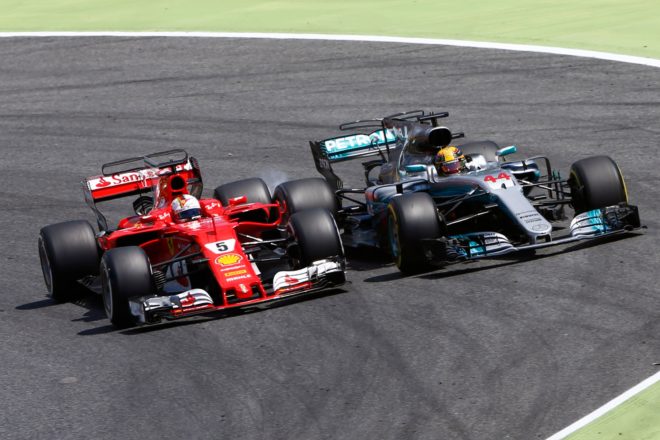
Ferrari-Mercedes renew battle in Barcelona; Red Bull in frame as one of favourites

Sebastien Vettel (Ferrari) and Lewis Hamilton (Mercedes) all set to renew their rivalry. Photo: formula1.com Barcelona, 10 May 2018: Four rounds ticked off the Formula 1 calendar, and this season has certainly kept us on the edge of our seats. We’ve had two triumphs for Ferrari, and one apiece for Red Bull and Mercedes. So, who has the momentum as we head to Europe for the Spanish Grand Prix?
It’s very hard to say indeed. Last time out, Baku provided us with a chaotic and thrilling race with Ferrari looking on course for a third win of the campaign before the Red Bull collision set off a chain of events that ultimately conspired to hand Mercedes their first victory of 2018.
The Silver Arrows still trail their rivals in red by four points in the constructors’ standings, but Lewis Hamilton’s latest triumph – his first of the season – gave him the lead ahead of Sebastian Vettel in the drivers’ championship after four races this season, the Briton having waited until after round 13 to move ahead last year.
Mercedes have locked out the front row in Barcelona in four of the past five years, but their qualifying prowess has already been questioned this year – Azerbaijan was the third race in a row they have missed out on P1.
But as we’ve seen already this season, it won’t just be about Mercedes and Ferrari this weekend. In fact, perhaps most of the attention will be on Red Bull, following the clash between Daniel Ricciardo and Max Verstappen in Azerbaijan.
They have now suffered two double DNFs in the past three races, having previously not suffered one at all since the 2010 Korean GP – and after being read the riot act, their drivers will be desperate to avoid more contact in Spain.
Barcelona is a track all the teams know extremely well – but who will come out on top?
The form book
Looking at the stats, Mercedes have every reason to be confident on their return to Barcelona. This track has arguably been a demonstration of their dominance in the turbo hybrid era.
In 2014, they locked out the front row with no other car within one second of pole. In 2015, this gap dropped to 0.777s, then 0.680s in 2016, before Vettel narrowed it to 0.051s last year and became the first non-Mercedes to start on the front row here since 2012.
The qualifying stats suggest the winner will need to come up with the goods on the Saturday. Twenty-four of the 27 Grands Prix in Catalunya have been won from the front row (89 per cent), the highest ratio of any circuit on the calendar with at least 10 previous races, such is the difficulty of overtaking at the Spanish venue.
Over the last decade, though, we have seen plenty of different drivers triumph, including shock victories for Pastor Maldonado in 2012 and Max Verstappen – on his Red Bull debut – in 2016. Hamilton’s victory last year ended a run of 10 different winners in the same number years in Spain, but could we see another new winner this year? Neither Ricciardo nor Bottas has triumphed here, but both have been in terrific form.
This is a race where, traditionally, the teams bring significant upgrades to their cars, so whilst no one is expecting the established top three to be toppled, in the supremely tight midfield there could be movement. McLaren, in the midst of a tight battle for P4 in the constructors’ championship with Renault, are one of the teams bringing significant revisions.
Both teams have Spanish drivers, but it’s Renault’s Carlos Sainz who has the better recent record at Barcelona, finishing the last three races in ninth, sixth and seventh. Alonso, meanwhile, hasn’t scored points at home since 2014 when he was still driving for Ferrari.
Elsewhere, several teams will be looking to carry momentum into Spain. Force India’s surprise podium in Baku, with Sergio Perez landing P3, kick-started their season, while Toro Rosso were boosted by Brendon Hartley’s first points-finish last time out.
Sauber’s Charles Leclerc also scored points for the first time, while Williams got their 2018 campaign underway with Lance Stroll scoring four points for P8.
Source: Formula1.com
-
Spanish Grand Prix: A statistical perspective
Barcelona, 10 May 2018: This weekend’s race will mark the 28th edition of the Spanish Grand Prix at the Circuit de Barcelona-Catalunya. Michael Schumacher tops the all-time winners list, with an impressive six triumphs here. When the drivers take to the grid on Sunday, there will be five previous victors among them – Kimi Raikkonen, Fernando Alonso, Sebastian Vettel, Lewis Hamilton and Max Verstappen.
The Stats That Matter
- Hamilton is looking to join a small list of F1 legends to win at this circuit for a third time. Should he triumph on Sunday, he’ll be on the same number of wins as Mika Hakkinen and three behind Michael Schumacher.
- The Briton, who won from pole here in 2014 and 2017, certainly enjoys coming to Spain. He hasn’t been off the front row here since his final year for McLaren in 2012, when he took top spot in qualifying only to be excluded for having insufficient fuel.
- Despite leading the drivers’ standings, the four-time World champion has been suffering somewhat of a qualifying drought recently. He took pole in Australia, but has been outqualified by team-mate Bottas in four of the last six races.
- Vettel has surprisingly never been on pole in Catalunya. But the Ferrari man has been in superb qualifying form this season, topping the timesheet at the last three races.
- Baku ended Raikkonen’s longest run of front-row starts (3) since Spain-Monaco-Europe in 2005, but he still finished on the podium for the sixth time in the last eight races.
- The Finn has set the theoretical best lap of qualifying at the last two races (adding up the three best sectors from any lap), without having taken pole at either of them. Consistency in Barcelona could see the Ferrari man take P1.
- Two years ago, Max Verstappen’s triumph saw him become F1’s youngest-ever winner at 18 years 227 days, become the first Dutchman to win in F1 and the first man to win on a mid-season debut for a team since Juan-Manuel Fangio for Mercedes in 1954.
- Force India will be hoping to spring another surprise. Perez finished fourth in Barcelona last year, his and team’s best-ever finish on this track. The Mexican is attempting to score back-to-back podium finishes for the first time in his and his team’s history this weekend.
- Nico Hulkenberg has not been eliminated in Q1 since the 2015 Spanish GP, and this is the only circuit at which the German has never qualified higher than 10th in his F1 career (seven previous visits).
- It’s safe to say Pierre Gasly has endured an action-packed start to his first full season in F1. And there’s no reason he cannot replicate his fourth-placed finish in Bahrain this weekend. He has scored more podium finishes in Catalunya than on any other circuit in his GP2 career, with three podiums in four starts in 2015-16.
- Not including retirements, Nico Rosberg, who started the 2013 race in P1, is the only pole-sitter to finish outside the top-5 in a Spanish Grand Prix – regardless of venue – in the history of Formula 1.
The circuit
This Circuit de Barcelona-Catalunya is familiar territory for Formula 1 teams. Not only have they raced there every year since 1991, they also take part in extensive testing at the track.
But this does not mean they’re in for an easy ride. In fact, the venue’s mix of high and low-speed corners plus its new track surface will once again provide the drivers with a physical and mental challenge.
Teams often struggle to find and execute an optimum set-up here, when you consider tyre wear is particularly high and the varying winds that cut across the circuit.
Turn 1 provides spectators with one of the best places to watch given it is one of the track’s few overtaking opportunities. The drivers, however, tend to find the latter stages of the track the more challenging. In particular, the final two turns require a fast exit in order to maximise speed down the start-finish straight into Turn 1.
Source: Formula1.com
-
Sahara Force India, Alfa Romeo Sauber F1 team withdraw EU complaint
Joint release by Sahara Force India and the Alfa Romeo Sauber F1 Team:
We have decided to withdraw the complaint we lodged with the European Commission in 2015 on the subject of anti-competitive practices in the sport of Formula 1.
We have been greatly encouraged by the dialogue that has been introduced following the appointment of Chase Carey as Executive Chairman and CEO of the Formula 1 commercial rights holder and his new management team. Their approach has brought a new culture of transparency to the sport and illustrates willingness to debate fundamental issues such as the distribution of the prize fund monies, cost control and engine regulations.
We are encouraged and reassured by the even-handed and fair negotiating approach taken by the new management of Formula 1 to all the teams and their issues. While the concerns leading to the compliant were fully justified, we believe this new approach provides the necessary degree of assurance that our concerns will be looked at objectively, and we prefer to resolve the issues facing the sport through dialogue rather than a legal dispute.
We want to support this transformational process in Formula 1 and thus have resolved to withdraw our complaint with immediate effect.
-
I am really happy to be back, says Sauber’s Werhlein
Sochi, 27 April 2017: Part II of the FIA press conference on Thursday before the fourth round of the Formula One (F1) World Championship to be held here on Sunday.
PART TWO: DRIVERS – Kimi RÄIKKÖNEN (Ferrari), Daniel Ricciardo (Red Bull), Pascal Werhlein (Sauber)
PRESS CONFERENCE
Q: Kimi, you’ve been knocking on the door of a podium at every race this year – but judging by your radio messages, you’re still not happy with the car. What feeling is it giving you and how does that change over the course of a grand prix?
Kimi RÄIKKÖNEN: I’m more happy now that I was probably first race. I think in the last race it was pretty good, I was very happy with it but qualifying not so, but the race itself was good. Then we had pretty average Saturday, so the starting place already was not very good. Then pretty bad first lap so was a bit off. Bad start then couldn’t really get past Felipe in the beginning. Then got past him, we had very good speed but then Safety Car was a bit unfortunate after our pitstop. Then the feeling was pretty good. So, you know, you have to make the Saturday better and then obviously you can use the speed.
Q: How do you see things panning out this weekend between Ferrari and Mercedes?
KR: I don’t know, you tell me. We’ll see tomorrow how it goes. It’s been pretty close between everybody so far, it the first three. You wouldn’t expect it to be a whole lot different here – but who knows.
Q: Can you say that there are still a few things for you to iron-out with the car? But is this still the best Ferrari you have raced in Formula One?
KR: You cannot really compare from the early days but comparing the last few years, then yes. I drove a very good Ferrari when I came first time in Ferrari and, you know, it’s a good car, good package but we have to improve it all the time like anybody who does it but yeah, we just need on my side to put things a bit more better where we want it to be and I’m sure we’ll get the results that we want.
Q: Daniel, I want to start with a technical question. You struggled with tyre temperature in Bahrain, with track temperatures not expected to be that high here, are you worried that the issue will be the same at this grand prix?
Daniel RICCIARDO: Not worried. I think we learned a bit from that. We had the test on Tuesday after the race. We experimented with a few things, so I don’t expect to be in that position again. So yeah, we’ll see. We know that this track is one where you sometimes circulate for a bit and then do a push lap. The tyres maybe aren’t’ there on that first lap for, say, qualifying but I think for the race we should be OK. We’ll be alright.
Q: The team is planning to bring pretty much a new car to the Spanish Grand Prix in a couple of weeks’ time. What do you expect from that car – and what are the major problems with the current car that need addressing?
DR: I expect… I’ll use the word hope, not expect. I hope for a bit of a bullet: something fast. We want to be in a three-way fight with Ferrari and Mercedes. So, that’s what I would hope for: something that puts us in that fight. I look back at least year and think here in qualifying we were over 1.5s off pole and then we went to Barcelona and we were about half a second off pole and we made some gains and then obviously in Monaco we were quick. It’s a time of the year where we should start to see these updates take place and some performance really start to come out of the car. I’m hopeful of that. We just need a bit of everything now. We’ve talked a bit about downforce, feeling a bit in the rear. We’ve had a bit of time to look at Ferrari: they’ve been in front of us for a few races and can study them for a lap or two before they get too far away and yeah, they look strong. Mercedes as well: they’re just carrying a bit more grip in the rear and that’s where all the lap time is in these cars these days.
Q: You say you want a bullet – but the guys next to you aren’t standing still. Are you confident the upgrade in Spain is going to be enough to make it a three-way fight at the front?
DR: I hope so. I’m confident it’s going to be better than what we’ve got now and for now that’s all we can ask for is an improvement. A bit like last year: we made that step and were able to just keep chipping away at it. I think to make that first step is important. I believe we will get that in Barcelona and then let’s see where it puts us. If it puts us within half a second, then I think we’re in striking territory soon after that.
Q: Pascal, great first race back in Bahrain. You then completed 91 laps during testing, so is it safe for us to assume you’re now back to full fitness.
Pascal WERHLEIN: Yes. Really happy to be back, first of all. I think my first weekend was great, P13 in qualifying, P11 in the race, so couldn’t be more happy about my first weekend. Then obviously the test after the race went well. Nearly did 100 laps and just feeling more and more confident with the car, and also with the team and all of the procedures. Just looking forward to start my season finally now.
Q: Looking back, how tough, in hindsight, was your recuperation – physically and mentally – to get yourself back to full racing fitness, how tough was it? You posted a picture of you on social media wearing a neckbrace. Was there ever a moment when you felt your career slipping way or were you confident you’d get back and have the sort of race you had in Bahrain?
PW: No, I fought, of course, very hard to come back and also with the people around me which helped me massively to come back as soon as possible and as quick as possible. We knew that it’s a matter of time but obviously to break a few vertebrae it will take a bit of time and y’know, still it took me only ten weeks to come back to racing and I’m very happy about that. I think, when I posted the picture after Bahrain, people realised more which injury I had, and yeah, as I said, just really happy to be back and to start.
Q: Daniel has just been telling us about the rate of development at the front of the grid. Given that’s the case, how crucial are the next few races for you, to get points? Do you see the next three as the best chance?
PW: I don’t think so. Of course we have a disadvantage, especially, I think in the second half of the season with the engine because we have last year’s Ferrari engine but I think we can make bigger progress with the car, then second half of the season, the engine is a disadvantage. Let’s see how the season goes, I will do my best and I’m sure everyone in the team does as well and hopefully we can score a few points.
QUESTIONS FROM THE FLOOR
Q: (Dieter Rencken – Racing Lines) The latest information from the FIA says that the cockpit shield has received the nod over the halo for 2018. First of all, which of the two systems do you prefer, what do you think of the shield in any event?
KR: Well, I have seen a bit of the shield, of what they showed to us. Until we try, it’s very hard to say how it is. Is it better than the halo? I don’t know. Look-wise, I don’t think there’s much difference between either of them.
DR: Yep. Like Kimi said, we got a presentation in China, I think, all us drivers, about the new shield. I think yeah, we’ve still got to see a bit more but yeah, first impressions seem OK and I guess we’ll now try and get some development on that and then start to run it in some practices as soon as they can put it on the cars and then get some more feedback on it. It’s good that they’re still obviously looking for this head protection stuff so that’s positive.
PW: I didn’t see the shield yet as I wasn’t in China so I don’t know how it looks. I think it looks similar to the new idea last year, no?
DR: It’s like a middle of the road look. It looks alright actually.
PW: I think the halo looked a bit strange so the version of last year of Red Bull. I liked it quite a lot, it looks like a spaceship and very futuristic. I liked it. If it looks similar, it’s good. If it’s more safe, it’s good for us drivers.
Q: (Simon Lazenby – Sky Sports) Kimi – a similar question that I put to Valtteri – 34 points between yourself and your teammate right now. Have you had a conversation with management about your role in the team this year? Has Sebastian been identified as the number one driver?
KR: No. Obviously we have our talks at the beginning of the year. We know exactly what we are supposed to do between us as drivers and that hasn’t changed. If it comes to that at the end of the year when either one has no chance, purely on points, then obviously things will fall into place but apart from that, I don’t see anything happening until then.
Q: (Kiril Zaytsev – 66.ru) Kimi, can you tell us more about your businesses outside of F1? Is it true that you have a karaoke bar in Helsinki? And how can your fans find it to sing some songs, maybe? And do you sing yourself?
KR: I do some other stuff than F1 in my life but I’ve no interest to tell what I do or where I do. Do I go in bars? Yes, lately less, no time, unfortunately. I’m involved with a few things.
Q: But Kimi, can you sing?
KR: Can I sing? Badly. But I can sing. But I don’t think it’s the point of that. It’s more fun than actually trying to sing.
Q: (Lasse Lehtinen – Ilta Sanomat) Kimi, you’ve been pretty frustrated in the races during this season. What has helped you to handle these disappointments?
DR: Karaoke!
KR: No, it’s the normal story I would say. Every year… in any race that you don’t do as well as you hope it’s never going to be fun or easy. It can look either way. I’m lucky that I haven’t been in the position that I have won all the time, so that you get used to these things but on the other hand you would rather be in that position. It’s worse fun. It’s very normal stuff, you know. I want to do better and the fact is that if you don’t do as well as I want then for myself it’s never going to be fun. It’s always more fun when we do have a good result. It’s just go to the next race and try to do better.
Q: (Marco Mensurati – La Repubblica) Kimi, in Shanghai, Marchionne was not so fine with you. We heard him talking not so gently and I would like to know about your relationship with him and with the team? And the second one: how long do you think your career will last?
KR: As far as I’ve spoken to our personnel it has always been fine. I know that there’s some things that have been said and written but for me, you can find so many nonsense stories in newspapers, on the web, that I trust much more how my relationship is personal with the team or with him. For me it’s all fine. Like I said before, I expect a good result from myself; when I don’t get them I’m unhappy with myself so if the people aren’t happy that’s fine because I’m not either so it’s not really a big deal for me. What comes to my future I don’t know. There’s always a lot of talk on that since years. I’m not going to try and I’m not going to do this and that. My first thing is that I want to do well and then we’ll see what happens after this year. It’s definitely not the first thing in my mind right now. My first thing in my mind is to do well and here and then the next race and whatever that brings we will see in the future. I have a good relationship with him, I know him well and it depends on many things.
Q: (Flavio Vanetti – La Corriere della Serra) Again for Kimi: can we say that Ferrari is definitely at the same level as Mercedes or is Mercedes still having something more than your team?
KR: I think there are many different ways to look at things. If you look at pure results, if you look at qualifying results. It depends what you look at but I think as a team they have done a very good job for us to bring the car to the level that we have and obviously it’s up to us to make the best out of it. Seb has done good races. As a team I think we’ve come a long way from the last few years. Yes, there are still things that we have to improve all the time and do better but that’s the same with everybody. Are we at the same level as them, Mercedes? I don’t know. It’s not far off, let’s put it that way. In qualifying, I think they’ve been a bit stronger I would say but then in the race it seems to even out. That’s a bit the same trend as it’s been the last few years, that they seem to find something extra on one lap and then it evens out a bit in race conditions. I think it depends a bit on the circuits where we go but we have a good package and we have to make the best out of it.
Q: (Angelina Grebtsova – Nation Magazine) To you all: which is your favourite track?
DR: Favourite track? To drive on: Monaco. Yeah. It’s unique. It’s so tight and twisty and the whole weekend is great as a spectacle but for pure driving and as far as adrenalin goes that’s a stand-out above the rest.
KR: I don’t think there’s one bad circuit but I enjoy maybe Spa, Monaco. I guess they’re quite opposites. There’s a lot of nice places but maybe those two.
PW: For me it’s Macau. It was very impressive to be there in Formula Three. I think I was 16 or 17 and driving with a Formula Three car at 280kph on a street circuit was something very impressive and the track is also very nice.
Q: And Pascal, a Formula One track as well?
PW: Maybe it’s becoming a Formula One track in the future. No. I love street circuits so maybe Singapore.
Q: (Angelique Belokopytov – Autodigest) Daniel, your lack of performance, if I can call it that, is it all on your car or is there something missing in the driver and if yes, what is it?
DR: No, nothing’s missing in the driver. I haven’t forgotten anything. I think just with the car – we know that we can do better, I guess. I think we’ll see that in Barcelona. I think the team’s learned a lot from the past, from testing but also the past few races and also with our feedback, myself and Max’s feedback, I think we’ve been targeting the same things and I think now the team has really understood the point on the car to work on, to focus on and that’s why now they’re bringing this update for Barcelona and that’s as soon as it can come. That’s pretty much that, so for everyone asking why isn’t it here for this weekend… it takes time to build the parts, basically, and then to put them on the car. They test them and then it takes time for the development and all the process but from Barcelona we should be good. From a driving point of view I feel good, very good.
Q: (Darya Panova – F1 Only) What is the main feature of Sochi for you?
KR: I think it’s a nice place to come. The circuit is quite good. It’s been a bit tricky over the last three years. It’s just been very slippery – at least for us – but it’s a nice place to come. Everything is new, everything is well done and I enjoy coming here. It’s a beautiful place.
PW: I like the track so I’m looking forward to driving turn three, hopefully flat this year. It wasn’t possible last year in the Manor. I think there are some nice corners also, the one after the back straight, hard braking into a left hander. It’s very easy to lock up the tyres. There are a few nice places as a street circuit but with a bit more space so you can lock up, you can go a bit wide sometimes so it’s a good track.
DR: Yeah, I think the low grip makes it quite tricky, quite unique and a lot of the corners are flat so there’s not really any camber, any positive banking to kind of pull you round the corners so when it’s slippery and you have like a flat corner then it’s a lot more easy to slide and it’s harder to sometimes find the grip so that’s a challenge but quite a fun one. There’s not many tracks we go to now with that feature and yeah, as Pascal said, I guess it’s turn 13 I believe, after the back straight, braking for there is quite tricky. That’s a good one, it can be a passing opportunity as well. If you can pull off a move there it’s normally a nice one.
Q: (Livio Oricchio – GloboEsporte.com) Kimi, we saw in the tests in Barcelona, bends number nine, ten that you could brake on the entry, you didn’t have a lot of understeer, and this year you have complained on the radio – we have heard that – that you suffer with understeer. Maybe it’s one of the reasons for a lack of performance between you and Sebastian. What has happened from the winter test to now? And to Daniel, you said about the development of the car; what about the power unit? Is there a development from Renault, from Australia to now?
KR: I think people always look at the lap times in testing and obviously if you’re the fastest they think everything is perfect but I think the problem is also that you do testing in one place, one circuit and any other circuit is usually a chance to set up and we’ve been not far off but off enough to not be 100 percent happy and like I said, last race already we were a lot happy so let’s hope that this weekend we are even better off and go from there. So just small things but they all make a difference.
DR: Yup, power unit – we’ve had a little bit since Australia, so it hasn’t been an upgrade but we’ve been able to squeeze a tenth out of it since then, I would say, and I think around Montreal we’re looking for let’s say that power unit upgrade where we should hopefully find a couple of tenths or something like that. Yeah, we’re obviously still trying to get chassis and power unit stronger but yeah, the big upgrade has not come yet.
Q: (Andrea Cremonesi – La Gazzetta dello Sport) Kimi, last week or two weeks ago you were in Holland to see the motocross World Championship because you have a team there. Could it be possible to see you there, managing the team when you finish Formula One? You are 37-years old, you said before you are focused on the season to improve yourself but you are in your mind drawing that line to say OK, now that’s enough for me, I want to change my life?
KR: I don’t want to change my life. I’m happy with my life. I’ve had the World Championship team for many years. I enjoy going there when I have time. Unfortunately I’m quite busy with a lot of stuff so not enough time to go often but it’s good fun, it’s different to here so I enjoy it also on that side but like I said, we will see what happens in the future. I’ve been in the same position for many years. People always question me on many things but I’m not in a hurry to decide anything and whatever the future brings is what I want also and we will see.
eom/FIA transcript of the Press Conference
-
We want to first stabilise the team: Kaltenborn
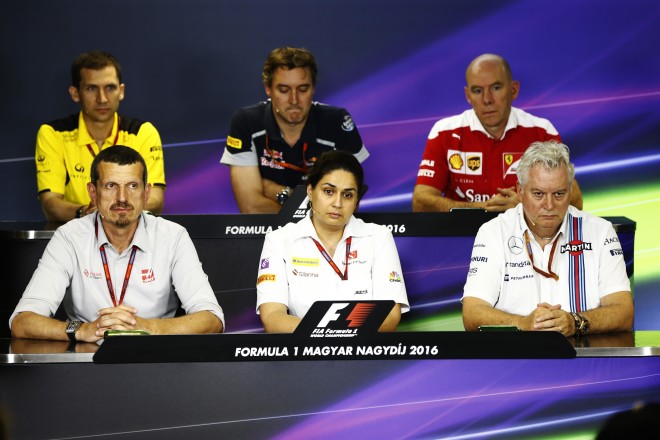
Kalternborn of Sauber (front row, centre) at the FIA press conference. FIA image TEAM REPRESENTATIVES – Rémi TAFFIN (Renault Sport), Monisha KALTENBORN (Sauber), James KEY (Toro Rosso), Pat SYMONDS (Williams), Jock CLEAR (Ferrari), Guenther STEINER (Haas)
PRESS CONFERENCE
Monisha, if we could start with you: a very positive news story both for Sauber and for Formula One following the buyout of the team by Longbow Finance. Can you tell us a little bit more about the new owners? Who are these people who have bought one of the most prestigious brands in Formula One?
Monisha KALTENBORN: Well, Longbow Finance is a Swiss company. They have been active in financial investments for more than 20 years, from Switzerland. Their operation involves, well typically private equity investment for international client and of course investment portfolio management.
So when are we going to start seeing the benefits and when are you going to start seeing the benefits of the buyout – something this year?
MK: Well, we are working on that, but you know these things take time. We have had a rough time these past few months and the first target of course of the new owners is to stabilise the entire group. So you have to settle matters and then of course, again, to get back to your business as usual to have then a basis for being competitive. I’m sure we’ll have a few things still coming up this year, I mean we still have a few things to do, we don’t want to end up where we are, but of course we are focusing more on next year and there I am very confident you will see a lot more.
Thank you. Guenther, coming to you, we’re half way through your first season in Formula One, can you just give us a half-term report? How do you feel it’s gone?
Guenther STEINER: I think it has gone pretty well. I would just like to take this occasion to thank Gene Haas for the trust he has put in all of us, you know that we can come here, because I think the Haas story, an F1 team from America is good news, like good news that Sauber found an investor. Back to where it has gone, we had a very good start, for us, sure some people might think differently, if you are Mercedes or Ferrari, but we are very happy. Then we had a bit of a downturn, which wasn’t massive, I mean we still finished 11th. We finished 11th three times, so we were almost there but not really there. But we got back. The team has grown a lot in these 10 races up to now, if you saw it in the beginning. I wouldn’t say we were bad in the beginning, but if you are new it take some to gel and we always knew this and maybe we were lucky to get these points in the beginning because it gave us confidence, we knew where we were, that the car is good or that it is decent and we were building on it. And then when we had the four races where we didn’t score, we didn’t lose our head or get nervous. We just kept on working, we said “we know we can do it, we just have to do it again”, and I think we did it again, we finished eighth and then in Austria we finished in the points again, so all in all, very happy. Now we are at the point where we look to next year, well we started before now to look to next year, but now it’s full steam ahead on the new car and the race team is just getting better and better because they learn more and more every weekend. We are getting more people in on aero development for next year because we want to be even better next year. I hope we can achieve that. Everybody in the team can be proud of what they achieved and I would like to thank everybody in them because they worked hard because the first three races weren’t easy. They were difficult for everybody. People worked day and night. But they pulled through and now we are where we are, we’ve got 28 points and we are proud of them.
You say the team is growing, you’ve got more people in the aero department, what about the infrastructure in Banbury? Do you feel confident enough to take on more of the manufacturing of next year’s car in-house?
GS: No, that was never our plan. We continue a few years like we are. We want to grow in a few areas like race engineering and aero development, but design staff and manufacturing we don’t want to take, because we don’t want to get distracted. I think our principle works – to buy as much as we can from somebody else. We want to keep doing that because there is not a lot in it if you go to do it yourself, not a lot of speed we think is in it in the car. We would just distracted we don’t want anything of that to happen, so we keep on with our business plan, as we set out in the beginning.
Thank you. James if we could come on to you please. An impressive double points finish for the team at Silverstone. Do you think you pre-season target for the season of fifth in the Constructors’ Championship is still on? Can you catch Force India?
James KEY: Well, we’ve got a long way still to go, so you’d hope so, we’ve done just about half the season so far. Force India have done a really good job recently and they’ve made the most of some good opportunities, where perhaps we haven’t. We’re not happy with the number of points we’ve scored. We’ve got developments to come to the car, which could give us a chance later in the season, so there’s more to come from us. You clearly can’t give up in the middle of the season; you have to keep pushing. I know a bit of a gap has developed, that was really only made over a couple of races, a couple of big scoring races for them. So the same has got to happen for us to close up, so we’re not going to give up on our chase but it’s not easy.
You say you’ve got some chassis developments coming but there will be no power unit developments because you’re using the year-old Ferrari engine. How much of a frustration is that for you now?
JK: Well, we knew it was going to get more and more difficult as the season went on. The pace of power unit development has continued at a pretty high level. It was never an advantage for us to have an established power unit but one that was a year old, it was always a disadvantage – that’s no disrespect to Ferrari, but clearly they have made good steps on their own ’16 unit and we’re not benefiting from any of that. So it’s deeply frustrating really, but we knew what to expect. We have to try to compensate with chassis and make better use of our opportunities.
Thank you. While we’re on the subject of power units, Rémi, if we could turn to you please, how satisfying has the development of the power unit been, given where you were a year ago?
Rémi TAFFIN: I think it only be a good satisfaction, because where we were coming from was a difficult year last year and now we can see the improvement on track and everything we got out from the factory to the track was working well, so that was a good step forward, either first race or actually Monaco/Montreal specification we introduced. It’s all working well. I just have to say we’re on it, but we have a good way to go.
What’s next on the roadmap fro Renault? When are we going to see the next upgrade?
RT: I think it will be next year. The big step we will have will be next year’s engine, race one. Until we get to the end of the season now we will be working on the specification we have now, trying to extract the most out it, but there won’t be any more let’s say big step as we had for race one and six.
Thanks. Pat if we could turn to you now please, it’s been a difficult year for Williams, not least in Austria and Silverstone, the last two races, two tracks where you went so well in recent years. Have you discovered the cause of the problems at those two tracks? Were they track specific or was there something more serious at hand?
Pat SYMONDS: Well, I think we’re getting on top of it. It does seem that Canada was a long while ago – we were on the podium there – but it was only five weeks ago. But three races since then, Baku, Austria, Silverstone, and I feel in all three of those we haven’t performed in the way I expected to. S we are looking into it. We are looking at various things that we have introduced. We’re making sure that we understand them; that’s a process that’s been going on even today. But it’s quite an intense period, you know. Over a period of just five weeks we’re actually doing four races and one test – five events in five weeks. It’s hard to catch your breath when it’s going at that sort of pace. But I’m pretty confident we’re getting on top of things. We had a good day today. I was pleased with how it went, particularly on the long runs, and I think we’re getting back where we should be.
Where’s the focus in Grove now, is it on 2017? Do the 2017 technical regulation changes come at a good time for you, a chance for you to press the reset button if you like?
PS: Well, they come at the same time for everyone. We all have equal opportunities and I really do regard it as an opportunity. In answer to the first part of your question, we’re pretty focused on 2017 now, as I’m sure all the teams are, because there is so much work to do. There is so much to be gained in the early part of the learning curve that you can’t afford to leave things too late. It makes it quote challenging of course. If you are in a fight in 2016, as indeed we are, but you’ve still got an eye on the future, you have to balance things pretty carefully. But of course not all development is aerodynamic and while the wind tunnel is pretty devoted to 2017 work, there are other areas where principles do carry over, so we’re still carrying on in those areas.
Thank you, Pat. Jock, turning to you: like Williams, Ferrari hasn’t been able to maintain the momentum it built up towards the end of last year. Why is that? Are you simply losing ground in the development race or are there more fundamental problems than that?
Jock CLEAR: Firstly, apologies for keeping everybody waiting. I don’t thing we feel that we are losing a huge amount of ground if you see what I mean. From my point of view I have recent knowledge of the opposition and a huge respect for what we are trying to beat effectively. Our performance has come under a bit more scrutiny now that Red Bull are putting us under pressure, but again that is a testament to how strong they are as a team. We haven’t lost a huge amount of ground to the leaders. If you look at it over the course of the last couple of races, in Canada we were very close and in Silverstone we were a long way off. I think we have learned a lot about some of the areas where the car is weak and that has helped us to identify where we need to work and we are under no illusion that Mercedes are going to continue to be strong and Red Bull are going to continue to be strong. All the teams are working hard. It’s the ongoing challenge. We are working as hard as we can on closing that gap and sorting out the issues, but as everybody has said already, we can’t take our eyes off next year, because that’s a big opportunity. So we’re now having to measure that resource and measure that balance between keeping some momentum or looking to get some momentum later in the year but also putting a lot of resource on what, as Pat says, is a huge challenge for everybody next year. That balancing act is very difficult for all of us. And as I say, it’s just a testament to the guys at the front how well they are continuing to develop and that puts us under pressure because we are not closing the gap as quickly as we’d want to be and that’s racing.
You say you have recent knowledge of Mercedes. That gives you a unique perspective on the two teams. How are Mercedes and Ferrari different from an operation point of view?
JC: Sorry to be no fun but I’d rather not share those details if you like. Obviously my own experience at Mercedes I take with me into this position and those sort of insights are really helpful to Ferrari and we’ve talked about those long and hard – the areas where actually Ferrari are stronger, the areas where Ferrari are weaker, again filling in all those details. It doesn’t happen overnight. I was never going to arrive and change things overnight. Far be it from me to think I’ve got anything like that much influence. I’m just here to try and get the race team to do the best we can with the package we’ve got and make sure we’re feeding back the right things to Ferrari at Maranello. That’s the same structure as all the teams I’ve ever worked at. The dynamic is different, the people are different, but again that’s probably true wherever you go. There are no obvious stark differences that I can share with you, but there are those details that obviously I’ve shared with Ferrari.
Maybe no differences, but many similarities?
JC: Oh absolutely, many similarities. The passion. If anybody was under any illusion that Ferrari is not as passionate as they used to be in the halcyon days of Ferrari, it’s incredibly for the passion. That is a huge, huge boos for all of us. It’s a pleasure to be part of that passion. Some times it’s our Achilles heel, sometimes we know very well that passion can make things quite difficult for you, but on the whole it is just a huge positive and it is a joy to be part of.
QUESTIONS FROM THE FLOOR
Q: (Dieter Rencken – Racing Lines) Question for Monisha. Following the non-starts that were Qadbak and with the Russian investors, I’m sure that you did some due diligence on Longbow Finance, so you are in a position to confirm or deny that the Rausing family are participants in Longbow Finance please?
MK: What I can tell you is that our partner is Longbow Finance, it operates in Switzerland. All disclosures that are required in Switzerland are done and that is important to us, who exactly our partner is. And that is Longbow Finance.
Q: (Viktor Bognár – Magyar Szó) Question to Pat. We have some new technical directives about the radio communication between the engineer and the drivers. Is there any fear that it causes some over-complication of the rules? What would be the best solution in your opinion?
PS: It’s an interesting question. I think that the interpretation that’s been put on the rules is quite harsh. The rules that are taking about is a rule that says the driver must drive the car alone and unaided. I think it was put there many, many years ago to perhaps limit some of the electronic controls and things like that. Indeed it was that very rule that was cited in the banning of traction control, for example. To bring it in to the sphere of communication with the driver is odd. I’ve always through of Formula One as being a team sport and I’ve always thought, as teams, we should participate together to assist our driver. And you know, you can ask where the limit is. If the driver is to do everything alone and unaided, should he change his own tyres at the pitstop? Clearly ridiculous but that could be the logical extension of it? But I think what’s particularly interesting is that, I think it’s rather a shame that something that’s really unique in motorsport is something that we are doing away with. If you cast your mind back just a few weeks, we have the Euro football championship going on, that fantastic game, Italy and Germany, it’s going to penalties, wouldn’t you have loved to have heard what was being said? Three penalties missed. Would you have not wanted to hear what the goalkeeper was saying? Would you not wanted to hear what those strikers were saying? Now in Formula One we actually have the ability to engage our fans and allow them into the cockpit to get that sort of level of immersion… and we’ve allowed it to go away. I think that’s the biggest shame of all.
Q: (Joe Saward – Auto X) This is a question for everybody, specifically based on what Pat was saying. We’ve got six races in eight weekends. Is that sensible?
Guenther, why don’t we start with you?
GS: You’re asking me about sensible! It is a lot of work, it is tough. I think for us we didn’t feel the difference so much because we started off new and we were just running anyway, so a littlebit more or less is not a difference. Is it sustainable? I don’t think so. I think we should try to make it a little bit more scheduled. A better schedule that you don’t have six events in six weeks because it gets old pretty quick. Sometimes these things happen and maybe change is in the future, I don’t know – but asking if it’s sensible… no.
James, your thoughts
JK: I think when you have 21 races you’re always going to get a compressed timescale for things – unless you lengthen the season, which I don’t think any of us would like to see. So, whether it’s sensible or not, difficult to say but I think as long as you’ve got that many races in a season, you’re going to get a situation where you get six weeks of enormous activity, particularly in the middle of the year.
Pat?
PS: I think that… we examined, I think around 2008, how we were going to go racing in the future and we decided that 20 races was very much the tipping point. Now, of course, you say, “20 races, what about testing and things like that,” we do still have two in-season tests, we have reduced to only two pre-season tests – but what we’ve done is get rid of test teams, so there’s an awful lot for the race team to do. On top of that next year… well, firstly, we’re not at 20 races any more, we’re at 21 and who knows whether that will go beyond, but we’ve also got tyre testing to take into account next year, so I think we’re way past the tipping point and we, as a team, and I think most teams, are looking at a completely different structure because we cannot ask our personnel to maintain the level of activity that’s being asked of them. And therefore we’re going to have to look at rotation. It’s an incremental cost, we have to put people in there and, y’know, I’ve been in racing now for 40 years and this is the first time when I’m starting to see people say, “well, actually, y’know, we don’t want to go racing. We love Formula One, we enjoy working in the factory but it’s actually too much of a drain on family life and quality of life to be on the road all the time.
Jock, Monisha or Remi, do you have anything to add?
JC: Just to support Pat, his point on pushing people and people making that level of commitment. Big sports play very well off the bench these days – and that’s a big part of rugby, big part of football is what you do with your substitutes. We don’t have that luxury I’m afraid, and we’ve got a lot of guys out there who, during this five-week period who are really, really up against it to get enough sleep and, as you say, to find time to look after their families. It’s beyond the tipping point, as Pat says. I don’t think it’s necessarily not sensible, I don’t think we’re worried about the safety of it, we’re still very comfortable that we can put those cars out there safely for Seb and Kimi every week – but people are just very, very tired and we’re only halfway through that five week four race period.
Q: (Ralf Bach – Auto Bild Motorsport) A question to Jock. One of your drivers told us yesterday that we shouldn’t write that negative about Ferrari, we should write more positive. So maybe we could start right now. Could you tell us some areas where Ferrari is stronger than Mercedes?
JC: Ha! I would rather not share those areas. As I say, I’m sorry to not play to the party. The comparisons are very, very difficult. It’s a very different culture, it’s a very, very different way of working. Just the geography of the setup is very different. And that naturally arrives at a different solution. The people involved are all very, very experienced in F1. They’ve all had different upbringings through either the British teams or the Italian teams and that arrives at a different result. As I say, the difference are not necessarily those that are going to make the difference between whether you’re on the front of the grid or not. That still boils down to how well you can get the results out of your wind tunnel, how well you can develop your power unit, and I would say the key, key point with Ferrari and all of the teams is that with this new hybrid engine, it’s much more integrated than ever before. You can’t just say “right, that’s your aero, that’s your chassis, that’s your engine,” and those three will come together. They’re all so closely linked nowadays and that integration is a strength of Ferrari because nobody has a closer relationship with their engine manufacturer than we do. Even at Mercedes, geographically, they’re not in the same place. So we have that advantage. That’s one that’s obvious to everybody – but it is an advantage. And having that close community with the engine side and the chassis side, not that we have this hybrid unit where they’re so closely integrated, with the aero, with the cooling systems, that is a strength that we need to work on and we need to make the most of.
Q: (Kate Walker – motorsport.com) I’ve got a question for all of you please. Recently we’ve heard comment from Paul Hembery of Pirelli talking about his preference to return to some form of warm-weather testing for 2017, particularly with the changes in the tyres and everything else. Could each of you please tell me what your position is on warm-weather testing, whether you’re pro- or against it and what you see as the key advantages and disadvantages?
Remi, if we start with you.
RT: I’m not sure I’m really well-placed to comment on tyre testing. The only thing I maybe would comment on that one is something we already covered: the resources we’d have to put in front and the people we have to get on board for that. Apart from that, I guess I’m not going to comment on tyres, to be fair.
Monisha?
MK: Technically, it’s difficult for me to argue anything on that but I think the picture I have here is we had good reasons to get rid of these kinds of testing activities. We’ve seen times where there was unlimited testing, lot of tyre testing was done at the time, basically with one team and we all got those tyres. And we had at that time, when there were many manufacturers actually in the sport, where money was not that much an issue, we still got rid of these kind of things and, step-by-step, we are getting back to areas again that we never wanted at that time. So, I just wonder where this is all going to. We’ve again got in-season testing, fine, we got something else away, but it’s just becoming more and more expensive, costs are just going up and I just feel it will end up somewhere in a very, very bad situation and I think we should learn from the steps we have taken in the past and not again wait for something to happen where people again may be leaving the sport. It’s not always just the small ones. It could equally happen, which we’ve seen years ago, how bigger… how manufacturers have left. I think we should be very cautious in opening up these kind of shows again. I think as teams we should probably not have that much liberty with regard to tyres. It would probably be easier if we were to just let the tyre manufacture do what he does and focus on other things.
PS: We are actually evaluating the costs at the moment. It is an incremental cost, there’s no doubt about it. If you have the situation where you could test in the venue where you were racing, you can limit some of those costs, and indeed many years ago we used to do that. We used to start the season in Brazil and test there. We started the season in South Africa and we tested there. You can stop on the way and this is the sort of Middle East on the way to Australia and you can mitigate your costs by not bringing things back to base, in our case, back to the UK. It is an incremental cost and one of the problems is that you’re always sending a lot of people to these tests; there are so many systems that need looking after. From the UK, a flight to Barcelona is £50 or something. To Abu Dhabi, it’s significantly more and so it doesn’t come at no cost. But I think that we have got a problem but the problem is probably greater than you might realise because the rule that came in for this season, which allows the teams to chose their tyres and chose three tyres from the five available – which incidentally, I think is a very good rule and it has done quite a lot to spice up the racing and to bring a little bit of randomness into some of the strategies – it really does fall down next year because we have to make those tyre choices before Christmas, before we’ve even run a car with the tyres and indeed, I think by the time we’ve done our testing, we will have supposedly chosen tyres for the first five or six races. Now that hands an enormous advantage, in my opinion, to the teams that have done the testing, even if it’s blind testing, even if we’re getting that data, you won’t pick up all the nuances that the test teams have had. So I think what’s far more important is that we look at that problem and perhaps for a year or for the first half of the season or something like that we suspend the right of the teams to make that tyre choice so that we all live together, we don’t hand that advantage to Ferrari, to Red Bull and to Mercedes, because we would love to have been involved in that testing and we got quite a long way down the path to designing a car for it but we simply couldn’t afford to do a test like that and these costs just keep on adding up all the time.
JC: Yeah, obviously we were very much like Pat, very keen to be involved in that and we have the advantage of having the resource and being able to put a car together, not specifically because we thought it would give us a huge advantage. I think we’re all comfortable – I would like to hope – with the way that data is going to be shared and the way the tests are going to be run but Pat is absolutely right, there will be nuances that you will get out of it by being there at the time and the drivers involved will get a feel for it so there’s an advantage there and certainly, for all of us, I think we’re well aware that making decisions for what tyres we’re going to be racing at the beginning of next year when even we will have had very little touch on them is very difficult to do, so Pat’s very correct on what he says. That probably needs to be looked at. We certainly don’t… and we never envisaged our involvement with the Pirelli testing as an opportunity to steal a yard on everybody else and as such, we would be quite happy to go along with that if some way were found to even out that possible advantage early season. More about the Pirelli testing: I think we sympathise with Pirelli in their plight to make the best tyres they can. They come under a lot of pressure every now and then and they don’t have much testing opportunity in the same way as we don’t and obviously, they’re always going to be pushing to do testing and warm weather testing is important because a lot of these races are in the warm weather. So again, I think we have to sympathise with Pirelli’s position and a season that is long, and as we’ve discussed before, has 21 races and doesn’t have test teams any more, those sort of long distance, long haul tests that you could put after the flyaway races are just going to add to a hugely busy programme already. So it’s finding the team as well as the resources as well as the money; it’s all pushing the boundaries in every direction. We’re almost at explosion point in fitting everything into a year.
JK: I think I’d add a query to Jock’s points. I think to be fair with Pirelli they do need to be given a bit of a break with this. We’ve had a significant demand on them from our new regulations. There’s some targets for them to try and meet which are tough and they haven’t got so long to do it. Tyres are big players now, tyre management and all the science that goes into it just from the tyre point of view is significant and I think it’s going to be the same or probably more so next year, they’re going to be a very big part of the 2017 regs. A cold Barcelona isn’t the best place to try and learn exactly what these things are going to do, neither for Pirelli nor the teams so although of course there’s a financial implication which has to be carefully considered, the bang for buck of going somewhere which is more representative and gives both the tyres – well, both Pirelli tyre information and the teams the sort of tyre information which is useful and makes testing useful – is significantly better perhaps at going to warm weather conditions than the cold Barcelona.
Q: (Peter Farkas – Auto Motor) This is primarily for Pat, Jock and James: could you tell us how you found the new asphalt (here) in terms of grip, in what way is it different from the old one, the kerbs and what kind of driver feedback did you get today?
PS: I think we were pleasantly surprised. There were some problems in the European F3 race that was held here a little while ago, there was quite a lot of blistering on the tyres and we were aware of that so we were thinking that maybe we were going to have a tough day today but in actual fact, even the supersoft tyre has actually held up very well today in the longer runs, better than we had expected. The track is quite smooth, the kerbs are quite good, we’re pretty happy with the work that’s been done.
JC: Yup, absolutely the same feedback as Pat really. We had some fears and they’ve not really been founded today. We’ve had a reasonably comfortable day on the tyres, both the types that we’ve tried. The kerbs are smoother, I think you see that the lap times are considerably quicker than last year but I think a lot of that is the softer kerbs, basically. The grip level for us is similar to last year but certainly the kerbs are making a difference on lap time.
JK: It’s similar for us. We had a troublesome day today so it’s a bit difficult to make quite the same judgements but it hasn’t been as big a surprise as we thought.
Q: (Dieter Rencken – Racing Lines) Remy, when the 2014 engine regulations were introduced, one of the points was in fact the token system to save costs etc. That of course has been changed totally going forward. You’re talking about a big upgrade for next year. This is a time when major companies start putting together their budgets so what has the effect of the change of the regulations been on budgets?
RT: I think the short answer is not a lot to be fair, because we’re not really limited already by the number of tokens so that’s not really changed our world and since we look at what we’re going to be doing next year and the year after, it’s not going to be changed so I guess the short answer is nothing.
Q: (Joe Saward – AutoX) We have these fantastically efficient hybrid engines at the moment and it takes 350 trucks to move the Formula One circus from one race to another. Are we getting confused, here?
GS: We haven’t got 350, I think we’ve got nine. I think if that is what it needs, you know, we are highly efficient, absolutely. I don’t know what to say to this one. It’s like we are putting a show on, if this is what it takes to put the show on we need to do it. I don’t think it has a lot to do with what we are doing out on the track, how we bring it here. It’s actually a good number. I never knew that number, that there are so many trucks involved in getting this circus up and running. We try to be efficient, just to let Joe know. We have got only nine out of… there’s 11 teams so everybody should have about 30. We’ve only got nine so we are very efficient which goes along with the efficient engine in our F1 car.
Q: Jock, Ferrari would have more than nine trucks, what’s your take of it?
JC: Well, obviously in my new role I suddenly became aware of how much of this we ship around the world. It was one of the first questions I asked and they told me that most of them are there to deliver the breakfasts for the journalists! But no, as Guenther says, we’re putting a show on. Are we getting confused? We’re here to race racing cars as fast we can around the track, that’s never been any confusion for me. What the circus looks like is just as much a part of what you guys want, what the fans want, what we want. I don’t think Ferrari are chosing to put more and more trucks on the road. I think we’re just part of this circus and if it wants to go in a different direction, Ferrari are willing to with it. It’s our sport, it’s your sport but from my point of view, I’m here to make a racing car go fast around the circuit.
PS: Well, I think like you, Joe, I was quite surprised as I walked into Silverstone and thought I’d arrived at the truck Grand Prix rather than the Formula One Grand Prix. I think we shouldn’t confuse things. We have produced a very very efficient power unit. It is the way of the future and I think it is a pretty good contribution to automotive engineering. If you start looking at the fuel used going Grand Prix racing where do you stop? Do you count all the cars in the car park? I’ve often argued that actually the person who is sitting at home watching our race on television is not using any fuel and if we didn’t have a race, he would probably be driving around the countryside going shopping or something so where do you draw the line? I don’t think we should confuse the fabulous job that the power unit manufacturers have done with putting on a bit of a show.
MK: I know that Joe got a bit confused the other day when he saw a few Sauber trucks going in different directions and he wondered if we’d got lost. I think there are other points we’d rather look at if we talk about confusion but I do agree that if you compare us to other big sporting events – if you look at, for example, the entire carbon footprint we have – I think Formula One in spite of being racing and the automotive factor, is much better than compared to football or so because most of our audience is at home it’s been said, as compared to at these big games or big events, 80,000 that are travelling actually to the event. So I think we’re not doing a bad job on that.
Q: (Daniel Johnson – The Telegraph) Jock, you’ve worked with lots of drivers. Fernando left Ferrari after five years, I think, because he became frustrated that there wasn’t a championship there. What’s your impression of Sebastian and how patient he will be, because he’s been very admirable on what he’s said about how you’re doing this year but he’s a winner and wants to keep winning?
JC: Yeah, as you say I’ve worked with a lot of drivers and I think I said in Australia when that comparison was asked of me in that sense, Seb is every bit the four time World Champion that you people know him to be and he is a very very integral part of what we’re trying to do to win another World Championship at Ferrari. How patient will he be? He is a racing driver who is used to winning and passionate about winning – all racing drivers are passionate about winning – but as I say, he’s used to winning so it hurts, it cuts him deep to be not being able to compete side by side with Lewis and Nico at the moment. But having spoken to him, he’s up for the battle. He enjoys the fight, he said as long as we can go there on a Sunday and we can have a battle, even if it’s not at the front, if it’s with the Red Bulls, he enjoys racing, he just loves racing racing cars. He’s a bit like Michael when he came back into Mercedes; he just loves racing racing cars. Now, yes of course he wants to win but he believes in us, we believe in him, he’s part of this Ferrari team, he doesn’t consider himself an outsider. He’s part of this as much as we are and he considers his contribution will be measured by whether we make it or not as well. We often talk about whether we can deliver a winning car to the driver; well I think we all now know over the last few years it’s probably been true for many years in F1 that the driver is an integral part of bringing that together. It’s no coincidence that the great drivers end up at the best teams if you see what I mean; that’s because they’re part of creating the best teams and Seb will be a central part of that and we look to him to help us get there and he looks to us to help him get there and we’ll do it together.
Q: (Silvia Arias – Parabrisas) Mr Clear, I would love to know if it’s true or not that Ferrari had a contact with Ross Brawn and in this case, if Ferrari’s looking for a somebody – an engineer or somebody like that?
JC: Honestly, that sort of discussion is certainly not something we would talk about in public. I don’t know anything about it directly, so I really can’t comment. I’m obviously well aware that it might be speculation in the press but it’s not a conversation we’ve had at Ferrari that I know of and as I say, those sort of discussions, anyway, would certainly not be for public consumption.
Q: (Daniel Johnson – The Telegraph) Just a quick one again on drivers. Pat how would you feel about having Jenson at the team? Is that something you’d push for internally?
PS: I think Jenson’s a great driver and of course he started his career at Williams, so there’s quite a lot of affection for him. As a person, I regard him as someone I have been friendly with for many years. He drove for us at Benetton when I was there, he’s a great driver, he’s still showing to be very strong. I hope that he’s in Formula One next year, whether it be with Williams or elsewhere.
Q: (Dieter Rencken – Racing Lines) Guenther, obviously a team in your situation needs stability going forward and one of those components is on the driver front. What are your plans for next year, when can we expect to know what your driver line-up will be like for next year?
GS: We decided to wait, to talk internally even about drivers until the European season is over so after Monza, because at the moment we are quite happy with what we are doing. So we don’t want to get distracted or get the drivers distracted by talks, what will happen, what will not happen. We just wait until after Monza and then we sit down and try to make a decision as soon as possible so we keep that stability going.
-
Sauber’s Brazilian driver, Felipe Nasr, sets the pace: Day 3 of Jerez testing
Brazilian quickest on soft tyres as Rosberg posts 151 laps. McLaren enjoy productive morning before hitting more trouble.
Felipe Nasr tops timesheets on 3rd day of testing at Jerez. A Sauber Motorsport image Jerez (Spain), 3 Feb 2015: Sauber’s Felipe Nasr went quickest on day three of Formula One’s first pre-season test, the Brazilian finishing two tenths clear of Kimi Raikkonen, who was making his first appearance of 2015 for Ferrari.
Brazilian Nasr set a best lap of 1:21.545 on soft tyres to eclipse the previous best of Raikkonen, who had recorded his best time on medium tyres.
On a day when early morning rain left the track greasy and of little real value for the first two hours of the session, Nasr racked up an impressive 108 laps in the process but it was Mercedes’ Nico Rosberg who once again put in the biggest total. On day one of the test the German posted a huge total of 157 laps and he almost matched the tally today with 151 laps of the 4.4km circuit. The Rosberg’s morning outing also included a race sim. By just after midday he had already posted a total of 76 laps.
The 2014 title runner-up’s day was not without problems however. Just before 1pm his Mercedes W06 suffered an engine shutdown and the red flag appeared. The problem didn’t halt Rosberg for long and by 2pm he was circulating again, eventually ending the day with the third fastest laps, a 1:21.982 to finish just under half a second adrift of Nasr.
Rosberg’s wasn’t the only technical issue of the day. Following a difficult day yesterday in which it was forced to run without a front wing following an off from Daniil Kvyat early in the session, there was more frustration for Red Bull Racing today, as after just five lap in the morning a power unit issue forced Daniel Ricciardo back to the garage where the team had to change the Renault powerplant.
Ricciardo finally got back out in the afternoon and put together a number of longer runs, which he said had given him a better feeling for the car.
“Although we were limited with running today the last hour was good, we got some long runs together and that was encouraging,” he said. “I was happy to do some 10-15 lap runs as that’s always where you get a better understanding of the car. Every lap we do we understand something more about the car or the driveablility of the Renault power unit. So it was a decent afternoon.”
In the morning Honda-powered McLaren enjoyed its best period of the test so far, with Fernando Alonso putting in 32 laps, more than two and a half times the total number of laps achieved over the first two days.
However, at lunchtime the team confirmed that a water pressure problem had been discovered and that the MP4-30 would not be running in the afternoon.
At Williams, Felipe Massa made his first appearance behind the wheel of the FW37 and the Brazilian made it through 71 largely untroubled laps to eventually finish fourth on the timesheet.
Behind him Pastor Maldonado was back behind the wheel of the Lotus E23. A telemetry problem kept the Venezuelan in the garage for some time in the morning but he eventually put 96 laps on the board only for a mechanical failure to halt him in the final minutes of the session.
Carlos Sainz Jr put in the second highest lap total of the day with 136 tours in the STR10, the Spaniard enjoying a much more profitable outing than his first day in which a series of mechanical niggles interrupted his running.
Jerez Test – Day Three
1 Felipe Nasr Sauber 1:21.545s 108
2 Kimi Raikkonen Ferrari 1:21.750s 0.205s 92
3 Nico Rosberg Mercedes 1m21.982s 0.437s 151
4 Felipe Massa Williams 1:22.276s 0.731s 71
5 Pastor Maldonado Lotus 1:22.713s 1.168s 96
6 Carlos Sainz Jr Toro Rosso 1:23.187s 1.642s 136
7 Daniel Ricciardo Red Bull Racing 1:23.901s 2.356s 48
8 Fernando Alonso McLaren 1:35.553s 14.008s 32 -
Dehradun to Vienna, Monisha Kaltenborn brings a welcome change to male-dominated F1 world
In the series of articles on Indians and India’s contribution, we begin with Dehradun-born Monisha Narang, who migrated to Austria and married Mr Kaltenborn. She became the Sauber F1 team principal in Jan 2010 and her many witty exchanges with Force India team principal Vijay Mallya apart, the teams headed by these two principals fought closely and are in the midfield.
Here are Excerpts from Sauber Motorsport AG interview from Hinwil:
As a child her ambition was to be an astronaut. When she made her first acquaintance with the world of motorsport, she was determined one day to compete in the Paris-Dakar Rally. Monisha Kaltenborn had no time for minor aspirations. She plotted her career path early on: law was what interested her, and she also had an executive position firmly in mind. Now aged 43, Kaltenborn’s career trajectory led her from the Fritz Kaiser Group straight into Formula One. In 2010 she was appointed CEO of the Sauber F1 Team – the first woman to head up the business operations of an F1 outfit. On 11th October 2012 she also took on the role of Team Principal.
She was still a child when her family decided to emigrate from their homeland of India and settle in a different part of the planet. “Back then it happened not out of necessity but more out of curiosity,” she recalled, “and in the end my parents opted for Vienna.” It was there that Kaltenborn completed her law degree and took on Austrian citizenship. She was to continue her law studies at various internationally renowned universities, worked for the United Nations as well as for German and Austrian law firms. When she joined the Fritz Kaiser Group in 1998, Kaiser was a shareholder in the Red Bull Sauber F1 Team. The group’s legal and corporate affairs became Kaltenborn’s responsibility. When Kaiser sold off his shares in the team at the turn of the millennium, she moved to Hinwil to run the Sauber Group’s legal department. She has been on the Board of Management since 2001, which she now heads after her appointment as CEO in 2010.
Negotiating contracts with drivers, sponsors and suppliers was her daily fare over all those years. She also dealt with relations with the FIA, the commercial rights holder FOM, and FOTA. Prior to 2010 she rarely appeared on the public radar, though she was well known to company directors and key figures such as Bernie Ecclestone and Jean Todt. Unlike a former team boss: “For a whole year he assumed I was Peter Sauber’s interpreter,” Kaltenborn recalled with a laugh. She has no problem in graciously allowing a man in a man’s world to believe what he wants and will occasionally conceal her razor-sharp mind behind a smile. “Being underestimated can sometimes be an advantage to be exploited,” she said.
Kaltenborn is involved in the FIA’s Women in Motorsport Commission, founded in April 2010 and headed by Michèle Mouton. At Hockenheim in 2010, she was the first woman to attend an FIA press conference, where she was representing the team’s top management. It attracted a good deal of attention at the time, but since then much has become routine.“However, the truly exciting part of my job,” she pointed out, “takes place behind the scenes.”
Strict management structures are also de rigueur in her private life. Kaltenborn, with her family, lives in Küsnacht, just a 20-minute drive from the factory. When a rare window of leisure time opens up, she will usually make the most of it on a yoga mat, on the tennis court or on a rare visit to the opera.
As the new 2015
File photo of Monisha Kaltenborn by Sauber F1 team season begins, we wish all the best to Monisha Kaltenborn and the Sauber team.
eom/David
-
Sauber team presents the new Sauber C34-Ferrari, the 2015 F1 car
Hinwil, 30 January 2015: The Sauber F1 Team presents the new Sauber C34-Ferrari on its Media Portal. The Sauber F1 Team will go into the 2015 FIA Formula One Championship with new drivers Marcus Ericsson (SE, 24) and Felipe Nasr (BR, 22). Raffaele Marciello (IT, 20) has signed as test and reserve driver. The roll-out of the new Sauber C34-Ferrari will take place at the first winter test in Jerez de la Frontera (Spain).
With regard to the 2015 season, team principal Monisha Kaltenborn said: “2014 was a very disappointing year. However, this is in the past, and we now focus on what comes next. We have learned our lessons and are confident for the new season.”
The team principal’s prediction for the new season is short and concise: “We have to improve, and be able to fight for championship points.” For the Sauber F1 Team 2015 is its 23rd season in Formula One; it is the fourth oldest of the current brands.
Monisha Kaltenborn is optimistic about the new driver line-up: “I am delighted about our two new drivers who bring a breath of fresh air. Both are young, talented and highly motivated. On their way to Formula 1 both stood out through victories in Formula BMW and Formula 3. Both then finished this career progression off in the GP2-Series. While Marcus looks back to one season in Formula 1, Felipe will have his rookie year in which he comes fully prepared due to his role as test and reserve driver at Williams last year. I feel confident with regard to our drivers.”
Marcus Ericsson also looks into the future with optimism: “I am pleased about being a member of the Sauber F1 Team. After a difficult season, we want to move forward and fight in the mid-field like the team previously did. From a driver’s point of view, I want to continue to learn and establish myself as a Formula One driver. I have the feeling of being in the perfect environment to do so. In Formula One it is difficult to have precise targets, as it depends on the overall package. It is clear that we want to be fighting for points.”
Felipe Nasr explains: “In my rookie season there is a lot to learn, and especially as I have not yet driven on some circuits yet. In general, I am ready to take on this challenge. In my role as test and reserve driver for Williams last year, I was involved in every race weekend. Furthermore, I also had the chance to drive the car a few times, so I think I have a certain understanding of Formula One. Now I am taking the next step in being a race driver, and I am looking forward to bringing my experience from 2014 as well as to supporting the Sauber F1 Team in getting back into the points.”
Test and reserve driver is Raffaele Marciello who, as well as other series, won the 2013 Formula 3 Championship in an outstanding way. Last year he had two podium finishes and won the main GP 2 race in Spa-Francorchamps. Raffaele will also have the opportunity to participate in some Friday practice sessions during Grands Prix. Monisha Kaltenborn said: “Raffaele’s previous career is impressive. Therefore it is a logical step for us to give him the opportunity to become more familiar with Formula 1. As a team we are pleased to be there with him on his way to the pinnacle of motorsport.”
Raffaele Marciello explained: “I am really pleased to be a member of the Sauber F1 Team, which has a long tradition of building up excellent drivers. I really think that this is the best choice for my future career. I am also happy to compete for one more season in the GP2 Series, which, together with my new F1 role, will give me a very busy 2015 season. I want to thank the people at the Ferrari Driver Academy who are responsible for giving me this important opportunity, and now I really can’t wait to start delivering my best.”
Sauber C34-Ferrari
After a season with the most comprehensive technical changes in the history of Formula One, there are significantly fewer regulation changes for the 2015 season. During the development of the new Sauber C34-Ferrari the Sauber F1 Team’s engineers focused on three areas: performance in slow corners, weight reduction, as well as braking stability.
Eric Gandelin, chief designer of the Sauber F1 Team, explained: “We were able to gain a lot of experience during the course of the 2014 season, which will have an influence on the Sauber C34.”
Aerodynamics traditionally play a key role in the development of a new car. But on this occasion it wasn’t only a question of optimising downforce and drag, but also improving the balance of the car and its responses in particular through low-speed corners.
The greatest visual difference compared to the Sauber C33 can be found around the nose section, which is now bigger in volume and lower to the ground following further changes to the technical regulations. This has a considerable impact on the aerodynamics of the entire car: the nose and front wing play a key role in determining how the air flows around the front wheels and how effectively the central and rear sections of the car function aerodynamically. The new design of the wheel rims has progressed in a similar direction, in the interests of optimising airflow around the front wheels.
The front suspension concept has changed little, with the springs and dampers again pushrod-actuated. However, the engineers put a lot of effort into improving the feedback from the steering for the drivers.
The sidepods of the new Sauber C34, are now slimmer than those of the Sauber C33, despite higher cooling requirements from the new power unit. This has been made possible by modifications to the attachment of the side crash elements. In addition, the architecture of the radiators, which are now positioned horizontally, has been fundamentally revised. The engineers also paid great attention to the flexibility of the cooling system, which can be adapted precisely – and individually for the various components – to the ambient temperature and circuit characteristics. For example, small air vents on the side of the cockpit are only used in certain situations.
Beyond this, the rear section as a whole is less voluminous, which benefits aerodynamic efficiency.
The car’s minimum weight has been increased in line with the FIA’s technical regulations, up from 691 kg a year ago to 702 kg now. The engineers, of course, set out to undercut this figure in order to give themselves ample room for manoeuvre when it comes to weight distribution – an important factor in determining how the car uses its tyres.
Modified powertrain
The car’s engine, energy recovery system and gearbox are again supplied by Ferrari. The 1.6-litre turbocharged V6 engine has a rev limit of 15,000 rpm. The technical regulations allow for certain components to be completely redesigned for the 2015 season. The aim has been not only to increase the power from the turbocharged engine, but above all to optimise the car’s energy recovery and energy storage capability.In terms of its concept, the engine is very much comparable with last year’s, but its architecture has changed significantly, necessitating numerous adjustments to the chassis.
The exhaust tailpipe is again positioned centrally between two pylons, though they are no longer supported by the rear crash element, but by the gearbox housing.
The spring and damper elements at the rear axle are again pullrod-actuated, but otherwise this is a totally new construction with separate lower wishbone legs. In addition, the engineers worked on improving the mechanical traction. Besides a number of other parts, there will be optimised gear ratios to support this effort.
As with its predecessor, the packaging of the Sauber C34 presented the engineers with a genuine challenge. After all, in excess of 40 electronics boxes have to be accommodated, of which more than 30 require cooling.
New parts to follow in stages
A first impression of the value of these measures will be obtained at the first test in Jerez. “Later on it will be crucial to see where we stand in comparison to our competition,” explained chief designer Eric Gandelin.
The Sauber F1 Team will use a roll-out version of the car for the first test at Jerez. Some components are still from the Sauber C33 and will be successively replaced by new parts. “We will use the time up to Melbourne to ensure we’re as competitive as possible when we line up on the grid for the season opener,” added Eric Gandelin.
eom/Sauber launch press
Sauber Motorsport Ag photos release
-
Test in Fiorano – Simona De Silvestro debuts in a Sauber F1 car
Fiorano, 26 April 2014: Today, Simona De Silvestro completed her first day of testing in a Sauber Formula One car on the Ferrari test track in Fiorano. She completed a total of 112 laps in a two year old Sauber C31 (without KERS and with special tyres from Pirelli). Simona used the opportunity to become familiar with the specifics of a Formula One car and was able to improve constantly during the day.
Circuit: Fiorano Circuit / 2.997 km
Driver: Simona De Silvestro
Weather: Overcast, sunny, air 16-21 °C, tSimona debuts in Sauber F1 car on Saturday. A Sauber F1 team image rack 19-30 °C
Chassis / engine: C31 / Ferrari
Laps today: 112 laps, 336 km
Paul Russell, Test Engineer:
“In the morning, Simona went out for baseline runs. She drove at a reasonable pace, getting the tyres and the brakes to work and taking it easy finding the limits. Simona then drove short runs. Before the lunch break she did a run on new tyres which was at a good performance level. In the morning we achieved even more than we had planned. For Simona it was really about learning and building the pace. In the afternoon she continued doing shorter runs, which gave us time to look into the data and discuss things in order for her to get a better understanding of the car. We also did some set-up changes. At the end of the day we used a couple of new sets of tyres, which is always interesting for new drivers in order to experience how far they can push. Simona did a very solid job today. It was immediately clear that she is an experienced driver. It was as good a start in a Formula One car as you could hope for, and you couldn’t really ask for more today.”
Simona De Silvestro:
“Although it’s something very special to drive a Formula One car, I was not too nervous in the morning. I was more focused on what my job would be. But, after completing the installation lap, I realised that this was my first lap in a Formula One car, and that this was something really special. What impressed me most was the downforce of the car and the braking. When I did my first lap the brakes were cold, but even then the decelaration was beyond what I had experienced before. The g-forces are significantly higher compared to what I was used to in IndyCar. Overall, I’m happy with my first day in a Formula One car. I concentrated mainly on understanding the tyres and finding out how to get the best out of them. And with every outing I learned more about the behaviour of the car. I can feel now where there is more potential and how I can use it. Physically I feel quite good, which is definitely a result of my preparation in recent months. I have been training really hard and this paid off. I can’t wait to get into the car again tomorrow. The feeling you get driving a Formula One car is just awesome!”
What comes next
Tomorrow (Sunday 27 April 2014) Affiliated driver Simona De Silvestro will again be behind the wheel of the Sauber C31-Ferrari in Fiorano.eom/Sauber release