Your basket is currently empty!
Tag: Formula One
-
Rosberg takes over at top in final practice in Spain

Nico Rosberg tops third Practice session. A Mercedes AMG Petronas image German eclipses Mercedes team-mate Hamilton as Alonso is third-fastest at Circuit de Catalunya.
Nico Rosberg claimed the fastest time in final practice ahead of qualifying for the Spanish Grand Prix, beating out Mercedes team-mate Lewis Hamilton by eight tenths of a second. Fernando Alonso was third for Ferrari.
As is usual with the final practice, opening stints on the weekend’s Prime tyres – here Pirelli’s hard compound – have way to qualifying simulations on the this race’s option soft tyre and when the switch was made Rosberg set the best time of the session, with a lap of 1:25.887.
Hamilton, though, made a mistake on his run and backed out of his final lap, leaving him with a best time of 1:26.756 set on the hard tyre.
Hamilton was, however, still more than 0.4s ahead of Fernando Alonso, who was best of the rest, in front of Williams’ Felipe Massa.
Lotus’ Romain Grosjean recovered from a problematic Friday in which his running was compromised by power unit and brake issues to end final practice in fifth position ahead of the McLaren of Kevin Magnussen and Red Bull Racing’s Daniel Ricciardo. The Australian was followed by the second McLaren of Jenson Button and the second Lotus of Pastor Maldonado.
Sebastian Vettel, who completed just four laps of the Circuit de Catalunya on Friday, made up for lost time by claiming the final top-10 position.
Elsewhere, Toro Rosso’s Jean-Eric Vergne, 12th in FP3, will head into the afternoon qualifying session knowing that wherever he finishes in the session he will start the race 10 places further back, having been penalised by the race stewards for the wheel detachment that saw him stop on track just after leaving the pit lane in the final minutes of the second practice session.
2014 Spanish Grand Prix – Free Practice 3 Times
1 Nico Rosberg Mercedes 1:25.887 16
2 Lewis Hamilton Mercedes 1:26.756 0.869 9
3 Fernando Alonso Ferrari 1:27.188 1.301 15
4 Felipe Massa Williams 1:27.223 1.336 10
5 Romain Grosjean Lotus 1:27.682 1.795 18
6 Kevin Magnussen McLaren 1:27.806 1.919 16
7 Daniel Ricciardo Red Bull Racing 1:27.808 1.921 12
8 Jenson Button McLaren 1:28.006 2.119 11
9 Pastor Maldonado Lotus 1:28.076 2.189 19
10 Sebastian Vettel Red Bull Racing 1:28.085 2.198 20
11 Valtteri Bottas Williams 1:28.101 2.214 12
12 Jean-Eric Vergne Toro Rosso 1:28.242 2.355 16
13 Daniil Kvyat Toro Rosso 1:28.298 2.411 16
14 Kimi Räikkönen Ferrari 1:28.419 2.532 16
15 Sergio Perez Force India 1:28.571 2.684 13
16 Nico Hulkenberg Force India 1:28.668 2.781 13
17 Adrian Sutil Sauber 1:28.715 2.828 16
18 Esteban Gutierrez Sauber 1:28.865 2.978 18
19 Max Chilton Marussia 1:30.169 4.282 15
20 Jules Bianchi Marussia 1:30.670 4.783 12
21 Kamui Kobayashi Caterham 1:30.712 4.825 18
22 Marcus Ericsson Caterham 1:31.559 5.672 19eom
-
Hamilton on top again as Vettel sits out Friday session: Spanish GP

Hamilton obliges fans on Friday. An FIA image Mercedes driver fastest again ahead of team-mate Nico Rosberg and Red Bull Racing’s Daniel Ricciardo.
Lewis Hamilton continued to set the pace in Barcelona repeating his time-sheet-topping performance of the morning in the day’s second session.
Mercedes ended the day with top two times as Nico Rosberg joined his team-mate at the top of the order, the German making up for lost time after his opening session was interrupted by power unit problems. He finished just under half a second adrift of Hamilton, who set a best lap of 1:25.524.
Third place went to Red Bull Racing’s Daniel Ricciardo, the Australian finishing just under a second behind Rosberg, but over half a second up on fourth-place Fernando Alonso.
Ricciardo was the only Red Bull running in the afternoon, however. After being restricted to just four laps in the morning with an electrical problem, the Austrian team failed to repair the damage caused in the afternoon and the champion was forced to sit out the whole session.
Alonso, meanwhile, was less than 0.2s ahead of team-mate Kimi Raikkonen, who finished the second in fifth place. The twin Ferraris were followed by the McLarens of Kevin Magnussen and Jenson Button respectively.
Felipe Massa was eighth for Williams and was followed by the Lotus of Pastor Maldonado. The Lotus driver had a good afternoon completing 42 laps but it was a more tricky outing for team-mate Romain Grosjean.
The Frenchman suffered with engine woes and brake issues, the latter forcing him to abandon the session after 26 laps.
Elsewhere, there was a worrying moment for Jean-Eric Vergne late in the session. The Toro Rosso driver came out of the pit only for the right-rear wheel of his STR9 to detach and he was to stop at Turn 2.
2014 Spanish Grand Prix – Free Practice 2 Times
1 Lewis Hamilton Mercedes 1:25.524 33
2 Nico Rosberg Mercedes 1:25.973 0.449 36
3 Daniel Ricciardo Red Bull Racing 1:26.509 0.985 38
4 Fernando Alonso Ferrari 1:27.121 1.597 33
5 Kimi Räikkönen Ferrari 1:27.296 1.772 33
6 Kevin Magnussen McLaren 1:27.788 2.264 37
7 Jenson Button McLaren 1:27.811 2.287 29
8 Felipe Massa Williams 1:27.824 2.300 31
9 Pastor Maldonado Lotus 1:27.866 2.342 42
10 Daniil Kvyat Toro Rosso 1:28.049 2.525 35
11 Nico Hulkenberg Force India 1:28.074 2.550 31
12 Jean-Eric Vergne Toro Rosso 1:28.246 2.722 30
13 Adrian Sutil Sauber 1:28.284 2.760 33
14 Valtteri Bottas Williams 1:28.698 3.174 33
15 Esteban Gutierrez Sauber 1:29.105 3.581 24
16 Sergio Perez Force India 1:29.129 3.605 34
17 Romain Grosjean Lotus 1:29.493 3.969 26
18 Jules Bianchi Marussia 1:29.991 4.467 26
19 Max Chilton Marussia 1:31.148 5.624 28
20 Kamui Kobayashi Caterham 1:31.338 5.814 38
21 Marcus Ericsson Caterham 1:31.586 6.062 39eom/FIA release
-
In Geneva, we agreed a protocol in terms of unanimous agreement on cost cap: Bob Fernley
TEAM REPRESENTATIVES – Cyril ABITEBOUL (Caterham), Robert FERNLEY (Force India), John BOOTH (Marussia), Monisha KALTENBORN (Sauber), Franz TOST (Toro Rosso)
PRESS CONFERENCE
A question to all of you to start with. What updates did you try on the car today? Obviously it’s always a talking point at the first European round. How did they perform and will they stay on the car for the rest of the weekend?
Cyril ABITEBOUL: Yeah, well, like every year and like most of the teams we brought an aerodynamic package, a typical race five, Barcelona package: front and rear, front wing, rear wing, floor and so on and so forth. Will we keep them? It’s sad to say that through the lap time it’s not working great. Will we keep them – I hope, because we don’t really have an alternative. So the plan is really to make them work at that point in time.
Franz?
Franz TOST: A new rear wing, new rear wing endplates, a new diffuser and they will stay on the car during the race weekend.
OK. Robert?
Robert FERNLEY: Mainly floor but it’s complementing a little bit what we did in China to finish off the package and they’ll be staying on the car.
Monisha?
Monisha KALTENBORN: We have a new front wing, we have new sidepod deflectors, we have a new cooling system, all that aimed at reducing the weight of the car a little.
Will they stay on the car?
MK: They will stay for the weekend, yes.
And John?
John BOOTH: Yeah, we have a few small trims and gurneys but nothing major this weekend, but we’re very pleased with what we’ve added and for sure they will be staying on.
Another question for all of you: obviously there were meetings last week on cost control – all the teams met and also the F1 Strategy Group met, so I’d like to ask all of you what you think of the progress so far, thoughts on next steps and the likelihood of a workable plan for 2015 as we stand here. Cyril?
CA: It was a good meeting; it’s always good to meet, in particular when there is an opportunity for all teams to be represented. It was certainly that opportunity. So, yeah, we put on the table our position. When I say ‘our’, it’s the position of the teams that are not in the Strategy Group and they are afforded less opportunity to make their position. So yeah, pretty much pleased to have that opportunity. Obviously an awful lot of work remains but pleased with that.
Franz?
FT: Yeah it was a good meeting, as Cyril already mentioned. The most important thing now is to find solutions how to reduce the costs. I think we are in a good way. I hope that at the end we will find possibilities to come down with the costs and to help the smaller teams to survive.
Robert?
RF: Yeah, I think it was a very good meeting; very positive. I think we shouldn’t lose sight though of the fact that in Geneva we agreed a certain protocol in terms of unanimous agreement to look at cost cap and we believe that still applies today and that the FIA should continue that process.
Monisha?
MK: I pretty much agree with what Bob said. We could sense that there is an overall feeling to reduce costs significantly but now it’s time that we really had concrete steps and of course there are different positions on the table but it’s important that we find a solution now and implement it.
And John?
JB: Yeah, we support any moves that lead towards the ultimate goal of getting the costs under control. Last week’s meeting was really a carry-on from Geneva in January. I think all teams are working hard to find the best way forward.
PRESS CONFERENCE
Q: (Kate Walker – Crash.net) It’s a question for all you. Since the 1st of May meeting we’ve heard that you guys have been asked to table your own propositions with regards to cost-cutting without a cap, such as scrapping FP1. Could you tell us what sort of proposals you have made and what ones you’ve discussed possibly in the meeting this morning?
MK: I’d like to clarify that we’ve not been asked to put up a proposal without a cost cap, we’ve simply been asked to put forward a proposal, which we will be doing shortly. What we want to do really is achieve something that everyone can agree to, and that’s what the FIA President asked for. So we are very gladly going to pick up the ideas, which were brought up but the Strategy Group. We’re working on that, yet we still have the position that particularly in view of this Geneva meeting, where we have a unanimous decision to a cost cap in principle, we can put these add-ons to it and that’s the basis we’re going to continue to work on.
A couple of other perspectives on this: Franz?
FT: Regarding the cost cap, there are different views on this. The Strategy Group at the end, one month ago, refused the cost cap for various reasons and as the cost cap will not be any more in place, as the top teams from the beginning onwards said that it is difficult to police it and if something cannot be controlled it doesn’t make sense to bring it in. I think we should find now a way with the Technical Regulations and the Sporting Regulations to cut the costs. If I look for example, next week we have a test here in Barcelona and in my eyes it’s a totally useless spend of money, because what do we bring in? We bring a car, an extra car, we bring in extra people. We are running here for two days and each kilometre in Formula One costs you three or four hundred euros or even more and if you calculate all this at the end we have spent a lot of money. That means we have to sit together, we have to find ways, with real examples, how to come down with the costs. This is for me not to do tests during the season, to limit upgrades, all this kind of stuff, which at the end will help us to come down with the dramatic costs which we have at the current time.
Robert?
RF: I don’t have a great deal more to add what Monisha said. I think she said it very eloquently. I think the question we have is that the FIA are comfortable that a cost cap can be administered and we respect their opinion and we question, as we always have done, the legitimacy of the Strategy Group to overturn the Geneva decision.
John, anything to add?
JB: No, not really. I would question the idea that we can control costs substantially by technical and sporting regulations. History shows the banning of testing and even of wind tunnel and we’re spending more on Formula One than ever before. So I question whether it is possible to control costs with technical or sporting regulations.
And a final view on this, Cyril?
CA: No, no further comment.
Q: (Dieter Rencken – Racing Lines) One of the phrases that’s kept on cropping up is Strategy Group. As the disenfranchised, do you believe that the Strategy Group actually has a constructive role to play at all in the future of Formula One and should it exist at all?
RF: Yes, I do. I think the Strategy Group does have a role to play. I think as it’s name says it’s for developing strategies and I genuinely believe that’s very positive but I don’t believe it substitutes, obviously, for unanimous decisions.
JB: I fully endorse what Bob says. I would just add that they have a real difficult task in the Strategy Group – developing strategies and ideas that are good for the sport as a whole, not just for the six people in the Strategy Group. So they have a really hard task achieving that.
CA: Yeah, I think the same thing. I think it is difficult to elaborate a strategy in particular in a sport which is as complex as Formula One, because each time you change something it has implications that you no necessarily foresee and therefore the feeling that you can elaborate a strategy without the opportunity to discuss thoroughly with all the teams first and secondly also with technical and sporting experts is maybe a bit short-sighted. The second thing I would say, though, is that it’s good to have some opportunities to think long-term. Therefore, in a proper group and adding some sort of top-down approach rather than only a bottom-up approach I think is good and I find in that respect strategy is good, but I don’t see why half of the grid, or most, should be kept away from the discussion – at least from the discussion. Then, in terms of voting, you know I can respect, from my perspective, the voice of Caterham does not count as much as the voice of Ferrari but it doesn’t mean that we cannot be part of the discussion, at least for the sake of transparency. We have the same obligation as Ferrari, for instance towards regulation: we need to enter two cars, we need to comply with the regulations and we are just as exposed from a cost perspective and therefore I think it would be fair that we have at least the opportunity to know what is being talked about and also the opportunity to express opposition. Then again, the voting mechanism can be a different issue.
Thanks. Franz?
FT: I think the system is OK, which we have currently. We have the Strategy Group, which works out strategies, and then we have the Formula One Commission and we are all sitting in there voting. It’s anyway coming to the World Motor Sport Council and for me the system is fine.
Monisha?
MK: With the regard to the jobs, I’d say the duty of the Strategy Group, Bob’s put it all in there as we see it. What gives rise to a lot of concern is what’s happened now with regards to the cost decision, because a Strategy Group can look at certain things and make proposals but if there is a unanimous decision, and like Franz says, we have the Commission, we have our forums I’d say where all teams actually have the same voice and they all agree on something, we do not accept that another group can come up there and just overrule that decision.
Q: (Ralf Bach – Sport Bild) A question for all of you: to make a long story short, is the cost cap now dead or not?
RF: I don’t believe… from our point of view, I don’t believe the cost cap is dead. I think as far as we’re concerned it’s still in the hands of the FIA to progress what was unanimously approved and we will do our very best to support other measures that can go in line, but I think you need the two.
John?
JB: Marussia very much share that view.
Cyril?
CA: Nothing to add.
Franz?
FT: For me the cost cap is dead because the top teams don’t accept it. It’s also complicated for them and as long as auditors are not allowed to look into the books it’s useless to make a cost cap.
Monisha?
MK: I don’t think it’s dead because first of all, as it’s been said already, there is a unanimous decision and I think it is very much possible to police it. Because it’s something can be policed, it’s figures – because they are pretty clear. It depends on the people that put down the figures if they are right or wrong. We do that all with our companies. I think there’s no country where our teams are situated where we don’t have book-keeping so I don’t think it should be an issue.
We, at Sauber, definitely could live with a system where you first of all come into with trust, and not the lack of trust, and say if the teams put in the figures and you have a certain actual policing system. It can work, we’ve been saying that for long and I think it is very much doable.
Q: Are there any timetables or deadlines on this?
MK: Well, we have the natural deadline by the rules that you have to agree to it by the 30th of June. So, I still hope we can agree to it. Of course you can achieve certain cost reductions through rules, maybe sporting or technical but I think you will not achieve that kind of drastic cost saving you want to. And at the end of the day it doesn’t matter how you get there because you’re looking at a figure. You have to ask yourself, do you want one figure at the end or do you want to have 20 different figures which just calculate again to one figure, so you always come to the same.
Q: (Mike Doodson – Honorary) I have a question about the viability of the Russian Grand Prix only a weekend after the Japanese. I put the question to Bob and John possibly first: there are serious concerns about the political situation in Sochi. The Superbike Championship round there has already been cancelled. My question is: do you think that Formula One should do the same? And on a practical note, have you yet confirmed your travel arrangements to go to that race.
JB: First of all, travel arrangements have been confirmed. There’s a charter going straight from Japan to Sochi. As to whether we go to Sochi or not, as with Bahrain over the last couple of years, we’ll follow our Government guidelines on whether its safe to travel or not, or whether we should go or not.
Q: British Government guidelines you mean?
JB: Yes
Robert?
RF: Yeah, I agree with that. I think there were certain criticisms that came to the teams and the organisation going to Bahrain but we were clearly in line and in accordance with British Government guidelines. I think unless the British Government advise otherwise and then from that obviously the FIA and FOM, then we are obliged to go, we are contracted to go.
Does anybody else have a view to put across on this?
FT: I personally just hope that we can go there because the Russian market is quite important for us. I hope that we will have this race. Until October there is a long time and I hope they can sort out all the troubles that they have currently.
Q: (Vladamir Rogovets – SB Belarus Segondnya ) For all participants: I started my season yesterday. Today, I heard Formula One engines for the first time and I’m really disappointed. It’s not Formula One, it sounds more like GP2 and GP3. What do you think can be done, in reality, to change this situation and restore it for the journalists and public?
MK: Actually I don’t agree with this that this is not Formula One. This is actually a good era of Formula One. We’ve got into this very exciting new era with very complex, sophisticated hybrid engines which are exactly doing what they were expected to do, that is showcase the highest level of technology. We’re always meant to be bringing it to a certain edge which we are doing and some people might like the sound or not but there’s too much of importance in this matter that you just reduce it to the sound; it would be a bit sad if we just look at that. Otherwise, I think the show has, on a couple of occasions, been exciting and it’s just the start of the season. I think it’s still an excellent platform, one of the best in the world, it’s one of the biggest. You look at the fans, you look at the global reach we have, how we are spread throughout the year so I think it is going in the right direction.
CA: I would agree with Monisha but it’s a bit too much left brain or right brain for me and Formula One is very much a compliment of emotion and intellectual exercise, so I think from a technology perspective we are set up now. We have been saying for a while that Formula One needed to do something with its engine formula and that’s ???? I think we should not forget also that it’s a show business so it’s a show and it has to satisfy the end customer who at the end of the day are not only the car makers but also the fans and if, in order to address that and continue to tick that box, we need to address something with the noise. There are ways to do it, and if indeed there is a test that is planned for next week, and I understand that it’s almost doubling the sound that you can feel when you are near the track and therefore I think that’s something that should be done, that can be done easily. Obviously there will be some cost implications and there we go again about cost cuts but we should do it. The last point is that obviously Formula One is also moving towards other media where sound is almost irrelevant. If I ask you what is the sound of Twitter, we see that we have to think a little bit differently to a certain degree. But the sound has to be right.
RF: I think you should always remember that the increase in sound is just loss of power and I think that when you’re harnessing all the power and it means that the engines are quieter then you’re actually doing a more efficient job and as I’ve said before, the show has been quite fantastic and I think that it would be very disappointing if we’re just judging Formula One purely on the fact that it makes a lot of noise.
JB: I think Formula One should really be applauded for managing to bring this modern technology to Formula One. As Monisha said, we showcase the cutting edge technology and the reliability that’s been achieved with these power plants in such a short time, I think is an incredible achievement.
FT: First of all, I think the most important part is that people write… the fans, Formula One fans with interesting races, with fights, with overtaking manoeuvres and Formula One is the peak of motor sports. That means the music that you hear now from Formula One, is what they will also hear in the future, because I think also the other categories will, sooner or later, come out with the same technology. A turbo engine doesn’t have the same sound as a 12 cylinder which was twenty years ago. We’re in another period of time and we have to adapt also what the automotive industry wants to see.
Q: (Renan do Couto – Warm-Up) To all of you; we’ve had new names coming into the direction of teams, like Marco Mattiacci, Eric Boullier leaving Lotus to go to McLaren and other ones. How does the arrival of new names on the pit wall affect the racing and the business in Formula One?
MK: I don’t really see any direct effect now. Some of the names that have been mentioned have been in other teams before and they are from the automotive business, so it’s always good if you have a certain new mix coming in there, maybe some new ideas come but I think Formula One teams are pretty independent. If you look at now the positions from new people coming in I think would have been a bit different if you look at team owners coming in, establishing their own team. That could still have maybe more effect how the team is run and what the team stands for. But I think it’s now really of no relevance.
FT: It’s a normal process. I don’t see anything special in this. Formula One is a very fast business, people are coming in, people are going and this is how it is.
JB: Some of the people who are no longer on the pit wall were very big characters, always sorely missed, but I don’t think it will change the show at all.
RF: I agree with John, there. From a personal point of view, I will dearly miss the people who are no longer here but Formula One will continue without even us and everyone else who matters. The sport is always bigger than any individual.
CA: Yeah, unfortunately I don’t there are many different ways to operate Formula One. I think there is a model. Maybe it can be perceived by people outside the sport that it is a bit old-fashioned but actually even the people making the comment that it is old-fashioned which would change it once they are within the sport, they go back to the old model.
Q: (Ian Parks – Press Assocation) Cyril and Franz; Jean-Michel Jalinier has revealed today that at least one of Renault’s customers has not paid its bill this season for the power unit supply and if that bill is not paid, has threatened to withdraw the power units for future races. Can you reveal whether you have or haven’t paid the bill and if not, what you make of Jean-Michel’s threat?
FT: As far as I’m aware we have paid everything.
CA: It’s a confidential issue but I’m happy since I’m on time to say that we are settled with invoices with Renault Sport F1.
Q: (Dieter Rencken – Racing Lines) One of the fall-outs of this cost-cap versus improvements plans or whatever have been threats maybe that this will end up at the EU. Do you people – particularly Robert because you’ve been one of the most outspoken about this – do you believe that it will or should end up with the EU? Should there be EU intervention in these matters?
RF: I don’t think that’s for Force India, Dieter. Force India doesn’t receive any subsidy payments, so it’s not in any possible contravention of any rules. I think that people who receive subsidy payments should be asking the questions themselves.
I think you know, generally, between the teams that are receiving additional payments or subsidy payments as opposed to the teams that are receiving the standard column one, column two payments, so the teams that are receiving those extra payments need to look into it themselves. It’s not a case for us. Even there was contravention, we’re not doing it because we’re not receiving anything, but they need to look at it through their legal teams.
MK: I think this topic regarding the European Union is not something that has just come up today. I think it goes back to a couple of Concorde Agreements before, it always just keeps coming up. At least I can say that the teams that have written to the ??? are certainly not threatened, excluding Franz here, he was not part of that, they’ve not threatened anyone. It’s just something which is very much there, as Bob has said. We don’t see ourselves in any danger. It’s more for the others to know what they’re doing or not and to assess the legal effects of that.
FT: I think there’s enough politics in Formula One, we don’t need an additional party.
Q: (Kate Walker – crash.net) I wanted to touch again on the F1 Strategy Group haves and have-nots kind of situation. Late last year when we discovered that this Strategy Group was coming into play, several of you made comments about the need for trust in a relationship where five of you weren’t going to be represented so for everyone except for Franz – because you are sort of represented – has the abandonment of the cost cap violated your trust in the Strategy Group moving forward?
CA: It depends what comes next. As we say, we still believe that there was an unanimous agreement that would explore the possibility of a cost-cap. We understand that some experts from the FIA believe that it’s entirely possible, so on that basis we feel that we need to look at the issue properly and not stop in the middle of the bridge, so on that basis, we continue to trust the F1 Strategy Group. Obviously the first thing that we saw from the F1 Strategy Group was double points-scoring at the last race, so we would like to think that they can do better than that.
MK: I agree with that. I think that as the name, and it’s been said already, as the name says, you do need always a smaller group and that’s very common for any bigger corporation which sits down and looks at strategy. We can understand certain memberships given in there because certainly they are bigger teams and can come up with the right ideas but as I said before, we have concerns now since we’ve seen what has happened with the cost cap.
RF: I think that one has to question that when you have a group that it is clearly, from our point of view, bringing in recommendations that are favouring the people that are involved in that group then one has to question it and that is where we are at the moment.
JB: First of all, we don’t accept that the cost cap is dead. We’re still working very much towards achieving that. I think it’s too early to say how successful the Strategy Group will or won’t be.
FT: I trust the Strategy Group!
Q: (Daniel Johnson – Daily Telegraph) Question first to Monisha and then Franz and then John; back to the crisis in Ukraine, have you seen any effects? You have relationships with companies inside Russia. Have you seen any effect on any potential partners or sponsors from the crisis and how will that affect you going forward?
MK: We’ve definitely seen an effect because a lot of talks which are very advanced have virtually come to standstill because people are waiting and seeing what’s going to happen and nobody really knows the entire impact it can have because the sanctions that have now been imposed are really biting some of them, so they’re very careful which again means that we simply have to wait and there’s nothing we can do about it, so we really hope that the situation can be clarified soon and all our deals can be sorted out.
FT: Yeah, of course the political situation affects our negotiations with companies in Russia because no one knows exactly which way it goes and I just hope that it will end up in a positive way and we will go to Sochi because that’s very very important and then I’m convinced within a short term period of time that everything comes back to normality.
JB: At the moment, there’s no immediate impact but if it continues to escalate no one knows what will happen in the future.
Q: (Ian Parkes – PA) There’s obviously been a lot of questions directed today about cost-control, finances, etc., As five of the smaller teams on the grid, as we stand here today, what would you assess are the chances of the 11 teams that are currently in Formula One being on the grid for the first race of next season?
MK: I really wouldn’t even want to give a percentage on that. Because clearly our target here is that all teams which are here today need to survive. Formula One needs this kind of diversity. This is what makes the show exciting and this is what allows sometimes a smaller team – as they call it – to even touch the front and get maybe a podium or two and that’s exciting for the whole show. So, I firmly want to believe that we will all make it and we certainly see it as our job, wherever we can do something, to make that happen.
Robert?
RF: I would hate to lose the diversity that we have. You should never underestimate the resolve of Formula One teams to survive. Historically it’s been proven it’s an amazing effort and I hope that with efforts than can be made, we can make it easier for people to survive by bringing in the cost controls and any other measures that are possible.
Franz?
FT: Difficult to say now. I can’t talk for the other teams. I just know that Toro Rosso will be on the starting grid. So far we are financed thanks to Red Bull, thanks to CEPSA, Nova Chemicals and Sapinda. For the next years we are on the financial side on good pillars.
John?
JB: We’ve battled every year through our short F1 lives for the last five years. We’ve been written off several times and we’re still here. I’m sure we’ll still be here at the start of 2015.
Cyril?
CA: Pretty much the same thing as John. I think we do, and will continue to do, every single thing that we can in order to be sustainable – not just next year but the following years. The one comment I would make is that we should not take anything for granted. Formula One is the pinnacle of motorsport. We need to deserve our position on track and making reference to lap times. It’s not like once you are in there you should sit down and relax. That’s the sort of thing I will not accept as the CEO of this team. And therefore we need to do a better job on track because we need a lot of noise about the finance but at the end of the day it’s also lap times that matter – although that’s also connected to finance and the overall model – but we need to make sure to deserve our position on the grid.
Q: (Thomas Maher – FormulaSpy.com) Question for Franz. Franz, Daniil Kvyat has had a pretty good start to his career – I think it’s three points finishes out of four – has he surprised you or exceeded the expectations of the team?
FT: No. He is in plan. This is what we expected. He is a very high-skilled driver. He is working very committed and disciplined and therefore I expect that he will continue also in the future to be within the first ten.
Q: (Sergio Lillo – Revista Scratch) Question to Franz. You have said this day that Daniil Kvyat will be a champion. I want to what kind of skills have he got to achieve this and what’s the difference between him and Vergne?
FT: First of all, whether he will become a champion or not, we will see. I think that he has the abilities to do this but the complete environment must also be in place to become a champion. He is a very, very high-skilled driver, that means he is a huge talent. He is very committed to motorsports, he is passionate to motorsports, he is disciplined and he is a very hard worker – and these are all the factors which are decisive, whether a driver wins races, and at the end championships, or not. Also Jean-Eric Vergne is a high-skilled driver and he is doing a very good job. If both drivers are being provided from the team with a proper car, then both of them can be successful.
eom/FIA transcript
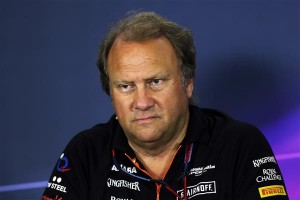
Robert Fernley at the FIA press conference on Friday. A Sahara Force India image -
Sending Formula One into Hybrid-Drive!
The technical revolution of 2014 can be expressed in one simple phrase: the engine is no more, long live the Power Unit! This change in terminology reflects the fact that the new powertrain is far more than simply an Internal Combustion Engine. Where the previous V8 format utilised a KERS hybrid system which was effectively ‘bolted on’ to a pre-existing engine configuration, the Mercedes-Benz PU106A Hybrid has been designed from the outset with Hybrid systems integral to its operation.
In recognition of the importance of this new philosophy to both Formula One and Mercedes-Benz, from the 2014 Spanish Grand Prix onwards the team’s F1 W05 racing car will be rechristened as the “F1 W05 Hybrid” and will carry the Hybrid branding featured on series production Mercedes-Benz cars prominently on the engine cover.
“Mercedes-Benz has been at the forefront of automotive innovation since the invention of the first automobile by Gottlieb Daimler,” said Toto Wolff, Head of Mercedes-Benz Motorsport. “This pedigree includes over a century of motorsport involvement, which has provided a testing ground for some of the brand’s most significant breakthroughs.
“What we are seeing in Formula One today is the next generation of innovations that will eventually find their way from the race track to the road. Mercedes-Benz is leading the way in promoting the positive new direction the sport has taken.”
Of course, while the Hybrid systems introduced for 2014 are altogether more far-reaching, the idea of the engine as a standalone source of propulsion in Formula One was consigned to history several years ago through the introduction of KERS Hybrid power in 2009 and from 2011 through 2013.
For Mercedes-Benz, the association between hybrid technology and motorsport stretches back beyond even that: over a century, in fact.
The early experiments of Daimler chief engineer Wilhelm Maybach focused on combining the gasoline engine with alternative drive technologies in the early 1900s, but the company’s first true hybrid was the Mercedes Mixte, employing a serial hybrid drive incorporating a gasoline engine and a dynamo that converted the energy of the engine into electric energy: subsequently supplying power to two wheel hub motors on the rear axle.
To demonstrate its performance, a Mixte race car was developed before the end of 1907, with a 30 / 55 hp engine powering the generator and wheel hub motors that transferred the electric energy to the road. 102 years later, the Mercedes-Benz KERS Hybrid system powered Lewis Hamilton to the first ever Hybrid Formula One victory at the 2009 Hungarian Grand Prix.
During the early development phases of KERS in 2007, the system weighed in at over 100 kg and worked at a thermal efficiency level of 39%. By the end of the 2012 season the units weighed just 24 kg and were capable of 80% thermal efficiency levels. In other words, Formula One development enabled a twelve-fold increase in power density from KERS systems: the impact of which has filtered down into Hybrid systems used by the everyday motorist.
The perfect example lies in the Mercedes-Benz SLS AMG Coupé Electric Drive: with lessons learned during development of the high-power-density F1 KERS Hybrid flowing directly into the technology at the heart of this ground-breaking vehicle. The battery solution for the all-electric supercar was developed with Mercedes AMG High Performance Powertrains (HPP) in Brixworth, delivered 740 hp, an incredible 1,000 Nm of torque and set a new benchmark for energy density. All of which added up to a 7:56 record lap of the Nürburgring Nordschleife!
This rate of development has historically come as something of a by-product to the ultimate goal of faster lap time. For 2014, however, this has fundamentally changed. “Formula One is the pinnacle of automotive innovation. As such, it has a responsibility to push the boundaries of technology,” explains Toto. “The new regulations not only encourage this innovation but also align the sport with the direction in which the automotive industry is heading. As a works manufacturer team, we are perfectly placed to reap the rewards of aligning our racing activities with the future technology path for series production. Formula One always has been about pure racing – and it still is today. At the same time, we’re now back at the cutting edge of technology and pioneering new solutions. That’s a huge positive step for the sport.”
eom/Mercedes F1 team
Mercedes gets Hybrid branding for F1 car ahead of Spanish GP! A Mercedes AMGA Petronas image release
-
We need to take bigger steps than what other teams do: Alonso
DRIVERS – Max CHILTON (Marussia), Kevin MAGNUSSEN (McLaren), Daniil KVYAT (Toro Rosso), Sebastian VETTEL (Red Bull Racing), Fernando ALONSO (Ferrari), Pastor MALDONADO (Lotus)
PRESS CONFERENCE
Daniil, can I start with you? Three points finishes, one 11th place, you must be quite pleased with the way things have started in the first four races?
Daniil KVYAT: Yeah, it’s going quite OK now. A bit of a shame not finishing in the points in Bahrain as well, but anyway you have to learn from something. So far we’ve been a bit on the limit of the points zone, but I hope that we can make some good steps and become even a bit more competitive, so we can take points a bit more easily. It would be a really good step but we are working hard together and soon it will be reachable.
So the story so far is that Jean-Eric Vergne your team-mate is three-one up on you in qualifying but you’re ahead of him in races. He’s had a few reliability issues in races but how do you see the balance between you, and your own progress?
DK: I’m not really looking too deeply into these scores and so on. We’ve been quite close. Don’t forget that Jean-Eric is a very fast driver and he’s in the peak of his shape probably now. Also very experienced. In the wet I have to admit he was very fast so far and in Bahrain it was a dry quali. Of course, he’s also been having a bit of issues. But in China it was a very good balance. I was quite happy in the race. I was quicker than him at that point but in the end we have to see in the future races.
Max, coming to you. The run continues: 23 consecutive finishes in your Formula One career, two 13th places so far this season, are you proud of what’s been achieved so far?
Max CHILTON: Yeah, I am. Last year it wasn’t a perfect season but lots to take away from it. I remember someone asking me in me in Monza, I think, saying: ‘you’re 10 races in, that’s a good little record you’ve got going there’. And then I broke Tiago [Monteiro’s] record, which was 16 from a rookie start, and we though it would be nice to get to the end of the year, which we did. Credit to the team; that’s pretty good for a small team reliability-wise. And we’re four races in now and we’ve carried that on. It’s not our main goal, but where we are it’s absolutely crucial to finish the race as I’ve shown this year with the two 13ths. We did have good speed but we had to be there at the finish to make sure those results counted. So we will try to keep it going but our main focus is to try to get a bit more speed out of the car and myself.
Apart from Malaysia, in the races where you and Caterham have both finished Marussia has tended to be in front of them. Can you say a little bit about how you see that battle and also about how close you feel you are now to the teams in front of you?
MC: We’ve always had a good battle with Caterham. They kind of hold back sometimes, I think, in practice and qualifying and surprise us in the race. But I think this year, to me, our car is definitely better. We’re developing well. We’ve brought some good updates to here. I’m not sure if they have or not. It would be nice if we could push forward. Sauber hasn’t been too far ahead of us and we’ve been battling with them in at least the first few stints of the race and so… yeah, I guess you’ve got to focus on the cars in front, there’s no point in focusing on your mirrors, so we’ll try to improve our results this weekend.
Thanks for that. Coming to you Pastor. Obviously you’re a former winner here in Barcelona. Lotus in Q3 in qualifying in China, running in the top 10 obviously. How would you describe progress within the team?
Pastor MALDONADO: It’s clear that we have been progressing quite a lot in the last couple of races. Still maybe we were not at 100 per cent but we’ve been working really hard. Hopefully here with a bit more time, putting everything together we can be much more competitive and we can fight for good places. This is our main focus at the moment and I think we can. We have a good car, a good team. We have been not good enough with all the new engine system at the beginning but now it seems to be more clear in terms of technology, you know, controlling all the systems in the car and hopefully from this race to the end of the season it will be much better for us.
We’ve heard about a lot of new parts on the car this weekend and also power unit upgrades from Renault. What are you expecting and what are you expecting from yourself this weekend?
PM: I’m expecting to have no problems, a competitive car, and do my best. I the past I’ve been quite good here, so I think as soon as we manage to solve all the problems we will be back to fight for good places.
Sebastian, Red Bull have announced that you have a new chassis this weekend, so I wonder if you could share with us what’s in it, why do you need it? Obviously, we’ve heard you saying that you don’t feel that the car was talking to you; maybe you’d like to elaborate on that. So, what are you looking for from this car and how close do you think you’re getting to finding it?
Sebastian VETTEL: I think we concluded after China, where we were quite a little bit behind to change the chassis, so actually it’s not a new chassis, it’s an old one that we used in testing in the winter, and we have some experience with it. It’s more a sanity check rather than a real problem with the other chassis. So it’s just to try everything we can and basically reset and start again. Obviously there is still a lot of work ahead of us, as I mentioned after the first couple of races, maybe I’m not as happy as I want to be but it’s a long process, a lot of things have changed and I think we need to be patient.
Kevin, two-all versus Jenson, you personally have been three times in Q3, so Saturdays are going OK, but it’s been a rough couple of grands prix, the last two for you. Tell us about that?
Kevin MAGNUSSEN: Well, I think I’ve learned a lot. It’s been good in many ways as well. Obviously we’re not where we want to be and we need to keep working really hard to get there. But I think I have learned a lot and there have been many positive points to take away from the last two races. It’s no secret that we are not where we want to be; it’s not that we’re happy or that I’m happy. We just need to work hard, keep working hard. The team is doing a great job. They are staying positive, although they are not happy with the position. They are staying strong and keeping the fighting spirit up. So, yeah, I’m pretty happy with how things are going in terms of the progress we’re making.
It’s unusual for McLaren to have two races where you score no points with either car. How has the team reacted to that internally?
KM: Well, in Bahrain I think we would have scored points. China was not good for us. It was a bit of a shock how far off the pace we were but again I think we learned a lot. We know China is probably the worst circuit for us at the moment, but we’ll just see how it goes here.
Fernando, a two-time winner here, winner last year in a Ferrari. Tough start to the season clearly but third place last time out in China. How much encouragement has that given you and the team, and how big a step have you brought with you here this weekend in terms if updates?
Fernando ALONSO: The China result is a boost for all the team – extra motivation to keep working hard. As you said we are not in a position we are happy with. We start with some deficit to the top teams, especially Mercedes who won the first four races and is dominating now with good margins, so we try to decrease that gap and we try to get closer and closer. To do that we need to make bigger steps than what the other teams will do. For here, to be honest, we need to wait and see. I think the characteristics of the circuit will help us a little bit, with not too big straights – only one here on the finish line. About the new parts, we bring some new parts but nothing out of this world. I don’t think we will be different compared to any other top team in terms on what we bring here, or even less. We need to see. As I said, track characteristics are the biggest help we have here.
PRESS CONFERENCE
Q: (Mathias Brunner – Speedweek.com) Sebastian, not to use the same chassis again, how much of a ‘black cat’ decision was that?
SV: Not really. I think it’s not unusual to change chassis, generally. Obviously if you change, you change to a new one, but we decided, as I said before, to change back to an older chassis just to make sure nothing is wrong. Just to see, or basically change the things that you can, to have a reset and try again. We don’t think that there was anything wrong with the old chassis but nevertheless we decided to change, so if so we should get an answer this weekend.
Q: (Jackob Melgaaro – Metro express Denmark) For Kevin, how do compare the car after the break to the car you drove at the last grand prix and how do feel about this track in Barcelona?
KM: We don’t know how the car feels, we haven’t driven it yet since the last race, so we’ll have to wait and see. I don’t expect it to feel a lot different. We are bringing a few new parts but nothing that is going to change the world. This track is the first track on the calendar this year that I’ve been to before, so that’s nice. It’s nice to be in Europe again, so feeling a bit more at home. So I’m looking forward to it.
Q: (Manuel Franco Peral – Diario AS) Fernando, podium is a real goal for you here in Spain?
FA: No, I don’t think so. We cannot start the weekend thinking to be on the podium. Or thinking to win the race. That will be creating… y’know, false targets to everyone who will come here. We finished ninth and tenth in Bahrain, we did podium in China because we had some things putting together on that Sunday but it’s not that we are in a position now to say we will fight for the podium here. We will do our best but we know it is going to be a tough weekend and it’s not going to be easy. But, you never know, this is sport and anything can happen but today, sitting here, if I tell you that I will fight for the podium, probably I will lie to you and I don’t want to do so for all the people coming.
Q: (Renan Do Couto – Warm Up) Question for Fernando. Fernando, after four races this season Kimi has only 11 points. At the same point last season Felipe Massa had 30 points. Does it show that Ferrari need much more than a driver-change to get back on the title fight?
FA: I don’t know really. We are not in a position at the moment that we expect. We thought to be more competitive and we struggle, as everyone sees, at the start of the season. I think it is the same for all the teams that we are facing some problems, apart from Mercedes, they had an easy four races, four wins. But, you know, we will work hard. We will work hard to come back in a better position and the start of Felipe or the start of Kimi was not the best in terms of points but I think hopefully soon they will be close to the podium or to the victories and we, both Ferraris, can score many points for the team.
Q: (Ralf Bach – Sport-Bild) Question to Fernando. When I listen to your, let me say, remembrance from China, between the lines I could hear that maybe the driver was better than the car in this weekend – or on the Sunday?
FA: I think the car is always what it is. The car never changes. The driver, also, sometimes you have better luck, sometimes you have worse luck. In China, for example, I have a crash at the start and nothing happened to my car and I could finish the race. I think the Red Bulls, they were fighting a little bit, they lost a little bit of time and I could be there. My pitstops were very quick. In the first stop I overtook Sebastian in that lap, so there were many factors together that put us on the podium. But, y’know, we need to do very special weekends to be on the podium and China was one of those. Lucky. And some other factors. So arriving here, sitting on Thursday on the next press conference. To repeat that podium will be unbelievable. But it’s not, at the moment, our main target.
Q: (Vladimir Rogovets – Sb Belarus) My question is for Sebastian and Fernando. You are the champions. How long can you work without first place in the podium?
SV: Well, I think – and Fernando will probably say the same – we’re here to win. I’m not coming here to finish second or fifth – but you have to be realistic and the target is always to get the maximum out of yourself, out of the car, out of the package that you have. And you can get a lot of satisfaction if you achieve that. So, it means basically if a podium is in reach or P5 is the best you can do then you need to ensure to become fifth. If you then become seventh it is not satisfying. But surely, ultimately we are here to win. That’s the target but obviously you know much better what’s going on inside your team and how competitive you are. So yeah, there’s a lot of things that need to come together. Right now, obviously, we have Mercedes in a very, very strong position. Difficult to beat but never impossible.
FA: Unfortunately I have a lot more experience! So, yeah, there is nothing really you can do apart from try to do the best job you can and try to find different goals. Obviously we are here all to win. My last win was last year, here. So it’s one year without victories. I would like not to have that long period. On the other hand, we are 22 drivers on the grid and maybe 20 are in a worse position than me. So, I cannot also be… y’know, blaming my luck for that. I’m extremely lucky and a very privileged guy, so, you need to keep working and if your boss is happy with you, that’s something very important.
Q: (Andrew Benson – BBC Sport) Sebastian, Christian said in Autosport today that you are extremely sensitive to rear stability on corner entry. But that was… last year you were using the rear instability to turn the car into the corners. Can you explain what it is about this year’s car that you don’t like and why you’ve not been able to adapt to it so far?
SV: Well, I think generally we all have our own style to how we like to drive the car, how to set up the car. I think in general I don’t mind when the rear’s moving so I don’t mind suffering or having oversteer in the car. But if it is too much obviously if it starts to bother you when the car slides too much, then you find yourself correcting more than actually being able to push or get the maximum out of the car. And, yeah, it slows you down. I think that has been part of the problem so far. There’s lots of reasons behind it so it would be nice to have just one problem and one fix for that but obviously it got a lot more complex this year. There’s a lot more factors than just the car setup. So yeah, we’re still learning a lot. We did already a lot of improvement but there’s still obviously a lot to do. But I think generally you never change your… the way you like to drive a car or your style I think doesn’t change.
Q: (Cristobal Rosaleny – Car and Driver) Question for Sebastian. You’re changing now chassis. You have spent four races with problems behind Daniel Ricciardo. Do you feel this time you have lost is a bad thing for you for your own progress during the season and could affect the rest of the season for you?
SV: Surely if I had won the first four races it would be better for my season that what I did! Yeah, it is what it is. There’s two ways. You can always look back and try to find something to complain about – or you can look forward. And I think in general we are trying to look forward to the next race. There’s a lot more races this year to come and for sure we didn’t score as many points as we hoped. But then again after winter testing I think we were in a very bad position. I think right from the first race it was probably better than what we initially expected. Lots of positives with Daniel’s podium in Australia – which obviously got taken away – but then the podium in Malaysia showed that we are on the right track but knew, just reading the feeling inside the car that it’s not yet where we want to be. And you also see that in the results. As I said, there is a lot of work but I think we are generally quite good in getting the maximum out of the car. At the moment there’s a couple of things that we need to get on top of and then it should be a different story.
Q: (Daniel Johnson – Daily Telegraph): Seb, looking forward it’s no secret that your car’s good in the corners but not so good at the straight bits in between. How much are you and the team – particularly considering it’s the start of the European season – relying on Renault to make a big step forward for you to mount some kind of a championship challenge?
SV: As you mentioned, it’s not a big secret. If you look at the sector times or comparisons that we have available, we currently lose out too much on the straights – but there’s always hope, obviously. Again, you have to look at it from the start. Where we started in winter testing was unfortunately way, way off compared to where we wanted to, in all means. Talking about the car, we set fire to the car nearly every run. Talking about the engine, obviously we were not on the same page that we expected to be, both in terms of reliability and performance. So, since that, I think we had a very, very strong comeback but obviously you miss that time of development. But I think there’s always hope. Just look at Ferrari, for example, the last race, the step that they did was mostly in straight line. I think they got a better fuel and picked up around 7kph on the straights. So… we know that our disadvantage is more than 7kph to the Mercedes which are currently the benchmark down the straights but things can change quickly. We need to make sure we push 100 per cent on the car and also on the engine side. In the end we are a team: Renault and Red Bull Racing, so both parties know that we need to push very hard to make sure that we beat these guys and also the currently strongest team with Mercedes.
Q: (Graham Harris – Motorsport Monday) Sebastian, you’re changing chassis at this race, why not a new chassis? And the second part: does the chassis have a name?
SV: Same as before. It’s not that much of a black cat, I hope.
Q: (Carlos Miguel – La Gaceta) Fernando, this morning Toto Wolff said that you are a real race monster. He said that Ferrari is the biggest enemy in the championship; what do you think of these words?
FA: About the monster, it depends how you take it. At least he’s a man. If it was a woman who said that I was a monster it would be even worse. We need to do it step by step. As I said, we need to be realistic with the position that we have. We will not give up, there’s a big gap and a big gap in points and in performance with Mercedes but there’s still a long way to go in the championship so we will try to do our best. As a team, and with the potential that Ferrari has, we must do anything we can to close that gap and to become competitive. That will not happen between one race to the next one, that will be a slow recovery and hopefully not too late when we become competitive in terms of points to fight for the championship but let’s do it race by race. China, as I said, was a combination of things and very good luck to get that podium. Here in Barcelona, it’s a good point to check how competitive we are, because it’s a circuit with different characteristics again and a circuit that will give us an answer in some of the parameters and some of the areas that we need to find some answers. Monaco is the next one, then Canada – again a completely different circuit so we are in a moment of the championship that will tell us many many things in terms of how competitive we can be and how much of a threat we can be for Mercedes. If they count on us for the championship fight, it’s good news because they respect us but we need to deliver if we want to really become a threat, so we are on that, that work.
Q: (Silvia Reneé Arias – Parabrisas) Fernando, I want to know if you find any change in the Ferrari team after Stefano Domenicali left?
FA: Not really. At the moment, everything is more or less the same. I have been in Maranello last week. Everything is calm and no big changes, nothing really that you’re going to spot that is different at the moment. As I said in China, Marco (Mattiaci) arrived – as we said – with little experience in motor racing, a lot of experience on the managerial side but he’s listening, he’s learning as quickly as he can in everything. I don’t think Marco wants to become an engineer because that’s not his priority at the moment but he will need some time to settle down and to make some changes, some decisions if he thinks they are needed. As I said, in the two or three weeks that he’s in the job, nothing has really changed at the moment. He needs more time.
Q: How much are you guiding him; how much are you contributing to that?
FA: We had some meetings, obviously, to try to help him in all the areas. He’s quite interested to listen to everyone. He called all the engineers and all the engine side, electronics, the drivers, we are going to his office and try to explain all our points of view and all our requirements. As I said, he’s taking note of everything and he will make the necessary changes, what he thinks is best for the team. Hopefully that’s a good thing for Ferrari to move forward and to improve some things, some historical mistakes that we’ve made in the past and we will see if this fresh approach… and not influence about any technical things because, as I said, he’s not an engineer. Hopefully that will help Ferrari.
Q: (Valenti Fradera – L’Esportiu) To all of you: the circuit Barcelona Catalunya used to be the venue of choice for pre-season testing but this year you haven’t run here yet. Will that change how you approach the weekend, and will we get to see more laps than usual tomorrow during free practice?
PM: Even without any tests, it will be same approach as the other tracks, for sure. I was quite interested to run before this season, because it’s a good track, a good combination of corners, good weather but it’s what we have so it will be the same.
MC: Yeah, it will be pretty similar. Obviously when we’ve come here in the past we’d pretty much know the ideal set-up for the circuit. Obviously the cars have changed drastically since last year so there will be a lot more to find out now we haven’t done any pre-season (testing) here. And we’ve now got the extra set(of tyres) in the first thirty minutes of free practice which we can use so there will definitely be more laps completed but if you compare it to China, for example, it won’t be any different.
Q: Kevin and Dan are obviously rookies (in F1) but you’ve got personal experience of this circuit, even if it’s not necessarily in Formula One.
KM: I don’t think it’s going to be a lot different – the approach to this weekend than the other weekends. Personally, I like this track, I think it’s a good track, the mix of corners. As I’ve said before, it’s a track that I’ve been to a lot of times, so it’s nice to feel at home here but other than that, it’s just a normal weekend.
DK: For me as a driver I don’t think it’s going to change a lot compared to other years we’ve been coming here. It’s my first time here in Formula One as well so let’s see how it will start going tomorrow.
SV: I don’t think it makes a difference. We didn’t run in Bahrain. I think that even if we had had the test here in the winter it would make a difference. But usually it’s quite cold in winter time, so when you come here in May it’s quite a big difference, so you need to use the time that you have available in free practice, but I don’t think we can run as much as we’d like to because we’ve all got the safety… the engines. We will see, but for sure the running tomorrow will be important.
FA: Nothing to add, really.
Q: (Livio Oricchio – Universo On Line) To all of you: when you have one driver from a team that has a car that is winning everything – like Mercedes – and your team needs to win three times in a row (to catch them up), how does it work for teammates? For example, the guy who is behind, does it stimulate him to try to win or does it work in the opposite direction?
FA: Yeah, I said waiting for Rosberg. I don’t know really. For this, when it happens, it was a question for Mark last year, when Sebastian won nine times. For Rosberg now. It’s not so difficult to know what you’re experiencing. Probably I will answer because I will have the experience, but now… of course, I think Rosberg would like to win, that’s for sure.
SV: I would hate Lewis now, if I was Nico.
PM: I would hate Lewis as well. It’s a difficult answer. For sure, you always want to beat your teammate, you always want to do your best and to be ahead of your most close contender. For sure, it’s not ideal to always be at the back but in my opinion, they are both competitive, sometimes one is quicker than the other and sometimes it’s vice versa. It’s a difficult answer because it depends about any driver.
MC: It would be nice to be in that position, obviously. It’s hard to beat someone who never gives up and Rosberg, I’m sure, will never give up. I’m sure he will get his fair share of wins back. Sometimes if you’re constantly winning you sometimes let things slip so if you just make sure you just keep giving 100 percent, he will definitely get other race wins.
KM: I don’t have anything to add.
DK: I don’t want to talk for others but if I have to talk for myself there’s never a huge friendship between teammates so I think you always want to be in front of everyone and there are some circumstances, sometimes if you’re teammate is in front of you, it means that there is something that you can maybe do better but once again, there are different circumstances.
ends/FIA release
-
Sahara Force India is very hungry and we are performing better: Nico Hulkenberg
Vijay Mallya sums up the fly-away races and sets his sights on more success in Europe.Vijay, 54 points from four races and Sahara Force India is third in the standings. The team’s best ever start to a season continues…“I think we can feel extremely satisfied with our performance during the first four races. We’ve been in the points in every race, Sergio has been on the podium and Nico has finished no lower than sixth place. We’ve already scored 70% of the total points we scored in 2013 and that puts us in a fantastic position to potentially enjoy our best season to date.”What are your expectations for Barcelona and the other upcoming tracks?“It’s encouraging that we have performed well across a wide range of circuits, so I’m optimistic that we can maintain our competitive form in Barcelona. China has never been an especially strong track for us, so to come away with ten points was a very good effort. We also expect our car to perform better in warmer conditions and there are some upcoming races that will play more to our strengths. At the same time we know that Formula One never stands still and Barcelona is always a pivotal moment in the development race, but I’m optimistic we can keep up our momentum.”It’s going well off the track as well with the team announcing a significant partnership with Smirnoff last week…“It’s an exciting time for us. Smirnoff is another global brand keen to be part of our journey and ready to take advantage of the marketing power offered by Formula One. The partnership means we have now signed ten new partners in the last six months and that has made a vital contribution to our competitiveness this year.”Driver’s View: Nico HulkenbergNico Hulkenberg looks forward to another strong showing in Barcelona.Nico, fourth in the standings after four races – an ideal way to start the European season…“I’ve enjoyed the first part of the year. It’s probably gone better than we were expecting after winter testing and it’s good to keep picking up the points. I’m fourth with 36 points and I think that’s a big achievement. The car has worked well everywhere and we’ve made the most of the opportunities. Consistency is surely one of our strengths at the moment.”Has the strong start to the season changed the attitude inside the team?“I think this team has always been hungry and that’s still very much the case. We’re up in third in the championship and we want to stay there. The hard work over the winter is paying off, but we know that Formula One is always a development race and things can change from one weekend to the next. So we need to keep working hard to maintain our good position.”Barcelona next, do you expect this track to be a challenge?“Even though we know the place inside out, it remains a tough, tricky circuit and one of those places where it’s especially important to optimise the car balance. If you don’t feel totally comfortable with the car it really hurts your laptime. Barcelona is the true test for downforce because of the quick corners in the first and second sectors. Traction is also important in the final part of the lap with the low-speed corners and we should be strong there.”Driver’s View: Sergio PerezSergio Perez prepares for the start of the European season in Barcelona.Sergio, Formula One is heading to Europe – are you feeling ready for Barcelona?“I love coming back to Europe to race on some of the classic circuits. I enjoy Barcelona and for me it’s one of the best circuits on the whole calendar. It’s very complete with a mix of everything and some very long, quick corners. It’s tough physically, especially on the neck with so many right hand corners, but it’s a fun place to drive a Formula One car. It’s always a race where teams bring new updates so it’s going to be interesting to see how everyone will perform there.”You’ve had four races as a Sahara Force India driver – are you happy with how things are going?“On the one hand I’m happy. The podium in Bahrain was very important; it helped me get to know the team properly and gave us all something special to celebrate. At the same time I feel there is more to come and that we’ve yet to achieve our full potential. Bahrain has been the only weekend where everything has worked out perfectly. If we can have more weekends like that I think we can get some more great results.”Are you enjoying the racing this year? Is it more challenging than you expected?
“It’s not any harder or any easier than last year; it’s just different. The grip has changed and the sound is different, but it’s still a Formula One car and the competition element has not changed a bit. It already feels normal to me after just four races.”eom -
The fans have been incredible this week: Lewis Hamilton after his hat-trick
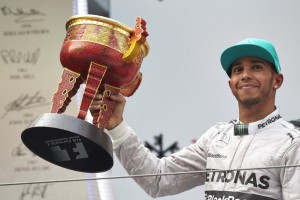
Hamilton with the cup after winning the Chinese GP. A Mercedes AMG Petronas image DRIVERS
1 – Lewis HAMILTON (Mercedes)
2 – Nico ROSBERG (Mercedes)
3 – Fernando ALONSO (Ferrari)
PODIUM INTERVIEWS
(Conducted by Martin Brundle)
Three consecutive for Lewis Hamilton – how about that? Great stuff, Lewis. That looked, from where we were sitting, incredibly easy. How was it for you?
Lewis HAMILTON: Ni hao. The fans have been incredible this week, so I really felt a lot of energy but I really couldn’t do this without all the hard work from the team, it’s incredible. Honestly, I just can’t believe how amazing the car is, and how hard everyone has worked. The results we’re getting is a real true showing of all the hard work.
Absolutely incredible. You were radioing in and saying ‘my tyres feel good’ and everybody else was screaming to come into the pits. The first stint was just beautiful for you.
LH: Yeah. Surprisingly, again, as I said, after P2 I had to make a lot of changes in anticipation of today, even though yesterday was wet, but it worked perfectly and I was able to look after the tyres. After that I was just really racing myself. I did lose a lot of time after the first stop but still it was great. I am really happy that Nico is up here with us, it’s great points for the team and they really deserve it.
You had one little trip off the circuit, obviously when the front tyres were finally going away. A little fright there for you?
LH: No, no, fortunately there’s lots of run-off area. Basically the left front is the one that’s graining and wearing and I’d gone quite a lot longer than I’d planned and eventually the tyre was dead so I locked it, but it was OK and I recovered.
Nico, you still lead the Formula One World Championship so some consolation in that respect?
Nico ROSBERG: Yeah, definitely. That’s there. I’m not going to use the word still because I plan to keep it that way. Definitely in the lead and that’s good. Especially considering that the whole weekend was really, really bad for me. It went completely wrong in so many different respects. Also, in the race we had no telemetry so there was no communication between the car and the pits, so they had no idea what was going on on track and that’s why the start was also so bad and a lot of things came together. So I’m pleased with second and I just look forward to a normal weekend again in Barcelona, full attack again.
Yeah it was a bad start. Take us through that first corner when you had contact with Valtteri Bottas in the Williams.
NR: It was just very close, there were cars all over the place. Just had a bit of contract there and it was great that my car held on.
Then you had to make your way back through the field. You had a little bit of fun coming through?
NR: It’s really a pleasure to drive this car at the moment. It’s incredible the car that the team has built – fantastic. So thanks to the whole team. And Mercedes. This thing is so quick. It really increases the enjoyment level even further.
Let’s talk to Fernando Alonso, third for Ferrari. I know there are a lot of Ferrari fans out there and of course Fernando Alonso fans. Fernando, you beat the Red Bulls and you’re third only behind the Mercedes Benz cars. You must be really satisfied with that.
Fernando ALONSO: Hello everybody, first of all. It was a good weekend. We did improve the car a little bit compared to the first three races, so we felt more competitive and now in the race being here on the podium is some kind of surprise for us, a nice surprise finally. Happy with a podium finish today. I think I’m third in the Drivers’ Championship behind these two guys. So we didn’t have the start of the season that we would like but at the end of the day we’re still in the fight.
Just briefly you had a big contact with Felipe Massa going into the first corner. You were lucky [there] with no suspension damage.
FA: Yeah, it was a big contact. I asked on the radio ‘can you check the car’, because it felt OK but I don’t know how it looks from the outside, but it was OK and we managed very lucky to finish the race and hopefully next one it will be a clean start.
Lewis, we’re back to tracks you know well, obviously Barcelona, you’ve got some testing coming up. Surely you can’t keep improving this car?
LH: Well, this team is a on a roll that’s for sure. The team have done a great job, as I said. We’re going to keep pushing; we’re going to keep moving forwards. That’s what Mercedes Benz want to do. They want to keep moving forward, developing, hopefully improving the engine, also the car. But as I said, I’m going to be working hard, we’re going to keep working hard because obviously the others are pushing to catch us up. So I hope it continues.
PRESS CONFERENCE
Q: Lewis, congratulations, a three-time winner here. How does that feel?
LH: It feels incredible. I just have to shout out a big thank you, thank you so much to the team, firstly for embracing me into the team last year and for all the hard work and for them continuously pushing forward. I really hope that the guys back at the factory are enjoying this and really have a great week. I’m so, so happy. I had such a great race, really enjoyed it, particularly the last few laps, y’know? Really trying to keep temperature in the tyres, pushing a little bit more, just to keep temperature up and the car was great.
Q: You spoke about the work being done in FP2 and then of course the car was good enough for pole in the wet and then good enough to win in the dry. How perfect was it?
LH: The car was really good. As I said, made lots of changes overnight on Friday night and obviously it was wet for qualifying. So I didn’t get to feel… I didn’t know what it was going to be like today. And really just that hard work sitting down with the engineers, really choosing… we didn’t guess, we really made those steps in anticipation for today and it worked perfectly. I couldn’t really have asked for more.
Q: The only really big surprise I guess was getting the chequered flag a lap early – which could have tripped you up.
LH: That was very strange! I was thinking ‘am I seeing things?’ I looked up, I was coming across the line expecting to do another lap and all of a sudden I looked for a split second and I saw the flag, I lifted for a second and I saw there was no-one on the wall, so then I just kept going. I did lose a second or so. I asked the team, they said no, so I just kept going. Very, very strange. It was good to do another lap.
Q: Nico, you said so many things went wrong. What was your set-up like from Friday FP2 though to the race itself?
NR: It was all OK. Set-up-wise it was a good team effort this weekend. Because it’s a very unique track here with the understeer being the main problem and the front-left tyre, so you really have to change everything, adapt to the needs of the track and we did well as a team. It wasn’t perfect in the race but it was definitely… pretty good.
Q: As you played catch-up from the start you could really see what your strengths were in comparison to other cars.
NR: Yeah, definitely. We have the best car, y’know, and that makes it more enjoyable then to do catch-up, even though of course don’t want to do any catch-up – but I was back there so then catching up was nice with this fast car. It’s a good weapon.
Q: Then we heard you not entirely happy giving a fuel report every lap.
NR: No! My telemetry failed, yeah? So I was completely on my own out there. The team then never… doesn’t see any information from the car, so they have nothing to do. Er… well not… they do have things to do! So I had to do all the things on my own out there and, for example, it was then telling the team what my fuel level is so that they could judge if I was using too much fuel or if I’m safe – and I had to do that in Turn One y’know and Turn One is a difficult corner anyways, so yeah, didn’t enjoy that point.
Q: Fernando, first of all, first podium this year for Ferrari, how satisfying is that?
FA: It is. Obviously we had a difficult start of the season with some lack of performance in the first races and, y’know it’s good to be on the podium here on the fourth race after a not-easy weekend with changeable weather conditions and a difficult race as well, as Nico touched on. I think with the tyres, being a unique track with the front graining that you need to take care, plus some actions because we were not alone on the race. We managed, I think, quite well to get this podium and this is hopefully some boost of the team and some extra motivation y’know, to keep improving and to do even better in the next couple of races.
Q: And again, the set-up from FP2 to the race, how good was that?
FA: I think we make very few changes to be honest, from FP1 to now in the race. We brought some new parts here, a small step that probably we are a little bit more competitive now and we concentrate on Friday testing those parts and not much set-up work to be honest. Yesterday on the wet conditions, now in these days it’s not much to do, wet to dry anyway, so, as I said, the setup, my feeling was quite OK from Friday to now.
Q: The podium here, what can you promise your home fans at the next grand prix at home?
FA: We need to see. We need to remain very calm. It has been a very unique race, we make a step forward. We were ninth and tenth fifteen days ago and that was hard, pain a little bit. So, yeah, we need to remain calm. We are happy, we need to enjoy the result today but still a long way to go and we cannot promise anything for Barcelona. We will give 100 per cent again and we will fight – but in terms of result we need to remain very calm and see how development is these three weeks if we can bring some extra new parts for Barcelona.
QUESTIONS FROM THE FLOOR
Q: (Michael Schmidt – Auto, Motor und Sport) Nico, when you said that you had to report your fuel consumption or fuel level to the pit lane every lap, why is that? Wouldn’t it be easier that you saw on the dashboard a plus or minus and then you could drive on your own rather than talking to your pits?
NR: Yeah, you’re right. Just that I didn’t have that function, probably because we don’t really need that normally. It’s fine like that, it’s just reporting once in a while to the paddock. It wasn’t every lap, you know, it was just once in a while so they can put a few dots and see where it’s going. That’s it. So that wasn’t a problem at all, it was just that I didn’t like where I had to do it because it was in turn one and that was not good.
Q: (Flavio Vanetti – Corriere della Sera) Fernando, you said several times that Ferrari needs a global improvement but is there a priority in this situation, to try to get closer to Mercedes?
FA: Well, of course it is a priority, we need to close, we need to catch them as soon as possible before the championship is over, so we need to keep scoring points, as many as we can now that we are not super-competitive, try not to lose too much ground on points in the championship, and if in one race we become as competitive as them, try to catch up in terms of points. At the moment, it seems very far away because they have a big advantage and we need to work really hard if we want to have that possibility. There is nothing really special we can do, just don’t give up; we’re in the fourth race in the championship, there ‘s still a long way go but being super-realistic, knowing that the gap is very very big it’s going to be very tough.
Q: (Livio Oricchio – Universo On Line) Fernando, how can you understand this race? In the last one, you finished a long way behind the Mercedes; this time you were seven seconds behind Nico. Is it the characteristics of the track or the new parts that you brought that has made the car so fast?
FA: I think it was a combination. As I said, we brought new parts that feel a little more competitive – the car feels a little bit faster – we also tested in Bahrain, they felt OK and we confirmed that here. On the other hand, I personally have had an extremely good weekend, probably at the level of 2012 in terms of driving and feeling comfortable with the car, qualifying, Friday, today. In Bahrain, we were one minute behind the leaders, ninth and tenth and today we are on the podium, seven seconds behind Nico as I said, but Kimi’s one minute behind the leaders. I think it’s a combination. Hopefully I can keep going like this. I felt more comfortable with the car and we will not give up.
Q: (Alexander Aucott – China Radio International) Lewis, you mentioned the support of the Chinese fans on the podium. Have you seen an increase in support over the years here and is it something that makes them unique here at Shanghai?
LH: Every year I come here, I feel that the fan base – at least my fan base – feels like it’s growing every year here. Growing up in Stevenage, I never ever thought that I would fly halfway round the world and have so many people who chose to wear my cap, to wear my top, to have my flag and really support me. It’s absolutely phenomenal, and here it’s maybe my second year, I think, that from the moment I’m at the airport – I don’t know how they know I’m there but they know I’m there – it’s almost like they radio to the guys at the hotel
and when I get to the hotel – I don’t know how they know I’m at that hotel – but they’re there every morning, every evening, day and night and that’s why I always say we win and we lose together. This morning and on the way, one of my fans she gave me like a digital photo frame and on it, they did a special video for me from all the fan base here and for me, it’s touched my heart so much so I want to say a big thank you to all of them.Q: (Luis Fernando Ramos – Racing Magazine) Nico, all the other teams have set their sights on the Barcelona race as their best chance to improve their performance with the novelties on their cars, so how confident is Mercedes that the things you’re going to bring to Barcelona will keep the gap or maybe even extend the gap you have to the other teams?
NR: Hopefully, more than all the other teams; we want to go to Barcelona with the biggest step, that’s our ambition. Barcelona is a chance for us to extend the advantage that we have and that’s the approach that we have going to Barcelona, 100 percen
eom
-
Hamilton wins for the third consecutive time, Rosberg 2nd; Double points finish for Sahara Force India
Hamilton on Friday at Sepang. Photo by Mercedes AMG Petronas F1 team Shanghai, 20 April 2014: Number 44. Lewis Hamilton gave himself a wonderful Easter presentation, a hattrick of wins in Formula One. A few months back before the last season, when he left a strong McLaren andn signed for Mercedes AMGj Petronas, many wondered if the Briton made a mistake chosing a team for money rather than being in the sport to win many more laurels. But the drivers have a sixth sense and that knack of moving to a team which has the potential to win races and that is exactly what happened. He may have been behind teammate, but he has the potentiall and knows what he is capable of… and he proved that this season despite his teammate German Nico Rosberg winning he first race in Australia.
Lewis Hamilton won the Chinese Grand Prix to notch up his 25th Formula One World Championship race to over take one great Niki Lauda and is only two races away to overtake one more legend Jim Clarke in the all-time greats list. Leading from pole to flag the Briton had an impeccable race.
He received the prize on the podium, had a sip of the champagne, after the rose wqter in Bahrain, and then unleashed it on him manager and teammate on the podium before turning to the pit babes for that hint of a pleasure, which he hid this year, with a more mature approach to his racing. Belief is something which keeps you going, he said in Malaysia and he is a more mature and calm in life than ever before. The third consecutive win, the first ever for the Briton in F1, looks good for him to take another World Drivers Championship.
He led the race, for a Mercedes AMG Petronas, one-two. After splashing the grid girls, he poured a bit of champagne on himself and then changed the hat. Pirelli always has the plrivilege of drivers wearing the Pirelli cap during the anthem, and when Hami switched to a Petronas cap, he graciously accepted the cap and the mike from the grid girl and then thanked the team during the podium interview.
For the record, Rosberg came second for the third time but still maintains his lead in the championship, with much lesser 4 point lead, nevertheless.
Ferrari got the first podium of the season with Fernando Alonso in third and both the Red Bulls lining up thereafter with Daniel Riccardio disappointed in not getting a podium. “I was expecting a podium,” he said. But he did beat the world champion Seb Vettel to fourth.
Force India once again did a brilliant job with both the cars finishing in the points. Nico Hulkenberg finished sixth and Sergio Perez came in 9th. So Sahara Force India stands third in the Constructors championship with Red Bull regaining the second place.
Kyvat got his third points finish in the season to take the last place behing Perez.
Kobayashi did an overtake in the fag end to gain a place for his team.
eom/david
-
Hamilton masters wet qualifying for third pole position of the season
Shanghai, 19 April 2014: Lewis Hamilton marched to a dominant Chinese
Hamilton tops wet qualifying for his third pole this year. A Mercedes AMG Petronas image Grand Prix pole position at a rain-soaked the Shanghai International Circuit, finishing six tenths clear of Daniel Ricciardo of Red Bull Racing, who in turn beat third-placed team-mate Sebastian Vettel by half a second.
“It was so slippery out there, trying to find the grip, obviously not making mistakes on your lap, and really putting it together, especially when you have these guys [Red Bull] pushing you,” he said of third pole position of the season so far. “It was a tough session. I really enjoyed it. The car was feeling great. It’s a good position for the race and I hope we can follow through tomorrow.”
Ricciardo edged closest to the Briton in the final moments of the session but the Australian admitted afterwards that he had not got the best out of the session.
“To be honest, I struggled a bit throughout the session, at least personally I didn’t feel like I was getting on top of the conditions,” he said. “But then the last set of inters, right at the end of Q3, we managed to get a bit more out of it and I put a good lap together, so pretty pleased to be on the front row. A good day.”
Vettel, meanwhile, finished just under five tenths behind Ricciardo and admitted that the Australian’s better record in qualifying so far was far from pleasing.
“Daniel is doing a very good job, he has not just had one good weekend, he had good weekends and so far he seems to be able to get the maximum out of the car,” said the defending champion. “On my side, maybe I’m struggling a little bit more, but at the end of the day we have the same car – there’s nothing between cars, so if he manages to beat me, then he beats me on the circuit, fair and square. Of course, that’s not to my liking but equally, I know that I have to do a little bit better.”
Steady rain at the start of the first made wet Pirellis the tyre of choice but as the 18-minute segment reached its final minutes a number of drivers gambled on a switch to intermediate rubber and as the Sauber drivers began to put in good sector times it looked the right move for those who might otherwise be bounced out in Q1.
Toro Rosso’s Jean-Eric Vergne made himself safe by jumping to ninth place (which was eventually good enough for 11th) but Sauber’s Esteban Gutierrez was the man caught out, the Mexican failing to improve enough. He was pushed to 17th and out of the session by Lotus’ Romain Grosjean. Behind Gutierrez, the Caterhams of Kamui Kobayashi (P18) and Marcus Ericsson (P20) and the Marussias of Jules Bianchi (P19) and Max Chilton (P21) were also eliminated. Pastor Maldonado, meanwhile, had already bowed out, Lotus unable to ready his car following the problems that caused him to stop on track during the morning’s final practice session.
Intermediates remained the tyre of choice in Q2 too, with all 16 remaining drivers opting for the green-banded Pirellis. The top of the table took on a familiar look as the Mercedes cars of Hamilton and Rosberg occupied first and third places respectively with the Red Bull of Sebastian Vettel and Daniel Ricciardo second and fourth. Ferrari’s Fernando Alonso also looked solid, the Spaniard eventually taking fifth spot. Behind that quintet the battle for the remaining top 10 places was a fluid affair, largely dependent on the shifting conditions. Late in the segment, Vergne jumped to seventh spot with a good lap but he was the last driver to make a significant improvement and as the rain briefly intensified in the final minute, other failed to make a similar leap.
It meant that Nico Hulkenberg’s earlier lap of 1:58.847 was good enough to see him through in 10th spot, ahead of Felipe Massa, Vergne and the impressive looking Grosjean. However, out went the second Ferrari of Kimi Raikonen (P11), the McLarens of Jenson Button (P12) and Kevin Magnussen (P15), the Toros Rosso of Daniil Kvyat in 13th place and, suprisingly perhaps, the Force Indias of Adrian Sutil (P14) and Sergio Perez (P16).
The left the battle for pole and once again Hamilton was untouchable. The Mercedes driver posted a lap of 1:54.348 with his first run to take provisional pole, with Rosberg slotting into second spot ahead of the Red Bulls. Rosberg then attempted to put pressure on his team-mate but a brief lock-up put paid to that ambition. Ricciardo jumped into P2 with the first lap of his final run but Hamilton’s time of 1:53.864 was untouchable and the Briton claimed his third pole of the season.
2014 Chinese Grand Prix – Qualifying Result
1 Lewis Hamilton Mercedes 1:53.860 21
2 Daniel Ricciardo Red Bull Racing-Renault 1:54.455 23
3 Sebastian Vettel Red Bull Racing-Renault 1:54.960 23
4 Nico Rosberg Mercedes 1:55.143 22
5 Fernando Alonso Ferrari 1:55.637 21
6 Felipe Massa Williams-Mercedes 1:56.147 24
7 Valtteri Bottas Williams-Mercedes 1:56.282 24
8 Nico Hulkenberg Force India-Mercedes 1:56.366 23
9 Jean-Eric Vergne STR-Renault 1:56.773 23
10 Romain Grosjean Lotus-Renault 1:57.079 2211 Kimi Räikkönen Ferrari 1:56.860 17
12 Jenson Button McLaren-Mercedes 1:56.963 17
13 Daniil Kvyat STR-Renault 1:57.289 18
14 Adrian Sutil Sauber-Ferrari 1:57.393 17
15 Kevin Magnussen McLaren-Mercedes 1:57.675 17
16 Sergio Perez Force India-Mercedes 1:58.264 1717 Esteban Gutierrez Sauber-Ferrari 1:58.988 10
18 Kamui Kobayashi Caterham-Renault 1:59.260 10
19 Jules Bianchi Marussia-Ferrari 1:59.326 10
20 Marcus Ericsson Caterham-Renault 2:00.646 10
21 Max Chilton Marussia-Ferrari 2:00.865 10
DNQ Pastor Maldonado Lotus-Renault No time 0eom/FIA release
-
F1, the foremost single-seat racing, should be in the forefront of technology, says Charlie Whiting
TEAM REPRESENTATIVES – Pat FRY (Ferrari), Charlie WHITING (FIA), Yasuhisa ARAI (Honda), Andy COWELL (Mercedes AMG HPP), Rob WHITE (Renault Sport F1)
PRESS CONFERENCE
If we can start with you Charlie? The new power units have excited a lot of debate since the beginning of the year. Will you once again briefly take us through the philosophy behind this technology and why F1 believes it was the right time to introduce it?
Charlie WHITING: I think it was fairly clear, we’re going back a little while now, that Formula One, being the foremost single seat category, should be at the forefront of technology. I think bit was also clear at the time that the motor manufacturers were also looking towards conservation. So we felt we had to go that way. I think to ignore that would have been rather silly. I think we would have possibly lost some manufacturers and certainly deterred others from coming in.
I guess efficiency plays a part in that as well?
CW: Of course that was the major goal. We started four years ago with the engine manufacturers. We had quite big meeting with lots of them assembled in Paris. It was the 27th of April, in fact, in 2010. We assembled them all together and the initial goal was to have a 50 per cent increase in efficiency but over a period of time that became diluted somewhat because it appeared that was rather ambitious for the start of this new engine era. So we ended up with what we have now and that is an engine that everyone can see is about 35 per cent more efficient than the previous engines.
So, Andy Cowell, does that represent a small step in the right direction or a giant leap?
Hamilton tops timesheet in FP2 at Shanghai on Friday. An Mercedes AMG Petronas image Andy COWELL: It represents a giant leap – going from internal combustion engines, naturally aspirated at about 30 per cent thermal efficiency up to engines where we’re all targeting 40 per cent thermal efficiency is a huge step, a huge introduction of new technology both on the internal combustion engine for efficiency and also on the two energy recovery systems that we’ve got on the power unit.
What do Mercedes expect to get from this project in terms of technology that can be eventually transferred to the road? Is that a long way in the future or is it already happening?
AC: It’s already happening. The regulations were specifically written to take some of the ideas are already in the road car world, so downsizing, downspeeding and turbocharging but adding some new, interesting technologies in there such as the electric turbocharger as a specific example and those sort of projects are already being worked on.
Can I ask the same question of Rob White. What does Renault expect to get from this project in terms of road cars.
Rob WHITE: It’s a big leap, as Andy says. I share the remarks that transfers are already happening. The transfers are not only specific technologies, the e-turbo being one of them, but also the fundamental alignment of the mission we have. Our challenge now is to race, to go as fast as we can with the given fuel allocation, which is a very, very similar mission to our road car colleagues who have to use the smallest amount of fuel to get a given mission done and that’s extremely close.
There’s been quite a lot of talk about how the power units are contributing to racing and we’ve heard some unusual suggestions for things might be changed. Firstly, do you think there are problems with the racing this year? Secondly, what do you think of ideas such as shortening races, raising fuel limits etc. Do those suggestions miss the point?
RW: The main problem I see so far is that Andy has won rather more than I’d like and we have win less than I’d like. The specific suggestions are just shifting the goalposts rather than doing anything fundamental and I think as Charlie indicated the basic parameters that we’re now racing with were decided well upstream in sufficient time that we knew what to do with them. I honestly feel that the numbers were well judged and I think the 100kg/h fuel limit and the 100kg for the race, as well as having the benefit of being nice round numbers, also play out more or less as predicted in terms of the level of performance and the level of fuel saving needed to get to the end of the race. I think we’ve seen in the early races that there hasn’t been an excessive amount of fuel saving that would perhaps have damaged the show. I think we’ve seen more recently, particularly in Bahrain… We all enjoyed the race there, it was the first one I saw from the comfort of my living room and it was certainly an exciting one to watch.
Now we’ve heard from two of the manufacturers currently involved in F1 but let’s get the thoughts of a manufacturer that will next year return to the sport after six seasons away? Thank you very much Mr Arai for coming to our press conference. What is it in the new regulations that has encouraged Honda to come back into Formula One at this time?
Yasuhisa ARAI: Thank you very much. I am delighted to be here and to be given this opportunity by the FIA to speak at this conference. As you mentioned we will return in the year 2015 for the Formula One. One of the major reasons for our decision was the new regulation introduced this year and that the various environment… I mean green technologies in the new Formula One power unit, as well as the total energy management are both very challenging and significant. The new regulation encourages each power unit supplier to pursue the ultimate combustions efficiency and high pressure direct injections, such as many, many new technology. Thus the challenge is to convert each unit of gasoline into energy and this is expected to be reflected on the huge production mode. That’s the reason why.
Q: You’re setting up a new base at Milton Keynes in the United Kingdom. What will that facility be responsible for in the coming years?
YA: That, we will open June this year. Now still under construction but that factory is to do the engine maintenance for the races and rebuilding the Formula One engine and also to go to the race-track for the trackside service. That’s Milton Keynes.
Q: Pat, as someone more responsible for the chassis side of things at Ferrari, let’s talk about how you integrate these new power units with the cars. Have you found that the chassis and engine departments have needed to work closer together this year or is the relationship pretty much the same as always?
Pat FRY: I think with the changes to the power unit this year, there’s obviously a huge amount more technology to understand and that has definitely pulled the chassis department and the engine department closer together. That starts everywhere from the simple, basic simulations that you do before an event to tuning the car. Everything is now inter-related. So where you used to play with a diff and brake balance and whatever, you’ve now got all the various ERS levels of charging and deciding what to do with waste gates and turbos. So there’s a huge amount more interaction between the two groups.
Q: Has the engine department given you a power unit on the minimum weight or are you having to shed weight from the car?
PF: We’re fairly close to the weight limit. I’m sure everyone is struggling. The combination of an engine on the weight limit and just all the bits and pieces we want on a standard car, it’s quite a challenge to get down to the weight limit anyway. But yeah, we’re just on that limit.
QUESTIONS FROM THE FLOOR
Q: (Dieter Rencken – Racing Lines) Question to Andy and Rob and Mr Arai if you would like to contribute as well please: Andy, you were talking about 40 per cent efficiency. Now, we’ve got relatively immature technology at the moment. What sort of progress in terms of efficiency do you engine manufacturers foresee over the seven-year lifecycle of these engines?
AC: It’s a difficult one to predict. We’re working hard to improve the efficiency of the internal combustion engine, make sure that every single drop of fuel that goes in… and that’s where working with Petronas helps tremendously to get us to the point we’re at today and to move forwards race by race with fuel developments. And then it’s just mastering the conversion efficiencies – so every single step where we’re converting the energy, just improving little by little and then with a new power unit homologated next year. I guess I’m not coming up with a prediction for exactly how much we’re going to improve year by year – but I imagine it’s going to be very similar to when we were in the naturally-aspirated era, where there were times when we thought 13,000rpm was impressive and we all ended up well over 20,000rpm. So it’ll be a similar level of development.
Rob?
RW: I think Andy was cautious when saying 40 per cent. I think to be competitive you need to be a bit better than 40 per cent already. I think we shouldn’t underestimate just how important that is in terms of automotive technology. I think these power units are fantastic pieces of kit in terms of the raw, thermal efficiency that is achieved. Better than any road car engine by a margin. And I think it’s also important to draw attention to the fact that the energy management challenge is also part of the real efficiency of the race car which is in addition to the thermal efficiency of the power unit. There will be rapid progress even during the course of this year. We’ve seen progress in the early races without any change to the underlying hardware. That’s something that will continue during the season. That’s something that will take another step forward over the winter – as Andy as suggested – when we homologate a new version of the power unit for 2015. This is another mirror-image of what happens in the big, wide world outside, where every iteration of our road car product brings with it a significant step forward in fuel consumption, which of course is the same thing for us: a step forward in performance for the same fuel flow or fuel limit.
Mr Arai, would you like to comment or is it a bit too early for you to make any predictions.
YA: There is a strange feeling because our door for 2015 is still not open yet. So I can make just a small comment. How to make the good efficiency is just a three major fields. Technology fields. One is combustion itself – combustion chamber design, another one is how to recover the energy, that’s very important for these new regulations and finally the torque management. Positive and negative torque management is very important to make a good, fast car. That’s my comment.
Q: (Gary Anderson – Autosport) As you were saying Andy, revs, that’s always been the push, everybody wanted to get more revs, more revs, more revs. This year the regulation maximum is 15,000 but on a good day you might see twelve. Do you see that changing, and if it did change do you see that helping the noise?
AC: You’re correct with regard to the revs that we’re running on the track. I don’t see that changing, I don’t see the need for the revs to change to change the noise of the power unit. The principal reason why the engine is quieter is the turbine wheel and the muffling effect that you get from that. That’s one of the key technologies for recycling the waste energy that would normally go down the tailpipe so it’s a key aspect of the technology that we’ve got. There are other things we can do though with the tailpipe, perhaps, to change the noise.
Q: (Gary Anderson – Autosport) Could I just add a second part: why is it 12,000 rpm instead of 15,000rpm?
AC: The fundamental reason is the fuel flow rate formula so you get the 100 kilograms per hour once you’re at 10,500 rpm. If you rev an engine faster, you generate more friction and friction is the enemy of an engine and the enemy of a race car because you have to reject it to the radiators and there’s then an aerodynamic deficit from doing that. None of us want to be below 10,500 rpm but none of us want to be at high revs because all you do is create heat.
RW: There’s not much to add. The fuel flow curve, the fuel law is the thing that fixes the engine speed as Andy indicated. We hear a little bit less about the slope below 10,500 than the maximum which is 100 kilos but it is that knee point that fixes the rpm at which the engines make the best power and best efficiency and the engine speed above that is to do with the spread needed to pass the gear ratios.
Q: (Marc Surer – Sky Germany) It’s in a similar direction, my question for the motor engineers: what can you do to increase the noise? There’s a lot of talk about it but I haven’t heard a solution yet.
RW: First thing to say is that the noise of the current engine is a consequence of the overall layout, the architecture and so forth. I think in terms of the possible adjustments to change the noise it makes, I think we’re at the beginning of a consultative process that will kick off in about an hour’s time. Andy’s alluded to tail pipe changes – that’s something that could be a way to go. I think the scope to fundamentally and profoundly alter the noise of the engines is extremely limited by the type of technology that we have deployed and therefore I think we need to be realistic about the scope of any action that we might take but of course we’re sensitive to the subject and we’ll certainly participate in any of the studies that might lead to actions being taken.
PF: I think the engine people in the room know the problem a lot more than I do. I think what Andy said about… you’ve got the turbo there to try and take all the energy that we can out, so it’s always going to be quieter. There’s a round of meetings starting today, in fact, that will discuss and try and work out how to improve the situation.
Q: (Dieter Rencken – Racing Lines) Mr Arai, if we have a look at Mercedes, they’re supplying their own team and three customers. Renault are doing four customers; Ferrari are doing one plus two. Next year, you’ve got McLaren. Could you give us some insight into your plans for both 2015 and thereafter in terms of customer teams, whether your relationship with McLaren actually permits that, please?
YA: So, for year 2015, McLaren is our only customer. I don’t think about the future, because we want to concentrate on next season.
Q: (Dieter Rencken – Racing Lines) I understand your philosophy there but surely you must have done costing and recovery against the units and that must surely include some sort of sale or customer-type project or do you not have any plans for customers at all?
YA: Of course we want to have good results next season and see the results from other manufacturers. Please chose our power unit for next season. If teams want to use our engine or power unit, we can deliver after year 2016 but right now there are no plans.
Q: (Gary Anderson – FOM) Rob, it’s been fairly well documented that you obviously haven’t started the season the way you intended to. Do Renault need any concessions from other manufacturers or the FIA, to do the improvements that you need or are you happy to work within the regulations and do what you’re allowed at the moment to catch up?
RW: I think the first thing to say is that the technical and sporting regulations are the same for all the engine suppliers. We knew what we were getting into and we’re in it now. We’re not lobbying for any regulatory change. I think that for the time being our priority is to continue the recovery actions that we’ve put in place and I expect to pursue that over the course of this season.
Q: (Michael Schmidt – Auto, Motor und Sport) Question to Charlie: the rules allow changes to the engines if it is for reliability, cost-saving and safety. But let’s say if you do a change for reliability reasons and you make a certain component stronger, isn’t that – let’s say – automatically gaining horsepower through the back door?
CW: I think that the system that we have now is the same as it’s been since 2006. If an engine manufacturer asks for changes for reliability, we always assess that, we always try to see if there is a possible – as you put it – back door route to get more performance but we are absolutely confident that the changes that we’ve allowed so far this season are purely for reliability and we also have the fall-back of consulting all the other engine manufacturers so if we agree to some changes for reliability and we then circulate it among the other engine manufacturers, they have the opportunity to highlight any potential back door treatment, as you put it.
eom/FIA transcript of Friday Press Conference