Your basket is currently empty!
Tag: Formula One
-
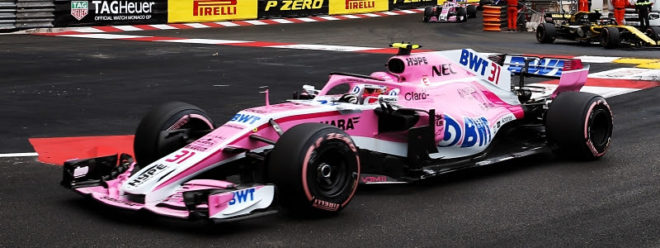
Esteban Ocon finishes 6th; Perez 12th
Monaco, 27 May 2018: Sahara Force India driver Esteban Ocon managed to keep his position and gained a sixth place and very valuable eight points in Monaco on Sunday. Senior teammate Sergio Perez who started inside the top-10 could only finish 12.
After six races, Perez stands 12th in the driver standings with 17 points followed by Ocon in 13th with 9 points.

Ocon finishes P6 in Monaco. A Sahara Force India image. Esteban Ocon managed a P6 bringing his VJM11-03 safely home. He started on Used Hypersoft and shifted to New Supersofts after 23 laps and went on for the next 55 laps. “A fantastic result today. I’m really happy and it was great fun. The pace we had was impressive and the team did a fantastic job with the strategy. We had a great understanding of the tyres and there were times during the race when we were the fastest car on the track. In the final few laps I was catching Bottas and Raikkonen by over a second per lap and I was right behind them at the end. It feels great to get this result and a good bunch of points after a few disappointing races. I hope we can have many more weekends like this one,” he said.
Sergio Perez said: “I am disappointed today because we didn’t get the result our pace deserved. We had a problem at the pit stop and this completely ruined our race. Our first stint was strong, we looked after the tyres well and pushed hard just before the stop. We had a good rhythm but we pitted slightly early to react to what was happening around us. We lost some time, but in the second part of the race we had good pace. Unfortunately, it was impossible to overtake. I was quicker than the cars in front, but you need a big advantage to be able pass around here, especially with these very wide cars. I leave Monaco feeling we have lost some important points. Esteban showed what we could do today and it feels like an opportunity lost.”
Chief Operating Officer Otmar Szafnauer said: “Congratulations to the entire team on a well-deserved sixth place in Monaco. Esteban did an excellent job all weekend and hasn’t put a wheel out of place. After his strong qualifying performance it was very satisfying to see him bring home eight points today with a very mature drive. It’s a shame that Sergio had an issue at the pit stop, which undoubtedly cost him the opportunity to finish inside the top ten. He showed good pace in the second half of the race but without track position it was hard to make it count. We take a lot of encouragement from out strong performance this weekend and will look to carry this momentum into Montreal in a couple of weeks’ time.”
-
Daniel Ricciardo takes a lights-to-flag Monaco victory despite engine issues
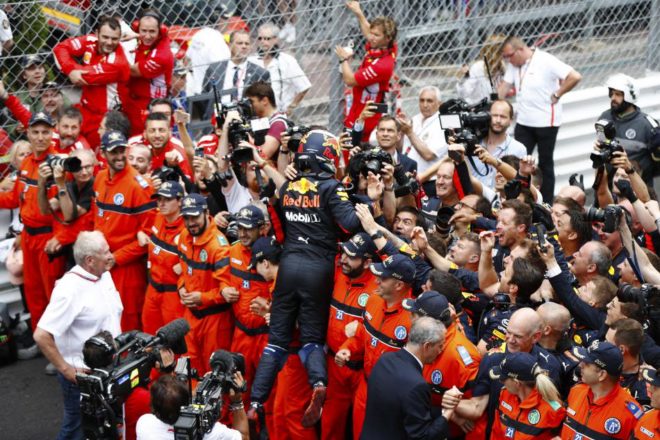
Daniel Ricciardo celebrates after winning a difficult Monaco race on Sunday. An FIA image Monaco, 27 May 2018: Daniel Ricciardo battled engine issues and soaked up race-long pressure from Ferrari’s Sebastian Vettel to score a superb Monaco Grand Prix win ahead of the German and Mercedes’ Lewis Hamilton in the sixth round of the Formula One World Championship here on Sunday.
The Australian, who led away from pole position, developed a power issue and a possible gearbox problem with his car midway through the race and after being told by his team that the problem could not be rectified, he delivered a superb defensive drive, with just six of his car’s eight gears at his disposal, to claim his seventh career win and his first in Monaco.
The victory makes up for 2016 when the Red Bull driver lost out on victory in due a botched pit stop that dropped him to second place.
At the race start, Ricciardo made a clean getaway and despite a brief attack from Vettel, he held his advantage to lead through Ste Devote ahead of the German and Hamilton. At the back of the grid, Max Verstappen made a good start and swiftly cleared the Haas cars of Kevin Magnussen and Romain Grosjean to hold P18 at the end of the opening tour.
Verstappen then worked has way past Sauber’s Marcus Ericsson on lap three and began to close on Williams’ Lance Stroll. He made light work of passing the Canadian on lap seven, down the inside into the Nouvelle Chicane. The next move was past Toro Rosso’s Brendon Hartley and that came soon after, putting the Dutchman in P14 before the start of lap nine.
At the front Ricciardo eked out a 2.5s gap top Vettel but then on Lap 11, Hamilton pitted for ultrasoft tyres, emerging in P6 behind Force India’s Esteban Ocon. The Mercedes driver passed the Frenchman soon after and then began to chase after the leaders, 28s behind Ricciardo.
Vettel was next in taking on ultrasofts and then, at the end of lap 17, Ricciardo pitted from the lead. He also took ultrasofts but as he rejoined in the lead, about four seconds ahead of Vettel, Valtteri Bottas pulled up at his pit box and went for supersofts.
Further, back Verstappen was still making his through the field and after passing Leclerc, Harley and Sainz and others pitted, he found himself in P11 behind McLaren’s Fernando Alonso who had pitted for supersofts.
By the end of lap 25 Ricciardo had a 1.7s lead over Vettel, while Hamilton was now 8.6s off the lead. Raikkonen had closed to 1.2 behind Hamilton, with Bottas 6.0s behind his fellow Finn.
Vettel then began to close on the leader and by lap 30 he was just 0.7s behind Ricciardo. The leader reported a loss of power and as the situation unfolded the Australian asked his team whether the situation would improve. His race engineer’s response was a swift negative.
Ricciardo was now in a position where he would have to defend for more than 40 laps. Behind him Vettel looked to attack but as the Australian protected his lead the German’s tyres began to grain badly.
Behind the leading pair Hamilton began to increase his pace, sensing that the slow laps being put in by the front pair could signal an opportunity. Further back, Bottas began to close on fourth-placed Raikkonen.
The top end of the order now began to bunch up and on lap 45 the leading five cars were separated by just eight seconds.
Further back, Verstappen finally made his sole pit stop at the end of lap 48, taking on hypersofts for a late race push to the flag. He emeged in P11, ahead of Toro Rosso’s Brendon Hartley and 10 seconds behind Renault’s Carlos Sainz.
Verstappen’s situation improved when Fernando Alonso retired with a geabox issue.
That promoted Verstappen to P10 behind the Hulkenberg who had dropped behind Sainz after his stop. When Sainz allowed his team-mate past, Verstappen closed on the Spaniard and after Sainz cut the chicane as they battled the Red Bull driver swept past in the Nouvelle Chicane to take P9.
Ahead, on lap 60, Vettel was still pushing, looking for a way to attack Ricciardo, but the Australian was controlling his defence with aplomb and the gap remained steady at around one second. Hamilton’s charge appeared to have ended as he fell 2.9s behind Vettel, while Raikkonen was a further 2.6 back in fourth place.
Verstappen, though, was till trying to make progress and with 13 laps remaining he had reeled in Hulkenberg, who in turn had caught up with Toro Rosso’s Pierre Gasly.
There was late drama when local hero Charles Leclerc crashed into the back of Hartley’s Toro Rosso, but with Leclerc sliding up the escape road and Hartley able to limp to the pits, it was only cause for the Virtual Safety Car to be deployed.
And as the caution came to an end, Vettel dropped right back, settling for second place, seven seconds behind the Australian. Hamilton, too, nursed his car to the finish, finishing almost 10 seconds behind Vettel.
Fourth place went to Raikkone, with Bottas fifth and Force India’s Esteban sixth. Gasly drove superbly to hold onto seventh ahead of Hulkenberg and Verstappen and the final point went to Sainz.
—
-
The boys have done a good job! And there are some girls in the team too, says Ricciardo
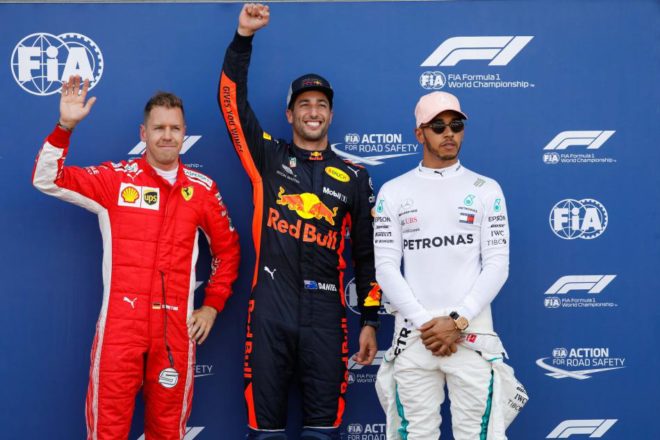
Daniel Ricciardo, flanked by Sebastian Vettel (left) and Hamilton, after taking the pole on Saturday. An FIA image Monaco, 26 May 2018: Daniel Ricciardo, who is known to have vocally supported the grid girls, took the pole today and thanked the team and also said that there are some girls too in the team. Despite the F1 Management’s decision to stop grid girls, Monaco proved that it is different.
The race will be on Sunday. The drivers who attended the Saturday press conference are polesitter Daniel Ricciardo (Red Bull Racing), Sebastian Vettel (Ferrari – P2), and Lewis Hamilton (Mercedes – P3)
Press Conference (Questions from the floor):
Q: Daniel, the Red Bull has been very strong here this week, but just how good was the car here today and how were you able to harness the strengths of the package here?
Daniel Ricciardo : It’s been good all weekend. Every session we’ve been quicken. It’s a bit like 2016; we came into this race knowing we had a legitimate chance to fight for pole. Just knowing how the car has performed in the first few races and knowing if it got hooked up around here then for sure we knew we could be here. We didn’t really change much on the car all weekend, it was kind of one of those pretty smooth ones and we could just build up to it and obviously find my rhythm and have some fun. I love this place and it’s obviously a pleasure to drive in a 1m10s, it’s a lot of fun. It’s been awesome, the boys have done a good job. The team. There are some girls in the team as well!
Q: Daniel, what happened to Max shows how quickly this place can bite. Was that at the back of your mind or were you able to clear your mind and just go for it?
DR: It’s always in the back of your mind here, I guess, because the risk and reward is very real and that was proven this morning. It’s one of those things… it’s there but it is at the back of your mind, because to be fast you can’t think about those things. Knowing we had obviously a great package all weekend… we need to push it but I don’t think we need to overdrive it. The car has been performing well. It’s just hitting your marks and just trying to keep it clean I guess. We’re all pushing each other, particularly Max and myself in the same time. It’s no surprise that these things can happen and, as I said, when we’re lapping 1m10s 1m11s there’s no room for error.
Q: Daniel, who were talking to on the phone directly after qualifying? I was wondering who you were talking to there?
DR: Do you know or not? No. OK. It was the boss, Dietrich. It was nice.
Q: What kind of guarantees do you have for your tyres tomorrow?
DR: Come on. Next question. They’re cool, yeah. We’ll be fine, there’s no rain tomorrow, we’re OK.
Q: Question for Seb and for Lewis. Do you think it was the general DNA of your cars why you didn’t have a chance against Red Bull here or do you think if you had got everything right, the set-up, the perfect lap, you would have had a chance?
Sebastian Vettel: I was pretty happy. I think there is always the feeling that there is a little bit but I don’t think we were a threat to Daniel’s time today. So, I think you always look back and think ‘here and there’, especially around this place, but well done to Daniel, he owned the qualifying session. For us, I think, we were playing around with the set-up quite a bit trying to squeeze out everything because we knew we had to if we wanted to have a word for front row and for pole. I think we put ourselves in a good position. I think they looked strong yesterday, they looked strong this morning, I think we got as close as we could and now we see what we can do tomorrow?
Lewis, How was the session for you?
LH: It was a good session. We knew we wouldn’t be quickest here. We did the best we could and the car was in a good place, just a little bit off them really.
Were you pleased with your lap?
LH: My first Q3 lap… I was happy with my last one. I was 0.27s but I lost it in the middle and the last sector so naturally not happy with that. That wouldn’t have been enough anyways for pole but it would have made a difference, obviously I would have been second. Am I happy about that? No, but it’s a long race tomorrow. I gave it everything I could and you can’t always get it perfect. The good thing is the car is in one piece and I can live to fight another day.
Q: A question for Seb and Lewis. Obviously, the unique characteristics of this circuit means that it doesn’t necessarily translate from here to other places. With that in mind, does it make missing out on pole here today easier to take, knowing that it’s a special circuit and won’t necessarily be repeated elsewhere?
SV: I think it was expected that Red Bull will be quick here. I think they have a strong car, they have more downforce than everybody else. I think in terms of drag or efficiency, maybe they’re not the best, so at this track, y’know, we knew that they will be strong. Other tracks, I think we have to look at ourselves, y’know? I think Barcelona we know we weren’t where we want to be. Going forward, Canada, will be different again. The think is, for us, that have potential in the car. We need to make sure we unleash it and we improve. Then, I think, I don’t need to answer your question, or these questions. For today, no doubt, Daniel was the best man out there. He deserves the pole and no matter whether his package was maybe a little bit better or a little bit worse, he did the job. That’s what it’s about here.
Lewis, the pace of the Mercedes elsewhere, does that make today an easier pill to swallow?
LH: Like I said, we knew what was going to happen this weekend. So… it still doesn’t feel great but it’s just one race, so…
Q: Question to Daniel and Lewis. On Thursday, there was some questions about the legality of the Ferrari ERS system. I just wondered if there’s any feelings amongst you two, whether you think it’s legal. Are you happy with the investigation, the answers that you’re being given by the team?
DR: Don’t know about it. Yeah. I don’t. Probably because I haven’t been reading anything. Particularly since Thursday, just been focussed on trying to put myself here, in this position. So, I’m sure the team know about it – but they haven’t bogged me down with that information at the moment.
Lewis, anything to add?
DR: Do you know about it?
LH: I keep my ear very close to the ground, for sure. I know what’s going on.
Q: To all drivers. Come back to the subject of tyres, changing the approach. What expectations do you have for the hyper tyre from Pirelli? And also, Daniel, having around 40hp less than your competitors, were you afraid at the end in the Q3 that you could lose your pole position?
DR: No, I knew the first lap in Q3 was pretty good. I felt it was enough but obviously you never know – but it was a relatively clean lap. So yeah, for sure the chassis works well around here and we don’t have maybe as much power in qualifying but we’ve still got enough around here to get it done. So that feels good. The tyres. Thursday seemed mixed for everyone. Some people suffered a lot of graining with the front. We didn’t do a very long run but what we did, it was OK. So, I’m OK for tomorrow. I feel confident. I think we’ll still be able to one stop. I think everyone will make it happen. Yeah. It’s good.
Sebastian. Anything to add on the tyres?
SV: Well, I mean this is a track where we put the least energy on the tyres. So, I think it’s normal the softer the tyres, the better it is for us. We have more grip. Yeah, we saw, as Daniel said, in practice that maybe the tyre’s not meant to last super-long. So, I’m sure if you put it on a normal race track it’s fun for probably half, or one lap – but after that it will be difficult. But I don’t know. The tyre choices now, going forward, when will be have the hypersoft next time, I’m not sure. Is it in Canada? Canada is quite smooth on the tyres so it makes sense. Yeah.
Lewis, your thoughts on the hypersoft tyre.
LH: It’s OK.
You guys experimented with the ultra in Q2.
LH: That wasn’t the greatest either.
Do you think a one stop is possible tomorrow, as Daniel suggested?
LH: I think that’s the target, which I think is not very good here. They should make us use multiple ultrasofts, or hypersofts. One stop is always a boring race. Especially on a track where you can’t even overtake. So, it adds more excitement to it. I’m sure we’ll do one stop tomorrow. The other tyres could probably go a long way.
Q: Your thoughts on the hypersoft?
LH: It’s OK.
Q: You guys experimented with the ultra in Q2.
LH: Yeah, that wasn’t very good.
Q: Do you think a one stop is possible tomorrow, as Daniel suggested?
LH: I think that’s the target which I think is not very good here. They should make us use multiple ultrasofts… hypersofts. One stop is always a boring race, especially on a track where you can’t even overtake, so it adds more excitement to it. I’m sure we’ll do a one stop tomorrow. Yeah, I think the tyres could probably go a long way.
Q: To Seb and Lewis, you’ve won Monaco outside the pole, what would your mind set tomorrow? Would it be a waiting game during the race?
SV: Well, jump Daniel at the start.
DR: Preferably don’t jump, like over me. That would hurt.
SV: No, no. I mean it’s a long race. If you look at the race, then it’s nearly impossible to overtake, we know that, but it’s still one of the most fascinating races because things can happen. It doesn’t mean that they do happen but they can. Rain is not forecast, I guess, for tomorrow but who knows? It’s going to be a long race, a lot of laps, easy to do a small mistake which goes without noticing or can be very costly. I think the plan is to – as I said – make a good start and then settle into the race. Keep the pressure up until the end.
Q: Lewis, tomorrow, do an even better start? What’s your plan?
LH: To catch this one, to catch this guy, that’s my goal. Switch places with him.
Q: Seb, the first lap in Q3, did you have any specific mistake there or was it just a bit easygoing, well, just to set a time on the board?
SV: I don’t know what the others did but I did two times one lap and in Q2 I tried a little bit but it didn’t work so for Q3 I think I knew what I had to do and yeah, I was happy with the first lap, not so happy with the beginning or with the feel for the tyres throughout the lap. I think today I was – I would say sensitive but it was important for me to feel the car, the tyres switching on. In the last run I definitely felt it was a bit better so I had a cleaner lap and more trust and that’s where the extra time is usually coming from. The lap before wasn’t bad but I could do better, I knew it and I was pretty happy with the last one I had.
Q: Daniel, do you look forward to a race when you don’t have to think about passing with your teammate?
DR: I only heard passing your teammate, is that what you said? What was your question?
Q: do you look forward to the race more when you haven’t got to worry about passing your teammate?
DR: I don’t know. It’s not a bad question. We’ll move on. At least you laughed, you got your kick out of it. No comment.
Q: Daniel, because Red Bull’s been so strong this week, how much of it has been a mental, psychological battle between you and Max, just trying to get the upper hand before qualifying? Obviously he ended up paying the price for it on his side but how important was it just to be the number one guy basically?
DR: Obviously you’re aware of your teammate’s speed and everyone’s speed but for me, from the start of the weekend, I guess a battle with myself, wanting to be the quickest from the start and trying to reach my personal goals for the weekend. Obviously, yeah, we were close throughout all the sessions but yeah, I don’t know if it’s… it could be a psychological battle if an opponent sees it that way but for me personally I just wanted to see my name on top and just try to keep that momentum going from the start.
Ends
-
Bottas sets the early pace ahead of Hamilton in FP1: Spanish GP
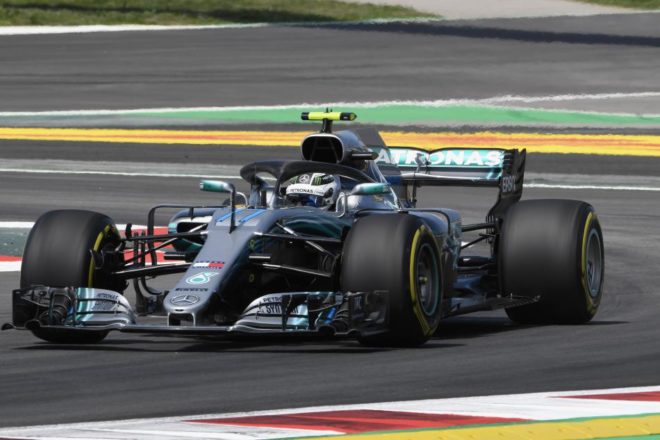
Valtteri Bottas of Mercedes F1 team tops FP1 on Friday. An FIA image Brcelona, 12 May 2018: Mercedes’ Valtteri Bottas went quickest in the opening practice session for the Spanish Grand Prix, finishing more than eight tenths of a second ahead of team-mate Lewis Hamilton and almost a second clear of third-placed Sebastian Vettel.
The Mercedes drivers’ dominance of the session was established early with Bottas using soft tyres to push into the 1m18s bracket.
At that point the were backed up by Red Bull Racing’s Daniel Ricciardo, but the Australian wouldn’t figure in the session for much longer. With grip at the premium on the new track surface, Ricciardo lost control of his RB14 in Turn 14 and slid off through the gravel, hitting the barriers and causing damage to the front-left of his car.
The incident saw the Virtual Safety Car deployed and when the cautionary period ended, Bottas took a new set of soft tyres and stretched his legs once more, eventually improving to a time of 1:18.4311.
A second VSC period then ensued when Williams’ Lance Stroll went off at Turn 5, soon after complaining about the poor balance of his car.
And once again when the VSC period ended, Bottas improved his time, this time establishing a benchmark of 1:18.148 that would remain for the remainder of the session. Hamilton, meanwhile, finished 0.849s behind the Finn.
Vettel, meanwhile, sat in fourth for much of the session before Ferrari sent both of its drivers out on supersofts. Vettel vaulted to third late on but still could only manage to get to 0.950 behind Bottas. Räikkönens initial foray on the red banded tyre left him 1.6s down on Bottas’s best time but he eventually managed to work his way to a time of 1:19.499, some 1.3s behind his fellow Finn and four tenths of a second behind Vettel.
The gap was sufficiently large to allow Max Verstappen to slot his Red Bull Racing car between the Ferraris, with a time of 1:19.187, a second adrift of Bottas.
Behind fifth-placed Räikkönen, McLaren finished as best-of-the-rest, with Fernando Alonso setting a time of 1:19.858 to take sixth spot on the timesheet. The Woking team also debuted a radically redesigned nose and also new bargeboards during the session.
Ricciardo’s early time was in the end good enough for seventh place, ahead of Haas’ Romain Grosjean, McLaren’s Stoffel Vandoorne and Toro Rosso’s Pierre Gasly, who rounded out the top 10 order.
2018 Spanish Grand Prix – Free Practice 1
1 Valtteri Bottas Mercedes 32 1:18.148
2 Lewis Hamilton Mercedes 22 1:18.997 0.849
3 Sebastian Vettel Ferrari 24 1:19.098 0.950
4 Max Verstappen Red Bull Racing 26 1:19.187 1.039
5 Kimi Raikkonen Ferrari 19 1:19.499 1.351
6 Fernando Alonso McLaren 26 1:19.858 1.710
7 Daniel Ricciardo Red Bull Racing 11 1:19.871 1.723
8 Romain Grosjean Haas 24 1:19.906 1.758
9 Stoffel Vandoorne McLaren 28 1:20.083 1.935
10 Pierre Gasly Toro Rosso 29 1:20.508 2.360
11 Kevin Magnussen Haas 28 1:20.637 2.489
12 Charles Leclerc Sauber 23 1:20.665 2.517
13 Sergio Perez Force India 36 1:20.924 2.776
14 Marcus Ericsson Sauber 18 1:20.984 2.836
15 Carlos Sainz Renault 28 1:21.053 2.905
16 Esteban Ocon Force India 27 1:21.144 2.996
17 Nico Hulkenberg Renault 26 1:21.159 3.011
18 Brendon Hartley Toro Rosso 28 1:21.373 3.225
19 Robert Kubica Williams 24 1:21.510 3.362
20 Lance Stroll Williams 15 1:22.756 4.608 -
As a team we have a duty… to improve the show, to improve F1: Mattia Binotto of Ferrari
Barcelona, 11 May 2018: The FIA Friday press conference of the Team Representatives saw attendance from Mattia Binotto (Ferrari), Andy Cowell (Mercedes), Rémi Taffin (Renault) and Toyoharu Tanabe (Honda). Transcript:
Q: Gentlemen, before we deal with the here and now, can we kick things off by throwing things forward to 2021 and the new engine regulations. There are various elements to this and Mattia, if I could start with you, the new power unit has to hit the track in about 30 months’ time. How tight is the timescale? Is it enough time?
Mattia Binotto: Is it enough time? It will depend much on how different will be the new power unit compared to the one of today. So, no changes to the regulations, plenty of time. As much as you change it, obviously the more time you need. At the moment, so far, for what we may understand, because we are still discussing – FIA, FOM – what will be the format. We had several meetings in the last days. We have some more in the next days, let’s see where it will go. But 30 months is plenty enough but it would be good to try to reach an agreement on what will be the format, in really the next two to three months.
Q: Andy, coming to you, there have been various presentations already, as Mattia has just referred to. Is everyone aligned as to what those regulations are going to be in ’21?
Andy Cowell: As Mattia says there have been several meetings, starting last summer. Discussions are never 100% aligned. There’s always difference of opinion, but you end up coming up with a compromise and setting off on a direction, hopefully with enough time to do a decent job before the first race.
Q: And have we found that direction now?
AC: I think those discussions are ongoing. None of us can read a published set of regulations, so the discussions, the debate, the compromises are a work in progress.
Q: Remi, can we just get Renault’s take on the new engine regulations and where you would like to see them go?
Rémi Taffin: I think we wish to go forwards. We are still interested in developing the engine. We think the engine is a big part of Formula 1. As my colleagues have said, we are all discussing this, we want to get this forward. We know we have some work to do. We know we will have some changes compared to today and we have to deal with them. But the most important thing for Renault is that we all work together with the FIA and F1, to get this right and yes, to make sure that the engines keep a good part in Formula 1.
Q: Tanabe-san, what’s Honda’s position on the new rules and specifically the MGU-H?
Toyoharu Tanabe: Yes, we will miss the MGU-H. I think we haven’t decided everything yet for 2021. But the direction from the FIA we respect, we respect the other manufacturers’ direction, but we think we will miss the MGU-H, such a high pinnacle of technology for the future and relevant to the production car as well.
Just to clarify: Honda would like the MGU-H to stay?
TT: Yes, we would like to keep that technology.
Q: Rémi, if I could back to you now and deal with the present. Can you just talk about the progress you’ve made with the power unit in Viry, where have you made the biggest gains this year?
RT: I think the gains that we have for a few months and a few years now is through the ICE, the internal combustion engine that we have lifted the efficiency with and that’s where we are focusing our efforts.
Q: OK. Renault, a while back, gave Red Bull Racing a deadline of May to fix a 2019 partnership. How are those talks going and might that deadline be extended?
RT: I think from my perspective, obviously I do not deal with contract, I leave it to my boss Cyril, and he has been speaking about that. But if we come back to the technical aspect of that, obviously there are some deadlines, which is simply based on the fact that we have to order parts. So, as a starting point, we know that by the end of this months we would have to start buying some parts to supply as many teams as we would have to for next year. So that is one of our technical deadlines. Then the rest, as I said, is all about having a contract or not with them, which is obviously on their side.
Q: Tanabe-san, coming back to you, we’ve just been talking about Red Bull Racing’s future engine partner, what can you tell us about the talks between Red Bull Racing and Honda?
TT: As my role, as Technical Director, I am not involved much with contract matters, but as Honda we have studied, discussed and then we had a preliminary conversation in Baku, but it is still under discussion.
Q: Do you have a deadline in mind when Honda needs to know if it’s supplying Red Bull Racing as well as Toro Rosso?
TT: We will follow the FIA regulation, but at the moment I cannot tell you exactly.
Q: Let’s talk about the performance of the power unit now. You obviously had a great weekend in Bahrain. Where is the power unit improved from 2017?
TT: Of course we work for the reliability, but not only reliability but performance as well – maybe the same as others. But we focused on the reliability from last year. We learned a lot from the previous years and we applied that type of knowledge or learning point to this year’s power unit.
Q: Thank you. Andy, returning to you, congratulations on that win in Baku last time out. If we’ve learned one thing about Formula 1 on 2018 it’s that it’s very tight at the top and the first question to you is whether we have seen evidence that the power advantage in recent seasons has been eroded?
AC: The last race was very pleasing, the three races before not so. With regard to the power advantage, I think at the moment, in qualifying, then the gentleman to the right of me has a small advantage – well done! – but in racing I suspect we’ve got a small advantage. I think Renault and Honda are very close behind. As we discussed a couple of years ago that if you have regulation stability you do see technical solutions converge and that’s what we’re enjoying at the moment and we’ve all got the pleasure of working hard in the factories and trying to catch each other up and I think it’s going to be a tight battle all the way through this year and next year, and the year after.
Q: You talk about convergence: this is year five of these regulations, so how close are we getting to the limit of what you can get out of these regulations?
AC: I think that comes down to your belief and understanding of whether there is a limit. I personally don’t believe there is a limit. I think you can always find gains. Every week I have the pleasure to sit in our performance and innovation meeting and listen to bright engineers come up with ways of getting a little bit more efficiency out of the various systems and then enjoying the competition in the factory to turn those ideas in proven experiments, and then prove that they are reliable enough to come racing and compete in this wonderful environment. So, for all four us, we will continue to develop and there is no such thing as a limit.
Q: Mattia, we are talking about limits, would you agree with Andy that there are no limits?
MB: I would agree with Andy, no doubt. When you put engineers together, there will be always innovations, creativity. And for an engineer there are never limits. I think we have seen in the last years, in the last season, how much we improved, year after year and I don’t think we have shown so far that we have reached the limit of the product.
Q: Can we ask you about those gains that Ferrari have made, particularly over the winter coming into this season. How do you quantify those gains: how much is chassis, how much is engine?
MB: I think we have improved in most of the areas and our spirit is really to try to improve first, what were the weaknesses of last year, try to focus, we knew that maybe on top speed we were not our best, in terms of overall efficiency we could have improved, especially on what were the fast circuits. So I think all our engineering focus was to improve the car in all the areas. I don’t think we can say there is a specific area that improved the most and I’m quite pleased to see that in all the areas we made progress.
Questions from the floor:
Q: Mattia, what is Ferrari’s position on these recent changes for ’19, especially the less complex front wing?
MB: OK, I think that as a team we have a duty and a task to improve the show, to improve the Formula 1. I think that certainly the regulations may be a good step in that respect. It is a big change, a drastic change to the rules, to the aero. I think each team will be focused on develop what are the new regulations, it’s quite a game changer, but overall I think from an egoistic point of view we could have stuck with what we had at the moment but I think that looking at the show and the good for the sport, it was the right choice.
Q: With the growing move to electrification in the Automotive industry, how relevant is the current battery technology in Formula One to production cars and, going forward to 2021, how much freedom would you like in terms of battery technology.
RT: I think we still like, as engineers, to develop batteries but I guess at the beginning we all have different interests in batteries, whether we wish to develop a chemistry ourselves or not, for sale, for example, so it’s really depending on the intent. As far as Renault is concerned, the Group is liking us to develop so I think we eventually wish to have some development in that area. And then, what we’ve got now is not a bad solution. We can do our work, we can make some progress, we can make some differentiation and at the end of the day we wish to keep that freedom. Whether we need to have that complete freedom as we have now, whether we have to proscribe some element of that, it’s another territory that obviously we are discussing these days.
MB: So, how much our battery technology are relevant for our cars, automotive, certainly they are. If we look at LaFerrari GT cars, the technology of the batteries is coming from F1 directly, so certainly it is relevant. Looking at 2021 again, I think as Ferrari it’s important we maintain freedom in developing the key technologies. So we are certainly against any standardisation or big proscriptions on key technologies. Certainly whatever is related to the power unit , which, for Ferrari, is a key element.
AC: I think all the batteries that we’ve got are high-performance road relevant in terms of their power density. I think we’re lagging in terms of the energy density. I think it would be good if the regulations encouraged us to develop higher energy densities – because that is something that’s particularly relevant to mobility. If you think about 2021, then there’s a lot of electric-only cars that are going to be on the market there – but we’re in this. We’re torn. You’re talking to a group of engineers who like to develop new technology, that like to be pushed to drive to the pinnacle of technology. The regulations for 2021 are heading in a downwards step with regards to technology, with the removal of the electrical energy that we get from the MGU-H. Sixty per cent of the electrical energy comes from the MGU-H, we will be going to just a KERS system and therefore the demands on the battery are perhaps a little bit less. I personally, as an engineer, would like to see more on the electrical hybrid side and more of a challenge on the energy density of the battery because I think that would draw more blue-chip companies into this industry. It’s one of the most amazing development platforms on this planet and we’d all like to look after the planet.
TT: I think our hardware itself, it’s not a direct move to the production car area. I think to keep developing the energy management itself and we can learn a lot. And then we can move that technology. Energy management also controls systems. We can improve and that helps our production car areas as well. We can cooperate with production car area. Then keep working on that area is a high technology challenge for us. I’d say it’s important for us as well.
Q: Question for Mattia, Andy and Remi. Honda will miss the MGU-H and would like to keep it. Do you share that view – and why do you think it will no longer be a part of the F1 engine from 2021?
AC: I share the view of Honda. I think the MGU-H has been blamed for the lack of noise, for high complexity. It’s been referred to as a miracle. There are four technology companies that have made it work and get 60 per cent of their electrical energy to then power the K. It contributes 5% of the thermal efficiency of the power unit and to make up the power difference we’re going to have to increase the fuel flow rate, which I think is a backwards step. It’s not progress, so, my view is the H should stay because the development has been done. Removing it removes a lot of energy, which is a lot of car performance. Yeah, it feels like a backwards step when the development work’s been done. We will all now start developing anti-lag systems. The MGU-H is the most marvellous anti-lag system on a turbocharged engine because it gives you speed control. That’s been removed so we’ll now have to come up with various devices and systems and that will probably involve burning some fuel in the exhaust which doesn’t feel like the most honourable thing to do, as an engineer. But, as I’ve said previously, it’s a balance between technology and entertainment. We’ve got to get that balance right.
Q: Mattia, your thoughts.
MB: I think that Andy has already illustrated, certainly the MGU-H is a fantastic, efficient component, for the reason he mentioned. But looking ahead, we know that we know we need to find a compromise. The compromise based on what are the main objectives of 2021: spectacle; noise; simplification; cost. When you are dealing with compromises, there may always be different opinions and I think somehow we may accept the MGU-H to be removed but certainly removing the MGU-H doesn’t mean that we fully need to standardise the power units and the engines. There are still areas in which we believe an engine is a key element, a key technology and important that we still maintain the challenge in these technologies and we try to maintain the engine, or the power unit, as a competitive differentiator between manufacturers – because that’s about the DNA of the sport, and F1.
Rémi?
RT: I think I will have to make the sum-up of what has been said but I think first all three of us have voted to keep the MGU-H, and that was an initial proposal that we have made but there was some alternatives that we’re not taking the way of, and again we’re trying to have good discussions to go forwards for keeping developing this power unit. It may be in a different way, try to keep some more fun for anyway. So, again, at the end of the day, we’re doing the job these days to make sure the power unit in ’21 is where we need to be. And then, yes, we did a lot of work on the MGU-H. We have these things working and it’s a very nice tool, or piece or part – but at the same time I would maybe bounce back on the last question we have, it is not something we will put on the shelf and just forget. As far as Renault is concerned, we have some other projects, we are working on Formula E where battery is also of an interest, so we also work on that front. MGU-H is not directly transferred to Formula E but it’s a very high-speed motor and it’s quite a unique technology and again, we’re not going to put that on the shelf, so it’s all going to be of interest.
Q: Andy mentioned earlier that it’s work in progress and there are discussions and everyone has a different opinion. Obviously you all share the opinion on the MGU-H, but can I please ask each one of you where he personally has problems with the proposal that is on the table yet with the engine regulation for 2021.
TT: I think we have a lot of things to make clear for the detail. So, we generally have a good summary but we don’t have any detail. So, that area we are trying to make clean and this is under discussion. I think many, many ideas.
AC: I’m not sure it’s appropriate to discuss all the details of the ongoing discussion. The MGU-H is a topic that’s already been in the media over the last three years, it’s been blamed for all the evils of Formula One power units, so there’s a lot of commentary out there and so discussing that feels appropriate. Going into others details, it’s probably best if we have a press conference in a month’s time when the regulations are… or whenever the regulations come out.
Q: Andy, I was going to ask you, when you want to see the regulations some out?
AC: I think so long as the regulations come out over the next few months and, as Mattia rightly pointed out, as long as it’s not a complete tear-up of what we currently have, then there’s sufficient time to do a professional job, so we don’t embarrass ourselves at the beginning of 2021.
Q: Mattia, any more thoughts?
MB: No, they summarised. The current discussions are just at the very start so very… let me say ‘green’, or not mature at the moment, with regulations. Very difficult to judge or to comment. As I said, I think as Ferrari, but I’m sure they are joining, it would be a shame to standardise or to limit much, especially compared to what we’ve got today, so reducing some freedom compared to today would be somehow a shame. I believe we should keep up the challenge.
Q: Rémi, anything you’d like to add?
RT: I think maybe the most important is not the proposals, which could be very different to what we see in the last three or four months, but it’s the objectives that we see at the beginning of our discussion. I think as far as the objectives are concerned, we will tackle all of them and we will have, at the end, we will have a proposal that is able to do that – which I guess is the most important for all the parties. FIA, F1, us. That’s what we are working for. It’s also true that we have to make sure, when we work on that proposal, we work out the right change in the right time frame, so that we can do a proper job and be ready for 2021.
Q: A question to everyone. Do you think taking out the MGU-H will improve the balance across all four power units in terms of performance and reliability or should we look at completely different solutions?
RT: No (I don’t think it will even out the performance). As we say, we’ve done the job, we’ve got the MGU-H, which is working where we wish to be. Obviously, it’s a big part of the performance of our power unit but as Andy mentioned it’s part of its efficiency, we’ve worked that out and as we say we still jhave to make sure that every single drop of fuel is burned as efficiently as possible, then it’s the work on the ICE, it’s work on the turbo and obviously if we have to get rid of the ICE and turbo and that’s what we will make the efficiency out of. So, it’s not going to let’s say bring any levelling of any performance or reliability – we’re there.
Q: Mattia, anything to add?
MB: No, Andy.
AC: I guess one of the things we all wish is that there were 10 of us sat here, that there were 10 manufacturers in the sport – 10 teams, 10 power unit manufacturers. And there is a desire from us and from the FIA and Formula 1 and so removing the H does that help a new entrant come in – quite possibly. We’ve offered to help with technology transfer to help a new entrant. The best way to make it easier for a new entrant is to take some of the systems away, the ones that are perceived to be complex.
Q: Tanabe-san?
TT: We are working on the future, so it is still under discussion.
Q: Without the H do you think it would help Honda.
TT: No.
Q: This year we have the rule that you can only use three engines, MGU-K, H and two batteries and I guess at the beginning of the season, every one of you was striving to do the whole season with these three. Now, knowing the balance of power, somebody has to catch up, somebody wants to get an advantage again. Is it worth thinking, now, to introduce maybe a fourth engine in order to have more scope of development, to have another development step in order to get ahead of somebody else or catch up?
MB: I think that when you’re setting your development programmes, you are not looking at the others but to yourself. As I was saying before, I think that we are looking to our (inaudible) and trying to improve, so we made a programme looking at ourselves and not to the others. We knew that it was three engines per the season, our pack is three engines per season, I don’t think that will change, whatever is the balance, because the best way somehow to achieve or optimise your performance is trying to optimise your own performance and not relative to the others. Again, at this stage of the season, we are in Spain, if you look, no one has introduced, at least, to the second power unit, so I think we are all trying to go longer on the life of the power units and to manage the three engines per season.
RT: I think we knew we had to go to three ICEs and energy store a few months ago, a lot more than that, and as far as I am concerned, we have taken this on board and we have done everything we could to make sure that we stick to that rule because obviously the quicker way, actually, when you are 18 months ahead of going into a season, is to make sure that you keep to the new rules and try to exploit them as much as you could so in terms of reliability, you would try and stick to that. Obviously the closer you get to the points, to go racing with this power unit, you have to have a look at what you’ve got and try to optimise, so maybe the optimisation is a bit different but as far as we are concerned, we are going to the season and we will try and go as quick as possible. If it needs to be three ICEs, then we are ready to do the season on three ICEs. If for some reason, there is an opportunity to get more performance and optimisation we have to get the fourth ICE, then so be it, but I wouldn’t say it’s something that you just throw on the table and follow other plans. The plan is to try and get the rules in and be the best with that rule.
TT: We had a poor start in Melbourne and unfortunately we lost some units already but we stick to the regulations and then also we are developing the performance and the reliability and then when we are comfortable to apply those development items we will update but basically we stick to the Formula One regulations.
Q: What can you tell us about those performance upgrades; when can we expect to see them?
TT: I don’t mention specific timing now.
AC: I think, as Mattia said, you run your own race, you look at your own situation and you move on and now again you have curved balls come towards you. Some of them are miserable curved balls; if you have a quality issue and a failure. Some of them are happy curved balls: if you discover 10 kilowatts in performance development, you might suddenly to decide to introduce an extra engine towards the end of the year, but I think we all support the rules. The direction has been in place over the last ten years where progressively we’ve reduced the amount of hardware we use in racing because it’s cheaper for the customers, and it actually helps reduce the cost of performance development in the factory, because if you have a power unit that will do 5000 kilometers before it needs rebuilding compared to one that does 2000, you can get a lot more performance development done, so you build less. So I think it’s healthy for the factory, healthy for the industry and maybe we should get together in Abu Dhabi and see where we’ve all ended up.
Q: Mattia, can you explain the concept behind the new rear view mirrors we’ve seen dropping down from the halo of the Ferrari and what sort of gains you are trying to achieve there?
MB: When developing aerodynamics you are looking at all the opportunities you’ve got which are allowed by the regulations. These mirrors are as well somehow positioned in a better area for the drivers, looking not only behind but ahead as well, front tyres or whatever, so it’s normal development. I think you may judge why a mirror as you’ve done for a wing or a bargeboard or a turning vane, so it’s simple development, coming from the creativity of the engineers.
Q: There is much speculation around oil burning and the federation confirmed to have improved its controls on this side. Is that technology really useful in Formula One and how much theoretically can it influence the performance, especially in qualifying?
RT: The short answer from us is that we never experienced this oil burning thing, so I would not give you any effect from that but as a simple thing, we are a fuel flow limited formula so obviously the more combustible you can find and put into the ICE, the more power you will get through, so it’s as simple as that.
MB: First of all, the regulations are discussing about oil consumption and not oil burning and I think we should distinguish what the FIA has done for this season is to reduce the overall oil consumption, the average in the race which has somehow been reduced to 0.6 litres per hundred kilometres. I think that all the manufacturers now simply stick to it. The FIA are certainly controlling it at each session, they’ve got all the data, telemetry and I’m pretty sure that all the manufacturers are simply sticking to the regulations. How much does it affect the performance? It may have a bit of an influence but if you look at the performance of the power units today compared to last year I think they are much equivalent so it’s not overall much influence.
AC: I think in the regulations prior to this year there were some loopholes. I think the FIA have closed down the size of that hole and you know we all work with the FIA to flag issues and then work with them to come up regulations that make sure that the prime focus is on the honourable quest for making the thermal efficiency of the engine better and the efficiency of the hybrid systems better.
TT: We follow FIA regulations, 600cc per hundred kilometres, then we maintain that number and then I don’t know how much, I mean, the gain, with that system. Just to follow the Formula One regulations.
Q: Andy, just picking up on something you mentioned earlier about offering to help with tech transfer for possible new engine manufacturers; could you just elaborate a little on whether that’s a new position from Mercedes in terms of being willing to help a possible competitor, and to what extent would you go in terms of assisting them technically?
AC: It’s not a recent thing, it’s something that we’ve always supported. We’ve always been keen to provide our fair share of customer teams and I guess a few years ago, more than our fair share and we’ve always supplied exactly the same performance level there so the topic of a newcomer then… we’re keen to help, so long as the regulations permit us to help, so that’s why that’s been discussed with the FIA and Formula One. And how far would we go? We’d go as far as was required to help the newcomer and I guess that support would then taper out. We really would like more manufacturers to be in to make the sport healthier.
Q: Can I just ask that question to the other manufacturers with customer teams? Mattia, would Ferrari help a newcomer, a new manufacturer to Formula One?
MB: I think it would be good for the sport, new manufacturers. I think we would help them certainly, through the regulations, as we said, in order to reduce some complexity or not to frighten newcomers as to what is the complexity of our technology at the moment. So we would support it, certainly through regulations. I think that’s the best we can do.
Q: And Remy, would Renault help a new manufacturer coming into Formula One?
RT: I think we would have to define the frame of that but obviously we are discussing that. We will be looking at this and we will see where we get but we really appreciate to have top competition. We at Renault are already helping teams because we have customer teams so we supply power units. Whether it comes to a part or a fraction of that power unit is a different matter and it’s being discussed.
source: f1.com
-
Sharing the record with Pedro is a massive reward to my career: Sergio Perez
Barcelone, 10 May 2018: After four rounds, the Formula 1 teams start the European leg and are no strangers to the Circuit de Barcelona-Catalunya (formerly known as the Circuit de Catalunya); not only have they raced there every year since 1991, they also conduct extensive testing at the venue.
Familiarity does not, however, lessen the challenge for car or driver. Barcelona’s mix of high- and low-speed corners, plus its abrasive and rather bumpy track surface, makes for a physically and mechanically taxing race.
Tyre wear is particularly high and the varying winds that cut across the circuit mean an optimum set-up can be hard to find.
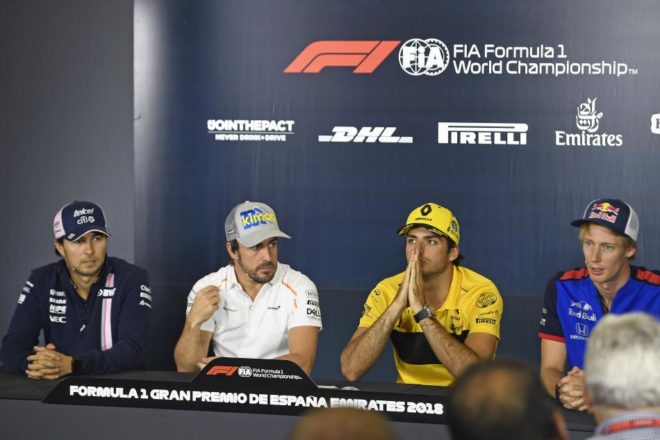
The drivers present for the Thursday Press Conference are: Brendon Hartley (Toro Rosso), Carlos Sainz (Renault), Fernando Alonso (McLaren) and Sergio Perez (Force India).
Q: Brendon, you scored your first World Championship point in Baku, last time out, how good did that feel?
Brendon Hartley: Yeah, it was maybe a bit of a relief, in a way because I’d had a couple of opportunities already and didn’t capitalise. Bahrain was the most obvious one where we had a very competitive car. So, it’s nice to finally get that first point. Had a bit of pressure on the last lap from Marcus, closing in the Sauber. Happy I kept it clean, kept it on the road and got my first point.
Q: And what can we expect from both you and Toro Rosso in the coming races, because, end of last season you did four races in Formula One but you were dovetailing a WEC programme at the same time. Now you’re focussing on Formula One, how do you feel it’s all coming together?
BH: I felt strong, especially starting the season after all that preparation. Like I say, I felt quite disappointed after Bahrain, having such a competitive car that Toro Rosso brought to the table, almost getting through to Q3 then having the penalty and not scoring a point there. The last couple of races have actually been quite challenging for us as a team, with nowhere near the pace we had in Bahrain. But yeah, I’m feeling a lot more comfortable than I did last year – but still waiting to piece together the perfect weekend.
Q: Sergio, coming to you, your podium in Azerbaijan was the eighth of your career, surpassing the Mexican record of Pedro Rodríguez. What did that mean to you?
Sergio Perez: Yeah, it was an amazing result, especially for us this year, it’s been so difficult at the start of the season. So, having… actually, they were my first points of the year so it was a massive boost for the team, we’re certainly improving. That podium meant a lot to me. As you say, it’s my eighth podium in my career, but now I’m the most Mexican driver with podiums, so it means a lot. Obviously Pedro… Pedro Rodríguez is a big name in our country, so to share that with him, it’s a massive reward to my career.
Big news back home?
SP: Definitely.
Q: Did that result in Baku flatter the car? How confident are you of repeating, for example, your fourth place here last year?
SP: Well, that fourth place came in… very much, we had a couple of retirements in the race but the most important thing, and where our challenge is, certainly in Baku we were the fourth fastest team and that’s the target for us here. Everyone is bringing upgrades. We’re bringing also our bit so we’re certainly closing up the gap. The midfield pack, the group is so close anything can happen. For us it will be very important to be on top of that group.
Q: Carlos, coming to you now, fifth last time out in Baku, you’re now racing in your home grand prix for a works team for the first time. What does that mean to you can what can we expect this weekend?
Carlos Sainz: It means a big boost. It has been a good start of the season but that result in Baku definitely has made it a lot better. From now on is keep pushing, keep learning, keep improving the car in the right direction to keep scoring that kind of result again. Like Checo said, the fifth place is helped a bit by the accident for the Red Bulls and all that – but we need to make sure we keep being the fourth fastest team. The Force India looks like it’s catching up a bit.
Q: And are you comfortable with the car now?
CS: No. No, definitely not. It’s not one hundred per cent confident yet. There’s still things to test, things to adapt to, things to make the car be well-suited to me and it’s something that I’m taking a lot of care of, a lot of effort and a lot of timing and it’s coming little by little and sooner or later it will be one hundred per cent.
Q: Carlos, tell us a little about qualifying, if you would because you’ve been out-qualified by your team-mate Nico Hülkenberg so far this year, that’s a new experience for you, because you’ve always been a very good qualifier. Do you feel under pressure from your team-mate – particularly here in Spain this weekend?
CS: No, not at all – because in the end, if I don’t have full confidence in the car, and don’t have the car well-suited for the qualifying lap time, there’s always going to be tenths around. That’s what I was talking about before. As soon as I will get the balance I like, the car better suited to me, it will just come automatically and I’m definitely not worried.
Q: Fernando, let’s start by talking about last weekend. Congratulations on your victory at Spa in the FIA World Endurance Championship. How did it feel to be back on the top step of the podium?
Fernando Alonso: Well, definitely felt good. It felt a long time not being on the podium and it has been a good preparation, a fast preparation into the WEC programme as well and a lot of testing, a lot of simulator, a lot of preparation, even going to Baku and from Baku, I had to keep studying, and watching onboard videos from previous years and things like that. It was nice for the team to get this result, one-two in qualifying, one-two in the race, and yeah, definitely quite a very good moment for the whole team and for me as well after a long time not being in the podium.
Q: Was there a sense of relief to kick off your sportscar career with a victory?
FA: Well, obviously, those races are quite long, quite difficult to predict. Even if you are quite confident in the first two hours then suddenly everything changes. We had a little bit of drama with an extra pitstop and things like that. Yeah, it was nice, definitely to start with a nice result, even if it was second or third, just finishing the race, get the experience and warming up for the big one, Le Mans in a couple of weeks’ time.
Q: And turning to Formula One now, can you give us a progress report on McLaren. How far behind the curve do you feel the team is, and how crucial is this weekend in terms of upgrades?
FA: Well, I think we are behind. Definitely we are not in the position we wanted or expected at the beginning of the winter. At the same time, I think it has been a very positive start to the season. We are the only team completing the full four races with both cars. We did score points in every single race and we are fourth in the Constructors’ Championship. Three months ago we were here testing and we did the least laps of every single team and we had a lot of issues. Reliability seems a concern into Australia for the first race and now we are quite happy with the results and the standards – but competitive-wise, we are not in the Q3, we are not in the top ten yet and that’s something we want to change, if we can, this weekend. Obviously, it’s a different circuit layout compared to the last couple of races and with upgrades everyone brings here, the same as us, hopefully we can pick up the pace a little bit. But let’s see. The most important thing is to keep scoring points on Sundays and keep helping the team to secure this fourth place in the Championship.
Drivers attending the FIA Press Conference on Thursday. An FIA image Q: Question for Fernando and Carlos. After a good fight and good points between you in Baku, you are here in a special Derby – Oviedo-Madrid – in front of your fans. What do you expect, the both of you have a stand here in the circuit? What does it mean for you?
FA: Well, obviously, we expect a close fight again. I think the mid-part of the field, as Checo said, is quite tight. In two or three-tenths there are seven or eight cars and I think in those cars are the Renault and McLaren normally, so I guess it’s going to be a close fight again. Hopefully, we put on a good show for our fans. As you said, a lot of people will come here to support us and a grandstand for Carlos, another grandstand will be for me as well, and, as I said, if everyone enjoys the race on Sunday and we both can finish and score points and put on a good show, that’s the thing I wish for Sunday.
Carlos, your thoughts.
CS: Yeah, I think it’s an exciting battle, what we have now in the midfield actually. There are many times in the Drivers’ Parade, us three together chatting about what’s going to happen today: who’s going to be fastest: is it going to be Renault? Is it going to be McLaren? Is it going to be Force India? So, we are obviously… it’s obviously quite exciting back there in the field and there are a lot of battles together with Fernando, with Checo, even the Toro Rossos sometimes are there. It just makes for very good, exciting racing and it’s something that I’m enjoying a lot this year. Hopefully, we can keep them behind, because I think up until now Renault has had a bit the upper hand and it looks like these two guys here are coming with big upgrades here in this part of the season and we need to keep pushing.
Q: Fernando, question for you. You mentioned the limitations McLaren has at the moment, performance-wise, how far off do you think McLaren is of it’s stated position of challenging for podiums and wins again? And are you prepared to wait as long as you think it’s going to take?
FA: I think it’s difficult to say, and to be precise on how far behind we are – but if you take the first qualifyings over the year so far in Q2 times, that we are eliminated in all four races. We were 1.8-2.0 seconds behind. That’s my estimation. I don’t know how much they push in Q2, so maybe it is a little bit more or a little bit less, depends on the circuit. We have been in power-sensitive circuits so far in the first four races to I think here, Monaco, we see a different picture of different teams. They’re moving around, so hopefully McLaren is one of those that picks up a little bit of pace. And, as I said, Spain brings a lot of updates for all of the teams. Some of them they work better, some of them, they need a little bit more time. So, hopefully on that we can benefit somehow as well.
Still a long way to go for us – but at the same time we were here last year with zero points. We are sixth in the World Championship and fourth in the Constructors’ Championship, so it has been a very good start, in a way. Let’s keep the momentum.
Q: Fernando, this weekend it will be five last since your last victory in Formula 1. What have you done to keep the motivation all this time? Secondly, after your last victory, in Spa, can it help to achieve a victory again?
FA: I kept the motivation because I’m a competitive man. I love to win. In 2013, we won here… I think the tyres were degrading a lot that year and we make an extra stop and we managed to win the race. Not with the quickest car, Nico was on pole by six tenths or something like that. That was a good call by the team at that time. In 2014 we had quite a difficult season, and then the last three years you know that we struggled a lot and that the project was always getting a bit difficult and we tried to give hope for the following year. It’s the same this year. As I said, I think the start has been not too bad, in terms of results especially and the number of points. The win last weekend in Spa will not change anything. I think it’s two different series and two different worlds. It will not change anything for me. Every time that I will have a car that is close to victory, I will go for it. I did some better races in the last five years, even if the last victory was five years ago. Here, in the last five year, I did much better races than previously, even if I was not able to win the race. The Baku race is one of… I will never probably do a race as I did in Baku, and I finished seventh. It’s difficult to see from the outside but extremely proud and motivated every time you do a one-off performance.
Q: A question for Fernando and Carlos. If you had to choose, which victory would mean more to you: the Spanish Grand Prix or the 24 Hours of Le Mans?
CA: Ah to win in this time sounds very good to me. I think it’s something that I look forward to and I would never forget, to win in your home grand prix. It’s what I’m working for at the moment. Every time I go training, every time I go to bed, I have one dream in mind and that is to win a race in Formula 1 and to win a world championship. Maybe in 10 or 15 years’ time that dream will change and it will go towards Le Mans, because I don’t want to be anymore in Formula 1. I doubt that will happen but in life everything can change. But at the moment, Formula 1 and winning is in my mind all the time.
FA: Difficult to comment, you know. A couple of years ago I would say the Spanish Grand Prix. Winning a race in Formula 1 is obviously something that we dream for a long time, when you are a go-kart driver and you dream for Formula 1. Now that I have won a couple of times here in Spain, obviously for me it would be winning the 24 Hours of Le Mans, because it’s the biggest race in the world. But I think everyone will have different answers in different parts of his career.
Q: Given how well you did on your WEC debut and given the troubles McLaren are going through it seems impossible that you will be able to challenge for victories with McLaren, do you think your future lies away from Formula 1 next year?
FA: It doesn’t matter, I think, the results that we are achieving in one or other championships, you know I am attempting two world championships at the same time. I am happy with the progress we did here at McLaren and with the direction that everything is going for the future. I am happy on the endurance attempt as well. It’s quite demanding, especially the F1 calendar. The biggest thing here is how predictable everything is. We can put on a paper now what will be the qualifying here on Saturday, what will be in Monaco, in Canada and in Silverstone, so that’s something you need to take into account for future decisions. This is sad, in a way, for Formula 1, the direction in which everything went.
Q: Fernando, in the WEC car are you closer or further away from your personal limits than in Formula 1? Did driving the WEC car give you any apprehension about the possibility that you would have to re-adjust and waster time getting back to driving the Formula 1 car?
FA: I struggle a little bit more when I go from Formula 1 to the WEC car, just because the driving styles are so different. I think when I come back here I don’t need any adaptation. I’m straight away comfortable with everything. It’s what I learned and my driving style developed for Formula 1 driving, so I expect no problem on the comeback. I think I am closer to the limit here in an F1 car. You need to maximise, you need to make perfection every lap and repeat that perfection over and over the laps. That’s Formula 1’s style. In WEC, you have to be super-flexible, and super-open-minded on everything. You will not repeat the same lap in six hours. You will find traffic in different places, you will have different conditions, you will have different tyres age, you will have everything. So, that flexibility in terms of driving, I think it’s quite good for me. That adaptation you need to make, you have to do it really quickly. Brendon has even more experience than me, but it’s part of what’s special about WEC: how you need to adapt, every single, every single laps, about different driving styles and how unpredictable will be the race until the chequered flag. That’s lovely, in terms of sport, driving and the spectators.
Q: Brendon, at the end of last year, you were doing what Fernando is doing: dovetailing WEC and Formula One. How do you compare the two?
BH: I think Fernando summed it up pretty well. Yeah, there’s a lot more variability in endurance racing, like Fernando mentioned, with the traffic. It was a bit the opposite for me last year; I felt so comfortable in the WEC car with the Michelin tyres, four wheel drive, everything else that goes along with LMP1 hybrid, so I was feeling a lot more confused coming back into the Formula One, which is exactly why, when I had this opportunity to be in Formula One this year, that there was no question mark that I would try and compete Le Mans and WEC at the same time. Obviously I’m at a different stage in my career than Fernando but it takes a lot of focus and hard work to put a perfect Formula One Grand Prix weekend together. I think both are equally complicated but in quite different ways. Definitely the driving style is a little bit different. I guess my only argument with Fernando is the fact that I feel that in WEC you are all so equally on the limit every lap, but like he said, there are these variables that you don’t have the same in Formula One. Different, but a lot of similarities too.
Q: Carlos, you say you’re not comfortable in the car. Do you feel it’s because you weren’t involved in the design last year when it was set up or do you think there’s something else needed? Is it more suited to Nico’s style of driving or was it something totally different?
CS: I think it’s a bit of a combination of both but that at the same time I’m very confident that as soon as I correct a couple of things that I need… we’re talking about very small margins. In Formula One, those very small margins in one qualifying lap they can easily fall for you, so that’s why I’m not worried because it’s very very small, what I need to adapt and what I need from the car. As soon as this comes, every piece will fall in, you know. Responding to your question, I think it’s a bit of both but mainly the car to me.
Q: Fernando, last week we were with you in Spa. Thank you very much for a good race and thank you for your first place. First, do you like this system without control, open door in the paddock in WEC. And the second question, what do you think for the future in Formula One: it will be possible or not, open door in the paddock for all people with tickets?
FA: I think I prefer this system in F1, it’s a little bit more under control, the paddock passes. In WEC, especially until Sunday (Saturday) or even Sunday (Saturday), being free access to the paddock, it was a little bit too much, a little bit of stress a couple of times. I think here is quite under control and I think if you open free entrance to the paddock here we will not even be able to walk and we will hide even more, we will close ourselves even more in our motorhomes and things like that because you cannot do normal things. Then it will probably not be in the direction we want. We want to open the paddock and like these fans, they see the drivers and they can communicate a little bit more, maybe it has the opposite reaction so I think it’s good as it is and I think every championship has its own philosophy and I think it’s working quite OK for each category, so I think it’s good as it is.
Q: Carlos, it may be true that you’re maybe having problems with the car but at the same time, it looks like your bosses are hinting about the possibility of extending your relationship with Renault in the future. How do you feel about those nice words?
CS: It’s not bad. It means that it must not be as bad as it looks like maybe! Importantly, though, I’m working very hard. I think Formula One bosses appreciate the hard effort, the travelling to Enstone, everything involved and they see that I am very very close and at any moment it can fall for me and because of that, I am very very calm, very confident and they are giving me that confidence that I enjoy and that I’m willing to give back with results like I did in Baku. As soon as the opportunity was presented to me I went for it and scored the best results for the team since I came back, so as you said, it’s going pretty well.
Q: Brendon, we’ve had some power sensitive tracks now, what do you feel about the Honda engine so far and do you think they can supply a top team in the near future?
BH: Yeah, I don’t think it’s my place to comment on supplying different teams in the future but yeah, I was asked a lot of questions after China and Baku, because we were lacking pace and a lot of the questions were directed towards Honda but actually Bahrain was similar on power sensitivity and we were very competitive there. So yeah, Honda have been working very hard and I know that there’s updates to come during the season. I would say everyone in Toro Rosso is only positive about being solely supplied by an engine manufacturer. I think that there’s more or less only positivity coming out of this partnership and I think there’s more performance to come during the year.
Q: For all of you: does this circuit still have any secrets for you, or can you drive it with your eyes closed? Is it a challenge or not?
SP: Well, it’s probably the circuit that we all know the most. We do all our winter testing here and I feel that this circuit is so much related to your car performance. It’s not like Monaco, Baku or other circuits where the driver can make something special. I think here’s it so much more down to what the car can do. If there is a circuit where the driver can influence the least I feel that it’s Barcelona.
FA: Yeah, not many secrets any more but still always challenging. This year, for example, the track, they put new asphalt last winter so it’s still a challenge for all of us to understand the best set-up and how you get around this new track. The same with the wind direction, the temperature. You know we come here over the winter with very cold temperatures and then in May you need to re-adapt a little bit so it’s always challenging. Yes, it’s a shame for Carlos or me or young Spanish drivers that we grew up in this circuit, we race in many smaller categories and then you arrive to F1 and you are the driver with the least laps at your home Grand Prix; you know, everyone has done more laps than you in Barcelona. You lose all the home advantage.
CS: Yeah, well at least we have the crowd which for sure helps a bit. I think there’s two points: I think there’s the tarmac that is going to make things a bit different this year, at least me I found personally in winter that the track has nothing to do with last year, the balance is very different. It is faster than it was last year, it has more grip, but it is a bit more difficult to find the right balance round here; at least, that was my impression. And then the second point: I think if you put this track in China, in Bahrain and you don’t visit it as much as we do because of being in Europe, close to all the team bases, I think drivers would love this track because to go new into Barcelona, it’s always the first two, three, four laps they are always fun, it’s a fun track, I enjoy driving it. It’s just that we do a lot of laps and because of that it takes away a bit the excitement, no? But I really enjoy it and this track somewhere else would be good.
Q: Well Brendon, you’ve probably done the fewest laps of the four guys in the room, how do you….?
BH: I’ve done a few actually, yeah. Yes, similar comments. A lot of winter testing here. During my time as a simulator driver nine times out of ten we were driving Barcelona so I think the whole grid knows this track so well which in a way also makes it very difficult to get any time or edge over your teammate or fellow competitors. In the end, we know the midfield can be extremely tight. It’s not only the drivers who know it very well, the teams know it well too. But it is a fun track and the surface has changed, which is nothing new for me, so in some ways it’s not really a disadvantage for me, maybe an advantage. The rain? If it rains, it will be extremely challenging. What we saw in winter testing was the new surface was very low grip and very few areas for the water to run off so that could be challenging. I think tyre management is interesting here because it’s not just about degradation through the whole race, at least from what I’ve studied over the last years but also managing temperatures in the last sector, so even in qualifying how you approach the first sector can heavily influence the last sector. Even though it’s all familiar for all of us there’s still a few things to manage and definitely still some areas to maybe get an advantage. The only tricky thing here is overtaking, doesn’t offer so many opportunities.
Q: Fernando, I guess you already tested the new updates in the simulator. What do you expect according to those this weekend?
FA: Faster car.
Q: Can you elaborate any more?
FA: You wish.
Q: What do you think about the probability of rain in qualifying?
CS: Personally my rain radar says Saturday afternoon/night, let’s put it like that, so I’m not too worried about it.
SP: I wish we can have some rain to mix up the grid a bit on Saturday. As Carlos said, we are expecting it later than qualifying. Hopefully it will get to us earlier.
Q: And Checo, do you agree with Brendon about the slippery conditions on the new asphalt if it does rain?
SP: Yeah. Do you remember in winter testing actually Fernando did a lap in the snow which is even more difficult. It will be very tricky, on this new asphalt with the rain. Looking forward to it if that happens.
Q: Fernando and Carlos: we know that you are both introducing new parts this weekend. If the results are great, do you think we could see a double Spanish podium someday?
FA: Ooof.
CS: It’s coming, it’s coming.
FA: Easy.
CS: One day, one day. This year maybe a bit difficult, no? But who knows? All of a sudden, Checo did a podium in Baku and I think no one expected it so it’s a good sign that strange things can still happen in Formula One sometimes but I think at the moment it’s extremely difficult. Both teams would need more than half a second – nearly one second of performance boost to start to fight with the top teams but that’s what we’re here for, to improve and make it happen, so we will push for it.
Q: Carlos, what would it mean to you to stand on a podium with Fernando Alonso?
CS: It would be great. I think I’ve said it many times already but it would be a dream come true. If it’s at the home Grand Prix even better but anywhere in world also. It’s one of my dreams, what I’m working for and as long as I’m in front, always better but… no seriously speaking, it would be great.
Q: Fernando and Carlos: what’s your bet for the final of the championship? Who will win the Spanish cup for Formula One, Fernando or Carlos? Who will win in the championship between you and Fernando? Who will finish ahead?
FA: I think it’s difficult to predict. It depends a little bit on our teams. If I have to bet my money, I will put it on McLaren and myself.
CS: I feel like…
FA: How many points do you have?
CS: I don’t know.
FA: How many points do we have now?
Off: 28 for Fernando.
FA: And you?
CS: I think I have 13, something like that. Ooof, I have some work to do.
FA: Bet even more now.
CS: But Renault is the team that has developed the most last year, so be careful. I just give it that it could happen the same this year and I’m going to develop also.
Ends
-
Spanish Grand Prix: A statistical perspective
Barcelona, 10 May 2018: This weekend’s race will mark the 28th edition of the Spanish Grand Prix at the Circuit de Barcelona-Catalunya. Michael Schumacher tops the all-time winners list, with an impressive six triumphs here. When the drivers take to the grid on Sunday, there will be five previous victors among them – Kimi Raikkonen, Fernando Alonso, Sebastian Vettel, Lewis Hamilton and Max Verstappen.
The Stats That Matter
- Hamilton is looking to join a small list of F1 legends to win at this circuit for a third time. Should he triumph on Sunday, he’ll be on the same number of wins as Mika Hakkinen and three behind Michael Schumacher.
- The Briton, who won from pole here in 2014 and 2017, certainly enjoys coming to Spain. He hasn’t been off the front row here since his final year for McLaren in 2012, when he took top spot in qualifying only to be excluded for having insufficient fuel.
- Despite leading the drivers’ standings, the four-time World champion has been suffering somewhat of a qualifying drought recently. He took pole in Australia, but has been outqualified by team-mate Bottas in four of the last six races.
- Vettel has surprisingly never been on pole in Catalunya. But the Ferrari man has been in superb qualifying form this season, topping the timesheet at the last three races.
- Baku ended Raikkonen’s longest run of front-row starts (3) since Spain-Monaco-Europe in 2005, but he still finished on the podium for the sixth time in the last eight races.
- The Finn has set the theoretical best lap of qualifying at the last two races (adding up the three best sectors from any lap), without having taken pole at either of them. Consistency in Barcelona could see the Ferrari man take P1.
- Two years ago, Max Verstappen’s triumph saw him become F1’s youngest-ever winner at 18 years 227 days, become the first Dutchman to win in F1 and the first man to win on a mid-season debut for a team since Juan-Manuel Fangio for Mercedes in 1954.
- Force India will be hoping to spring another surprise. Perez finished fourth in Barcelona last year, his and team’s best-ever finish on this track. The Mexican is attempting to score back-to-back podium finishes for the first time in his and his team’s history this weekend.
- Nico Hulkenberg has not been eliminated in Q1 since the 2015 Spanish GP, and this is the only circuit at which the German has never qualified higher than 10th in his F1 career (seven previous visits).
- It’s safe to say Pierre Gasly has endured an action-packed start to his first full season in F1. And there’s no reason he cannot replicate his fourth-placed finish in Bahrain this weekend. He has scored more podium finishes in Catalunya than on any other circuit in his GP2 career, with three podiums in four starts in 2015-16.
- Not including retirements, Nico Rosberg, who started the 2013 race in P1, is the only pole-sitter to finish outside the top-5 in a Spanish Grand Prix – regardless of venue – in the history of Formula 1.
The circuit
This Circuit de Barcelona-Catalunya is familiar territory for Formula 1 teams. Not only have they raced there every year since 1991, they also take part in extensive testing at the track.
But this does not mean they’re in for an easy ride. In fact, the venue’s mix of high and low-speed corners plus its new track surface will once again provide the drivers with a physical and mental challenge.
Teams often struggle to find and execute an optimum set-up here, when you consider tyre wear is particularly high and the varying winds that cut across the circuit.
Turn 1 provides spectators with one of the best places to watch given it is one of the track’s few overtaking opportunities. The drivers, however, tend to find the latter stages of the track the more challenging. In particular, the final two turns require a fast exit in order to maximise speed down the start-finish straight into Turn 1.
Source: Formula1.com
-
Spanish GP: Fernando Alonso, McLaren team hopeful of improved performance
Barcelona, 9 May 2018: The first European race of the 2018 Formula One season starts with a trip to Circuit de Barcelona-Catalunya, a well-visited and well-loved track by all in the F1 paddock. The 28th running of the Spanish Grand Prix not only sees the return of the McLaren team’s home away from home – the buzzing Brand Centre, but a new-look pit garage, a handful of car parts to test and of course, Fernando Alonso’s home race. Look out for passionate Fernando fans with their Asturian flags, cheering on their homegrown hero and the team!
Despite having finished on points in all the previous four races this season, Alonso believes there is still a long road ahead for the team and much scope for improvement. Being the home race for him, Alonso said he looked forward to performing well in his home country this weekend.
Fernando Alonso Alonso said: “It’s great to be back in Europe, in Spain, and at home! You can never beat the feeling of racing in front of your home fans. I’m very lucky that we get to race in my country of birth as not all drivers get that opportunity, and every year the support from the Spanish fans gets bigger and better.
“The Spanish Grand Prix represents the start of a very busy few months leading up to the summer break – both for McLaren and for me with my other racing commitments. I’m more than ready for the challenge and I’m really excited to see what the next few races bring us.
“I know we have some developments in the pipeline, but we also know there is no magic bullet that will propel us to the front of the grid overnight. There has been a lot of work happening at the factory and there is still a lot of work to do.
“So in Barcelona, it’s a chance to evaluate some new things, see where we are, and determine the direction that we take with car development as we progress through the season. As always, and especially after the battle we fought in Baku, I’m really looking forward to pushing hard on track again this weekend in front of my home fans.”
Stoffel Vandoorne Alonso’s team-mate Stoffel Vandoorne said: “Heading back to European races always feels very satisfyingly familiar, especially in Barcelona. We all know the track very well and spend a lot of time there. In fact, it doesn’t feel that long ago that we were there during pre-season testing!
“Thankfully, the weather should be a little bit more reliable this time around. Although we do a lot of testing here and we have a lot of data about the circuit, we weren’t able to do a lot of representative running pre-season due to the weather conditions and the issues we had.
“However, I’ve spent time back at the factory in the simulator since Baku, so the key will be to translate that information to the track and get a read on our package as soon as possible on Friday. That package will include a few new components that we’ll be working hard to learn about and evaluate on Friday. There’ll be a lot to assess and for sure other teams will be planning the same thing, so as always we’ll need to race hard, ensure good reliability, and optimise our strategy to be able to come home with more points.”
Eric Boullier Eric Boullier, Racing Director, said: “The whole team is looking forward to heading back to Barcelona. It’s a great circuit – one of the classics on the calendar – and it always feels good to start the second chapter of the season as we start racing again in Europe.
“This also means the return of our much-loved Brand Centre, and having all the teams’ hospitality units back in the Paddock brings a real ‘back-to-school’ feeling. For us, being Fernando’s home race, the support we receive is nothing short of spectacular, and the fans always bring another level of enthusiasm.
“Like most teams, we’re planning to bring some new parts to the car to test on Friday and decide which of these to take forward into the rest of the weekend, and the coming races. While for logistical reasons Barcelona was the most logical time to implement these, it’s part of a season-long plan to develop the car as we always do until the final race.
“We’re taking each grand prix weekend step-by-step, and hope we can begin to address the challenges we know we face with our package. We’re all gunning for a positive weekend for both cars in front of Fernando’s home crowd.”
The essentials
Focus points: Gaining a quick understanding of the car and the conditions. The teams had eight days of winter testing at the Circuit de Catalunya, but the weather was unrepresentative. Snow, rain and single-digit temperatures resulted in little meaningful performance testing, which gives the teams little relevant data going into this weekend.
Most demanding section: Turns One, Two and Three. Turns One and Two are deceptively fast, taken at 180km/h (112mph), and many drivers hit the inside kerbs to help rotate the car and aid direction change. Turn Three is a breathtakingly fast right-hander, through which the cars accelerate to 285km/h (177mph) at the exit.
Unique difficulty: Barcelona has an eclectic mix of corners, and that is the circuit’s unique difficulty. Sectors One and Two are high-speed, through which aerodynamic efficiency is crucial; Sector Three is all about slow-speed mechanical grip. To be fast, a car needs to work in every type of corner.
Braking: There are eight braking events around the lap, but only two significant stops – into Turns One and 10. Turn One is the most severe corner for the brakes, with the cars scrubbing off 215km/h (134mph) in just 100m/0.0621 miles, which subjects the drivers to 5.6g.
Power: The cars use 1.7kg of fuel per lap, which is average for the season. It’s quite a demanding race for the ERS as well because there are two long periods of full deployment.
Aero: After running a low downforce configuration in Baku, it’s back to maximum downforce in Barcelona. The eclectic mix of corners, particularly the slow-speed chicanes in Sector Three, mean the best lap times are achieved by maximising cornering performance.
Source (text and photos): McLaren F1 team
-
Lewis Hamilton wins incident-packed Azerbaijan GP; Force India’s Sergio Perez third
Lewis Hamilton celebrates after winning the Azerbaijan GP on Sunday. Photo: FIA Baku, 29 April 2018: Lewis Hamilton claimed a fortunate 63rd career win and control of the Drivers’ Championship standings at the end of a chaotic and incident-packed Azerbaijan Grand Prix that saw long-time race leader Sebastian Vettel drop to fourth after a collision between the Red Bull drivers and Valtteri Bottas exit the race from the lead with a late puncture.
Kimi Räikkönen was left to take second place behind Hamilton, with Force India’s Sergio Perez taking a second career podium finish in Baku thanks to a late pass on Vettel.
The 2018 Azerbaijan GP was full of drama right from the start. Pole position man Vettel held his advantage when the lights went out, taking the lead ahead of Hamilton, Bottas and the Red Bulls of Daniel Ricciardo and Max Verstappen.
Behind them, there was drama as Räikkönen and Force India’s Esteban Ocon collided in Turn 1. The impact pushed the French driver into the barriers and out of the race, but the Finn was able to make his way back to the pits for a new front wing and a set of soft tyres.
More incidents were to follow soon after when Williams Sergey Sirotkin tagged the front right wheel of Fernando Alonso’s McLaren. The Russian driver was forced to retire, but the Spaniard was able to limp back to the pits, though by the time he had reached the McLaren pit box he had shed both right side tyres. He too took a new front wing and soft tyres. With debris strewn across the track, the Safety Car was deployed.
When the action resumed, Vettel again held his advantage, demonstrably backing the field up to shorten the run to Turn 1. He quickly opened up a gap to the Mercedes and it was further back in the battle for fourth to sixth that the big battles began to happen.
Verstappen passed team-mate Ricciardo but in doing so Renault’s Carlos Sainz pounced and managed to slot between the two Red Bulls. The Spaniard then began to exert pressure on the Dutch driver and quickly made a decisive move past the Red Bull.
Behind them, Ricciardo was also a target for Renault. Nico Hulkenberg swiftly passed the Australian and then got past Verstappen as both Red Bull drivers complained of battery charging problems.
Hulkenberg’s stay in fifth place was brief, however, as on lap 11 he made an error in Turn 4. The German lost the back end of his Renault and the rear left hit the wall. He drove straight down the escape road at Turn 5 and retired.
The Red Bull drivers appeared to now be recovering from their woes and as Verstappen began to push back towards Sainz, the Spaniard opted to pit, shedding his ultrasoft starting tyres for a set of softs.
At the front, Vettel was busy constructing a comfort zone back to Hamilton, and by lap 20 the Ferrari driver had built a foufour-secondshion over the Mercedes man. Hamilton was in turn six seconds clear of team-mate Bottas.
Vettel’s advantage was stretched on lap 21 when Hamilton suffered a huge lock-up into Turn 1, flat-spotting both front tyres. He dropped three seconds to Vettel and immediately headed for the pit lane were he took on a set of soft tyres. He rejoined in P3.
The race then settled until Vettel, with a 4.8s lead over Bottas and 23.6s in hand over Hamilton, made his pit stop at the end of lap 30, taking on soft tyres. And when they crossed the line next, the German found himself 11.7s behind new leader Bottas (who needed to make a pit stop) and 7.9s ahead of Hamilton who was going to the end on older soft tyres.
Behind them, the Red Bulls, who had been duelling fiercely throughout the race, traded positions once more. Fourth-placed Verstappen complained of waning grip from his ageing supersoft tyres and Ricciardo, spotting the opportunity, pounced at Turn 1, using a good two from his team-mate to overtake around the outside. The Australian did well to keep his car out of the wall on exit as he locked up. It was all in vain, however, as when they pair pitted the Dutchman jumped his team-mate and re-took fourth place.
Ricciardo was urged by his engineer to “get it all done again” but in doing the Red Bulls set the pattern for the end of the race.
Ricciardo tried to pass his team-mate into Turn 1. The interplay between the cars was hard to judge, as Verstappen moved marginally right and then more decisively defended to his left, but the result was that Ricciardo slammed into the back of Verstappen’s car and both crashed out of the race.
The safety car was deployed, but as it dictated the pace, sixth-placed Romain Grosjean lost control as he weaved to keep heat in his tyres and he hit the wall.
The medical car was sent on track, the safety car stayed out and it took a number of laps before the Frenchman’s Haas was lifted off the track.
Racing finally resumed on lap 48, after all of the leading drivers had pitted for ultrasoft tyres, and Vettel desperately tried to get past Bottas. The German locked up though and went wide, allowing Hamilton and Räikkönen to get past.
The race took and even more dramatic turn later in the lap as Bottas suddenly suffered a punctured rear left, caused by debris, that dropped him out of the race. Further, back Vettel was struggling with his tyres and he was passed by Sergio Pérez.
And that was how the podium shaped up, with Hamilton taking a somewhat fortunate 63rdcareer victory ahead of Räikkönen and Perez. Vettel was left with fourth place ahead of Sainz, while Sauber’s Charles Leclerc collected his first F1 points with sixth place. Alonso brought his damaged McLaren home in seventh place ahead of Williams’ Lance Stroll, the second McLaren of Stoffel Vandoorne and the final point, for 10th place, went to Toro Rosso’s Brendon Hartley.
2018 Azerbaijan Grand Prix – Race
1 Lewis Hamilton Mercedes –
2 Kimi Raikkonen Ferrari 2.460
3 Sergio Perez Force India 4.024
4 Sebastian Vettel Ferrari 5.329
5 Carlos Sainz Renault 7.515
6 Charles Leclerc Sauber 9.158
7 Fernando Alonso McLaren 10.931
8 Lance Stroll Williams 12.546
9 Stoffel Vandoorne McLaren 14.152
10 Brendon Hartley Toro Rosso 18.030
11 Marcus Ericsson Sauber 18.512
12 Pierre Gasly Toro Rosso 24.720
13 Kevin Magnussen Haas 30.663
14 Valtteri Bottas Mercedes 3 laps
Ret Romain Grosjean Haas 9 laps
Ret Max Verstappen Red Bull Racing 12 laps
Ret Daniel Ricciardo Red Bull Racing 12 laps
Ret Nico Hulkenberg Renault 41 laps
Ret Esteban Ocon Force India –
Ret Sergey Sirotkin Williams – -
Sebastian Vettel grabs 53rd career pole ahead of Lewis Hamilton: Azerbaijan GP
Baku, 28 April 2018: Sebastian Vettel grabbed his 53rd career pole position at the Baku Circuit Circuit, edging Lewis Hamilton by just under two tenths of a second in an enthralling qualifying session for the Azerbaijan Grand Prix, the fourth round of the Formula One World Championship here on Saturday.
Vettel’s party might have been spoiled by team-mate Kimi Räikkönen, who was on course to beat the German’s time on his final flying lap, but a mistake in Turn 16 mean the Finn lost all the time gained in his first two sectors and he finished sixth behind third-placed Valtteri Bottas of Mercedes and the Red Bulls of Daniel Ricciardo and Max Verstappen.
In Q1, Ricciardo set the early pace with a lap of 1:43.259 that put him three tenths of a second ahead of team-mate Max Verstappen. But the Red Bulls’ hold on the top two spots was brief as Räikkönen and Vettel stole the places, with the Finn topping the order with a lap of 1:42.985. He eventually improved that to a time of 1:42.538 as Hamilton worked his way to a time of 1:42.693 to sit in second place. That wouldn’t last, however, as Verstappen went for another attempt and stole into second place ahead of the Briton with a lap of 1:42.642. Vettel was third ahead of Ricciardo and Force India’s Esteban Ocon and Mercedes’ Valtteri Bottas.
In the drop zone as the clock counted down to three minutes left, were Sergio Perez, whose opening flyer has been wrecked when he locked up at Turn 15 and was forced to take an escape road, Williams’ Lance Stroll, Sauber’s Marcus Ericsson, Toro Rosso’s Brendon Hartley and Haas’ Romain Grosjean who had driven off track at Turn 3 early in the session with a gearbox problem.
Perez quickly hauled himself out of danger, rising to 10th before dropping back to 12th place at the end of the session. That dropped McLaren’s Stoffel Vandoorne into the danger area, and as the final runs played out the Belgian was unable to drag himself out of the mire and was eliminated in P16.
There was drama in the final moments as Toro Rosso’s Pierre Gasly was forced to take evasive action when he came across team-mate Brendon Hartley going slowly. The Frenchman was justifiably furious when his team-mate moved across on track, but he was told that Hartley had a puncture and had no choice but to drive slowly and the New Zealander apologised over team radio for his lapse. Both Toro drivers were eliminated, with Gasly in P17 ahead of Sauber’s Marcus Ericsson and with Hartley behind the Swede. Haas’ Romain Grosjean also exited the session, driving off track early in the session with a gearbox issue.
In Q2, Mercedes, Ferrari and Red Bull opted to start the session on supersofts, looking to set their quickest lap on the compound and start on the red-banded Pirelli tyres. Räikkönen though struggled on the tyres, locking up twice and ruining flying laps as he tried to find a comfort zone. In P15 in the final minutes, he was forced to switch to the ultrasoft and his final run vaulted him to top spot ahead of Hamilton.
There were nervous moments for Ricciardo as he abandoned a final run on ultrasofts. His supersoft lap left him 10th and he snuck through to Q3 just a tenth ahead of William’s Lances Stroll who was eliminated ahead of team-mate Sergey Sirotkin, McLaren’s Fernando Alonso, Sauber’s Charles Leclerc and Haas’ Kevin Magnussen.
Vettel led the way in the first runs of Q3 with a time of 1:41.498 that put him 0.342s ahead of Hamilton, with Bottas third ahead of Verstappen and Ricciardo, who reported that he’d brushed the wall in Turn 15 on his first flyer.
In the final runs, as Vettel failed to improve and Hamilton made an improvement, but not enough to threaten the German’s opening time, it was Räikkönen who threatened to make the biggest move and spoil his team-mate’s party. The Finn was two tenths up on Vettel after the first two sectors of his final flying lap but a huge slide in Turn 16 wrecked his lap and he remained sixth.
Vettel, therefore, took his 53rd career pole ahead of Hamilton and Bottas. Ricciardo made a good step on this final run to claim fourth place ahead of Verstappen and Räikkönen. Force India’s good preparation was rewarded with seventh place for Esteban Ocon and eighth for Sergio Perez. Nico Hulkenberg was ninth with Renault team-mate Carlos Sainz tenth.
2018 Azerbaijan Grand Prix – Qualifying
1 Sebastian Vettel Ferrari 1:41.498
2 Lewis Hamilton Mercedes 1:41.677 0.179
3 Valtteri Bottas Mercedes 1:41.837 0.339
4 Daniel Ricciardo Red Bull Racing 1:41.911 0.413
5 Max Verstappen Red Bull Racing 1:41.994 0.496
6 Kimi Raikkonen Ferrari 1:42.490 0.992
7 Esteban Ocon Force India 1:42.523 1.025
8 Sergio Perez Force India 1:42.547 1.049
9 Nico Hulkenberg Renault 1:43.066 1.568
10 Carlos Sainz Renault 1:43.351 1.853
11 Lance Stroll Williams 1:43.585 2.087
12 Sergey Sirotkin Williams 1:43.886 2.388
13 Fernando Alonso McLaren 1:44.019 2.521
14 Charles Leclerc Sauber 1:44.074 2.576
15 Kevin Magnussen Haas 1:44.759 3.261
16 Stoffel Vandoorne McLaren 1:44.489 2.991
17 Pierre Gasly Toro Rosso 1:44.496 2.998
18 Marcus Ericsson Sauber 1:45.541 4.043
19 Brendon Hartley Toro Rosso 1:57.354 15.856
20 Romain Grosjean Haas .