Your basket is currently empty!
Tag: FIA Press Conference
-
It’s `hammer-time’ for Charlie Whiting; Time to let the Dashboards talk
QUESTIONS FROM THE FLOOR
Q: (Marc Surer – Sky Germany) The first session was quite confusing. What is driving advice? What is technical advice? What is allowed and what not?
Charlie WHITING: First of all, have you seen the Technical Directive that I sent?
MS: No.
CW: Well then you’re at a bit of a disadvantage! On that particularly question Marc, it’s quite straightforward really. If a team informs a driver to change his brake balance, that’s absolutely fine, provided it’s not for a specific part of the circuit. So, in other words, one click forward for turn five and two clicks backward for turn 10, those are the sort of things we consider to be driver coaching, assisting the driver, whereas, a global change to the brake balance, or any other similar parameter on the car, would be for overall performance, which is fine. It’s just the driver coaching element of it that we want to stop first of all.
Q: (Jonathan Noble – Autosport) Can you say what prompted the decision to impose this radio clampdown for this weekend? What were the specific things that were discussed with the teams yesterday that made you realise you couldn’t go as far as you’d wished to in the build-up to this weekend?
CW: What prompted it in the first place? A culmination of things really. It was becoming apparent that more and more was being done for the drivers and quite simply that is at odds with Article 20.1 of the regulations. We felt that this should extend to both car performance and driver-related parameters but when one looks into it in more detail it became quite clear that some teams would be at a serious disadvantage compared to others, not just in their know-how or in their ability to react in the short term, but also with hardware choices that were made a year ago. I think you’re familiar with the two types of dashboard that are available to the teams. One will simply show a great deal more than the other. In the interests of fairness, we felt that with hindsight it would be better to introduce it in two stages and that’s what we’ve done now.
Q: (Ian Parkes – Press Association) Why did you do it now though? Why didn’t you wait until the start of the next season? Wouldn’t that have been far easier than introducing this with six races remaining?
CW: Yes, it would have been easier, but I think when it comes to enforcing a rule then things have to be done. It’s as simple as that. Yes, of course it would have been easier but I think if you see or hear something that you uncomfortable with, with regard to whether it conforms to the rules or not, you have to do something about it. That’s our job.
Q: (Dieter Rencken – Racing Lines) Charlie, following on from John asked. Who initially instigated this? Was it an FIA or a commercial rights issue? Because we believe that the commercial rights holder said he had something to do with it as well.
CW: It was an issue that came up in the Strategy Group meeting in Monza.
DR: From the commercial rights holder?
CW: I think it’s not for me to say what goes on in those meetings. It was something that emerged from that meeting in Monza.
Q: (Mathias Brunner – Speedweek.com) Charlie, did you hear anything in free practice one which was questionable to you, (a), and (b) what would the possible fine be if a team does something wrong?
CW: First of all, no, we didn’t hear anything that was remotely questionable. Teams were playing it very, very carefully, I think because they didn’t want to step over the mark. I think it’s not for me to actually say what the penalty might be because it’s a matter for the stewards of course. All I would do is report to the stewards a possible contravention of Article 20.1 and they would then decide what the penalty would be. I think it would have to be a sporting penalty rather than a monetary one, however. I would imagine it would be something along those lines. If it happened in a race I think it might be – I emphasise might be – a five-second time penalty for example. If it happened in practice it might be a grid position or something. But I think a sporting penalty as opposed to a monetary one.
Q: (Jonathan McEvoy – Daily Mail) Might it be that we spend a long time after the race resolving these things? Is that a danger you’re worried about?
CW: No. We listen to these things in real time and if we hear anything… Don’t forget that teams listen to each other intently. We’ll hear, don’t worry, and we won’t have to trawl through hours of radio conversation to find out if there’s anything wrong.
JM: Just for example, if six of these land on the stewards’ desk at one go that there might be backlog as they go through them.
CW: Well, unfortunately that would always be the case if there were any six enquiries that the stewards had to look into but it’s rare, though, I think you’ll admit.
Q: (Ben Anderson – Autosport) Is there a plan to simplify regulating radio communication going forward for next season and maybe go further, rather than having this complicated ‘some things are allowed, some things aren’t’?
CW: The plan is to make it more far reaching, to take in the technical elements of it as well, the technical assistance that the driver is getting about the performance of the car as well. It will inevitable become more complex but unfortunately I think that is how the sport is. I think it’s going to be very hard to make it simpler, unless of course one was to remove radios from the car, for example, but I think that might not be very well received.
Inaudible follow-up question
CW: But the teams have still go to use it. I don’t think a standard radio system would help. The teams will still use and obviously we are faced with all manner of complications, such as coded messages for example, and those are the sorts of things we’ll have to deal with between now and the start of next season.
Q: (David Croft – Sky Sport UK) Couple of points Charlie: 22 drivers, 11 teams, how many people have you got monitoring the radio traffic during each session?
CW: In total, probably about eight, but it’s quite straightforward to listen to three or four. They don’t normally all talk at the same time but it’s being recorded, so if we were to miss something we could easily go back and find it very quickly.
Q: (David Croft – Sky Sport UK) And based on what fans were saying to us this morning: practice sessions are practice sessions. Why do you have to rigorously enforce this during what is a training session for qualifying and the race?
CW: Well, we believe that a driver should driver he car alone and unaided. He shouldn’t be told he’s going a bit too deep into this corner or should take a tighter apex on that corner. It’s for him to decide, not for his team to tell him how he is comparing with his team-mate for example.
Q: (Anne Giuntini – l’Equipe) Could it be imaginable to have modern Formula One without radio at all?
CW: I could imagine it, but I think the teams might find it unpalatable, shall we say?
Q: (Heiko Wasser – RTL TV) So for TV, at the moment, as I understand, we don’t get each and every radio so far. It’s taped and we don’t get everything. Now, in the future, it can happen that somebody gets a penalty for a radio that we didn’t hear on the television? Or will it be making sure each and everything will be broadcast so that the audience worldwide can follow that something went wrong?
CW: First of all, it’s impossible for you to hear everything that’s said, that’s quite clear. The television broadcasters decide what to broadcast. I suspect that if a team was accused of saying something that it shouldn’t have been saying, that would be available to the broadcasters in the fullness of time. I’m sure you would hear that, but whether you’d hear it live is, I think, a matter of chance more than anything else.
Q: (Daniel Johnson – Daily Telegraph) With phrases like ‘driver technique in general’, is there not a danger that we’ll just get into a situation where teams are making complaints and counter-complaints, because that seems like it could cover a whole range of things and could be quite easily argued one way or the other?
CW: You’ve obviously seen the list. That’s at the bottom of the list and the idea is that that should capture anything that’s not actually listed. I think it’s a fairly exhaustive list, so I think it’s quite unlikely. And teams have a tendency to make sure that they are absolutely clear on things. So, if they look at the list and think ‘I wonder if this driving technique in general’, they would probably ask before they decided to use it, so I don’t envisage any big issues over that. It’s a kind of a catch-all, just in case.
Q: (James Allen – Financial Times) When you last gave us one of these briefings in Silverstone, you talked about complication and you’ve mentioned complication again. Isn’t there not a risk that this whole debate has once again added something that is very complicated, with a long lost of very complicated thing, when it’s actually a question of perception to the public. Wouldn’t it have easier to just give the world feed TV director a list of radio messages that would suitable to air to the public, because the public doesn’t know all the other coaching that goes on between races and all the other things that happen between teams and drivers, so wouldn’t that have been a much more simple solution?
CW: Yes, it would have been simple, well, simpler. But the fact of the matter is when the driver is on the track he should be driving the car himself. That’s the fundamental essence of the regulation in question isn’t it really? Whether he receives coaching outside an event, he’s perfectly at liberty to do that of course. But once he’s out on that track, he should be doing it himself. That’s the reason for the rule and that’s the reason why we believe we have to enforce it. It is a complicated sport and this is an area that hadn’t really come into the spotlight previously, but it just shows that every single area in Formula One is complex. There are very few simple ones. That’s the nature of the beast, as we say.
Q: (Andrew Benson – BBC) Charlie, I have seen the directive that you sent out but radio beeps for gear changes aren’t mentioned on that. What side of the line do they fit on?
CW: It’s the same as a rev counter. That’s all. Instead of looking at a rev counter, you can hear one and that’s not a driver aid as far as we’re concerned.
Q: (Ian Parkes – Press Association) Charlie, we obviously have Article 20.1 but we’re constantly being told at the end of the day that F1, at the end of the day, is a team sport. While we appreciate that drivers are out there on the track, why is there any need to have article 20.1 in the first place?
CW: Well, it’s been there for, I think, over 20 years and it was originally there to capture things like traction control, as you probably know. It is also a safeguard against any other driver aid which hadn’t been thought of at the time and it has been used a number of time in its lifetime. And this is just one of those times, I believe. Things had got, I believe… the teams have become so sophisticated at being able to analyse exactly what a driver is doing on the track and be able to compare it to other cars – more often than not their team-mate – and to be able to give that driver that information so that he can then drive the car differently is fundamentally incorrect in our view.
Q: (Michael Schmidt – Auto, Motor und Sport) Is the radio ban as it planned for next year, is it maybe a first step to ban telemetry? Because if telemetry was banned the whole radio discussion probably would be finished, because if the teams don’t know in what condition the car is, then it doesn’t make sense to coach the driver or to tell him what’s going on.
CW: No, it’s not planned as a step in that direction at all. In fact, it’s not been discussed at all. This is purely to do with the application of article 20.1 at this stage.
Q: (Abhishek Takle – Miday) Charlie, you mentioned that coded messages are obviously banned but then how do you police that? Because there could be prearranged coded messages to get around the ban on coded messages as well. It’s hard to police isn’t it?
CW: Yes, I agree with you. It won’t be straightforward. We will have a little bit of time to think about that because the list that the teams have been given today is quite straightforward, whereas I think if you have a more complex, longer, more technical list, there will be greater opportunities for that sort of thing. It was put to me yesterday, for example, that if something oil transfer is allowed as a message it could be coded in such a way that oil transfer when told to a driver in turn one means something different to if it’s told to them in turn 10. It’s going to be a little difficult but I’m fairly confident we can get over that one, with enough time.
Q: (David Croft – Sky Sport) Will that be the end of ‘hammer time’?
CW: You never know.
DC: Is hammer time allowed? Is that a coded message?
CW: I think that’s push hard isn’t it.
DC: But surely it requires the adjustment of settings?
CW: To be discussed. That’s not for this current crop of rules but I think now we have a little bit more time we can discuss these things with the teams and hammer time might come into it!
-
It was quite an exciting qualifying session and great effort by team: Hamilton
DRIVERS
1 – Lewis HAMILTON (Mercedes)
2 – Nico ROSBERG (Mercedes)
3 – Daniel RICCIARDO (Red Bull Racing)
TV UNILATERAL
Lewis, pole position once again for Singapore and you saved the best until last it seems?
Lewis HAMILTON: Yeah, that’s always the plan. It doesn’t always go to plan but yeah, quite an exciting qualifying session. I wasn’t expecting… I guess no one was really expecting to see so much difference and how close everyone was. I did some good laps in the first and second qualifying sessions and saw the Ferraris were very, very close and then obviously for it to end up the way it did is good obviously for our team. My last lap, I locked up into turn one and lost a bit of time but still managed to pull it back later on in the lap. So, at that point I honestly thought that perhaps it was… I lost over a tenth and a half or was two tenths down but I just kept going and it just got better and better throughout the lap.
Were you surprised when you saw Felipe Massa on provisional pole after the first runs?
LH: I wasn’t really trying to look at it too much because there was so much happening. I don’t know what it ended up as but obviously it was very close. But a great effort by the team. To come here at very much a downforce and engine dependent circuit to have the performance we have I think it’s a fantastic performance by them.
Very well done. Nico you missed out by the smallest of margins, I think seven one thousandths of a second. Your radio message at the end on the cool down lap there said it all: “Damn it!”
Nico ROSBERG: Yeah, because seven thousandths, you know, when I think back at the lap, seven thousandths it’s nothing, a little bit here or there, you know, like “come on!” I could have done it. But OK, that’s the way it is. Lewis did a good job to get pole, fair play. And second place is OK, obviously first would be better but it’s a long race ahead and, yeah, it’s fine.
Tell us about the Q2 session? You were in sixth place in the closing stages there and you obviously felt you needed to run again so you did an extra lap?
NR: Yeah, because we changed brakes going into qualifying and I got into a rhythm with the other brakes and so that was a challenge. I mean we expected it to be, but it always is a bit of a challenge. So it took me some time to get into qualifying. And the balance was also very different because the track had cooled down relative to the session before qualifying, which was hotter. There was a lot more understeer now, in the rear we had a lot more grip, so had to complete adapt settings and it just took us some time to get into the qualifying. That’s why I’m pleased that in the end I was able to push flat out and put in a good lap time.
Daniel, a tenth-and-a-half behind the Mercedes; can you race them from here?
Daniel RICCIARDO: It’s definitely encouraging. Coming into the weekend I thought if we could be within two or three tenths it should give us a bit more optimistic chance in the race to stay with them, so, yeah, I think we ended up a bit closer than we thought we would, particularly after yesterday. So I think it was a good day. Yeah, it was good fun out there. The track was really improving so you had to adapt a lot during the session. Street circuits normally tend to be like that, so it keeps you on your toes. Yeah, good fun.
There was a big roar from the grandstands when you took provisional pole. Have you brought a few thousand of your closest friends from Perth?
DR: I’ve got a few mates here this weekend and there’s probably a few more here that I don’t know about. Yeah, it’s close to home and it’s nice to see a few Aussie flags. Yeah, hopefully keep it up there tomorrow and try and see a better view from the podium.
Q: Lewis, tyres have obviously been a big part of the story throughout this weekend, particularly today and it’s obviously going to have an impact on tomorrow’s race. What kind of race can we expect tomorrow?
LH: I think coming into the weekend we had a certain opinion about how the tyres would behave, and obviously when we got into the long runs yesterday we saw quite a big difference from what we had though was going to happen. So, I think tomorrow’s going to be a really interesting race. Looking after these tyres is not easy but I think it will be a great race to watch for the fans. I think there’s going to be a lot going on.
PRESS CONFERENCE
Q: Lewis, one of the things I think is interesting about how today has evolved, that might surprise a few people, is that Mercedes hasn’t really shown too much. FP3, then you weren’t really at the top of the timesheets throughout qualifying. You mentioned “that’s the plan”, about saving the best to last. So, what was the strategy today?
LH: I just mean that, as a driver through the weekend you plan to have the last lap as your fastest lap because that’s when the track is at its best. That’s when you’ve got the configurations as close to perfect. That’s really the lap you want to do it on. The others have just obviously taken a step. It’s a real, real surprise. I’m sure the team are surprised, I’m sure we are just as surprised to see Ferrari really competing on a lap, which is great to see. Also with Williams, also with Red Bull. I think for racing it’s great. It makes it… that’s probably the most exciting qualifying session I’ve had for a long time, where there’s a lot of people really in the mix and you have to be spot on. I was almost there with that.
Q: Nico, there was a radio message for you: “look after these, these are the race tyres.” Obviously there is a consideration there: you have to take some performance out of them because you need the lap time but you’ve also got to use them tomorrow. How do you see the use of them tomorrow playing out?
NR: Tomorrow is going to be a tough race in terms of tyres. They have a lot of degradation but I’m confident because I had some really good long runs on Friday, so I’m well prepared for the race and feeling good about it.
Q: Daniel, are you fully able to recharge the energy system around this lap? One or two drivers are saying it’s been a bit of a struggle. Are you completely on top of that side of things with Red Bull?
DR: Yeah. Yes we are. We’re not having any issues there. I think for such a long lap, a little bit on what Lewis touched on, it’s amazing how close we are, y’know. Monaco is a street circuit but it’s a lot shorter lap so you can expect us to be closer but this one, yeah, it’s pretty cool how many cars are within half a second or a second. So, it’s going to be a fun race tomorrow definitely. I think tyres will be key, as always, but particularly here. It’s not going to be as straightforward as Monza with a one-stop. So, it should be fun.
QUESTIONS FROM THE FLOOR
Q: (Silvia Arias – Parabrisas) Daniel, we saw you doing a wonderful lap, it was unbelievable watching it on TV. Do you have the same feeling when you’re going to the limit? Your feelings about this lap please?
DR: Yeah, street circuits are fun. I think all us drivers enjoy them. You jump across kerbs, you brush near the wall, it’s a little bit like the closer you get the more you want to risk and I guess that’s why we race, we love that rush, that adrenalin. It’s like speed, we wish we could go faster. It’s a bit like that when you come to a street circuit, you just really enjoy handling the car, playing with fire, so to speak. It’s not always the quickest way when it’s sliding around but I think you’ve got to take hold on a street circuit so that’s where I get the enjoyment.
Q: (Michael Schmidt – Auto, Motor und Sport) Lewis, Nico just explained why, on the last lap, he was quick enough to be on the front row. How was it with you because you also did your fast lap only on the last lap? I guess you didn’t go slowly beforehand intentionally. Did you have any problems before?
LH: I just didn’t really have a clean lap through the whole of qualifying. The last one was the cleanest. When you do the first lap, you get your lap time. The next time you go out you have a delta so you know whether you’re up or down on that lap. I locked up into turn one and missed the apex and so I was down 0.18/two tenths by the time I got to turn five. At that point, I was thinking this is going to be almost impossible to regain that but the previous lap there were a couple of corners where I lost out as well so I fixed those and got back the time. It’s great that there’s still potential there and with a perfect lap it’s a good place to be.
Q: (Don Kennedy – Hawke’s Bay Today) Lewis and Nico, if I understand the restrictions on radio use, how important is that going to be in terms of this race and information about how each other is doing in terms of your position on the track and what tyres you’re on and so on? Do you think it’s going to affect your battle for the championship?
NR: I don’t think it’s actually going to make too much of a difference tomorrow. There’s just a few bits and pieces… you know they can’t tell me ‘OK, work on turn seven because that’s where you’re losing some time’ or something like that or ‘turn twenty is good, keep doing what you’re doing.’ That’s the main difference, so actually for tomorrow’s race really, I don’t think it’s going to be too much of a thing.
Q: Lewis, anything to add? The starts, obviously, you’re going to be able to be talked through all the things you need to do still, that’s still permitted.
LH: Yeah, obviously coming into the weekend there was a plan of zero being able to say to us but I think there’s a just a few things (that are banned). We’re all in the same boat so I’m quite excited about that.
eom/FIA transcript of the Press Conference
-
The actual influence of Pit-wall communication on the Driver is debatable: Vijay Mallya
TEAM REPRESENTATIVES – Franz TOST (Toro Rosso), Vijay MALLYA (Force India), Manfredi RAVETTO (Caterham), Monisha KALTENBORN (Sauber), Eric BOULLIER (McLaren), Claire WILLIAMS (Williams)
PRESS CONFERENCE
If I could I begin with a question to all of you? Obviously there have been changes today to the team radio ban. The FIA met with the media earlier today but I wonder if we could get a perspective from the teams: why the changes were needed and what it was like today to manage the relationship between the pits and the drivers? Monisha, maybe you would start?
Monisha KALTENBORN: The change comes from complaints that were raised by the fans that the drivers receive too many instructions and are just, in a way, carrying out whatever instructions they have been given. That’s something we as teams of course understand and that that’s not exciting for the event and for the show. So I think it was the right decision to say that we should try to stop these type of instructions and that the drivers do more on their own. As a team, we were a bit surprised to see what extremes the first clarification went to, because we felt that it went into areas that could have raised other concerns as well. So we’re quite happy that the FIA has now taken this position to really just cover areas that were meant to be covered, performance of the driver and not, as such, the entire car.
Franz, can I ask you, because obviously you’ve got a 20-year-old in your car and next year you’ve got a 17-year-old. So to what extent is it a disadvantage not being able to quote-unquote ‘coach them’?
Franz TOST: The changes are absolutely not necessary and I still don’t understand why because all these information are also entertainment for the people in front of TV, to hear a little about the communication between the team and the driver. And for us, of course the more inexperienced a driver is the more information you have to give him and it requires a lot of work during the week to work out the programme and we still have the possibility within the regulations to communicate in a proper. For me it’s absolutely nonsense what we are discussing here, because in all the other kinds of sport a coach gives some information, instructions to a footballer player on the sidelines or whatever. This does not mean that the sportsman is not able to do his job. He can do his job, he does do his job, but maybe he can do it in a better way. It’s just a performance improvement, therefore I don’t understand it.
Manfredi, what’s your view on this? You too have got a rookie in your car. Do you share Franz’s view?
Manfredi RAVETTO: First of all, I have to say, it’s remembers us a little bit of the good old days. I think so many nice pages of motor sport history have been written without pit to car communication. Having said this, we take it easy. It’s a decision from FIA and we have to accept and respect it.
Vijay, you’re active in many sports, you car a lot about the show. What do you think about this?
Vijay MALLYA: You know, the FIA rule has always existed: that the driver should drive unaided. But despite that rule being in existence, teams have taken pit wall to car communication to a certain level and now we have been asked to pull back. It’s as if we have been abusing the regulation in one form or another. This is not Playstation. Whatever you may say from the pit wall, the amount of influence it actually has on the driver and the excitement of the race and the race result is something that is highly debatable. But then, the FIA makes the rules and it’s the obligation of every team to abide the rules. So I guess we will abide by the rules that were fortunately clarified to a more practical extent this morning.
Claire, you’ve got one of the more experienced drivers in the field, how has it been for you?
Claire WILLIAMS: I think it’s been OK. I think it’s an adjustment for everybody, but as Vijay said, they are the new regulations, they have been put forward in an effort to make the show more exciting. But I’m pleased that the new directive that came out this morning has adjusted what is and what isn’t allowed to be said and it has clarified that. From our perspective, as long as we are able to communicate messages around safety and reliability to our drivers, that’s the most important thing. But we’re racers at heart and we want our drivers to be going out there and driving the cars.
And Eric, your feelings? You’ve obviously always been very involved in this side of things, do you have any concerns about what is and what isn’t allowed?
Eric BOULLIER: Yeah, obviously we had some different messages internally during both free practices, like ‘shall we say this’ or ‘shall we not say that’. So we had to police a little bit, or monitor what we wanted to say. In the end I think most has been said by my colleagues. The only thing which was worrying a little bit is to change the regulations during the course of the season, which is never a nice thing to do, even if we obviously listen to the fans and obviously respect the decision of the FIA. Happy as well that they clarified a little bit what can be said and not. And obviously happy that we can still say or deliver some message about safety or reliability of the cars.
Coming back to you Monisha. Can you give us an insight at the heart of the team at the moment? Do you need to shake the tree to break this cycle that you have got into this season? And also, can you tell us what the latest is about Sergey Sirotkin and whether he’ll run in free practice one?
MK: Well, we’re probably having the worst season we have had in the history of the team so far. We know the reasons for it. We’ve been trying to make changes, which not easy when you have certain limitations that you have work within. We’re step by step coming out of it. The steps in my view could be bigger sometimes, that they are a bit more measurable. But the direction is right. So, we have to be patient, focus on the right things and hopefully get out of it. Coming to Sergey, we have announced that he will be driving FP1 in Sochi. That’s one of the milestones we have agreed with him and then we’ll see where we go from there.
Thanks for that. Vijay, coming back to you, you’re neck-and-neck with McLaren for fifth in the Constructors’ Championship. How do you deploy the resources then from here for the rest of the season. Do you want to develop hard this year and try to beat or have you also got one eye also on 2015?
VM: As you rightly said, McLaren is just one point ahead – literally as well, as we sit. Having said that, it is my intention to reverse that. We will do everything possible to achieve that by the end of the season. I’m sure they are developing their car and so are we. Unlike previous years I think all developments done this year will, in fact, carry over to next year’s car. So whatever investment is made I think it’s not lost on 2014 alone. But we enjoy tough racing – I’m sure McLaren do too – and we’ll have some fun and let’s see in Abu Dhabi who’s ahead of whom.
Coming to you Manfredi. Changes again in the management structure at Caterham, the third different team boss in the course of the season. Can you tell us a bit about Christijan’s departure, the structure as it is now and your plans for the development of the team?
MR: First of all, I must say thank you to Christijan Albers, because he supported us, coming on board in a very crucial stage. His decision is a very private and personal one, but it is kind of a natural cut-off with the end of the European season, because he wanted to stay closer to his family and the flyaways are not the best option in this case. Having said that, there is a new structure in place. The main goal is to stabilise the company, on the financial side as well as on the technical side. We are very much focused on getting the best out of the current 2014 car but we are also working very hard on 2015. We are enjoying an excellent co-operation with Toyota and its wind tunnel in Cologne, where our next year’s car is already testing. Unfortunately we inherited… when I say we, I refer to new ownership and new management… a quite difficult situation. The situation was difficult to such an extent that previous ownership decided to pull the plug and therefore whatever we do we see it as an achievement.
Franz, last time you were with us in one of these Friday press conferences you were on a good roll of top-10 qualifying and race results. It seems to have thinned out a bit. I think you’ve had two top-10 finishes in the last four races. What’s been going on to cause that, and also can you give us an update on Max Verstappen’s development?
FT: I think here this weekend I expect a good performance and I expect that both cars are in qualifying three and I expect that we score points. Max Verstappen did, last week, a test in Adria. He finished by doing 396km without any problem. People were really impressed with his performance and now it’s in the hands of the FIA whether he gets a Superlicence to do the Friday P1 session in Suzuka and then we will see. We will prepare him step by step and I am convinced that he is the correct driver for us for 2015.
Do you know when you will get answer on the Superlicence?
FT: It must be soon as the next race is already in Suzuka.
Q: Claire, obviously now third in the Constructors’ Championship after that result in Monza, can you catch Red Bull, do you think, for second? And can you tell us what this renaissance for Williams has meant for the spirit inside the team?
CW: It would be lovely to catch Red Bull but as I was told by my team when I last said ‘we’re after Red Bull’ I got into a lot of trouble. I think now the position for us is very much to consolidate where we are in the Championship – which is obviously in P3 – to build hopefully that gap between us and Ferrari, I think. From where we were last year, obviously we finished in P9, it’s a really great turnaround for everybody at Williams. Probably not one, if you’d said to us last year, this is where you’re going to be this time next year, we would have believed you – but a lot of hard work has gone into that turnaround from changing our power unit, bringing in new personnel, bringing in Felipe Massa and obviously some new commercial partners to support us as well. That’s all contributed to a great new atmosphere at Williams. I think if you just come to our motorhome, you get a sense of revival and a refreshed spirit about what we’re doing. We’ve always been here to race. Obviously the past few years have been really challenging for us. It hasn’t necessarily dampened the spirit but there is a real galvanised effort now within the team. Everyone believes that we can win and we can go on to fight for a seventeenth world championship.
Q: Eric, in a little over four months from now by my calculations, you’ll be hitting the track with a McLaren-Honda in pre-season testing. It doesn’t sound like very long when you say it. Where are you in the development programme for that? And is it looking like the current drivers will be the ones driving that car.
EB: There is obviously a lot of work behind the scenes with our new partner for next year. We have not exactly defined when and where we will test first, to be clear about some discussions and rumours. There is a lot of work going through and, to be honest, as per the original schedule, everything is fine so far. Regarding the driver line-up, wait for the decision and the announcement.
QUESTIONS FROM THE FLOOR
Q: (Abhishek Takle – Midday) Bernie Ecclestone has once again raised the possibility of three car teams, perhaps as soon as next year. I wanted to ask you, how real is the danger that we might lose three teams before the start of next season and, specific to Monisha and Manfredi, how confident are you that your teams will be on the grid in Melbourne next year?
MK: Well, as I said, we are having the worst season of our history, of our team, and yet at the same time, we are more than 21 years in Formula One and we do get that question often and every time we say, ‘well we’ll be around’. I’m going to answer the same way, we’ll be around next year as well.
Manfredi, do you share Monisha’s confidence?
MR: All I can say is that we are very relaxed in this respect. I mean, everybody knows the situation in which we found this team, in which state it was and, well, we are just trying to keep it alive to improve and we are working, as I said before, also providing you with some details on the programme for next year. This is what we are targeting. Of course we want to be on the grid in Melbourne next year – that is definitely our goal.
Vijay, I guess you’re in the part of the grid that doesn’t like the idea of three-car teams too much?
VM: No. I’m a firm believer, as I’ve always said, that every effort should be made to make sure all teams, big and small, survive and race. That’s part of the DNA of Formula One. But the regulations and the agreements do provide that, if the grid is less than 20 cars, then participating teams will race a third car. That’s something everybody signed up to as well. I hope it never comes to that. As I said, I think the DNA of Formula One should be preserved. I will repeat once again that I will try to persuade the decision makers – the commercial rights holders – that they should look very seriously at a more fair and equitable revenue-share model so that we don’t have to answer such questions all the time.
Eric, I guess you would be one of the teams that would be looked at to provide a third car. What are you your thoughts on this situation?
EB: Well, it’s a little bit like Vijay said. We obviously all look for what will keep all the teams onboard. That’s the first priority. There are some mechanisms that, effectively, if some teams were not on the grid, we would maybe run three cars to keep the grid at a decent number. But I don’t think we are there yet, as I said before.
Claire, your views.
CW: Yeah, I agree with what everybody has said. I think that to be having this conversation now shows where we are as a sport. We need to be working harder to ensure that we protect the teams that we have on our grid to ensure that competition that I don’t necessarily think having three-car teams brings. I think we want to have a healthy grid of ten teams all fielding two cars. Not four teams fielding three cars. For Williams, that’s not the DNA of our sport.
Franz, what would it mean for you?
FT: I hope that all the teams which are now taking part in the Formula One World Championship will be on the starting grid next year in Melbourne, and then it’s not necessary to discuss a third car.
Q: (Ralf Bach – Sport-Bild) A question to Mr Ravetto. Can you give us some background to your financial situation at the moment, starting maybe from Silverstone to now, and the status quo now?
MR: Yeah. Thanks for asking this question. In reality I believe our team was not set-up to race in Silverstone. This is the truth. Since new ownership came on-board, since new management has been established, I think we managed not only to race in Silverstone but also to arrive to Singapore. I must say it’s not a very easy task. The financial situation is not one of the easiest. I only have to repeat myself when I said even before, we inherited a situation which was more than critical. I do not know what the reasons are for this, maybe you should ask the previous owners.
Q: (Dieter Rencken – Racing Lines) Another topic that’s reared its head this weekend is the possibility of an engine un-freeze for next year. I believe it was discussed this morning in the team bosses’ meeting. None of you produce your own engines. Accordingly you’re either customers or partners. Where do you stand on this issue, particularly where potential cost increases are concerned?
MK: If we look at this year’s season we’re seeing that there’s such a big disparity between the different engines. And Formula One is not just about different engines, engines do play a role there but the gap should not be that big. We do support the idea that development of an engine is allowed within certain given parameters but it not necessarily leads to the fact that we, as customers, should actually bear the costs for that. Because that’s something that is always taken for granted, that the moment we talk about engine development it’s just a logical step next to say ‘it’ll get more expensive’. As a customer we say ‘why should it?’ because actually the supplier is doing it first of all for his own team. Not for us. We are benefitting from it, of course. We are also paying a lot for the engines. Yes, we as a customer, support that – within the parameters. But we should be getting the same spec at the same cost.
Do you share that Vijay?
VM: Well, you know the engines for 2014 are already a lot more expensive than in previous years and if unlimited engine development in-season is allowed, I agree with Monisha, that that the teams, those sat around this table, shouldn’t be burdened with these additional costs. But on principle, maybe I would agree to support maybe one in-season update of the engine in a very controlled and limited way but I think it would not be appropriate to allow unfettered in-season development.
Claire, it’s one of the secrets of your 2014 success. Would you welcome teams being able to upgrade their engines?
CW: No! Because, as you say, we’ve got the Mercedes power unit and fortunately they’ve done a great job this year. I look back over history in Formula One when we have these kinds of conversations and, you have to enter the season with your race car and, if you haven’t done a good enough job, then why change the regulations? Why should teams be allowed to do that? However, if it is part of the conversation, then fine, we’ll be involved in that conversation and we’ll support it – but only based around what Monisha has already said: as a supplied team, we don’t believe those costs should be passed on to us. If the manufacturers want to spend that money developing their engines, then fine – but as a customer team we want to receive the same specification that the manufacturers provide, and at the same cost that we have now. The cost of changing to this year’s spec engine have been considerable. We’re paying about £20 million for our engine in a period when we’re trying to control costs in Formula One. We’re now looking at a period where engine development costs are going to increase significantly – and I’m not sure that’s the conversation this sport should be having.
What about you, Eric, because next year you go back to being a works engine team again, but it will be a first generation Honda hybrid turbo versus second generation Renaults, Ferraris and Mercedes, so where do you stand? Presumably you would like to be able to upgrade.
EB: No, we would like obviously to make sure there is a… I like to use as reference that first comment of Monisha, a regulation which makes the possibility for all engine manufacturers to have a fair, let’s say, trade, to make sure we can be as equal as possible. I think that’s very important for the show, obviously as well, as there was a lot of stories written about the engine since a long time, a lot of complaints as well about the fans, a lot of positive as well because the racing was good and it’s just a normal discussion, let’s say, going forward to make sure there is more equity between the engine powers.
MR: Regarding a lift of engine freeze, I believe that generally speaking everybody deserves a second chance in life so why not applying this to engine manufacturers? Having said this, I have to emphasise that the most important thing for a small team like Caterham is to keep costs under control. I remember times when we were using 60/70 engines per year instead of the number we are using now and the bill was very similar, so there must be something to readdress.
Q: Franz, you remember those times as well? Where do you stand on this?
FT: No, first of all I must say that the parity of the performance of the engines is fundamental to increase the show. It cannot be that two cars are one-to-two seconds ahead of the rest of the field. Fortunately and nevertheless we’ve had some very interesting races but the engine manufacturers should have the possibility – if they want – to come up with modifications but only if the additional costs will not come to the customers, because this is unacceptable, but generally, I think it’s good that Ferrari and Renault can come up with new modifications for next year.
Q: (Kate Walker – crash.net) I’ve got a question for Claire and Eric as members of the F1 Strategy Group. I know you can’t give us too much information about the meetings that you have; however, Charlie’s said that the radio decision was made at the Strategy Group meeting in Monza. What kind of pushback did the teams present give with regard to the rules, and why was it such a surprise that the recently-cancelled radio rules were quite so strict as they were?
CW: I think the conversation came out of a need to improve the show as we talked about earlier but I think our concerns were around the reliability and safety and so Charlie was asked to go away and have a look at that and obviously that’s what’s come out this week and the directive that came out this morning addressed and clarified what we were and weren’t allowed to say. So that was as much of the conversation as I would want to talk about.
EB: Yup, nothing to add. Just a discussion which we obviously had in Monza and as you say, it was raised and just based on the regulation, there was some adjustment that was proposed and just to make sure that in such a short term there was back and forth discussion.
Q: (Ian Parkes – Press Association) Vijay, over the past couple of months, we’ve read a lot about your financial troubles in India, court issues etc. How much is that impacting on you personally, at a personal level? How much is that impacting on your personal running of the team and is there any carry-over financially for the team? And secondly, Roy Sahara has his own personal issues; does he still play an active role with the team or are you now looking for other investors to take over from him?
VM: Sahara Group have problems relating to funds raised from the public which the Securities and Exchange Board of India have determined were not raised as per regulations and need to be refunded. Sahara claims that the investors have been refunded and claims to have provided the necessary proof of refund to the Securities and Exchange Board of India. They don’t seem to be able to verify the facts provided by Sahara, therefore the current situation. As far as my situation is concerned, I’m not a borrower, I have not borrowed any money from any bank and therefore all that you read about may contain my name but has to do with one of our companies which is Kingfisher Airlines but of course, if you continue to refer to me in my personal capacity, it conveys the wrong impression that I’m a debtor in a sense, which I’m not. The agreement between Sahara and myself is that they’re shareholders in the team, they continue to be shareholders in the team. I have asked them if they would like to change the situation and they said no, they want to stay in. I’ve always run and managed the team which is doing better than it ever has in its history and we’re going forward from here.
Q: (Chris Lyons – AP) It seems that the ban on messages about car performance – not driver coaching but car performance – will come in at the start of 2015. Is that your impression or is this something that is going to be argued and debated more between now and then?
EB: I think it’s going to be discussed further. There’s clearly been a pushback on part of the allowance for the messaging which has been postponed for now and the article 20.1 of the sporting regulations is quite clear, even if there is always some room for interpretation, so that’s why there will be some more debate.
Q: (Graham Harris – Motorsport Monday) Monisha, without going into the politics about whether we should or shouldn’t be going to Sochi, obviously Sergei is being backed by Russian money. Are any of the new sanctions that have been put in place by the EU and the US affecting that money coming into you or do you expect it to be affecting you, and any general questions about that?
MK: It’s not affecting it.
Q: (Graham Harris – Motorsport Monday) So it’s not Russian money coming to you.
MK: I never said that. You asked me if it’s affecting it and I said no.
Q: (Graham Harris – Motorsport Monday) And do you expect it to affect you in the future as sanctions get tighter?
MK: If you look at the sanctions which at least apply to Switzerland, it wouldn’t really affect us so we wouldn’t fall within that ambit. What happens in the future we don’t know.
Q: (Stuart Codling – F1 Racing) Manfredi, just to follow up from Ralf’s earlier question, there seems to be a new name on the nosecone of your car this weekend. Could you clarify whether that’s a change of your operating company or whether there’s a new company?
MR: No, no, no, definitely not, this has nothing to do… Basically, it’s not there is a new name. The team has always been identified by the abbreviation of CF1. You write it also in your comments. By the way, the entrant is and stays One Malaysia Racing team and One Malaysia Racing team is a conglomerate of companies which are working on different tasks and it stays like this.
Q: (Dieter Rencken – Racing Lines) Another question to you Manfredi, particularly about the structure of your team. I’d like to give you a second chance of answering this question: your investors, the Swiss-Middle Eastern investors, your team has consistently refused to identify them. In this paddock, one gets suspicious so is there a reason why they are keeping such a low profile?
MR: It’s impolite to answer with a question but who’s the beneficial owner or ownership of an investment fund? Who’s the owner of Blackstone, just to make an example? So the ownership behind our team is a group of investors, it’s a club of investors. They just want to make the best out of their investment and they don’t need to have any kind of personal visibility or publicity. By the way, it’s something they refuse. They are very much business-driven and investment-orientated. I hope it helps.
Q: (Kate Walker – crash.net) Another question for you, Manfredi. If you’re not able to tell us who the investors are, could you please tell us what other items might be in their investment portfolio?

File photo of Vijay Mallya courtesy Sahara Force India F1 team. MR: I’m not supposed to know this in detail. It’s a group of wealthy individuals and I’m just trying to make my best in running this team, together with a very nice group of people. That’s my main concern. All the rest, I’m really not supposed to go more in detail.
eom/FIA transcript of the Press Conference
-
Ban on certain Radio calls is a dramatic change: Perez, it’s a part of the game, so its ok: Kimi Raikkonen

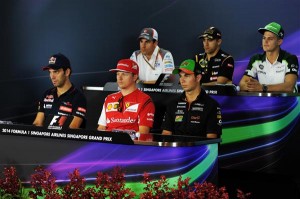
Sergio Perez: Image courtesy Sahara Force India Drivers – Marcus ERICSSON (Caterham), Pastor MALDONADO (Lotus), Sergio PÉREZ (Force India), Kimi RÄIKKÖNEN (Ferrari) Adrian SUTIL (Sauber), Jean-Eric VERGNE (Toro Rosso)
PRESS CONFERENCE
Q: First of all, a question to all of you about the ban on large amounts of radio traffic between the team and the driver. What’s your reaction to this? Sergio, perhaps you could start.
Sergio PÉREZ: Hi everyone. I don’t think it’s ideal that they, suddenly from one race to another, they change it dramatically that you cannot get certain calls. But it doesn’t influence it much. I don’t see it as a big deal, it’s something that we as drivers need to get more used to. We will have, definitely, more information and we’re going to be a bit more busy throughout the race to basically try to keep everything under control – fuel loads and engine modes, all that kind of stuff. I don’t see a problem to get used to, it’s just a dramatic change from the last race to this one.
Kimi, you famously told the team “leave me alone, I know what I’m doing.” Does that mean you welcome this change?
Kimi RÄIKKÖNEN: Well, obviously we don’t speak a lot on the radio in my case usually, when there are no issues – but obviously it might get quite complicated if there are some problems with the car and you have to change certain things to try to finish the race. I don’t know how the rule goes at those times. Obviously it makes it more complicated for us but it’s part of the game so it’s OK.
Pastor, your thoughts on it.
Pastor MALDONADO: For sure it’s not a great thing, especially with all the complex systems we have at the moment – but it’s the same for everyone so it doesn’t matter.
What about from a rookie perspective. Presumably there’s been quite a lot of coaching going on over the radio Marcus, so far this season. Are you going to miss it? Particularly on the approach to the start, getting everything prepared for a start, for example?
Marcus ERICSSON: No, I think… I like the idea, to be honest. I think it’s good to get the drivers more in focus. I think it’s good. But for us as a small team I think it’s a bit more trickier because our steering wheel, we don’t have a big display. A lot of the other teams, I think they have a big display, so they can show a lot of stuff on this, whereas we have a very small one. So it’ll be a bit more tricky – but yeah, like I said, I like the idea and I think it’s good to make us drivers a bit more in focus.
Jean-Eric, are you supportive as well?
Jean-Eric VERGNE: I don’t mind it. I think it will be more or less the same as before. I like to do things by my own and many times this year I changed the settings before my engineer told me, so yeah, I will be a bit more lonely on the radio – but it should be fine.
Adrian?
Adrian SUTIL: No problem really. I think all manageable. It’s a bit more work but we’ll handle it.
Q: Kimi, coming back to you, obviously this season hasn’t been quite what you expected it to be – but did you expect to have your problems sorted out by now? And what’s your focus for the remaining six races or so?
KR: Obviously to do as well as we can and have good results for the team and for myself. I expect it to be difficult. Probably the team didn’t expect to have such difficulties over all. We expected to be more stronger overall. It’s part of the game and we have to try to sort things out. I think we have done pretty good improvements – compared to where we started – as a team and obviously then I’m getting more happy with things but obviously still not where we want to be in the end. Still a lot of work to do.
Q: Pastor, front row qualifier here two years ago with Williams, it’s always been a strong Lotus track – so is there some optimism there for a top ten result maybe this weekend?
PM: I hope. For sure, the qualifying pace is always a bit tricky for us but during the race, for any reason we are able to recover the pace and sometimes we are much more competitive. So hopefully here we can be a bit more competitive than Monza for sure but it’s difficult to say something before we get in the car.
Q: Sergio, you’ve scored points in all three of your appearances here at Singapore and you’ve come off the back of two strong results, so your thoughts on this race and also how close you are to committing to Force India for another season?
SP: I think things are settling down and I think we should be very close to committing for next year with the team but you never know; I have experience from the past so you never know what’s going to happen. Yeah, we are really optimistic for this weekend. We have a good upgrade package and I believe we can be competitive and definitely our target is the McLarens which we are fighting with really closely and hopefully we can score more points than them this weekend with both cars and the upgrade package gives us some boost.
Q: Adrian, like Sergio you’ve scored points in your last three races here in Singapore but there’s no getting away from the fact that Sauber is yet to get into Q3 this season, so what’s the rescue package and what lies ahead for the rest of the season?
AS: We have a good package here, the last one, but it should give us a little bit more speed. We have to try it out on Friday. We’re not so far away – especially in qualifying – from the group in front and it’s just missing a little bit to the top ten normally but Monza was quite tricky, especially in the race. We were losing a bit too much time and our performance was a bit slower but this track is very special and very different so I hope it suits our car. There’s a lot of work, we need some points and this is the main target for the moment.
Q: Marcus, since the last round, obviously the team principal has moved on so can you tell us a bit about the structure now at the team and the plan for upgrades and so on?
ME: We’re still pushing hard like we’ve done the last couple of races and bringing some more updates for here, so not much has changed. Obviously Christijan left which is a shame, we got along very well, but still I think the team is pushing on quite a lot and it’s a positive atmosphere from everyone. We just have to wait and see this weekend, see how it suits our car but in general I have a good feeling. I had a really strong race last time out on a street track so I think hopefully we can try and repeat something similar to that.
Q: Jean-Eric, still six races to go but you’ve already scored points more times this year than you did last year so what’s the plan now for you for the rest of this season and what about next season? Have you made any progress yet with your plans for 2015?
J-EV: Yuh, talking about this weekend and the race and the season, I really want to end the season strongly. I think we should have had a lot more points with our team if we didn’t have so much bad luck but I think now that’s behind. I really want to make the best out of the last six races with Toro Rosso and then find a good option for next year.
QUESTION FROM THE FLOOR
Q: (Heikki Kulta –Turun Sanomat) Kimi, it’s two hours in very humid conditions; Nico Rosberg said that the last laps are always very painful here because it’s physically so demanding. How painful are they for you?
KR: I don’t know. Everybody has their own feelings so I can’t know how they feel like but in the past it hasn’t been a problem. It doesn’t feel as hot or humid in the last years unless the course has slowed in the race, so I don’t see why it should suddenly be a problem.
Ends
-
I feel excited for tomorrow. I am proud of my team: Hamilton after taking Monza pole
1 – Lewis HAMILTON (Mercedes)
2 – Nico ROSBERG (Mercedes)
3 – Valtteri BOTTAS (Williams)
TV UNILATERAL
Lewis, it’s the first pole since Barcelona since Barcelona back in May. It’s been quite a journey since then to get to this point. How do you feel?
Lewis HAMILTON: I feel excited for tomorrow. I’m very proud of my guys. My guys on the side of the garage have also been through the difficult time with me and they’ve done a remarkable job in terms of every time bouncing back and fixing the car and dealing with the difficulties so we’ve done this as a team and it’s great to have another one-two for the team and I’m really proud that I can be up there for them.
Well done. Nico, you were up by a tenth-and-a-half at the end of the first sector on that final run, but then it got away from you. What happened?
Nico ROSBERG: A tenth-and-a-half relative to Lewis?
Yes, Lewis’ benchmark, which he did on his first lap [in Q3].
NR: Yeah, but we’re always going to be quicker in some parts and slower in some other parts, so relative to my own [first] lap it was an OK lap, so from that point of view second place is still a good position for tomorrow. It’s a long race you know, everything can happen and so just need to now work towards the race and try to get a good start and have a good race. Anyways, also, I mean, definitely the team again. It’s so great. Even on a track like Monza, where it’s such a different track to all the others and even coming here, still we’re so dominant and that’s great to see. Of course it’s only qualifying and the race remains to be seen but it’s really awesome. The team is doing a fantastic job.
Coming to you Valtteri. Your third top three qualifying in the last four races. Particularly strong long runs yesterday in free practice. Does that suggest that you can challenge these gentlemen for the victory tomorrow?
Valtteri BOTTAS: I really hope so. From Friday to today they seem to have a bit more pace. In qualifying we expected that maybe we could be a little bit closer to them today but yeah, I really hope so. I think we have solid race pace and it just depends how much more pace they have left than on Friday.
OK, thank you very much. Coming back to you Lewis. Obviously the margins are always pretty fine around here. How do you feel about the race tomorrow? You’ve got some points, clearly, you need to make up, any suggestion of team orders or are you free to race?
LH: Free to race. That was the decision last week, so it continues as usual. I hope that tomorrow… it would be really good to get another one-two for the team. I think they’re working extremely hard. I hope that we also have some competition from these guys [Williams]; I think that would be really great for the fans. As for me, I feel, I feel… I’m looking forward to it.
PRESS CONFERENCE
Q: Lewis, I guess the key really is to put a complete race weekend together, that’s what you’ve been looking for, for some time. Did you feel, coming into this weekend, and do you feel again now, that this would be that weekend that would give you that momentum back.
LH: Well to be honest, for probably at least seven races I’ve always gone into the weekend thinking that it could be a clean weekend. We saw the issue that we had yesterday and, again Nico had a problem today. It’s definitely an area that we’re focussing on to try and improve as a team but, y’know, I’m grateful to have got through qualifying today. It was kind of a very clean qualifying session for me, for once. And so, yeah, it’s a great feeling to be up here.
Q: Nico, Lewis mentioned there the problem that you had this morning with the electronics on the gearbox which meant that you didn’t really do any meaningful running. Where you able to bounce back today? Do you blame what happened here today on that loss of time this morning and the preparation of things like the braking points and that precision that’s needed for a lap around here?
NR: To be honest, straight in the first run in qualifying I had a good feeling and the car was better than yesterday in many areas. Adapted the setup overnight and worked on it so actually I got straight into it. I was happy about that feeling because I was expecting it to be a bit more complicated but that was good, definitely. So, from that point of view, qualifying was OK.
Q: Valtteri, when you talk to engineers here, they all say it’s incredibly difficult for a driver to get all four of those big brakings around this circuit absolutely perfect. How close did you get to that today and how do you feel about it?
VB: Pretty close! There are many braking zones that are quite bumpy here and with the low downforce and coming in at really high speed it’s not easy – but today managed to hit them quite well, the correct braking points, and lap by lap the lap times were really consistent so I really felt today there was not much more in the car – so we definitely have some work to do.
QUESTIONS FROM THE FLOOR
Q: (Frederic Ferret – L’Equipe) Question to all three drivers. What are your thoughts on the new Parabolica? Is it the same way of driving and attacking it, or is it different? You can take some more risks?
LH: I think naturally you can take more risks. In the past it was a corner that you really had to build up to and you really did not want to go past the limit because you would be in the gravel and it’s hard to get back from the gravel at that place. Now, of course, you can attack it more. I go in with the same mentality but you do know you have that cushion there if you have an oversteer moment or you went in too far, you can run wide and come back on. That’s the same everywhere really, that they do that.
For the race?
LH: For the race, yeah, for sure it makes it a little bit easier in the race but I haven’t been anywhere near the green or out of the white lines so I don’t really know what it’s like out there – but it is a safer option in terms of stopping the cars if there is a problem there.
Your thoughts Nico?
NR: I think they’ve done well. Of course it’s a pity because it’s more exciting, in a way, the way it used to be, y’know? But we all need to think about safety and it was one of the most dangerous corners in the year – so I think it’s the right way to go, what they’ve done. And also , it works out really well because as soon as you do put the tyre over the white line, you lose grip because of the metal thing that’s there, and so it works out pretty well actually.
Valtteri?
VB: Yes, I pretty much agree with the guys. Yeah, it’s not the same as last year. It takes a bit more time to build into it, to be absolutely on the limit. It’s just a bit less risky really, that’s it.
Q: (Heikki Kulta – Turun Sanomat) Valtteri, our rally hero Markku Alen is here and he’s very famous for his slogan ‘Maximum Attack’. Was this your version of ‘Maximum Attack’ today?
VB: Yeah. It’s always maximum attack! You always aim for that. You always want to do your best – but trying too much, it doesn’t help. There’s a fine line with a maximum attack.
Q: (Péter Farkas – Autó-Motor) Lewis, you seemed to out-brake just a bit yourself on your first lap in Q2 which proved to be your best in Q2 – which means you have to start on that set of tyres. Is it a concern for you?
LH: Erm… I don’t remember that to be honest. I didn’t have any problems with the tyres when I finished the lap, so they’re fine.
Q: (Ian Parkes – PA) Lewis, Nico, congratulations on the front row – but how much will the words of your bosses be ringing in your ears as you approach the first chicane tomorrow?
LH: They won’t be ringing in my ears at all.
NR: It’s not changed. Already before, when we started the season, the message has been clear – so there’s no real change at the moment. So, from that point of change it’s the same as always, in a way.
Q: (Vincent Marre – Sport Zeitung) Nico, you say you improved the car since yesterday; I would like to know, technically speaking, how you improved it mainly?
NR: Mainly overnight, just looking at yesterday… at the running yesterday and the difficulties that we’ve had. The team made some suggestions because there’s also a whole group of people back in the factory looking at the computer and analysing. They made a good set-up suggestion which worked and then we just adapted it also here at the track, and I was quite pleased about that because it felt a lot better. Roll-bars, for example.
Q: (Livio Oricchio – Universo Online) Valtteri, considering it is difficult to fight with Mercedes, who do you consider can try to beat Williams tomorrow? Do you think Red Bull, McLaren and Ferrari can be up with your team?
VB: I don’t think we should ever under-estimate them. Like we saw last week in Spa with the Red Bull, they were really quick and we didn’t expect to be behind them so we should not under-estimate but we are a bit more confident here than Spa for example. Hopefully there’s not much threat from behind us and hopefully we can mainly focus on things happening just in front of us or hopefully we can really challenge them, but let’s see.
Q: (Ian Parkes – Press Association) Lewis, Nico, you’ve both had issues this weekend, Lewis yesterday with electrical, today Nico with a gearbox. You seem to keep having these little niggles, these technical issues. Are there any concerns going into tomorrow’s race, that you can both have a clean race throughout?
NR: It is an area which we need to keep working on for sure, also medium term to make sure the car is working 100 percent all the time, but it is a challenge, it is difficult but we’re getting there. I’m very confident for tomorrow.
LH: It’s a little bit different for me because it’s happened quite a few times on my side of the garage. But… no, I feel optimistic, I think the guys have rectified whatever problems we may have had this weekend. Yeah, it’s not really a mindset you can go into a race with, thinking ‘what if?’ You go into it with ‘this is what I have and I want to do the best with it.’
Q: (Barna Zsoldos – Nemzeti Sport) Niki Lauda was a bit upset after Spa because you tried a risky overtake on the second lap. Now, if you will have the chance on the second lap, will you go for it again or will you wait a little bit?
NR: It’s a question that I’m not able to answer. The message is that we’re keeping on racing, that is the message, that’s the way it is. And then every situation is different. And Niki has apologised for that also which was great.
Q: (Andrea Cremonesi – La Gazzetta dello Sport) Nico, you haven’t won in Formula One here in Monza if I’m not mistaken. At the same time, you are leading the championship with quite a good gap. Tomorrow, what is your aim: to become a new winner here or to conserve the second position, thinking about the championship?
NR: Well, first of all Monza is a special place, also for me because I really like Italy, all my friends are Italian, so it’s great to race here and great also in front of the tifosi and they give me a lot of support which is great. I really enjoy that and I’m very thankful for that. And then at the moment I’m out to win, it doesn’t matter where we are, I’m not thinking about the end of season yet or things like that. It’s really every race, try and get the best out of it and try and win the race.
eom
Poleman Lewis Hamilton flanked by championship leader and teammate Nico Rosberg to his right and Valteri Bottas to his left at Monza on Saturday. An AMG Mercedes Petronas image -
Drivers’ championship is the most important: Toto Wolf, Mercedes
TEAM REPRESENTATIVES – John BOOTH (Marussia), Paul HEMBERY (Pirelli), Federico GASTALDI (Lotus), Toto WOLFF (Mercedes), Marco MATTIACCI (Ferrari), Christian HORNER (Red Bull Racing)
PRESS CONFERENCE
Toto, could I begin with you? First of all, can you bring us up to speed with what happened to Lewis Hamilton this afternoon; we saw he lost at least an hour of running. What was the problem and what else have you lost?
Toto WOLFF: Yeah, obviously not very good. We lost a lot of running due to an electronic problem, which we need to identify yet. It shouldn’t be a big issue but losing valuable time in free practice two is obviously not perfect.
Looking back to the last grand prix, can you tell us what new rules have you imposed on the drivers since that collision in Spa and given that there will always be, I guess, close calls on track between drivers in a tight championship fight, are you convinced that they will be enforceable?
TW: First of all, you know, if that particular incident would have happened somewhere back in the field it would have… or it has been actually judged as a racing incident. Now you don’t want to see these kinds of things between team-mates and I think this is valid for any other team and particularly not between team-mates who are racing each for a win, for a podium. We’ve made it very clear that we want to stick to our philosophy in letting the drivers race – it’s about the Drivers’ Championship, we acknowledge that, that this is the most important championship. Nevertheless, what we said from the beginning was that there shouldn’t be any contact between their cars and I guess this is valid for us and it is valid for any other team and this is why we re-emphasised that point.
Christian, coming to you, it looked pretty close today in terms of times at the top of the running and two wins in the last couple of races. Does this give you belief that maybe you could pull off an unlikely ambush in the championship?
Christian HORNER? Well certainly Spa was a big surprise for us, we didn’t expect to be competitive there and ended up winning the race. Monza is a different challenge. We can’t go any lower on downforce without taking the wings off. Obviously everybody has come down on downforce level this weekend. Hopefully we can put in a good performance tomorrow, get as high up the grid as we can and have a grandstand seat to see what happens between the Mercedes boys at turn one.
Obviously engine penalties are looming, with only five engines per driver allowed this season. Can you tell us what has been discussed in your planning meetings on this, what it’s yielded and how you think it might affect these next few grands prix in the championship?
CH: Well it’s inevitable for us that with the amount of failures we’ve had this year that we’re going to have to take an additional engine at some point. We don’t have to take it just yet but certainly over the next four races I would think we are going to be faced with that question. Where other teams are in their sort of duty cycles with their engines and gearboxes is unknown to us. So we can only focus on ourselves and deal with issues as they arise. Sebastian’s situation is slightly worse than Daniel’s because he’s had the lion’s share of issues during races on his power unity. So we’ll see how the next couple of events go.
Thank you very much for that. Coming to Federico Gastaldi, the Deputy Team Principal of Lotus. Obviously Gerard [Lopez] is unable to join us I take it?
Federico GASTALDI: He was trying to… actually he’s here at the race track but for some reason he was stuck in traffic and he might be arriving any minute, so I apologise for that.
OK, so let me ask you the first question I was going to ask him, which is that there’s quite a contrast between the Lotus of 2014 and the Lotus of last season?
FG: This year obviously with the new regulations, I mean everything has been a big change for everyone, but for us certainly it’s very, very tough. Actually at the beginning we thought it was only an engine problem but as the season kept going we found out we had different problems. We try to learn from every race and we try to improve for the next one but so far it’s not been very positive for us, that’s all.
And what measures are you and Gerard and the rest of the management team putting in place for the future?
FG: We are trying to… everyone know we have lost very good, experienced people form the team, going to other teams and that affected us a lot and also we were trying to find a solution for the engine, so that’s the key for us.
Thanks very much. Coming to you, Marco. Obviously it’s your first Italian Grand Prix as a team principal of Ferrari, so can you describe your emotions, your workload and obviously your feeling on the performance today?
Marco MATTIACCI: It’s my first Monza, as you said. I’m impressed about the passion around Ferrari. To see all these children outside, people cheering at us, it gives us positive pressure and responsibility and motivation to keep working very hard. It is Friday, we have good indication that we keep working consistently, but it’s still Friday, so I would until Saturday afternoon, Sunday afternoon.
In your various appearances here over the course of the year so far you’ve given us your vision. You’ve been arguing recently that you think there needs to be a change to the rules to developing engines in-season. Why do you think that’s the right thing to do for Formula One?
MM: We’ve been discussing this all together, so I think that Formula One is about innovation. I think that naturally who did a fantastic job, it’s important that it’s clear that he’s ahead, but I think that to wait one year, to give possibility to catch up with the best, to develop and to innovate is too much. I think fans sometimes they don’t understand why we need to wait so long to close the gap. But at the same time I think that we can find a balance to do some productive progress and probably loosen up the rules in order to see a little bit of work on the engine, to let our engineers be creative and to improve.
Thank you very much for that. Obviously yesterday we heard from Max Chilton about the situation in Spa regarding him. In your mind is that now fully resolved and where has it left you?
John BOOTH: Well, I don’t want to dwell on it for too long, I think we’ve done it to death over the last two weeks. Obviously down at our end of the grid sometimes these things happen. We normally like to deal with all this sort of stuff in house but with a four o’clock deadline on Thursday at Spa it wasn’t possible. But we managed to resolve it overnight and things were back to normal and the important thing is that we look forward and move on.
Turning to your driver, the other driver, Jules Bianchi, he obviously got himself into Q2 again at Spa. With your extensive experience over the years of young drivers, how would you describe his development and do you think you can hold onto him again for next year?
JB: The first part is pretty easy. Jules is obviously a very special driver. He’s always been quick – from the first day he sat in the car at the second winter test at Barcelona. But now he’s got much more maturity. He’s learned how to manage tyres, how to manage his pace, manage to manage the whole race situation. I think he’s maturing into as top-line driver. As regards holding on to him, maybe I’m not the person you should be asking?
Maybe we’ll ask Marco about that?
MM: Bianchi is a guy that is coming out of the Ferrari driving academy, that is a very important project for us, and it is clear that we want to venues for a talent to express himself. So that’s what we are going to work on.
Finally, Paul: a home grand prix for Pirelli, so tell us what you’ve learned today about the performance of the tyres, what we’re likely to see in terms of strategy?
Paul HEMBERY: It’s pretty straightforward from our point of view. It’s a circuit that is low on abrasion. High speed is the biggest challenge, so structurally it’s a challenge for the tyres. The difference between the tyres is about half a second, six tenths, so not a great difference to create any interesting strategies. You lose a lot in the pit lane here, so like last year looking at a one-stop race.
The tyres this year, generally though, have made for races where there have been a number of strategy options. Do you feel enough has been made of the impact that this has had on the racing?
PH: I think it’s been a reasonable balance. We are having less stops, coming up to about one per race less than in the past. But this year was always going to be about the new technology of the vehicles and quite rightly. The change in regs has given us some pretty exciting racing, which has been wonderful to watch.
QUESTIONS FROM THE FLOOR
Q: (Daniel Ortelli – Agence France Presse) A question for Toto. It’s not a question about Hamilton and Rosberg, I hope you’re happy. It’s about the Russian Grand Prix. There’s a lot of talk about the Russian Grand Prix this week. I want to know what’s the position of your title sponsor Petronas about the Silver Arrows racing in Sochi a few weeks after the tragedy of the Malaysian flight?
TW: I would have preferred the first question. You know we are a sports team and we are a sports team and I think that sport should unite. We must rely on the governing body and the promoter to give us guidance and to give us information. It is always dangerous to read the news and build an opinion, because that opinion could be very wrong of what is really going on. And I think this is what we are going to do, rely on the opinion of the FIA and decide or then go forward, with their guidance
Q: (Ian Parkes – Press Association) Toto I do have a question about Nico and Lewis. You were quoted in a radio interview that you would potentially risk changing your driver line-up should there be any further indiscretions from your drivers in the future. Could you just clarify that remark as to what circumstances would force you make what would appear to be a drastic change?
TW: This was exactly the context – what would happen if we could not get on top of the situation. Obviously at that stage we are very happy with the line-up of the two drivers and we’ve always said that. We trust them and we had a very good discussion with the two of them, a very clear discussion, and we’ve always said that this shouldn’t happen and I think at that stage of the season maybe it was important to re-emphasise that. My statements were about what would happen if we wouldn’t get on top of it and this is something obviously which is a very, very worst case vision and I don’t think that we were ever going to get there.
Q: (Péter Farkas – Autó-Motor) Marco, it’s a question to you. I’m afraid it’s a dead-end but I have to ask it: there have been some vile rumours during the weekend that Luca di Montezemolo was leaving, you were leaving as well or maybe replacing him. Could you please comment on that. Is there any base to them? And will you elaborate on it later maybe?
MM: No, I’m not going to elaborate. I’m not going to comment on rumours. I have so much things to do. I spoke to Mr Montezemolo half an hour ago. Plenty of work on my table. To even comment on rumours is going to be extremely difficult for me also. No comment.
Q: (Dieter Rencken – Racing Lines) To the five team principals. In Spa we heard that Max Verstappen will take the start next year at the age of 17. This morning we had a driver who doesn’t quite qualify for a superlicence yet ran FP1. Jacques Villeneuve in Spa said that he thought this was an indictment of the ease with which you can get a superlicence. Do you people believe that it’s actually right for drivers with that little experience to get superlicences the way they are?
JB: First of all, the driver in FP1 today, I know he doesn’t quite qualify for a superlicence at the moment but he is a driver of the highest order who will make a very good grand prix driver in the future. As for the Max Verstappen situation, I think it’s far too early to tell.
Federico?
FG: I think they should have more kilometres under their arms. They should have definitely much more experience, like in the old days.
Christian?
CH: I think it’s a case of if you’re quick enough, you’re old enough. Very seldomly a special talent comes along and warrants a place in Formula One. We saw it with Kimi, we’ve seen it with other drivers that have progressed very, very quickly. Verstappen quite clearly is a considerable talent. I think what we’ve seen this year with the change of regulations is that a Formula One car is probably as easy to drive as it’s ever been, which makes the transition from the lower formulas much easier. There aren’t the G-forces, there aren’t the loads on the drivers and the physical demands on the drivers. You’ve seen the graduation of Daniil Kvyat, jumping from GP3 to Formula One who’s performed tremendously well. So I think that gave us all confidence at Red Bull. Verstappen is quite clearly a hugely talented youngster, Toro Rosso’s purpose is to develop young talent and give that talent an opportunity and therefore it was logical to give him a try.
Toto, “A Formula One car is as easy to drive as it has ever been,” says Christian. Do you think that’s a good thing?
TW: First of all, coming back to FP1 this morning, the boy who was driving in FP1 is an ex-F3 European Champion and he’s 22 or 23, so it’s a different situation. I think if somebody’s good enough, he deserves to be in a Formula One car. Now, we’ve had the discussion this morning and we still believe Formula One is the pinnacle of motorsport and Formula One drivers should be people who inspire, drivers who inspire, and they should have the qualification. I think this could be an endless discussion: somebody who is very talented, does he deserve to have a seat in Formula One? The example we discussed this morning was Kimi Räikkönen. So we’ve seen that in the past. I think he probably deserves a go in Formula One because he has shown great talent in the categories below, in karting and in F3.
Marco, coming from a business background, it’s all about empowering talent do you think? What’s your take on this situation?
MM: Usually I doing judge on demographics and passport about people. Let’s say if he’s a talent… what I’m a little bit concerned could be the message that will be send out to those thousands of kids starting to approach racing or karting. I think we need to be sure there is a path to arrive to Formula One. Naturally, to define a talent is quite complicated but I think we need to give opportunity to young people – but at the same time I think we need to, as we’ve been doing this morning, to think about what could be the perimeter of this and be very careful about the message because there is a lot of passionate people around the world of racing. There’s a lot of young people and we need to be careful because we’re talking about impressive cars with impression technology.
Q: (Leigh O’Gorman – Walker Watson) Toto, you made comments recently that you may be putting together a junior programme for your F1 team. Any updates on those comments? And could you elaborate on a route or a programme that you’d give to that driver?
TW: There is a great history in the Mercedes-Benz junior programme, many years with Frentzen, Wendlinger and Schumacher. We have a junior programme, we have obviously a good F3 engine and some of the boys we co-finance, we help them in racing the budgets to finance those engines. This is already happening since many years. The idea was in further expanding that programme, similar to the one 25 years ago. We’ve started to think about it. We had a look at some of the very good boys but we are not yet ready – and the simple reason is that there is a championship in our way. In the next two-and-a-half months we should be concentrating on getting that done – and probably over the winter we’re going to structure a junior programme and I’m very much in favour of doing it. But if you’re going to do it, you need to do it properly.
Q: (Michael Wittershagen – FAZ) Question to all of you. Apart from contracts and the FIA guidance and the Russian question, do you still feel comfortable in racing in Russia in four weeks’ time and entertaining Mr Putin or do you think there is a responsibility for sports like Formula One not to do things like this?
PH: From our business point of view, Russia is an important country for us, we’ve got two factories there and globally we’ve been internationally training for over 140 years. So, we will continue to operate across the globe and in those years, you can image there has been all sorts of worldwide incidents and situations. So you have to take a slightly longer term view. I agree with the comment of Toto. At the end of the day, if there’s going to be an event we’re the people that are supplying the tyres and if the sport is going there, we’ll be going.
John?
JB: I think very much I refer back to what Toto said when he was first asked the question. We are sports people and we operate under our governing body’s regulations and we have to follow their advice on where we’re going to race.
Federico?
FG: Same thing actually. We’re part of the event so we have to be there. Politics or not politics, we don’t control that.
Anything to add Christian?
CH: Nothing to add really. If there’s a race, we’ll be there.
Marco?
MM: Aligned.
Q: (Kate Walker – crash.net) Nothing has been confirmed but it has been discussed that both NATO and the EU will try to implement sporting sanctions against, not just us, but the World Cup, other events. Sporting sanctions are not legally binding however. Would any of you choose to go against those sanctions if the race were to go ahead?
Toto? Third time around. I think everything has been said. Your question relies on information out of the news. We haven’t gotten yet a formal opinion or guidance from the FIA and I think we need to wait on what they say. This is the role that the FIA has. Obviously once there is an opinion, once there is a guidance, we will discuss it.
PH: Again, it’s worthwhile saying, that until you have the information and it’s not press speculation, you cannot say anything.
Q: (Ian Parkes – PA) There is a banner in the main grandstand opposite the pit straight that you may have seen today. It reads ‘Ugly Circuits, Ugly Cars, No Engine Sound, F1 is Dead’. That banner may have only been put together by one person or a small group of people but how do you feel when you see something like that inside what is one of F1’s most historical venues – and what can be done, again, to change that kind of negativity that is currently swirling around the sport? That’s to anyone who would like to answer but perhaps Marco first, as Ferrari team principal.
MM: I don’t think that one banner sums up the overall opinion about Formula One, that I still believe is a phenomenal sporting platform. So, I think there has been enough excitement in the last races. It is important to listen to criticism, we are debating in order to address some of the issues but, again, I don’t see such negative, gloomy scenarios.
Christian?
CH: Who’s garage was it outside opposite? Opposite the McLaren garage or…? I’ve got nothing, I haven’t seen that one, I’m afraid.
Toto?
TW: Obviously everybody has an opinion and there are lots of forums where you can express your opinion. If I would have read all the opinions in the last two weeks I would have needed heavy drugs to survive that. So, another opinion…
JB: It seems a very strange place to talk about ugly circuits on one of the most iconic circuits that we go to.
PH: I think the racing’s been really good. I’m, y’know, Toto’s doing a one man job at the front there to keep us all alive but I mean I think it’s been a fantastic season, the racing’s been really interesting and if you sit back and look at it as a fan, it’s been very, very good.
Federico?
FG: It’s actually between McLaren and ourselves. I think I recognise people from Formula E putting that banner there. Listen, as Toto said, one thing in there. This is a fantastic race, it’s history. Come on.
Q: (Dieter Rencken – Racing Lines) We’ve heard from Marco regarding the engine unfreezing, if I can term it that, but we haven’t heard from Toto and also from Christian who’s the works Renault representative here. What are your thoughts on it, particularly in terms of the possible costs increases of an unfreeze?
CH: Well obviously Toto will want to freeze the engine for the next 25 years but we need competition, we need to catch up. I think as Marco said Formula One’s all about innovation and competition and I think that innovation and development is going on anyway but there are only certain junctures that you can introduce new technology and upgrades. I think with the chassis, you’re allowed to develop every race, you’re allowed to… if you start off poorly, you can develop your way out of it and I think that with the engine, all we need to consider without hopefully having a significant effect on costs is next year we’ll be allowed a power unit, perhaps more freedom to allow manufacturers to develop in order for that competition to be there to compete at the front.
Q: Can you do this without increasing costs, Toto?
TW: Well, there is another point besides costs. I think we need stability. Obviously we have a competitive advantage, it’s pretty clear at the moment but we would take the challenge on. I think it’s about defining what we want to do. We are twelve races into a season and we’ve had that advantage. Is it the time at the moment now to change the rules to change something? Maybe. I think we did… the discussions we’ve had so far were pretty open. There are various concepts on the table and if we decide to go completely in the opposite direction and to open it up completely, it’s like Christian said, we have four power units per drivers, this will increase the costs quite dramatically, not sure whether we could deliver all the same engines – all the same specification of engines to everybody, logistically it’s not feasible – so the devil lies in the detail but the discussion we are having is very open.
Q: (Kate Walker – crash.net) Again, question for everybody. I think we’re all in agreement that we’ve had a fantastic show this season, great racing, no complaints there. The big problem that we seem to have is that circuits aren’t getting as many fans through the gates because it’s too expensive and the fans can’t afford to pay to watch it on TV. So we’re giving a fantastic show and sending it out to a largely empty theatre which in the end hurts your bottom lines as sponsors pay less. Given that you’ve got contracts in place, what can Formula One do to make sure that people are watching the fantastic spectacle that we’re giving them, because they can’t get it now, which is the problem?
PH: I fall in two camps there because we’re also a sponsor. So, of course we look at all incidences, we look at what’s going on but we also see what’s going on in other sports because we’re involved in other sports. People often give the example of football but football is a tribal sport and it’s quite different to something like Formula One. The answers to the questions are complex, obviously. If they were easy, we would have done it. I’m quite sure that there’s a lot of people involved in the sport with a great deal of experience and a great deal of ideas, so if it was just a one-off shot to solve things, then it would happen. But the people around me here are involved in discussions, they have no strategy group which is involved in looking at different ways the sport needs to approach the public. We, as a sponsor, look forward to hearing what they come up with.
CH: Well, Red Bull for the first time has hosted and promoted a Grand Prix this year which was a great success. It was a capacity crowd, more than 100,000 people and there was action from start to finish of the weekend, on and off the track. Obviously it is a difficult question. Our responsibility is to put on the best show that we can and then obviously the different promoters – it’s up to them to promote that event and set their prices according to how they run their businesses, whether it be ticket price or television etc etc. I think our responsibility is to put the best show on that we can and then rely on the promoters to do their bit.
MM: We have been discussing about this several times and definitely they are open to do something different but again it’s a such wise discussion that there are so many variables and so many players that it’s quite a long discussion, and I think it has to be done with the right institution and venues because otherwise we keep throwing ideas that can create confusion. I think that there is an alignment that we need, an integration among all the players because, as you said, the product is great so that’s a great base to start, it has to be fine tuned but I think that’s beginning to work in order to make sure that we are aligned to promote the sport.
JB: I think people have more choice of entertainment than they ever had before. There’s so much out there for people to do and watch with their spare time, so that’s an issue. I don’t think it’s all doom and gloom. I think, as Christian said, the Austrian event was fantastic. Silverstone and Canada were both sell-outs but there have been a few that have been more disappointing but I think it’s not quite as black as some people make out.
FG: Quite the same, actually. We all agree here that we need to keep improving the show. I think we’re putting on a great show. There are other tools than television these days so there’s much more choice for the general public to watch or to interact with different sports. Also every race is a different story so as Marco said, the situation is very wide.
TW: I think everything has been said.
Q: (Luis Fernando Ramos – Racing Magazine) Christian, one of the big stories of the season is how quickly Daniel Ricciardo has established himself as a top driver, winning three races – in Spa, a very unbelievable race. Does Red Bull plan to adjust his contract of length and earnings of top drivers like Vettel, Alonso and so on?
CH: Well, Daniel is a product of the Red Bull Junior programme. He’s come up through that scheme, through Toro Rosso in the same way that Sebastian has and he’s done an unbelievable job. Winning three of the last six races is beyond all of our expectations, probably even Daniel’s, but he’s under contract until about 2030 but most importantly, more importantly than the contract, he’s enjoying being in the team as does Sebastian and I think that you invest in these guys, you give them the chance and I think Red Bull should be applauded for investing in youth and talent and coming up with talent like Sebastian or like Daniel Ricciardo that on pure merit, have come through the system and are now sitting in cars, doing what they’re doing.
Q: (Vincent Marre – Sport Zeitung) We have been mentioning new races that are coming but if there is one race that you would like to exclude from the championship, which one would it be?
JB: None.
PH: They’re alright.
JB: Every country is very interesting, every circuit is a different challenge. The variety of circuits and challenges around the world – I can’t think of one I would like to drop.
FG: They all deserve to be there. They work very hard to get it so they deserve it.
PH: It’s a bit negative as a question, why not ask what race would we add in to the calendar?
Q: To which you would reply?
PH: Well, Dieter’s there so South Africa, I think I would better say.
CH: As Paul says, it’s a question of… it’s a shame not to be going to venues: India was always a fun race, good track; Istanbul, again, from a circuit point of view. There are so many venues, it’s great that Formula One has got that competition for the 20 or so events during a year.
Q: (Silvia Arias – Parabrisas) Federico, you said that the team lost very important people during this season. I’m asking how difficult is it to find the right people again? Is it about money, about new talents? What is the main problem to get the right people back?
FG: It’s not about the money, it’s about the opportunity like any other job or opportunity for the people out there. If someone comes and offers you three times the money which you’re being paid, even if you are paying a very good salary, what will you do? It’s very hard to… even if you go to the best universities to get the best graduated guys in engineering, the guy needs to get experience. You don’t get experience in one day in Formula One so when they’re gone, it’s hard to replace them.
Q: (Peter Farkas – Auto-Motor) There was a team principals’ meeting with Bernie today. Could you explain what was on the agenda, has anything been agreed and have there been any new developments?
TW: Pretty much what we’ve discussed during the press conference. We discussed engines, engine homologations. We discussed young drivers, what we can do to increase ??? around Formula One. Nothing very spectacular. It’s just another meeting we had, another important meeting.
Q: (Kate Walker – crash.net) This is a follow-up question for Paul, based on what you said about being both a sponsor and a supplier. Given that we have new ways of accessing all of our sport, all of our media, to what extent do you take into account illegal streaming and torrenting of F1 to see how many eyeballs are viewing your product?
PH: We don’t. We still look at classical evaluation of television distribution.
Q: (Dieter Rencken – Racing Lines) Toto, you’ve been remarkably open about the meeting, the agenda that you had this morning so I wonder if you would clarify if you discussed budget caps, and if any form of cost-control is back on the agenda and was discussed please?
CH: Toto will now be in breach of his obligations as a strategy group member if he discloses any further information. His pass probably won’t work as he leaves this press conference!
TW: Yes, I think it’s very important to discuss costs and how to manage costs. That is part of every agenda, because we feel that we are responsible.
Ends
-
We are fighting closely with Force India and every point is important: Magnussen, McLaren
DRIVERS – Kevin MAGNUSSEN (McLaren), Max CHILTON (Marussia), Valtteri BOTTAS (Williams), Nico ROSBERG (Mercedes), Fernando ALONSO (Ferrari), Lewis HAMILTON (Mercedes)
PRESS CONFERENCE
Fernando, can we start with you? Twice a winner here obviously, on the podium here in Monza for the past four years, but the podium count is down a little bit this year, just the two so far. Do you see signs, though, of encouragement from the performance in Spa?
Fernando ALONSO: Well, definitely I think it’s one of the most important races for us in the year, here in front of our tifosi, and we would like to give them some good results on Sunday. I’ve been extremely lucky to have been on the podium in the last four years and hopefully I can repeat that good feeling. It’s going to be difficult. On paper it should be one of the toughest for us. But as you said, I think we saw some signs of being a little bit more competitive in Hungary and we were nearly on the podium in Spa as well with Kimi, so hopefully we can have that opportunity and as I said, being on this podium is something special.
You had quite a battle with Kevin (at Spa) and obviously he was penalised afterwards and we’ll hear from him in a moment, but can you describe the battle from your perspective?
FA: Obviously, you know, we try always to fight and overtake. More than 30 laps behind Kevin in Spa and it was not easy to overtake. I had one chance with some cars in front of us and I took that opportunity and at the end I went a little bit on the grass. The race direction decided to penalise him at the end. We gained that position; we lost a couple more because of that fight but when you are fighting for sixth or seventh at the end of the race it’s not a big deal.
Kevin, obviously you were hit with a penalty after that. Give us your perspective in the battle with Fernando.
Kevin MAGNUSSEN: Well, obviously I did my best to fight for sixth position. For us that was a really good result or would have been – sixth. In the end I went over the line and got a penalty. I guess that’s just something you learn from as well, it’s all good experience and I can always say I did my best. I enjoyed it as well. Hopefully, we can have another good strong race here.
Without that penalty you would have had a sixth points finish in seven races. Are you getting any signs of encouragement from the team that this is the kind of form that will keep you in this seat next year?
KM: We’re fighting very closely with Force India. Williams is a step forward compared to us, but we’re fighting for position in the Constructors’ Championship and every point is very important at the moment, so keeping consistency up is very important at the moment.
Well, obviously another duel that had everyone talking in Spa was the Mercedes battle at the start of the race. Nico, we’ve all seen the statement from the team and other things you’ve said since, but what persuaded you that you had something to apologise for because when we spoke after the race in Spa you weren’t sure?
Nico ROSBERG: Just with time. I took the week to think about it and had a look at it and discussed with the team on Friday and I just in the end decided that it was me who should take responsibility for it.
So, Lewis, in your mind, is it a racing incident? Is that how would put it in your mind now?
Lewis HAMILTON: There was nothing in my mind. I think this is the first time that we’ve been in the room for a long time that there have been so many people here. For me, I’m really excited about moving forward, I feel energetic, I had a good couple of days break last week, so excited to be here, this is one of my favourite circuits so I hope that we can have a good weekend.
And how do you move forward? Have you found a baseline, if you like, of trust and understanding to encourage you to believe that you guys can work together from here?
LH: I knew you were going to say that! I think I already said everything in the press release. Trust is a big word and it’s not something I would particularly apply to racing on the track. Naturally, me and Nico have been racing for a long time and I think we have set a good foundation a long, long time ago so that’s what we work from.
Nico, coming back to you, this duel is often compared to great duels from the past history of our sport. Are you becoming aware that the two of you are making history this year and do you feel the responsibility of that?
NR: Yes, definitely, yes. And in Spa, definitely I was not proud of the way it went because in general I really want to contribute to ‘my sport’ in inverted commas, you know, because I want it to be the most entertaining sport in the world and if I’m able to contribute to that in many ways throughout the season then I’m very happy about that and I’m sure in many we have and that’s great.
And Lewis, just a word from you on that: do you feel the hand of history on your shoulder? Are you aware of the responsibility?
LH: I don’t think I have a responsibility towards history. I mean, history is created every day. I just love racing and I’m proud to be amongst all the drivers here and I’m just trying to enjoy every single day as it comes, you know. Everything becomes history eventually and I personally don’t put us in the same ranking as the greats back in the day.
Thanks for that. Valtteri, coming to you. Another podium in Spa, the fourth for you now this year. You’ve generally been the fastest man throughout this season through the speed traps at a lot of places we’ve visited, so is Monza a potential fifth podium for you?
Valtteri BOTTAS: Well that should be the target. We don’t see any reason why it would be not possible, so we’re aiming for that. We know it’s a good place for us, one of the good ones. We do have good straight-line speed and a special package for here, as I’m sure everyone does. I’m really looking forward to this one and I really think Sunday will be good fun.
Williams wasn’t too far off a win in Austria or Canada. What will it take to get that final push to get you over the line?
VB: I think by pure pace, it is going to be really, really difficult. Mercedes is… any track they are going to be the strongest at the moment. Even Red Bull was surprisingly quick in Spa, so it’s never going to be easy but we are aiming for that and we still need to work on all areas of the car. We already have a good straight-line speed but all areas including, especially the corners, getting more grip into the car is the main thing really. We’re working on that. It’s still a long season to go, so let’s see.
Max, you were obviously on pole here in your GP2 days. Is this one of your favourite tracks?
Max CHILTON: Yeah, I think it’s everyone’s favourite or one the favourites of the year. I was on pole here in Formula 3 and GP2. I’m not saying I’m going to be doing that this weekend but I will give it my best shot and will try to extract the most from the car and I just enjoy being here. You only have to do the track walk this morning to see the old banking and it just gives you a good feeling for the weekend.
Can you shed some light on where you and your backers are now with Marussia after what took place in Spa? You said at the time that it was not what everyone thinks it was. So, is it resolved for you now for the rest of this year and what about 2015?
MC: Yeah well there was never really an issue in the first place. It was a busy weekend, I’m not going to lie, but it was a commercial decision that was overturned by senior management over the course of Thursday evening. So, my weekend didn’t really change. I was always out of the car for practice one for Alex, our reserve driver, and so it was nice to be back in the car for free practice two, because Spa is my favourite circuit so we ended up having a good race and a good weekend.
QUESTIONS FROM THE FLOOR
Q: (Ian Parkes – Press Association) To Lewis and Nico. In a TV interview earlier this week that Fernando did, he remarked that both sides of the garage would now be divided – engineers, mechanics, people that know you well would favour one or the other. Do you sense that within the team that you are now a garage divided?
LH: I don’t know if that’s the case. We have a very professional team and yeah I mean they just want to win. So they’ll be working as hard as they can. Also the guys working in the garage work collectively for the pit stops. That thought doesn’t even cross my mind. I think the guys will be working flat out this weekend. They know we have the chance to have one-twos and to win the championship for both the Drivers and the Constructors and I think they will giving it their all.
NR: I general, there has been throughout the whole season a healthy rivalry, within the team also. That is why we are where we are, you know. We have the best car out there, we have the best team at the moment. That’s because we work well together as a team and if you don’t work well together as a team you can’t dominate the sport as we are at the moment so I think that’s the best proof of that.
Fernando you were mentioned there as being quoted. Do you want to qualify your comments or add anything?
FA: No, whatever I say I will always be misinterpreted and always any comment you say after two or three days will be a big thing. I didn’t say exactly that but I cannot change the world.
You don’t want to clarify what you meant.
FA: It’s OK.
Q: (Frederic Ferret – L’Equipe) Question to Fernando, could you speak about your early days with Minardi and how difficult was it to begin your Formula One career at the back of the grid and not scoring points and not being visible.
FA: It was tough but it was worse at the end of the year, first year in Renault as test driver. As far as… you are driving, you are on the grid. OK, you are not able to deliver the result that you would like and to fight for the top positions but at least you are racing – which is what you have done for many years in go-karts and different categories. And then, OK, this is Formula One – but you are racing. When you are watching races on the television in the garage, that was very tough.
Q: (Péter Farkas – Autó-Motor) Lewis, do you now accept that it was simply a racing incident from Nico’s part, and Nico, do you think that, in fact now you will be at a small disadvantage because you will have to be extra careful not to have an accident in close combat?
LH: Well, again, I know it’s something you all want to talk about but after the race it was important to really try and move forwards and that’s really what I’m focussing on. What’s happened in the past is in the past and it is what it is. I’m excited to get back in the car. I have seven races, there’s still a lot of points available and so that’s my focus.
Nico?
NR: It’s been very clear from the beginning that we must not have contact between us team-mates. And so from that point of view the approach doesn’t change now for the future. It’s been the same.
Q: (Barna Zsoldos – Nemzeti Sport) Nico, as the tension in the Championship battle is getting bigger and bigger, have you prepared yourself psychologically for a very vicious media attack? What we saw in the past two weeks was basically some kind of witch-hunting already against you from certain journalists.
NR: I respect the opinions and then for me I really try and focus on driving my race car fast, working together with the team, getting the best out of the situation and also, importantly, enjoying the moment. I’m very, very lucky to have such a car. It’s very seldom in F1. I go to every race now and know that I can get pole and I can win the race with the car that I have. The team is doing an unbelievable job, also with the development. Keeping it up, y’know? Pushing further and further and further. The other guys are not getting closer really, y’know? So, that’s great and I want… my focus is on that: in the moment; make the most of it.
Q: (Ralf Bach – Sport-Bild) Lewis, a question for you, we learnt from last Friday that Nico gets punished by the team for the incident in Spa. What I want to know is: did you get punished by the team for not accepting the team order in Hungary as well or not?
LH: Um… well, I don’t know really. We all get punished for all the incidents that we… we have meetings always. We always get a big slap on the wrist. But as I said I’m moving forward. In actual fact in the first… in Hungary I didn’t say ‘no’ to the situation. I said that “if he gets close then I’ll let him by,” so I wouldn’t hold him up. And afterwards I sat with Toto and Paddy and they said “ you made the right choice.” As human beings, we have the right to question things that are said to us – orders – just to make sure that it is the right one. And it turns out that that one wasn’t the right one and the team said that to me in the meeting.
But it was a team order during the race…
LH: It was, but Nico didn’t get close enough to go by…
Q: (Vladimir Rogovets – SB Belarus Segodnya) My question for Fernando. You had already seven years ago the negative experience in partnership with Lewis but today I see you are friends – it’s very good. I think same compete between Nico and Lewis. My question: can you be the ambassador for peace between Lewis and Nico?
FA: Good! Ah, no I’m definitely not an ambassador for peace but yeah, I think 2007, I think it didn’t work as we wanted. But, as I’ve said many times, it never was a problem with Lewis. We had a very professional relationship, very competitive people inside the team and that was quite normal. It didn’t work because the team… I was not happy with some of the philosophies, and some of the team management at that point and I had more possibilities to go in different teams the year after and we decided to move forward from there. But I never had a problem with Lewis and it’s not a surprise today that we still have a good relationship and I’m sure these guys will move forward. As Nico said, they have a clear target, which is winning the world championship, both of them. They are in a privileged position, which is to fight for that goal. From the outside we will try to enjoy as maximum this beautiful battle. The sport is made of these kind of things. They have a good problem: fight for the world championship.
Q: (Andrea Cremonese, La Gazzetta dello Sport) Question for Nico and one for Lewis. For Nico, how has the booing on the podium affected you in Spa? If you think about that and are you afraid it can happen again? And for Lewis, what does it mean that you freeze the discussion for the future contract with Mercedes? Are you thinking something like Fernando’s strategy in 2007?
NR: It was definitely not a nice feeling to hear boos towards me. And I understand, because they travel a long way, some of them, to watch a great, exciting race; a big battle between Lewis and I, and they didn’t get that. I understand that and I accept that.
Lewis?
LH: Well, I haven’t said that I was freezing anything. We’re constantly talking with the team – but I think at the moment the priority is to win the championship. I still have a contract for a whole ’nother year on top of this one, so there is no rush. But I do want to say that I see my future with Mercedes. I’m really happy there, so…
Q: (Luis Fernando Ramos – Racing Magazine) A question to Lewis. You fought for the 2007 title with Fernando as an opponent in the team, and now with Nico in the team. Which of the two offered you a fairer fight on and off the track?
LH: That’s not really a particularly good question. When you’re fighting with your team-mate, as Fernando said, you’re fierce competitors but outside it’s really important to remain respectful and, I think I’ve had the pleasure of working with quite a few different drivers and every single one of them has been hard to race against, in a different way, a different manner. I think generally, the majority of the time, we’ve not really had many problems. And that’s what I hope for moving forwards.
Q: (Byron Young – Daily Mirror) Nico, could I just ask why you apologised? Was it because your team bosses made you or was it a heartfelt thing?
NR: They can’t make me apologise. It definitely was a decision that came from me after hearing people’s opinions and after having looked at it myself again. I felt that it was my responsibility.
What changed?
NR: Time. And hearing other people’s opinions.
Q: (Rosie Bailey – F1 Plus) Question to all of you: what do you think about the changes to the run-off area at Parabolica and how will it affect the way you approach that corner now? Will you take more risks because there’s tarmac instead of gravel?
KM: I do think we will take more risk… well, you’re not really taking more risk because it’s more safe and you can just go off the track and come back again and generally I’m not a big fan of that. I think it adds to the experience of driving at circuits if there is a little bit of a bigger consequence of going off the circuit. I’m not saying we should compromise safety but in my opinion, I don’t think we’re making the track more unsafe by having gravel there, but it’s still an awesome circuit – I’m sure – and I’m still going to really enjoying driving here, I know that for sure. But yeah, I haven’t driven it yet so we will see how it is.
VB: Yeah, I agree quite a lot with Kevin. I really think last year it was maybe a bit more challenging in a way because on the exit we were always going with the outside wheels just on the white line and you knew that if you went a couple of centimetres too wide that that would be it, you would go off, but now it doesn’t matter if you go a bit over the white line, you just need to keep at least two wheels on the track and that’s it. It’s still a good track. It’s just that one corner is less exciting.
MC: Yeah, I’m not a huge fan of it. I think it’s maybe allowed us to go for slightly more risky overtakes but I don’t see why they needed to extend it so far around. As Valtteri said, it was a bit of spice, the old circuit, where we used to run up against the white line and if you went slightly too far you would hit the gravel and you knew it was over. Now, to me, it looks like we can get away with it so I’m not a big fan of it but that’s the way it is.
LH: They’ve pretty much said everything. I think the FIA are very very conscious of safety and I think that’s nothing to shy away from, I think that’s a very very important issue but I’m old school, so I like the old circuits, back in the nineties when there was no tarmac run-off areas, where it was grass, because even last year, here, when you went round that corner, you didn’t, as I said, you know… and I experienced it last year, I went wide through a mistake and you pay for the mistake. But what is really important is that of course if you do have an incident the tarmac does slow the car down better, so that is a good move but you can’t win, both sides.
FA: I think they’ve said everything. Nothing to add.
NR: It was one of the more risky corners that we still had in our calendar so it definitely makes things a lot safer and that is the right direction to go in.
Q: (Livio Oricchio – Universo On-line) Nico, in a battle for the world title between two drivers, how important is the psychological war?
NR: Of course in sport it plays a part of it. Your performance is linked to many things and your mental state of mind is always important in sport.
Q: (David Croft – Sky Sports F1) Fernando, back to the Parabolica again; the FIA said it was the drivers that wanted to see a safer corner so how many drivers were consulted and who were the drivers who actually wanted that tarmac run-off area put there because the back row, I think, would have left it as it is? Lewis you spoke very well about the safety, but Fernando, who were the drivers who said we want this changed?
FA: I don’t know, I don’t know.
Q: (David Croft – Sky Sports F1) Did the GPDA not discuss this?
FA: As far as I know, I don’t think so. There have been some discussions in the past for the entry, probably in case you have a brake failure or something to have the possibility to not go straight, just into the gravel and hit the tyres but probably from mid- to exit of the corner, that was probably a surprise for us also. Which it still is I think. Artificial grass on mid- to exit which before probably we said that we can put two wheels out of the track and two inside and don’t pay a big price but I don’t agree. I think if you put two wheels now, you will go on that artificial grass and you have to back off because you have a snap on the car and you need to back off, so you still need to be a few centimetres from that artificial grass now to do a perfect corner.
Q: (Sarah Holt – CNN) Just one more question on Spa, if I could ask Fernando and the two Mercedes drivers as well: in a situation that we saw happen last time out in Belgium, when there’s a mistake by one driver and it effectively puts another driver out of the race and then the first driver makes an 18 point gain over the second driver in a hotly contested title race, should the FIA investigate the incident a bit more closely than they did in Spa?
FA: I don’t know why I need to answer so many questions on Spa! No, I would like to answer, you know, to be honest, because I have no clear input on that. It’s FIA rules and they get us to race in a fair way and to respect the rules and they always try to do that and if in Spa they didn’t decide to go any further, they thought that it was OK like this but as I said, I was not in that incident, I was not involved. I saw it the week after but I have no clear opinion.
Q: Nico, were you asked to clarify your comments or anything?
NR: No. Just we need to trust the FIA to make the right calls, that’s our position as drivers.
LH: I think the FIA have a really tough job, particularly over the last couple of years they’ve done an exceptional job, I think, on the majority of the calls. I think their problem is always that the rules… the scenario is always different, so the same rule doesn’t always apply exactly. Sometimes perhaps it’s difficult to say which rule applies to what situation but I think there’s a very good question, to be honest, because how do we move forward from that? Does that mean that we can all now say OK, we can race a lot closer and if the guy in front comes off and is out of the race, nothing’s going to happen so then we will be more relaxed towards it or does that mean if it happens again there will be a penalty? I think we’re always asking to be able to race. It’s very hard out there to manoeuvre a car at those high speeds without sometimes having contact but there’s a fine line. But I think it’s a really good question, I don’t know the full answer to it really.
Q: (Ralf Bach – Sport Bild) Nico, is it right that Niki Lauda talked to you in the week after the Spa race and apologised for the interviews he gave directly after the race at Spa?
NR: Yes, it’s true, yes, and that was a nice gesture of his which I have accepted, fully accepted of course, and also there, it’s a thing of the past.
eom/FIA transcript of the press meet
-
Hyundai celebrate 1-2 finish in first-ever WRC win; Ogier, Latvala retire
At the end of an astonishing final day of Rallye Deutschland that has seen two rally leaders crash, Thierry Neuville and Nicolas Gilsoul have claimed their first-ever WRC victory and the first win for the Hyundai i20 WRC. Remarkably, the Belgians were lucky to even start the event having rolled six times at shakedown which resulted in the team working 19 hours to fix the car for Friday’s start. To add to Hyundai’s celebrations, team-mates Dani Sordo and Marc Marti made it an impressive one-two for the Korean manufacturer in its debut year in the FIA World Rally Championship with the car. Andreas Mikkelsen and Ola Floene finished third, the only Volkswagen crew to make it to the finish of the rally.In the FIA World Rally Championship, Volkswagen crews continue to dominate, despite Sébastien Ogier and Jari-Matti Latvala retiring. The pair remain first and second with Mikkelsen third and it is now assured that a Volkswagen driver will clinch the Drivers’ title. In the Manufacturers’ Championship, Volkswagen’s fight for a second consecutive title continues, the German marque now 167 points ahead of the Citroën Total Abu Dhabi World Rally Team with four rounds remaining.Today’s route covered two loops of two stages over 74.60 competitive kilometres and looked set to see Jari-Matti Latvala claim his first asphalt rally win, which would also have put him firmly back in contention for the Championship title following the retirement of Ogier. However, the Finn went off in dramatic style in the opening stage, plunging through the vineyards and into instant retirement. Kris Meeke then looked set to become the first Briton to win a WRC event since 2002 until he too crashed out on the first corner of the following stage when a misjudged pace note resulted in him hitting a wall and taking a wheel off. Neuville then became the third rally leader of the day and, with a 37 second advantage over team-mate Sordo, was in a position to control the pace to the finish. Sordo, who won the event last year with Citroën, finished 40.7 seconds adrift and, with Hyundai claiming the victory it has ended Citroën’s 12-year reign of winning Rallye Deutschland and Volkswagen’s winning run of 12 events which began in Australia last year. Mikkelsen, in his first full Tarmac event in the Polo R WRC, finished a fine third despite a spin in the first stage. M-Sport team-mates Elfyn Evans and Mikko Hirvonen battled to the end, Evans taking fourth by just under seven seconds after possibly the best performance of his career which culminated in him winning the Power Stage. Mads Østberg claimed sixth in the sole remaining DS3 WRC and Martin Prokop finished further adrift in seventh.The FIA World Rally Championship contenders now head to the other side of the world for Rally Australia (11-14 September), the penultimate all-gravel round of the series.ADAC Rallye Deutschland – Final Unofficial Results (subject to scrutineering)1. Thierry Neuville/Nicolas Gilsoul Hyundai i20 WRC 3hr 07min 20.2sec 2. Dani Sordo/Marc Marti Hyundai i20 WRC 3hr 08min 00.9sec 3. Andreas Mikkelsen/Ola Floene Volkswagen Polo R WRC 3hr 08min 18.2sec 4. Elfyn Evans/Daniel Barritt Ford Fiesta RS WRC 3hr 08min 23.8sec 5. Mikko Hirvonen/Jarmo Lehtinen Ford Fiesta RS WRC 3hr 08min 30.7sec 6. Mads Østberg/Jonas Andersson Citroën DS3 WRC 3hr 08min 42.9sec 7. Martin Prokop/Jan Tomanek Ford Fiesta RS WRC 3hr 12min 13.0sec 8. Dennis Kuipers/Robin Buysmans Ford Fiesta RS WRC 3hr 16min 38.3sec 9. Pontus Tidemand/Emil Axelsson Ford Fiesta R5 3hr 18min 55.6sec 10. Ott Tanak/Raigo Molder Ford Fiesta R5 3hr 18min 57.4sec FIA World Rally Championship for Drivers (after 9 of 13 rounds)Sébastien Ogier (FRA) 187 points Jari-Matti Latvala (FIN) 143 points Andreas Mikkelsen (NOR) 110 points Mads Østberg (NOR) 74 points Thierry Neuville (BEL) 73 points Mikko Hirvonen (FIN) 73 points Elfyn Evans (GBR) 57 points Kris Meeke (GBR) 54 points Martin Prokop (CZE) 37 points Henning Solberg (NOR) 26 points Juho Hänninen (FIN) 20 points Bryan Bouffier (FRA) 18 points Dani Sordo (ESP) 18 points Robert Kubica (POL) 12 points Ott Tanak (EST) 11 points Benito Guerra (MEX) 8 points Hayden Paddon (NZL) 8 points Chris Atkinson (AUS) 6 points Pontus Tidemand (SWE) 6 points Jaroslav Melicharek (SVK) 4 points Dennis Kuipers (NLD) 4 points Nasser Al-Attiyah (QAT) 3 points Lorenzo Bertelli (ITA) 2 points Matteo Gamba (ITA) 2 points Craig Breen (IRL) 2 points Yuriy Protasov (UKR) 2 points Jari Ketomaa (FIN) 1 point Karl Kruuda (EST) 1 point Khalid Al Qassimi (ARE) 1 point FIA World Rally Championship for Manufacturers (after 9 of 13 rounds)Volkswagen Motorsport 305 points Citroën Total Abu Dhabi World Rally Team 138 points Hyundai Motorsport 131 points M-Sport World Rally Team 128 points Volkswagen Motorsport II 109 points Jipocar Czech National Team 40 points RK M-Sport World Rally Team 21 points Hyundai Motorsport N 12 points -
It’s one of the most special tracks: Nico Rosberg after taking pole
DRIVERS
1 – Nico ROSBERG (Mercedes)
2 – Lewis HAMILTON (Mercedes)
3 – Sebastian VETTEL (Red Bull Racing)
TV UNILATERAL
Nico, many congratulations, your first Spa pole. Typical Spa conditions of course today, tell us how special the feeling is right now?
Nico ROSBERG: Yeah, it’s awesome definitely at this track. It’s one of the most special tracks of the year, so to be in front here is great. Not quite as difficult out there as on some other occasions as the conditions were pretty much always intermediates, just varying slightly, so that made it a bit easier today. But still, it’s always difficult on this track in the wet, so I’m really, really happy. The car was handling well and together with my engineers we fine-tuned it perfectly now in qualifying and really got there in the end. So, in the end I was really feeling comfortable and able to push, so fantastic. But it’s only qualifying, so still a long race tomorrow but of course, very happy.
In terms of the detail, the first sector was always particularly strong for you throughout this qualifying session, why is that?
NR: I’m not sure, it’s Eau Rouge mainly the first sector you know. I was feeling good through there, really going for it and maybe that’s where the time was done. I haven’t looked.
Very well done. Coming to you Lewis, you were right in the hunt all the way through qualifying but it seemed, if anything, Q3 wasn’t quite as comfortable for you from the outset as the previous sessions had been, why was that?
Lewis HAMILTON: I had a glazed front-right or front-left brake, so the car was pulling to the left or to the right and there was nothing I could do on the out laps to try to get rid of that, so I was struggling under the braking. I had to bring the braking point a little bit further back and I was losing massive amounts out of particularly turn one.
Before that it looked like you were enjoying yourself out there, though. How much can you enjoy driving in conditions like these?
LH: It’s more fun in the dry but it’s still a huge challenge and as Nico said the conditions were quite good so…
Coming to you Sebastian, you were a winner here last year for Red Bull Racing. Your feelings on this result and what you can do from here tomorrow?
Sebastian VETTEL: Well, I think it would be nice to be a bit further up but obviously the gap is quite big. I think it was the best we could do for today. I think it was a tricky qualifying, especially Q2 looked very tight for us. I tried to stay out on the same set of tyres. It started to rain heavier, so I was quite confident that the track won’t get quicker and I wanted to save that extra set for Q3. It was quite tight. I got the lap in in the end because the circuit did pick up and in Q3 I was able to use both sets of tyres. It was obviously very tight behind the Mercedes. It was tricky out there, especially on low downforce, especially through Eau Rouge, so I had a couple of moments. But it was a good challenge and for sure happy with third.
Coming back to you Nico. You’ve never been on the podium before in Spa either. Clearly a big fight in prospect tomorrow in what promises to be, at the moment anyway, a dry race with Lewis and Sebastian. Your thoughts on tomorrow’s grand prix?
NR: Again, we have a great car here. We’re leading the way and that’s so cool to see that, definitely, that the team is doing such a great job. Just keeping it going all the time, staying ahead and keeping that gap. That’s nice to see. So yeah, definitely a really good chance tomorrow. I need to get a good start and from there I’m looking forward to it.
PRESS CONFERENCE
Q: Nico, one of the things that was noticeable from the outset of this session – obviously it was very wet, had been very wet before the start of the session – was the performance difference between the Mercedes and the rest, right from the outset of Q1. You’ve been quick obviously all season but was this about downforce? Was there any specific reason in your mind why you had such a big advantage all the way through?
NR: I have really no idea. It was amazing to see that, how quick our car is. That was really great. Obviously then it was just Lewis I had to focus on, and that makes it a bit easier too –when there’s not a whole bunch, just one guy. Yeah, but really impressive car.
Q: Lewis, you’ve got to go back to Canada in June for the last time you were this far up the grid. It’s been a difficult period of time for you on Saturday afternoons. So, although I’m sure you’re disappointed today, nevertheless this gives you the kind of platform you’ve been looking for on Sunday to challenge, right?
LH: I’m not disappointed today actually. If you look at the previous years, P2 is the best place to start here so I feel quite blessed that this is the case. I started on pole here last year and Sebastian flew past me down the top straight, so I think it gives you the most opportunity here at the start. And I’m just happy to be up here. I was nervous going into qualifying, not knowing if the car was going to make it through it, and grateful for all the hard work the team put in to make sure we have no problems. It’s a great feeling to be back up here.
Q: Sebastian, you mentioned driving this circuit, in these conditions, with low downforce and it did seem that Red Bull had decided to run quite low levels of downforce, obviously thinking ahead to tomorrow’s grand prix. Is that the case?
SV: Yep!
Q: And how did that feel? A gamble clearly…
SV: It was very tricky in the wet. We knew it would be even trickier obviously when qualifying is wet, qualifying was wet so we can confirm it was trickier – but the reason behind it is fairly simple: we know that we are down on power, obviously Mercedes can run a lot more wing level and they have a very strong car this year, you have to admit, so they have a lot of downforce but they can still take that wing onto the straights. If we do that I think we are similar in the corners but quite a long way off on the straights and therefore vulnerable in the race. So, I think that’s the reasoning behind it, and in the wet probably it hurt us a bit more, but hopefully tomorrow we’ll be closer in terms of race pace and closer to them than in the last couple of races.
QUESTIONS FROM THE FLOOR
Q: (Angelique Belokopytov – AutoDigest) Sebastian, you are a four time champion and this year you’ve never won a pole so how long can you, a champion, live with that?
SV: As long as I have to, I guess. I’m trying very hard so it’s not like I’m deciding consciously not to qualify on pole. Obviously these guys are doing a very good job from the drivers’ point of view, their team is very strong so that is what makes them very difficult to beat. Obviously we’ve been on the other side for quite a while but that’s the name of the game. Obviously my season wasn’t the way I was hoping for but there are still some races to come. I think we did the maximum today so I’m hoping for a strong result tomorrow.
Q: (Vladimir Rogovets – Sb Belarus) Nico, to your left is one champion, to your right is a second champion but today you have pole position. How do you feel here between two champions?
NR: I feel very good but not because it’s Lewis and Sebastian. To me they’re competitors like all the others: great drivers. I’m just happy to be first; first is the best position for tomorrow’s race.
Q: (Paulo Ianieri – La Gazzetta dello Sport) Nico, this morning the Williams were pretty fast and many people were expecting them to be a challenge in the dry. Do you think that having a wet qualifying helped you a little bit to keep them away or you just were hiding a little bit this morning?
NR: I think even in the wet we would have been strong. Maybe the others would have been a little bit closer. It’s very difficult to say who exactly, I’m not too sure about that but for sure it helped us that it was wet because in the wet, clearly the gap was a lot bigger and our car was really dominant.
Q: (Livio Oricchio – Universo OnLine) Lewis, you had a problem with your brakes today. In German qualifying you also had the same; you had a problem with the engine in other races; a lot of problems. How can you understand it, so many difficulties that you’ve had?
LH: I don’t really know. Today, this is a circuit where – as on all circuits – you need to have confidence in the brakes. You saw a couple of times in Q3 when I was just going straight on everywhere because the left brake wasn’t working and then for some reason – I don’t really know why – it went into glazing but yeah, I’ve had some good experiences and bad experiences but it’s OK. Who knows, it might be a blessing in disguise.
Q: (Sven Heidinger – Sport Woche) Lewis, do you fear that the issue with the brakes will appear again tomorrow or was it a one-off? What do you think?
LH: Well, when it glazes, it’s sometimes very hard to recover, especially in the wet. You have to put the brake balance forwards but whilst you’re trying to clear that, you’re also overheating the rears so it’s really not that easy to always clear but in the evening they’re able to scrub it and get rid of the glazing. I think it goes shiny and then you lose that bite so hopefully over the evening we will lose that and in the dry tomorrow it shouldn’t be a problem.
eom
-
We have fond memories at Spa and we look forward to Sunday: Andrew Green of Sahara Force India
TEAM REPRESENTATIVES – John ILEY (Caterham), Andrew GREEN (Force India), Dave GREENWOOD (Marussia), Robert SMEDLEY (Williams), Adrian NEWEY (Red Bull Racing), James ALLISON (Ferrari)PRESS CONFERENCE
John, can I start with you? Obviously, a new driver today, tell us how did he go and where do you go from here?
John ILEY: I think Andre’s been… possibly he should have been in Formula One 10 years ago. I think he subsequently proved in world sportscars and Japanese single-seaters that he would have been more than vindicated in being Formula One. He’s well known to the owners and the management of the team. They rely on good feedback and we’re basically getting his experience and feedback on the car during this weekend and he’s done a very solid job for us so far. It’s important to stress though that Kamui remains part of the Caterham team and they both worked together in the simulator in the week prior to Spa and gave us good assistance for this weekend.
Obviously there have been a lot of changes and restructuring, what’s it been like for you on the shop floor as it were, on the technical side of the team? Do you know, for example, what resources you have to work with going forward, that kind of thing?
JI: It has been a very, very challenging time. The last six weeks, if you include shutdown, has been a transitional period for us. We were struggling a lot prior to that period. We were non stop; we were unable to do what we wanted to do. Fundamentally, the new owners have come in and it’s been difficult on the human side – restructuring and various things – but you can see this weekend we’re starting to add performance and do upgrades to the car that frankly we’ve not been able to do for a long time. We’ve been wanting to do them, we know what we need to do, but we haven’t been able to do them. So whether it’s aero, mechanical, car characteristics, even some powertrain things, you’re starting to see this weekend the beginning of that process.
Thanks very much. Dave, sort of same first question to you as to John really. You had Alex Rossi in the car for FP1, Max Chilton back in the car for FP2. How did you as an operations group of engineers deal with that and what happens next in your situation?
Dave GREENWOOD: Well, clearly we had quite a lot going on yesterday as a team and I’m quite proud of the way we handled it and the guys in the garage have ultimately been very professional and got on with everything thrown at them during the course of yesterday and today. They’ve done a fantastic job. In terms of the drivers, all three have done a good job today. Alex’s first run out in FP1 went quite well for him. We subsequently had a few issues on the car in between the two sessions, which probably hampered him a little bit in terms of his overall performance. But he got right in touch with where the problems were and gave good feedback. From that point, overall it’s been a good day and credit to all three drivers and the team for dealing with what we’ve been thrown at.
Jules Bianchi said here yesterday in the drivers’ press conference that the target isn’t to try to catch Sauber as far as he’s concerned, it’s to stay ahead of Caterham, but what’s your objective?
DG: Well, catching Sauber obviously, but that’s going to be a little bit more tricky. I prefer to look forwards at all times. That’s not to say that we don’t respect Caterham. They occasionally get closer and we need to keep watching what they are doing as well. They’ve clearly got some upgrades on the car this weekend, but so have we. We’ve managed to come here with a few mechanical parts that actually have paid massive dividends to us today.
Thank you very much. Coming to you Rob: one of the notable features as far as Williams is concerned is that most, if not all, of the developments you’ve brought to the car have worked. Can you tell us a bit about what’s gone on to create that situation and your part in it?
Robert SMEDLEY: I think that we’ve had changes in process if you like, where we’ve looked at correlation between wind tunnel and track, how we improve the accuracy of the measurements that we take here at the track and the process of that whole thing. I think that being able to have accurate feedback from the start of the year from the track back to the tunnel, not only as to what the parts are doing in terms of correlation but also in terms of what we want from a car – not only from total downforce but from car characteristics as well, in high, medium and low speed – has ultimately paid dividends. That correlation has thankfully been very good, because even when you do all your homework you can’t take it for granted that it will be. But I think that the work that has been done by the people back in Grove in the wind tunnel, by the operations group in terms of the accuracy of the aero measurements. It’s an ongoing process. We’re still improving it and we’ve still got a way to go with it, but at the minute it’s working well and I think we’re quite pleased with it.
A few points have gone begging along the way, but on the other side pit stop times have improved a lot. Looking at the whole picture then, how far off being at the level you want to be are you operationally?
RS: Miles away! It’s an ongoing process. I’ve said before it’s an ongoing process. The team is on a bit of a journey. We’ve already made inroads as to where we need to get to but if the team wants to make good on its ambitions of eventually winning races and then going on to win world championships again, as it has done in the past, then we still have a way to go. But the good thing is, the encouraging thing is that there has been progress made already and the team, as a group of people, there’s great synergy there. Everybody’s on board with it and everybody is pushing forward with it and every new target that we set, however big or small, the team gets on with it and gets it done and that’s really encouraging.
Thanks for that. Coming to Andrew Green. Your team has always been a strong performer around this Spa-Francorchamps circuit, what do your prospects look like after today do you think?
Andrew GREEN: Yeah, we’ve always had fond memories of Spa, we’ve had some good results in the past. I think as a general rule we always look forward to Sunday more than we do Saturday. I think we’ve got a good race car and I think it will be the same here. I think come Sunday afternoon, regardless of where we are on the grid, we can score some good points and keep the pressure on the people around us. That will be the aim for this weekend.
We talked to Rob there about development steps. With your team it’s not quite so clear to read as the season’s gone on. What’s been happening behind the scene and in your mind are we reaching an important point in that Constructors’ battle with McLaren – only one point in it?
AG: Yeah, it’s going to be a tough with the likes of McLaren; they’ve got a huge amount of resource compared to us. We’ve obviously got next year’s car to think about, which is looming. But yeah, we’ll keep the fight with them as long as we can. It only needs a couple of good results and we can stay ahead of them. Like I said before, I think definitely on a Sunday afternoon we can race well. I think it’s going to be difficult, no doubt about it, but we’ll see what we can do.
Thank you. James, can you spell out for us what you and Marco Mattiacci have identified as the things that need to be done to make Ferrari win again?
James ALLISON: I don’t think Ferrari’s ever lacked for resource, it’s never lacked for quality of people, quality of drivers, so we have many of the key parts of being a successful team. What all of us are trying to do, and Marco is spearheading that, is to identify the areas where we are not championship-leading material and to put them right. Most of those weaknesses are organisational and a tendency to have worked a bit short-term in the past. That’s the main area where we are trying to make sure that we bring out the best from all the manifest good things that are there at Maranello.
You’ve worked with both the drivers that you’re with at the moment quite a lot through your career. Obviously what Fernando is doing this season is fairly clear but can you spell out or put your finger on what’s characterised Kimi’s season so far?
JA: Well, I would say that we have had a car that is not especially easy to drive – that’s certainly true. Particularly in Kimi’s case he doesn’t much like the front end of the car and Kimi’s a driver who likes to have a very strong and predictable front end to the car and then he’s able to make the most of the skill he had. That isn’t something he’s found yet in Ferrari and we haven’t yet provided for him. That’s, I think, what we’re looking at.
Thanks for that. And finally, Adrian: where are we now on the evolution of your new role with Red Bull Racing? For example, have you been involved in the early laying out of the 2015 car?
Adrian NEWEY: Very much so. At the moment I’m still full time at Red Bull Racing and will be certainly over the coming months as we finalise the general layout of the car, so it won’t be until Christmas that I start to really get into new roles let’s say. So at the moment it’s full concentrated.
Obviously two wins so far this season, the only team to break Mercedes’ stranglehold as far as that is concerned. What do you think are the chances of adding to that tally in the remaining races? Which ones do you target as being possibilities?
AN: Possibly Singapore we have a chance. Difficult to forecast. I think it goes without saying that the circuits that have the shorter straights are the ones that suit us best.
QUESTIONS FROM THE FLOOR
Q: (Heikki Kulta – Turun Sanomat) James, as Fernando and Kimi, they have different kinds of driving style. Is it possible to build a car that suits both of them next year?
JA: Yeah, I think so. There’s no reason why we shouldn’t, put it that way. Any driver responds to more downforce, any driver responds to more horsepower, any driver responds to more mechanical grip. We’re putting all of those things into next year’s car and I hope that both the drivers will be satisfied with the outcome.
Q: (Ted Kravitz – Sky Sports) Adrian, are you looking outside for somebody to take on your sort day-to-day chief technical officer responsibilities at the track – a sort of de facto technical director – or do you think you’ve got that talent within the team, that you can bring someone in to take over your responsibilities in terms of making those big technical calls at the track?
AN: I think that at the track in Paul Monaghan, ‘Rocky’ [Guillaume Roquelin] and Simon [Rennie] we have three very able technical people and I see no reason why they shouldn’t be able to take those decisions, no.
Q: (Edd Straw – Autosport) Question for James and Adrian please. Formula One cars aren’t as quick as they once were, not just looking at the very short term past but ten years ago. Is that right for Formula One? Should grand prix racing always be about ever-faster cars or is it OK that it’s about the fastest car within set regulatory parameters?
JA: I have to say I don’t spend a lot of time worrying about where they sit in the grand scheme of things. I’m mainly concerned with how fast mine is relative to these guys’. I think it’s important that Formula One cars are fast, it’s important that they look dramatic on the track, that the best drivers in the world find them exciting and challenging to drive. I think all those things are true. It’s easy to design a set of regulations that would allow them to be massively faster – but I think what we have at the moment is fast. I think it looks dramatic, I think it requires skill from the drivers and I think it’s producing fairly good races. So I don’t really see any big problems in that regard.
Adrian, do you share that view?
AN: I think lap time per se is not necessarily the be-all and end-all. I think, as James says, the critical thing is the cars should look fast and, if you’re sitting their watching television that it should be “wow, those guys are superheroes, I couldn’t do that.” If I’m honest I don’t think the current cars really do that. I think If you watch MotoGP then you certainly have that feeling, that those guys are superheroes, whereas the current crop of cars, their power-to-weight is not fantastic. Going back to the 1300hp in qualifying Formula One cars that were quite a bit lighter than they are now. Then those things, you had to bolt on some fairly special appendages to drive them in qualifying. I think the fact that young drivers – no disrespect to them at all – that they can jump in and instantly be at the front, or competitive certainly, is an interesting one. I don’t think there’s an easy answer but I think it would be good to make the cars a bit more difficult to drive in truth. I think the extra torque of the new engines is good in that respect – although there’s obviously lots of ways of producing more torque. I think the way the old regulations had gone was very much with a small capacity, high-revving normally aspirated is bound to be low on torque. That’s my personal opinion.
Q: (Rodrigo Franca – VIP Magazine) Question for James, Adrian and Rob please. Formula One technology is being used to improve performance and product innovations, not only in our road cars but also in our lifestyle and day-by-day. How important is this work in your teams? I know McLaren, for example, has McLaren Applied Technologies. I would like to know if Ferrari, Red Bull and Williams have this kind of work.
RS: Obviously with Williams we have the Advanced Engineering arm of the business. There are some crossovers to electrical hybrid power there. The vision of Williams at least is that, although you’ve got two standalone businesses, there should be cross-pollination of that knowledge between the two and there’s absolutely no reason why we shouldn’t do that. As to the wider range of a car manufacturer as Ferrari are, I’ll leave that up to James to answer – but certainly the vision of our business is that we grow both the Formula One team and the Advanced Engineering group together and we’re able to exploit both of those businesses from a knowledge point of view.
Adrian, is that important to Red Bull, and is that what you’ll be heading on to after this?
AN: I think to use the technology that’s developed in Formula One in other avenues, other applications is without doubt an interesting one and one which other teams have demonstrated the value of in all sorts of diverse areas. So, yes, it’s something that Red Bull are certainly looking at.
James, from a Ferrari perspective.
JA: From a Ferrari perspective, I’m fortunate that the F1 part of Ferrari is right next door to the road car part of Ferrari and that we have the opportunity to mix our ideas and we benefit a reasonable amount from some of the work they’ve done over the last few years and they certainly continue to benefit form some of our know how. It’s just a relationship that works both ways and long may it continue.
Q: (Dieter Rencken – Racing Lines) There’s a possibility that by 2016 Formula One will be racing on low profile tyres – be that 18, 19 or 20-inch. From your own teams’ perspectives and also given the relatively short timeframe, is it the right move that F1 should be making? Possibly from 2016 onwards?
JI: I think from my point of view, the aero aspects, as it’s close to my heart, is one of the key areas. The simulation of tyres in the wind tunnel and CFD environments has come on an awful long way and I think that’s a key aspect for us to adjust or adapt the F1 platform to that. It also begs the question, the legality areas around the much greater space within that rim and how that is managed going forwards. Going back quite a way now, it was brake duct area but it is now very much more aero performance area. So, how those regulations are drawn up and how quickly that’s implemented, and how soon we know enough information to come up with a good, solid platform around that format I think would be key.
Andrew?
AG: I think the key for us is just making sure we have enough time to adapt to the new regulation. It’s not something that we can move forward with over a short term. It needs quite a lot of development, a lot of work. Like John said, windtunnel; mechanical systems. It’s reasonable change, more than happy to go in that direction, to be honest it would suit the way that we’re set up, so yeah, more than happy.
Dave?
DG: Yeah, I think as engineers we’ll be very interested in it from the point of view of it being the next challenge, and everybody likes to be involved in changes like that in terms of just the engineering challenge, if you like and definitely as a team, so long as it’s properly managed when it’s introduced and not rushed in, then I’m sure with the right timescales and delivery of certain parts of the product from the supplier – whoever that is – at the right times then I’m sure we’ll all get used to it and it’ll be another step forward for Formula One.
James, your thoughts, and any thoughts on appropriate timescales?
JA: Well, we’re halfway through 2014, we’re talking about something to be introduced in 2017, so there’s certainly adequate time. The tender process for deciding on the new tyre supply is something the FIA looks after and have been taking the trouble to consult among the teams for what type of consideration should be built into the timing of that so that we can manage the engineering of it. So I think there is enough time and as long as the various inputs from the teams are heeded, it will all be fine – and it will be exciting and fun for us to have a change in the geometry.
Adrian?
AN: I agree with all those points. The only thing I’d add though is that I think, and maybe I’m ignorant of what’s been going on, but as far as I understand, then the only reason for proposing this is to suit… to make it look more like the road tyres that that particular tyre manufacturer makes. So it’s not being done for technical reasons, it’s not being done for performance reasons, it’s being done purely for styling and commercial reasons and I think that to me does not seem the right reason to make a technical change.
Rob?
RS: I think I’d probably second what Adrian just said to be honest. We have to really question the reasons for doing that, and what does it actually bring to the sport? As an engineering exercise then all the teams are big enough to be able to just get on with it. It’s not a great engineering challenge, it is an engineering challenge as most things in Formula One are – the question that Formula One has to ask itself is: what are the reasons that we’re doing it for, and are they the right reasons, does it bring anything to the sport?
Q: (Sven Heidinger – Sport Woche) Question for James. You had huge problems with the wind tunnel in the past, you revamped it. Are you happy with how it works and are you using the one in Cologne any more?
JA: No, we’ve not been using the one in Cologne for really quite some time and all the development work we’ve done on this year’s car, the in-season development has been done in our facility at Maranello. We’ve been pretty happy with the output from that. The stuff that we’ve been saying should be an improvement has been an improvement and that’s the main thing you want from a wind tunnel.
Q: (Nicolas Carpentiers – F1i.com) We are at the stage of the season where there is a balance to find between development and preparation of next year’s car. I would like to know if the reduction of the time you are allowed to spend in the wind tunnel, and CFD –so the 30:30 rule – will force you to switch on the preparation of next year’s cars sooner than previous years.
AN: No, I don’t think so. It means you’ve got to be more careful in the way that you use your runs, be it CFD or wind tunnel, but I think in terms of timing, that’s much more led by the manufacturing and design deadlines than it is by the aerodynamic research.
Rob, is it in any way a leveller between the bigger teams and the smaller teams?
RS: I’m not sure. Possibly is the answer but I couldn’t give you a definitive response. Possibly it helps the smaller and midfield teams with slightly less resource. And I think that’s the whole point of it, isn’t it? How effective it is, I think you’ve got to look at the spread of the grid over the last years with the old ratio and look at it with this one and see whether or not there’s been a change.
Q: (Silvia Arias – Parabrisas) To all of you: I would like to know how difficult you find it – or not – to explain this Formula One to a teenager of 16 or 17 years old?
DG: Well, most 16- or 17-year-old teenagers I’ve met are pretty bright so I’m sure they know plenty about technologies and they know the resource of the internet to go and look where you can find out about it. I think definitely as a sport, what we’ve done this year with the power trains is complicated for sure but that’s the way the future of hybrid road cars is going to go so clearly this is the technology of the future so from that point of view, then yes, we do need to make sure we explain to them but I’m not so sure we do as slightly older people. I’m sure they’ve already worked it out for themselves and they use the internet to find out exactly what it means.
Q: James, you have teenage children. Do you have trouble explaining it to them?
JA: I think probably the only 16-year-old people I talk to are my children so I don’t have a very broad span of experience there and they’ve had to put up with me all their lives so they’re probably better equipped than many to cope with any explanation I might give. But it’s not that complicated. We fill the things up with fuel and then we race them as hard as we can and then someone finishes in front and hopefully it’s fun along the way.
AG: I don’t tend to have an issue explaining to anybody to be honest. I explained it to my parents and they understand it and I think that’s harder than explaining to a 16-year-old who can probably Google most of it and understand it in a few seconds. So no, I don’t think so.
JI: I think there might be an opportunity to look at how Formula One’s portrayed maybe in your areas more, going forward, whether we’re attracting the youth market as much as we could be in an ever increasing market place for attention and opportunity for them to be looking at other things but so long as I think we provide a good show and something really interesting and exciting for them to watch, and I think that’s something going back to an earlier point, I think Formula One in any format needs to be exciting as well as being fast. MotoGP was mentioned and I think the racing and overtaking in MotoGP is probably one of the big attractions so I think giving entertainment and something that they want to watch in the right places where they want to watch it is probably key.
AN: I think that in terms of complication then I think it’s not a problem, in fact I think it makes it more interesting for the people who start to get into it. If you look at something like American football then despite having lived in America for a few years, I still have no clue how that works but a lot of people take the trouble to learn that and to become very involved in it and I think it’s a similar thing that very often the sports that are most rewarding to spectate are the ones where you take the trouble to understand the complications of how it works.
RS: Yeah, I personally don’t see the technology that we have at the minute with the power units as being particularly complicated to understand anyway, and especially not for 16/17-year-olds. I think that they are more apt and more equipped than anyone to understand that level of technology. Again, what you have to question is what does it bring to Formula One? What does it bring to the man who’s sat at home, not the 16/17-year-old but all age ranges, when they sit at home on a Sunday afternoon and they watch it, does it make it more exciting, does it bring a bigger audience, does it create a bigger interest? And if it does all of that then it’s good for the sport, because that’s what we have to do because they are, at the end of the day, the people who keep the sport alive.
AN: Just to interrupt, I think possibly we’re all talking in slightly different ways because in truth, when you watch it, then you’ve got all sorts of aspects: you’ve got the tyres, DRS, how the power units are used, etc, etc and if you really want to get into it, you’ve got break down which bits do you think are involving to understand and which bits, as Rob said, are probably actually in truth not relevant to the satisfaction of watching the show and I think clearly the tyres are working well this year, in terms of the degradation and the opportunities that offers with different strategies and so forth. So many other bits – how the K is used around a lap, is that really important or not? – I think that’s more debatable.
Q: (Angelique Belokopytov – AutoDigest) Adrian, as far as I know, you will leave Red Bull but in doing so, will you accept that Mercedes is stronger?
AN: Well, I’m not leaving Red Bull the family. I will be spending much less time – much less involvement in the Formula One team. I think our cars have been competitive in certain aspects this year, as we showed in Hungary. But to chose when you step away from something, based purely on where you are at the time, is a dangerous game. I made this decision some time ago. Yes, of course it would be nice if we were about to win the championship this year but that’s not going to happen but that’s the nature of timing. I’m looking forward to what I’m going to be doing next, not worrying about even where I am at the moment, if you like. It’s the future that’s the exciting bit.
Q: (Oana Popiou – F1 Zone) Adrian, will this weekend just be an exercise in damage limitation for Red Bull?
AN: Unfortunately, probably yes is the answer. I think it’s unlikely that it will be… certainly unless weather plays a part in the race and we manage to get that right or unless we are plain lucky, then given a sort of normal dry race, it seems very unlikely that we will be battling for the win, so as you put it, at that point it becomes damage limitation.
Q: (Ziv Knoll – F1i.com) Adrian, we’ve been talking about 16-year-olds; what are your thoughts about having a 16-year-old in the Red Bull stable?
AN: I don’t think age per se is particularly important. Over the years we’ve seen a huge spread in driver ages: Fernando is still one of the very top drivers but has been in it for many seasons. I think Nigel Mansell was 40 years old when he won. So Formula One as a sport – where actually drivers, providing their motivation, if you like, remains, can have a very long career so you could argue that when they enter is not that important. I think what is a much more concerning question personally is the effect on education that happens for these drivers to get there at that age. A lot of the drivers in karting and in junior formulas frankly just aren’t going to school. They don’t go to school at all. The parents then hide behind that by saying that they have private tutors but I think in many cases – not all, I’m sure, but in many cases – that’s actually a complete sham and I think if you asked a lot of those kids to sit their baccalaureat or GCSEs or whatever it might be that the results would tell a fairly depressing story which means that the few kids that do get through, fantastic. Being at a motor race and so forth, the kids do learn in a different way – not an academic way but they learn in other ways – but I think for many of those children that don’t quite make the grade, they have spent all that time not going to school, not having a proper tuition and then what happens to them afterwards is altogether another question. It’s something which motor racing as an industry urgently needs to look at, because personally I think we’re being irresponsible allowing that.
Q: (Alberto Antonini – Autosprint) James, as you’re probably aware, there were some remarks in the press from a former member of the team, saying that the power unit had to be compromised to accommodate the taper of the rear end and there is no adequate tail-off in terms of aero downforce. What is your comment on this?
JA: Well, I wasn’t actually at Ferrari during any of that period and I would prefer not to comment on that. What I would rather do is to look forward to what we’re trying to do at the moment which is to make sure that we’re getting absolutely the best possible result out of our vehicle, taking our power unit and our chassis development and trying to bind the two together in a way that gives us a good result. There are any number of compromises that need to be made when you’re making these cars and my focus is on trying to make the right ones together with our team for 2015.
Q: (Craig Scarborough – Scarbs F1) Adrian and James: looking at the development path between now and going into next year, you’ve got relatively stable aero regulations but you’ve all got the potential to reappraise your power unit layout. What opportunities have you got in apportioning your resource development between this year and looking into next year?
AN: Well in our case, well obviously we have an engine partner in Renault and therefore the division is very clear. We make requests in terms of what we’d like from the engine architecture point of view and how that would best install in the chassis. Renault are able to accommodate some of those requests – some of them. Others they say no they can’t do that in the time available or they don’t believe it’s the right thing to do anyway.
JA: Well, the aero regs are stable but they are also still young, relatively young. I would guess that there’s as much to be had out of – in the time between the ’14 and ’15 cars – there’s as much to be had out of making the aero better as there is out of making the power unit better and we’re throwing as much weight as we can behind both those things.
eom/uploaded from FIA transcript by Christina