Your basket is currently empty!
Tag: featured
-
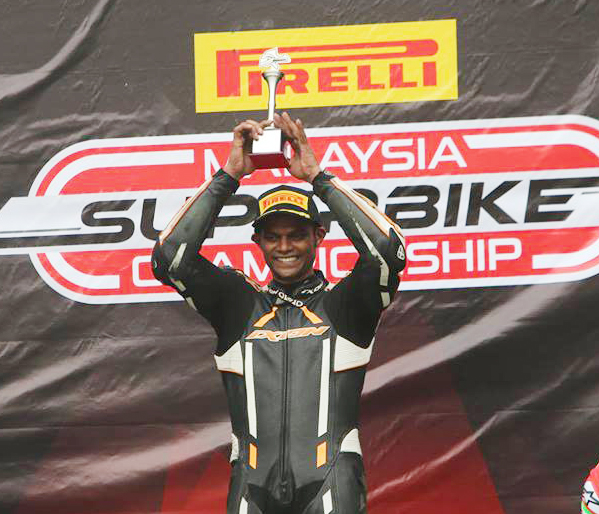
A big win for Rajini Krishnan in Race 1: Malaysian SBK 1000cc Open Class

India’s Rajini Krishnan holds aloft the winner’s trophy. Sepang (Kuala Lumpur), 14 May 2018: Indian racer Rajini Krishnan won the opening round Race 1 of the Pirelli Malaysian Superbike series Round 1 of the 2018 season at Sepang International Circuit here on Sunday.
Krishnan started from P3, but the 2015 Malaysia Super bike champion in the 1000cc open class, took the lead early by Lap 2 and won with ease for a big win in almost one year.
The Indian talent suffered a high slide and fell on Lap3 while in second position and fell back to 18th place. However, he managed to race hard to climb back into the fifth place and had to be content with the same position in Race 2 for some valuable points.
The RACR Team also had racers taking part in the Super 250 , 600cc Supersport and the Superbike 1000cc open categories.
Another talented racer, Vishwadev Muralidharan finished 8th in Race 1 of the Super 250cc category and improved to 7th place in the second race in the evening.
In the Supersport 600cc class, Abhijith Prasad came 5th in Race 1 while another RACR racer Ritesh Sapre came 11th. Prasad, however, could only finish 9th in Race 2 while Sapre ended up 18th.
-
Bengaluru’s Ruhaan Alva finishes 9th in Round 3 of Easykart Italia championship
Lonato (Italy), 14 May 2018: India’s Ruhaan Alva did well to finish ninth (100cc category) in the third round of the Eastkart Italian Championship at the famed South Garda karting circuit here on Sunday.In the 18-lap final, Ruhaan, the 11-year old schoolboy from Bengaluru, supported by Play Factory and Birel Art, started ninth on the 25-kart grid. He made two places to seventh by the end of the second lap, but could not make further progress and eventually finished ninth.
Earlier, starting ninth in the pre-final, Ruhaan, who opted for the more competitive Easykart 100 category after finishing second runner-up in the Cadet class last season, did well to jump four spots to fifth, with sights trained on a possible podium finish. However, a shunt from the back saw him slip to 11th before fighting back to finish ninth.
Ruhaan will next take part in the fourth round of the championship scheduled for June 2-3 at the International Circuit 7 Lakes in Castelletto.
-
Hamilton leads Mercedes 1-2 in a dominant victory; Perez takes 2 points
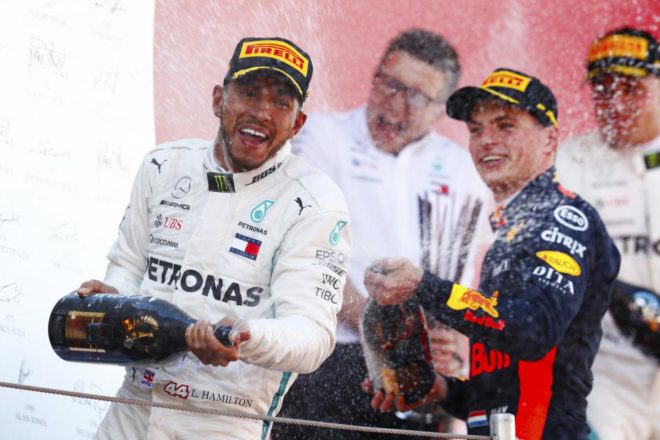
Hamilton celebrates with Verstappen (right) after winning the Spanish GP on Sunday. An FIA image Barcelona, 13 May 2018: Lewis Hamilton powered to a dominant Spanish Grand Prix win as Mercedes scored its first 1-2 finish of the season, with Valtteri Bottas finishing ahead of Red Bull Racing’s Max Verstappen as Ferrari’s Sebastian Vettel dropped from second place to fourth after a mid-race pit stop the fifth round of the Formula One FIA World Championship here on Sunday. Force India Sergio Perez managed to take a last-gasp ninth place for two points while his teammate had to drop out due to mechanical issues.
Vettel had stolen second place from Bottas in a dramatic start to the race, but the German then pitted early to change to medium tyres. Red Bull’s chasing drivers meanwhile went deep into the race before taking on fresh tyres and when a Virtual Safety Car was deployed after Force India’s Esteban Ocon stopped at the side of the track, Ferrari elected to pit Vettel for more tyres.
He ceded position to Bottas and Verstappen but in the late stages of the race he couldn’t find a way back past the Red Bull and he was forced to settle for fourth.
When the lights went out for the start, Vettel got away well and using the slipstream created by the Mercedes ahead the German rounded Valtteri Bottas on the outside to steal P2. Further back, Haas’ Kevin Magnussen had to correct in mid-corner in Turn 3 and directly behind his team-mate Romain Grosjean was forced to brake hard. The Frenchman went into a spin, sliding off the track and then back on – into the path of Renault’s Nico Hulkenberg and Toro Rosso’s Pierre Gasly. The collision was significant, though all three drivers escaped unhurt.
With debris scattered across the track and three cars requiring removal, the Safety Car was called into action and stayed on track until the end of lap six.
On the re-start the frontrunners all held their position, with Hamilton leading Vettel ahead of Bottas, Räikkönen and the Red Bulls of Max Verstappen and Daniel Ricciardo, Further back McLaren’s Fernando Alonso was the only driver to make a significant gain in the re-start, passing Force India’s Esteban Ocon to claim the final points position of tenth.
The race then settled until Vettel triggered the pit stops at the end of lap 17. The German took on mediums and rejoined in P7 ahead of SAI. Mercedes responded, pitting Bottas, who also took mediums, but a slow stop, allied to Vettel blasting past Magnussen into Turn meant the Finn could no pass the Ferrari.
Räikkönen caused the next shift in the order on lap 24. Verstappen, who was right behind the Finn reported that the Ferrari had some kind of engine problem and within moments Räikkönen slowed dramatically.
Verstappen and Ricciardo blasted past the Ferrari as Räikkönen was told the stop the car but the Finn eventually brought his car back to pit lane where he retired from the race.
Ahead Hamilton pitted at the end of lap 25, taking on medium tyres and slotting into P2 behind new leader Verstappen, though the Red Bull and third-placed team-mate Ricciardo needed to pit.
The Australian was the first of the Red Bulls to pit, at the end of lap 33, with Verstappen pitting a lap later. Both took on medium tyres to go to the end of the race. The order now saw Hamilton lead Vettel by 10 seconds with Bottas third ahead of Verstappen and Ricciardo. The Red Bulls though had much fresher rubber than either Vettel or Bottas, both of whom had made early stops for new tyres.
On lap 41 Esteban Ocon pulled over at the side of the track and the VSC was deployed. During the cautionary period Ferrari responded to the Red Bull threat and decided to pit Vettel for new mediums. The German rejoined in fourth place between the two Red Bulls as Bottas moved into P2 ahead of Verstappen.
The Dutch driver hit trouble after the VSC withdrew, however. He clipped the back of Lance Stroll’s Williams as he attacked the backmarker and damaged his front wing. That might have given Vettel hope but with Verstappen told that his wing was “structurally OK” despite end-plate damage, the gap widened, with Verstappen stretching his advantage over Vettel to 2.1s by lap 49.
The pair repeatedly traded personal bests over the following laps but Vettel could find no way to close in on Verstappen and Ferrari were left to rue ceding track position to Mercedes and Red Bull.
At the front, Hamilton was untouchable, powering to his 64th career win with more than 18 seconds in hand over his second-placed team-mate. Despite Vettel’s attentions, Verstappen was faultless over the final laps and claimed Red Bull Racing’s 150th podium finish with 0.7s seconds in hand over the sole remaining Ferrari.
Ricciardo added 10 points to Red Bull’s haul with fifth place, while Kevin Magnussen finished sixth for Haas ahead of Renault’s Carlos Sainz. McLaren’s Fernando Alonso took his fifth points finish of the season with eighth place ahead of Force India’s Sergio Pérez. Tenth place went to Sauber’s Charles Leclerc who scored points for the second race in a row.
2018 Spanish Grand Prix – Race
1 Lewis Hamilton Mercedes –
2 Valtteri Bottas Mercedes 20.593
3 Max Verstappen Red Bull Racing 26.873
4 Sebastian Vettel Ferrari 27.584
5 Daniel Ricciardo Red Bull Racing 50.058
6 Kevin Magnussen Haas 1 lap
7 Carlos Sainz Renault 1 lap
8 Fernando Alonso McLaren 1 lap
9 Sergio Perez Force India 2 laps
10 Charles Leclerc Sauber 2 laps
11 Lance Stroll Williams 2 laps
12 Brendon Hartley Toro Rosso 2 laps
13 Marcus Ericsson Sauber 2 laps
14 Sergey Sirotkin Williams 3 laps
Stoffel Vandoorne McLaren
Esteban Ocon Force India
Kimi Raikkonen Ferrari
Nico Hulkenberg Renault
Pierre Gasly Toro Rosso
Romain Grosjean Haas. -
Aitken clinches first F2 victory in Barcelona sprint; Arjun finishes 13th
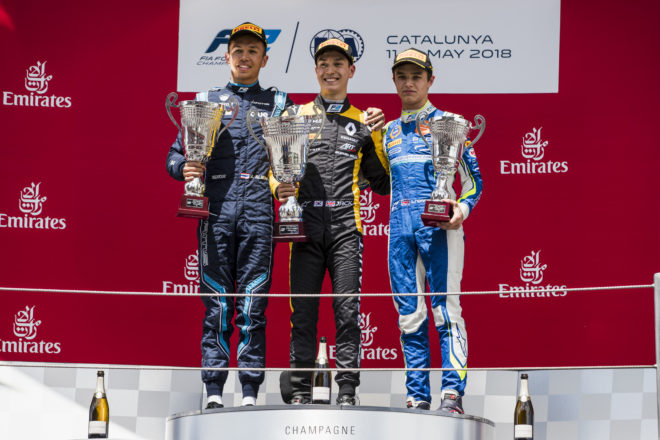
British driver masters difficult conditions to claim maiden winJack Aitken (ART Grand Prix), Alexander Albon (DAMS), Lando Norris (Carlin) on the podium in the sprint race on Sunday. An FIA image Barcelona, 13 May 2018: Jack Aitken managed a flurry of virtual safety car periods to collect his first FIA Formula 2 Championship victory in the Sprint Race in Barcelona, Spain, assuming the lead at the start of the race and holding on to claim ART Grand Prix’s second win of the weekend, ahead of DAMS’ Alexander Albon and Carlin’s Lando Norris.
Although the circuit was damp following overnight rain and a short spell of drizzle in the morning, all driver started on medium-compound slicks as no further downpours were expected throughout. Polesitter Artem Markelov had a poor start, dropping down the order as Aitken darted to the front of the pack ahead of Sergio Sette Camara, clearing a wild first lap behind them as Nyck de Vries went wide at turn 4 before Roberto Merhi went sideways on the exit of the same corner.Keeping his head cool, Aitken had found a 3.3s advantage over Sette Camara after the opening lap, the British driver setting the early quick laps before the first Virtual Safety Car period was introduced for de Vries’ stopped car, the Prema driver spinning at turn 10 before coming to a halt. At the return of green flag running, Sette Camara went wide at the same corner to allow Albon and Norris through, while Aitken had managed the restart to perfection to assume a gap of 11.7s over the Thai driver.A full safety car period emerged shortly after, as Japanese duo Tadasuke Makino and Nirei Fukuzumi tangled at turn 3 which eradicated Aitken’s lead as the two cars were cleared from the barrier. Aitken handled the restart adeptly, goading Albon into getting close before accelerating away to retain his lead, leaving the DAMS driver in the clutches of the chasing Norris.Albon and Norris proceeded to draw nearer to Aitken after the ART driver briefly ran wide, while Luca Ghiotto nestled in behind the leading trio to pick up any pieces. Recomposing himself, Aitken hit back with a series of fastest laps to keep Albon out of DRS range, leaving Norris to occupy his mirrors. Behind them, Sette Camara had fallen some way behind and the Brazilian fell victim to Feature Race winner George Russell before subsequently pulling over at the side of the road with a mechanical issue – requiring a second VSC period to remove the lifeless Carlin.Aitken increased his gap over Albon at the lap 15 restart, with Norris falling back dangerously close to Ghiotto. The Italian driver grabbed DRS on the following lap, but was too far back to seriously challenge for third place. Behind, Russell was hunting the pair down, bringing himself into DRS range of Ghiotto – delicately tucking his car down the inside of the Campos driver at the start of the 20th lap to claim fourth.With Albon having his hands full trying to keep Norris away, Aitken was able to scamper up the road with a 2.8s lead before a third virtual safety car, called to clear the parked MP Motorsport car of Ralph Boschung after the Swiss driver sustained a heavy lock-up trying to pass Santino Ferrucci, puncturing his front-left tyre in the process. The race resumed with three laps left, Aitken surging ahead once more, but the Brit lost a full second to Albon on the penultimate lap. Dusting himself off, Aitken found time on his final lap to sweep home for his first F2 win, 1.5s clear of Albon in second.Norris took third, some five seconds ahead of Russell who collected the fastest lap on the final tour of the circuit, while Ghiotto was further back. Sean Gelael produced an impressive overtaking display to grab sixth ahead of Antonio Fuoco. Nicholas Latifi fought tooth and nail with Markelov for the final point, even making contact in the penultimate corner, leaving the Canadian to hang on to eighth.Leaving Barcelona with the championship lead, Norris sits on 80 points, 13 points clear of second-placed Albon as Russell is five points further back with 62. Carlin lead the Teams’ Championship with 126 points, 21 points ahead of ART Grand Prix as DAMS have 88 points to sit third.The next FIA Formula 2 round will take place in Monaco from the 24-26 May, and the Principality’s famously tough street course will provide a unique challenge to the drivers as they seek to navigate Monte Carlo’s close barriers and tight corners.2018 FIA Formula 2 Championship Round 3 Sprint Race – Barcelona, SpainDriverTeam1Jack AitkenART Grand Prix2Alexander AlbonDAMS3Lando NorrisCarlin4George RussellART Grand Prix5Luca GhiottoCampos Vexatec Racing6Sean GelaelPertamina Prema Theodore Racing7Antonio FuocoCharouz Racing System8Nicholas LatifiDAMS9Artem MarkelovRussian Time10Louis DeletrazCharouz Racing System11Santino FerrucciTrident12Maximilian GuntherBWT Arden13Arjun MainiTrident14Roy NissanyCampos Vexatec Racing–Roberto MerhiMP Motorsport–Ralph BoschungMP Motorsport–Sergio Sette CamaraCarlin–Tadasuke MakinoRussian Time–Nirei FukuzumiBWT Arden–Nyck de VriesPertamina Prema Theodore RacingFastest Lap: George Russell (ART Grand Prix) – 1:30.987 -
Russell prevails in action-packed feature race; Arjun Maini crashes out: F2
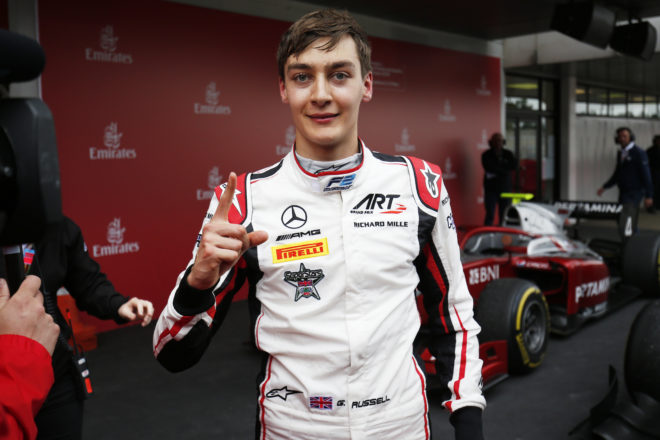
Barcelona, 12 May 2018: George Russell claimed victory in a thrilling FIA Formula 2 Championship Feature Race while Indian racer crashed into the wall on the exit of turn 5 here on Saturday.Russell, the ART Grand Prix driver took the lead from a fast-starting Nyck de Vries before holding on throughout four virtual safety car periods for the win, keeping the Pertamina Prema Theodore Racing racer at bay as Carlin’s Lando Norris followed the pair home for third.Heavy clouds loomed over the Circuit de Barcelona-Catalunya, with sporadic spots of drizzle peppering the start-finish straight at the start of the race. The rain held off, and a flurry of activity at the race start resulted in de Vries wresting control of the lead after polesitter Alexander Albon endured a slow getaway, which also allowed Russell and Luca Ghiotto to filter through. Immediately, a virtual safety car was called for Maximilian Gunther’s beached BWT Arden machine at turn 2, neutralising the race before the action resumed on lap 4.Albon sought redemption for his slow start and overtook Ghiotto a lap later, cruising past on the inside of turn 1 as Norris closed down on the pair. Ahead, de Vries and Russell were battling hard for the lead, with the British driver snatching a tow from the leader before making a move down the inside of the first corner at the opening of the sixth lap – taking the lead.The virtual safety car (VSC) emerged again as a tussle between the two MP Motorsport drivers boiled over – Roberto Merhi and Ralph Boschung made contact in their scrap for 12th place, with the Swiss driver ending his day in the tyre barrier as Merhi retreated to the pits with damage. The race returned to full-speed action on lap 8 as the race restarted, and de Vries soon found himself under pressure from Albon – who fired his way up into to second place two laps later.The Thai driver then went in pursuit of Russell, but any charge was halted by a third VSC period after Trident’s Arjun Maini found the wall on the exit of turn 5. The running resumed on the 14th lap, and soon after, the drivers on soft tyres were making their mandatory stops as the threat of rain appeared to subside.All wearing medium sets of tyres, the leading trio continued to push on with Albon the first to hit the stages of tyre degradation, losing second to de Vries once more as the Dutchman sought to get back on level terms with Russell. With Albon out of the picture shortly after, having pitted to fall behind Norris and Jack Aitken, the front-running pair came into the pitlane nose to tail, Russell maintaining his position by fractions.De Vries opened lap 27 with an assault on Russell, but the Brit held firm before the PREMA driver’s teammate Sean Gelael had contact with Louis Deletraz on the next lap, bringing out a fourth VSC with Artem Markelov and Nirei Fukuzumi leading – and yet to stop.The pair pitted at the end of lap 32 once the race was restarted, which went down to the clock as the slower speeds had resulted in a longer race time. De Vries almost collected the lead at the restart, trying a move down the inside of Russell at turn 5, but braked too deeply and conceded the place. With Norris looming larger in the pair’s mirrors, having converted his alternate strategy into a top three berth, Russell refused to be drawn into a battle and edged ahead of de Vries, opening the taps enough to seal his second F2 win.Despite Norris’ best efforts to snatch second in the final stages, de Vries held on by 0.7s ahead of the Carlin driver. Ghiotto emerged ahead of Albon once more to take fourth place, as Aitken’s alternate strategy helped him to sixth ahead of Sergio Sette Camara. Markelov recovered from a lowly 19th on the grid to take eighth, swiping the reverse-grid pole slot from teammate Tadasuke Makino on the last lap, as Antonio Fuoco completed the top 10.Markelov also swiped the points available for the fastest lap and, having completed 32 laps on his medium compound tyres, will be a formidable opponent from pole in tomorrow’s Sprint Race – which promises to deliver plenty of excitement once more.2018 FIA Formula 2 Championship Feature Race Provisional Classification – Barcelona, SpainDriverTeam1George RussellART Grand Prix2Nyck de VriesPERTAMINA PREMA Theodore Racing3Lando NorrisCarlin4Luca GhiottoCampos Vexatec Racing5Alexander AlbonDAMS6Jack AitkenART Grand Prix7Sergio Sette CamaraCarlin8Artem MarkelovRUSSIAN TIME9Tadasuke MakinoRUSSIAN TIME10Antonio FuocoCharouz Racing System11Nirei FukuzumiBWT Arden12Roy NissanyCampos Vexatec Racing13Roberto MerhiMP Motorsport14Nicholas LatifiDAMS–Sean GelaelPERTAMINA PREMA Theodore Racing–Louis DeletrazCharouz Racing System–Arjun MainiTrident–Ralph BoschungMP Motorsport–Maximilian GuntherBWT Arden–Santino FerrucciTridentFastest Lap: Nicholas Latifi (DAMS) – 1:30.039 -
Masterful Rea wins Imola WorldSBK Race 1
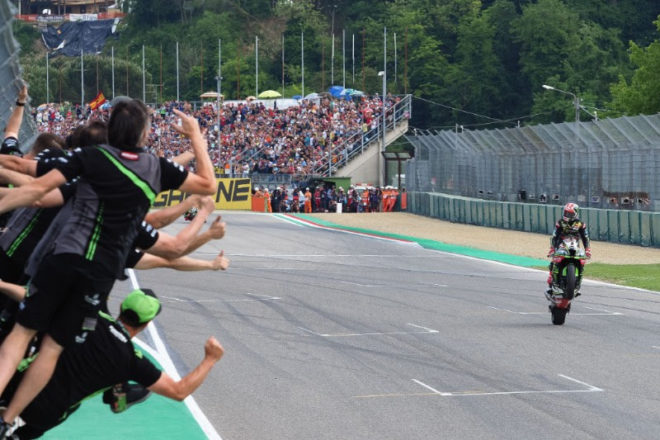
Jonathan Rea wins WorldSBK first race on Saturday in the Pata Round. A WorldSBK image Imola (Italy), 12 May 2018: Jonathan Rea (Kawasaki Racing Team WorldSBK) took his first win at Imola since 2015 with a dominant performance at the Autodromo Internazionale Enzo e Dino Ferrari di Imola, controlling the race from the start and not giving anyone on the track any opportunities. His teammate Tom Sykes (Kawasaki Racing Team WorldSBK) completed the second consecutive KRT one-two of the season, with Marco Melandri (Aruba.it Racing – Ducati) returning to the podium in third.
The Kawasaki riders shot out from the lights, quickly opening up distance with the riders behind. That gap would increase to 3-4 seconds between the British pair at the halfway point, with both riders leading the race from that point forwards. Rea is now just one win away from the all-time win record in MOTUL FIM Superbike World Championship history, and opens up a 42-point lead at the top of the standings.
Sykes too gave no option to the rest of the field, showing that his Assen pace was no fluke and that, when he’s got room in front, his ZX-10RR’s pace is almost unparalleled. It will be interesting to see how the rider from Yorkshire fares starting from 8th in Race 2, given the issues that have plagued him in the past. He now moves up to fourth in the championship.
The first two laps were a nightmare for Chaz Davies (Aruba.it Racing – Ducati), looking for his fifth consecutive win here. Following his crash in the Superpole 2, the Welshman struggled at the lights, falling back from third to seventh. After climbing back to fourth, Davies went straight through the Variante Bassa chicane, losing several positions along the way and any chance of a victory. He later redeemed himself with two wonderful passes at that same turn 21, but by then the podium was out of sight, thanks to the fantastic rhythm shown by Marco Melandri (Aruba.it Racing – Ducati) in front of his home fans. The Italian equaled his best WorldSBK result here in third, while Davies’ fourth will at least have the consolation prize of starting from P1 tomorrow.
Behind the two teams that have dominated proceedings throughout the weekend, Xavi Fores (Barni Racing Team) repeated his 2017 Race 1 finish with fifth place, finding the pace to hold off Michael van der Mark (Pata Yamaha Official WorldSBK Team) in sixth. The Dutchman will however be pleased at his performance, after starting from the back of row 4.
Michael Ruben Rinaldi (Aruba.it Racing – Junior Team) had an extraordinary start to Race 1, moving up to third in lap one. He fell back as the race progressed, but his seventh-place finish equals his best result in WorldSBK. Just behind, Lorenzo Savadori (Milwaukee Aprilia) completed his best finish of the season in eighth.
Leon Haslam (Kawasaki Puccetti Racing) finished a successful return to the WorldSBK paddock in ninth, pipping ahead at the line of fellow Brit Alex Lowes (Pata Yamaha Official WorldSBK Team). Haslam beat his teammate for this weekend in Toprak Razgatlioglu (Kawasaki Puccetti Racing), whose WorldSBK Imola debut finished with him in eleventh.
P1 – Jonathan Rea (Kawasaki Racing Team WorldSBK)
“It was a perfect race, I was able to take a step back and enjoy that race. It was difficult compared to the beginning of the day, we lost a bit in the race so it’s something to work on for tomorrow, I ran into some issues with the temperature. I’m super happy with the way the team have been working and I just want to try and do it again tomorrow.”P2 – Tom Sykes (Kawasaki Racing Team WorldSBK)
“Its always nice to come home first, but I was running very strong and very consistent. But I was missing a few tenths per lap which is a lot less than I was expecting. But we worked hard yesterday with tyre and set up information and we will try and fix the bike a bit tomorrow, and push again and try and go one better.”P3 – Marco Melandri (Aruba.it Racing – Ducati)
“It was very difficult race today, this was as good as I could get at the beginning, as with a full tank it was hard to get the bike into the turn. But in the end with less fuel the bike was a lot better, but it was too late to get a good pace. I hope to get back tomorrow at the beginning of the race but we will need to make a good start because, its important to get good start at Imola.”#ImolaWorldSBK at Autodromo Internazionale Enzo d Dino Ferrari di Imola: Race 1
1. Jonathan Rea (Kawasaki Racing Team WorldSBK)
2. Tom Sykes (Kawasaki Racing Team WorldSBK) +3.755
3. Marco Melandri (Aruba.it Racing – Ducati) +6.906 -
Hamilton takes pole ahead of Bottas, Vettel: Spanish GP
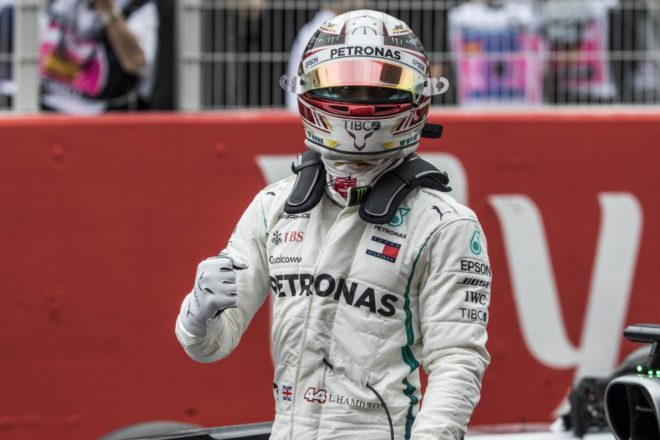
Hamilton celebrates after taking the Spanish GP pole on Saturday. An FIA image Barcelona, 12 May 2018: Lewis Hamilton powered his Mercedes to top spot in qualifying for the Spanish Grand Prix, the fifth round of the Formula One World Championship here on Saturday.
It is the Briton’s first pole position since the season-opening Australian Grand Prix ahead of team-mate Valtteri Bottas and the Ferraris of Sebastian Vettel and Kimi Räikkönen.
In Q1, after the early pace was set by Kimi Räikkönen, Vettel then raised the bar considerably with a lap of 1:17.031 that put him four tenths of a second ahead of the Finn, with Hamilton third. Red Bulls drivers then disrupted things with Daniel Ricciardo jumping ahead of Hamilton and Max Verstappen recovering from an FP3 electrical problem to vault to P2 with a time of 1:17.411.
In the drop zone as the final runs began were Sauber’s Marcus Ericsson, William’s Lance Stroll and Sergey Sirotkin, as well as Renault’s Nico Hulkenberg and Toro Rosso’s Brendon Hartley.
After crashing heavily in FP3 Hartley and causing extensive damage to the rear of his Toro Rosso, Hartley was never going to figure in the session, but Hulkenberg, who had qualified in seventh place three times this season, was an unlikely candidate for the drop.
The German suffered with a fuel pressure issue early in the session but Renault managed to get their driver out for the final runs. His lap, though, was not stellar and in P14 after his run he was still in danger.
And the danger in the end came from McLaren’s Stoffel Vandoorne whose final lap was good enough to push Hulkenberg out of the session in P16. Eliminated behind the German were Ericsson and Sirotkin. Out, too, went Stroll whose session was ended both by poor performance and by a crash at the very end of the session. The Canadian lost control in Turn 13 and slid off into the gravel trap and out of the session ahead of Hartley.
In Q2 the frontrunners went out on soft tyres at the start of the session and Hamilton laid down what looked like a solid marker with a lap of 1:17.166. That was swiftly eclipsed by team-mate Bottas and then demolished by Vettel, who became the first man under 1m17s with a lap of 1:16.802. The lap put him 0.269 clear of team-mate Räikkönen.
Behind Mercedes and Ferrari, Verstappen looked secure in fifth but Ricciardo had not put in the perfect lap and as the final runs began Red Bull chose to send out again, on supersofts, as they did with Verstappen and as Mercedes did with Hamilton.
In the end, though, Ricciardo’s passage to Q3 was never in doubt as rivals behind failed to find the time necessary to dislodge him and the Australian was eventually told to back of in third sector to preserve his soft tyre lap as his quickest of the session. Thus, like the Ferraris and Mercedes and Verstappen, he will start on the soft tyres.
Out, though, went Vandoorne in 11th place with the Belgian finishing ahead of Toro Rosso’s Pierre Gasly, Force India’s Esteban Ocon, Sauber’s Charles Leclerc and the second Force India of Sergio Pérez.
In the first runs of Q3, it was Hamilton who set the pace with a time of 1:16.491, but while it might have been expected that Vettel would respond, the German’s opening time of the final segment was not good and his lap of 1:17.255, slower than his Q1 time, left him fifth.
Red Bull, meanwhile, found more pace and Verstappen set a time of 1:18.816 to sit just over three tenths behind Hamilton. Ricciardo took third with a time of 1:16.818 ahead of Bottas and Vettel.
An in the final runs Hamilton converted his advantage, setting blistering pace to claim his 74thcareer pole position and his first since the season-opening Australian Grand Prix.
Bottas joined his team-mate on the front row, just four hundredths of a second behind his team-mate and Vettel, who made a significant improvement to 1:16.305 finished third ahead of team-mate Räikkönen who used soft tyres to climb from P8 after the first run to P4.
The third row was annexed by Red Bull with Verstappen taking fifth with time of 1:16.816. Like Räikkönen, team-mate Ricciardo gambled that the soft tyre might provide more lap time but in the end he only improved by four hundredths of a second to finish just 0.002 behind his team-mate.
Kevin Magnussen was seventh for Haas, while Fernando Alonso took Renault powered McLaren ahead of Renault works driver Carlos Sainz. Tenth place was taken by Romain Grosjean in the second Haas.
2018 Spanish Grand Prix – Qualifying
1 Lewis Hamilton Mercedes 1:16.173
2 Valtteri Bottas Mercedes 1:16.213 0.040
3 Sebastian Vettel Ferrari 1:16.305 0.132
4 Kimi Raikkonen Ferrari 1:16.612 0.439
5 Max Verstappen Red Bull Racing 1:16.816 0.643
6 Daniel Ricciardo Red Bull Racing 1:16.818 0.645
7 Kevin Magnussen Haas Ferrari 1:17.676 1.503
8 Fernando Alonso McLaren 1:17.721 1.548
9 Carlos Sainz Renault 1:17.790 1.617
10 Romain Grosjean Haas 1:17.835 1.662
11 Stoffel Vandoorne McLaren 1:18.323 2.150
12 Pierre Gasly Toro Rosso 1:18.463 2.290
13 Esteban Ocon Force India 1:18.696 2.523
14 Charles Leclerc Sauber 1:18.910 2.737
15 Sergio Perez Force India 1:19.098 2.925
16 Nico Hulkenberg Renault 1:18.923 2.750
17 Marcus Ericsson Sauber 1:19.493 3.320
18 Sergey Sirotkin Williams 1:19.695 3.522
19 Lance Stroll Williams 1:20.225 4.052
20 Brendon Hartley Toro Rosso Honda. -
Hamilton takes over at the top: Spanish GP FP2
Hamilton fastest in FP2. An FIA image Barcelona, 11 May 2018: After being beaten to top spot in first practice by over eight tenths of a second by team-mate Valtteri Bottas, Mercedes’ Lewis Hamilton powered forward in the afternoon session to claim P1, a tenth of a second ahead of Daniel Ricciardo in the Formula One World Championship fifth round Free Practice second session of the Spanish GP here on Friday.
The Red Bull Racing driver bounced back from a first-session crash to edge team-mate Max Verstappen by 0.141s.
Hamilton’s best lap, in a time of 1:18.259, came on the soft compound Pirelli tyres and was set early in the session. When the Briton later went for a qualifying simulation on the supersoft compound, a mistake at Turn 7 lost him time and his soft tyre time remained the benchmark.
It was a similar tale for Ricciardo. Despite limited running in the first session following a slide in the barriers that damaged the front left corner of his car in, the Australian quickly found a rhythm in the afternoon session and he joined Hamilton at the top end of the timesheet with a soft tyre best of 1:18.392.
But when he moved to supersofts his pace ebbed slightly and he found himself three tenths off his earlier time.
With other drivers struggling to get the best out of the red-banded tyre on qualifying sims, the soft compound times stood until the end of the session with Ricciardo 0.133s behind Hamilton and with Verstappen, who didf improve on the supersofts, marginally further back.
Sebastian Vettel, third in the opening session, also improved on supersofts, ton finish just five hundredths of a second behind Verstappen, while FP1’s quickest driver Valtteri Bottas finished in fourth place, two hundredths of a second further back. Kimi Raikkonen in the second Ferrari finished in sixth place just over half a second adrift of Hamilton.
In the opening session it was McLaren who had taken best of the rest honours behind the top three teams, but in the afternoon Haas improved to end with Romain Grosjean seventh on a time of 1:19.579, over 1.3s behind Hamilton but just six hundredths of a second ahead of eighth-placed team-mate Kevin Magnussen.
McLaren’s decent start to the weekend was confirmed by Stoffel Vandoorne whose lap of 1:19.722 left him ninth, over two tenths of a second clear of Force India’s Sergio Pérez, whose session was brought to an early end, 13 minutes from time, after a pit stop left him with a loose front-left wheel.
2018 Spanish Grand Prix – Free Practice 2
1 Lewis Hamilton Mercedes 39 1:18.259
2 Daniel Ricciardo Red Bull Racing 41 1:18.392 0.133
3 Max Verstappen Red Bull Racing 39 1:18.533 0.274
4 Sebastian Vettel Ferrari 34 1:18.585 0.326
5 Valtteri Bottas Mercedes 39 1:18.611 0.352
6 Kimi Raikkonen Ferrari 16 1:18.829 0.570
7 Romain Grosjean Haas 24 1:19.579 1.320
8 Kevin Magnussen Haas 39 1:19.643 1.384
9 Stoffel Vandoorne McLaren 32 1:19.722 1.463
10 Sergio Perez Force India 28 1:19.962 1.703
11 Esteban Ocon Force India 38 1:20.024 1.765
12 Fernando Alonso McLaren 35 1:20.035 1.776
13 Nico Hulkenberg Renault 43 1:20.183 1.924
14 Pierre Gasly Toro Rosso 32 1:20.373 2.114
15 Marcus Ericsson Sauber 37 1:20.501 2.242
16 Charles Leclerc Sauber 29 1:20.514 2.255
17 Carlos Sainz Renault 31 1:20.672 2.413
18 Brendon Hartley Toro Rosso 34 1:21.265 3.006
19 Lance Stroll Williams 35 1:21.556 3.297
20 Sergey Sirotkin Williams 36 1:22.060 3.801 -
Bottas sets the early pace ahead of Hamilton in FP1: Spanish GP
Valtteri Bottas of Mercedes F1 team tops FP1 on Friday. An FIA image Brcelona, 12 May 2018: Mercedes’ Valtteri Bottas went quickest in the opening practice session for the Spanish Grand Prix, finishing more than eight tenths of a second ahead of team-mate Lewis Hamilton and almost a second clear of third-placed Sebastian Vettel.
The Mercedes drivers’ dominance of the session was established early with Bottas using soft tyres to push into the 1m18s bracket.
At that point the were backed up by Red Bull Racing’s Daniel Ricciardo, but the Australian wouldn’t figure in the session for much longer. With grip at the premium on the new track surface, Ricciardo lost control of his RB14 in Turn 14 and slid off through the gravel, hitting the barriers and causing damage to the front-left of his car.
The incident saw the Virtual Safety Car deployed and when the cautionary period ended, Bottas took a new set of soft tyres and stretched his legs once more, eventually improving to a time of 1:18.4311.
A second VSC period then ensued when Williams’ Lance Stroll went off at Turn 5, soon after complaining about the poor balance of his car.
And once again when the VSC period ended, Bottas improved his time, this time establishing a benchmark of 1:18.148 that would remain for the remainder of the session. Hamilton, meanwhile, finished 0.849s behind the Finn.
Vettel, meanwhile, sat in fourth for much of the session before Ferrari sent both of its drivers out on supersofts. Vettel vaulted to third late on but still could only manage to get to 0.950 behind Bottas. Räikkönens initial foray on the red banded tyre left him 1.6s down on Bottas’s best time but he eventually managed to work his way to a time of 1:19.499, some 1.3s behind his fellow Finn and four tenths of a second behind Vettel.
The gap was sufficiently large to allow Max Verstappen to slot his Red Bull Racing car between the Ferraris, with a time of 1:19.187, a second adrift of Bottas.
Behind fifth-placed Räikkönen, McLaren finished as best-of-the-rest, with Fernando Alonso setting a time of 1:19.858 to take sixth spot on the timesheet. The Woking team also debuted a radically redesigned nose and also new bargeboards during the session.
Ricciardo’s early time was in the end good enough for seventh place, ahead of Haas’ Romain Grosjean, McLaren’s Stoffel Vandoorne and Toro Rosso’s Pierre Gasly, who rounded out the top 10 order.
2018 Spanish Grand Prix – Free Practice 1
1 Valtteri Bottas Mercedes 32 1:18.148
2 Lewis Hamilton Mercedes 22 1:18.997 0.849
3 Sebastian Vettel Ferrari 24 1:19.098 0.950
4 Max Verstappen Red Bull Racing 26 1:19.187 1.039
5 Kimi Raikkonen Ferrari 19 1:19.499 1.351
6 Fernando Alonso McLaren 26 1:19.858 1.710
7 Daniel Ricciardo Red Bull Racing 11 1:19.871 1.723
8 Romain Grosjean Haas 24 1:19.906 1.758
9 Stoffel Vandoorne McLaren 28 1:20.083 1.935
10 Pierre Gasly Toro Rosso 29 1:20.508 2.360
11 Kevin Magnussen Haas 28 1:20.637 2.489
12 Charles Leclerc Sauber 23 1:20.665 2.517
13 Sergio Perez Force India 36 1:20.924 2.776
14 Marcus Ericsson Sauber 18 1:20.984 2.836
15 Carlos Sainz Renault 28 1:21.053 2.905
16 Esteban Ocon Force India 27 1:21.144 2.996
17 Nico Hulkenberg Renault 26 1:21.159 3.011
18 Brendon Hartley Toro Rosso 28 1:21.373 3.225
19 Robert Kubica Williams 24 1:21.510 3.362
20 Lance Stroll Williams 15 1:22.756 4.608 -
As a team we have a duty… to improve the show, to improve F1: Mattia Binotto of Ferrari
Barcelona, 11 May 2018: The FIA Friday press conference of the Team Representatives saw attendance from Mattia Binotto (Ferrari), Andy Cowell (Mercedes), Rémi Taffin (Renault) and Toyoharu Tanabe (Honda). Transcript:
Q: Gentlemen, before we deal with the here and now, can we kick things off by throwing things forward to 2021 and the new engine regulations. There are various elements to this and Mattia, if I could start with you, the new power unit has to hit the track in about 30 months’ time. How tight is the timescale? Is it enough time?
Mattia Binotto: Is it enough time? It will depend much on how different will be the new power unit compared to the one of today. So, no changes to the regulations, plenty of time. As much as you change it, obviously the more time you need. At the moment, so far, for what we may understand, because we are still discussing – FIA, FOM – what will be the format. We had several meetings in the last days. We have some more in the next days, let’s see where it will go. But 30 months is plenty enough but it would be good to try to reach an agreement on what will be the format, in really the next two to three months.
Q: Andy, coming to you, there have been various presentations already, as Mattia has just referred to. Is everyone aligned as to what those regulations are going to be in ’21?
Andy Cowell: As Mattia says there have been several meetings, starting last summer. Discussions are never 100% aligned. There’s always difference of opinion, but you end up coming up with a compromise and setting off on a direction, hopefully with enough time to do a decent job before the first race.
Q: And have we found that direction now?
AC: I think those discussions are ongoing. None of us can read a published set of regulations, so the discussions, the debate, the compromises are a work in progress.
Q: Remi, can we just get Renault’s take on the new engine regulations and where you would like to see them go?
Rémi Taffin: I think we wish to go forwards. We are still interested in developing the engine. We think the engine is a big part of Formula 1. As my colleagues have said, we are all discussing this, we want to get this forward. We know we have some work to do. We know we will have some changes compared to today and we have to deal with them. But the most important thing for Renault is that we all work together with the FIA and F1, to get this right and yes, to make sure that the engines keep a good part in Formula 1.
Q: Tanabe-san, what’s Honda’s position on the new rules and specifically the MGU-H?
Toyoharu Tanabe: Yes, we will miss the MGU-H. I think we haven’t decided everything yet for 2021. But the direction from the FIA we respect, we respect the other manufacturers’ direction, but we think we will miss the MGU-H, such a high pinnacle of technology for the future and relevant to the production car as well.
Just to clarify: Honda would like the MGU-H to stay?
TT: Yes, we would like to keep that technology.
Q: Rémi, if I could back to you now and deal with the present. Can you just talk about the progress you’ve made with the power unit in Viry, where have you made the biggest gains this year?
RT: I think the gains that we have for a few months and a few years now is through the ICE, the internal combustion engine that we have lifted the efficiency with and that’s where we are focusing our efforts.
Q: OK. Renault, a while back, gave Red Bull Racing a deadline of May to fix a 2019 partnership. How are those talks going and might that deadline be extended?
RT: I think from my perspective, obviously I do not deal with contract, I leave it to my boss Cyril, and he has been speaking about that. But if we come back to the technical aspect of that, obviously there are some deadlines, which is simply based on the fact that we have to order parts. So, as a starting point, we know that by the end of this months we would have to start buying some parts to supply as many teams as we would have to for next year. So that is one of our technical deadlines. Then the rest, as I said, is all about having a contract or not with them, which is obviously on their side.
Q: Tanabe-san, coming back to you, we’ve just been talking about Red Bull Racing’s future engine partner, what can you tell us about the talks between Red Bull Racing and Honda?
TT: As my role, as Technical Director, I am not involved much with contract matters, but as Honda we have studied, discussed and then we had a preliminary conversation in Baku, but it is still under discussion.
Q: Do you have a deadline in mind when Honda needs to know if it’s supplying Red Bull Racing as well as Toro Rosso?
TT: We will follow the FIA regulation, but at the moment I cannot tell you exactly.
Q: Let’s talk about the performance of the power unit now. You obviously had a great weekend in Bahrain. Where is the power unit improved from 2017?
TT: Of course we work for the reliability, but not only reliability but performance as well – maybe the same as others. But we focused on the reliability from last year. We learned a lot from the previous years and we applied that type of knowledge or learning point to this year’s power unit.
Q: Thank you. Andy, returning to you, congratulations on that win in Baku last time out. If we’ve learned one thing about Formula 1 on 2018 it’s that it’s very tight at the top and the first question to you is whether we have seen evidence that the power advantage in recent seasons has been eroded?
AC: The last race was very pleasing, the three races before not so. With regard to the power advantage, I think at the moment, in qualifying, then the gentleman to the right of me has a small advantage – well done! – but in racing I suspect we’ve got a small advantage. I think Renault and Honda are very close behind. As we discussed a couple of years ago that if you have regulation stability you do see technical solutions converge and that’s what we’re enjoying at the moment and we’ve all got the pleasure of working hard in the factories and trying to catch each other up and I think it’s going to be a tight battle all the way through this year and next year, and the year after.
Q: You talk about convergence: this is year five of these regulations, so how close are we getting to the limit of what you can get out of these regulations?
AC: I think that comes down to your belief and understanding of whether there is a limit. I personally don’t believe there is a limit. I think you can always find gains. Every week I have the pleasure to sit in our performance and innovation meeting and listen to bright engineers come up with ways of getting a little bit more efficiency out of the various systems and then enjoying the competition in the factory to turn those ideas in proven experiments, and then prove that they are reliable enough to come racing and compete in this wonderful environment. So, for all four us, we will continue to develop and there is no such thing as a limit.
Q: Mattia, we are talking about limits, would you agree with Andy that there are no limits?
MB: I would agree with Andy, no doubt. When you put engineers together, there will be always innovations, creativity. And for an engineer there are never limits. I think we have seen in the last years, in the last season, how much we improved, year after year and I don’t think we have shown so far that we have reached the limit of the product.
Q: Can we ask you about those gains that Ferrari have made, particularly over the winter coming into this season. How do you quantify those gains: how much is chassis, how much is engine?
MB: I think we have improved in most of the areas and our spirit is really to try to improve first, what were the weaknesses of last year, try to focus, we knew that maybe on top speed we were not our best, in terms of overall efficiency we could have improved, especially on what were the fast circuits. So I think all our engineering focus was to improve the car in all the areas. I don’t think we can say there is a specific area that improved the most and I’m quite pleased to see that in all the areas we made progress.
Questions from the floor:
Q: Mattia, what is Ferrari’s position on these recent changes for ’19, especially the less complex front wing?
MB: OK, I think that as a team we have a duty and a task to improve the show, to improve the Formula 1. I think that certainly the regulations may be a good step in that respect. It is a big change, a drastic change to the rules, to the aero. I think each team will be focused on develop what are the new regulations, it’s quite a game changer, but overall I think from an egoistic point of view we could have stuck with what we had at the moment but I think that looking at the show and the good for the sport, it was the right choice.
Q: With the growing move to electrification in the Automotive industry, how relevant is the current battery technology in Formula One to production cars and, going forward to 2021, how much freedom would you like in terms of battery technology.
RT: I think we still like, as engineers, to develop batteries but I guess at the beginning we all have different interests in batteries, whether we wish to develop a chemistry ourselves or not, for sale, for example, so it’s really depending on the intent. As far as Renault is concerned, the Group is liking us to develop so I think we eventually wish to have some development in that area. And then, what we’ve got now is not a bad solution. We can do our work, we can make some progress, we can make some differentiation and at the end of the day we wish to keep that freedom. Whether we need to have that complete freedom as we have now, whether we have to proscribe some element of that, it’s another territory that obviously we are discussing these days.
MB: So, how much our battery technology are relevant for our cars, automotive, certainly they are. If we look at LaFerrari GT cars, the technology of the batteries is coming from F1 directly, so certainly it is relevant. Looking at 2021 again, I think as Ferrari it’s important we maintain freedom in developing the key technologies. So we are certainly against any standardisation or big proscriptions on key technologies. Certainly whatever is related to the power unit , which, for Ferrari, is a key element.
AC: I think all the batteries that we’ve got are high-performance road relevant in terms of their power density. I think we’re lagging in terms of the energy density. I think it would be good if the regulations encouraged us to develop higher energy densities – because that is something that’s particularly relevant to mobility. If you think about 2021, then there’s a lot of electric-only cars that are going to be on the market there – but we’re in this. We’re torn. You’re talking to a group of engineers who like to develop new technology, that like to be pushed to drive to the pinnacle of technology. The regulations for 2021 are heading in a downwards step with regards to technology, with the removal of the electrical energy that we get from the MGU-H. Sixty per cent of the electrical energy comes from the MGU-H, we will be going to just a KERS system and therefore the demands on the battery are perhaps a little bit less. I personally, as an engineer, would like to see more on the electrical hybrid side and more of a challenge on the energy density of the battery because I think that would draw more blue-chip companies into this industry. It’s one of the most amazing development platforms on this planet and we’d all like to look after the planet.
TT: I think our hardware itself, it’s not a direct move to the production car area. I think to keep developing the energy management itself and we can learn a lot. And then we can move that technology. Energy management also controls systems. We can improve and that helps our production car areas as well. We can cooperate with production car area. Then keep working on that area is a high technology challenge for us. I’d say it’s important for us as well.
Q: Question for Mattia, Andy and Remi. Honda will miss the MGU-H and would like to keep it. Do you share that view – and why do you think it will no longer be a part of the F1 engine from 2021?
AC: I share the view of Honda. I think the MGU-H has been blamed for the lack of noise, for high complexity. It’s been referred to as a miracle. There are four technology companies that have made it work and get 60 per cent of their electrical energy to then power the K. It contributes 5% of the thermal efficiency of the power unit and to make up the power difference we’re going to have to increase the fuel flow rate, which I think is a backwards step. It’s not progress, so, my view is the H should stay because the development has been done. Removing it removes a lot of energy, which is a lot of car performance. Yeah, it feels like a backwards step when the development work’s been done. We will all now start developing anti-lag systems. The MGU-H is the most marvellous anti-lag system on a turbocharged engine because it gives you speed control. That’s been removed so we’ll now have to come up with various devices and systems and that will probably involve burning some fuel in the exhaust which doesn’t feel like the most honourable thing to do, as an engineer. But, as I’ve said previously, it’s a balance between technology and entertainment. We’ve got to get that balance right.
Q: Mattia, your thoughts.
MB: I think that Andy has already illustrated, certainly the MGU-H is a fantastic, efficient component, for the reason he mentioned. But looking ahead, we know that we know we need to find a compromise. The compromise based on what are the main objectives of 2021: spectacle; noise; simplification; cost. When you are dealing with compromises, there may always be different opinions and I think somehow we may accept the MGU-H to be removed but certainly removing the MGU-H doesn’t mean that we fully need to standardise the power units and the engines. There are still areas in which we believe an engine is a key element, a key technology and important that we still maintain the challenge in these technologies and we try to maintain the engine, or the power unit, as a competitive differentiator between manufacturers – because that’s about the DNA of the sport, and F1.
Rémi?
RT: I think I will have to make the sum-up of what has been said but I think first all three of us have voted to keep the MGU-H, and that was an initial proposal that we have made but there was some alternatives that we’re not taking the way of, and again we’re trying to have good discussions to go forwards for keeping developing this power unit. It may be in a different way, try to keep some more fun for anyway. So, again, at the end of the day, we’re doing the job these days to make sure the power unit in ’21 is where we need to be. And then, yes, we did a lot of work on the MGU-H. We have these things working and it’s a very nice tool, or piece or part – but at the same time I would maybe bounce back on the last question we have, it is not something we will put on the shelf and just forget. As far as Renault is concerned, we have some other projects, we are working on Formula E where battery is also of an interest, so we also work on that front. MGU-H is not directly transferred to Formula E but it’s a very high-speed motor and it’s quite a unique technology and again, we’re not going to put that on the shelf, so it’s all going to be of interest.
Q: Andy mentioned earlier that it’s work in progress and there are discussions and everyone has a different opinion. Obviously you all share the opinion on the MGU-H, but can I please ask each one of you where he personally has problems with the proposal that is on the table yet with the engine regulation for 2021.
TT: I think we have a lot of things to make clear for the detail. So, we generally have a good summary but we don’t have any detail. So, that area we are trying to make clean and this is under discussion. I think many, many ideas.
AC: I’m not sure it’s appropriate to discuss all the details of the ongoing discussion. The MGU-H is a topic that’s already been in the media over the last three years, it’s been blamed for all the evils of Formula One power units, so there’s a lot of commentary out there and so discussing that feels appropriate. Going into others details, it’s probably best if we have a press conference in a month’s time when the regulations are… or whenever the regulations come out.
Q: Andy, I was going to ask you, when you want to see the regulations some out?
AC: I think so long as the regulations come out over the next few months and, as Mattia rightly pointed out, as long as it’s not a complete tear-up of what we currently have, then there’s sufficient time to do a professional job, so we don’t embarrass ourselves at the beginning of 2021.
Q: Mattia, any more thoughts?
MB: No, they summarised. The current discussions are just at the very start so very… let me say ‘green’, or not mature at the moment, with regulations. Very difficult to judge or to comment. As I said, I think as Ferrari, but I’m sure they are joining, it would be a shame to standardise or to limit much, especially compared to what we’ve got today, so reducing some freedom compared to today would be somehow a shame. I believe we should keep up the challenge.
Q: Rémi, anything you’d like to add?
RT: I think maybe the most important is not the proposals, which could be very different to what we see in the last three or four months, but it’s the objectives that we see at the beginning of our discussion. I think as far as the objectives are concerned, we will tackle all of them and we will have, at the end, we will have a proposal that is able to do that – which I guess is the most important for all the parties. FIA, F1, us. That’s what we are working for. It’s also true that we have to make sure, when we work on that proposal, we work out the right change in the right time frame, so that we can do a proper job and be ready for 2021.
Q: A question to everyone. Do you think taking out the MGU-H will improve the balance across all four power units in terms of performance and reliability or should we look at completely different solutions?
RT: No (I don’t think it will even out the performance). As we say, we’ve done the job, we’ve got the MGU-H, which is working where we wish to be. Obviously, it’s a big part of the performance of our power unit but as Andy mentioned it’s part of its efficiency, we’ve worked that out and as we say we still jhave to make sure that every single drop of fuel is burned as efficiently as possible, then it’s the work on the ICE, it’s work on the turbo and obviously if we have to get rid of the ICE and turbo and that’s what we will make the efficiency out of. So, it’s not going to let’s say bring any levelling of any performance or reliability – we’re there.
Q: Mattia, anything to add?
MB: No, Andy.
AC: I guess one of the things we all wish is that there were 10 of us sat here, that there were 10 manufacturers in the sport – 10 teams, 10 power unit manufacturers. And there is a desire from us and from the FIA and Formula 1 and so removing the H does that help a new entrant come in – quite possibly. We’ve offered to help with technology transfer to help a new entrant. The best way to make it easier for a new entrant is to take some of the systems away, the ones that are perceived to be complex.
Q: Tanabe-san?
TT: We are working on the future, so it is still under discussion.
Q: Without the H do you think it would help Honda.
TT: No.
Q: This year we have the rule that you can only use three engines, MGU-K, H and two batteries and I guess at the beginning of the season, every one of you was striving to do the whole season with these three. Now, knowing the balance of power, somebody has to catch up, somebody wants to get an advantage again. Is it worth thinking, now, to introduce maybe a fourth engine in order to have more scope of development, to have another development step in order to get ahead of somebody else or catch up?
MB: I think that when you’re setting your development programmes, you are not looking at the others but to yourself. As I was saying before, I think that we are looking to our (inaudible) and trying to improve, so we made a programme looking at ourselves and not to the others. We knew that it was three engines per the season, our pack is three engines per season, I don’t think that will change, whatever is the balance, because the best way somehow to achieve or optimise your performance is trying to optimise your own performance and not relative to the others. Again, at this stage of the season, we are in Spain, if you look, no one has introduced, at least, to the second power unit, so I think we are all trying to go longer on the life of the power units and to manage the three engines per season.
RT: I think we knew we had to go to three ICEs and energy store a few months ago, a lot more than that, and as far as I am concerned, we have taken this on board and we have done everything we could to make sure that we stick to that rule because obviously the quicker way, actually, when you are 18 months ahead of going into a season, is to make sure that you keep to the new rules and try to exploit them as much as you could so in terms of reliability, you would try and stick to that. Obviously the closer you get to the points, to go racing with this power unit, you have to have a look at what you’ve got and try to optimise, so maybe the optimisation is a bit different but as far as we are concerned, we are going to the season and we will try and go as quick as possible. If it needs to be three ICEs, then we are ready to do the season on three ICEs. If for some reason, there is an opportunity to get more performance and optimisation we have to get the fourth ICE, then so be it, but I wouldn’t say it’s something that you just throw on the table and follow other plans. The plan is to try and get the rules in and be the best with that rule.
TT: We had a poor start in Melbourne and unfortunately we lost some units already but we stick to the regulations and then also we are developing the performance and the reliability and then when we are comfortable to apply those development items we will update but basically we stick to the Formula One regulations.
Q: What can you tell us about those performance upgrades; when can we expect to see them?
TT: I don’t mention specific timing now.
AC: I think, as Mattia said, you run your own race, you look at your own situation and you move on and now again you have curved balls come towards you. Some of them are miserable curved balls; if you have a quality issue and a failure. Some of them are happy curved balls: if you discover 10 kilowatts in performance development, you might suddenly to decide to introduce an extra engine towards the end of the year, but I think we all support the rules. The direction has been in place over the last ten years where progressively we’ve reduced the amount of hardware we use in racing because it’s cheaper for the customers, and it actually helps reduce the cost of performance development in the factory, because if you have a power unit that will do 5000 kilometers before it needs rebuilding compared to one that does 2000, you can get a lot more performance development done, so you build less. So I think it’s healthy for the factory, healthy for the industry and maybe we should get together in Abu Dhabi and see where we’ve all ended up.
Q: Mattia, can you explain the concept behind the new rear view mirrors we’ve seen dropping down from the halo of the Ferrari and what sort of gains you are trying to achieve there?
MB: When developing aerodynamics you are looking at all the opportunities you’ve got which are allowed by the regulations. These mirrors are as well somehow positioned in a better area for the drivers, looking not only behind but ahead as well, front tyres or whatever, so it’s normal development. I think you may judge why a mirror as you’ve done for a wing or a bargeboard or a turning vane, so it’s simple development, coming from the creativity of the engineers.
Q: There is much speculation around oil burning and the federation confirmed to have improved its controls on this side. Is that technology really useful in Formula One and how much theoretically can it influence the performance, especially in qualifying?
RT: The short answer from us is that we never experienced this oil burning thing, so I would not give you any effect from that but as a simple thing, we are a fuel flow limited formula so obviously the more combustible you can find and put into the ICE, the more power you will get through, so it’s as simple as that.
MB: First of all, the regulations are discussing about oil consumption and not oil burning and I think we should distinguish what the FIA has done for this season is to reduce the overall oil consumption, the average in the race which has somehow been reduced to 0.6 litres per hundred kilometres. I think that all the manufacturers now simply stick to it. The FIA are certainly controlling it at each session, they’ve got all the data, telemetry and I’m pretty sure that all the manufacturers are simply sticking to the regulations. How much does it affect the performance? It may have a bit of an influence but if you look at the performance of the power units today compared to last year I think they are much equivalent so it’s not overall much influence.
AC: I think in the regulations prior to this year there were some loopholes. I think the FIA have closed down the size of that hole and you know we all work with the FIA to flag issues and then work with them to come up regulations that make sure that the prime focus is on the honourable quest for making the thermal efficiency of the engine better and the efficiency of the hybrid systems better.
TT: We follow FIA regulations, 600cc per hundred kilometres, then we maintain that number and then I don’t know how much, I mean, the gain, with that system. Just to follow the Formula One regulations.
Q: Andy, just picking up on something you mentioned earlier about offering to help with tech transfer for possible new engine manufacturers; could you just elaborate a little on whether that’s a new position from Mercedes in terms of being willing to help a possible competitor, and to what extent would you go in terms of assisting them technically?
AC: It’s not a recent thing, it’s something that we’ve always supported. We’ve always been keen to provide our fair share of customer teams and I guess a few years ago, more than our fair share and we’ve always supplied exactly the same performance level there so the topic of a newcomer then… we’re keen to help, so long as the regulations permit us to help, so that’s why that’s been discussed with the FIA and Formula One. And how far would we go? We’d go as far as was required to help the newcomer and I guess that support would then taper out. We really would like more manufacturers to be in to make the sport healthier.
Q: Can I just ask that question to the other manufacturers with customer teams? Mattia, would Ferrari help a newcomer, a new manufacturer to Formula One?
MB: I think it would be good for the sport, new manufacturers. I think we would help them certainly, through the regulations, as we said, in order to reduce some complexity or not to frighten newcomers as to what is the complexity of our technology at the moment. So we would support it, certainly through regulations. I think that’s the best we can do.
Q: And Remy, would Renault help a new manufacturer coming into Formula One?
RT: I think we would have to define the frame of that but obviously we are discussing that. We will be looking at this and we will see where we get but we really appreciate to have top competition. We at Renault are already helping teams because we have customer teams so we supply power units. Whether it comes to a part or a fraction of that power unit is a different matter and it’s being discussed.
source: f1.com
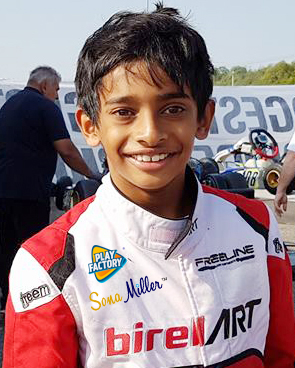
 Lonato (Italy), 14 May 2018: India’s Ruhaan Alva did well to finish ninth (100cc category) in the third round of the Eastkart Italian Championship at the famed South Garda karting circuit here