Tag: F1

  • Rosberg takes pole in Sochi; Hamilton suffers power-unit issues, starts P10

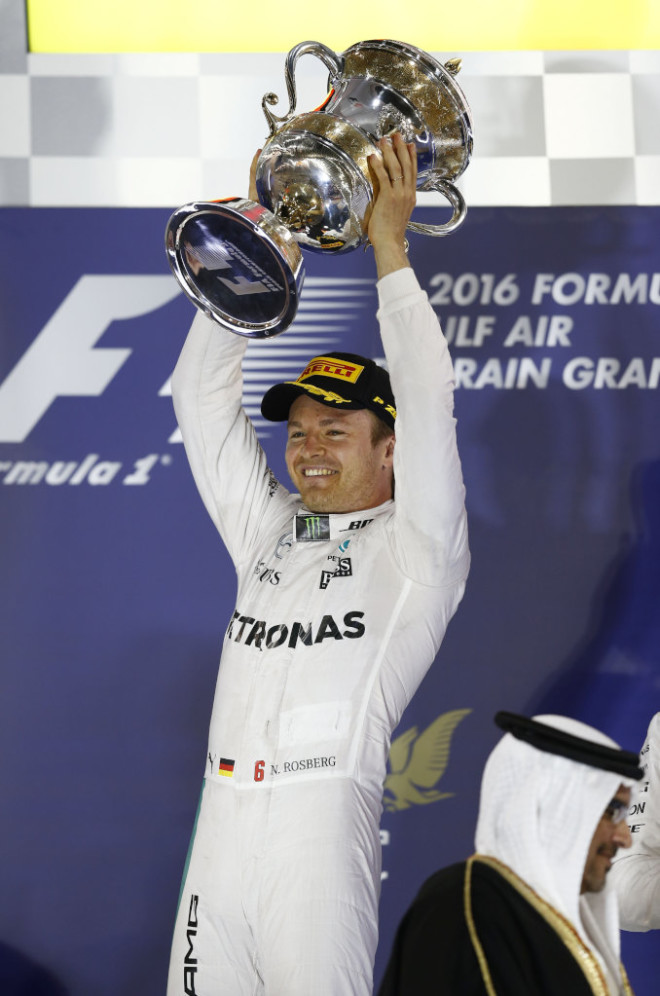
    Nico Rosberg took his second pole position of the 2016 Formula One season as Mercedes team-mate Lewis Hamilton suffered power unit problems for the second consecutive weekend.

    Two weeks ago in China Hamilton was hit with an Energy Recovery System issue and exited qualifying without setting a time. This time out the champion was at least able to make it though the opening two sessions of the qualifying hour, but as the rest of the Q3 qualifier prepared to begin the top 10 shootout, Hamilton was out of his car and the final session. Mercedes soon revealed that the Briton had been struck by the same issue that hamstrung him in China. He is set to start 10th depending on whether additional penalties are accrued if his car requires components to be changed.

    Having opened a significant 1.3s gap to Sebastian Vettel in Q2, with the Ferrari driver third behind Hamilton in the segment, the Q3 field was left open to Rosberg and the German seized the opportunity with both hands.

    Vettel managed to close the gap to seven tenths of a second but Rosberg’s Q3 lap of 1:35.417 was good enough to secure a second consecutive pole position and to leave him perfectly positioned to tomorrow claim a fourth successive win this season.

    “I was quite confident that the lap was good enough out there, because in quali two Ferrari was quite far away and I knew that Lewis was not able to participate in the last part of qualifying, so I was very sure that it was going to be enough,” said Rosberg afterwards. “But you never know, your know, so there’s always still a remaining uncertainty and so I was glad eventually when Sebastian finally crossed the line that it was good enough.

    Starting from pole position will be great,” he added. “It’s never easy but the way the grid is it does help me out a lot for sure to try and get that win tomorrow.”

    Although Vettel qualified in second position the Ferrari driver will start from P7 on the grid, having incurred a five-place penalty for an unscheduled gearbox change on Friday.

    The four-time champion remains optimistic of a good result, however, especially in the light of Hamilton’s difficulties.

    “Obviously we benefit from what happened to Lewis, which I’m not sure exactly what it was, but it allowed us to go P2, which helps for tomorrow with the penalty,” he said. “We are a bit closer, starting on the clean side of the track. I think we can have a good race from there. It should be quite exciting. The car feels good and I think all weekend it has been quite strong.

    “Obviously we know that on Saturdays we are probably a little bit still further back than we want and a bit further back than on Sundays, so high hopes for tomorrow.”

    Third place in the session went to Williams Valtteri Bottas, with the Finn repeating his qualifying efforts of last year and at the inaugural event in Russia. Due to Vettel’s penalty he will, however, start from the front row.

    “I’m really pleased with how it all went. This weekend has been very positive,” he said. “We have some new bits on the car and the car has been feeling better. It’s also a good track for us. I’m glad we could maximise the qualifying today. Pleased with that but it’s tomorrow that counts. So far my Sundays haven’t been so great but I’m sure tomorrow we have a good chance to have a good one.”

    Behind them Kimi Raikkonen qualified in fourth for Ferrari ahead of Felipe Massa in the second Williams. Daniel Ricciardo was sixth for Red Bull Racing ahead of Sergio Perez of Force India. Daniil Kvyat was eighth in the second Red Bull Racing and the final top 10 spots were taken by Toro Rosso’s and the unfortunate Hamilton, who was also summoned to the stewards office for “failing to follow the race director’s Turn 2 instructions”.

    Kvyat’s eighth place was notable as the local hero narrowly escaped elimination after Q2.

    The Russian was in P11 as the chequered flag was waved at the end of Q2 but he had just begun a final flying lap. To the delight of his home crowd the Red Bull driver was able to find enough pace to climb to P10, at the expense of Toro Rosso’s Carlos Sainz.

    Behind the Spaniard, Jenson Button came close to taking McLaren into Q3 for the first time this season but ended up just under 0.1s shy in P12. Nico Hulkenberg was 12th to split the two McLarens, with Fernando Alonso in P14. Romain Grosjean was 15th for Haas ahead of team-mate Esteban Gutierrez.

    Q1 saw the elimination of Renault’s Kevin Magnussen in P17, followed by team-mate Jolyon Palmer, Sauber’s Felipe Nasr, Manor’s Pascal Wehrlein, team-mate Rio Haryanto and the second Sauber of Marcus Ericsson.

    2016 Russian Grand Prix – Qualifying

    1 Nico Rosberg Mercedes 1:36.119 1:35.337 1:35.417
    2 Sebastian Vettel Ferrari 1:36.555 1:36.623 1:36.123
    3 Valtteri Bottas Williams 1:37.746 1:37.140 1:36.536
    4 Kimi Raikkonen Ferrari 1:36.976 1:36.741 1:36.663
    5 Felipe Massa Williams 1:37.753 1:37.230 1:37.016
    6 Daniel Ricciardo Red Bull Racing 1:38.091 1:37.569 1:37.125
    7 Sergio Perez Force India 1:38.006 1:37.282 1:37.212
    8 Daniil Kvyat Red Bull Racing 1:38.265 1:37.606 1:37.459
    9 Max Verstappen Toro Rosso 1:38.123 1:37.510 1:37.583
    10 Lewis Hamilton Mercedes 1:36.006 1:35.820
    11 Carlos Sainz Toro Rosso 1:37.784 1:37.652
    12 Jenson Button McLaren 1:38.332 1:37.701
    13 Nico Hulkenberg Force India 1:38.562 1:37.771
    14 Fernando Alonso McLaren 1:37.971 1:37.807
    15 Romain Grosjean Haas 1:38.383 1:38.055
    16 Esteban Gutierrez Haas 1:38.678 1:38.115
    17 Kevin Magnussen Renault 1:38.914
    18 Jolyon Palmer Renault 1:39.009
    19 Felipe Nasr Sauber 1:39.018
    20 Pascal Wehrlein Manor 1:39.399
    21 Rio Haryanto Manor 1:39.463  |
    22 Marcus Ericsson Sauber 1:39.519

    eom/FIA press release


  • FIA announces global agreement on Formula One power units till 2020

    Paris, 29 April, 2016: The FIA is pleased to announce that, following extensive work done in conjunction with the four Power Unit manufacturers involved in the FIA Formula One World Championship, and with the support of the Commercial Rights Holder, a global agreement on power units has been reached for the 2017-2020 period.

    The agreement has been approved by all levels of the F1 governance structure, including the World Motor Sport Council, and will now be included as Technical and Sporting regulations for the 2017 and 2018 FIA Formula One World Championship.

    The global agreement on power units covers four key areas relating to the cost and supply price, obligation to supply, performance convergence and the sound of the power units.

    As part of the power unit agreement, adherence to the measures outlined below will see the FIA commit to supporting power unit regulations stability and the maintaining of the current Formula One governance structure for the 2017-2020 period.

    COST

    Agreement has been reached on a significant reduction in the price of power unit supply to customer teams and a reduction in cost to manufacturers over the coming years.

    – In 2017 the power unit price for customer teams will be reduced by €1m per season compared to 2016.

    – From 2018, the annual supply price will be reduced by a further €3m.

    – Cost reduction on power units will be driven by changes to the Sporting and Technical regulations in 2017 and 2018, with a progressive reduction of the number of power unit elements per driver per season.

    SUPPLY

    Supply of power units to customer teams will be ensured, as the homologation procedure will include an “obligation to supply” that will be activated in the event of a team facing an absence of supply.

    PERFORMANCE CONVERGENCE 

    The new agreement includes a package of measures aimed at achieving performance convergence.

    – The token system is to be removed from 2017

    – Additionally, constraints on power unit part weights, dimensions and materials, and on boost pressure will be introduced in 2017 and in 2018.

     SOUND

    Manufacturers are currently conducting a promising research programme into further improving the sound of the current power units, with the aim of implementation by 2018 at the latest.

    eom/FIA press release

  • Hamilton sets the fastest time in FP2: Russian Grand Prix

    Shanghai, 29 April 2016: Lewis Hamilton set the fastest time of the second practice for the Russian Grand Prix, as Ferrari’s Sebastian Vettel’s afternoon was cut short due to electronics problems.

    Vettel was one of the first drivers to take to the track at the start of the 90-minute afternoon session at the Sochi Autodrom and he quickly set an early benchmark with a time of 1:38.921 that was just five thousandths of a second quicker than the first flying lap of Mercedes’ Nico Rosberg.

    Vettel’s time held until 17 minutes into the session when Hamilton, who had struggled over his early laps popped up with a time of 1:38.311, 0.610s faster than the Ferrari driver.

    Rosberg then improved to briefly dislodge Vettel but the German quickly reclaimed top spot with a time 0.076s up on the Mercedes pair.

    That was to be Vettel’s last action of the session, however. On his next tour the German slowed and eventually ground to a halt on the start-finish straight. He was quickly on the radio to tell his team that he had “lost electronics”. His car was recovered to the garage but he would play no further part in the session.

    Forty minutes into the session Hamilton reclaimed P1 with a lap of 1:37.583 that was 0.652s faster than Vettel’s effort.

    Rosberg, though had hit traffic and he contented himself with third on the timesheet two tenths of a second behind Vettel as he returned to the pit lane for a period before emerging with half an hour left on the clock on a set of used supersoft tyres. Hamilton, meanwhile, stayed in the garage as Mercedes worked on set-up changes on his car.

    Behind Rosberg, Ferrari’s Kimi Raikkonen took fourth spot with a time just over three tenths of the Mercedes driver.

    Red Bull Racing’s Daniel Ricciardo set the afternoon’s fifth fastest time, 1.5s behind Hamilton’s benchmark and a tenth clear of Williams’ Valtteri Bottas. Daniil Kvyat was seventh in the second Red Bull.

    eom/FIA press release


  • Over time… there is no such thing as luck: Otmar Szafnauer of Force India

    Over time… there is no such thing as luck: Otmar Szafnauer of Force India

    Sochi, 29 April 2016: Friday FIA Press Conference

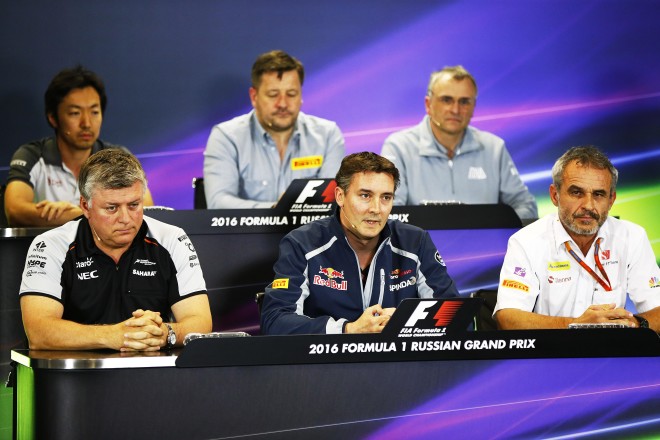
    Otmar of Force India at Fri PC 29apr2016 Sochi FIA picTEAM REPRESENTATIVES – Ayao KOMATSU (Haas), Paul HEMBERY (Pirelli), John McQUILLIAM (Manor), Otmar SZAFNAUER (Force India), James KEY (Toro Rosso), Beat ZEHNDER (Sauber)

    PRESS CONFERENCE

    James, if I can start with you. Toro Rosso have made a good step forward over the winter but perhaps you haven’t maximized potential over these first few races. Is that why John Booth has been brought in? What can you expect from him? What do you hope for him to deliver to the team?
    James KEY: Well, to answer that question in two halves. We have underperformed this year in terms of the points we’ve got. This has been for various reasons I think. There’s no one area that you could say has been a weakness. In Australia we had various issues we probably don’t need to go through again. In Bahrain unfortunately we lost Carlos early because of getting hit by another car. In China it was OK but we got fairly badly affected by the Safety Car, as did some of our competitors, so we had to fight our way back. So all of those circumstances are different but we believe we should have got more points certainly and, you know, we need to recover from that. But that’s not the reason John is here. John is with the team as a consultant, to visit the races over the coming months and help out where he can. It’s a big operation; we have grown very quickly. We’ve got a lot of people doing a huge amount of detailed work and John is there to help us step back a little bit and look at the wider picture and see if we can draw things together a little bit more in the coming races. So it’s purely there to help us. And I think with his good experience and his very clear enthusiasm about joining STR, which is very welcome, I think it can only help and strengthen the team.

    One of the areas in which he has a reputation for succeeding is in bringing through driver s. Your drivers are heading into their second season. Is this a season in which you now expect them deliver rather than hope that they will?
    JK: Yes it is, year two for sure. It was a great story last year with Carlos and Max and we warned them and I think they acknowledge that year two is difficult, not only because the expectation is there but it’s not a repeat performance, it’s a step up, and we worked hard in winter testing on trying to ensure that that step up was understood and recognised, so the consistency of tyre management, thinking smartly, using your capacity to think about what’s going on in a race rather than just to drive, as most rookies do in their first year and so on. That’s the benchmark we set and I think since Bahrain they’ve done a pretty reasonable job of that to be honest with you. But certainly the expectation is there; the pressure hasn’t gone for sure.

    Thank you for that. Ayao, if we can come to you. It’s obviously been quite a transition for you over the winter, coming to a new team, following Romain. I wondered how complicated a process that is for an engineer and in your time at Haas have you been able to implement the systems and procedures you wanted to?
    Ayao KOMATSU: It’s not complicated as such, but it’s certainly a new challenge, a completely different challenge. The team is set up in a different way, much smaller, less people but also the parts situation is quite different as well. But it’s a very good challenge. It’s really good to be part of the building up of a new team, so really enjoying it. In terms of implementing and process, of course we are not their yet, we’re miles from that, but we have so many different areas, we can improve every single area. Every event, ever day we are finding some new problems, new areas we need to improve. So it’s just a matter of prioritising them because we haven’t got many people, so we need to be realistic, but whatever is the highest priority, the highest sensitivity we are just tackling it. So really step-by-step, again, our target is still trying to finish the races with both cars. We achieved that for the time in China. We’ll try to repeat that here and hopefully with a slightly better performance. So yeah a good challenge.

    After the results of the opening two races of the season, China was a more difficult exercise, even though you got both cars home. In the past couple of days Romain has been full of praise for the response back at the factory. What has that response been and what did you learn from that race?
    AK: Quite a lot. Obviously I feel there were more questions than answers, so obviously we couldn’t get the tyre to work really well in China and we were really struggling with the balance and consistency and some of the direction we took during that weekend, when we reviewed it, which we weren’t convinced that was the right decision. But again all of us are learning and the good things is that everybody is working on the same vector, facing the same direction, working as a team. So, OK, we only got a few number of people but everybody is working hard with the right attitude, so that sort of analysis… we haven’t finished our analysis and I don’t claim that we understand exactly how to solve it but at least we have started to identify the problem and we are putting in place the way to improve. But we’ve still got miles to go.

    Thank you. Paul, coming to you, Jenson here yesterday was suggesting that because of the change in time of year that we are racing here and a possible increase in temperature we might see some difference in strategy, we might go to a two-stop. Is that what you are expecting, what are you hoping for?
    Paul HEMBERY: I think in reality, having looked at today’s results, unlikely. It’s likely to be a one-stop race still. Unless something dramatically changes before Sunday, that’s what we see so far.

    You obviously have an increase in test days for the 2017 regulations coming up, that’s been acceded to. What’s the plan for that and for the teams involved? What coming up in the future?
    PH: Well you can imagine, a lot of hard work. Very big changes, not only in the physical size of the tyres, but also in the characteristics of the tyres; what we are being asked to deliver. The first phase is working with some V8 cars, up until probably the end of July, where we’ll be working on the current tyre size and developing new concepts in terms of materials, the actual physical shape of the tyres and also the compounding in particular. That’s the first phase, then we move on to a hybrid, we believe, based on the availability of the vehicles, from the end of July. So, yeah, it’s an intensive programme.

    Is that it for this year’s programme on those tyres? What happens over the winter? 
    PH: Well, there isn’t going to be and end-of-season test this year. We were originally planning for it to be available in November, to give the product to the teams. It looks likely now that the first time we’ll run with all the cars will be next year when they define the winter test plan and I know there is a lot of discussion underway at the moment for that, to decide where we go, when it’s going to happen.

    Otmar, if I could come to you, six points from the three races so far. Compared to last year, you had 11 at this point, so the deficit isn’t massive, but like James, there’s maybe a sense of missed opportunity. What’s the key to overcoming those missed opportunities from the drivers’ side and from the pitwall.
    Otmar SZAFNAUER: It’s difficult to predict red flags, for example. That’s hard to do. From the drivers’ perspective, I think in our second race they both had lap one incidents. There is a higher probability when you qualify where we have been qualifying for that to happen. If you qualify up front it’s a little bit easier to get away. So they just have to do what they are good at doing – getting through the first lap or two cleanly, and then after having good strong races and having goo strategy. Over time… there is no such thing as luck. You make your own luck, so if you work hard it should come. I think we’ve got a decent pace in the car and if we just continue working hard we should score some points.

    Last year you also had the positive impact of the B-spec car coming in mid-season. What’s the development plan for this car across the course of the season and are the resources in place to give you a chance of surviving in what’s a really tight midfield battle?
    OS: Yeah, it really is a tight, fierce competition in the midfield. We do have a development plan that also has to be rationalised with what are doing for 2017, so last year we had the fortune of whatever we developed in that year carried over to this year, but next year that won’t be the case. So we’ll have to address that when we come to it. But we have some significant upgrades coming at the next race and some more planned thereafter.

    Great, thank you. John, you’ve been with the team quite a while now. You’ve been through a lot of the upheavals that have come and gone there. How would you characterise the situation at Manor at the moment? Last year it was always about the team rebuilding, has that process been completed?
    John McQUILLIAM: Not fully completed. The team is a lot stronger this year than it was last year. So we’re a lot bigger, we’ve had some recent starters who are very experienced and who are adding to our capabilities. So we are still expanding and the atmosphere is very optimistic. We’ve got two good rookie drivers who are really pushing the car and if we keep a nice steady progression of the car’s performance we think we can challenge the cars immediately around us and start moving up, so there is a great sense of optimism.

    What’s the plan for the near future? Otmar was talking about development; can you give us an insight into what’s happening with your team?
    JM: Yes, we’ve got some developments, actually very similar to Otmar, so we’ve got a fairly big upgrade coming for Barcelona and there are more upgrades planned for throughout the season, so we’re pushing hard throughout this year.

    Thank you. Beat, coming to you; last but not least. I just wanted to get an idea from you about Felipe today, whether he ran that new chassis and what the feeling was? Was he more comfortable?
    Beat ZEHNDER: We did run a new chassis, as you all know. He’s still struggling with brake performance, he’s not too happy. Compared to Marcus he was quicker, but Marcus underperformed today, he was not happy with the car set-up at all. It’s very slippery out there and he struggled a lot.

    For both of them, and for the team in general, it hasn’t been the easiest start to the season and the rumours of financial difficulties at the team continue. Can you give us an idea of what’s happening behind the scenes and how things are at Hinwil?
    BZ: We’ve been in a more comfortable situation already. We have financial difficulties, it’s not a secret, but I think the good thing is we are still around. We’re working hard to solve all the problems but it’s not easy. An annual budget this year is just a massive one and to just cover it by sponsors and the income from Bernie is just not sufficient at the moment.

    QUESTIONS FROM THE FLOOR

    Q: (Alan Baldwin – Reuters) A question for Otmar. We’ve seen Vijay Mallya in the press a lot in the last week or two. He’s had his diplomatic passport revoked and now India have asked for him to be extradited back from Britain. I was just wondering, how does that affect the team, having a principal who seemingly can’t attend any races unless they are held at Silverstone?
    OS: Well, we’re all used to seeing Vijay at the circuits, but he has many business interests and at the factory he used to come at Christmas time and also around Silverstone, so from that regard, from an operational standpoint I don’t think it has a big impact on the team. I know he’s working hard with the Indian government to resolve his issues and hopefully soon we’ll see back at the races.

    Q: (Dieter Rencken – Racing Lines) A question for Otmar, James, John and possible Paul as well, if you’d like to comment? Although the 2017 regulations have been finalised they had actually been talking about them for some time. But do you have sufficient time going forward to develop the cars given the change in the regulations, things like wind tunnel tyres etc? Is there enough time to do the regulations justice by next year?
    JK: Well, you never have enough time. I think you always value more time, particularly with new regulations. But it is in time for 2017. As you say, we have been discussing them for a long time now and the basic principles have been kind of kept, even though they have been refined and changed etc, the way forward effectively was agreed technically earlier this year and that’s what the teams I believe have based their activity on. Some activity, in fact, was going on before then, certainly a lot of simulation activity to try to understand what these tyres and the wider track would do. So I think that there is enough time. It’s going to be busy and as Otmar said you’ve got to compromise this year versus next year a little bit to get it right, especially if you are a smaller team, but I think there is time to do a reasonable job of it.

    John, what does that mean to a team like Manor, which basically has just got itself back on it’s feet and everything changes?
    JM: It’s going to be a challenge for us of course. I guess we would have preferred the regulation change to come a year later. The thing it does mean is that there is no carryover of parts, so it means that there has to be a brand new car with enough spares ready at the first race. Almost every single part will be new for next year and for a small team it’s a big task to redesign effectively every single component on the car and being a small team we have to very much do that in series rather than in parallel. But going back to answer your first question, yes, there is enough time. As James says we have known what the regulations were. There has been a little bit of uncertainty as to whether what agreed early in the year will be carried forward. I believe it will be and we’ve been working on that in CFD and in the wind tunnel, so we have a small development programme running for 2017 and again it’s a balancing act between how much time we spend on ’16 and ’17, but there is enough time to do it.

    Q: Otmar, when does that shift take place?
    OS: It’s a million dollar question. It depends on many factors, including what compromises you have to make on this season’s performances versus next. That all depends on how many points you’ve scored by a certain time. But like James has said, we started looking at what these regulations would do already, mainly through simulations. We will soon start our wind tunnel programme with physical parts and the tyres so it’s happening already. The big question is when do you completely switch from one to the other and we haven’t quite made that decision yet. We’re still pushing for developments  this year; as you said, we’ve only scored six points so we have to ensure that we hit our performance targets this year before we completely switch to 2017.
    BZ: As John said, the financial impact is a massive one and for a small team like Sauber it’s really  difficult. It’s not only the cars and not being able to carry over parts from one year to the other, it’s the list of investments you have to make starting with tyre heating blankets and… and… and… We’re talking about millions and millions here, so for a smaller team it’s really a difficult time.

    Q: (Boris Gubkin – Rambler News Service) Paul Hembery, I wonder how much the cheapest tyre costs?
    PH: The cheapest tyre? We only make expensive ones! There’s no such thing as a free lunch. Quality costs. Well, I’m not really sure how to answer that. A Formula One tyre – we don’t really determine a cost because you could have the material cost of the tyre but if you add in the overall costs of research and development and the overall project cost then they run to thousands and thousands. I’m not really sure how else to answer that.

    Q: (Dieter Rencken – Racing Lines) Otmar, James, John, one of the prices you will pay for the increased performance is obviously the fact that the engines are going to consume more fuel. How do you view that from an engineering perspective, will that have any impact on your designs, on your philosophies?
    JMcQ: It does have an impact. At the moment, I believe that the fuel capacity’s going to stay as it is or maybe go up by five kilos so it’s not going to have too big an impact as far as the chassis design. If we get the expectation, the cars will be draggier, they will have the ability to run with wide open throttle more often so we might have to see a little bit more fuel saving in the races which is sporting and tactical. Technically, I don’t believe there’s going to be a big change to the layouts of the cars.
    OS: I think these hybrid power trains were introduced with goal of – or an intent –  of reducing the amount of fuel that we use over time and yes, although the cars will be a bit draggier, if the fuel limit stays the same, then effectively it is like reducing it over time, but I still think we should look at doing just that and over time reducing the amount of fuel we use just to complement the philosophy that we had when all this was introduced.
    JK: I agree with Otmar. In the longer term it’s always a good thing to target ever more efficiency. I think these power units are incredibly efficient now anyway, they are really extraordinary things. For me, really, it’s a case of regulation compatibility. These engines were designed around a given chassis and a given aerodynamic set-up – in fact for that matter, a given tyre design and we’ve now changed that and you’ve got to make sure that your power unit and the way you use it is compatible with your chassis design. So I think if we do need to squeeze a little bit more just to ensure that races don’t become fuel-saving events, then that’s probably the right thing for the sport but certainly in a longer term we need to look for continued efficiencies as we go down the line.

    Q: (Angelique Belokopytova – AutoDigest) So back to regulations: F1 regulations are becoming more and more complicated so my question is for all of you: did it have some impact on your work, did it make it harder and how are your expectations for next season? Are they more positive or negative?
    BZ: I don’t think that the regulations are getting more and more complicated; they have been complicated for quite a while and one of the reasons – talking now on the sporting side – is that you have to close every possible loophole and this makes the rulebooks bigger and bigger. Will it be better for the show, the 2017 regulations? I don’t know, I hope so. At the moment I have my doubts, although I hope that I’m wrong.
    Q: James, a complex set of regulations;  regardless of the complexity a changes in regulations always gives a team an opportunity to do something special. Is 2017 that change an opportunity rather than a hindrance?
    JK: Definitely it’s an opportunity – like you say, any big regulation change is an opportunity to go either way, actually. You can also get it very wrong so you have to play it carefully. But it is an opportunity and I think – as we’ve said before – with time, the more time you spend on next year’s regulations therefore the less you spend on this year, you’re kind of making a sacrifice, maybe short term but for a longer term benefit and the longer term is the future ultimately because your baseline car is where you start from, so I think it’s a carefully balancing act. I tend to agree with Beat, I think the rules are complex anyway. The cars are a very complicated unit now, particularly with the power units and we’ve added various operational things like three compounds etc this year, the tyre compounds which have added complexity to a weekend but for good reasons in many cases. So I think the complexity is maybe a little bit increased for 2017 but I don’t think it will be a problem. I think most technical departments will welcome the challenge.
    Q: Ayao, from your side of things, complex regulations, is it just another set of problems that you have to solve over a race weekend? Is it good for a race engineer?
    AK: Well, we’ve only done three races and a half so I’m too busy thinking of this year rather than next year. We’ve got our design department and aero department so I’m largely leaving them to think about it and I’m really concentrating on this year’s operation but yes, certainly if you operate efficiently it’s a good challenge and it’s an opportunity, for sure.
    Q: Otmar, do you just take the rules that you’re given and work with them?
    OS: Well, it’s a good question: will the show be better next year? I think that was the intent of the regulations and I hope that that will be the outcome. If it isn’t, I think we’ve recently seen changing sporting regulations where it didn’t improve and we quickly went back. The difficulty with these regulations is that it’s going to take some time to go to something that doesn’t improve the show quickly, so hopefully we’ve got it right.
    Q: Paul, the shift to three compounds per weekend has obviously been successful this year. That complexity hasn’t harmed the sport particularly.
    PH: It seems to have worked quite well initially; let’s see how it evolves through the season. That was something that we worked with, the FIA and the teams and ourselves to come up with this regulation. That’s going to carry through, as far as we know, to next year. Working with the teams, they’re all quite modest, I think they all like a technical challenge. They might fight one way or the other to move the technical regulations in one direction but ultimately they are brilliant engineers and brilliant engineers like a technical challenge so I think whilst they might be scratching their heads now, they’re all still looking forward to getting an advantage over their competitors. From our point of view, the input we had from the strategy group was very much to improve the pace of the cars, so cornering from our point of view, and to try and increase the overtaking opportunities so we’re making the tyres less thermally sensitive. It’s down to the aero people to know whether the changes to the aero will reduce the disruption when one car’s following another, so that’s the area that’s hard to understand because you talk to different people, they have a different viewpoint on that matter. But the objective is certainly to try and make the sport more compelling and the cars harder to drive and more enjoyable to drive for the drivers. From the spectators’ point of view, to see more overtaking action.
    JMcQ: Technically regulations aren’t really more complicated, they are just different. It’s difficult to gauge how that will affect our team for instance. There’s one school of thought that would say that the bigger teams will benefit from a large rule change in that they’ve got the capacity to investigate more options and try out more ideas. The small team really has to pick and chose, decide the layout very early and stick with it and then develop it and hope it’s got it right. When you look back to 2014 when there was quite a big rule change, I think as a team we did quite well – we certainly didn’t fall back against the competition so I’m optimistic that with a rule change we’ll maintain or improve our  position relative to the others but it is a costly exercise but a great challenge.

    Q: (Alan Baldwin – Reuters) Beat, sorry to be negative but going back to the financial difficulties, could you perhaps give some insight as to how manageable they are? We’ve still got 18 races to go; is this threatening the team’s continuation this season, and secondly, how much of these difficulties are caused by being based in Switzerland? Is that adding to the costs and general problems?
    BZ: I think this is a question which Monisha should answer, because I haven’t got the overall picture. A simple figure: in 2007, one dollar was 1.5 Swiss francs. Now we have parity. So what we had income in dollars is now worth 50 per cent less. Switzerland doesn’t make it really easy. The other thing is that obviously F1 personnel, technical, mechanics, you kind of have a pool in the UK, we don’t have it in Switzerland so for motor sport, it’s maybe not the best place to be although we have wonderful living!

    Q: (Graham Harris – Motorsport Monday) Otmar, if I remember correctly, you came up with the original idea of multiple tyre compounds. Your suggestion has been implemented but perhaps not as radically as you originally came up with. Do you have any comments on how they took your comments and implemented them and do you have any more ideas that you can perhaps share?
    OS: Well, selfishly it would be nice to have it implemented just as I thought. In F1 we do all get together and speak about technical as well as sporting regulations and it is a hybrid of the initial proposal that we had but like Paul said, I think it’s working well, I think it does mix things up in the race. It sure has in the first three and hopefully it will stay for next year because I think it’s better for the fans if you don’t know what the outcome is from the onset.
    I haven’t thought of any more ideas but we’ll get together and think about what we can do for future years and see.

    Q: (Dieter Rencken – Racing Lines) Paul, it was last year in Sochi that you were announced by the commercial rights holder as being the successful tenderer for the three year supply contract going forward. However, I believe that the contract still hasn’t been signed and there were some fairly dramatic comments made recently that you may have to withdraw if you didn’t get your testing regulation etc. Has the contact now been signed? And the second question is: obviously having been announced by the commercial rights holder you must have been rather happy with the commercial package that you were offered which involved bridge and board advertising. If you didn’t spend the amount of money that you do on marketing, would there be any difference to the quality, the construction, the approach that Pirelli take from a competition point of view?
    PH: Well, from a contractual point of view, there were obviously some elements of a link to the recent changes regarding testing, that was essential for us, but the actual terms are all agreed. We’re now in the final phases of signing all the final documentation but that’s a matter of days, I would think, rather than anything else. As I’ve said previously, in (comparison to) previous seasons this has actually proved to be very early in the day to have signed the contracts because historically we’ve actually gone into the first year of the contract before everything’s been signed so there’s been a lot of progress and some excellent collaboration with all the people involved.
    The second part of your question: would it change if we didn’t invest so much commercially? No, there’s two separate aspects of our involvement in Formula One. One aspect is the technical partnership and the second part is the commercial and one doesn’t impact on the other.

    eom/FIA transcript of the Press Conference on Friday

  • My 100th race, it is very special as a driver, says Sergio Perez of Force India

    DRIVERS – Felipe NASR (Sauber), Sergio PEREZ (Force India), Esteban GUTIERREZ (Haas), Jenson BUTTON (McLaren), Nico ROSBERG (Mercedes), Daniil KVYAT (Red Bull Racing)

    PRESS CONFERENCE

    Daniil, I’ll start with you, as it’s your home race. Twenty-second birthday this week also. You were fifth on the grid here in 2014 and fifth in the race last year but Red Bull’s performance in China must give you hope of improving on that this time out?
    Daniil KVYAT: Yeah, you know, lately we have been competitive on most of the tracks – doesn’t really matter, any kind really, starting with Australia, Bahrain, China we always looked in quite good shape. I think Sochi also in the past for us maybe hasn’t been the easiest track, as a team, but now we are just coming to any track and we are just trying to extract everything the car has got and I believe also here we can fight for quite strong points. We will do our best and I think the car is looking in great.

    Obviously you’ve had time now to look at the video from the last race, of that start. Are you happy enough with everything that went on, with your moves during that race, or at the start?
    DK: Yeah, I’m very happy actually. I think everything confirmed my point of view. I think obviously everyone told their opinions on that incident, also the people involved. I think all in all I did what any competitive racing driver would do. But now I think there has been enough talk about it. Now it’s time to turn the page and move forward and now we are fully focused on the upcoming races.

    Thank you. Nico, if we could come to you. Three wins from three. Formula One love a statistic and there have been plenty bandied about concerning your start to season – best start since 2004 for Michael Schumacher. However, you’re the one who has been sounding a note of caution through all that hyperbole. Lewis you’re obviously expecting to bounce back, but how real a threat over these three races has Ferrari been. Have you seen any evidence of what they are capable of yet?
    Nico ROSBERG: I’m not really sounding any notes of caution, I’m just realistic and Ferrari, amongst others, just haven’t shown what they can do yet. They’ve taken each other out in the last race, for example, in the first corner and from then it was just messy, an an example. A lot of things have been going wrong and for sure they are a lot quicker than they have shown and we think they are very, very close to us.

    Mika Hakkinen made some interesting comments earlier this week, I read, talking about your performance this season and what it takes to be a world class driver. I’ll read them: he said the road is long and painful and it doesn’t whether or not your father is a world champion or not, or whether you have friends and family beside you, ultimate a driver is alone in the process. Is that a fair analysis?
    NR: I didn’t know that.

    Is that how you see it. Is a driver alone in the position that you’re in?
    NR: No. I’m not alone. I have our whole team. It’s a team sport in the end; alone I can’t achieve anything. Then the closer group, which is my family, friends, my management, physio and everything. Everything plays into it, everybody has their role and any success I have on the track they are a part of it.

    Does it feel like there is a mental burden upon you? Last year, as well, when you were going for a championship, and this year, is there a greater mental burden in that. Does it become very tough?
    NR: I generally see it as a very pleasurable experience! Because it’s just an awesome feeling to come to a race track, to know that I have the car to be able to be on pole and win the race. I just look forward to it. So I’m here in Sochi and I can’t wait to get going and see where we are compared to our direct rivals and try to make it happen.

    Thank you. Sergio, you’re celebrating your 100th grand prix presence this weekend and also coming back to the scene of one of your most memorable podiums, last year. That obviously must give you a good feeling for the weekend?
    Sergio PEREZ: Yes, definitely. When I come back here and I remember my great race that I had last year, not that long ago actually. It was a great feeling, a great achievement to the team. And as you say my 100th race [weekend]. It has gone really quickly, I really hope I can have a great race on Sunday to have a full achievement, you know, because my 100th race, it’s something very special as a driver to achieve and hopefully there’s hundreds more to come.

    It hasn’t been the easiest start to the season for you; there have been some incidents during the race that have maybe hampered your progress. Those race incidents – have you been happy with the team’s reaction to those incidents during the race and the strategic decisions that have been made?
    SP: Obviously you always learn a lot after a race, after you have done the decisions. I think we have been affected a bit by strategy sometimes, the track position we’ve been having more than our pace. I think clearly in the last race we did a great race. I think we have improved quite a bit. But still we need a bit more especially in the race pace. I think our quali pace over one lap is good. We have to improve our degradation and I think we have found the issues with the car. I think it’s just a question of time how quickly we can fix them. We are planning to have some upgrades for Barcelona. But I’m pretty confident it will be a good season for us, although right now we have zero points. We should have a couple of points already in the pocket, but the season is very long.

    Felipe, if we could come to you. There’s been some talk in the run-up to this race about you getting a new chassis here. Can you give us the latest on that? Is it happening?
    Felipe NASR: Yes, I can confirm I do get a new chassis here. You have to remember that a Formula One car is made up of many components and it’s just one part of it. I think it’s a sensible step from the team that we are looking further to discover these problems, these handling issues I’m having in the car. Since we put the car on track in Australia we’ve been having this very strange behaviour let’s say, it’s very unpredictable to drive the car. As I said, I can confirm, it’s a sensible step here and let’s see how the weekend goes.

    Was there a definite problem with the chassis, the old one?
    FN: Not that they could identify. But as I said, there’s so many places to look at. For this we need resources, we need time. The cars haven’t been back at the factory. It was really good to have a full let’s say look to every detail if we could, but I’m sure they are doing everything they can on the things we have in our hands now. It’s a good step we take on this, ticking the box now and seeing if there’s anything wrong with the chassis, and let’s see how the weekend goes. It’s been great here last year. I had one of my best races in Formula One. It’s a track that I like, so at least I have this good reference in my mind.

    Esteban, we’ll come to you. You’ve also had a couple of difficult races at the start of the season but you completed a race distance in China. How much of relief was that, how much of a weight off your shoulder?
    Esteban GUTIERREZ: For sure it was a relief to finish the race finally. It’s been a frustrating start for me, a lot of interruptions over the weekends, but I wasn’t satisfied completely just by finishing the race of course, I want much more than that. China overall wasn’t a great track for our car. Hopefully we can recover from now on, in Russia, and that this track gives us better possibilities.

    Last week you said the year you spent out, doing a lot of work in the simulator, had give you the opportunity to develop a range of driving styles that you may not have used before. How has that informed your approach to driving the car you have now?
    EG: It didn’t change the approach; it changed my knowledge. I basically experiment a lot. I used that time for it in the simulator, having different references. I made sure that that time, that year, was a benefit and not only a post time. I made sure of it and I really used everything, so I feel very confident and I feel very prepared right now and everything is in front of me.

    Great, thank you. Jenson, finally coming to you. Would it be fair to say that this season so far McLaren has slightly flattered to deceive? There has been good performance on Friday and Saturday you’re on the cusp of Q3 but the races haven’t quite gone according to plan. What’s that down to, why are the races not panning out as you’d like to them to?
    Jenson BUTTON: Not doing a good enough job possibly. I think the last race, if you look at it – it’s very difficult for a driver, because you come home 12th and 13th and it’s not where you want to be – but if you look at it compared to last year, every car finished in China. So it’s a big step forward to last year in China. In terms of where I think we are, yeah, our qualifying pace has been reasonable but I still don’t think we have shown our true potential in qualifying either. We have been close to Q3. Circuits like this don’t really help us either, but I think when we get back to Europe it should be easier to show our pace in qualifying and hopefully in the race. Yeah, it’s moving forward but you always want more, you always want more. Formula One is so competitive right now. For us I feel that having something new coming every race, aerodynamically and also with the power unit, it’s moving in the right direction, but we always want more. I think when we start scoring points on a regular basis we’ll be a lot happier, but that hasn’t happened.

    Honda have said the power unit is ‘”nearly there”. Is that a fair analysis, is that what your experience has been?
    JB: It’s very difficult to know what ‘nearly’ means. I think we’re very happy with the way the deployment is this year, compared to last year. We’re a lot close to the other manufacturers, which is great. In terms of outright power, I don’t know. I don’t think anyone really knows, but we know there is still a lot of work to do and that’s the aim.

    QUESTIONS FROM THE FLOOR

    Q: (Angelique Belokopytov – Auto Digest) You drive in Formula One since more than 15 years and that means you have driven a lot of cars. Which style of car do you prefer? Today more complicated at a technical level or as you had in the past requiring more stylish driving or something like that?
    JB: I think it’s a very easy answer. I think the drivers that were racing back in 2004 will say the V10s, lots of downforce, a tyre war – but this isn’t were we are. We’re not there right now. It’s easy to look back and say the racing was better – and it probably was. And more fun to drive – but things have evolved and things have changed. Technology is a big thing with Formula One and manufacturers are very interested in Formula One because of the technology and I know that Honda is – so we’re moving in a certain direction. I think Formula One can be as good as 2004 and hopefully that is soon.

    Q: (Andrey Kortasha – TASS News Agency) Question to Daniil Kvyat. How much is it important for you to finish ahead of your team-mate at your home grand prix? Is it important for you?
    DK: I think it would be logical to say that it is always important to finish in front of as many people as possible and, since your team-mate is one of those other drivers of course you try to do your best and finish in front of him. Of course, you know I’ve got quite a tough team-mate to beat. Very talented, very strong driver, very good reference since then. To beat him you have to do an absolutely perfect job in qualifying and in the race. And every time that happens I know it has been a really good day. Of course it’s only three races this season so far and it hasn’t been looking too bad. I think it can only get better as the season goes by. Let’s see where the end of the season is going to be.

    Q: (Livio Oricchio – GloboSport.com) To all drivers. We had in the last race more than 150 overtakes and here we have just one pitstop predicted, considering the history of the grand prix. What scenario do you project for the weekend. Similar to the last one or something completely different: a more stable race let’s say.

    EG: Well, I think it is a very different type of track. Russia offers… yeah, let’s say a medium range of overtaking so it’s not very straightforward but hopefully the strategy can be a bit more viable, that we can have more pitstops. As you say, the prediction is not the case, but hopefully we have a fun race for the people outside to watch, and have fun.

    Nico, is there much you can do on strategy at this race? It’s been a regulation one-stop in the past.
    NR: Yeah, strategy-wise that’s not going to make it as exciting probably as China, for example, in terms of overtaking. More straightforwards there. But, y’know, Turn One, for example, is still a good place to overtake on this track and we’ve seen some exciting stuff in past years. Not as much, of course, as China but some individual exciting moves so hopefully it will still be good. Let’s see.

    Felipe, does the tyre choice you get now, will it make any difference here?
    FN: I think it’s very straightforward as well. Looking back to last year, we got basically the same compound and I think it’s the kind of track you can push pretty much every lap. I agree with Nico, it’s not going to have as much excitement as it was in Shanghai but it’s still a race. The time when to box, to know which tyres to start the race – sometimes a car is better on one compound, another is better on the other – so it’s still playing to whatever tyre adapts better to which car and how you take it into the race. But from what I remember, last year was good that we could push throughout the whole race.

    Sergio, is it a good track for overtaking?
    SP: When you compare it to China, of course not because degradation, as Felipe says, is a lot lower here. It’s not as high as China. But I think if we have a straightforward race we’re going to see different strategies. We have an extra compound, having the medium this year, it might create something towards the end of the race, something different, especially if you are having people on the medium and others on the supersoft, that’s a two-step softer tyre so there might be the opportunity to overtake. I don’t think we’ll see as much overtaking as China but it will be an interesting race in terms of strategy. This characteristic of Pirelli bringing three compounds might create a little bit of different strategies and at the same time more excitement in the race. I think last year the race was very exciting – but given the conditions and what happened all through the race. I think if we have a straightforward race we might see a more interesting race than in the past years. I don’t think we’re going to see many cars on one stop this weekend.

    Jenson, your thoughts on it. Fernando did 40 laps I think on a supersoft last year. Is there much you can do? Is there any strategic variation?
    JB: None of us are muppets here, we know what the race is going to throw at us! It’s not going to be like last year, with the time of the year and the circuit temperature, it’s 20°C hotter than last year, so it’s not going to be as easy to do a one stop, I don’t think. It’s going to mix it up, which is great. I don’t think every race is going to be like Shanghai. I wish it was – but I don’t think it will be. But still I think this race will be an interesting race.

    Dany, your thoughts on your home track. Red Bull have gone quite aggressive with tyre set choice here with ten supersofts for both you and Daniel
    DK: Yeah, I think obviously looking at last year, similar compounds to what it was last year and most of the people managed one stop I guess last year. Maybe it wouldn’t be a bad track actually for the debut of the Ultrasoft, I don’t know. But anyway, I think it is what it is, the same for everyone, and I still think the track offers some good opportunities for racing because there are long straights, so it can be quite exciting.

    Q: (Krill Zaytsev – 66.ru) Question for Daniil. Please tell us more about relationships with your team-mate and, one more question, do you have number one and number two pilot in your team or you are equal with Ricciardo?
    DK: I think it’s a normal working relationship, we know each other for a while, we can share a joke outside the track like everyone, like normal,  I guess like everyone. But once it comes to the work I think we’re both focussed on our work because we’re both professionals and we have plenty of things to do over the race weekend. Regarding your second question, it’s not a very popular question to be honest. What defines Formula One is how fast you drive, how hard you work and then this brings you the result in the end. It’s the only thing.

    Q: (Andrea Cremonesi – La Gazzetta dello Sport) Nico, after six wins in a row, can we say that this is the best Nico ever and is it possible for you to describe when the spark ignited, maybe because of the birth of your daughter or maybe they changed the modifications on the car?
    NR: First of all yeah, I’m the most experienced Nico since I gained experience last year and the last two years from battling for the championship. Definitely I’m pleased with the way I’ve been driving now in the first three races. For me, it’s not six in a row because the three last year were last year and they don’t count for anything in this year’s championship so for me it’s winning the first three which I’m really happy about but as I said, it’s because… yes, I’ve been driving really well but my opposition had a really messy start. That’s the reality of it. I definitely expect them all to bounce back, especially Lewis and it’s going to be a great battle against them as always and it will be tough, even if I have some points lead now but it’s still such a long season: three races is a seventh or something of the whole thing. There’s like 450 points to take still and now I have 30-something  in front or whatever. There’s still a massively long way to go so it’s not really changing the situation much.

    Q: (Andrea Cremonesi – La Gazzetta dello Sport) Kvyat, I would like to know how different this car is to last year’s that allows you to do better performances? What is the strongest part of the car this year?
    DK: I think generally at the end of last year I think our car was behaving itself pretty well. Over the winter there hasn’t been any revolution, let’s say, in terms of the car. There were just a few ‘tidies up’ here and there on the chassis side. I think also the engine side also improved, there was a step forward and it was very pleasing to see and hopefully there will be another step forward coming at some point soon when we will be able to give a bigger fight to the competitors which are still ahead of us. It would be very nice, especially in the last year we have been able to develop through the season quite nicely and I think that if we will have a similar rate of improvement we will become hopefully a headache for some people.

    Q: (Livio Oricchio – GloboEsporte.com) We are reaching a moment where we are seeing nice races this year but everything will change dramatically for next season. There will be a more downforce in the cars, wider tyres and everything. This solution, from the drivers’ point of view, is the solution to make the show even better, to see more competition, to attract the public more?
    NR: Our opinion was that it’s not the right direction to go and we were hoping that they would definitely re-look into it and just make sure from a technical point of view to double check. Now this is the way it is, so now all we can do is accept it and make the most of it and hope that there are going to be some surprises.  Maybe we’re going to love the cars and enjoy driving them even more than we are now. Maybe all the grip is going to feel great or whatever. Now it’s just accept it and make the most of it.
    Q: Jenson, was it worth waiting for some degree of convergence?
    JB: I concur.
    DK: Well, I’m not completely clear where we’re going to head but maybe it’s going to make it interesting because obviously for 2014 the regulations, everyone knew quite well in advance how the regulations were going to be, so some people could be better prepared for it, but now I think, as time to prepare is a bit limited, I think everyone might start in a very similar condition, which could lead to closer racing perhaps. All the teams might be much closer and yeah, I think downforce, generated in the right way and mechanical grip from the tyres could be an interesting combination, also for racing, for us drivers to really reach some incredible speeds would really be quite cool.
    Q: Sergio, is it a case that you accept what regulations are given to you? Do you drive the car that you’re given?
    SP: Yeah, I meant there’s nothing else you can do. I really hope that the sport goes in the right direction, that we can see more competition, closer teams as we’ve seen in the past. We’ve seen big gaps between the teams in the past. I really hope that we can have a much closer field and that the regulations and the direction we’re going in cannot create those sort of gaps, that we can close up the gaps. In my opinion it’s what Formula One needs, it needs more competition rather than more downforce, it needs more competition across the teams.
    Q: Esteban, is this regulation change something that could disadvantage a team like Haas, just coming in at the point it has come in?
    EG: Not disadvantage. My opinion is that the changes of having wider cars, wider tyres  is the right one because what we need is to increase the mechanical grip of the cars. In my opinion that will give us a better feeling when we are driving on the limit. What I’m not fully convinced about is obviously the increase in downforce which will naturally make overtaking more difficult or let’s say following a car more difficult. The changes are there so as a driver, we don’t have an option, we just make the best of it. I think the cars will look spectacular so from that side of things it’s positive.
    Q: Felipe, is it important to have a change like this in order to improve the show or did it need improving?
    FN: Well, I guess it is. I do believe changes can always bring different kinds of mixes and surprises, depending on how teams face it but all I can say is that in a team like Sauber at the moment it’s  difficult for them in the actual situation they are facing plus to have such a change to face next year is complicated. You need to have the right resources and time, fighting against other things that they are facing now, so it is difficult but on the other hand, I think that from a driver’s point of view, I think the mechanical grip will be such a good thing for us drivers to have it back, as I think we are all pretty much leaning in that… trying to get this back in the car but I agree with the others, what they are saying about the downforce, is it exactly what is going to improve the show? We don’t know but let’s hope for the best. Everybody’s here to try and do the best with what we have and what we can do as drivers but I think that’s pretty much it.

    Q: (Angelique Belokopytov – AutoDigest) For all of you; Nico you were just saying that we just have to accept and do the best with it. Do you all agree with the fact that you have no word to say about what you’re doing on the track? You are making the race so why not have a part of the decision-making?
    NR: Actually we’ve been trying to get more involved and actually it’s moving in the right direction because the FIA is asking us more things now. They want to hear our opinion, asking us for get-togethers and so the process is going well, I think, and with time, let’s see where it goes. We will try to be more and more involved because I think we can really give something additional to the direction of the sport, because we know a lot of things about what should be good for the sport, because we’re driving the cars in the end.
    Q: Jenson, you concur again?
    JB: Yes.
    SP: I share the view of Nico.
    Q: What I did wanted to ask was: drivers, the input that you have, when you’re driving the car, do you really know what is the best for the sport from the outside, because a driver will always want what’s best for a driver but can you make that valued judgement on what occurs?
    JB: You could say that for anyone that makes a decision, couldn’t you?
    NR: What I meant  was  we love the sport, all of us and I don’t say that we’re just going to say what we think is best for us driving in the car. We do think beyond that and think about everybody who’s in front of a TV screen,  supporting us and excited about this sport. That’s what we’re think about and we think that as a group we are wise enough to definitely give some added value for the future direction.


    eom/FIA transcript of the Press Conference

  • Rosberg makes it a hattrick winning Chinese GP to continue perfect start to 2016 F1 season

    Rosberg makes it a hattrick winning Chinese GP to continue perfect start to 2016 F1 season

    Nico Rosberg celebrates after winning the Chinese GP on 17 April 2016. A Mercedes AMG Petronas image
    Nico Rosberg celebrates after winning the Chinese GP on 17 April 2016. A Mercedes AMG Petronas image

    Nico Rosberg’s perfect start to the 2016 Formula One season continued in Shanghai as the Mercedes driver took a controlled Chinese Grand Prix victory, while behind him a dramatic race saw Ferrari’s Sebastian Vettel recover from a first-corner collision to take second place ahead of Red Bull Racing’s Daniil Kvyat.

    While the bulk of the race was comfortable for Rosberg, his grand prix began shakily as he was beaten off the line by a hard-charging Daniel Ricciardo who lined up beside the Mercedes driver on the front row of the grid.

    As Rosberg slotted into second place, there was drama just behind. Kimi Raikkonen approached Turn One in P3 but made a mistajke and went wide. Vettel drew alongside seeking to go down the inside. Kvyat, who had made an excellent start, was already powering into that space, however, ands Vettel was force to adjust. Raikkonen, recovering from his mistake was turning in and the two Ferrari’s collided. Kvyat drove away into third while Vettel dropped back. Raikkonen was forced to pit for repairs, though he would later claw his way back to a useful fifth place.

    At the back of the field, Lewis Hamilton, who had started last after failing to set a time in qualifying and due to an overnight power unit change, ran over the debris from the collisions ahead and then was hit by Felipe Nasr.

    He took pitted for a new nose and set about staging a comeback. The champion’s efforts would not be as successful as Vettel’s however and with his car handling, in his own words “like a four-poster bed” he struggled to make major inroads, though he did eventually finish in seventh place having made five pit stops.

    Ricciardo’s time in the lead was short. Rosberg, starting on the soft tyres, kept pace with the supersoft-shod Red Bull and then and seemed to cruise past the Red Bull under DRS into the hairpin. However, it soon became apparent that Ricciardo had a puncture. The Australian quickly swung into the pit lane for repairs and rejoined in 17th place.

    The debris from Ricciardo’s incident led to the Safety Car being deployed on lap four. That gave Vettel an opportunity to pit for a new nosecone and to plot a recovery.

    On the restart, Rosberg led away from Felipe Massa, Fernando Alonso, Pascal Wehrlein and Esteban Gutierrez, all of whom had elected to stay out. Kvyat, meanwhile had made a pit stop and was circling on the soft tyres.

    The Russian was soon passing the slower cars ahead and within the space of a few laps he was back into third place and on lap 12 he passed Massa to reclaim second place.

    Vettel, meanwhile, was in the wars again, damaging his front wing when he tried to pass Valtteri Bottas for eighth place. The Ferrari driver eventually made his way past and then claimed the scalp of Force India’s Sergio Perez as his race through the ranks continued.

    After the second round of stops Vettel found himself in third place with just a second separating him from Kvyat. The Russian was able to maintain the gap for the full length of the stint, however, and it looked like the Red Bull driver might be on for a repeat of his career first podium placing of second at the 2015 Hungarian Grand Prix.

    It wasn’t to be, however. The pair pitted together on lap 35 with Kvyat on medium tyres and Vettel on softs. The Ferrari driver immediately sought to use the faster warm-up and better pace of the yellow-banded Pirelli and with a few corners he pushed past the Red Bull to take a second place he would hold until the flag.

    Behind them Ricciardo was surging through the field. On lap 37 the Australian made his final stop from P4 and dfropped to P8 behind a hard-charging Hamilton. They quickly passed the Williams of Valtteri Bottas, but Ricciardo, on his fresher tyres, sensed an opportunity to pass Hamilton and he overtook the champion with a good move under braking into Turn 6 on lap 42. He dismissed Massa later on the same lap and then closed to within 12 seconds of his team-mate Kvyat by the chequered flag to complete a superb comeback from P17 after his lap two puncture.

    At the front though, Rosberg was cruising. He took on a final set of medium tyres 20 laps from home and having opened a 27-second gap to P2 in his second stint, widened the gap to Vettel to an eventual 37.7s by the time he crossed the line to take his third win of the season and his sixth in succession.

    With Vettel second ahead of the Red Bulls, fifth place went to Raikkonen, with Massa sixth ahead of Hamilton. Toro Rosso’s Max Verstappen was eighth ahead of team-mate Carlos Sainz and the final points position was taken by Bottas.

    2016 Chinese Grand Prix – Race
    1 Nico Rosberg Mercedes 56 laps – 1h38m53.891s 2
    2 Sebastian Vettel Ferrari + 37.776 3
    3 Daniil Kvyat Red Bull + 45.936 3
    4 Daniel Ricciardo Red Bull + 52.688 3
    5 Kimi Raikkonen Ferrari + 65.872 3
    6 Felipe Massa Williams + 75.511 2
    7 Lewis Hamilton Mercedes + 78.230 5
    8 Max Verstappen Toro Rosso + 79.268 3
    9 Carlos Sainz Toro Rosso + 84.127 3
    10 Valtteri Bottas Williams + 86.192 3
    11 Sergio Perez Force India + 94.283 3
    12 Fernando Alonso McLaren + 97.253 2
    13 Jenson Button McLaren + 101.990 3
    14 Esteban Gutierrez Haas +1 lap 3
    15 Nico Hulkenberg Force India +1 lap 4
    16 Marcus Ericsson Sauber +1 lap 2
    17 Kevin Magnussen Renault +1 lap 3
    18 Pascal Wehrlein Manor +1 lap 3
    19 Romain Grosjean Haas +1 lap 4
    20 Felipe Nasr Sauber +1 lap 3
    21 Rio Haryanto Manor +1 lap 3
    22 Jolyon Palmier Renault +1 lap 3

    eom/FIA press release

  • To get a front row in dry conditions is awesome, says Ricciardo

    To get a front row in dry conditions is awesome, says Ricciardo

    DRIVERS
    1 – Nico ROSBERG (Mercedes)
    2 – Daniel RICCIARDO (Red Bull)
    3 – Kimi RAIKKONEN (Ferrari)

    TV UNILATERAL
    Q: Nico, it all looked fairly in control, a little bit of a glitch at the start of the session with Lewis, but how does that feel for you?
    Nico ROSBERG: I’m pleased of course. The whole weekend has gone well. The car was handling well in qualifying, you know, so to get the lap done and to put it on pole, I’m happy about that of course. Not ecstatic, because of course Lewis had bad luck and his car broke down so the fight didn’t happen but anyways I’m pleased.

    Q: Daniel, you pulled that one out of the bag at the last minute, your second time on the front row here. Where did that come from?
    Daniel RICCIARDO: I’m not sure! To be honest the qualifying – I didn’t think we started in the best position in Q1 in terms of it being a disrupted session. Just with the balance we didn’t seem like we were really going to be in a fight with the front few rows today and then in Q3 we found a bit more speed. The option here, the supersoft, it’s a tricky tyre to manage. To get the one lap out of it is not exactly easy, it gets chewed up quite a bit as the lap goes on. I think just understanding that as the session goes on and obviously between me understanding a bit more what to do on track and the engineer making a few adjustments with pressures and front wing and I think we got a good package at the end and second is pretty awesome, we didn’t expect this.

    Q: Thank you. Kimi, coming to you, Ferrari look good on the supersofts, but there was a maybe a mistake on your last run. Was there more to get out of it?
    Kimi RAIKKONEN: Yeah, I mean even the previous run, same corner I ran really deep, too deep, and in the last one I was quite a bit up on that lap and I just ran wide on the hairpin and obviously I lost a lot of time. It’s a shame, I think we had a chance to be even on the top today, but that’s how it goes and we try to make the best out of it tomorrow.

    Q: Thank you. Coming back to you Nico. Looking ahead to tomorrow, you obviously went on the soft tyre in Q2, so that’s the tyre you start on. Does that leave you with a significant advantage tomorrow do you think?
    NR: I’m not sure, I haven’t dug into strategy stuff so much yet, but I would think that it’s going to a good thing, for sure, to start with that tyre and maybe it gives me a bit of an advantage over the others but as I say I’m not sure yet, we need to look into it tonight.

    PRESS CONFERENCE

    Q: Nico, once again you seemed able to pull out another half second gap in that final run in Q3. Where’s that coming from. Where are you finding that?
    NR: Well, I think the team is just doing a great job and we have the fastest car out there – and that’s it. We’re putting it together in qualifying and it’s great to see. But Kimi did a big mistake – apparently, I haven’t seen it – and lost quite a lot of time, so it would have been… my lap was very good, so it would have been very, very close. That’s what we were expecting actually. That’s why I needed to pull one out, to make sure that I can be on pole today. And I’m glad that it worked out.

    Q: Daniel, you’ve been on the front row here before but it looks like you’ve definitely found something here. It bodes well for the future?
    DR: Yeah. The start of the season, obviously we’ve only had a couple of races but up until now, this point, I think we’ve exceeded or maximised everything that we’ve got. We showed true dry pace today. I got a front row here a couple of years ago but that was in the wet. We always know we’re a bit stronger in the wet, at least the last few years, so to get a front row in dry conditions, it’s awesome – and yeah, it’s testament to how far we’ve come since the end of 2015. We’ll try to keep doing it. It feels good to be back up here. I know it’s only quali but the plan is to be back here tomorrow after the race We’re kicking goals at the moment. Really happy.

    Q: Kimi, what’s likely to happen for you tomorrow in the race? What can you do? Especially with Nico starting on that soft tyre and being able to go a lot longer in that first stint.
    KR: I don’t know! Not going to start guessing or anything. Quite disappointed about what happened in qualifying but third is not a bad place to start. On the better side still. We have to make a normal good start and go from there – obviously then see how it pans out. I’m sure the circuit is not in ideal conditions today after the rain. Hopefully tomorrow it is more close to what it was yesterday. But who knows? We’ll try to make the fastest race and see what it brings, if we can fight against the guys that are in front of us or not, we will see.

    QUESTIONS FROM THE FLOOR

    Q: (Dan Knutson – Auto Action/Speedsport magazines) Daniel, as you say, great one lap pace, and you hope to be back here tomorrow but how do you see the race going over a whole race distance with the pace of the car?
    DR: I think today’s encouraging. If we can have this on one lap, in the race we should still be pretty competitive. We’re normally a bit better off in the race. Let’s see. I think the race will be… hopefully we’ve got a race with Ferrari. I think Nico, starting on the softs, should be in good shape but let’s see. I hope to have a race with the Ferrari and if we can battle for the podium, that will be awesome. The track changed quite a lot today, this afternoon. Compared to yesterday I felt the balance  was quite a long way different. Depends if it goes back towards yesterday track conditions or if it stays as today. That will probably dictate where we end up in the race, what the track temp does tomorrow and if it wears out the front tyres or wears out the rears. I think that’s going to be a determining factor. Hopefully we’re on the good end of that. I think we should be. Looking forward to it.

    Q: (Haoran Zhou – Top Driver) Question to all drivers. Because of the unique structure of the grandstand we have a wet patch just before the start line and another at the entry to Turn One. We would like to know, did that affect how you approached the start of your flying lap at all – especially in Q1?
    NR: It was difficult initially, quite tricky, as we saw with Wehrlein also, and so even on the last lap, just to keep it safe, I didn’t use DRS over the patch, for example.

    Kimi?
    KR: Yeah, at the start it was slippery but at the end it was OK to go full speed DRS but it wasn’t completely dry. Not ideal but that’s how it is.

    Daniel?
    DR: It was the same, first Q1 and Q2 without the DRS, just to play it safe and then Q3 we managed to keep it open. It’s not so much the wet patch, it’s the bump, which then unloads the rear and then, on the wet it’s coincidence where the bump is and where the bridge, I guess… yes, it’s more the bump than the wet patch itself causing some issues. It was, yeah, a bit edgy the first few runs and then it was OK.

    Q: (Michael Schmidt – Auto Motor und Sport) Kimi, did you consider like Sebastian to save a set of Supersofts for the race and, if not, why not? And can you say where you lost the time – I didn’t see your lap, unfortunately.
    KR: Obviously we had different options what to do but we will not know what was the best for tomorrow. I decided to go out again and it was a good lap until, I think, Turn 14, the end of the back straight, the hairpin. I almost ran off the circuit there. Not idea but that’s how it is.

    Q: (Keren Wang – Top Driver) One question for Nico. As Lewis has encountered some engine situation or power unit failure, have you encountered any similar situations today, so far?
    NR: No, I haven’t. I had an issue yesterday. Need to have a look and try to understand that. Of course it’s bad luck for Lewis today, definitely.

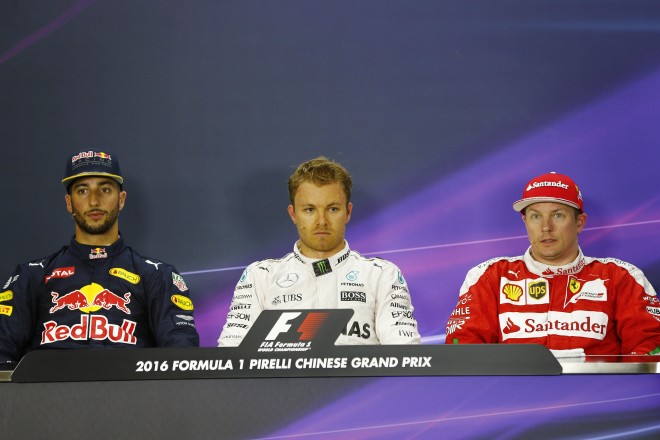
    Nico Roseberg (Centre) at the Saturday FIA Press Conference after taking pole. An FIA image
    Nico Roseberg (Centre) at the Saturday FIA Press Conference after taking pole. An FIA image
  • Rosberg’s dream-start continues at Bahrain; Hamilton recovers to 3rd behind Raikkonen

    Rosberg’s dream-start continues at Bahrain; Hamilton recovers to 3rd behind Raikkonen

    Rosberg celebrates after winning the Bahrain GP on 3rd April 2016. A Mercedes AMG Petronas image
    Rosberg celebrates after winning the Bahrain GP on 3rd April 2016. A Mercedes AMG Petronas image

    Nico Rosberg dream start to the 2016 season continued as the German took his second consecutive victory and his first in Bahrain and his first at the Gulf circuit. Kimi Raikkonen took his fifth second place with Lewis Hamilton recovering to third after a first-corner collision.

    Before the start there was disappointment for Ferrari as Sebastian Vettel, set to start from third, slowed on the formation lap with smoke billowing from the back of his car.

    His failure to start, the first of his career, meant a space opened on the grid beside Raikkonen and in front of Red Bull’s Daniel Ricciardo, starting from fifth.

    The Australian couldn’t capitalise, however, and when the lights went out he made a poor start. That allowed Williams’ Valtteri Bottas to surge past.

    Hamilton too had started badly and as Rosberg powered into the lead and Raikkonen stole second Hamilton fell back towards Bottas.

    The Finn tried to push past the champion on the inside of Turn One but they clashed. Ricciardo got involved too, losing part of his front wing.

    However, while Hamilton and Bottas, who would later be penalised for causing the collision, fell back, Ricciardo managed to hold position and he slotted into third.

    At the front Rosberg began to pull away rapidly and he soon built up a sizeable lead over Raikkonen, with the Finn later commenting that the Mercedes driver was “a straight in front after a few laps”.

    That set the pattern for the top two positions as Rosberg managed his pace and comfortably kept Raikkonen at bay for the whole race.

    Behind them, Ricciardo dived for the pits on lap six, but while he did take on new tyres, he chose not to take a new wing and he rejoined still nursing the damage but with greater pace thanks to hi new tyres. Across his first stint he battled back to third.

    Hamilton, though, was also recovering from his earlier travails and despite sustaining debilitating floor damage, the champion rapidly made his way through the order on medium tyres, which he took onboard on lap 13. He passed Ricciardo on lap 17 and that spelled the end of any hopes the Australian had of a podium finish.

    He settled into fourth spot and though he relinquished it twice as the strategies played out, his final stint on medium tyres, saw him solidify the result and he took his second fourth place in a row to score 12 points and to take third in the Drivers’ standings from the unfortunate Vettel.

    Although Hamilton got to within five seconds of Raikkonen at one stage, he could not match the Finn’s pace and in the final stint he dropped back as he save his tyres in the hope of a safety car period that never came.

    With Ricciardo fourth, fifth place went to Romain Grosjean, as Haas again surprised. The Frenchman worked his way through three sets of supersofts as he rose from ninth on the grid and though he couldn’t find the pace to challenger Ricciardo he still managed to better his opening result in Australia by one position. The new team now sits fifth in the Constructors’ Standings, ahead of Toro Rosso, Force India, McLaren, Renault, Sauber and Manor.

    Toro Rosso’s Max Verstappen took another good result for the Italian squad with sixth place, though there was disappointment for the Faenza team as Carlos Sainz failed to finish.

    Daniil Kvyat delivered an excellent performance. Starting 15th, the Russian ran two stints on soft tyres to avoid traffic and rise through the order before using two superbly aggressive stints on supersofts to claim seventh place. The run included a brave pass on Felipe Massa on the final lap.

    Massa took eighth ahead of team-mate Bottas, while the final point went to McLaren rookie Stoffel Vandoorne who drove a faultless race to the points from 12th on the grid. It was a less successful day for team-mate Jenson Button, with the veteran racer exiting the race with power loss on lap six.

    2016 Bahrain Grand Prix – Race
    1 Nico Rosberg Mercedes 57 laps – 1h33m34.696s
    2 Kimi Raikkonen Ferrari +10.282
    3 Lewis Hamilton Mercedes +30.148
    4 Daniel Ricciardo Red Bull Racing +62.494
    5 Romain Grosjean Haas +78.299
    6 Max Verstappen Toro Rosso +80.929
    7 Daniil Kvyat Red Bull Racing +1 lap
    8 Felipe Massa Williams +1 lap
    9 Valtteri Bottas Williams +1 lap
    10 Stoffel Vandoorne McLaren +1 lap
    11 Kevin Magnussen Renault +1 lap
    12 Marcus Ericsson Sauber +1 lap
    13 Pascal Wehrlein Manor Racing +1 lap
    14 Felipe Nasr Sauber +1 lap 3
    15 Nico Hulkenberg Force India +1 lap 4
    16 Sergio Perez Force India +1 lap 3
    17 Rio Haryanto Manor Racing +1 lap 3
    18 Carlos Sainz Toro Rosso DNF 3
    19 Esteban Gutierrez Haas DNF 2
    20 Jenson Button McLaren DNF 0
    21 Sebastian Vettel Ferrari DNS 0
    22 Jolyon Palmier Renault DNS 0

  • Hamilton edges out Rosberg to take pole; Hulkenberg P8 for Force India

    Sakhir, 2 April 2016: Lewis Hamilton set the fastest ever lap of the Bahrain International Circuit to take pole position for tomorrow’s Bahrain Grand Prix.

    The champion was pushed hard by team-mate Nico Rosberg, however, and with the competition tight at the front of the grid, the second instalment of the sport’s elimination-style qualifying format saw the top drivers take to the circuit for a second run, which saw Hamilton post a blistering lap of 1:29.493 to beat his team-mate.

    It was an impressive lap from the champion, as on the first run in Q3 he had run wide and found himself in fourth place as Rosberg put in a faultless sub-1:30s lap to seize the initiative. Hamilton dug deep, however, and as the clock counted out Ferrari’s fourth-placed Kimi Raikkonen, the three-time champion found enough pace to edge Rosberg by just under eight hundredths of a second.

    “The car felt great. It’s quite incredible to think that we are quicker now to the V10 days. It just shows how far technology has come,” said Hamilton of the lap. “It’s obviously not been a smooth-sailing weekend in terms of pace. Nico’s been right on it all weekend and I was just generally struggling to put laps together,” he added. “Luckily the one lap I did put together was the last lap. That was actually the only lap probably the whole weekend so far. I hope that’s the first of many.”

    Sebastian Vettel took third place for Ferrari, just under half a second off Rosberg’s pace.

    Behind Raikkonen, Daniel Ricciardo took a solid fifth place for Red Bull Racing. His lap of 1:30.854 put him ahead of both Williams drivers and confirms that the Milton Keynes squad currently have the upper hand over the Grove outfit, at least with one car.

    Ricciardo’s team-mate Daniil Kvyat scraped through to Q2 but couldn’t improve and was the first man out in second session that proved the most lacklustre of the three, with few drivers managing to get in ‘survival’ runs. Neither McLaren drove managed a second run, though Stoffel Vandoorne though, managed to edge McLaren team-mate Jenson Button, and Haas’ Esteban Gutierrez was also ruled out while sitting in the garage.

    Nico Hulkenberg did manage to get in another hot lap, however, and with his team having timed his track time right, the German driver did his part by vaulting into P8 to secure the last place in Q3.

    His success meant Romain Grosjean was ruled in P9 ahead of Toro Rosso’s Max Verstappen and Carlos Sainz.

    In the opening phase of the session, the big casualty was Force India’s Sergio Perez, who qualified in 18thposition. The best performance of the opening segment came from Manor’s Pascal Wehrlein, who final hot lap in the session saw him climb from the bottom of the order to a very respectable P16. His time of 1:32.806 was 1.3s better than that of his 21st-placed team-mate Rio Haryanto.

    Behind Wehrlein were Sauber’s Marcus Ericsson, the hapless Perez, Kevin Masgnussen of Renault – who completed just one run as a penalty means he will start from the pit lane tomorrow – team-mate Jolyon Palmer, Haryanto and Sauber’s Felipe Nasr.

    2016 Bahrain Grand Prix – Qualifying
    1 Lewis Hamilton Mercedes 1:31.391 1:30.039 1.29.493
    2 Nico Rosberg Mercedes 1:31.325 1:30.535 1:29.570
    3 Sebastian Vettel Ferrari 1:31.636 1:30.409 1:30.012
    4 Kimi Raikkonen Ferrari 1:31.685 1:30.559 1:30.244
    5 Daniel Ricciardo Red Bull Racing 1:31.403 1:31.122 1:30.854
    6 Valtteri Bottas Williams 1:31.672 1:30.931 1:31.153
    7 Felipe Massa Williams 1:32.045 1:31.374 1:31.155
    8 Nico Hulkenberg Force India 1:31.987 1:31.604 1:31.620
    9 Romain Grosjean Haas Ferrari 1:32.005 1:31.756
    10 Max Verstappen Toro Rosso 1:31.888 1:31.772
    11 Carlos Sainz Toro Rosso 1:31.716 1:31.816
    12 Stoffel Vandoorne McLaren 1:32.472 1:31.934
    13 Esteban Gutierrez Haas 1:32.118 1:31.945
    14 Jenson Button McLaren 1:31.976 1:31.998
    15 Daniil Kvyat Red Bull Racing 1:32.559 1:32.241
    16 Pascal Wehrlein Manor Racing 1:32.806 
    17 Marcus Ericsson Sauber 1:32.840 
    18 Sergio Perez Force India 1:32.911 
    19 Kevin Magnussen Renault 1:33.181 
    20 Jolyon Palmer Renault 1:33.438 
    21 Rio Haryanto Manor Racing 1:34.190 
    22 Felipe Nasr Sauber 1:34.388

    eom/FIA press release

  • Competition from 3rd to 6th place is very challenging: Bob Fernley of Force India

    Competition from 3rd to 6th place is very challenging: Bob Fernley of Force India

    TEAM REPRESENTATIVES – Franz TOST (Toro Rosso), Dave RYAN (Manor Racing), Robert FERNLEY (Force India), Claire WILLIAMS (Williams)
    Not in attendance: Monisha KALTENBORN (Sauber), Paul HEMBERY (Pirelli)

    PRESS CONFERENCE

    Bob, the car showed some flashes of real speed in pre-season in testing and in Melbourne you had a good result with seventh. How confident are you that you’ll be able to take a step on from the fifth place overall the team achieved last year? ?
    Robert FERNLEY: I wouldn’t say that I was overly confident but optimistic. I think that Toro Rosso have done a good job. Williams are always strong. Red Bull are coming back and the engine’s proving well there. So I think the competition for that third to sixth place in the Constructors’ Championship is going to be very, very challenging this year and very tough and we’ve just got to prove that we’re up for it.

    Talking about Toro Rosso and other teams, in the second half of the race in Melbourne, Romain Grosjean in particular was able to stay ahead of the Force India. Were you surprised at the pace of the Haas and do you think that everybody has closed up behind you, quite tightly?
    RF: I don’t think that necessarily the Melbourne pace was something worrying. Melbourne’s just a very difficult circuit to overtake on and I think the red flag played in the favour very much of Haas. In our case I think it went against us slightly. So I don’t think it was a pace issue particularly, just a circuit-related issue.

    Thanks for that. Franz, coming to you, you got off to a good start in Australia, with a double points finish, and the car clearly has some pace. That obviously puts the team in the spotlight, in many different ways. Does the improvement in the team’s pace make you attractive again for outside investors?
    Franz TOST: I hope so. At Toro Rosso the doors are always open for people who bring money, because we have many ideas how to invest it in a proper way. Of course it’s easier to negotiate with partners if you are successful at the race track. This year, so far, we have a very competitive package. The STR11 shows a good performance; also both drivers are very skilled and very fast. The engine is also good and the team has improved as well and therefore I expect to have a successful season and I hope that we can find additional money.

    That improvement in pace was evident in Melbourne but you might not have got the race result you wanted. Obviously, we all saw what happened with Carlos and with Max in the pit stops. Have you spoken to the drivers in between and how has that been resolved?
    FT: Yeah, we had a very good first part of the race until the red flag. After the red flag we lost the pace. The reason why we called in Carlos was that he had a lot of vibration on the front axle and for safety reasons we wanted to change the tyres. Max then came into the pits and the team didn’t know this and we were too late with the tyre change. Therefore, he came out behind the group of Grosjean, Hulkenberg, Palmer and behind Carlos and then of course there was a little bit of a fight between them. But that’s normal. That’s competition. We discussed everything after the race, we analysed everything and we explained to the drivers what happened. Everything is sorted out and I expect from them a good and competitive race here as well.

    The battle between the drivers looks like it might shape up to be one of the season’s most intense. How do you, in the team’s best interest, manage them, given that they a relatively young partnership?
    FT: You must not forget that both of them are very young. Both of them want to make a career in Formula One and therefore they are fighting for every millimetre. This is what we want to see and therefore why we also have them in the team. At Toro Rosso the philosophy is not to come out with a team order, to say ‘you have to let the other past’. Only if we change the strategy, of the drivers are on a different strategy and if we think it will be an advantage for the team, then of course, but otherwise there are no team orders. We expect discipline from the drivers. What do I mean by discipline? That they respect each other, that they let the other driver the space to survive, that they don’t crash on each other and that they compete on the race track like people want to see it and then we will see who will be the better.

    Dave, welcome back, a couple of questions for you. Your car seemed fairly comfortable running in the lower midfield in Melbourne. What kind of result of results do you expect from the rest of the season, what’s achievable? 
    Dave RYAN: I’d like to think we can run with the pack. We haven’t been able to do that in previous years. If we can do that then we can be in a good position to seize opportunities that come our way. I believe we can score points and we need to score points, and that’s the goal.

    You’re almost six months into your tenure at Manor. When you arrived what did you feel were the things that most urgently needed addressing and now where do you feel the team is at now in terms of personnel, resource and operational stability?
    DR: The team was clearly, or had been, in a very difficult place. They did a fantastic job last year. They were in a bit of a holding pattern really. Most of last year was spent looking forward to getting a package together for this year. Stephen Fitzpatrick, our team owner, did a great job on that front: he secured a terrific engine deal, a great transmission arrangement. After that, it was just a question of putting a good car together, which our guys have done. So, last was a bit of a holding pattern and it was all about getting ready for this year. We’ve got a pretty good package. There are no excuses on the engine front, the driveline, and it’s down to us to show we belong here – and we do. And we’ve managed to change the team considerably. We’ve got a lot of new people. There were a lot of good people anyway. Even from Melbourne to this race it’s developed, it’s changed a lot and we’re going forward and that’s what we need to see.

    And what about your drivers? They are both quite inexperienced. What do you see is the potential from both of them?
    DR: I see huge potential. First of all they’re both young guy, a bit like Franz was saying. I enjoy their enthusiasm. Having youngsters around is very invigorating. They’re both very, very switched on young guys. Quite different personalities but fierce determination in both of them to succeed and I’m sure we’ll see two very good drivers develop during the year.

    OK, thanks. Claire, coming to you, lonely at the front there…
    Claire WILLIAMS: I have no friends!

    Williams have finished third in the past two seasons. This year, do you see it as the same battle again, against Red Bull for that third position, or has there been that step over the winter that will allow you to take the fight to Ferrari and Mercedes?
    CW: I’d like to think so. As you say, we’ve come third in two consecutive seasons now, which is a fantastic achievement for Williams. But we did come into this year knowing and understanding that it was going to be much harder to try to maintain that position, let alone push forward and try to catch the Ferraris and Mercedes, but of course that was the target for the guys back at Grove over the winter period. I think in Melbourne it was far too early to tell really where anybody is on the grid this year, so we’re going to have to give it a few races to see where we are, but of course the target for us as a team is always to make improvements. We’d love to be able to close the gap to Ferrari and Mercedes, but I think we’ve seen in Melbourne that the competition has closed around us. The Force Indias, the Reds Bulls, the Toro Rossos, they are all there. We had a great fight in Melbourne and I expect the rest of the season will be like that, so we have our work cut out if we are to maintain third, let alone push forward.

    One of things you have been working on is the new short nose that is supposed to be arriving. Are we going to see that tested tomorrow? Has it arrived? Is it arriving?
    CW: It is winging its way here as we speak, so I very much hope it will be on the car, it’s going on Felipe’s car tomorrow in P3, and we’ll just have to understand where it is, what performance it’s giving us and then decide whether we run it in qualifying or not.

    QUESTIONS FROM THE FLOOR

    Q: (Kate Walker – motorsport.com) A question for everybody please. We’ve had an awful lot of doom and gloom – and I’ve very over that. Could everybody please tell me one thing that you’re looking forward to about the 2016 season. Something that excites you, that makes you passionate.

    RF: If you look at it from the point of view that probably the first… the manufacturing teams in terms of Mercedes and Ferrari are clearly ahead of the game, I think what’s exciting for me is what Claire’s just hit upon: I think we’ve got four or five teams that are really fighting hard for those third to sixth places. I think that’s going to be an incredible battle through the year. If that was the front of the Formula One field, think how wonderful it would be for the fans.

    Franz?
    FT: We have a very competitive midfield where all the competitors are very close together, we go to Azerbaijan and see a new race, and we have 21 races.

    Claire?
    CW: The same as what everyone else has said: I think the competition this year is going to be phenomenal. I think we’ve had a couple of good years of racing. As I said, Melbourne really demonstrated that it’s going to be a really close fight for everybody this year, up and down the order, which is really exciting. I’m really pleased with what you said about the doom and gloom, because I’m totally over it as well and I think it would be really nice if we recognised the positives of our sport, of which there are so many. I think actually now Formula One, from a strategic perspective, and looking at where we’re moving forwards to into the future to into the future, now coming close to signing off the new power unit regulations – hopefully – in addition to the new 2017 regulations, I think there’s a lot to hopefully look forwards to. I think the driver aids situation, as much as there’s been a lot of talk around that, positive and negative, I think that’s really exciting: the drivers have what they wanted, and that’s to be drivers in the car again and to take control of their cars. For me, to see drivers going out there, having a fight, I think it will be a really exciting season. That’s what I’m looking forward to.

    David, it’s a new role for you…
    DR: Yes, I endorse that. Melbourne showed, or gave every indication of the season to come. For me personally it’s going to be… I’m really looking forward to the season and I’m going to enjoy seeing Manor Racing progress. That’s what I’m looking forward to most.

    Q: (Dieter Rencken – Racing Lines) A question to Robert Fernley. Bob, there’s been a fair amount of negative coverage about your team owner, team principal Vijay Mallya recently. He’s not here so I need to ask you. Is the team endangered in any way? We hear some stories of $400million dollars being offered in repayment. How does that affect the team?
    RF: You know Dieter, I didn’t see you behind the camera – I thought I’d got away with it for this meeting! Vijay’s issues are well publicised but, like all things, I think there’s been a bit of media over-reaction, especially from India on all of that. It’s something, just to give you an idea of India itself, I’ve been in and out of India for well over 30 years and the only thing I’ve learnt in 30 years is how little I know about India, so I think you’ve just got to let that flow and for Vijay to deal with it. Force India is blessed with a very good technical team and that technical team has progressively moved Force India up the Constructors’ table and I think today we are realising some of the best returns the team has ever had from the payments side of things, even though we complain about the disparity – which is a separate issue. And we also have a very good commercial team. And I think the commercial team is allowing Force India pretty well now to stand on its own feet and, whilst the shareholders are always there to help us – and Vijay’s been the main person in doing that over the last nine years. It’s not a short term, nine years, to be keeping a Formula One team going. I don’t think there’s any concerns for Force India.

    Q: (Dieter Rencken – Racing Lines) Claire, very brief one to you. You’ve just said you’re signing off the 2017 powertrain regulations and ‘hopefully’ the 2017 aero regulations. Can you elaborate on why you use the word ‘hopefully’? I doubt you normally use words willy-nilly.
    CW: I think I should have applied ‘hopefully’ to both. We have a Strategy Group meeting that’s just been scheduled coming up, and as we all know in Formula One, things are fluid. I said ‘hopefully’ just to temper it. I don’t think you should put too much emphasis on that word.

    …so there is a chance that they may not go through, based on that?
    CW: I doubt it. I think it’s becoming far too late in the day. I think we pushed the date anyway and we need to get these signed off if we’re all to be ready for 2017.

    Q: (Dieter Rencken – Racing Lines) My second question to all of you. There’s been a lot of noise coming from the GPDA recently and one of their points of concern is that they’re not being heard, particularly when it comes to the governance structure, regulations changing etc. given that two of you people are on the Strategy Group and the other two on the Formula One Commission, have the drivers aired their concerns to you at all as team principals on the various commissions and groups?

    BF: No, I’ve not spoken to any of the drivers on that Dieter. I think the drivers have got a role to play. They do have a meeting every race weekend with Charlie so they do represent their views at that meeting and those are transmitted to us through Charlie, which is the correct way of doing it. I think it’s very difficult to have a member of the GPDA on the F1 Commission. It’s very difficult to represent 22 people with one opinion. We have enough difficulty doing it with six on the Strategy Group, so I’m not sure where that would go. Clearly the voice of the drivers is very, very important and we should be listening to them.

    Claire?
    CW: Yeah, I echo what Bob has said. The drivers are one of the key stakeholders of our sport, as are the teams, the media and our fans and we have to listen to all those stakeholders if we’re to create a sport that’s going to sustain in the long term. I’m pleased that they’ve come out and talked about their concerns. I think now we have to go away and think about them and address them and to see how we can engage them. Personally, in the team we have a constant and open dialogue with both our drivers and they always feedback information. On the converse, I think drivers have been listened to, probably more than they have in recent times, talking about the driver aids and the cars we are producing for them for next year – but as Bob said, it’s difficult to represent such a wide group. And then, how does that potentially fit in to the current governance structure that we have at the moment.

    Dave, your thoughts on this.
    DR: I think the drivers are the great personalities of this sport. I think they should be listened to. I think their opinion is really valued and we should heed what they say. We should certainly take notice, that’s for sure.

    Finally, Franz.
    FT: Our drivers are fortunately young, they are not so involved in all of this political issues. Generally the drivers are here for driving and, regarding the Formula One rules, there are so many parties being involved, it’s unnecessary to bring in another party. Nevertheless, the drivers can come up with ideas – but not after regulations are being defined. Like now, the 2017 regulations. To come now and say ‘this is not good’, it’s too late: because this has been defined. They should do it before. Generally, they should be concentrated to drive. That’s their job.

    Q: (Sanjeev Palar – Fox Sports Asia) The fans are holding their breath to try and understand and then figure out what’s happening with qualifying, so perhaps someone can tell us how is it going to be resolved, are there going to be any more changes that we see this season, and what is the process and opportunity to implement such changes?
    DR: We’re holding our breath as well.
    FT: We’ve discussed this qualifying procedure many times and the reason why this new qualifying came into play is because the organisers wanted to increase the show. Now, we saw in Melbourne that qualifying three ended up in a mess, because during the last four or five minutes  no car was out there, but this was already mentioned before, because the calculation of all the teams showed that at the end, maybe one or two cars would have tyres to go out twice in qualifying three. The new qualifying model itself is not so bad but in qualifying three, the eight cars need to have two sets of tyres so that all the cars are out there. Why? Because qualifying three is the most important part of the qualifying, it’s when pole position is being decided and therefore the cars need to be out on the track and neither the old qualifying… all this would be good, in combination with the new one because then the drivers would be out only at the last one or two minutes and with the new qualifying we know that the last four or five minutes no one is out any more. Therefore, in my opinion, we should go back to the old qualifying when we know that the cars will be on the track and will race for pole position.
    CW: In qualifying, the revised form in Australia came out and we said we would give it a go and if it didn’t work we would revert and come back to the drawing board, and obviously that meeting happened on Sunday and everybody agreed that we would revert back to the 2015 format until we could all come together and decide and actually try and come up with a well considered revised process for qualifying. Unfortunately that obviously has happened in the interim, we’ve had a new vote among strategy group members which then went to the commission. Now we have this hybrid system which we’re running tomorrow. Personally, from a Williams perspective, we would have rather to have gone back to the 2015 format as a holding pattern, to give us time to meet again as a group and to actually have time to go through what a new system could look like rather than kind of go to a hybrid system which might not work again. I think we have to wait anyway and see whether that will work or not tomorrow and then take the time to actually think about it. I think otherwise our fans are just going to look at our sport and go ‘what are they doing?’ You can’t do this in the second race of a championship so it’s really important to us that we get this resolved as quickly as possible but to do it in a well-thought through manner.
    Q: Dave, your drivers were probably disadvantaged in Q1 last time out, it didn’t probably go according to plan. What’s your feeling about it?
    DR: No, it didn’t go according to plan for us in Melbourne. I think the important thing is that the regulations were changed for Melbourne, we did give it a try and it clearly didn’t work for many reasons. But the fans have overwhelming said ‘we didn’t like it’. We did have the meeting on the Sunday morning and we did agree to change it. However, since then circumstances have intervened and we’re now back to what we had in Melbourne, so I guess we’re going to go through it again and just see how it pans out. Maybe we’ll all be a bit better prepared for it this time round and maybe it will be a bit different. So let’s see what happens in qualifying tomorrow and we’ll review it again on Sunday morning.
    Q: Bob, do you think teams will be a bit more comfortable with the process tomorrow and it might go a bit more smoothly than it did in Australia?
    BF: For sure I think teams will be better prepared. There still could be issues with it. From a personal point of view, I would like to have seen the compromise programme come in because I think that actually Q1 and Q2 were quite exciting. Clearly we got it wrong for Q3. I would have liked to have seen a little bit of an adjustment before we stopped everything but we have to go, at the end of the day, with the way the governance system works and we are where we are and let’s see how it goes tomorrow.

    Q: (Sanjeev Palar – Fox Sports Asia) Everyone has expressed their opinion on what they prefer but I think what we’re trying to understand and what we’re trying to convey to the fans is what process happens to decide what the final qualifying system will be for 2016, because it doesn’t seem like we have one. We had one in Australia, then we thought it’s gone all over the place, so what is the actual process to finalise the qualifying system that we’re going to have for this season?
    BF: It has to go through the strategy group and then from the strategy group it has to go through the F1 commission. You need 100 percent of the votes from the teams, the F1 commission, and then if it gets the majority that’s necessary, it will go back to the world council to be put into sanction, so that’s the process. There is no other process.
    DR: I think it’s true to say that once it passes through the strategy group for the Formula One commission, it can’t be changed so it can only be approved or disapproved from that point on, both at the Formula One commission and beyond. We only get what comes through from the strategy group, so that’s the process and then we vote on it and it’s a yes or a no, not a maybe we can do this instead, so that’s the process, it is very clear cut in fact.

    eom/FIA transcript of the Press Conference