Your basket is currently empty!
Tag: F1
-
Rosberg overcomes technical woes to claim pole
Nico Rosberg bounced back from an early Q3 electronics problem to claim pole position for his home race, the German Grand Prix, ahead of Mercedes team-mate Lewis Hamilton and Red Bull Racing’s Daniel Ricciardo.
After breezing through the first two sessions (the Mercedes drivers were the only drivers to qualify from Q1 having used only soft tyres), Rosberg set off on his first run in Q3 only to have to abandon the run at the end of his first lap when his Mercedes suffered an electronics issue.
“It just suddenly lost the throttle,” he said. “It just cut completely the engine, just at the end of the lap. That was disappointing but I’m sure we’ll fix it for tomorrow. It’s never happened before, so I’m sure it will be OK.”
Rosberg dived towards the pit lane for repairs and out on track team-mate Lewis Hamilton set the early Q3 pace with a lap of 1:14.486 with Ricciardo slotting in P2 with a time of 1:14.724 to sit 0.240 off Hamilton.
As the rest of the field returned to the pit lane to plot their final runs, Rosberg headed out again and with an almost clear track he posted a superb lap of 1:14.363 to take provisional pole. And as Hamilton made a small mistake in Sector 2 and went slower in Sector 3, Rosberg took his 27th career pole position and his fifth of the season.
“Just a great lap,” said the German. “Not only was it just one lap that I had, but I also had extra fuel to make sure that I would have an extra shot if a mistake or something happened. So I had fuel for three laps. That was some more time in the bag there, so I was really satisfied with that one. That was really cool.”
Ricciardo took P3 behind Hamilton and admitted that though he had got close, he did not feel he had to pace to compete for pole.
“My first lap in Q3 was really good and I knew there probably wasn’t that much more on the table in the second run and in the end a couple of mistakes in that run,” he said. “There was maybe a tenth or so in it with the perfect lap, but not enough to challenge the pole. We’re close enough. I said yesterday that if we could be within half a second that’s not a bad day in qualifying, so hopefully it means something tomorrow. From what I understand we might have different tyres available for us for the race, so hopefully that makes it interesting.”
Ricciardo will be joined on row two of the grid by team-mate Max Verstappen, while row three will be filled by Ferrari’s fifth-placed Kimi Raikkonen and P6 man Sebastian Vettel.
Behind them, Nico Hulkenberg will line-up in seventh place alongside Williams Valtteri Bottas, with Sergio Perez ninth in the second Force India ahead of the second Williams of Felipe Massa.
The earlier sessions had progressed largely as expected. Q1’s only somewhat unforeseen elimination was that of Toro Rosso’s Daniil Kvyat. The Russian driver qualified in P19 behind 17th-placed Renault driver Kevin Magnussen and Manor’s Pascal Wehrlein and ahead of Manor’s Rio Haryanto and the Saubers of Felipe Nasr and Marcus Ericsson. P19 was all the more frustrating for Kvyat after he was informed that team-mate Carlos Sainz had made it through to Q2 in P12.
That was as far as Saing got however and in Q2 the Spaniard took P13, though he was also placed under investigation for allegedly impeding Massa during the session.
Haas’ Esteban Gutierrez almost made it through to Q3 for the first time since the Korean Grand Prix of 2013. The Mexican was in P9 after his final run of Q2 but Massa eventually beat him to the final Q3 slot by 0.184s.
Behind Gutierrez, Jenson Button was 12th for McLaren ahead of Sainz, Fernando Alonso in the second McLaren, Romain Grosjean in the second Haas and Renault’s Jolyon Palmer. Grosjean is set to take a five-place penalty for tomorrow’s race after he had to switch gearboxes following problems in FP3.
2016 German Grand Prix – Qualifying
1 Nico Rosberg Mercedes 1:15.485 1:14.839 1:14.363
2 Lewis Hamilton Mercedes 1:15.243 1:14.748 1:14.470
3 Daniel Ricciardo Red Bull Racing 1:15.591 1:15.545 1:14.726
4 Max Verstappen Red Bull Racing 1:15.875 1:15.124 1:14.834
5 Kimi Raikkonen Ferrari 1:15.752 1:15.242 1:15.142
6 Sebastian Vettel Ferrari 1:15.927 1:15.630 1:15.315
7 Nico Hulkenberg Force India 1:16.301 1:15.623 1:15.510
8 Valtteri Bottas Williams 1:15.952 1:15.490 1:15.530
9 Sergio Perez Force India 1:16.169 1:15.500 1:15.537
10 Felipe Massa Williams 1:13.503 1:15.699 1:15.615
11 Esteban Gutierrez Haas 1:15.987 1:15.883
12 Jenson Button McLaren 1:16.172 1:15.909
13 Carlos Sainz Toro Rosso 1:16.317 1:15.989
14 Fernando Alonso McLaren 1:16.338 1:16.041
15 Romain Grosjean Haas 1:16.328 1:16.086
16 Jolyon Palmer Renault 1:16.636 1:16.665
17 Kevin Magnussen Renault 1:16.716
18 Pascal Wehrlein Manor 1:16.717
19 Daniil Kvyat Toro Rosso 1:16.876
20 Rio Haryanto Manor 1:16.977
21 Felipe Nasr Sauber 1:17.123
22 Marcus Ericsson Sauber 1:17.238.eom/FIA press release
-
It was a great feeling. Just a great lap: Rosberg
DRIVERS
1 – Nico ROSBERG (Mercedes)
2 – Lewis HAMILTON (Mercedes)
3 – Daniel RICCIARDO (Red Bull Racing)
TV UNILATERAL
Nico, under pressure there: only one run in the end in Q3 after, we understand, an electronics glitch on your first run. How satisfying is this pole under those circumstances?
Nico ROSBERG: Yeah, it was a great feeling. Just a great lap. Not only was it just one lap that I had but I also had extra fuel to make sure that I would have an extra shot if a mistake or something happens. So I had fuel for three laps. So that was some more time in the bag there, so I was really satisfied with that one. That was really cool.
Very well done. Lewis, a little lock-up there, I think into the hairpin, on your final run, only a tenth off Nico. It looks like it’s been a little bit of a tricky weekend, but did you feel it was all coming together for you in qualifying?
Lewis HAMILTON: It’s been a good weekend, I had no problems. I had the pace today I just didn’t finish it off in the last lap, so…
Was it the lock-up ?
LH: I didn’t really have much of a lock-up. It was subtle; I didn’t lose any time.
Thank you for that. Coming to you Daniel, obviously a very close battle between Red Bull and Ferrari there. Do you feel though that you could have been a little bit closer to the Mercedes in the end than the two and a half tenths that it was?
Daniel RICCIARDO: I think we got pretty close to be honest. My first lap in Q3 was really good and I knew there probably wasn’t that much more on the table in the second run and in the end a couple of mistakes in that run. There was maybe a tenth or so in it with the perfect lap, but not enough to challenge the pole. We’re close enough. I said yesterday that if we could be within half a second that’s not a bad day in qualifying, so hopefully it means something tomorrow. From what I understand we might have different tyres available for us for the race, so hopefully that makes it interesting.
Just coming back to you Lewis: your thoughts ahead of tomorrow’s grand prix? It’s going to be another tough battle in prospect?
LH: It’s should be a good day for Mercedes. That’s the goal and yeah, we’ll race it out.
And the final word from our pole sitter: your thoughts Nico then, the race in prospect? Another tough battle in prospect, not only with Lewis but with Daniel as well, and any worries for you on the electronics glitch going forward into the grand prix?
NR: No, I don’t know what it was. It just suddenly… how do you say… it just suddenly lost the throttle. So just cut completely the engine, just at the end of the lap. That was disappointing but I’m sure we’ll fix it for tomorrow. It’s never happened before, so I’m sure it will be OK. Definitely it will be an exciting race against Lewis and the Red Bulls and maybe also the Ferraris but they’re a bit further back it seems.
PRESS CONFERENCE
Q: Nico, maybe you could just tell us a little bit more about what you experienced with that electronics glitch – and also, I’m interested in the mental reset after that. You obviously get yourself psyched-up, you know you’ll have another run but to know it’s all on that one lap after you’ve had a setback, just tell us about that mental reset you have to do.
NR: Yeah, it was frustrating at the time because it was a good lap and then to lose it two corners from the end in a way that I’ve never experienced before was definitely tough in that moment. And then also to know that I had to put extra fuel for the last run, to be able to do three laps because just to have a little bit of a contingency plan in case lap one doesn’t work out. And then, yeah, just very happy with that first lap. That was awesome, it really came together well. Yeah, so as a result it was quite challenging to do that last run.
Q: Lewis, obviously it’s been a very strong couple of months for you. You’ve come right back to the point where you’re now leading the championship going into tomorrow’s grand prix. Just tell us a little bit about the importance for you of going into that summer break with a win under your belt. Is that something you particularly target? And how do you look back on this last few weeks?
LH: I think the importance is not particularly relevant. We’ve had, what, five out of six races wins, so it’s been a good mid-stint of the season, and hopefully tomorrow we get the first or second and that’ll still be great. We’ll still be in good position. Of course, every race you approach to win.
Q: Daniel, going into tomorrow’s grand prix, just looking back on your comments yesterday after the long runs, it seemed that you felt reasonably optimistic in terms of your pace relative to these guys. So tell us a bit more about that.
DR: Yeah. I felt that, on low fuel yesterday, Mercedes had a pretty good buffer over everyone and the long run pace we looked to be closer than that, so that was giving us a bit of optimism coming into Sunday. Obviously today we’ve got a bit closer on one-lap pace than we were yesterday so let’s see. Hopefully it translates into something tomorrow. Even to put a little bit of pressure on them at some point in the race would be nice. But yeah, we’ll see. Obviously tomorrow, you never know what can happen, and racetracks change day to day with the temperature and whatever but yeah, obviously we’re looking pretty good. Obviously a lock-out with the second row and hopefully we can do something with it.
You hinted there that you have something different on the tyres there, so you think obviously strategies going to play a big part in the race tomorrow.
DR: Yeah, from what I understand, we’ve got different tyres available for the race, so there could be some different strategies amongst the first few cars. Hopefully it works out. If it does, the fans might have a race on their hands.
QUESTIONS FROM THE FLOOR
Q: (Dan Knutson – Speedsport and Auto Action) Nico and Lewis, last weekend the start and the first couple corners set the race. How much different is it this weekend and how much easier is it to get past on this track?
NR: It’s a different world here because you can overtake on this track if you get a significant speed difference. Nevertheless it’s still going to be a good battle off the start and in the first couple of corners, for sure.
LH: It’s a much easier track (on which) to overtake. But that doesn’t mean you can but it is much easier, it’s one of the easier ones.
Q: And your thoughts just on that first corner and then the run down to turn two?
LH: Only one car can go through turn one so it’s whoever gets there first.
Q: (Graeme Keilloh – Grand Prix Times) Lewis, you said earlier that you just didn’t get it done in the final qualifying lap. Did you feel that pole was on today, was there a particular mistake or something else that denied you?
LH: Well, I’d been first in every qualifying session so yeah, it was definitely on. I was two tenths up on the lap and I just didn’t finish it. That’s it.
eom/FIA press release of the transcript
-
Race Director Charlie Whiting shares thoughts on `Halo’
Charlie, the Halo decision, what is the objection from the FIA to just bringing it in on safety grounds?
CW: The FIA has decided that we would go through the governance procedure as has been well stated in the past. The first step was yesterday in the Strategy Group, so that is exactly what we did. The decision was taken, as I believe you know, that simply because only three drivers have ever tried it, and they have only done a total of four laps, this was something that everyone felt was quite a relevant thing and it wouldn’t really be feasible to expect, in the short term, to get the relevant number of laps with the Halo. That was the reason for introducing if for 2018 instead of 2017.
Was it yesterday an argument that in a worse-case scenario that if we have an accident that people will not say, ‘well, the FIA had the Halo but did not introduce it’? Are you not afraid of this?
CW: It was mentioned, of course. But I think, equally, it would be very difficult to roll these things out at the beginning of the year and then find you’ve got a fundamental visibility problem. They felt that that was a real possibility and until it has been tested properly in the right environment, everyone felt it was best to defer it.
As far as the decision or clarifications that were taken yesterday, we were talking about the Halo, we were talking about the radio, we were talking about track limits and talking, possibly I believe, starts in the rain under safety cars and I believe there was one other you can’t work under a red flag or something. Which of these has to go through the due process and which can be sorted out in a clarification?
CW: Let’s start with radios: that’s always been done under the heading of an interpretation of Article 27.1 and that is driver aids. What we decided was that we would be happy to take a more relaxed position on that provided that the full content of all the conversations was provided to the broadcaster with the sole intention of making sure spectators and fans get better content. Then, track limits; it was proposed by some that we should take a completely relaxed view on track limits but I felt that was inappropriate and I think we should carry on doing what we do. My principal aim has always been to get the track to enforce the track limits, if you see what I mean. I think by and large we have done that, but there are certain corners on certain tracks that do present us with little problems but we are getting rid of them one by one. Here we have a similar position to Hungary – Turns 4 and 11 in Hungary – Turn 1 here appears to be a similar sort of thing, with 93 cars going across there today. So we have to think carefully about what to do for tomorrow. The difficulty of allowing complete freedom and letting them go very wide there and no longer taking any notice of it, is that simply there would be a different track fundamentally and it would be faster and there would be less run-off area – so we couldn’t possibly contemplate it. Safety Car starts, yes it was agreed that that should be done in the future, but that needs to be a proper rule change that goes through the process. But everyone seems to agree with that and we had a Sporting Working Group meeting on Wednesday afternoon in which the team managers also agreed with that. Red flags: a similar situation, the rules just need to be changed, but they agreed yesterday and that will have to go through the due process
Regarding the Halo, you mentioned that it has not been tested properly in the right environment, but from the moment we first saw it in pre-season to the Strategy Group meeting we’ve just had, there have been 11 grands prix. Why was the Halo not run more during practice sessions than the four laps we saw it over the course of that period of time?
CW: This is something that we had to leave to the teams because we couldn’t at that point feel as though we could actually insist upon trying to put it on one of the current cars. But there are also problems. If you talk to anybody from Red Bull, for example, they say they can’t run Halo for more than two laps before the air intakes for the cooling of the engine and cooling of the gearbox start to be affected. What we are looking to do is make it clear that every driver has to try it for a whole free practice session during the course of this year. That would give us a proper way of going forward, to make sure that we don’t get caught out by something that is very hard to change back. That’s really the idea.
A Halo that springs out when a danger is present, how technically feasible is that in your point of view and what type of time frame would we face there?
CW: Are you talking about a sort of airbag-style deployment of a Halo? I’ve seen someone has sent me one of these designs, but I think it would be wholly impractical personally. I can’t see how you would deploy it in the right period of time and the inventor, if we may call him that, misunderstands because the drivers are not going to see something coming and think ‘oh, my goodness! I know, I’ll push that button’. Honestly, I don’t think that’s feasible, but as you know we have tested extensively with the Halo and to a slightly lesser extent the Aeroscreen, but we think we are submitting those things to possibly the worst-case scenario and I think it is better to continue down that path and not try to do something completely new that might need another three years of development.
It’s likely that Halo is a structural element of the car, so how would it be possible to consider to use it on next year’s car if the monocoques of next year’s car need to be ready by this stage at the end of July?
CW: The Halo is going to be a structural part of the car, yes. It’s going to be the secondary roll structure which was formally, basically, the front roll hoop of the car, but I think now the teams have been designing the cars with Halo in mind but not with complete certainty. Now they have certainty about next year’s design and they can adapt accordingly. I think there are some fundamental decisions that need to be made: weight distribution, for example, would be dependent and wheel base would be dependent on whether or not the Halo is nine kilos up high and all those sorts of things. They would all need to be taken into account, so the designers needed some clarity as well. They know now that they don’t have to design for Halo for next year.
Are there any plans to have at least one or two cars run it in Spa because of the visibility in Eau Rouge, in Singapore at night time, in day and night in Abu Dhabi and whenever it is raining hard?
CW: We asked the teams yesterday all to look at the possibilities of running a car in Spa and Monza but that was before the decision was taken to defer it until 2018. But now I think we should look towards a structured plan where all teams can run it at some point during the season at all tracks. But my aim would be to get every driver to try it.
If the plan is for all teams and drivers to run the Halo at some time, are they going to use a standard version of the Halo or will they all have to produce it themselves?
CW: It will be a standard version of the Halo. A standard shape, of course, but dummy versions. They wouldn’t be actual production Halos. They’ve all got the drawings, they all know exactly how big they have to be and where they have to mount, but they could make what is effectively a dummy one.
You keep talking about the Halo coming in in 2018; is the intention to introduce the Halo or is the intention to introduce frontal protection?
CW: At the moment it’s Halo, but there will be some form of additional frontal protection. If, for example, the Aeroscreen can be redesigned to fit the free head volume – which is one of the stumbling blocks at the moment – that might be the way to go. But I think we need to look at visibility first, because that is the thing that is a little bit of an unknown. So we really do need to make sure that is not a sort of showstopper. But it really would be similar between the Halo and the Aeroscreen, I would imagine.
The clarification of radio that we’ve got at the moment, does this mean driver coaching is back on the agenda?
CW: Yes.
Is that a good thing?
CW: Yes.
Do you have a long-term view on it?
CW: My view doesn’t actually matter, but being serious we have to look back to when the Strategy Group decided that there was too much radio traffic and it was detrimental to the sport. We were getting quite a few complaints, if I remember, from fans saying ‘Why are they being told all these things? They should be driving them for themselves’. In the August of 2014 the Strategy Group decided that we should cut out nearly all radio conversations. We issued a note reflecting those views and everyone said ‘Oh, it’s too much, it’s too much’. So we scaled it right back and we introduced bits and pieces and then we went to single clutch paddles and those sorts of things. Now the feedback is that we’ve gone too far and this actually has not been the best thing and the Commercial Rights Holder feels he can improve the content for the fans with the radio conversations. This is contingent upon the teams providing all the content from their discussions with the drivers, because before they had privacy buttons and they were chopping out great big chunks of it. So now they’ve got to provide everything to the broadcasters and this is seen as a way to improve the experience for the fans and spectators.
Charlie, is there no compromise with regards to the radio? As you said, initially it was cut out to get rid of things like driver coaching, lift and coast. Surely there must be some compromise solution that can be reached all round?
CW: There didn’t seem to be much stomach for that yesterday. The feeling was let’s keep it absolutely simple and as long as Bernie gets what he wants – the Commercial Rights Holder gets what he wants – for the show then I think we’ve done the right thing.
Looking purely at the safety research that has been done into the Halo, is it 100% proven it has a net safety gain or is there still the need to analyse for other unintended consequences in maybe other type of accidents where it can pose a safety risk?
CW: No, I think we’ve done a good enough risk assessment. The thing that is missing is the driver experience.
I think Niki [Lauda] expressed yesterday the concern for what happens if the car is lying upside down on fire, for obvious reasons. I know it’s a very unlikely scenario nowadays but the Halo protects against very unlikely scenarios, especially next year when the tyres will be tethered much stronger than now. So why do you neglect one concern over the other?
CW: We’re not neglecting it, it has been thought of. Now, for example, if a car turned over and was on fire I think it’s quite unlikely … if it has been in an accident big enough to cause a fire then the driver probably can’t get out by himself anyway. Then the first course of action will be for marshals to get there and turn the car over and this is the sort of thing you see quite regularly. So I have always felt that a car being upside down is always a worry, but the marshals are normally there very quickly and they would turn it back over. That’s the way we’ve always felt about that particular scenario.
Coming back to the radio if we can Charlie, Christian Horner was just saying he wants the messages allowed to be broadcast from team managers to you. Would you be happy for that to go out?
CW: No, I don’t think I would. I told him that yesterday, I think we need to sort this lot out first. We need to sort out all the team radio to the drivers before even contemplating something like that. We have private conversations with the teams and I don’t think it’s right… because the teams wouldn’t feel comfortable about asking us the sort of questions that we get asked in the race if they knew the rest of the teams could all actually listen, or anyone could listen in to that. So I think that’s a step too far.
I don’t understand how you can differentiate – obviously at the start of a race and the end of a race parc ferme is over and you can do whatever you want to the cars – you are going to suspend that when there is a red flag?
CW: I’m sorry I’m not quite with you…
What you said about the red flags is that you might be able to change whatever you want on the car…
CW: That’s right. Basically the principle is that when we suspend a race it is normally done after the safety car has been deployed – pick the cars up, then we bring them into the pit lane and we suspend the race, say after a couple of laps. If the safety car continued the teams would not be able to work on the car, they wouldn’t be able to change the tyres and they wouldn’t be able to do anything unless they came into the pits and suffered this time penalty concerned. So this is just the same thing. The timing doesn’t stop either, it is a stationary safety car if you like and that is what we want to try and achieve, to make sure it is exactly the same as leaving the safety car out, only it’s stopped. If you remember in Monaco in 2011, when we were building up to a great climax in that race with Vettel on very worn tyres and Jenson and Fernando had pulled right up and it was looking like a really good end. It was stopped, [they] changed tyres and the race fizzled out. That is what happened. I have been trying to talk them into it for 5 years.
Like in Australia this season?
CW: Yeah, but it is the same thing of course. They are allowed to change tyres and work on the car but now if the rule goes through next year we will not be allowed to work on the car or change tyres.
I believe there was a discussion about double yellows and potentially using a red flag to neutralise things and stop people improving. Is that correct?
CW: That is correct.
From this weekend?
CW: Yes. Ever since we had the Virtual Safety Car in 2015 and then this year we use it in free practice – well, we can use it in qualifying really but we tend now to stop if there is going to be a yellow flag for any length of time. The reason we didn’t show a red flag in Hungary was simply that session had ended but some cars were behind Alonso’s car and some in front, so I think the procedure would be to red flag it any time there is a double waved yellow flag. Then there will be no discussion.
Coming back to the Halo, are you happy as the FIA with the result of yesterday because there were some very good explanations to back it up but are you happy with that? And if so why did it go to the Strategy Group in the first place if you accept it wasn’t ready for implementation?
CW: I think you misunderstood things slightly. My opinion doesn’t matter when it comes to introducing something like that, it is a complete change of rules, a lot of rules had to be changed. We prepare the rules. We have done all of the testing and the only bit the Strategy Group felt was missing before they could finally confirm it was the drivers don’t have any experience of it. That is the point that they needed before it could be properly introduced that is it really.
If you are going to red flag a situation like the Alonso one in the last race, do you leave yourself open to any driver who mucks up sector one on his final run is going to spin his car and it is going to lead to a lot of Monaco 2006s?
CW: Quite possibly, but I think we would be able to see that happening and I don’t think that is any different to now because it could happen at any time, couldn’t it? If you see what I mean: just a yellow is normally enough to prevent a driver improving but what we saw in Hungary it wasn’t quite enough.
We saw Pierre Gasly trying a Halo during the test with special glasses and camera mounting. Did you get any pictures from that that would help you with the assessment?
CW: We got one image from it and if you compare it with an LMP1 car it is extremely good visibility, but Pierre’s comments were that it felt claustrophobic and the view wasn’t very nice. But that is only after two laps and I think with a lot of these things I would expect drivers to get completely used to it. But you don’t know that for certain, there may be some hidden problems there. It is the right thing to do to research that properly. The more drivers can get to do it the better, of course
When it comes to driver feedback, a lot of them said: ‘Oh, we’re not involved in the vote, we’re not involved in having our say’. Because they are going to be giving you specific feedback are they going to be more involved in the process before the Halo is implemented?
CW: We have involved them and tried to involve them anyway, but yes of course. Their feedback is key to this next stage.
Just stepping back a bit and leaving the Halo to one side, we’ve had the radio thing, which has got increasingly more and more complicated and difficult for us to follow let alone the public over the last 12 months. Australia, we had a complicated new qualifying format that was u-turned on and just looking back at to the last time we were here this race was the first one since FRIC was banned mid-season. It seems the last few years there have been quite a lot of this rule u-turn stuff, you having to explain things, things being complex for fans to follow. Do you regret this, not in terms of your part in it, but do you regret that we seem to be in the this situation where we are changing the rules half-way through the year?
CW: I think you can leave FRIC out of it, because that was a technical regulation and it was something that we felt had to be done at that time. But if you look at the qualifying procedure, I think everyone realise – I say everyone; I’m talking about the Strategy Group and the members of the F1 Commission, and they felt that this was a good idea. It didn’t work, I think we can all accept that, and we felt that the most grown-up thing to do would be to go back. I think that was that, really, with qualifying. It dragged on a little longer than it could have – sorry, than it need have – but there you go. I think someone asked me yesterday: ‘Do you remember that qualifying?’ I couldn’t actually remember what we did in Australia straight away. These things disappear. I don’t feel that the radio thing is a U-turn as such. It was done… The original things were requested of us for a good reason, and it kind of worked at the beginning but it’s beginning to mean that the spectators and the fans are not getting quite what they could. I think that that is why they thought it was a good idea to try and go back to something that gave them more. I think we have to respond to those sorts of things; I don’t think it’s a bad thing at all.
The FIA is presenting the Halo decision as a purely practical issue, but it’s quite clear that some of the people on the Strategy Group had wider concerns – and more fundamental philosophical concerns – and already there’s talk about some kind of hybrid solution between Halo and Aeroscreen or what have you. Bearing that in mind, are you not concerned that you’ll get to a similar sort of position next year and they’ll vote against it again, presenting it as practical but actually what they’re doing is they just don’t like it, Bernie as well for example?
CW: I’m not concerned about that because it was clearly adopted for 2018. There is no question of it being deferred further unless there is a completely unknown at this point show-stopping thing about it that we don’t know about.
Clarity on a couple of bits: The red flag under double-yellows – is that only after we’ve seen the chequered flag end the session?
CW: No, no. As you know, we’ve been stopping qualifying more than we have done in the past, if there’s a tractor out and those sorts of things, especially in qualifying where obviously time is vital, and you don’t want to lose any time, so that’s the reason we do that. It will be done, routinely, if there’s a double-waved yellow flag.
And on the radios. Are teams still able to hear each other on team radio?
CW: Do you know, I’m not actually sure. That’s not our deal; that’s what Bernie’s people do. But my feeling is – and I expressed this to Bernie yesterday – I think it would be far better if teams can’t hear each other. I think they’ll say more, provide more. But that’s only my humble view.
Charlie, clarification on something you said just now. You said that when the red flags thing… in other words, no work under red flags comes in next year – and I would assume you’re looking at next year for the wet starts as well – how would you manage to achieve that unless you get unanimity, because we’ve passed the cut-off date? And if you can get it ahead of time, why can’t we do it for the five races this year that are going to happen in rainy territories?
CW: That’s a good point. It will need the unanimous support of all the teams; I’m expecting that to happen, I think they’re quite sensible things to do. But you’re right – I suppose that if we did try to rush things along a little bit, because there’s not that much to do – there are a few things to consider when we talk about having a standing restart. Because you need to think about race length, for example, and how many laps shorter it is; what happens if you suspend a race after the start; there are a few things that need to be thought through carefully so we don’t have any own goals.
We’ve got the Halo and we’ve got the Aeroscreen. They both seem to be trying to solve different scenarios and incidents. What scenarios are we trying to protect the driver from with this process and is there the possibility of some sort of hybrid Halo-Aeroscreen?
CW: I don’t think there’s any possibility at this stage of any hybrid, but we know that the Halo is being tested with a wheel being thrown at it – a wheel and upright assembly, which is 20kgs – at 225 kph, which is a pretty awesome thing to watch. So the Halo is there principally to look into the way drivers have been hit by wheels, but also where we’ve seen cars in contact with the environment, so to speak: walls, for example. Campos in Magny-Cours, Greg Moore in Fontana, was it? Those sorts of things as well. It can withstand a load 15 times the weight of the car, so that’s twice as strong as the current roll structure. It’s a very, very strong thing, but of course when you look at the small objects coming towards it, we’ve done a paper study to theoretically throw over a million angles and different scenarios, and we conclude that 17 per cent of the time, it will deflect something from the driver – as opposed to none without the Halo. So it stops 17 per cent of these things from hitting the driver, whereas before they would all hit the driver, if you see what I mean. But the Aeroscreen obviously offers the screen, which is in addition to the Halo, because it is like the Halo but with two bits here instead of a bit in the middle, and it’s got the… it’s called Perspex but it’s 10mm thick and that provides more or less complete protection from the front. But the downsides are that it gets dirty and needs to be cleaned; rain – we’re not sure what would happen in the rain, but there are coatings and treatments that can be done; and those are the sorts of things that have to be developed.
A vertical impact like [Henry] Surtees’ or…
CW: I think that’s a bit of a myth, because if a car’s travelling at great speed nothing’s going to actually drop vertically onto a driver. That’s the theory.
We’ve had situations in the past where decisions of the stewards of the meeting Formula One-wise came relatively late because I was told they were dealing with matters GP2, GP3. Was it never discussed to maybe put Formula One in front because more fans basically care whether Nico Rosberg is punished or not, loses his pole or not, than some matter in GP3? Was that ever discussed?
CW: That was going back a long time, when the Formula One stewards also did GP2. It doesn’t any more. GP2 and GP3 are separate from the Formula One stewards. If you’re referring to the length of time it took to get a decision on Nico’s flag in Hungary, then that was simply… We looked at it first off; the stewards said ‘we think that’s fine’. Then there was lots of discussion about the 107 per cent. And then we decided to have another look at it and the stewards felt, after looking at it from a different camera, that ‘maybe we do need to have a chat with Nico’, so we did. They accepted his explanation, and that was that. I don’t see a big issue there, personally – I’d rather they be thorough and get it right than not. Than rush it and get it wrong, that’s really what I’m saying.
The need for the change of the yellow-flag regulations would surely suggest that the decision reached in Hungary was not the appropriate one if then the next week it’s felt that you need to be clearer on what happens under double-waved yellows.
CW: It just removes the discussion about how much you’re slowing down. The stewards accepted Nico’s explanation, and looked at the data and felt that he had slowed down. But then the question is: ‘Did he slow down enough? What is enough?’. If you can’t set a time, then that’s that. It removes all that subjective discussion.
Charlie, to permit again a conversation between teams and drivers through the radio, is a clear simplification of the rule. Is it an isolated case or are the Strategy Group and the FIA planning to simplify some other areas of the regulations, which a necessity for the fans?
CW: That’s another reason exactly. Wherever we can we will try to simplify regulations, but you must remember that the reason the regulations appear complex to some is because the cars are complex and the sport is complex and whenever we try to write a simple rule, the teams say ‘ah, but what about this, what about that’ and we reply ‘OK, we’ll write that in’. The downside of having it completely simple is that then you don’t have complete clarity and hence the stewards would have to decide on a case by case basis and the teams would much rather it written down absolutely clearly, but that needs more words, the rule book gets fatter and that’s what people think leads to more complexity.
That 17% figure you gave for the Halo seems a bit too low to justify it at the moment, does it not? Given the Aeroscreen has the potential, if the other problems are solved, to have 100% protection, doesn’t that mean the Halo is very much an interim small step?
CW: You have to put it into context. It will stop a wheel. It will stop large objects and it will protect the driver against incursion from another car, walls, interaction with tyre barriers, all those things. We are only talking about small objects. One hundred per cent would hit him and this would reduce the likelihood of that happening. It’s a positive. OK, Aeroscreen might stop them all, but you have to look at the downsides of Aeroscreen as well.
Charlie, on the Verstappen-Raikkonen incident in Hungary, particularly the one down to Turn Two, while he was obviously within the rules to do with crowding off the track, some of the drivers feel that those moves were too late and too sudden in the braking zone. I know they’re going to raise it with you later, as I’m sure you do too. What’s your view on that situation?
CW: A lot of people, including the teams concerned, felt that Max had moved more than once to defend his position, which we don’t believe he did. There’s no actual rule about moving in the braking zone, although it’s a fairly undesirable thing according to most drivers. Obviously we will discuss this later. I think it was on the edge of being fair. But I asked the stewards to look at both incidents during the race and I asked them to review it again after the race and they felt it was firm but fair. ‘Robust defence’ I think was the expression they used.
Going back to the yellow flag. Can I ask you about the degree of lobbying you’ve had from the drivers in one direction or another since Sunday night on the waved double yellows and the severity of the reaction?
CW: None. I’m sure we’ll get a little bit of discussion this evening but I’ve had no lobbying from drivers. I’ve read a few bits and pieces from them but no, nothing.
And it’s coming in from the start of next year?
CW: No it will be with immediate effect. It’s just another way of applying those same rules.
Just coming back to the Hungary incident with Fernando: with the new regulations you would have put out red flags, correct?
CW: That’s what I intend to do in the future, yes. Just to remove any discussion about whether a driver slowed down or not. I think you would have noticed that most drivers decided to call it a day; they stopped their attempt at qualifying. But in Nico’s defence, he had only one yellow sector to go through and that was a short one, whereas the other drivers had two yellow sectors to go through, so there is a difference. But I just don’t want to get into these discussions where you need to try and decide whether a driver has slowed down enough and if you applied the double-waved yellow flag rule absolutely to the letter, it says you must be prepared to stop and I think that is a difficulty one to call really and if we just say ‘red flag’… it’s a little unfair to those who are in front of Fernando and were trying to complete a lap, but that’s what happens when a red flag goes out anytime. I don’t know if any of you saw but Pascal Wehrlein was caught out by the third red flag in Q1. He was about to set a time but the red flag came out less than a second before he crossed the line, but his time didn’t count and that’s what happens unfortunately when a red flag is shown.
If it’s enough just to spin, not to crash, just a spin, don’t you fear that drivers will do this on purpose just to avoid others setting a fast time?
CW: If we had any suspicions that a driver had done it on purpose that would be quite a serious offence. But Fernando spun, as you know, he was across the kerb, half on the track, half on the kerb, so it was without any doubt a double waved yellow flag scenario. So I think it was all done correctly. At the time you don’t know when he’s going to get going again. You listen on the radio but they’re not saying anything. The team says ‘Fernando?’ but he doesn’t say anything, so you don’t know what’s going to happen, so you have to wait a little bit. But then all of a sudden he’s going. If we knew that he had stopped, that the engine had stopped, then it would have been a red flag immediately, but you have to wait a few seconds to find out what’s going to happen next.
Has there been any discussion about any potential alternative in that situation. Say the incident is in Sector Two and the guys following, say they all had a power cutting solution when you came through that sector, so they are affected the same and they were say credited with their previous sector best in sector two, they could then go on and finish the lap, or do people say they’ve lost too much tyre temperature or brake temperature, that kind of thing.
CW: I should think it’s too complicated. This is racing. I think when there’s a dangerous situation on the track, you need to attend to it. There could have been marshals there for example, and that would have been a double waved yellow flag in that second sector. I think if we just saw that under those circumstances we’re going to in future stop the session and make sure that the driver and the car can be recovered in complete safety then that’s what we will do.
You’re talking about red flags in qualifying, but what about practice and the race,. Or will there always be a VSC covering that?
CW: That’s what VSC is for. In free practice that doesn’t matter because it’s only free practice for a start and the time isn’t so important. Whereas in qualifying… although they are fixed duration sessions, not fixed end sessions – that’s why we differentiate between the two.
There have been complaints that Halo will affect the purity of formula racing. Do you think it’s acceptable to hold back certain technical developments, most notably for safety, for the sake of purity?
CW: Purity is a matter of opinion. My opinion doesn’t matter. It’s what the decision-makers think. The reason they deferred the Halo is purely because the drivers haven’t had a good chance to assess what they can see out of the car with it on – that’s fundamentally it. I know that some people have said they don’t like the look of it, but it’s never come across as being the reason for not having Halo, which is I think what you were asking.
I have been reading since a long time complaints from the fans concerning the start procedures behind the Safety car under the rain. Is there any plan to rethink this rule?
CW: Well, as far as starting the race because the track is in a bad condition is concerned, then no. The only thing that we’re thinking of changing is having a standing re-start when it’s safe to have a re-start. It will always be a matter of opinion. We listen to the drivers. We know that in Silverstone, for example, all the cars were set up for dry conditions. We know that the drivers don’t like driving on the wet weather tyres, they don’t have such a tread depth and then they start aquaplaning – these are all the things we had to take into account. We know that driving in the wet is not easy, but it never has been and there is no suggestion that we’re doing it for any other reason than to try and make sure that the drivers don’t aquaplane. In Silverstone for instance, even the Safety Car was aquaplaning, that’s not safe, it’s as simple as that. If the cars can drive on full throttle on a straight then that normally is an indication that it’s safe to continue.
Is it your feeling that as the Race Director that some kind of cockpit defence is inevitable in the long run?
CW: It’s been agreed. It’s going to be adopted in 2018, that was a decision made yesterday so…
I got the impression it’s about to get kicked into the long grass, because they could have just said yesterday.
CW: Absolutely not, not. It’s been adopted for 2018.
eom/FIA press release
-
We are working flat out on the 2017 car: Vettel
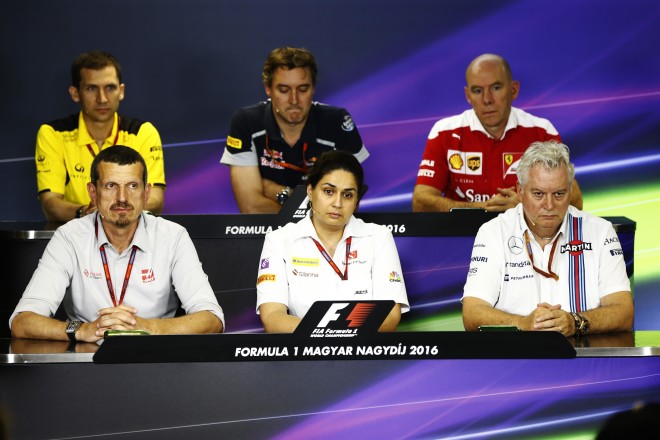
DRIVERS – Sebastian VETTEL (Ferrari), Nico HULKENBERG (Force India), Pascal WEHRLEIN (Manor), Daniel RICCIARDO (Red Bull Racing), Rio HARYANTO (Manor), Felipe NASR (Sauber)
PRESS CONFERENCE
Sebastian, let’s start with you, if we may. News yesterday that Ferrari is replacing technical chief James Allison with Mattia Binotto. Can you give us your thoughts on that?
Sebastian VETTEL: Well, not much to add. I think we have stated in the press release what happened. I think Mattia has been in the team for a very long time so he is very experienced and knows the team inside out. Obviously there will be a difference but in the short term it doesn’t change that much.
The timing of the switch means that he’ll be in charge with plenty of time to influence the direction of next year’s car. Would you like the emphasis of the team now to shift to the 2017 car?
SV: We are already obviously working flat out on the ’17 car, I think everybody is, the rules are very different. Still there’s stuff I think we can learn from this year, so that’s why I think it would be wrong to forget about this year’s car. So I think still directions are very important heading into next year with the different approach but of course there is a very large group in the factory focusing on next year’s car.
Thank you. Coming to you Rio, you’ve out-qualified Pascal five times in 11 races; that’s quite a statement isn’t it?
Rio HARYANTO: Yeah, it’s a good result. It’s good to be able to be quote competitive in qualifying but I still want to improve also a lot in the races and we are clearly working hard on that and there are some occasions in the race where I’ve been having a split strategy to him and I just try to keep learning and to move forward.
The fact that you’re here in Germany this weekend, does that bode well for the rest of the season in terms of your involvement with the Manor team?
RH: I have a contract for one year. Of course there are certain obligations that we need to fulfill. My management is working very hard and I would like to say thanks to the team and also to the people in Indonesia who have been very supportive and hopefully I can keep my seat for the rest of the season.
Thank you for that. Nico, coming to you, you’ve scored points in five of the last six races but after Budapest you seemed to be a little bit downbeat in your assessment of the team’s chances at this race, sating it could possibly be a bit like Hungary. Don’t you think this track should suit Force India a little better than that?
Nico HULKENBERG: Difficult to judge. I think in Hungary we had a bit more potential in the car, but it was kind of a tough weekend with the mixed qualifying and then in the race also the race, how it happened, it just evolved against us. I think there was more potential than what we got at the end, only a tenth place. Hopefully here this weekend we’re a bit more competitive again and obviously we’d like to beat the McLarens, the Toro Rossos and put on a fight with the Williams and not be behind them.
Now, Vijay Mallya told us in Silverstone that both you and Checo are confirmed for next season. Checo was a little more non-committal than that last weekend. What’s your situation?
NH: Everything is easy and relaxed, there’s not much more to add. I think Vijay said what the situation is and we’re just focused on this year now, trying to get as many points as we possibly can and that’s the main focus really.
So you’re staying for next year
NH: Yes.
OK, thank you. Felipe, we had the news last week about the takeover of Sauber. What difference can you notice inside the team and where is the focus of attention now?
Felipe NASR: Well, first of all, it’s good news. I was happy for the team to have these new investors taking over. It brings a lot more stability to the team, especially to all the employees at the team. I could see in their faces already that people are happy again, back in their work, they can just focus on the job they do pretty much. We were very limited on the things we could do this year, talking about development and car performance. We couldn’t unlock anything, just because we didn’t have the resources to do so. I think now looking to the short and the long term there’s a lot that can happen. I believe there are serious people behind it. We expect to see some decent, let’s say, updates to be on the car after the summer break, which I’m really looking forward to. I want to put the car back competitive, I want the team to score points, I want to score points as well, which is the only thing missing until now.
Well, you mention that, the team is still looking for it’s first point as we reach the half way stage in the championship. So are you taking some encouragement that you’ll get there soon?
FN: Well, I believe so. I’m doing all I can. Sometimes in the last few races we have been close to it, we just need that little bit extra from the car to be more competitive, especially in qualifying, being able to qualify a bit higher, Unlocking performance is all we look for and hopefully it will come soon and I can celebrate that first point as well.
Thank you. Coming to you Pascal, your first Formula One grand prix at Hockenheim, first home grand prix in a Mercedes-powered car as a Mercedes protégé, sum up the emotions?
Pascal WEHRLEIN: Yeah, it’s a very special race to me. I’ve already said in a few interviews that when I was five years old, in 2000, I was here in the grandstands watching my first Formula One race live and it’s amazing to be in the car now in 2016.
You’ve had podiums here, I believe, in DTM and in Formula 3, so it’s a track you clearly know well and like. Is there a belief that you could repeat the result from Austria?
PW: I hope so. The track shouldn’t be that good, as Austria was for us, but as soon as I am in the car I will push as hard as I can and hopefully I can do the same again.
Thank you. Daniel, coming to you, your 100th grand prix start this weekend, congratulations. Obviously a very strong weekend in Hungary last time out but do you feel that after that double setback of not winning in Spain and Monaco it took a few races to get your mojo back?
Daniel RICCIARDO: No, not at all, if anything it increased it. The way things turned out after Spain and Monaco, yeah, the race results weren’t as high as I was hoping for sure. It wasn’t a lack of mojo or anything like that. It was probably too much of the other! Obviously it was nice to be back on the podium last weekend; that was cool. Obviously I had a podium in Monaco, but unfortunately I didn’t really enjoy it, so it was nice to actually enjoy the one in Budapest and appreciate it, because you don’t get a podium every race. To see the fans and everything and to spray the champagne on Sunday afternoon, it’s a nice reward. It’s a beautiful feeling, so it was nice to soak that in. A hundred grands prix – I would say it’s gone quick, but at the same time it hasn’t. It’s taken a lot of steps to get here and yeah, I look back on HRT and it does feel like a long time ago. Yeah, 100 feels about right.
There was optimism before Budapest that Red Bull would be able to challenger Mercedes there. Obviously it was a slightly complicated weekend, particularly with the rain in qualifying, but in the end they did manage to keep you at arm’s length. You personally now are third in the Drivers’ Championship, it that the limit of what’s possible this season?
DR: There should be another chance or a slight chance you’d think in Singapore. It’s a strong circuit for us and for whatever reason last year it was a weakness for Mercedes, so if it’s a similar trend then we can genuinely have a crack there. But otherwise probably a wet race is our only real opportunity on an even playing field. Now we’re close with Ferrari in the Constructors’, I’m third in the Drivers’ Championship, it’s really close from third to sixth. But that’s fun, so hopefully we’’ just try and keep that. Some more consistent podiums would be good and yeah leave Sundays feeling happy, that’s always important.
QUESTIONS FROM THE FOOR
Q: (Daniel Johnson – The Daily Telegraph) A questions for Seb or two actually. When you first came here when you were a kid the grandstands were full, there were 100,000 people, and if you look at Michael’s heyday the sport was massive here. It’s not secret that now it’s struggling for popularity compared to that. Do you have an explanation for why that is? And the second question is, from a driver’s point of view what was Michael’s impact on Formula One, what’s his legacy would you say?
SV: Starting with the second one, I think he was obviously the first German world champion and the first one that made Formula One really popular in Germany. Obviously Formula One has been around for a long time and also there were a lot of races in Germany, but I think the real difference is that we didn’t really have a local hero for a very, very long time. There were Germans participating, but obviously if there is one really, really successful one, winning a lot of races, that’s what attracts a lot of the attention. That’s what also caused the hype initially and caused the grandstands to be full. I think entering the motodrom in the old days was a bit different than nowadays, because the track was different, all the other parts of the track there was only trees, so I think that’s different now, you have big grandstands around the track, a bit more spread. Plus the fact that it’s clear nowadays, let’s say the last couple of years haven’t been that popular, there’s been a lot of negative in the press and obviously people, fans, follow that as well and that doesn’t help. I think Formula One has lost a little bit of its excitement in terms of just if you listen, the cars are a lot more quiet, which also then looks a little bit less spectacular, even though it’s not true, corners speeds are as high as they’ve ever been. Just when we go on power it doesn’t sound as nice as it probably did in the past. So there’s a couple of reasons and I think it general grandstand tickets are too expensive. In my point of view they should be a lot cheaper, a lot more affordable, so a lot more people would be tempted to spontaneously say ‘yes, let’s go, we want to be part of it and let’s not miss it’. So I think there are a couple of reasons.
Q: (Livio Oricchio – GloboEsporte.com) To Sebastian. Sebastian, until September of 2014 Mr Marchionne didn’t have great approach to Formula One and then came Arrivabene also. All of them for sure hard workers, competent and they were doing their time – and now we have also Binotto, also another guy without experience to concept a car globally. He comes from engine side. Are you worried that you have very good people behind you but all of them, the mainstream leadership of the team with no experience in Formula One?
SV: No, I think we have the right people on board. I think obviously, yeah, it’s been a lot in the press, especially about our president and what he expects from us and so on… I think first of all it’s good to see, as I’ve always said, that he’s involved. Obviously he’s pushing the team very hard, and also in Maranello, he spends a lot of time there. I think he knows what he’s talking about and generally has been trying to understand what’s going on, in the last year in particular. So, I think things are heading in the right direction. Obviously it’s a big change now, which doesn’t impact on tomorrow’s work but obviously for the future. No doubt about it but I think things are heading in the right direction. When you say that they didn’t have access, I think it’s not entirely true. Obviously I haven’t followed that close but in Maurizio’s case as well I think he’s been in Formula One and involved for a long time, so I think he knows the business very well and I think he’s doing a very, very good job. That’s how we all feel in the team. He’s our leader, he’s the team principal and we’re happy he’s with us.
Q: (Sandor Van Es – Formula 1 Magazine, Netherlands) Daniel, I have a question for you. Congratulations with your third in Hungary, your team-mate hinted that in the first part of the race he was a little bit held-up by you because he was driving like his grandma.
DR: His grandma’s fast!
How satisfying was it to finish clearly ahead of him and, related to that, how are you going to approach your little battle in the second part of the season?
DR: Yeah, it’s part of… especially the early stages of the race, there’s always, a lot of the time, when there’s some tyre-saving, you always go through a phase where you try and make it to lap number X and sometimes the approach is to build up to it and make sure you get to that point, that you don’t throw yourself in a three-stop strategy, say, when you’re planning a two. So, from my side, at the start, I was just trying to do what I had to do. Try to hang with Nico and Lewis. It was sort of there – and then to the end of that stint they seemed to pull away but it seemed like my tyres had a bit more life at the end of the stint than perhaps Max’s did. Yeah, I don’t know if it was necessarily a shot at me, it was more, I think, as well, the way sometimes we have to manage the tyres. Especially at the start of the race with high fuel. You do have to be quite conservative and yeah, it doesn’t always feel that fast. I am impressed with the speed of his grandma. That’s pretty good.
Q: (Louis Dekker – NOS.NL) For Sebastian and Daniel. What do you need to beat Mercedes on Sunday. Help from above or something else?
SV: I think we both have the cars that we have and both of us are very happy. Obviously we’re missing a bit to really take it on to Mercedes in lap time. It’s been, on this type of track, probably around three-four tenths to seven-eight tenths per lap, which is a lot and obviously allows them to take it fairly easy but we will try to extract everything we can, try to do the best job possible and I think that way we enhance our chances to put them under most pressure. Then, I think, there’s always a lot of things that can happen. We’ve seen it in the past. That’s why we go racing. Otherwise, y’know, there’s no point for us being here.
Daniel?
DR: Yep, you always hope for some variables. I think all things even they’re clearly the quickest at the moment. Rain definitely helps us. We seem to be able to close the gap there, and also the rain, whether it suits our car more or not, it also opens up more opportunity for the driver to make a bit more of a difference. It’s easier to make mistakes with things like this. Even if they were quicker in a wet races there’s still more chances they might make a mistake, or whatever. So, yeah, otherwise, as Seb touched on, we’ve just got to try and do what we can do with what we’ve got. It if does open an opportunity, obviously Barcelona, on lap one, that opened an opportunity for everyone, these sort of things can still happen. It would be nice if we could beat them with them still on track. That would be, I think, more satisfying.
Q: (Joe Van Burik – De Telegraaf) Another question for Seb and Daniel. Do you have faith F1 will change much with the new 2017 technical regulations.
DR: Yeah. I’m confident the cars will be quicker, the cornering speeds will be quicker. I think that’s one thing which obviously we’re all going to be open to. If it does become a bit more physical – not that it’s not, I was sweating quite a lot after the race last weekend – I think more to just feel the car a bit more in the high-speed corners. I know our car is very strong in high-speed corners and I still feel like I want to do more, so I can imagine midfield teams, they’re not really experiencing a massive amount of gees and grip. So, looking at that, the wider tyres and more downforce, it should make that part a lot more fun. How much it’s going to change, I don’t know. I am having fun, as Formula One is now, but of course you can always improve things. Even if this improves one part of it, then that’s a positive.
Q: (Graeme Keilloh – Grand Prix Times) Question for all of the drivers. We understand a decision about whether the Halo is to be introduced for next year is fairly imminent. Jolyon Palmer said earlier today that most drivers he talks to are against the halo but reluctant to say so. Do you all agree this is the case? That perhaps drivers aren’t expressing all of their concerns or drawbacks about it?
Nico, why don’t you start with that one.
NH: Yeah, I think there is some mixed opinions amongst the drivers. Some favour it, some don’t favour it. Obviously the aesthetics are not so good – it doesn’t look very attractive – and yes, in some cases it would probably have been better and saved lives. But as it is I think F1 is already pretty safe and we also need to keep an element there, of danger, to keep it exciting, to keep it spectacular – but it’s not in our hands, our decision, what’s going to happen with it. So, I think today there is a meeting about Halo. We’ll wait and here about that.
Rio, what are your thoughts?
RH: Same comments
Pascal?
PW: I’m for the halo, especially after the presentation we had last week in Budapest. I think it’s a very good solution and maybe it doesn’t look so nice but it can save our lives, I think – until 17 per cent – so I’m clearly for it.
Felipe?
FN: I’m in favour as well. I think it doesn’t look great, as everybody pretty much says a similar thing. On the other hand, safety being the priority, I would be in favour. I believe it’s, for now, with what we have, it’s something better. There can clearly be, as I said, in the priority list of safety, it can be improved, but there’s also to consider that people will have to get used to it, if it does happen. Because it looks very different.
Daniel, your thoughts.
DR: I think what people from the outside need to understand is that, when we say it’s going to make it safer, it will – but it doesn’t mean the risks we take are any less. So it will not change our approach to a corner, for me, as much as I understand it, it’s to help the freak accident, or to support the freak accident, or if something comes flying in the air to stop it hitting us on the head, as some incidents happen, and y’know, with last year as well with Indy. It’s purely just to, I’d say, get rid of that risk, which I think it will do a good job. For us getting behind the wheel and going flat out in Eau Rouge or something, it does not change if we’ve got the halo on or not. So, I think that’s what people from the outside who are against it, need to understand, that we’re not all just turning into… y’know… we’re still race car drivers, it’s just trying to eliminate that freak accident side of it.
Sebastian?
SV: I’m a bit surprised because it doesn’t sound as if we were clear about what we want in the future, so I’m a bit surprised about these comments and I think 90-95 per cent voted for it – so I don’t know why all of a sudden it comes up the way it does. I think it’s the wrong impression. As I think the majority in here said as well, we don’t like the looks of it but I don’t think there’s anything really that justifies death. So, I think we’ve always learned from what happened, incidences that happened on track, and we’ve always tried to improve. Now, that would be the first time I would think in human history that we’ve learned a lesson and we don’t change. I think it’s up to us to make sure it does happen, otherwise I think we’d be quite stupid.
Q: (Daniele Sparisci – Corriere della Sera) Question to Seb. What do you expect from this race? A podium would be a good result for you here?
SV: Yeah, I think the nature of the track should suit us probably a little bit more than last week. But having said so, our main rival for victory will still remain Mercedes so we try to line all of our ducks up so we can deliver the strongest Ferrari that we can. Of course it would be very nice for me to be on the podium. Racing at home I think is something very special and, in that way, to give a little bit back would be great. It depends on how the race unfolds: if there’s a chance to win and you don’t, you cannot be happy. But yeah, I think, if everything goes, let’s say, normal, we should be fairly competitive and should be aiming at a podium.
Q: (Daniel Johnson – The Telegraph) Seb, on the halo, you said that you had a vote among the drivers. How do you feel about the fact that it’s something the teams are deciding on rather you. It would be in the FIA’s hands to just impose it but they’ve put it to a vote of the strategy group. Do you think that’s really fair on you guys?
SV: I think ultimately the FIA can do what they want, because based on safety grounds, they can do what they want so I think the message is clear, I think the feedback from the drivers so far – apart from the odd one or two here and there – has been clear. I think it’s fairly clear.
Q: (Walter Koster – Saarbrucker Zeitung) Nico, after your inter-mezzo with the Sauber team, you turned back to Force India in 2014. What is for you the main difference between your first time in Force India formerly and today? What has changed?
NH: Well, I think obviously the team has grown and really become a more solid, stronger competitor since. When I initially joined the team in 2011 as a reserve driver and then 2012 I was there as a racing driver, and then when I came back in 2014, I think we’ve really made a good step. The team has employed a lot of good people, changed structures back at base at Silverstone and I think just taken a lot of good directions, made some good decisions and hired some right people and that usually then sets you up, puts you in the right direction and makes you competitive on the track. So I think all in all the team has matured and grown a lot in a very positive sense.
Q: (Rzeczpospolita – Mikolaj Sokol ) To all gentlemen, after last weekend when you now see a double yellow flag, what will you do?
SV: I don’t know, whatever comes up, spontaneously. I was the car in front of Nico (Rosberg) and I lifted as well but maybe I lifted too much, I don’t know. What to say? I think double yellow is still… should be double caution and I think in the rulebook it says ‘prepare to stop’. I think after what happened last week, we shouldn’t change our mindset. I think it should still remain the same in terms of that you are aware that someone’s in trouble, marshals might be on the track to help him, whatever, so you should be aware of that and be prepared to lift. That’s it.
Q: Daniel, do you still have some question marks about this after last week?
DR: I voiced my comments in the post-race briefing. I couldn’t have done anything different. Fernando was still on the track so I was prepared to slow down a lot and that I had to because he was there. So yeah, for me, I even get thing when people go quicker on a single yellow. The double yellow, I think, has to be clearly… there has to be a difference between a single and a double. When I see a single, sure, I slow but I’m aware that there probably isn’t anyone on the track but when you see a double it’s a lot more of a stronger sign, at least for me, and yeah, you know there’s a bit more going on. I think it’s something we’re still going to talk about, discuss and make a bit more clear. There needs to be a big difference.
PW: I think there will be a big meeting tomorrow and let’s see what’s the discussion and solution after that.
NH: I will take some food and drink into that one, I think. It’s going to be long. Every double yellow, of course, means there is some danger and obviously we know (we have to) prepare to stop. Every case is different, though. It’s difficult also for Charlie (Whiting) and for those on the outside to judge. Obviously in that incident, if you come around turn eight in Hungary you look into turn nine so some cars saw Fernando sitting on the kerb there, so you know you have to lift, you’re forced (to) because he was right there on the ideal line and I think when Nico came he was clear and it was different so it’s difficult but yeah, we all definitely have to have great respect for yellow flags.
FN: I agree on what the others are saying too. There has to be a clear message. Tomorrow, when we all sit down together, there has to be something that is really being followed by everyone, I guess. We don’t want to get in those doubts of the position there, well the car wasn’t there… It has to be something clear that we have to do and then everybody respects that.
RH: I think a double yellow says you have to prepare to stop. I think tomorrow we will discuss things together and clarify the position to take from what happened two weeks ago.
Q: Just for clarity, Sebastian, from a leadership point of view amongst the drivers, will that meeting tomorrow bring forward something that you will take to the FIA? What will happen?
SV: Well, first of all we will see how the discussion goes but I assume it will be a bit longer, it won’t be dealt with in two minutes so I think we will have to wait and see.
Q: But it would be some sort of protocol that you would all agree between you from then on. Is that the idea?
SV: Well, to be honest, I think the difficulty is that with that, since we have the… again you could argue that modern technology didn’t do us a favour. Since we introduced the loops, the timing loops so that not just the sectors one, two and three but also in the individual sectors we have different loops and then there was a sort of guideline that if there was a single yellow waved flag you have to lift off by two tenths. If there’s a double yellow waved you have to lift off by five tenths but that was verbal, there’s no way (you will) find that in the rulebook and basically apply common sense. But then again the problem is that you leave it up to us and then where’s the limit, so you had a guy last weekend that arguably if a lot of other guys were in his shoes, we would maybe have done the same. He comes around the corner, sees the double yellow… first of all, comes around the corner, sees the track is clear, obviously then still has a shot at the rest of his lap, where do you draw the line? In the past it was probably more simple just because we didn’t have the ability with the loops, it was clear: sector two, in that case, if you go green or purple you abused the rule and yeah, in that sense it made it a lot easier for us in the car. Now you have to think about how much time you have to lose and so on and that, I think is what we need to discuss tomorrow and hopefully we will find a common agreement to move forwards.
Q: (Barna Zsoldos – Nemzeti Sport) Nico, Sebastian and Daniel, a follow-up on the 2017 changes, Stoffel Vandoorne recently made some interesting remarks comparing SuperFormula and Formula One. He said that in SuperFormula the tyres are rock solid so he can push, it’s quite enjoyable but that’s why the racing is not exciting. Now, next year we will have more aerodynamics, grippier and bigger tyres. Don’t you agree that the same will happen with Formula One and what is more important for you: having fun in the car or providing a good show? Because it seems to be a controversy.
DR: For me, the perfect or the ideal scenario would be to have something in qualifying with a lot of grip, that you can get the maximum out of the F1 car and push it to its limit and feel a real step but then yeah, the race, you don’t want it to go where it’s follow the leader and everyone’s going so quick and the braking points are too late and then you can’t overtake or anything so… I think the balance in racing hasn’t been too bad. I think the tyre deg and all that is not too bad. I think if we could just have that but with more grip like with quicker lap times but still the same rate of deg or whatever then I think that would still be a decent solution or outcome. So I think that’s what – looking at it – we probably will get, I think we will get just generally faster lap times but still the same amount of pit stops or whatever and hopefully in qualifying, we just get a bit more of a rush. Let’s see. I do believe it will go in the right direction, how much we achieve I’m not sure yet.
NH: Yeah, not much more to add really. Obviously we’re going to go faster for sure but we will also still see deg in the race which then allows a good show and overtaking and wheel-to-wheel racing so I think for now we will go in a good direction.
Q: Seb, to the gentleman’s point about it not just being about you guys having fun but also the wider show and spectacle.
SV: Well, I think on that it needs to be real so I think now you can argue that obviously we all know how much faster our car could go if there was a fresher set of tyres on the car, less fuel in the car, that’s what is not so satisfying in the race. I think that’s the point that Stoffel made and also amongst us that he can push all the way through the race and that’s how, to be fair, Formula One has been some years ago and to what people refer when they say this was the best time, in the year 2000 through 2005. You didn’t see a lot of overtaking but if someone made it stick it was real and that generally got appreciated. Nowadays, we also have arguments whether there have been too many overtakings, whether some of the overtakings have been too easy and that’s where, I think, it sums it up, where we say it has to be real. If we enjoy it, I think the people enjoy it, our passion transfers also to the people in the grandstands and following it on the television. I think that has to be the target. Whether we will achieve it or not we have to wait and see.
Q: (Ralf Bach – Autobild Motorsport) Question also about flag-gate in Hungary: Lewis went to Charlie’s office to get a clarification and he called him later in the evening as well; why didn’t you do this?
SV: Well, I think in that regard the rule is clear, in that if you read what it says under double waved yellow or yellow flag I think it’s clear. Obviously there was still the option to continue the lap which Nico did, fair enough to him and he made it stick and put the car on pole and then I think it means exactly that. What we are now all talking about is how much do you have to lift and every situation is different. I think we’re not too happy with that because there are certain inconsistencies there because then somebody has a different feeling or approach to somebody else. But to answer your question: I don’t know, I think to me it was clear what double waved yellow means so I didn’t feel that I had to go and ask.
DR: Yeah, I guess the team… I made my thoughts clear to the team and left that with them to deal with so I know… I think they were on to Charlie as well and seeing what the outcome was going to be.
PW: I don’t have Charlie’s number!
NH: Not much to say.
Q: (Silvia Arias – Parabrisas) Sebastian, talking about flags. You have been complaining during the race on radio about the blue flags. How much does it need to make you complain about other drivers? Does it affect your driving? What can you say about that, about these things happening?
SV: I think it’s emotions. I think in the race you want to… I was catching Daniel at the time, I believe, and yeah, it always feels that you’re losing more time than the guy in front which I don’t think is true and I have been in the other situation as well. It’s not easy, you know. The mirrors are small, you see the car coming and two or three corners later the car is a lot closer and maybe closer than you expect. Equally you’re racing someone, you’re doing your own race. Yeah, I think in that moment I was a bit emotional and complaining. After the race I was a lot more relaxed about it, maybe I got a bit tempted by Max in the last couple of races so I started to complain a lot about blue flags during the race. But yeah, i think we’re all trying to do our best and I think most of the guys most of the time do a very good job, especially because it’s not easy and it’s not a nice position to be in. I think we all come from a racing background where we were not used to seeing blue flags and especially not used to moving over so it is a pain but people are doing what they can.
eom/FIA press release
-
Rosberg defends speeding on double yellows…
DRIVERS
1 – Lewis HAMILTON (Mercedes)
2 – Nico ROSBERG (Mercedes)
3 – Daniel RICCIARDO (Red Bull Racing)
PODIUM INTERVIEWS
(Conducted by Kai Ebel)
Congratulations Lewis, you are the leader of the world championship right now, was it due to a tailor-made start, man?
Lewis HAMILTON: Well, firstly a big thank you to all the fans here, they’ve been amazing this weekend. It’s because of these guys that this race is so spectacular. We always have such a great time here, the track is great, the city is great, but the fans really make the event, so big, big thank you. With the race, yeah the start was everything. I got a good start… I mean I had one of the Red Bulls was on the inside of me, so I was pressured quite a lot into Turn One. But the team did a fantastic job with the strategy, preparing the car as always, the guys back at the factory continuing to push flat out, so a huge thank you to them, because this is a great result as a team, so yeah, what a day!
There was a crucial situation in between when the lap Gutierrez was blocking you a little bit, so I guess he’s not the next to be invited on one of your sailing trips?
LH: No, it’s good. But definitely traffic today was difficult to navigate through but… love you guys!
Coming to you Nico, even you had a fantastic start but just not good enough. Big question mark?
Nico ROSBERG: Yeah, it was down to the start in the end. I lost out a little bit and then into Turn One, with Daniel on the outside, Lewis on the inside, I ran out of space, so I had to bail out of it. That was it really. I was happy to take Daniel back in Turn Two and from then I was trying to put all the pressure possible on Lewis but of course it’s not possible to pass on this track.
So is it some kind of good news maybe that the next race is already on next Sunday in Germany on your home turf, you can hit back?
NR: That sounds very good. The next race is coming up very quickly, it’s my home race and that’s going to be awesome.
Coming over to Dan Ric. Dan, you are familiar to this podium here. They all know you, you have been here a couple of times. So was this third position enough to get the famous Dan Ric smile back on you face?
Daniel RICCIARDO: Absolutely. If that noise doesn’t, I don’t know what does. Yeah, thank you guys. It’s great to have another podium this year. Obviously the first one was a bit bittersweet but this one I can definitely enjoy and for sure the smile’s back. Super happy to be here today. It’s three years in a row I’ve been on the podium at this circuit. It’s been good to me and as Lewis said the fans are amazing, so thanks to everyone. Thanks to the team, we are continually getting better, so that’s great, and yeah, I’m having fun.
Coming back to Lewis, you guys are battling each other on the track but I know you are working out as well as Danny in the boxing business. So how about a charity match between Daniel and you in the paddock. You both work out at boxing, so would that be another idea, not only battling on track but in the squared circle?
LH: You never really have very good ideas, do you, so I’ll leave you to your ideas. But, to the man in the orang suit! Ha! Some of my best friends out here, thank you so much for coming and lastly to the fans: thank you all for coming out and we’ll see you next year!
PRESS CONFERENCE
Q: Lewis, many congratulations. You’re now the most successful driver here at the Hungaroring, surpassing Michael Schumacher. What does that statistic mean to you and how does this victory compare to the four that came before at this racetrack.
LH: It’s pretty incredible to hear those words and to… especially when you think I grew up watching Michael so to now have had similar, if not one more, than he had here, is just incredible. But, y’know, I wouldn’t have been able to do it without the great people I’ve worked with, both at McLaren-Mercedes and now here. It’s a result of great work from such a large group of people. I’m really just a chink in the chain. I love it here. I hope there’s more to come before I stop. Yeah, it was not the easiest grand prix I’ve had here in the ten years, nine, ten years – but definitely one I enjoyed. And a great battle between the three of us.
Q: Nico, it seems that so much was won and lost in the opening ten seconds of this race. Could you just talk us through what happened?
NR: For sure, yeah, the race was decided there. My start was OK but slightly down on Lewis’ start and Daniel also, ever so slightly. And then Daniel obviously got a tow and Lewis had the inside line. Just lost out there into Turn One. Got a bit tight between the two of them also so had to back out and then, OK, I was glad to at least get back second place from Daniel in Turn Two, that was cool, around the outside – but lost the win there.
Q: Daniel, moving onto you, it was a very close battle with Sebastian Vettel at the end of the race. Are you pleased to have beaten Ferrari or disappointed not to have challenged Mercedes harder this afternoon?
DR: I’m pleased with the podium. Obviously we got close at the start and tried around the outside of Turn One and I couldn’t really see I think at the time Lewis, when Lewis and Nico were in my blind spot, so at the apex of Turn One I thought I was in the lead and then saw one of the Mercedes sneak up on the exit. And then, yeah, into Turn Two, I was just on the inside and Nico had a clear run and got better drive. I think the first part of the race we looked quite competitive. But then yeah, it looked like Mercedes had a bit more in their back pocket and were able to improve the pace as the race went on. In the end the fight was then with Sebastian. It got pretty close at the end; did quite a long stint on those tyres. It wasn’t easy. The last lap, I’m sure he had DRS and, at least in my mirrors, it looked like he got quite close in Turn One. So, yeah, bit of a fight. So it was a bit of a relief actually coming across and keeping third.
QUESTIONS FROM THE FLOOR
Q: Barna Zsoldis – Nemzeti Sport) Lewis, you mentioned many times that you love it here, so do you plan some celebration in Budapest maybe?
LH: I do. I definitely will go and have a nice meal in town and see what the nightlife has to offer but obviously we race next week so nothing too heavy. And then I might go and spend the day sightseeing tomorrow before I head back to the UK.
Q: (Peter Vamosi – Vas Nepe) Lewis and to others, Lewis you are a fashion addict, how do you like the new dresses of the Hungarian grid girls?
LH: I like it very much, actually. I think they looked amazing. It’s not always that we have the best grid girls or outfits, should I say. This year it worked well and for some reason, Hungary just has an abundance of beautiful women. It’s perfect for us, we’re single, not so much for Nico but really enjoyed it.
DR: He (Nico) has to be careful what he says! Yup, they looked great. It’s hard, it’s hard for us obviously, you know that Sunday we’re focused on the race and the task ahead but it would be nice if we raced on Saturdays and then had Saturday evening to explore the city a bit more.
Q: (Livio Oricchio – GloboEsporte.com) Lewis, it looks like you controlled the race as you wanted. The moment Nico approached you, suddenly in one lap you could increase the gap easily.
LH: Compared to practice we knew that the temperature was a lot higher. I think it was 43 degrees track temperature in practice and today was about 53. It’s an unknown how long these tyres are really going to last. We have a target which need to get to so once I got into the lead, I was able to just manage my tyres, my car and manage the gap and react only when I needed to. For sure, I think the backmarkers caused a little bit of trouble towards the end but generally I was able to keep the buffer to the right amount. There was one moment… I was thinking… the whole race I was thinking, this has been great, I’ve not made any mistakes and in one moment… I can’t remember if I was behind someone but I locked up one or two front wheels and I went slightly wide and Nico then was all of a sudden on my tail which wasn’t exactly a moment… but then after that it was just head down and increase that lead.
Q: (Livio Oricchio – GloboEsporte.com) Daniel, I realise you don’t have a crystal ball but if you’d taken the lead of the race at the start, would it have been possible to keep it?
DR: I think for a part of the race, sure. You know there were moments when we looked competitive compared to Mercedes. I think once the first stint settled, they had a bit more pace than us but at the start of the second stint with the soft (tyres) we seemed really competitive but in the end it looked like Mercedes were just doing what they needed to do and then it felt like their pace got stronger and stronger. Little parts of the race where we thought we were quick enough but I think as the stints got on then they were able to keep a bit more pace. Probably wouldn’t have lasted the 70 laps if I had the lead at the start but yeah, what if? I don’t know.
Q: (Dieter Rencken – Racing Lines) Lewis, in yesterday’s Mercedes team press conference, your session, you said that you’d asked for urgent clarification of the double yellow flag ruling, regulation. In fact your words were ‘it just needs to be clarified now.’ About an hour later, Nico got called to the stewards. Do you believe that you influenced it in any way, did you contact anybody or was it purely coincidental that Nico was called in an hour after you made that comment?
LH: Well the stewards needs to come up with some kind of solution because it is… the whole 23 years of racing, it has been ‘if it’s yellow flag, you slow down’ and if it’s double yellow flag, you be prepared to stop and Nico was doing the same speed at the apex as I was doing on the previous timed lap. If there happened to be a car that was spun or a marshal on the track, it would have been pretty hard for him to have slowed down in that case, so that’s why… and the fact that he didn’t get penalised for it means that we need to be careful because the message we’re sending not only to the drivers here but also to the drivers in the lower categories is that it’s now possible for you to lose only one tenth of a second in a double waved yellow flag section which is the most dangerous – one of the most dangerous scenarios with the double yellow flags. They need to clear that up because before it was two tenths that you were meant to lose with one yellow flag and half a second with two yellow flags. It wasn’t the case yesterday and there was no penalty, so going into the next race, we could be battling for pole position and we see double yellow flags and we know we only have to do a small lift and lose one tenth of a second and we’ll be fine and go purple in the sector. So that’s why it does need to be clarified and I’m sure Charlie and the stewards are going to do so because it needs to be clear.
NR: Can I respond? Thank you very much. Thank you for making that statement, so now I’m going to put my response. What you have to do with a double yellow is significantly reduce your speed and make sure you go safe. I went twenty kilometres per hour slower into that corner, twenty kilometres per hour is a different world in an F1 car. Twenty kilometres per hour, you are going proper slow. It’s completely… everything is safe. That’s how I did my speed and lifted off thirty meters before my braking point, so I was just rolling there, twenty kilometres per hour slower until I got to the apex. Then of course when you’re in the apex, I would have a much tighter line because I went in slow and then so I could accelerate out again. So definitely I significantly reduced my speed and that’s what it says you need to do and that’s why for the stewards that was completely acceptable. It was very very obvious what I did, very clear and of course on a drying track you’re going to get massively faster every lap. It’s not like the track was consistent. On a drying track, it’s irrelevant what the sector time was because you’re going to get so much quicker every time you go out there because there’s wet patches and when they dry, you just go so much quicker. And so in that segment, I was slower, where there was the yellow flag but of course in the big sector, yeah, I’m quicker because the track is getting quicker and I’m pushing in all the other corners. So it was a pretty clear case for the stewards and that’s why I didn’t get any penalty.
Q: Daniel, can we just get your thoughts on what happened in qualifying yesterday?
DR: Yeah. With that incident? Yeah, for me, I think at least the principle, whether it was the situation yesterday or not but I think Lewis touched on the principle. It’s something which we’ve actually been wanting to probably discuss further for a long time or quantify because a single yellow, people are getting away with a micro lift and showing the stewards that look, I slowed down where you’re not really. But a double yellow is a significant… it’s a big risk on the track, perhaps and in my case, Fernando was still at the apex, pointing towards us on the racing line so I had no choice but obviously ,looking at the double yellows before that, it’s a little bit blind so already I was willing to drastically slow down, I guess. I think the double yellow needs to be very different to the single yellow and I think that’s what we’re not too pleased with at the moment.
Q: (Peter Farkas – Auto Motor) Nico, sorry to ask you but it was impossible not to notice that you were drinking a lot. Was it because maybe your drinking system failed in the car or was it a particularly hard race physically, and is it fair to say and also to Lewis and Daniel, that this is one of the hardest because it’s so hot, there are so many corners, you cannot really rest?
NR: Definitely it’s a difficult race, it’s very hot out there, but I’m just thirsty, because we sweat a lot and it’s nice to drink this good stuff and that’s it, nothing more than that. My drink system was working fine.
DR: Yeah, it was definitely hot, I’m still sweating. We don’t have a whole lot of liquid in the car. You could drink probably four litres during the race if you had it, so sure, we’re hydrating a lot after the race, a) because we’re thirsty and b) because it helps, I think, with recovery. But also this track has always been physical, because there’s not much rest. Obviously you’ve got the one main straight but after that it’s a lot of corners and you keep very busy. It’s probably top three on the calendar, I would say, for most physical circuit.
Q: Faster lap times this year, did that impact on the physicality of the race?
LH: Not really. It’s always hot here, it’s always physical but today wasn’t actually the most physical I’ve had here. I’m sure next year will be.
Q: (Sandor Meszaros – Kelet Magyaroroszag) Nico, for the first time this season, Lewis is the leader of the championship. How do you see the rest of your campaign?
NR: Well, it’s very close. It’s been a good season so far up to now, it’s been a good battle with Lewis and as I’ve always said, I’m not counting the points, there’s still a long long way to go. Everything’s still possible and I just want to focus on winning races, that’s what I wanted to do today, I had my full focus on that, it didn’t work out unfortunately, just losing out in turn one and now I move my focus to Hockenheim, because it’s my home race and I’m really looking forward to going there, racing there. I love the track and so I’m going to try and win there.
Q: (Istvan Simon – Auto Magazin) Daniel, during the podium interview you referred that the smile, the famous grin is back on your face. Is it due to the fact that you more or less managed to keep in touch with those guys in the silver cars, here in this physical race or more, due to the fact that you’ve managed to beat your teammate Max for the first time since Azerbaijan?
DR: Yeah, for me it was, I think for quite a few races, I think the qualifying generally has still been really strong. The Saturdays, I’ve put them together well but the Sundays, whether it was circumstances, bad luck or just not being quick enough, haven’t really felt like I’d get the most out of a Sunday. With Barcelona and Monaco which was so close and then it just felt like… I wouldn’t say, it looked like momentum, sort of swings a bit, but just the way racing goes. It was just nice to… I feel from Friday onwards until the last lap today, I got the most out of it, so I’m more pleased with that this weekend, to leave Sunday feeling happy again and knowing that I got everything I could out of the car and package and it’s nice to be rewarded with champagne and a very nice trophy here.
Q: (Dan Knutson – Auto Action) Daniel, you came in for your stop on lap 33, way before anybody else. Why so early and how difficult was it to keep the tyres alive for so long?
DR: Yeah, at the time we looked quite competitive to Mercedes. I think I was closing on them a few tenths a lap and basically, yeah, we were looking to maybe… we thought perhaps they were struggling, so we thought we’d try and just be aggressive and try and get closer to them, basically, if they were going to pit very soon. And also, I think Seb wasn’t too far behind but I think it was more trying to fight for the win at that time, as opposed to defending, I think, what was happening behind us. That was pretty much that, but then once we pitted, it looked like they just turned up the volume, unfortunately.
Q: (Silvia Arias – Parabrisas) Lewis, we know how much you like music. I would love to know, at this moment in your life, on the top of the wave, as you said two days ago, what is the song which describes this moment in your life?
LH: Right now I need to go the toilet so… It’s killing me, it’s something else! I don’t know. The song that was playing in my head today was LL Cool J, Mama Said Knock You Out. OK, can I go?
FIA transcript of the press conference
-
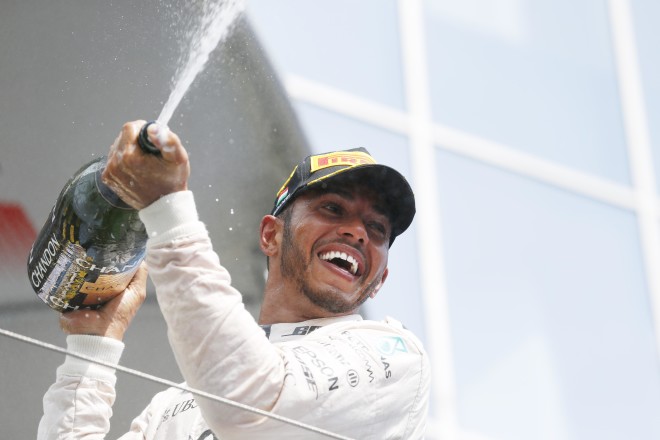
Hamilton jumps into championship lead with a commanding win; Roseberg rues 1st corner loss

Hamilton celebrates after winning the Hungarian GP on Sunday. An FIA image Budapest, 24 July 2016: Lewis Hamilton took a fifth career Hungarian Grand Prix victory ahead of Mercedes team-mate Nico Rosberg to rise above the German in the Drivers’ Championship standings for the first time this season.
Hamilton seized the lead from pole sitter Rosberg at the race start, making a better getaway than his team-mate and attacking down the inside as they made their way into Turn One. Rosberg, meanwhile, was coming under pressure from a fast-starting Daniel Riccirado and as the Red Bull driver made a move around the outside and Hamilton took up space on the inside, Rosberg was forced to lift. Ricciardo stole into second place but Rosberg managed to retrieve the position as the pair went through Turn Two.
Hamilton, though, was away in the lead and across the next 70 laps the defending champion put in a controlled performance, managing the gap back to Rosberg with ease to eventually claim his fifth Hungarian Grand Prix win. The victory makes him the most successful driver ever at the Hungaroring as he passes the record he held jointly with Michael Schumacher.
“The start was everything,” said Hamilton. “I got a good start. I had one of the Red Bulls was on the inside of me, so I was pressured quite a lot into Turn One. But the team did a fantastic job with the strategy, preparing the car as always, the guys back at the factory continuing to push flat out, so a huge thank you to them, because this is a great result as a team, so yeah, what a day!
Of his own start, Rosberg said: “I lost out a little bit and then into Turn One, with Daniel on the outside, Lewis on the inside, I ran out of space, so I had to bail out. That was it really. I was happy to take Daniel back in Turn Two and from then I was trying to put all the pressure possible on Lewis but of course it’s not possible to pass on this track.”
The win leaves Hamilton six points ahead of his team-mate as the season heads towards Rosberg’s home race, next weekend’s German Grand Prix, the final race before F1’s summer break.
The race could prove a crucial one in the battle for the Constructors’ crown too. While Mercedes top the manufacturers’ standings by a considerable margin, the battle for second is a tight one between Ferrari and Red Bull Racing and third and fifth places this afternoon for Red Bull ahead of Ferrari’s fourth and sixth places means the Milton Keynes team now heads to Germany just a single point adrift of their rivals from Maranello.
Both Red Bull drivers, Daniel Ricciardo and Max Verstappen, had to battle hard to hold on to their final places however.
In the closing stages Ricciardo came under pressure from Sebastian Vettel, and though the gap between the two at the chequered flag was just 0.6s, the Australian always looked assured of his third Hungarian Grand Prix podium finish in a row.
“It’s great to have another podium this year. Obviously the first one [in Monaco] was a bit bittersweet but this one I can definitely enjoy and for sure the smile’s back. Super happy to be here today. It’s three years in a row I’ve been on the podium at this circuit. It’s been good to me.”
Verstappen, though, had a real fight on his hands in the final quarter of the race.
The Dutch driver made his final pit stop, for soft tyres, on lap 39 and slotted in behind Kimi Raikkonen who was on a different strategy and who had made impressive progress from 14th on the grid. Raikkonen then pitted on lap 50, taking on a set of supersofts tyres. He rejoined behind Verstappen but armed with fresher, faster tyres he soon closed the gap to the Red Bull driver and began to put the youngster 18-year-old sensation under intense pressure.
As he had done to the Finn when taking his maiden win in Spain, however, Verstappen defended expertly, gapping the Finn in the final sector to eradicate the influence of DRS and the making his car as wide as possible through the opening corners to keep the Ferrari man at bay until the flag.
With Raikkonen sixth, seventh place went to Fernando Alonso, who took the place at the start by passing Toro Rosso’s Carlos Sainz. The six points earned by Alonso will be welcomed by McLaren but it might have neen more had eigth-on-the-grid Jenson Button not suffered a loss of hydraulic pressure early on. He soldiered on but an oil leak eventually led him to retire form P19 after 60 laps.
The Briton was also incensed by a drive-through penalty applied for an unauthorised radio communication. The 2009 champion questioned the sanction as he insisted that his message that his brake pedal was “going to the floor” and the response it elicited was a safety issue.
Sainz took a solid eighth place and four points, a useful return on a day when chief Constructors’ Championship rivals Force India managed to take just one point, with Nico Hulkenberg finishing behind ninth-placed Valtteri Bottas.
2016 Hungarian Grand Prix – Race
1 Lewis Hamilton Mercedes –
2 Nico Rosberg Mercedes 1.977 1.977
3 Daniel Ricciardo Red Bull 27.539 27.539
4 Sebastian Vettel Ferrari 28.213 28.213
5 Max Verstappen Red Bull 48.659 48.659
6 Kimi Raikkonen Ferrari 49.044 49.044
7 Fernando Alonso McLaren 1 lap 1 Lap
8 Carlos Sainz Jr. Toro Rosso 1 lap 1 Lap
9 Valtteri Bottas Williams 1 lap 1 Lap
10 Nico Hulkenberg Force India 1 lap 1 Lap
11 Sergio Perez Force India 1 lap 1 Lap
12 Jolyon Palmer Renault 1 lap 1 Lap
13 Esteban Gutierrez Haas 1 lap 1 Lap
14 Romain Grosjean Haas 1 lap 1 Lap
15 Kevin Magnussen Renault 1 lap 1 Lap
16 Daniil Kvyat Toro Rosso 1 lap 1 Lap
17 Felipe Nasr Sauber 1 lap 1 Lap
18 Felipe Massa Williams 2 laps 2 Laps
19 Pascal Wehrlein Manor 2 laps 2 Laps
20 Marcus Ericsson Sauber 2 laps 2 Laps
21 Rio Haryanto Manor 2 laps 2 Laps
Jenson Button McLaren 10 laps 10 lapsfia/press release
-
Rosberg claims 4th pole of the season; Hamilton P2
Nico Rosberg claimed his fourth pole position of the season in the final moments of a marathon rain-hit qualifying session as yellows flags behind the German ruled out final flying lap improvements for the German’s rivals.
After the first runs of Q3 four-time Hungarian Grand Prix winner Lewis Hamilton was in provisional pole position with a time of 1:20.108 and as the final flying laps began the Briton went quickest in the first sector. Red Bull Racing’s Daniel Ricciardo, too, was set to improve on his first-run time of 1:20.280, but then in the middle sector Fernando Alonso spun just ahead of Hamilton. The resulting yellow flags scuppered any chance of the defending champion or Ricciardo improving.
As Alonso recovered the green flags were soon waved just as Rosberg began the sector and he crossed the line in a time of 1:19.965 to take his first pole since last month’s European Grand Prix.
Behind Ricciardo, Max Verstappen was fourth in the second Red Bull ahead of Ferrari’s Sebastian Vettel, Toro Rosso’s Carlos Sainz, the McLarens of Fernando Alonso and Jenson Button, Force India’s Nico Hulkenberg and the Williams of Valtteri Bottas.
“For sure there were double waved [yellow flags], but I had a very, very big lift and lost a lot of time as a result and I was also slower than on my previous lap in that yellow segment, so I’m sure it will be OK,” said Rosberg of his dramatic final lap.
“It was a really challenging qualifying: the conditions changing all the time, very exciting out there. In the end it was pretty amazing that it did full dry out towards the end. I mean some kerbs still had some patches – going on to the start-finish straight, you had to be really careful opening DRS, I think you saw a lot of moments coming on to there. Then, yeah, I just got a really good lap in on that last lap – awesome, I’m very happy with that.”
Torrential rain in the hour before qualifying was due to begin made the track undriveable and there were two 10-minute delays before Q1 eventually got underway.
There was more rain to come, however, and a heavy shower a few minutes in brought out the red flags as the conditions again became impossible.
The conditions proved tricky however and there were three more red flag stoppages as Sauber’s Marcus Ericsson, Williams’ Felipe Massa and Manor’s Rio Haryanto all crashed out. In the end Q1 lasted more than 50 minutes with Renault’s Jolyon Palmer, Massa, Kevin Magnussen in the second Renault, Ericsson, Pascal Wehrelin in the second Manor and Haryanto exiting from P17 back.
Q2 began in wet conditions but with the track drying quickly the switch to supersoft tyres wasn’t long in arriving and when it did the times began to tumble. Thereafter the middle session was about timing and being careful to avoid mistakes. Two drivers who came close to failing the latter condition were Hamilton and Ricciardo.
Riccirado ran wide at Turn One late in the session and required a last-ditch lap to vault from P16 to P3.
Hamilton, meanwhile, made a similar mistake in Turn One and though the rest of his lap was clean and quick, the error saw him squeeze through to Q3 in P10 with just a tenth of a second in hand over Haas’ Romain Grosjean.
“I wouldn’t say my heart was in my mouth, but yeah, obviously when I came in and saw how close it was, that wasn’t great,” said Hamilton. “I went wide at Turn One. The rest of the lap I pushed as hard as I could. I was up on my previous lap, but of course I knew that everyone else would be quicker, so I lost too much time there. Very fortunate to get through and so that’s why even though I’m second I’m just grateful I got through and this puts me in a position to be at least be able to fight for the win tomorrow.”
One driver who did lose out was Kimi Raikkonen. The Finn finished Q2 in P14 and was eliminated along with Grosjean in P11, Daniil Kvyat in P12, Sergio Perez in P13, with Haas’ Esteban Gutierrez and Sauber’s Felipe Nasr, in 15th and 16th respectively.
2016 Hungarian Grand Prix – Qualifying
1 Nico Rosberg Mercedes 1:33.302 1:22.806 1:19.965
2 Lewis Hamilton Mercedes 1:34.210 1:24.836 1:20.108
3 Daniel Ricciardo Red Bull Racing 1:39.968 1:23.234 1:20.280
4 Max Verstappen Red Bull Racing 1:40.424 1:22.660 1:20.557
5 Sebastian Vettel Ferrari 1:35.718 1:24.082 1:20.874
6 Carlos Sainz Toro Rosso 1:36.115 1:24.734 1:21.131
7 Fernando Alonso McLaren 1:35.165 1:23.816 1:21.211
8 Jenson Button McLaren 1:37.983 1:24.456 1:21.597
9 Nico Hulkenberg Force India 1:41.471 1:23.901 1:21.823
10 Valtteri Bottas Williams 1:42.758 1:24.506 1:22.182
11 Romain Grosjean Haas 1:35.906 1:24.941
12 Daniil Kvyat Toro Rosso 1:36.714 1:25.301
13 Sergio Perez Force India 1:41.411 1:25.416
14 Kimi Raikkonen Ferrari 1:36.853 1:25.435
15 Esteban Gutierrez Haas 1:38.959 1:26.189
16 Felipe Nasr Sauber 1:37.772 1:27.063
17 Jolyon Palmer Renault 1:43.965
18 Felipe Massa Williams 1:43.999
19 Kevin Magnussen Renault 1:44.543
20 Marcus Ericsson Sauber 1:46.984
21 Pascal Wehrlein Manor 1:47.343
22 Rio Haryanto Manor 1:50.189eom/FIA press release
-
A really challenging qualifying: Rosberg
DRIVERS
1 – Nico ROSBERG (Mercedes)
2 – Lewis HAMILTON (Mercedes)
3 – Daniel RICCIARDO (Red Bull Racing)
TV UNILATERAL
Nico, what a dramatic qualifying session. How difficult was it out there and just describe your elation when you saw you had taken pole position at the end?
Nico ROSBERG: Yeah, it was a really challenging qualifying: the conditions changing all the time, very exciting out there. In the end it was pretty amazing that it did full dry out towards the end. I mean some kerbs still had some patches – going on to the start-finish straight, you had to be really careful opening DRS, I think you saw a lot of moments coming on to there. Then, yeah, I just got a really good lap in on that last lap – awesome, I’m very happy with that.
Lewis, I guess you must feel disappointed? You had set the fastest first sector and then you came across Fernando Alonso’s spinning McLaren. Do you think pole position was on for you today?
Lewis HAMILTON: I don’t know how much Nico was up, but obviously as you said I got the fastest first sector, I was four tenths up, so I felt good on the lap. Bit unfortunate with Fernando, but these things happen. I’m not really too disappointed, it was a tricky session and I did the best I could do and yeah, we still have a long race ahead of us tomorrow, so I’ll give it everything I’ve got from there.
Daniel, as Lewis says, it was a tricky session. You had a big moment exiting the final corner during qualifying. Describe what happened there and also your performance during qualifying, do you think you got the maximum out of the Red Bull package?
Daniel RICCIARDO: I think yeah… the maximum? I don’t know. We got hurt by the yellow as well. I was pretty angry on that last lap, because I was up a bit and I think it would have put me closer to pole. It would have been interesting without the yellow, so I’m a little bit disappointed, because it’s a maybe what could have been. But at the same time I think the session went really well. I think in all conditions we were competitive. It was crazy. You had to adapt quickly – when to go on the slicks in Q2 and even just little things: getting out of pit lane on the slick tyre when it was so wet, yeah it was sideways coming into turn one. It was fun, it was challenging. On the last corner, I think it was in Q3. There was still a little bit of a wet patch just next to the kerb and it sort of just sucked me in as I opened DRS as well, so I was in for a little bit of a ride but in the end I survived.
Nico, looking ahead to tomorrow’s race: you’ve never finished on the podium here at the Hungaroring and I guess looking to put that right tomorrow?
NR: I don’t really think of the past in those ways, just looking forward to it now, yeah, because of pole position and I’ve been really feeling good out there the whole weekend, in all conditions – wet, dry, even with high fuel on Friday – so it’s been a great weekend so far. Looking forward to the race and a great opportunity tomorrow.
PRESS CONFERENCE
Well, Nico that was an unbelievably exciting qualifying session ahead of the Hungarian Grand Prix. Timing seemed to be so important: when to be out on the track to ensure you were there when the track was at its driest. Just give us an insight into how tricky it was?
NR: Yeah, it was unbelievable. Just changing all the time, and so many things count, even just getting a gap at the end of the lap, everybody is backing off and to make sure you get a good gap there was difficult, even for there, because the time was quite tight. And then, yeah, I really nailed that last lap, so I’m very happy about that.
Congratulations. Lewis, I look to Q2 when I look at you. It was a very tense moment. You just got through into Q3 in P10; you heart must have been in your mouth?
LH: I wouldn’t say my heart was in my mouth, but yeah, obviously when I came in and saw how close it was, that wasn’t great. I went wide at Turn One. The rest of the lap I pushed as hard as I could. I was up on my previous, but of course I knew that everyone else would be quicker, so I lost too much time there. Very fortunate to get through and so that’s why even though I’m second I’m just grateful I got through and this puts me in a position to be at least be able to fight for the win tomorrow.
Well Daniel, Lewis wants to fight for the win tomorrow, do you think you can fight for the win?
DR: That’s the plan. We’ve more or less fought for it the last two years and I think we’re even closer this year than we have been in the past, in terms of pure pace. We’re getting stronger and we were close today and in all conditions we weren’t too far off pole. Tomorrow should be interesting. As always the Mercs have had good long run pace, we’ve seen [that] in free practice, but we’ll be there and obviously we start close enough to the front to make a fight of it and so hopefully it’s an exciting race.
QUESTIONS FROM THE FLOOR
Q: (Balazs Vajta – Eszak Magyarorszag) My question is for Lewis. Well, first of all, unlucky last lap of course, and it seems you have been struggling a little bit more on this weekend than usual. Would you be able to explain why you are struggling? That’s question number one and question two: looking at your qualifying today, rainy conditions, do you prefer rain conditions tomorrow or a dry race?
LH: Obviously I missed a lot of time yesterday. It was probably the first time, at least in the ten years that I have… actually in 2006 I had a spin in qualifying which meant I started at the back in GP2, otherwise in Formula One I’ve not really had any shunts here. Yesterday really put us on the back foot. Sometimes a missed session doesn’t really make too much of a difference but with a track as technical as this it’s really about building a solid foundation and I didn’t obviously get that yesterday and that was my fault. Today has been just trying to catch up from being on that back foot. I was kind of grateful it was wet at the beginning of qualifying because that levels the playing field a bit more, kind of helps you get back to the rhythm. As I said at the end it felt good. In terms of a wet or dry race, I hope it’s going to be a dry race tomorrow, but I don’t mind it being mixed because those are conditions I seem to go well in, so we shall see. For the fans I hope that it’s dry but for them also I hope that it’s a fun race like it was at the last one.
Q: (Istvan Simon – Auto Magazin) Nico, we were lucky enough to see replays of your quickest lap in Q3 and it looked like there were double yellow flags right after the chicane. How do you remember that lap? How was it from the cockpit and aren’t you afraid of losing pole, perhaps after the investigation?
NR: I don’t know. For sure there were double waved yeah, but I had a very, very big lift and lost a lot of time as a result and I was also slower than on my previous lap in that yellow sector, or in that yellow segment, or whatever it’s called, so I’m sure it will be OK.
Q: (Péter Vámosi – Vas Népe) Question to all drivers: the Hungarian government will rebuild the whole building here, it’s now official here, in two years. The whole media centre, this building, the boxes. Can you give us some advice what you need? Elevators? Bigger places? Whatever?
NR: We don’t really… it’s great that they’re doing it because yes, it’s a bit out-of-date, and that’s awesome because this place deserves to have Formula One for many, many more years y’know? So many fans come to watch us and the track is awesome – it’s a very, very exciting track – so it’s cool that they’re redoing it.
Lewis, anything to add?
LH: I love it here. I don’t think people need elevators! Could be a fun weekend but also one that you lose weight, bit of a workout! As Nico said, this is a historic grand prix, one of those that we cannot miss. I don’t think they need to go too overboard, we just need slightly bigger garages. I don’t know how it is for the hospitality but, just sensible improvement I would say.
Daniel, your thoughts.
DR: They’ve said it, yeah.
Q: (Barna Zsoldos – Nemzeti Sport) How did you find the new surface and the new kerbs in the wet conditions? Is it any different to how it was in the past? To all.
NR: It’s good. The grip is very high and that’s a great feeling, to be able to go so fast. Even in the wet, grip is very high. Yeah, I think they’ve done a very good job. Feels good. The only thing that still needs work are the two track limit areas where they just need to figure something out for there. Otherwise it’s been done very well.
Lewis, your thoughts on the track surface and the kerbs?
LH: I still don’t think they needed to do it, but obviously it’s done. I hope they don’t resurface it for a long time because it’s a track with age it gets better, it gains character. Yes, there are bumps and stuff but that’s what… as long as it’s not like a monster track bump then it’s fine; that means it’s more technical for us. But it’s very, very smooth now. And as Nico said, for one of the track limit kerbs, we have to find maybe a different solution – but the one seems to work now, so maybe that is the way forwards.
And Daniel?
DR: I’m sort-of on both sides. I definitely agree with Lewis that a lot of tracks have character through some bumps or some little parts on the track which… it’s like Monaco, for example, out of Casino Square we always avoid the bump, or the drain, whatever it is. If they smooth that out it would lose a lot of Monaco. It wasn’t to the extent here with Budapest, but there were some corners, like Turn Five, which was always really bumpy and sometimes uncomfortable but it was a challenge to work your way around that and setup the car around that particular corner. Thankfully it’s still got a lot of character, the track is still very flowing and still a lot of fun. Having a new surface, it does make it a lot grippier, so I think when you’re going faster as well, you are having fun. But yeah, they’ve done alright here. Hopefully they don’t resurface every track on the calendar because it does create a bit of atmosphere around it.
Q: (Heikki Kulta – Turun Sanomat) Nico, you have now 26 poles like Mika Häkkinen, do you feel that you equalled the Finnish record in this way?
NR: I didn’t know and, I don’t know…it’s not really… yeah it’s great to here that. But it’s not something that I think about. It’s just statistics. I’m not really focussed on that. I’m focussed on this weekend, happy to be on pole because it’s the best chance of winning the grand prix tomorrow.
Q: (Attila Lénart – Autó Stílus) I would like to ask all of you guys, after what we have seen here, we had more than an hour-long Q1, aren’t you feeling you are a bit over-protected?
DR: The only thing I feel is Hungry. I had a light lunch and now I’m hungry.
Can you elaborate a little bit for us? What were your thoughts about the conditions at the start?
DR: I think, a lot like these new surfaces, they do… because they haven’t bedded in, there’s not many cracks and whatever, the water does seem to sit on top of these very smooth types of asphalt. You could see that even the Safety Car, at least from what it looked like, the first ten minutes after two o’clock, it was even aquaplaning a bit. Normally if the Safety Car’s having problems then it’s very hard for us. Sure, we want to be out there, we don’t want to wait but at the same time, the car can only handle so much water and the tyres can only handle so much. I think they made the best of the situation with what it was. I think all of us where amazed at how quickly it then dried. From extremes to then Inters and then slicks in 10-15 minutes nearly.
Nico, do you feel the right decisions were made in Q1?
NR: Yeah, for sure because these puddles, they make it unbelievably uncontrollable, the car, this aquaplaning. You can’t drive in that. Even when we did drive, there were still a lot of those as you saw people going off everywhere. So, it was fine, it was good.
And Lewis, your thoughts on Q1.
LH: I agree with them. Honestly. I’m pretty crazy and I like to go out in conditions like that but I had crazy aquaplaning at one point Nico was mentioning. I was ahead of him. And so I think they made the right calls. Unfortunately the tyres… there is water sitting on top of the track and the tyres cannot disperse the water quick enough, and so I think they made the right call and the right steps.
Q: (Ralf Bach – Auto Bild Motorsport) A question to Nico and Lewis. We will see a total free race tomorrow between you guys, or could it be that we hear “keep position” at one moment of this race?
NR: For sure we can expect a good battle and free racing.
Lewis?
LH: Good to see you smiling Ralf! We’re supposed to race, same as always.
Q: (Livio Oricchio – Globosport) To Daniel, your team-mate comes from two podiums, two second places. What is the importance for you in this race to be in front of him?
DR: Always you want to beat your team-mate. That’s always, in a way, your first target. Everyone wants to win but if you can’t win you want to try to win the team battle, as it’s called. So yeah, I want to have a good race tomorrow. I really feel we can fight for more than just a podium – but let’s see. Yeah, I’ve obviously put myself in a good position I think from the start of the weekend, things have been working well. Obviously Max has done very well and he’s got some great results since he’s been here and I really believe we’re pushing each other to that next level and I think it’s showing in the team’s results. But also on myself I want to make sure I’m doing everything I can. So I focus on me first, and then try to understand a little bit of what’s happening around me.
Q: (Silvia Arias – Revista Parabrisas) For all of you, I want to know how difficult it’s going to be tomorrow: Avoid three times the corners Four and 11 out of the limits with the electronics.
NR: It’s OK. You can see the white line and I’m sure it will be fine.
Lewis, anything to add? Track limits.
LH: I don’t think it’s going to be a problem. It is relatively easy, you just don’t go through as fast as you would if you could go wider.
Daniel?
DR: Yeah, just being disciplined. That’s all it is really. It’s good that they are applying it. I think three times is definitely enough. Some people try to say ‘what if this happens? Or in this scenario…’ Three times is enough and that’s that. We can see it. It’s not like, as Lewis said, we can see the kerb, we can see the track limit. So, just be disciplined, be sensible and not too greedy.
Q: (Dan Knutson – Speedsport) Daniel, your team-mate reported on one run in Q3 that he lost ‘sync’. What does that mean, and did you have a similar glitch?
DR: Yes, so normally when you download from iTunes… I’m not sure what Max is using but obviously the music must have stopped. Weak wifi! Anyway, it’s normally just for the gears. Like a quick shift setting.
Did you have any problem?
DR: No, it was all good.
Q: (Péter Farkas – Autó Motor) Daniel, it was difficult to judge because of the conditions but based on what happened in P3, Red Bull seemed to get closer to Mercedes today than it was yesterday. How confident were you of fighting for pole if the conditions were staying dry?
DR: I think we would have got close on the last run, with the yellow. It sounded like Lewis was improving as well but looking at the 19.9 that Nico did, I did a 20.2, I think and I was three-and-a-half tenths up a the time of the yellow on my time, so I think it would have been very close at least to the time Nico set, so I was pretty frustrated on the radio. But anyway. It is what it is. I think we’ve definitely made some ground today over yesterday which is really nice because, particularly in qualifying Mercedes seem to, if not hold the gap, normally increase it, generally speaking. So I’m really happy with what we’ve done today. I did a little long run this morning which I was more comfortable than I was yesterday, so the signs are going there to be more competitive for tomorrow. Let’s see, give it a good crack.
Q: (Agris Lauzinieks – Kapitals) Nico, as a leader this season and your contract just being signed now, how can it be justified that you are earning less than Lewis?
NR: How do you know that?
I can feel it
NR: Well you need to check your feelings maybe. I don’t want to talk about such details.
Q: (Livio Oricchio – Globosport) To all drivers. In dry conditions, what do you project concerning tyres.
NR: Concerning tyres, it’s going to be, I think quite straightforward. Of course the supersoft is going to be very difficult initially, that’s going to be interesting how that goes. There could be some big differences there. After that, it’s going to be OK.
Lewis, you all did a lot of laps on the supersoft in Q2. How’s that going to impact on that first stint tomorrow.
LH: I only did the one lap on the supersoft in Q2. I think it’s the same for both of us. Only one lap on that tyre. I’m pretty sure that’s the case.
Daniel, how do you think it’s going to play-out tomorrow?
DR: I think if it’s hot the supersoft, it’s quite hard to get a lot of laps out of it. Or at least fast laps. It depends what the weather is doing. If it’s cooler, you can definitely run it longer but it does suffer more in the heat. Let’s see. I don’t think it’s going to be a one-stop race. We’ll see if anyone proves me wrong but at this stage it looks like a two stop and whether people do… obviously we’ve got three compounds to choose from. They might mix it up a little bit – but I don’t think we’ll see extremely long stints at the beginning with the supersoft.
eom/FIA transcript of the press conference
-
We want to first stabilise the team: Kaltenborn
Kalternborn of Sauber (front row, centre) at the FIA press conference. FIA image TEAM REPRESENTATIVES – Rémi TAFFIN (Renault Sport), Monisha KALTENBORN (Sauber), James KEY (Toro Rosso), Pat SYMONDS (Williams), Jock CLEAR (Ferrari), Guenther STEINER (Haas)
PRESS CONFERENCE
Monisha, if we could start with you: a very positive news story both for Sauber and for Formula One following the buyout of the team by Longbow Finance. Can you tell us a little bit more about the new owners? Who are these people who have bought one of the most prestigious brands in Formula One?
Monisha KALTENBORN: Well, Longbow Finance is a Swiss company. They have been active in financial investments for more than 20 years, from Switzerland. Their operation involves, well typically private equity investment for international client and of course investment portfolio management.
So when are we going to start seeing the benefits and when are you going to start seeing the benefits of the buyout – something this year?
MK: Well, we are working on that, but you know these things take time. We have had a rough time these past few months and the first target of course of the new owners is to stabilise the entire group. So you have to settle matters and then of course, again, to get back to your business as usual to have then a basis for being competitive. I’m sure we’ll have a few things still coming up this year, I mean we still have a few things to do, we don’t want to end up where we are, but of course we are focusing more on next year and there I am very confident you will see a lot more.
Thank you. Guenther, coming to you, we’re half way through your first season in Formula One, can you just give us a half-term report? How do you feel it’s gone?
Guenther STEINER: I think it has gone pretty well. I would just like to take this occasion to thank Gene Haas for the trust he has put in all of us, you know that we can come here, because I think the Haas story, an F1 team from America is good news, like good news that Sauber found an investor. Back to where it has gone, we had a very good start, for us, sure some people might think differently, if you are Mercedes or Ferrari, but we are very happy. Then we had a bit of a downturn, which wasn’t massive, I mean we still finished 11th. We finished 11th three times, so we were almost there but not really there. But we got back. The team has grown a lot in these 10 races up to now, if you saw it in the beginning. I wouldn’t say we were bad in the beginning, but if you are new it take some to gel and we always knew this and maybe we were lucky to get these points in the beginning because it gave us confidence, we knew where we were, that the car is good or that it is decent and we were building on it. And then when we had the four races where we didn’t score, we didn’t lose our head or get nervous. We just kept on working, we said “we know we can do it, we just have to do it again”, and I think we did it again, we finished eighth and then in Austria we finished in the points again, so all in all, very happy. Now we are at the point where we look to next year, well we started before now to look to next year, but now it’s full steam ahead on the new car and the race team is just getting better and better because they learn more and more every weekend. We are getting more people in on aero development for next year because we want to be even better next year. I hope we can achieve that. Everybody in the team can be proud of what they achieved and I would like to thank everybody in them because they worked hard because the first three races weren’t easy. They were difficult for everybody. People worked day and night. But they pulled through and now we are where we are, we’ve got 28 points and we are proud of them.
You say the team is growing, you’ve got more people in the aero department, what about the infrastructure in Banbury? Do you feel confident enough to take on more of the manufacturing of next year’s car in-house?
GS: No, that was never our plan. We continue a few years like we are. We want to grow in a few areas like race engineering and aero development, but design staff and manufacturing we don’t want to take, because we don’t want to get distracted. I think our principle works – to buy as much as we can from somebody else. We want to keep doing that because there is not a lot in it if you go to do it yourself, not a lot of speed we think is in it in the car. We would just distracted we don’t want anything of that to happen, so we keep on with our business plan, as we set out in the beginning.
Thank you. James if we could come on to you please. An impressive double points finish for the team at Silverstone. Do you think you pre-season target for the season of fifth in the Constructors’ Championship is still on? Can you catch Force India?
James KEY: Well, we’ve got a long way still to go, so you’d hope so, we’ve done just about half the season so far. Force India have done a really good job recently and they’ve made the most of some good opportunities, where perhaps we haven’t. We’re not happy with the number of points we’ve scored. We’ve got developments to come to the car, which could give us a chance later in the season, so there’s more to come from us. You clearly can’t give up in the middle of the season; you have to keep pushing. I know a bit of a gap has developed, that was really only made over a couple of races, a couple of big scoring races for them. So the same has got to happen for us to close up, so we’re not going to give up on our chase but it’s not easy.
You say you’ve got some chassis developments coming but there will be no power unit developments because you’re using the year-old Ferrari engine. How much of a frustration is that for you now?
JK: Well, we knew it was going to get more and more difficult as the season went on. The pace of power unit development has continued at a pretty high level. It was never an advantage for us to have an established power unit but one that was a year old, it was always a disadvantage – that’s no disrespect to Ferrari, but clearly they have made good steps on their own ’16 unit and we’re not benefiting from any of that. So it’s deeply frustrating really, but we knew what to expect. We have to try to compensate with chassis and make better use of our opportunities.
Thank you. While we’re on the subject of power units, Rémi, if we could turn to you please, how satisfying has the development of the power unit been, given where you were a year ago?
Rémi TAFFIN: I think it only be a good satisfaction, because where we were coming from was a difficult year last year and now we can see the improvement on track and everything we got out from the factory to the track was working well, so that was a good step forward, either first race or actually Monaco/Montreal specification we introduced. It’s all working well. I just have to say we’re on it, but we have a good way to go.
What’s next on the roadmap fro Renault? When are we going to see the next upgrade?
RT: I think it will be next year. The big step we will have will be next year’s engine, race one. Until we get to the end of the season now we will be working on the specification we have now, trying to extract the most out it, but there won’t be any more let’s say big step as we had for race one and six.
Thanks. Pat if we could turn to you now please, it’s been a difficult year for Williams, not least in Austria and Silverstone, the last two races, two tracks where you went so well in recent years. Have you discovered the cause of the problems at those two tracks? Were they track specific or was there something more serious at hand?
Pat SYMONDS: Well, I think we’re getting on top of it. It does seem that Canada was a long while ago – we were on the podium there – but it was only five weeks ago. But three races since then, Baku, Austria, Silverstone, and I feel in all three of those we haven’t performed in the way I expected to. S we are looking into it. We are looking at various things that we have introduced. We’re making sure that we understand them; that’s a process that’s been going on even today. But it’s quite an intense period, you know. Over a period of just five weeks we’re actually doing four races and one test – five events in five weeks. It’s hard to catch your breath when it’s going at that sort of pace. But I’m pretty confident we’re getting on top of things. We had a good day today. I was pleased with how it went, particularly on the long runs, and I think we’re getting back where we should be.
Where’s the focus in Grove now, is it on 2017? Do the 2017 technical regulation changes come at a good time for you, a chance for you to press the reset button if you like?
PS: Well, they come at the same time for everyone. We all have equal opportunities and I really do regard it as an opportunity. In answer to the first part of your question, we’re pretty focused on 2017 now, as I’m sure all the teams are, because there is so much work to do. There is so much to be gained in the early part of the learning curve that you can’t afford to leave things too late. It makes it quote challenging of course. If you are in a fight in 2016, as indeed we are, but you’ve still got an eye on the future, you have to balance things pretty carefully. But of course not all development is aerodynamic and while the wind tunnel is pretty devoted to 2017 work, there are other areas where principles do carry over, so we’re still carrying on in those areas.
Thank you, Pat. Jock, turning to you: like Williams, Ferrari hasn’t been able to maintain the momentum it built up towards the end of last year. Why is that? Are you simply losing ground in the development race or are there more fundamental problems than that?
Jock CLEAR: Firstly, apologies for keeping everybody waiting. I don’t thing we feel that we are losing a huge amount of ground if you see what I mean. From my point of view I have recent knowledge of the opposition and a huge respect for what we are trying to beat effectively. Our performance has come under a bit more scrutiny now that Red Bull are putting us under pressure, but again that is a testament to how strong they are as a team. We haven’t lost a huge amount of ground to the leaders. If you look at it over the course of the last couple of races, in Canada we were very close and in Silverstone we were a long way off. I think we have learned a lot about some of the areas where the car is weak and that has helped us to identify where we need to work and we are under no illusion that Mercedes are going to continue to be strong and Red Bull are going to continue to be strong. All the teams are working hard. It’s the ongoing challenge. We are working as hard as we can on closing that gap and sorting out the issues, but as everybody has said already, we can’t take our eyes off next year, because that’s a big opportunity. So we’re now having to measure that resource and measure that balance between keeping some momentum or looking to get some momentum later in the year but also putting a lot of resource on what, as Pat says, is a huge challenge for everybody next year. That balancing act is very difficult for all of us. And as I say, it’s just a testament to the guys at the front how well they are continuing to develop and that puts us under pressure because we are not closing the gap as quickly as we’d want to be and that’s racing.
You say you have recent knowledge of Mercedes. That gives you a unique perspective on the two teams. How are Mercedes and Ferrari different from an operation point of view?
JC: Sorry to be no fun but I’d rather not share those details if you like. Obviously my own experience at Mercedes I take with me into this position and those sort of insights are really helpful to Ferrari and we’ve talked about those long and hard – the areas where actually Ferrari are stronger, the areas where Ferrari are weaker, again filling in all those details. It doesn’t happen overnight. I was never going to arrive and change things overnight. Far be it from me to think I’ve got anything like that much influence. I’m just here to try and get the race team to do the best we can with the package we’ve got and make sure we’re feeding back the right things to Ferrari at Maranello. That’s the same structure as all the teams I’ve ever worked at. The dynamic is different, the people are different, but again that’s probably true wherever you go. There are no obvious stark differences that I can share with you, but there are those details that obviously I’ve shared with Ferrari.
Maybe no differences, but many similarities?
JC: Oh absolutely, many similarities. The passion. If anybody was under any illusion that Ferrari is not as passionate as they used to be in the halcyon days of Ferrari, it’s incredibly for the passion. That is a huge, huge boos for all of us. It’s a pleasure to be part of that passion. Some times it’s our Achilles heel, sometimes we know very well that passion can make things quite difficult for you, but on the whole it is just a huge positive and it is a joy to be part of.
QUESTIONS FROM THE FLOOR
Q: (Dieter Rencken – Racing Lines) Question for Monisha. Following the non-starts that were Qadbak and with the Russian investors, I’m sure that you did some due diligence on Longbow Finance, so you are in a position to confirm or deny that the Rausing family are participants in Longbow Finance please?
MK: What I can tell you is that our partner is Longbow Finance, it operates in Switzerland. All disclosures that are required in Switzerland are done and that is important to us, who exactly our partner is. And that is Longbow Finance.
Q: (Viktor Bognár – Magyar Szó) Question to Pat. We have some new technical directives about the radio communication between the engineer and the drivers. Is there any fear that it causes some over-complication of the rules? What would be the best solution in your opinion?
PS: It’s an interesting question. I think that the interpretation that’s been put on the rules is quite harsh. The rules that are taking about is a rule that says the driver must drive the car alone and unaided. I think it was put there many, many years ago to perhaps limit some of the electronic controls and things like that. Indeed it was that very rule that was cited in the banning of traction control, for example. To bring it in to the sphere of communication with the driver is odd. I’ve always through of Formula One as being a team sport and I’ve always thought, as teams, we should participate together to assist our driver. And you know, you can ask where the limit is. If the driver is to do everything alone and unaided, should he change his own tyres at the pitstop? Clearly ridiculous but that could be the logical extension of it? But I think what’s particularly interesting is that, I think it’s rather a shame that something that’s really unique in motorsport is something that we are doing away with. If you cast your mind back just a few weeks, we have the Euro football championship going on, that fantastic game, Italy and Germany, it’s going to penalties, wouldn’t you have loved to have heard what was being said? Three penalties missed. Would you have not wanted to hear what the goalkeeper was saying? Would you not wanted to hear what those strikers were saying? Now in Formula One we actually have the ability to engage our fans and allow them into the cockpit to get that sort of level of immersion… and we’ve allowed it to go away. I think that’s the biggest shame of all.
Q: (Joe Saward – Auto X) This is a question for everybody, specifically based on what Pat was saying. We’ve got six races in eight weekends. Is that sensible?
Guenther, why don’t we start with you?
GS: You’re asking me about sensible! It is a lot of work, it is tough. I think for us we didn’t feel the difference so much because we started off new and we were just running anyway, so a littlebit more or less is not a difference. Is it sustainable? I don’t think so. I think we should try to make it a little bit more scheduled. A better schedule that you don’t have six events in six weeks because it gets old pretty quick. Sometimes these things happen and maybe change is in the future, I don’t know – but asking if it’s sensible… no.
James, your thoughts
JK: I think when you have 21 races you’re always going to get a compressed timescale for things – unless you lengthen the season, which I don’t think any of us would like to see. So, whether it’s sensible or not, difficult to say but I think as long as you’ve got that many races in a season, you’re going to get a situation where you get six weeks of enormous activity, particularly in the middle of the year.
Pat?
PS: I think that… we examined, I think around 2008, how we were going to go racing in the future and we decided that 20 races was very much the tipping point. Now, of course, you say, “20 races, what about testing and things like that,” we do still have two in-season tests, we have reduced to only two pre-season tests – but what we’ve done is get rid of test teams, so there’s an awful lot for the race team to do. On top of that next year… well, firstly, we’re not at 20 races any more, we’re at 21 and who knows whether that will go beyond, but we’ve also got tyre testing to take into account next year, so I think we’re way past the tipping point and we, as a team, and I think most teams, are looking at a completely different structure because we cannot ask our personnel to maintain the level of activity that’s being asked of them. And therefore we’re going to have to look at rotation. It’s an incremental cost, we have to put people in there and, y’know, I’ve been in racing now for 40 years and this is the first time when I’m starting to see people say, “well, actually, y’know, we don’t want to go racing. We love Formula One, we enjoy working in the factory but it’s actually too much of a drain on family life and quality of life to be on the road all the time.
Jock, Monisha or Remi, do you have anything to add?
JC: Just to support Pat, his point on pushing people and people making that level of commitment. Big sports play very well off the bench these days – and that’s a big part of rugby, big part of football is what you do with your substitutes. We don’t have that luxury I’m afraid, and we’ve got a lot of guys out there who, during this five-week period who are really, really up against it to get enough sleep and, as you say, to find time to look after their families. It’s beyond the tipping point, as Pat says. I don’t think it’s necessarily not sensible, I don’t think we’re worried about the safety of it, we’re still very comfortable that we can put those cars out there safely for Seb and Kimi every week – but people are just very, very tired and we’re only halfway through that five week four race period.
Q: (Ralf Bach – Auto Bild Motorsport) A question to Jock. One of your drivers told us yesterday that we shouldn’t write that negative about Ferrari, we should write more positive. So maybe we could start right now. Could you tell us some areas where Ferrari is stronger than Mercedes?
JC: Ha! I would rather not share those areas. As I say, I’m sorry to not play to the party. The comparisons are very, very difficult. It’s a very different culture, it’s a very, very different way of working. Just the geography of the setup is very different. And that naturally arrives at a different solution. The people involved are all very, very experienced in F1. They’ve all had different upbringings through either the British teams or the Italian teams and that arrives at a different result. As I say, the difference are not necessarily those that are going to make the difference between whether you’re on the front of the grid or not. That still boils down to how well you can get the results out of your wind tunnel, how well you can develop your power unit, and I would say the key, key point with Ferrari and all of the teams is that with this new hybrid engine, it’s much more integrated than ever before. You can’t just say “right, that’s your aero, that’s your chassis, that’s your engine,” and those three will come together. They’re all so closely linked nowadays and that integration is a strength of Ferrari because nobody has a closer relationship with their engine manufacturer than we do. Even at Mercedes, geographically, they’re not in the same place. So we have that advantage. That’s one that’s obvious to everybody – but it is an advantage. And having that close community with the engine side and the chassis side, not that we have this hybrid unit where they’re so closely integrated, with the aero, with the cooling systems, that is a strength that we need to work on and we need to make the most of.
Q: (Kate Walker – motorsport.com) I’ve got a question for all of you please. Recently we’ve heard comment from Paul Hembery of Pirelli talking about his preference to return to some form of warm-weather testing for 2017, particularly with the changes in the tyres and everything else. Could each of you please tell me what your position is on warm-weather testing, whether you’re pro- or against it and what you see as the key advantages and disadvantages?
Remi, if we start with you.
RT: I’m not sure I’m really well-placed to comment on tyre testing. The only thing I maybe would comment on that one is something we already covered: the resources we’d have to put in front and the people we have to get on board for that. Apart from that, I guess I’m not going to comment on tyres, to be fair.
Monisha?
MK: Technically, it’s difficult for me to argue anything on that but I think the picture I have here is we had good reasons to get rid of these kinds of testing activities. We’ve seen times where there was unlimited testing, lot of tyre testing was done at the time, basically with one team and we all got those tyres. And we had at that time, when there were many manufacturers actually in the sport, where money was not that much an issue, we still got rid of these kind of things and, step-by-step, we are getting back to areas again that we never wanted at that time. So, I just wonder where this is all going to. We’ve again got in-season testing, fine, we got something else away, but it’s just becoming more and more expensive, costs are just going up and I just feel it will end up somewhere in a very, very bad situation and I think we should learn from the steps we have taken in the past and not again wait for something to happen where people again may be leaving the sport. It’s not always just the small ones. It could equally happen, which we’ve seen years ago, how bigger… how manufacturers have left. I think we should be very cautious in opening up these kind of shows again. I think as teams we should probably not have that much liberty with regard to tyres. It would probably be easier if we were to just let the tyre manufacture do what he does and focus on other things.
PS: We are actually evaluating the costs at the moment. It is an incremental cost, there’s no doubt about it. If you have the situation where you could test in the venue where you were racing, you can limit some of those costs, and indeed many years ago we used to do that. We used to start the season in Brazil and test there. We started the season in South Africa and we tested there. You can stop on the way and this is the sort of Middle East on the way to Australia and you can mitigate your costs by not bringing things back to base, in our case, back to the UK. It is an incremental cost and one of the problems is that you’re always sending a lot of people to these tests; there are so many systems that need looking after. From the UK, a flight to Barcelona is £50 or something. To Abu Dhabi, it’s significantly more and so it doesn’t come at no cost. But I think that we have got a problem but the problem is probably greater than you might realise because the rule that came in for this season, which allows the teams to chose their tyres and chose three tyres from the five available – which incidentally, I think is a very good rule and it has done quite a lot to spice up the racing and to bring a little bit of randomness into some of the strategies – it really does fall down next year because we have to make those tyre choices before Christmas, before we’ve even run a car with the tyres and indeed, I think by the time we’ve done our testing, we will have supposedly chosen tyres for the first five or six races. Now that hands an enormous advantage, in my opinion, to the teams that have done the testing, even if it’s blind testing, even if we’re getting that data, you won’t pick up all the nuances that the test teams have had. So I think what’s far more important is that we look at that problem and perhaps for a year or for the first half of the season or something like that we suspend the right of the teams to make that tyre choice so that we all live together, we don’t hand that advantage to Ferrari, to Red Bull and to Mercedes, because we would love to have been involved in that testing and we got quite a long way down the path to designing a car for it but we simply couldn’t afford to do a test like that and these costs just keep on adding up all the time.
JC: Yeah, obviously we were very much like Pat, very keen to be involved in that and we have the advantage of having the resource and being able to put a car together, not specifically because we thought it would give us a huge advantage. I think we’re all comfortable – I would like to hope – with the way that data is going to be shared and the way the tests are going to be run but Pat is absolutely right, there will be nuances that you will get out of it by being there at the time and the drivers involved will get a feel for it so there’s an advantage there and certainly, for all of us, I think we’re well aware that making decisions for what tyres we’re going to be racing at the beginning of next year when even we will have had very little touch on them is very difficult to do, so Pat’s very correct on what he says. That probably needs to be looked at. We certainly don’t… and we never envisaged our involvement with the Pirelli testing as an opportunity to steal a yard on everybody else and as such, we would be quite happy to go along with that if some way were found to even out that possible advantage early season. More about the Pirelli testing: I think we sympathise with Pirelli in their plight to make the best tyres they can. They come under a lot of pressure every now and then and they don’t have much testing opportunity in the same way as we don’t and obviously, they’re always going to be pushing to do testing and warm weather testing is important because a lot of these races are in the warm weather. So again, I think we have to sympathise with Pirelli’s position and a season that is long, and as we’ve discussed before, has 21 races and doesn’t have test teams any more, those sort of long distance, long haul tests that you could put after the flyaway races are just going to add to a hugely busy programme already. So it’s finding the team as well as the resources as well as the money; it’s all pushing the boundaries in every direction. We’re almost at explosion point in fitting everything into a year.
JK: I think I’d add a query to Jock’s points. I think to be fair with Pirelli they do need to be given a bit of a break with this. We’ve had a significant demand on them from our new regulations. There’s some targets for them to try and meet which are tough and they haven’t got so long to do it. Tyres are big players now, tyre management and all the science that goes into it just from the tyre point of view is significant and I think it’s going to be the same or probably more so next year, they’re going to be a very big part of the 2017 regs. A cold Barcelona isn’t the best place to try and learn exactly what these things are going to do, neither for Pirelli nor the teams so although of course there’s a financial implication which has to be carefully considered, the bang for buck of going somewhere which is more representative and gives both the tyres – well, both Pirelli tyre information and the teams the sort of tyre information which is useful and makes testing useful – is significantly better perhaps at going to warm weather conditions than the cold Barcelona.
Q: (Peter Farkas – Auto Motor) This is primarily for Pat, Jock and James: could you tell us how you found the new asphalt (here) in terms of grip, in what way is it different from the old one, the kerbs and what kind of driver feedback did you get today?
PS: I think we were pleasantly surprised. There were some problems in the European F3 race that was held here a little while ago, there was quite a lot of blistering on the tyres and we were aware of that so we were thinking that maybe we were going to have a tough day today but in actual fact, even the supersoft tyre has actually held up very well today in the longer runs, better than we had expected. The track is quite smooth, the kerbs are quite good, we’re pretty happy with the work that’s been done.
JC: Yup, absolutely the same feedback as Pat really. We had some fears and they’ve not really been founded today. We’ve had a reasonably comfortable day on the tyres, both the types that we’ve tried. The kerbs are smoother, I think you see that the lap times are considerably quicker than last year but I think a lot of that is the softer kerbs, basically. The grip level for us is similar to last year but certainly the kerbs are making a difference on lap time.
JK: It’s similar for us. We had a troublesome day today so it’s a bit difficult to make quite the same judgements but it hasn’t been as big a surprise as we thought.
Q: (Dieter Rencken – Racing Lines) Remy, when the 2014 engine regulations were introduced, one of the points was in fact the token system to save costs etc. That of course has been changed totally going forward. You’re talking about a big upgrade for next year. This is a time when major companies start putting together their budgets so what has the effect of the change of the regulations been on budgets?
RT: I think the short answer is not a lot to be fair, because we’re not really limited already by the number of tokens so that’s not really changed our world and since we look at what we’re going to be doing next year and the year after, it’s not going to be changed so I guess the short answer is nothing.
Q: (Joe Saward – AutoX) We have these fantastically efficient hybrid engines at the moment and it takes 350 trucks to move the Formula One circus from one race to another. Are we getting confused, here?
GS: We haven’t got 350, I think we’ve got nine. I think if that is what it needs, you know, we are highly efficient, absolutely. I don’t know what to say to this one. It’s like we are putting a show on, if this is what it takes to put the show on we need to do it. I don’t think it has a lot to do with what we are doing out on the track, how we bring it here. It’s actually a good number. I never knew that number, that there are so many trucks involved in getting this circus up and running. We try to be efficient, just to let Joe know. We have got only nine out of… there’s 11 teams so everybody should have about 30. We’ve only got nine so we are very efficient which goes along with the efficient engine in our F1 car.
Q: Jock, Ferrari would have more than nine trucks, what’s your take of it?
JC: Well, obviously in my new role I suddenly became aware of how much of this we ship around the world. It was one of the first questions I asked and they told me that most of them are there to deliver the breakfasts for the journalists! But no, as Guenther says, we’re putting a show on. Are we getting confused? We’re here to race racing cars as fast we can around the track, that’s never been any confusion for me. What the circus looks like is just as much a part of what you guys want, what the fans want, what we want. I don’t think Ferrari are chosing to put more and more trucks on the road. I think we’re just part of this circus and if it wants to go in a different direction, Ferrari are willing to with it. It’s our sport, it’s your sport but from my point of view, I’m here to make a racing car go fast around the circuit.
PS: Well, I think like you, Joe, I was quite surprised as I walked into Silverstone and thought I’d arrived at the truck Grand Prix rather than the Formula One Grand Prix. I think we shouldn’t confuse things. We have produced a very very efficient power unit. It is the way of the future and I think it is a pretty good contribution to automotive engineering. If you start looking at the fuel used going Grand Prix racing where do you stop? Do you count all the cars in the car park? I’ve often argued that actually the person who is sitting at home watching our race on television is not using any fuel and if we didn’t have a race, he would probably be driving around the countryside going shopping or something so where do you draw the line? I don’t think we should confuse the fabulous job that the power unit manufacturers have done with putting on a bit of a show.
MK: I know that Joe got a bit confused the other day when he saw a few Sauber trucks going in different directions and he wondered if we’d got lost. I think there are other points we’d rather look at if we talk about confusion but I do agree that if you compare us to other big sporting events – if you look at, for example, the entire carbon footprint we have – I think Formula One in spite of being racing and the automotive factor, is much better than compared to football or so because most of our audience is at home it’s been said, as compared to at these big games or big events, 80,000 that are travelling actually to the event. So I think we’re not doing a bad job on that.
Q: (Daniel Johnson – The Telegraph) Jock, you’ve worked with lots of drivers. Fernando left Ferrari after five years, I think, because he became frustrated that there wasn’t a championship there. What’s your impression of Sebastian and how patient he will be, because he’s been very admirable on what he’s said about how you’re doing this year but he’s a winner and wants to keep winning?
JC: Yeah, as you say I’ve worked with a lot of drivers and I think I said in Australia when that comparison was asked of me in that sense, Seb is every bit the four time World Champion that you people know him to be and he is a very very integral part of what we’re trying to do to win another World Championship at Ferrari. How patient will he be? He is a racing driver who is used to winning and passionate about winning – all racing drivers are passionate about winning – but as I say, he’s used to winning so it hurts, it cuts him deep to be not being able to compete side by side with Lewis and Nico at the moment. But having spoken to him, he’s up for the battle. He enjoys the fight, he said as long as we can go there on a Sunday and we can have a battle, even if it’s not at the front, if it’s with the Red Bulls, he enjoys racing, he just loves racing racing cars. He’s a bit like Michael when he came back into Mercedes; he just loves racing racing cars. Now, yes of course he wants to win but he believes in us, we believe in him, he’s part of this Ferrari team, he doesn’t consider himself an outsider. He’s part of this as much as we are and he considers his contribution will be measured by whether we make it or not as well. We often talk about whether we can deliver a winning car to the driver; well I think we all now know over the last few years it’s probably been true for many years in F1 that the driver is an integral part of bringing that together. It’s no coincidence that the great drivers end up at the best teams if you see what I mean; that’s because they’re part of creating the best teams and Seb will be a central part of that and we look to him to help us get there and he looks to us to help him get there and we’ll do it together.
Q: (Silvia Arias – Parabrisas) Mr Clear, I would love to know if it’s true or not that Ferrari had a contact with Ross Brawn and in this case, if Ferrari’s looking for a somebody – an engineer or somebody like that?
JC: Honestly, that sort of discussion is certainly not something we would talk about in public. I don’t know anything about it directly, so I really can’t comment. I’m obviously well aware that it might be speculation in the press but it’s not a conversation we’ve had at Ferrari that I know of and as I say, those sort of discussions, anyway, would certainly not be for public consumption.
Q: (Daniel Johnson – The Telegraph) Just a quick one again on drivers. Pat how would you feel about having Jenson at the team? Is that something you’d push for internally?
PS: I think Jenson’s a great driver and of course he started his career at Williams, so there’s quite a lot of affection for him. As a person, I regard him as someone I have been friendly with for many years. He drove for us at Benetton when I was there, he’s a great driver, he’s still showing to be very strong. I hope that he’s in Formula One next year, whether it be with Williams or elsewhere.
Q: (Dieter Rencken – Racing Lines) Guenther, obviously a team in your situation needs stability going forward and one of those components is on the driver front. What are your plans for next year, when can we expect to know what your driver line-up will be like for next year?
GS: We decided to wait, to talk internally even about drivers until the European season is over so after Monza, because at the moment we are quite happy with what we are doing. So we don’t want to get distracted or get the drivers distracted by talks, what will happen, what will not happen. We just wait until after Monza and then we sit down and try to make a decision as soon as possible so we keep that stability going.
-
Rosberg fastest in FP2 as Hamilton crashes
Nico Rosberg went quickest in second practice for the Hungarian Grand Prix after team-mate Lewis Hamilton crashed out early in the session.
Hamilton was on his fourth lap of the 90-minute session when he lost control as he headed into the 210km/h Turn 11. He spun across the run-off area and hit the barriers side-on. Surprisingly there was little outward damage done and Hamilton was able to get going again. He nursed his car back the pit lane but Mercedes quickly reported that it would need to be stripped back and that the3 champion would take no further part in the session.
It was left to Rosberg to carry the Mercedes standard during the session and the German obliged, using supersoft tyres on his quick run to set a session-best time of 1:20.435. That was almost a second quicker than Hamilton’s table –topper from FP1 and 1.8s quicker than Hamilton’s pole position time of last year.
However, while Mercedes had enjoyed a 1.6s advantage over closest challenger Sebastian Vettel of Ferrari in the morning session, the Silver Arrows’ advantage was cut in the afternoon by Red Bull Racing, with 2014 Hungarian Grand Prix winner Daniel Ricciardo getting to within six tenths of a second of Rosberg’s time. In the morning Red Bull opted to only run with soft compound tyres but in the afternoon the team bolted on supersofts to edge closer to Mercedes.
After finishing third in the morning session, Vettel repeated the placing in the afternoon, setting a best time of 1:21.348 31 to split the Red Bulls, with Max Verstappen fourth, four tenths of a second behind Vettel.
Hamilton was fifth fastest, his opening lap being good enough to second him a placing just under two tenths of a second behind Verstappen but ahead of the second Ferrari of Kimi Raikkonen.
McLaren, meanwhile, repeated its positions from the morning session, with Fernando Alonso seventh and Jenson Button eighth. The session wasn’t without issue for the team, however, with Alonso requiring a power unit change on his car in advance of the session after Honda noticed an “anomaly” on the data coming from it’s powerplant.
In the morning session P9 was taken by Toro Rosso’s Carlos Sainz ahead of Force India’s Sergio Perez. In the afternoon Perez again finished 10th, but this time Sainz was bounced out of ninth by Perez’s team-mate Nico Hulkenberg.
Sainz, meanwhile, dropped to P13 behind Haas’ Esteban Gutierrez and Williams’ Felipe Massa.
2016 Hungarian Grand Prix – Free Practice 2
1 Nico Rosberg Mercedes 1:20.435 45
2 Daniel Ricciardo Red Bull Racing 1:21.030 36
3 Sebastian Vettel Ferrari 1:21.348 31
4 Max Verstappen Red Bull Racing 1:21.770 35
5 Lewis Hamilton Mercedes 1:21.960 4
6 Kimi Raikkonen Ferrari 1:22.058 46
7 Fernando Alonso McLaren 1:22.328 21
8 Jenson Button McLaren 1:22.387 34
9 Nico Hulkenberg Force India 1:22.449 41
10 Sergio Perez Force India 1:22.653 38
11 Esteban Gutierrez Haas 1:22.673 38
12 Felipe Massa Williams 1:22.681 39
13 Carlos Sainz Toro Rosso 1:22.689 24
14 Valtteri Bottas Williams 1:22.773 38
15 Romain Grosjean Haas 1:22.864 28
16 Daniil Kvyat Toro Rosso 1:22.948 43
17 Kevin Magnussen Renault 1:23.347 41
18 Marcus Ericsson Sauber 1:23.437 36
19 Jolyon Palmer Renault 1:23.528 12
20 Felipe Nasr Sauber 1:23.986 31
21 Pascal Wehrlein Manor 1:23.992 22
22 Rio Haryanto Manor 1:24.265.36.eom/FIA press release