Your basket is currently empty!
Tag: Christian Horner
-
It is important to remain at a striking distance to Hamilton: Christian Horner
Monaco, Thursday, 20 May 2021: The following team representatives: Mattia BINOTTO (Ferrari), Toto WOLFF (Mercedes), and Laurent ROSSI (Alpine) attended the FIA press conference here on Thursday.
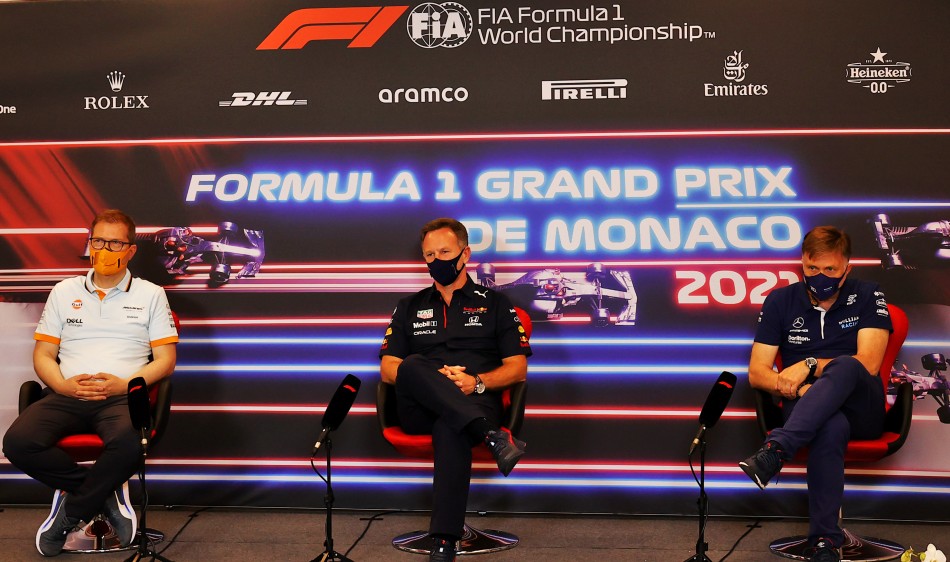
In the second PC the following attended: Andreas SEIDL (McLaren), Christian HORNER (Red Bull Racing) and Jost CAPITO (Williams).
PART ONE
Q: Mattia, can we start with you please. What is it about Charles Leclerc and his home race? A very frustrating start to the weekend for him with that gearbox problem.
Mattia BINOTTO: At first, I think enjoyable, exciting, I think it’s important for him, he knows very well the city, very well the streets and knows that he can drive very well around that layout. Last year we didn’t race here, the year before, we had somehow, let me say, a problem or an issue, a bad choice in quali that put him out of the top ten in quali. So, it was frustrating in the past and he knows that being back here this weekend he can try to do certainly better. I think it’s important to support him to his best, to our best, so that he can have a good weekend. The start, as you said, not exactly what we were hoping for. He had a gearbox problem very soon in the session, so he had to stop and that’s a shame – because certainly in Monaco it’s important to build the confidence and the more you can drive, the better it is. So certainly, he had missed an entire session – but he knows as well there is an entire history before quali and for him it will be important to get the experience he is missing from the morning.
Q: Mattia, looking at the positives, Charles has qualified brilliantly this year, fourth in three of the four races. What kind of opportunity does this race present him?
MB: I think Charles is very strong in quali. He has always been very strong and he has performed very well at the start of the season during the quali. Here again it will be important because, again, we know how important is quali in Monaco, for the entire race and the race result. So, at least he can try to do as good as he did in the first races, of course, and eventually, let’s see, whatever he can do on track. I think driver ability is very important. As we said, he’s very, very strong in quali.
Q: It’s been a strong start for Ferrari as well this weekend, now just five points from McLaren in the Constructors’ Championship. Would you have believed it after winter testing?
MB: It was for us important, I think, to show that our capacity of developing and addressing weaknesses and, when coming to Bahrain for winter testing, I think the car behaved at least as we were hoping and expecting and that was, let me say, the first good result, and after Bahrain we knew we had a car that was certainly better than last year, which was a minimum objective. We knew that somehow we could have done well during the races but we know as well that Bahrain is a very specific circuit and I think we said we should first wait for five races in the season to understand our true potential – but I think that the car is behaving consistently since the first start. The entire team as well. I think the team is dealing well through the race weekends. Solid race weekends from the pit crew, from engineering. We had some difficult events, difficult races, like in Imola with the wet race – but not only Imola. I think that overall in terms of strategy, pit-stops, overall I think it has been a solid start to the season and for that we are pretty happy.
Q: Toto, coming to you next, if someone had told you during winter testing that you’d win three of the opening four races, would you have believed it?
Toto WOLFF: No, probably not. We were lacking pace in Bahrain and then somehow we were just clinging on with our fingertips in Bahrain with the right strategy and then Max running off the track – but obviously that could have been his race. And then it just continued. So we need to take that, and I’m very happy about that.
Q: Can you tell us a little more about how you’ve done it? How have you made the progress?
TW: I think it’s just churning away. Looking at the data, trying to analyse. We have a completely new tyre that everybody needs to get on top of it. We needed to tune our car differently than in the past years but certainly the kind of gaps and advantages we had last year has vanished but that’s also good. I think we’re enjoying the ride.
Q: Let’s throw it forward to this weekend. Do you think, Red Bull Racing, is this their biggest threat of the year?
TW: I wouldn’t discount any other teams. We’ve seen the Ferraris have been pretty strong. Carlos was always there, right up, and Charles didn’t even run so the Ferraris have been very strong. Red Bull definitely, that has been their track, they have a lot of downforce, so we expect them too – but the McLarens have always come when it matters in qualifying. So yeah, everything can do well here.
Q: Laurent, coming to you now. While we’re talking progess, how pleased are you with things down at Alpine?
Laurent ROSSI: Well, I’m quite pleased because we started at a rather lower position than expected. Expected in terms of where we want to be. We want to carry on with the momentum from last year. We knew we would start a bit low because we had problems this winter in the wind tunnel, so it was a matter of catching up. And that’s what we did. The team put in a brilliant effort here, they’ve been adding downforce and tenths of seconds throughout the races and it’s been noticed. We’ve been picking up the pace, which is good. At the moment we’re in a good spot in terms of qualifying most of the time. On the race pace, we’re more in-line with our natural pace, which is natural position if you will, which is, like, mid-rank. We don’t stop here. We’ll carry-on improving the car for a little bit, so I’m pretty pleased here.
Q: Can we have a word on the drivers? Is it a surprise that your young charger is leading the way?
LR: I’m not surprised by it – if you mean Esteban – I’m not surprised at all. Esteban, we knew, is extremely talented. He’s been racing against all of the drivers, most of the drivers, when he was young – younger, he’s still young – and he’s always consistently beating them, most of the time. So, I knew he had a lot of talent. It’s the second year he starts having good references in the team. We also made some modifications to his own team, and also to the way we build-up the weekends. The race weekends and the qualifications, so it shows. The guy has talent, so it shows. I think he is where he should be – which is good.
Q: And Laurent, in a month’s time, we’re going to be at Paul Ricard. Can we just get your thoughts on having the French Grand Prix this year? How important is it that it’s there, even though it’s been moved – and do you have anything special planned for that weekend?
LR: Yeah. Anything special planned? I’ll keep it as a surprise. All the more so we need to make sure this can still happen because moving it forward was not necessarily anticipated. It’s an important grand prix, it’s the national one, it has a lot of meaning for the brand, for the Alpine brand beyond the F1 realm. That said, for us, it’s just another date on the calendar and we need to perform the same way as we do in Baku before and Austria after.
QUESTIONS FROM THE FLOOR
Q: (Luke Smith – Autosport, via email) Laurent, Toto was asked about Esteban Ocon’s future in Spain and he said that it would be up to you and Esteban to decide how to continue before Mercedes would have an involvement. Are you looking to sew-up Esteban’s future in the near future and lock him in with Alpine in the long-term.
LR: Yeah. We were very grateful after Toto said that. And it is indeed something we are considering and Esteban is doing everything to make me consider keeping him in the team. I would be remiss if I didn’t think about it. So, at the moment, we are already engaged in some conversations with his agent, his management team, Mercedes at large. Esteban is a great driver so I’m happy to have that type of problem – which is not actually!
Q: (Scott Mitchell – The Race) This is probably best addressed to Toto and Mattia but Laurent, if you have anything to add, please do. We know that the FIA are implementing stricter tests on flexible wings shortly. Andreas Seidl told us earlier that McLaren is pleased by that but strongly disagrees with the fact that it’s going to be a delayed implementation. What’s your view of the action being taken?
TW: My view is very similar to Andreas. We have seen in the past that complicated redesigns for teams had a delay. It’s clear that, if you have a back-to-back race, or maybe even two weeks, it’s too short for everybody to adjust – but we’re having four weeks to Baku and it is incomprehensible that, within four weeks you can’t stiffen-up a rear wing for the track that is probably the most affected by flexible rear wings. That leaves us in no-man’s land, because the Technical Directive says the movement of some rear wings has been judged as excessive – so teams who would run these kinds of wings are prone to being protested and probably this is going to do to the ICA, and nobody needs this messy situation.
Mattia, can we get your thoughts please?
MB: Yeah, at first, obviously what’s happening on the rear wing, I think it’s normal administration as whatever is happening in F1, always trying to push the boundaries, and somehow the FIA tried to clarify the intentions and the principles of the regulations. Now, on the time, I’m pretty sure that the FIA checked deep what was right, what was wrong, I’m pretty sure that by deciding a certain date, they somehow analysed pretty well, the case and I trust them fully. As Ferrari, we are happy there is now a clarification and eventually we need to adapt, or someone needs to adapt – whoever – to that new Technical Directive but on the time I think we should respect the FIA decision because I’m pretty sure they did it be being fully aware.
Laurent, anything you’d like to add?
LR: Well, I mean, on our end, we designed a car that conformed to the regulations. If the tests prove that we need to comply to a new set of rules, we will do that. That’s all I can say.
Q: (Andrew Benson – BBC) Will any of you have to change your designs as a result of this ruling? Are any of you currently exploiting flexible rear wings? And, despite what Laurent said, bodywork is not allowed to move, so, how come things aren’t being acted on more quickly, do you think?
MB: I’m not sure I understand the question.
Q: (Andrew Benson – BBC) Will you need to change your car as a result of this ruling? Are you currently exploiting flexibility in your rear wings? And, despite what Laurent just said, bodywork is not allowed to move according to the regulations – so why has this not been acted on?
MB: Yes, we are exploiting. I think as all the teams are exploiting somehow what’s possible and what we believe is right. The Technical Directive is clarifying furthermore. We will need to slightly adapt but I don’t think it’s impacting Ferrari much – and certainly on the lap time from what we’ve seen, very, very little but there are some redesigns just needed which need to be carried over somehow to comply fully to the Technical Directive. Again, I think that, as Ferrari, it’s not impacting us much but still, a redesign is required.
Toto please?
TW: I think before, let me clarify, each of us three here is doing the job and needs to adapt to the regulations. We have been left in a limbo since a long time. We have flagged the flexible rear wing situation last summer, without having received any feedback and I understand some of the teams’ frustration when, making the concept of this year’s car, that this was an area that should have been tackled much earlier. To come back to Andrew’s question, yes, we will need to modify our wing. We need to soften it. Our wing is extremely rigid, complying to the famous article 3.8 that it must remain immobile. The new test that has been introduced is a half-baked solution which is giving us opportunity and the whole thing can soften and can bend more in the future.
Laurent?
LR: I’m not going to add much more to what Mattia said. We’re going to make the modifications. I’m an engineer so I’m going to refrain from having a comment on the impact before my engineers give me a result. It would be an insult to their knowhow, so I will just say ‘we will adapt’. We’ll see how much it costs us, if anything.
Q: (Christian Menath – motosport-magazin.com) Question for Toto. You’ve mentioned the ICA earlier. If the regulations would stay as they are, or the Technical Directive that comes into place for the French Grand Prix, do you consider to protest another team at probably Baku?
TW: We had in the past a situation, I remember DAS last year, and every year we had these situations but this one, as I said before, delaying the introduction for whatever reason leaves us in a legal vacuum. It leaves the door open for protests. It’s not only us but it’s probably two other teams that are most affected. Maybe more. Obviously a protest could end up in the ICA. So – and that is a messy situation. It can take weeks before we have a result. And we should not have ended in this situation if we’re having four weeks to the race that is most relevant in the calendar.
Q: (Christian Nimmervoll – motorsport.com) Question is to all three gentlemen. It seems there is a growing consensus about getting rid of wind tunnels in Formula 1, which is understandable given they cost a lot of money to calibrate, to build. They’re using a lot of energy, which is not exactly the message that F1 wants to send, probably . Are you in favour of banning wind tunnels, and do you think it could happen any time soon?
LR: Eventually, if it helps curbing the cost obviously it’s a good measure. Now, it remains to be seen what the CFD to track reliability is, and I think we’re not there yet, to the point that we can just get rid of the wind tunnel altogether. So, I guess at some point we might phase it out with progress of simulation but in the meantime it will probably rely on the measures that are in place now – the ATR and such – which are limiting the number of hours, which is already a step in the good direction.
Toto?
TW: I can absolutely mirror Laurent’s feedback.
Mattia?
MB: Banning the wind tunnel has been discussed for 2030, not earlier. That was the proposal. So, it’s a long time from now to there. I think that all the teams are open to the discussion, and open to accept it eventually because it’s a long time from now. Are we today ready to ban the wind tunnel. Not at all. I think in general it has always been about design simulations and testing and testing is still very important, whatever it is: aerodynamics, power units etcetera. I think that in terms of cost reductions, we are already reducing at the moment the hours in the wind tunnel, which is a step in the right direction. Banning it completely, if you would do it today, the testing would be on track and that would be even more expensive, rather than doing it in the wind tunnel – so I don’t think the times are mature today for a decision. I think it’s right to discuss it but I think the testing is part of our normal engineering process, so for today, it’s important to have the wind tunnel, and let’s see how much simulation will develop in the future.
Q: (Dieter Rencken – Racing Lines) A question for Toto and then a second one for Mattia. Toto, I believe Mercedes has decided not to do the wet weather Pirelli test for the 2022 tyres. If that is correct could you also confirm it was due to the budget cap concession that are in there and that they are not sufficient and Mattia, could you confirm that you are actually doing the test and if so how can you afford it?
TW: Yes, Dieter, that’s right, we are trying to make the budget cap, which is not trivial and we couldn’t take the costs related to the tyre test and we wouldn’t have been able to send our mechanics on such a long journey.
MB: As Ferrari, we always said that 2022 is somehow our priority over 2021 and testing Pirelli tyres, helping Pirelli develop the new tyres we believe is important for us. Luckily enough we didn’t have a crash in Imola so eventually we have some more contingency to Mercedes today, so somehow we are happy to accept and support.
Q: (Julien Billiotte – Auto Hebdo) A question to all three please. Can you describe the challenges you are facing in terms of logistics after all the latest calendar updates, from the cancellation of Canada and Turkey, to the extra race in Austria and the change of date for France?
MB: I think that luckily enough we have been made aware that Turkey would have been probably cancelled in time enough not to send or ship any material there, so in terms of logistics costs we didn’t incur those costs at the time. What we are adding is adding European races which in terms of logistics are certainly the easiest and double races in Austria in terms of logistics is somehow pretty, pretty easy. I think the way the calendar has been shuffled is helping the current logistics and as well the costs we are affording for it, so overall I think it’s great and fine.
TW: Yeah, I think we can cope with it. It’s a shame for the French Grand Prix, because we had a nice programme planned with Romain and the car and some laps for the fans on the weekend and we can’t do that now. He’s still going to get a proper test thereafter. And with Austria, obviously for all the teams there is no better place to be – 10 days in Austria, in the mountains. It’s the right back-to-back.
LR: Yeah, I’m going to echo what Toto and Mattia said. It’s unfortunate that we have to move France forward, it’s changing a little bit our plans, but all things considered it’s still not that bad. I mean Canada was overseas for us European-based… all the teams are European-based obviously, so switching that to a European programme is not that big of a deal, so it’s pretty easy to adapt to that.
Q: (Dieter Rencken – Racing Lines) Another question for Toto. The Daimler Q1 results state that the team is held for sale. I take that to mean as part of the announcement in December – one third to yourself, one third to Ineos. Could you clarify how long this process is going to take and where we are in that process please?
TW: Yes, that’s right. That refers to the sale of 33 percent to Ineos and some percentages to me and the transaction is signed and not closed and we expect this to happen in Q3 and that’s what the reference was to.
Q: (Scott Mitchell – The Race) Laurent, you mentioned earlier the job that Esteban is doing. I just wondered if Pierre Gasly is a contender for an Alpine seat for next season. He’s young, French, a grand prix winner, and he doesn’t seem to have an immediate future at Red Bull, so he seems to have a ceiling there. Is he someone you might be able to tempt away?
LR: Well, we’re not looking at any drivers for next year. At the moment I am considering Esteban, as we mentioned earlier on. Fernando is here next year with us. If we want to carry on with the momentum we have we will do that. Pierre is obviously a great driver of value but at the moment this is not on the cars, I would say.
Q: (Christian Nimmervoll – motorsport.com) Toto, there seem to be rumours again and again about Andy Cowell joining Red Bull Powertrains. I just wanted to ask if you were aware of another offer they made to him or if you are confident that he is going to stay out of F1, as was reported so far?
TW: I speak to Andy every week about different things and for me it doesn’t seem that he is going to Red Bull. But in this sport we have seen many black swans, so at the moment, what I think is he’s not going there.
Q: How much of a surprise would it be if he does go to Red Bull Powertrains?
TW: It would be a big surprise because it would mean it’s different to what we have discussed but there is nothing stopping him from taking any decision, whether he continues on his entrepreneurial journey or returns to Formula 1 in a different role.
PART TWO
Q: Christian, let’s start with you: first and third in FP1, but let’s rewind the clock back a little. How confident were you and the team coming into this weekend?
Christian HORNER: You always look forward to racing in Monaco. It’s a different challenge, a different type of circuit. We had a good race here a couple of years ago. We missed not being here last year. It’s a great track. The driver is a key factor around here as well. So we look forward to this event, as we do every year.
Q: How do you rate your chances?
CH: Judging by the first four races, it’s going to be very tight again. There’s not much between the cars at the moment, certainly on a Saturday and that’s always crucial around here. So, it’s going to be about getting the perfect qualifying together, which will play a key role, as it always does, for the outcome of the race.
Q: Lewis Hamilton has won the last couple of races and he has eked out a bit of an advantage in the points table. How important is this race in terms of turning the tide?
CH: I think it’s important that we remain within striking distance and that ideally means beating Lewis this weekend so that has to be our target. Usually to beat Lewis you’ve got to try and win the race. So we will be doing the very best that we can to get the best result we can.
Q: You said after Spain that you need Checo to qualify better. When you look at his data, where is he missing out when you compare it to Max?
CH: I think he has had a relatively little amount of time in the car. I mean we see it with Daniel in the McLaren. It takes these guys a little bit of time to get completely familiar with their surroundings, the characteristics of the car and so on. Plus, he’s got Max as his team-mate. I think that’s certainly happening for him on Sundays: his race performances are getting stronger and stronger. And I think just with more time and more experience we will see his Saturday performances just naturally improve.
Q: Is there one particular area where he’s missing out though?
CH: It’s always difficult to identify one specific area, so I think you can always focus on trying to be a bit better everywhere.
Q: Zak Brown said recently that he thinks it’s inevitable that Max and Lewis will collide at some point this season. What are your thoughts on that?
CH: I would think Zak is praying for that, to capitalise. You’ve got two guys that are racing hard against each other and on my calculations Max has now passed Lewis three times to Lewis’ once in the race and they are racing hard and as the championship runs on tensions and pressure will inevitably grow. I don’t think it’s the intention of either driver to have a collision with each other and I think the racing we have seen so far has been exemplary.
Q: Andreas, you’ve made an early commitment to Lando Norris, with news of him re-signing for the team. He’s had a great start to the year, but what is it about him in particular that impresses you?
Andreas SEIDL: His speed. That’s the most important thing, because that’s something we can’t fix if it’s not there. I think if you look back now, what he has shown to us in the last two-and-a-half years it’s impressive to see how he started in his Formula 1 career, into the top 10 in his first ever qualifying in Melbourne in 2019. And then simply taking these steps from year to year, and also having this great start into this year’s season was enough for us to be fully convinced that he is the right guy for us going ahead. Lando is also feeling very, very happy within the team and therefore it was quite an easy and straightforward decision to put the next multi-year agreement in place and I’m obviously very., very happy for the entire team that we have with Daniel and Lando definitely one of the best driver line-ups in Formula 1 in our team and I think it will be key on our journey hopefully getting back towards the front in Formula 1 again in some years.
Q: Is this new deal exclusively for Formula 1 or could we see Lando race in another series – IndyCar or sports cars or something?
AS: That’s obviously a question you will have to check with Zak. He’s in charge of all the other projects. My focus is on Formula 1. I also think it’s important for both Daniel and Lando to have full focus at the moment on Formula 1. This task is big enough. Once we have achieved our goals as a team then I think it’s the right time to discuss also other projects within McLaren Racing.
Q: Let’s talk about this weekend now. How do you rate your chances coming in, the one lap pace of the car? Toto Wolff a moment ago mentioned McLaren as a team that could do well?
AS: I would say on paper this would definitely not be our strongest weekend. If you look at the start of the season, the first races, I think compared to Ferrari, especially on low speed we were definitely a bit behind. But at the same time, it’s obviously a special weekend here in Monaco, a special track, and it’s simply important again to focus on ourselves. Let’s make sure as a team, together with our drivers, to pull it off when it matters and then hopefully we are in a position again to fight for strong points.
Q: And does Daniel have the necessary confidence in the car to shine this weekend or is it still too early?
AS: I think, as Christian said before, Daniel is still in this process of getting fully familiar with the car, still building up this confidence which you need in the end to operate these complex cars at the limit, to get the last three or four tenths out of these cars, but also here I am very happy with the integration process so far. The team did a great job. Daniel is doing a great job. It’s important to simply stay calm. We know it will come but it will take a couple of races.
Q: Jost, Lando’s signature on a McLaren contract has placed the focus on other young hotshoes. When can we expect news of George Russell’s future?
Jost CAPITO: (laughs) You can’t ask me that! I think George is a Mercedes driver for many years and I don’t think they will let him go. But we will see. We’ve got time to talk about drivers. We are not in the need now to discuss that.
Q: He said yesterday that wherever he ends up next year he would like a multi-year deal. Would you be prepared to give him that?
JC: Of course. He is doing a great job. He is a fantastic driver. We created a really good relationship and I think he would fit very well to Williams for our future as well and if he believes in our future there might be a chance to keep him.
Q: George is brilliant in qualifying; he’s had four cracking sessions this year already. What sort of opportunity does this race present him and Williams?
JC: That’s very difficult to say. In Monaco anything can happen? You never know. With us being at the back of the grid, normally we can take some risks or strategies that the frontrunners can’t do. And that can work out and can not work out. We will think about what we will do this weekend. We might do something different to the others, if that makes sense, as we can afford to do that.
Q: The team is celebrating it’s 750th race this weekend. What’s your first Williams memory?
JC: My first Williams memory is I think 1993 when I was here with the [Porsche] Supercup and we had our VIP drivers and I discussed with Frank if I could have his reserve driver, I don’t remember who it was at the time, for the race, and he said: “What do you pay?” I said by principle we don’t pay, but you also don’t have to pay if he crashes. And he said: “Jost, you should never have principles in life.” I said: “Frank, is that a principle.” And he said: “No, that’s not a principle.” That was my first contact with Frank, in 1993. To think that was nearly 30 years ago!
Q: What a great story. And Andreas, you worked with Williams back in the BMW days. Do you have a highlight from your time there?
AS: My highlight was definitely when I started as a young and keen engineer in the Williams garage, which was a simply great education for me, seeing how committed and passionate these guys were and I still remember how Frank was interacting with his team, which is something I always admired and still try to follow a bit as well – this personal interaction he had every morning, every night, showing up at the track in the morning and greeting everyone by name, including the engine people! That’s something I admired a lot and that’s what I always have in mind when I think about these days.
QUESTIONS FROM THE FLOOR
Q: (Erik van Haren – De Telegraaf) Jos Verstappen said last weekend that Max makes the RB16B look better than it actually is. Do you agree with him?
CH: Driver’s fathers always have an opinion and Jos is obviously a little bit more educated than most drivers. Max is driving the wheels off the car. The car will only ever go as fast it can go. Max is doing a great, great job with it and getting every ounce of performance and obviously driving it at its limit.
Q: (Andrew Benson – BBC) Jost and Christian, because I’ve already spoken to Andreas about this this morning, although Andreas can chip if he wants to; Mattia Binotto just admitted in the previous press conference that Ferrari were exploiting a flexible rear wing. Does that apply to your teams? If so, why, given that flexible bodywork is illegal and will you have to change any aspect of the design of your cars to comply with the new Technical Directive?
CH: Well, the car is designed to comply with the regulations and of course there are tests that the FIA have for most of it and our car complies with all of those tests. Now, occasionally the FIA will change those tests, which they have the right to do. They’ve done that and that of course means that effectively it’s a change in regulations in many respects so of course there have to be changes made to the product and that’s expensive and of course time-consuming. But a lot of focus is on the rear of the car at the moment and I’m sure that in due time that’s also going to move round to other areas of the car that other teams will come under scrutiny, so of course it’s not just Ferrari and Red Bull that are affected. I think Sauber are quite badly affected by this as well, but that’s Formula 1, that’s what happens when Technical Directives get issued that change things like the tests that rear wings are subjected to.
JC: I think that for every team it’s the same, the same as Christian, it’s valid for everybody. For us, it’s no impact but we might not have looked carefully enough at the regulation when we designed this car.
AS: Well, I guess I said it today in the morning: I think if you see the pictures and footage from Barcelona, it is clear what’s happening there, therefore we also welcome what the Technical Directive of the FIA says, to put an additional or different test in place, which helps them to check the cars here in a pragmatic way at the race tracks. But at the same time, we strongly disagree with the timing of the introduction. For us, there’s no reason why it should be late for the two races and if the guys that have designed the cars in order to have these flexi-wings two more races, to have the benefit from it because from our point of view, what these guys are using is clearly against the regulations because the test that is in place is not the only criteria you have to meet in terms of being compliant with the regulations. That’s why we are having a dialogue with the FIA at the moment, because I think it’s a good opportunity for the FIA to show a strong hand here and not accept this any more, from today onwards and yeah, we take it from there.
Q: Christian, what do you feel about the timing?
CH: When you’re effectively changing a rule, there has to be a lead time. You can’t just magic up components. I think if they changed the test on the front wings, for example, this weekend and we’ve seen far more performance from front wing flexibility, shall we say, then that would affect every single team, some much greater than others and I think that there has to be a lead time. You can’t expect parts just to magicked up overnight with the costs that are incurred with that. The car complies with the regulations that have been there for the last 18 months or so with these load tests and then the test or the regulation has been changed or the test has been changed and there has to be a notice period for that.
Q: (Christian Menath – motorsportmagazin.com) Another one on the flexi-wings for Christian. First of all, would you have been able to reinforce the wings for let’s say Baku or do you need this lead time you mentioned? And also, on the other note, do you fear that there will be a protest if it still takes these two races for the new regulations to take in.
CH: Well, the car complies with the test, it complies with the rules, so that’s just a statement of fact and I think that obviously there are weight considerations, it’s a single pylon rear wing, there are so many things to take into consideration so there has to be a lead time with these things and it’s just not just a simplicity of just adding more weight to the car.
Q: (Scott Mitchell – The Race) Slightly different topic, question for Christian: Red Bull has recently increased the number of American partners; a few other teams have as well. F1 clearly thinks that the US is a priority for its own interests; what potential is in there in the US for the teams? How significant is that market to you and maybe Jost might have something extra to say, given Dorilton’s interest in Williams?
CH: Well, the US is a crucial market for Formula 1. I think it’s great that the interest in the US is growing and it’s fantastic to see more and more sponsorship and investment. Recently we’ve announced two new partnerships coming into Formula 1 from the US as a direct impact of the popularity of the sport growing there and I think obviously there are discussions abreast (sic) about more races, bringing in Miami in the future as well is going to be a fantastic addition, and of course for Red Bull it’s also Red Bull’s biggest market in the world, so of course, strategically, it’s a vital market to embrace and monitor and I think Formula 1 has never quite managed to capture the imagination of the American public previously, and I think there’s a real opportunity to do that now, and of course one of the key factors to do that, I think longer term, is to see a really competitive American driver or drivers coming through and running at the front in Formula 1.
JC: Yes, for us it’s the same. The US market is not just important for us, it’s important for Formula 1 in general as it is a big market. Of course Dorilton is very excited to have Miami having a second US Grand Prix within their portfolio of companies, there are quite a couple of US companies, so there are chances also for us to work with those companies who you’ve seen on the car recently. Also you’ve seen that we have on the car the new Dorilton ventures, which goes very much in the same direction. The popularity of Formula 1 in the US is growing a lot and not least because of the Netflix series and it brings also new fans to the sport. I think a lot of female fans came to the sport, especially through the Netflix series in the US and I think that Formula 1 in the US is on a really good track and that’s important for all of us.
Q: Andreas, can we get your thoughts on this, because McLaren recently signed a 13-year old American kart driver didn’t they?
AS: Yeah. To be honest, not a lot to add really. As we said as well after the announcement of the Miami race, America is an important market for McLaren, for our partners and for Formula 1 and therefore we are looking forward to having two races in the States next year.
Q: (Dieter Rencken – Racing Lines) For all three: when we have something like the bendy wing clarification, what does this do to your budget cap spend, because obviously now there’s an unforeseen spend. Do you have contingencies for these sorts of things or do you get to the end of the year and you sort of have to suddenly chop any other development programme you may have had planned?
AS: For us it doesn’t have any influence because we don’t have to change anything on the car. Our car was compliant with the regulations for the first races, it’s compliant now and I just want to make it clear as well that the Technical Directive is not a new regulation, it’s just an additional or different test, but the basic regulation, especially article 3.8, which is the key one, doesn’t change.
CH: Well, I think for a team like us that is obviously running up against the cap, then of course strategically you have to make choices. The impact of something like this is probably about half a million dollars so you’ve got to… that will prevent something else from happening, so that’s the juggling act that we’re now having to make with the budget cap and financial regs.
JC: Yes, in this special case, there’s no impact to us but our budget is quite a bit below the cost cap but that means we have to work very efficiently because we don’t have the resources that the bigger teams have. On the other side, you have to have something in the back, like the crashes that we had in Imola, they are cost effective (sic) and even if you are not with the cost cap it affects your budget and I think you have to have something in the budget for unforeseen accidents, things like this, you have to, and you have to cope with it and I think that what makes… that was the idea and also the sense of the cost cap to cope with this.
Q: (Christian Nimmervoll – motorsport.com) Christian, rumours just don’t seem to go away that Andy Cowell may be joining Red Bull Powertrains. Toto just said in the earlier part of the press conference that he’d be surprised if that would happen. Are you working on surprising Toto?
CH: Obviously there’s a lot of media traction on these topics with personnel joining this obviously new venture but I can say I was surprised to read this story this morning that apparently Andy has agreed to join us because that isn’t the case.
Q: (Christian Menath – motorsportmagazin.com) Christian, another question regarding the flexi-wings. You are doing this, exploiting the limits, because of a performance advantage, so how much performance do you lose due to the new regulations?
CH: Well, it’s difficult to quantify but it’s… You know it’s not as much as people think. I’ve heard comments of six tenths being bandied around which is ludicrous. I mean if you’re talking about a tenth, I’d be surprised. Yeah, and all these things have to work in conjunction with every other component on the car, so that’s going to vary from circuit to circuit.
Q: (Scott Mitchell – The Race) A follow-up to Christian on the flexi-stuff. In the rules, the load tests aren’t the only criteria for judging whether something is legal or not. There is still the part of the rules that stress about aerodynamic influences. How complicated is this, first of all, to police, and secondly, why is it that just because the car has passed these load tests, why would that be considered legal if there is television footage, for example, of the wings bending beyond what appears to be a legal amount?
CH: So trying to address the first part of your question: obviously the cars are built to be optimised to the regulations. It’s a competition, at the end of the day, and there are tests that are in place for the FIA to measure that which is what they do, and they vary those tests from time to time, but the whole car is under aerodynamic influence and a lot of noise is being made about the rear wing of the car, but just look at some footage from Imola at the front of our competitor’s car and it will show you very clearly flexible aerodynamics which, as we know, the front wing is a far more sensitive part of the car than the rear of the car, so you pick on one part of the car and inevitably that is just going to move around and of course that’s very difficult for the FIA to police, which is why they are continually evolving these checks and processes, which each team then obviously has to comply with. But to think that everybody’s aerodynamic surface was completely rigid would be a fallacy. On every single car on the grid it’s just not the case. You can visibly see that.
Q: (Dieter Rencken – Racing Lines) Christian, Toto has recently said something along the lines of he’s not afraid of 15 guys in an empty warehouse, referring to your engine programme. Look, I realise it’s still early days, but what are you looking at ultimately? You obviously have to go beyond 15 people so what are you looking at ultimately when everything’s up and running and you’re doing your own engine?
CH: Well, there’s obviously a lot of discussion going on about the future engine and what the future powertrain will be and I think, first of all, we need to establish what is that, what are the rules, what are the financial constraints, what are the dyno limitations? And then you package your team around those regulations, so of course we’ve been very focused on bringing in the leadership team into this project which we have largely now done. We’ve got some great talent that’s joining the business. We’re inheriting some phenomenal talent also from HRD and yeah, we’re looking forward with interest to see what those new regs are. But of course, cost is also fundamentally at the basis of that and I think there’s lessons to be taken from the chassis side into the engine world, to really address those costs, reduce the cost of the power unit, which are just ridiculous, where they currently stand within the regulations that we currently have.
Q: (Christian Nimmervoll – motorsport.com) Pat Symonds has been quoted as saying that that eight out of 10 in teams are basically in favour of banning wind tunnels from F1? Christian, do you know who the other two teams are and can you please provide some general comments on F1 wind tunnels?
CH: Well, it’s a topic I brought up a few months ago to say take a longer term view because a wind tunnel isn’t particularly efficient, it’s not very environmentally friendly and with the world evolving in simulations, the tools, the way that CFD is evolving so rapidly – for example, the Valkyrie was developed… it never went in a wind tunnel once during its whole development phase – and I think if you take a 10-year view on this, so it’s far enough out that these effectively dinosaurs of machinery that are heavily consuming electricity and power become a thing of the past and Formula 1 should be the cutting edge of technology – we’re seeing more and more investment from the tech sector, so why not be the showcase for that tech, with Formula 1 and I think if it is something like 10 years away, then there’s a glide path towards it that every team knows it’s coming and you adjust your investment over the period of time accordingly.
AS: Yeah, I fully agree with Christian, it’s something we supported, just important to have let’s say, a good medium- to long-term plan in place with a glide path of introducing this. At the moment, we discuss, at the earliest introduction of banning the wind tunnels from 2030 onwards, which is something we support as well.
JC: I think it’s a very complicated and difficult discussion, when the time is evolving, when you see the technology and digitalisation has evolved in the last 10 years. Ten years ago you would have never imagined where we are now and this technology is evolving even quicker. Just to say 2030 is the time to ban wind tunnels; it needs discussion, is that the right timing, yes or no, but these kind of technology discussions have to happen within the FIA Commission and we have to look forward, sustainability, for sure, is very important for all of us but it’s more than just wind tunnels, there is a lot, it’s also when you look at computing, it needs a lot of energy as well, so we have to look at all the details and then come up with a well-thought and agreeable decision on that. At the moment, I think we all use wind tunnels and it’s all still a very important tool and we also run more efficiently because the wind tunnel time is reduced so for us, I can say we run it very efficiently but the future with definitely be different but how the future looks, I think it’s too early to say.
-

Concorde Agreement is more of a partnership: Christian Horner
The following team representatives – Guenther STEINER (Haas), Christian HORNER (Red Bull), Toyoharu TANABE (Honda) were present at the first press conference. The second conference transcript follows later:
PRESS CONFERENCE
Q: Guenther, first of all, a quick résumé of FP1 and the problems that both of your drivers had, please.
Guenther STEINER: The résumé is very quick because we didn’t do a lap. We had both engine issues, non-related one between the two of them and we have to change engines now for FP2 and hopefully we can get it done in time.
Q: Let’s talk about some positive news. Haas has signed the Concorde Agreement last week. In the weeks and months leading up to that, how concerned were you about the future and what were your conversations with Gene Haas throughout all that?
Guenther STEINER: I personally was not concerned. I worked hard to present a case which works for Mr Haas, you know? Because it still makes sense to use Formula 1 as a global marketing tool for his company. We just needed to reduce costs and get more efficient and that’s what I did in the time we had off in the pandemic at home, working hard on plans, how to help finance the teams and how to do the next five years. And then, I presented that to him, and it took him a few weeks to think about it and he decided he wants to continue because it still works for his company.
Q: …and of course the deal means that you can now start planning things like driver line-ups. Have those conversations started, and can you give us the strengths of Romain and Kevin please?
GS: No, the conversations haven’t started yet because I always said I wanted to first to get the Concorde deal done – or we want to get the Concorde deal done, and then we think about it. Gene hopefully comes to some of the next races and then I can sit down with him and discuss our drivers, or what he will do for the future, which direction we go. I think their strengths are they are both experienced drivers now. They are both with us a long time, Romain even a year longer that Kevin and in the end they did a good job for us – but sometimes you need change. But we don’t know. I’m not saying here that we change them: I just don’t know what we’re going to do. I’m not thinking a lot about that one right now. That will come as well to sit down with Gene and have discussions with him and then for sure he will have his ideas and we’ll put everything together and come up with a solution for it.
Q: Christian, coming to you, on the subject of the Concorde Agreement, you signed it first in Barcelona. What was it about the agreement that prompted you to commit so quickly?
Christian HORNER: Well, I think we’ve been talking about this agreement for almost two years now so you have to take a holistic view on these things. I think we’d reached a point where the agreement was what it was and you’ve got to take a view on it. Liberty have been very clear since the beginning. It’s been a lot less fun negotiating with Chase than with Bernie but he’s been scrupulously fair and so I think there is a different distribution now, with things like the cost cap and a more even spread of distribution. Teams like Haas will certainly benefit from that. From a Red Bull perspective, obviously, seeing how Liberty have been running the sport the last few years, it feels like commercially they’re going in the right direction and this agreement feels less binding than other agreements that we’ve signed in the past but it’s more of a partnership I would say. It’s now down to the teams to work collectively with the promoter to improve the show and the appeal of Formula 1. And this is an opportunity by all the participants signing to that to work collectively on that.
Q: Now, looking at this season, we’ve just had the 17-race calendar confirmed. Given that you’re behind in the points, Max 37 points behind Lewis Hamilton, how significant is it that extra races have been added? How beneficial to you?
CH: Well, hopefully it helps! Obviously there’s still a long way to go. Usually after what would have been the summer break we’d have had nine or so races left, now we’ve got 11. It’s just great to be racing and obviously every measure and precaution is taken to keep Formula 1 active and going to some interesting new circuits. Circuits that we haven’t been to for many years. The last time I was in Mugello I was racing there in 1997. I just hope we do a little better than I did then. To go back to Imola, Nürburgring, Istanbul, again another great circuit, so there’s some good challenges coming up. I think the races come thick and fast. Hopefully we can put more performance on the car and it’ll be nice to have more days like we had at Silverstone a few weeks ago.
Q: Tanabe-san, starting with the Concorde Agreement, both Red Bull Racing and AlphaTauri have committed to Formula 1 for the next five years. Are Honda going to do the same?
Toyoharu TANABE: As a PU manufacturer, we are not involved in this. I think it’s a good thing all teams signed to the agreement for the next five years. Regarding your question, I’m taking care of the trackside technical things. I’m not involved in the discussion for the Honda future – but I know that talks are ongoing.
Q: Looking to next weekend’s Italian Grand Prix at Monza, there are going to be restrictions on the power unit modes that can be used. What will be the effect of that on how Honda operates over a race weekend?
TT: It happened very fast and actually we are working on how to operate our PU in the qualifying and the race – I mean with the same mode. We need to consider the performance and the reliability, balancing and then, as you said, we have 17 races now confirmed. We need to make a picture to the end of this season, so how to use the PU and how to compete in each race.
VIDEO CONFERENCE
Q: (Dieter Rencken – Racing Lines) Question for Christian and Guenther please. Christian, you referenced the fact that there was less of a commitment in this particular Concorde. There are constant comments about it being a five-year commitment, is it not more a case of it being a one year commitment for a five-year period? In other words an annual decision that can be taken before the end of March each year? And the other question is, did this particular element make it any easier to sign the Concorde Agreement?
CH: Obviously Dieter, as you well know, the agreement is strictly confidential between the teams and the commercial rights holder, so I’m not going to divulge any of the information within that agreement. But I think that previously parent company guarantees have had to be provided which hasn’t been the case in this agreement, so it obviously makes it a lot more tenable in certain areas. It’s, as I say, important to see the agreement as a collaboration that we all work for the benefit of Formula 1 to make sure that the product improves, that the racing improves and as a result the stakeholders, the fans, get a better product out of it.
GS: The only thing to add to what Christian just said there – which is completely correct – it’s also that you have to see it as… the teams are pretty big, even with the budget cap, the teams will be still big and you cannot plan just months ahead because then you will never be successful. The practical issue of it is that, even if there is a theoretical out, you can do it but you cannot plan for it. Because if you plan for that one, you will not be successful and you will just be wasting your time and money by going year-by-year. So, I think it’s as good as it gets and I think most of the teams see it as a five-year agreement, not with the intention to stop it any earlier.
Q: (Christian Nimmervoll – motorsport.com) Question to Christian. You’ve had Sebastian Vettel in your team between 2010 and 2013 when he was winning all those championships with blown diffuser cars, pre-hybrid. Do you think part of his struggle at the moment is the formula has changed, and that was a particular formula, those blown diffuser cars, that suited him?
CH: Not really. I mean, Sebastian drove with refuelling, no refuelling, blown diffusers, no diffusers, F-Ducts, no F-Ducts, DRS, no DRS so, he drove a whole variance of different cars over the years and obviously what he achieved in the period during those years with Red Bull was quite special. I think he’s the third most successful driver in the history of the sport and he’s achieved some incredible things – many records which will stand for some time. For whatever reason, things aren’t working for him at the moment. I think any driver has to be happy in their environment and you can see that he’s carrying quite a lot of weight on his shoulders and that has a bearing on any sportsman, on any athlete. I don’t think we’re seeing the real Sebastian Vettel at the moment. He’s obviously having a difficult time with the product that he has at the moment – but yeah, you can’t take away anything that he’s achieved, obviously, in his career to date.
Q: (Andrew Benson – BBC) Christian, you had high hopes of challenging Mercedes this year. What’s gone wrong? Why is the car not performing as well as you’d hoped? And how concerning is it this repeated pattern of starting seasons slowly?
CH: I think Mercedes have done a great job over the closed season. They’ve come out with a very competitive car. We’re still splitting the Mercedes at the moment which is a phenomenal achievement by Max and yeah, we are working very hard to close that down – but they are a big machine, a well-oiled machine, a well-funded machine and obviously, as a package they’re doing a very, very good job at the moment, so we’re working very hard, we’ve had a good run of results and obviously we want to close that gap down because it’s not just this year, it’s also next year that it applies to. I think hopefully we have stuff in the pipeline, hopefully a better understanding of some of our issues from earlier in the year which will see a stronger vein of development could through onto the car.
Q: (Luke Smith – Autosport) Question to all three. We’ve had the announcement about 20 minutes ago that Bahrain, for the second race, will be using the outer, oval-style layout for that circuit. Can I just get your reaction to that – and how impressed have you been with how creative F1 has managed to get with this year’s calendar, given all the challenges that have been put in place?
GS: I haven’t looked at any detail of the new circuit layout in Bahrain – but I think it’s a very nice thing if you’re staying two times in the same place to have a different circuit layout, if it is two in Bahrain, is doable. I think that will be good – also for the spectators on TV, to see how it works. The more important thing is how Liberty dealt with this, to find locations and to dig deep to find the places to go, which are new, which makes it interesting for the rest of the season. For this season, it’s fantastic. For sure, there’s a lot of work involved in very short periods of time and financially it all needs to work as well. I think it was a difficult task but they dealt with it very good. It’s like as Christian said before, going to race tracks you haven’t been to for a long time, it’s actually very nice. It’s something new, something to think about, something different – so for the spectators and for us I think it’s just a very good achievement from them.
CH: We’re always so welcome in Bahrain and they’ve got a great facility there so the fact that we’re using an oval is really interesting. It’s a big different for Formula 1. Honda – Tanabe-san – has a great deal more experience of oval racing having just won the Indianapolis 500 last weekend. We’ll be looking to benefit and draw on all of their experience and knowledge and, I have to say, congratulations to Honda on that 1-2-3 finish in Indianapolis last weekend. I don’t think it’s going to be an Indianapolis-type circuit but I think the challenge of an oval type layout, that part of the circuit is going to be different. It’s going to be a short lap and should be exciting. So yeah, we’re looking forward to it.
TT: I think it’s good to have a different type of track at the same place. Christian gave me a big pressure to improve our performance in the new layout – so it’s a challenge. We work on the simulation and improve our PU management to achieve the maximum performance at the circuit.
Q: (Erik van Haren – De Telegraaf) Christian, there are lots of stories and opinions about Alex Albon and the way he struggles besides Max Verstappen. You defend him and try to give him confidence. Is there a different approach from you guys towards Alex, compared to Pierre Gasly last year?
CH: Well everybody’s obviously got an opinion on this topic but they don’t have really the facts. So I think that Alex is doing a good job in what’s been a difficult car this year. It’s a different car to last year, I’d say the car’s harder to drive than 12 months ago. When he got in the car 12 months ago he did a much stronger job than Pierre had done up to that point in the year. I think Alex has got a lot of talent that obviously we haven’t seen come to the surface yet. His racing has been very strong on a Sunday but he’s struggled with the car over a single lap. And, of course, Max has been so strong at getting the most out of the car. You think back to some of the great drivers, whether it’s a Schumacher or a Senna, and being a driver alongside those guys was very tough. I think that’s a similar situation that the seat alongside Max has at the moment. Alex is only going to get better: he’s still pretty young and inexperienced. This is only his second season of F1 racing and we’re doing all that we can to support him and develop him. And as we’ve seen, this is a driver that nearly won the first race of the year. Strategically we were sharp. He obviously got turned-around by Lewis that race. He was fighting for the podium and should have been on the podium in Brazil at the end of last year. I think he’ll have more Sundays like that in the coming races where he’s competing and fighting for podium finishes on merit. So, the team has confidence in him and belief in him and we’re happy with our choice.
Q: (Dieter Rencken – Racing Lines) For Christian and Guenther. One of the criticisms of the previous commercial agreement was that the fact that it didn’t treat all of the teams equally. Could you two gentlemen please confirm that the current Concorde Agreement, in other words the ’21 to ’25 Concorde does treat everybody equally, with the exception of Ferrari who get their 5% and of course the protection right, or veto, as it is called. Does everybody else get treated exactly the same?
GS: I think it is a difficult answer, because the prize money is divided by your position you finish, so if I say it’s equal it isn’t right to say that. The rest of it is like everything has got a value and I think it is as equal as it can be for the show we are putting on. For sure, the smaller teams will be never happy until they get more and it gets ‘inequal’ in their favour. As far as going into details, I don’t want to here, of the commercial agreement, it’s between the parties, but I think it was made a big step from the last one to this one. To make 10 people completely happy, which are structured different between the 10 of us, is almost impossible, so I think it was a good step made in that direction and I guess everybody was happy, because everybody signed it. Because if somebody wasn’t happy, they wouldn’t have signed it, Dieter.
CH: I think it’s a fair agreement. I think as Guenther has pointed out if people didn’t like it, they wouldn’t have signed it. I think that everybody is treated equally. I’m sure in your world Dieter all journalists should be the same as well. So, the details of the content of the agreement is going to remain confidential between the parties and that’s the way it will remain.
GS: I’m sure Dieter, if he has the choice, he would like to be treated better than the other ones. It’s what I said before: you will never have everybody happy, so I think it is quite a good agreement for us. And Dieter will get more than all the other journalists anyway.
Q: (Edd Straw – The Race) A question for Tanabe-san, please. On the Bahrain Outer Circuit, how big a challenge is that track going to be for the engines, in terms of lots of full throttle, quite demanding and also establishing a good ERS recovery strategy for the whole lap? Is it going to be particularly difficult?
TT: I haven’t looked at the layout at all. Once we receive the detail, we will analyse and consider how to use the PU, in terms of an engine reliability point of view because of the high load, wide open and also the energy management. We will see.
Q: (Julien Billiotte – Auto Hebdo) A question fro Christian. You kept a fairly low profile on the Racing Point saga. What does Red Bull make of Renault’s decision to withdraw their appeals and are you as confident as they seem to be that the 2021 regulations will prevent a repeat of the RP20?
CH: I’m sure that Renault must have confidence that will be dealt with in the forthcoming presentation of regulations for 2021 onwards. Otherwise I can’t believe that they would have withdrawn that appeal. I haven’t had any discussions with Renault to understand their rationale behind withdrawing, but one can only assume that they must have that confidence that this issue is going to be fully addressed. From a Red Bull perspective, it’s just important for us, because we just want to know what is allowed and what isn’t, because Red Bull uniquely own 100% of two teams. There’s not another two teams in that situation. So of course if the Racing Point model is allowed, we will go that route and turn up with four identical looking cars next year. But I believe that in what has been agreed and in what is presented and which will be voted on has addressed that.
Q: (Andrew Benson – BBC, via email) You’ve changed frontal aero philosophy this year, adopting a cape rather than J-vanes. Is this partly the cause of the problems with the car’s unpredictable behaviour and do you and Adrian Newey believe that the high-rake philosophy has been proven now to be the wrong route given Mercedes’ success?
CH: Not really, because I think Mercedes have been raising and raising their rear ride height. If you look at how much it has increased over the last few years, it’s not a long way off where we are. So I would disagree with that comment. These cars are incredibly complicated aerodynamically now. You have only got to look at the components that make up a barge board, a front wing, the underside of a front wing and inevitably sometimes you can get things that don’t work in perfect harmony or in different conditions. I think we have got a decent understanding of what hasn’t been behaving on the car and have some hopefully good, positive steps in the pipeline. Our priority at the moment is to try to get the most out of this weekend and see what it brings. It looks like there could be some interesting weather on Sunday and that could also introduce another factor.
Q: (Joe Saward – Autoweek) I’ve got a question for Guenther on the Ferrari engine performance. Does it make sense for the team to talk to Renault, who don’t have any partners in the future and might be looking for one?
GS: It would be very difficult for us, how we are set up in the moment, to make a quick change. It would need to be made over a few seasons. It cannot be made, for example, for next year or something like this. At the moment we go through the tough times with Ferrari and hopefully we can both get out at the end in a better state and that is what we are doing at the moment.
Q: Tanabe-san a question for you. Looking at the list of power unit components used so far this season, Honda appears to have used the most. Do you have reliability concerns for the remainder of this year?
TT: No. We are working on our PU usage plan, according to the current allowed number of PUs. It looks like more than the other PU manufacturers but we have no plan to take a penalty because of the new unit introduction. So far we are on schedule.
Q: (Dieter Rencken – Racing Lines) Guenther, you previously said that until there was clarity about the number of races for this season and also for the future of the team there wouldn’t be any upgrades in the pipeline. Now that we know how many races there are going to be – there are going to be 17 – now that you have signed the Concorde for next year, where next year’s car is basically based on this year’s car, will you now be embarking on an upgrade programme this year?
GS: Not for this year, Dieter. We are not planning any upgrades this year. For sure, next year we need to do some stuff because the aero regulations changed to reduce the loads for the rear tyres. We are working on that but for this year we haven’t planned anything. We would run out of time anyway. If you had started now to designs something, wind tunnel test it and then produce it, it would make very little sense to make, because it would maybe two or three races. We decided not to do any upgrades this year and just focus on next year and then on the new regulation in 2022, which is our biggest opportunity in the mid-term.Team representatives Guenther STEINER (Haas), Christian HORNER (Red Bull), Toyoharu TANABE (Honda) at the first FIA Friday press conference. An FIA image Part II – Second Press conference
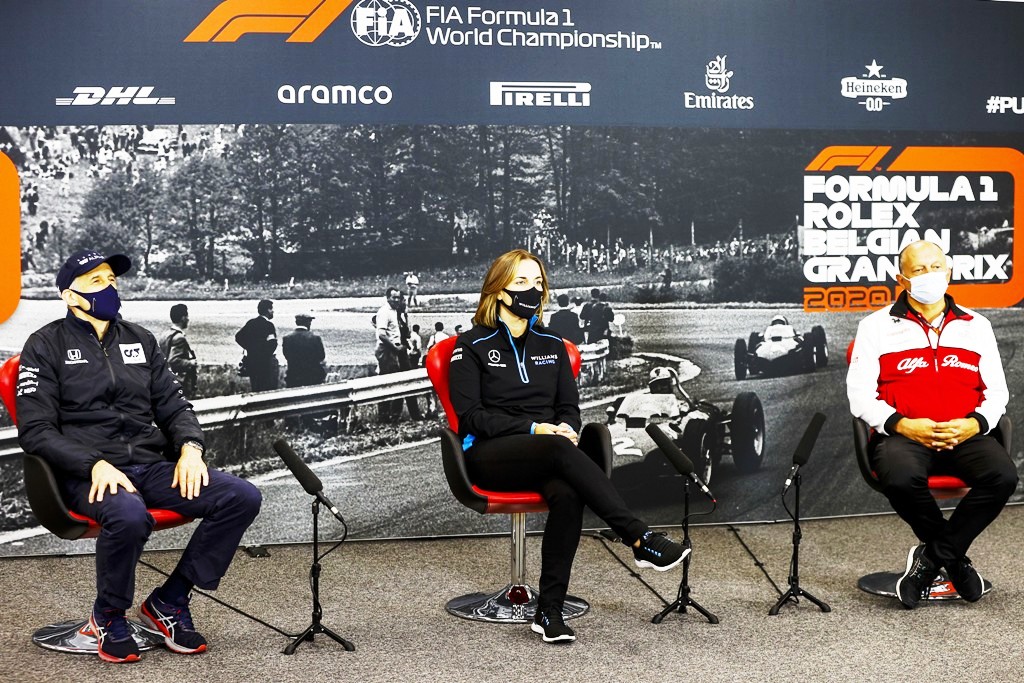
TEAM REPRESENTATIVES – Franz TOST (AlphaTauri), Claire WILLIAMS (Williams), Frédéric VASSEUR (Alfa Romeo)
Q: Claire, following the sale of the team to Dorilton Capital, what can you tell us about the new owners and the structure of the team going forward?
Claire WILLIAMS: First of all, I think it’s important to say that we are delighted that we have managed to secure this outcome of the strategic review process. In this kind of financial environment, it’s never easy to undertake these transactions but we are very happy at Williams that we have managed to secure new owners, but also owners that we know are hugely passionate about this sport and also about Williams. They have very clear ambitions for where they want to see this team and they are prepared to put that investment into the team in order to do that. For the moment, it’s business as usual, nothing changes in the here and now, and we’re looking forward to going racing this weekend.
Q: And Claire, knowing how passionate you are about your team, how difficult has it been for you to sell these shares?
CW: I won’t be lying if I said it hasn’t been emotional over the past few months, but it has been a few months so we have all managed to get our heads around it and this can only be a good things for Williams. We have always in our family put this team first. It’s always been at the heart of the Williams family. We’ve put our people first and we’ve put the success and the future of our team first in making any kind of decisions in what we do. So this was almost, I suppose, a no-brainer for us. The team needed the investment and the team now has a really bright future under its new owners. I think most importantly for the fans out there, you will still see the Williams name racing in Formula 1.
Q: Thank you Claire. Fréd, coming to you next. A frustrating morning for Antonio Giovinazzi. What can you tell us about his issues?
Frédéric VASSEUR: Ah, he had a water leak on the engine side. It’s a shame because he was not able to do a single lap today. Let’s see what happens with the weather also, because it’s a big shame if he is not able to do some laps with slicks before the quali. But it is what it is.
Q: Can I ask you about the new Concorde Agreement. How pleased are you with the new deal and what kind of opportunities does it present for a team like Alfa Romeo?
FV: I think it’s not just for Alfa Romeo or for another team. It’s good for Formula 1, it’s a good step forward for the championship. The sustainability of the small teams it’s probably also an important topic for the big teams. They have to avoid just being focused on themselves. At the end of the day we have to have a complete grid of 20 cars and we have to be sustainable. I think it is a good step forward in the right direction. I think that everybody would like to get a bit more here or there, but at the end of the day it’s a good compromise.
Q: We had Kimi in the press conference yesterday and he spoke about his future, saying that he has yet to decide whether he wants to continue in Formula 1. If he wants to continue, will you have him?
FV: I think the most important thing is the motivation, the motivation on the driver’s side first, because I think it’s difficult for Kimi to struggle with the pace when we are at the back. Now that we did a good weekend last weekend in Barcelona, the pace was much better. This morning was also much better and we have to continue to improve and to do small step by small step and to be back into the fight. This is the most important thing but not just for Kimi, but everybody in the team. The main motivation in a racing team is coming from the results and nothing else, from the drivers to the mechanics, to the engineers, to myself and we need to get results.
Q: Are you impressed with the job Kimi has done for you this year?
FV: Yeah, yeah! Honestly, Kimi is far from being the biggest issue! He’s doing a good job. We saw last week in Barcelona that the pace is there, this morning again – he is in front of the two Ferraris. It is a good reference for us. Let’s see what happens tomorrow and Sunday and we have to continue to push and to get the last tenth on every single topic and I think that Kimi is pleased when we have this kind of motivation.
Q: Franz, let’s start with the Concorde Agreement if we could. It’s the final part of the puzzle that’s hoped to level the playing field in Formula 1. Are you confident that it’s going to do that?
Franz TOST: Yes. I must say that we are really satisfied that the Concorde Agreement is signed now. Good job done by the teams and also the FOM and the FIA, because it was not so easy. It was long negotiations. We from the midfield teams, especially AlphaTauri, now are really happy that this Concorde Agreement is signed because the money distribution is much better nowadays than it was in the past and I think in combination with the cost cap and the much fairer money distribution the field will come much closer together, which should guarantee interesting races.
Q: Thanks. Now a question about Yuki Tsunoda. Have you been impressed by what he is doing in Formula 2 this year and are we likely to see him in an AlphaTauri any time soon?
FT: I’m not only impressed with his driving in Formula 2, I was impressed with him last year in Formula 3 as well and the years before. He is a high-skilled driver and he has all the ingredients together to become a successful Formula 1 driver. For sure, he will test for us in Abu Dhabi at the young driver test. Whether he will drive for us next year or not, this is being decided by Red Bull and it depends also whether he gets a Superlicence. If he continues like now then he will be within the first three or four drivers in the Formula 2 championship and it shouldn’t be a problem to receive the Superlicence and the rest then we will see.
Q: (Christian Nimmervoll – Motorsport.com) Claire, Dorilton Capital made the transaction through an investment vehicle that is called BCE Ltd, that is coincidentally the initials of Bernard Charles Ecclestone. Can you just clarify if there is any connection or any link in this deal with Bernie, if he’s involved in it in any way? And also, can you comment on if you’re going to be team principal beyond this season?
CW: Yeah, I saw this. I spoke to Mr Ecclestone earlier in the week and I did ask him if it was him behind it. That a joke, by the way. Bernie has nothing to do with our new ownership. Dorilton Capital is completely independent. Bernie is not the new owner of Williams and, as I said earlier to Tom, I am in my role, I’m here, I’m doing my job, I’m actually deputy team principal, not team principal. My father is team principal still and it is business as usual.
Q: (Luke Smith – Autosport) Another question to Claire: I think it has been quite a momentous couple of weeks for Williams in terms of everything that’s happened with the sale, with the Concorde Agreement, and also the clarification regarding car copying, which you said was the reason for withdrawing the appeal. How much brighter do things look for the team now, moving forward? How much more confident and excited are you about the team’s future, even compared to, say, a month ago?
CW: Yeah, that was… the whole purpose behind this strategic review process was in order to secure this team’s future. It has been an incredibly difficult few years for us for a number of reasons, both on track and off track. I think we have done an extraordinary job keeping the team going in what has been a very difficult financial environment for it and this is the dawn of a new era for our team. We have secured the investment that was the whole purpose of this strategic review process. We have great new owners who are willing to put the money in that’s required in order to take this team forward and so couple that with the new Concorde Agreement that kicks off in 2021 I think Williams can really start to start moving further forward up the grid and making some good progress and that’s all we want to see.
Q: (Adam Cooper – Motorsport.com) Claire, in the sale announcement you said that Dorilton are ‘people who understand the sport and what it takes to be successful. Can you expand please, on what sort of knowledge they have of Formula 1?
CW: As I said, the Williams family have always put this team first and we wanted to make sure that we would be able to find new owners for it that did understand this sport. I can’t go into a whole lot of detail as to the people behind Dorilton. That will become clearer over the… we will be able to make that clearer over the coming weeks and months but they’ve done a huge amount of due diligence since the start of this process. They were in the process from the beginning, they have spent an awful lot of time behind the scenes going through everything that you would expect them to go through to understand our team but also to understand the sport. They have some very strong advisors as well, who have been helping them through this process to build their knowledge and of course there’s still going to be a learning process for them but they are already within the team, they’re working on Grove with our team there currently in order to understand what’s required moving forward. So I have absolute confidence that they are the right people to take this team forward.
Q: (Dieter Rencken – Racing Lines) Franz, I wonder if you could clarify whether AlphaTauri, Toro Rosso or Red Bull have recently sold any of your older cars and if so, how many and why?
FT: (Chuckles) We have sold one, two, three or four older cars. One or two are being raced, as far as I know, from some gentlemen drivers. We just sold them because we have many of them; every year we build around four cars and the philosophy from AlphaTauri is that we keep one car and the other three cars, if there are customers, if there are people interested in buying them, they can have them. If you want to have a car, please come with the money and you will get them, no problem!
FV: The same for me.
Q: (Ben Hunt – The Sun) Sorry, just another question for Claire: I just wondered what’s stopping you from explaining more about… you said it will all become clear but what is the reason why we’re not finding out more about them now? Secondly, I just wanted to know, with reference to a question which was put to you earlier on. Remaining as deputy team principal or even Frank remaining in control, was that part of any of the negotiating when the sale went through?
CW: I think, Ben, your question about Dorilton… I’m not sure what more we can reveal about them. They are a US-based investment firm. Their chairman is a gentleman called Matthew Savage. Their CEO is another gentlemen called Darren Fultz. They own a number of different businesses. They’ve been in operation since 2009. They have 60 businesses under management; within that portfolio there’s a broad spectrum of industries across which they work and obviously they haven’t been in motor sports before and they are very excited about this opportunity. I’m not sure that there’s much more that we can explain about who Dorilton actually are and I’m sure you’re going to be seeing them at a race track soon. And I think the second question as about my role, Frank’s role. This is very early days, obviously, and for the moment though, it is business as usual. I’m here in my capacity that… I was running the team in Barcelona and the races prior to that and that will continue to be the case.
Q: (Andrew Benson – BBC) Can I ask about the future of Mike O’Driscoll as well?
CW: Exactly the same: it is business as usual.
Q: (Joe Saward – Autoweek) Claire, along the same subject, I’m afraid. On their website, Dorilton say that they are a family office, in effect they are spending the money for a family, so the people you’ve mentioned are just managers of the fund, not the actual money. Can you confirm that’s the case?
CW: I can confirm that’s the case, yes Joe.
Q: (Abhishek Takle – Mid-Day) Claire, could you talk a little bit about how contact with Dorilton was initiated, once you started the process and were there ever any other parties, be they investors or potential buyers, involved?
CW: As I think I talked about, over the duration of this process, which started back in April/May time, we had a number – a considerable number of interested parties in the team who we talked with throughout the process, over the past few months. We were very happy with the level of interest that we received and I think that is also a great barometer for the health of our sport, as well, that there is interest in our teams and our sport as a whole. I think that clearly the new regulations are helping that. Dorilton approached us, initially, and I think in fact all of the bidders that we were talking to made the approach to us, versus us going out to the market, making those approaches.
Q: Franz, this race marks the anniversary of Pierre Gasly’s return to the team. How has he developed over the last 12 months?
FT: No, I must say it’s exactly one year ago when Pierre came back to us. I remember when he came the first time to the factory, I said to him, hey, it looks like you were here yesterday, because we were so familiar together and he knew his engineer quite well, his mechanics, he felt familiar from the very beginning onwards. And fortunately our car last year was also quite competitive and therefore he immediately got some results, some good results and of course the highlight was the second place in Sao Paulo and he made really good progress during the last year, but also this year you can see that he gets more and more self-confident and I am also convinced that he will show very good races the rest of the season.
Q: (Adam Cooper – Motorsport.com) To all of you: Formula 1 has confirmed that the second Bahrain race will run on the outer circuit with qualifying times of less than 55 seconds. What are your thoughts on that and have your guys looked at it in detail or done any simulations yet?
FV: Yeah, we didn’t do any simulations yet but for sure with 55 seconds per lap it will be a big mess on that traffic on the qualifying laps and it will be nightmare but I think it’s exciting to have different layouts of the tracks when we have a double event like this, that it makes sense to do something a bit different and the advantage with Bahrain is that you have at least three configurations for the layout of the track. It makes sense, it will be a bit different to the first one. Let’s see.
CW: Yeah, I share Fred’s views. Firstly, I think that Formula 1 have done a fantastic job to try and get so many races on the calendar and to allow the teams or to facilitate the teams to be able to race in the same location twice obviously helps with a load of logistic issues that we’re facing at the moment with all these triple headers. But from what I hear, this new track layout is going to be incredibly fast which is going to make it interesting but clearly it has only just been announced, we haven’t started doing any simulation work but I’m sure everybody is going to be jumping on that as quickly as possible.
FT: There’s not much to add. You know we haven’t yet started the simulation work but it will become… especially in the qualifying, from the traffic, maybe a little bit chaotic but entertaining, we will see, and in the race then we will see how it is with overtaking because all the cars are very close together and then we will see how good the top cars and are how many times they will overlap everyone.
Q: (Christian Nimmervoll – Motorsport.com) Claire, now that the transaction is completed, we basically know that Dorilton Capital is a shareholder in Williams, we know about some shares that are at Frankfurt stock exchange in pre-float; are there any other shareholders remaining? What about, for example, Brad Hollinger, Toto Wolff? And following up on Joe’s earlier question, who is the family behind Dorilton Capital?
CW: No, so Dorilton Capital has bought the full shareholding of Williams, so they are 100% owners and I have no comment to make on your second question I’m afraid, Christian.
Q: (Edd Straw – The Race) Claire, obviously with the new Concorde having been signed which is a good direction forward for F1, is it a little bit frustrating almost…because obviously the situation has seen the family having to sell it is partly connected to the terms of the last round of commercial agreements, seven years ago, so is it a little bit frustrating that you couldn’t take is a little bit further under family ownership because of that difficult period under those commercial terms, because obviously it could be quite a good sustainable going concern under the cost cap and the new Concorde etc?
CW: Yeah, I think… and I read your article that wrote about Williams’ decline over the past 10 years, it may have dated back earlier and I think you probably hit the nail on the head. I don’t think the new Concorde Agreement helped our team and I’m sure it didn’t help a number of other teams either, just purely based on the financial disparity I suppose, between the prize fund distribution and clearly we’ve been able to work with Formula 1 in order to restore greater balance, I think. Whether it’s frustrating, it is what it is, I think. I personally am really pleased that the Concorde Agreement and most importantly the financial regulations that are coming through with the cost cap and the redistribution of that prize fund money, are going to make it a lot fairer playing field for teams like ours and whether the Williams family own it or not, that doesn’t matter. This new Concorde Agreement certainly puts our team in a much better place moving forward and that’s the only thing that matters.
Q: (Dieter Rencken – Racing Lines) To all three: how much did the fact that there’s an annual flexibility in the Concorde Agreement make it easier for yourselves or your team owners to sign up to the Concorde?
FV: Yeah, but as we said before, this kind of agreement, with ten teams around the table, the FIA and FOM, it’s never easy to sign. I think everybody did compromise and finally I think we found a deal with a good step forward for everybody and OK, we always want to get more and every single team would like to get a different position but at the end I think it’s a very good step forward for us and when I say us, it’s everybody around the table and it is like it is.
CW: I didn’t actually understand Dieter’s question. I echo what Fred said.
Q: (Dieter Rencken – Racing Lines): Claire, basically the question was… there’s this annual flexibility built in there so it’s not really a five-year commitment. How much easier did it make to sign the Concorde Agreement under those circumstances?
CW: Yeah, I think the most important thing is that the Concorde Agreement is signed and the terms within that across the various different elements are what we wanted to see so I’m very comfortable with that.
FT: I must say that all the negotiations for this new Concorde Agreement were much more transparent than in the years before. I must also say that the top teams, at the end, agreed to lose some money because it’s not so easy for them. We must not forget that they have built up a fantastic infrastructure the last years and they will also lose some people and I think in the sense that for the future of Formula One all the teams were sitting together, negotiating together which was not always the case in the past and therefore I think we now have a really good basis for the future of Formula 1.
Q: (Abhishek Takle – Mid-Day) Claire, but I just had a clarification on your business as usual comment. Obviously it’s business as usual in terms of the management structure of the team but will it be business as usual for the foreseeable future? Is that how you see it as well?
CW: Look, you’re asking the same question that everyone else keeps asking me and my answer remains: it is business as usual for the time being and that’s all I can really say.
Q: (Mario Luini – Revue Automobil) Fred, do you know have a better idea of the problems with the C39 and how soon can you correct them?
FV: I’m not sure that we have a big problem with the car. If you have a look, I’m sure we have a lack of performance compared to last year but it’s never coming from one single thing, it’s coming from different areas and step by step we are improving, we are trying to sort it out and we are doing good steps. If you have a look, last week we were P13, we are one position in front compared to the year before in Barcelona and this morning we were also in good shape. We have to stop fantasising about things like this. The most important is to stay focused and to try to catch up tenth after tenth in every single area with the performance and I think the team is dedicated too.