Your basket is currently empty!
Tag: Brembo
-
Brembo explains the breaking points of the 2019 Formula 1 German GP
An in-depth look at the braking systems on the Formula 1 single-seaters at Hockenheimring
Hockenheimring will host the eleventh race of the 2019 Formula 1 World Championship season from July 26 to 28.
The track in use since 2002 is very different from the original used by the Formula 1 single-seaters since 1970, given that chicanes were added and modified throughout the years.
Yet, the current layout still includes the Motodrom section featuring every type of turn possible: The Spitzkehre hairpin turn (turn 6), fast corners (turn 7) taken at full-throttle, and other corners where brake use is at mid-level.
Hockenheimring is a track that puts the power-units to the test, but the brakes benefit from long straightaways that help them cool down after the intense work in the first two-thirds of the circuit.
But if it rains, the opposite problem could occur where the carbon braking system (discs and pads) doesn’t reach its optimal operating temperature. In this case, the drivers don’t have all of the friction they need to brake.
According to Brembo technicians who have classified the 21 World Champion tracks, Hockenheimring falls into the category of circuits that present a high-level of difficulty on the brakes. On a scale of 1 to 5, it earned a 4 on the difficulty index.
The demand on the brakes during the GP
On average, the Formula 1 drivers use their brakes on a single lap for just over 11 seconds and a half, a value that is a second lower than that of the Canadian GP.
However, the German track is longer by 213 meters (699 feet) than the track in Montreal and the cars’ average lap speed is faster. The braking systems are engaged for 16% of the race, the exact same percentage registered at the Australian GP and the Russian GP, but these races are very different in terms of the number and intensity of braking.
The average peak deceleration is 4.6 G overall, despite the first three braking sections never going below 5.2 G. From the start of the race to the checkered flag, the amount of energy dissipated by each single-seater is over 237 kWh.
Summing up the load applied to the brake pedal from the start to the finish, each driver experiences a force of 49 tons (108,027 lbs).
The most demanding braking sections
Less than a third of the 17 turns on Hockenheimring require brake use: four are classified as demanding on the brakes and one is light.
The most challenging braking section is at turn 6 because the cars slow down from 329 km/h (204 mph) to 65 km/h (40 mph) in a mere 2.9 seconds.
The drivers are subjected to a deceleration of 5.7 G as they apply a load measuring 214 kg (472 lbs) on the brake pedal and travel 129 meters (423 feet).
The drop in speed is less decided at turn 2: From 320 km/h (199 mph) to 103 km/h (64 mph) in just 2.66 seconds, which translated into very hard braking.
The deceleration is slightly lower (5.2 G) at this turn, but the load on the brake pedal reaches 178 kg (392 lbs).
These characteristics make this turn one of the favorites for any driver looking to pass a competitor.
It’s also worth mentioning the braking done on turn 8: From 303 km/h (188 mph) to 109 km/h (68 mph) traveling 110 meters (361 feet) in 2.22 seconds and applying a load of 155 kg (342 lbs) on the pedal.
Brembo performance
Cars with Brembo brakes have won 21 editions of the German GP. Five teams have won here at least once, including Ferrari in 1977 with NikiLauda.
This was the first victory Ferrari secured with Brembo brakes, it then went on to win 11 other races. Only one of these victories by the single-seaters from Maranello took place at Nürburgring.
Michael Schumacher on the other hand, won four times on this track, every single time with Brembo brakes.
-
An in-depth look at the braking systems in Formula 1 at the Red Bull Ring: A Brembo view
The 2019 Formula 1 Austrian GP according to Brembo
The Formula 1 stay in the heart of Europe for the 9th event of the 2019 World Championship. The theater for the Austrian GP is the Red Bull Ring, inaugurated in May 2011 and situated near Spielberg, in Styria.

Image by Brembo Although being more or less the same length as the Budapest and Montreal circuits (all 4.3 km, 2.67 miles give or take ten meters) the Austrian circuit is the only one in the World Championship where a lap takes less than 65 seconds.
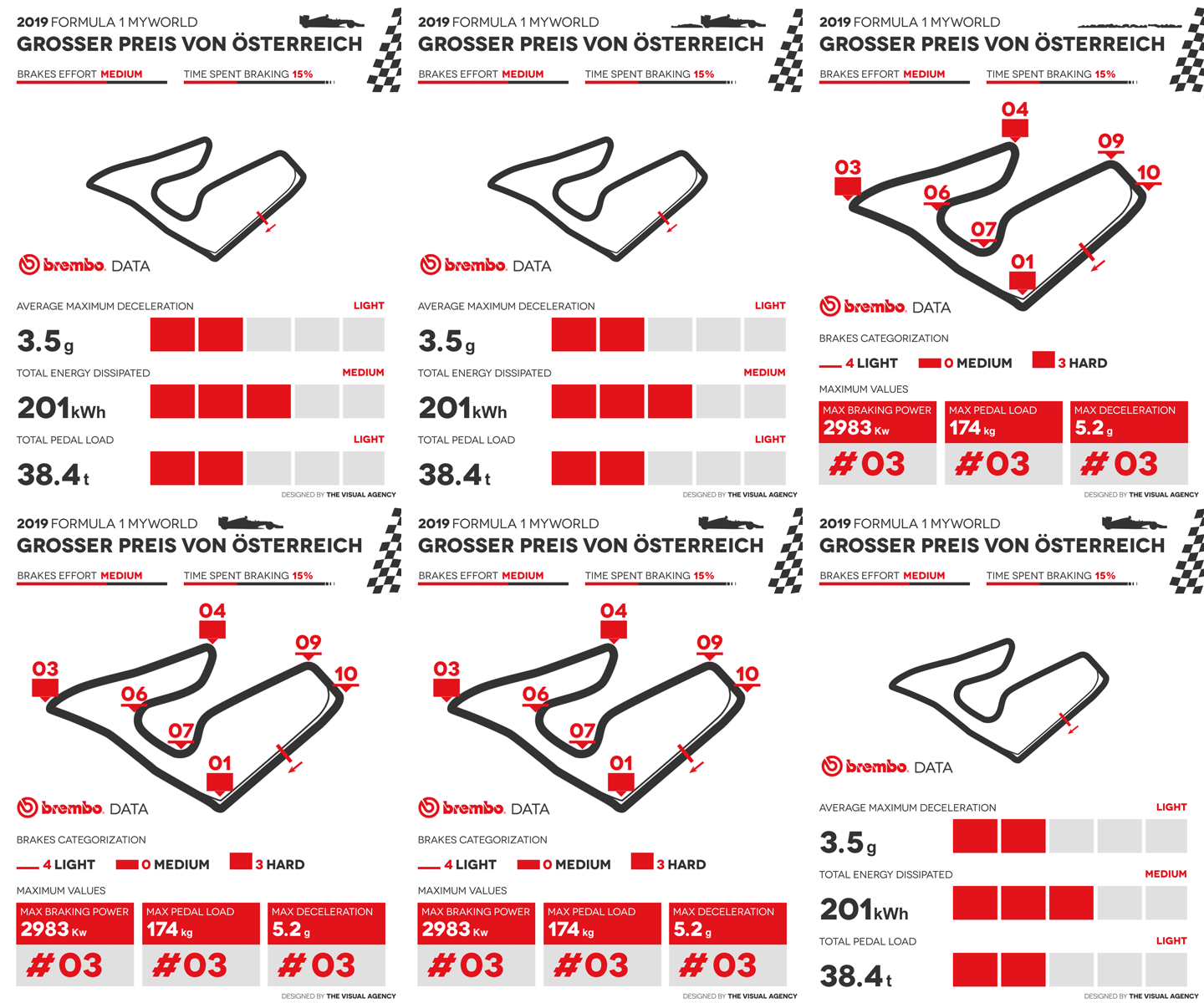
This is thanks to the high speeds achieved but also to the small number of bends, only 3 of which require the use of brakes for more than one second. The many undulations of the track complicate the drivers’ choice of timing braking: from the highest to the lowest point there is in fact a 65 meters (213 feet) difference in level.
According to Brembo technicians, who have classified the 21 World Championship tracks, the Red Bull Ring falls into the category of circuits presenting medium difficulty for the brakes. On a scale of 1 to 5, it earned a 3 on the difficulty index.
The demand on the brakes during the GP
During each lap brakes are used 7 times, for less than ten seconds in total, 8 tenths less than on the Monza track. From start to the checkered flag, braked are in action for a total of 11 and a half minutes, equal to 15 per cent of the whole race.
Brakes are used even less in the second half of the track, from the Rauch curve (turn 6) onwards: if in fact in the first half drivers use the brakes for 6 and a half seconds, in the second part they use them for about 3 seconds.
The maximum deceleration is also affected by this variation: from an average of 5.2 G in the first section to 2.3 G in the next. Consequently the average track deceleration is 3.5 G.
The energy dissipated during braking in the whole GP from each single-seater is quite limited: 201 kWh.
During the whole race, a driver uses his brakes a little less than 500 times, exerting a total load of 38.5 tons on the brake pedal.
The most demanding braking sections
Of the 7 Red Bull Ring braking points 3 are classified as hard on the brakes and 4 are light.
The most challenging for the braking system is the Remus bend (turn 3): the single-seaters approach at 328 km/h (204 mph) and in 2.59 seconds they decrease to 84 km/h (52 mph). To manage this, drivers must exert a pressure of 174 kg (384 lbs) on the braking pedals, and decelerate by 5.2 G. With the brake pressed the vehicles travel for 127 meters (417 feet).
Drivers are subjected to a 5.2 G deceleration also on Schlossgold bend (turn 4) thanks to the 331 km/h (206 mph) that they reach on the preceding straight. The entrance speed on the bend is higher to the Remus bend: in the first one the single-seaters enter the bend at 120 km/h (75 mph). This last one requires the use of brakes for 2.57 seconds and pedal load of “only” 171 kg (377 lbs).
Brembo performance
Single-seaters with Brembo brakes have won all the last 7 Austrian GPs.
This is one of the few tracks in the world where Sebastian Vettel has not yet triumphed. Spielberg’s last Ferrari victory dates back to 2003 when the circuit was called A1-Ring.
Find the Brembo Animated Infographic here
ends