Your basket is currently empty!
Blog
-
Gaurav Gill sets the pace to take lead in RC2 class: Kennards Hire Rally Australia

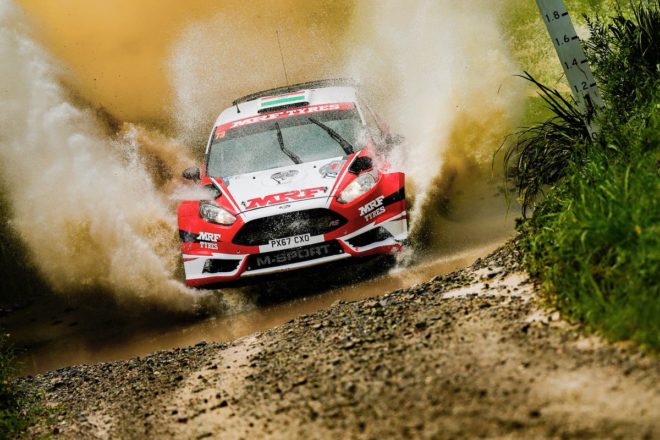
Gaurav Gill in action on Friday in Kennards Rally Australia. Photo: MRF Racing Coffs Harbour, 16 November 2018: Winning six of the day’s eight Special Stages, India’s Gaurav Gill and his Australia co-driver Glenn Macneall of MRF Tyres took a healthy lead of 33.6 seconds to top the RC2 (WRC2) class in the Kennards Hire Rally Australia, the concluding round of the 2018 FIA World Rally Championship, here on Friday.
Building on the hot pace he had shown in Thursday’s shakedown which he topped in the RC2 class, Gill enjoyed a fruitful outing today as he gradually shifted gears to end the day on a high to be placed 11th Overall, just behind the WRC cars!
Gill, driving the M-Sport prepared Ford Fiesta R5, finished the day with a combined time of 58mins, 32.7secs, while Alberto Heller from Chile and his Argentine co-driver Jose Dias, also in a Ford Fiesta R5, were second with 59:06.3 as the cars headed into the final service of the day.
The Rally continues on Saturday, the longest day of the three-day event, when 10 more Special Stages over 133 Kms will be run.
Gill during Shakedown. Photo: MRF Racing During Thursday’s Shakedown, Gill was the fastest in 03:08.0 which he clocked on his third attempt, improving five seconds overall during the session. “We had a couple of good runs in the car and the MRF Tyres worked well on this short stage.” Gill said. “Tomorrow looks like it will be dry so the work here today will be very important. The stages tomorrow will be tough and this is my first visit to the Coffs Harbour stages.”
Following the morning’s shakedown, thousands of people packed into the centre of Coffs Harbour for the ceremonial start and autograph sessions.
While Gill has never rallied in the Coffs Harbour region before, his success in the Asia Pacific Rally Championship, combined with Macneall being on home ground meant that the MRF Tyres Ford Fiesta R5 was popular with the fans.
“It was great to see so many people out here for the start of Rally Australia,” Gill said. “I have had a lot of success in previous rallies I have done in Australia and I am looking forward to rallying in front of the Australian fans again.”
-
Jamie Chadwick sets the pace in MRF Challenge
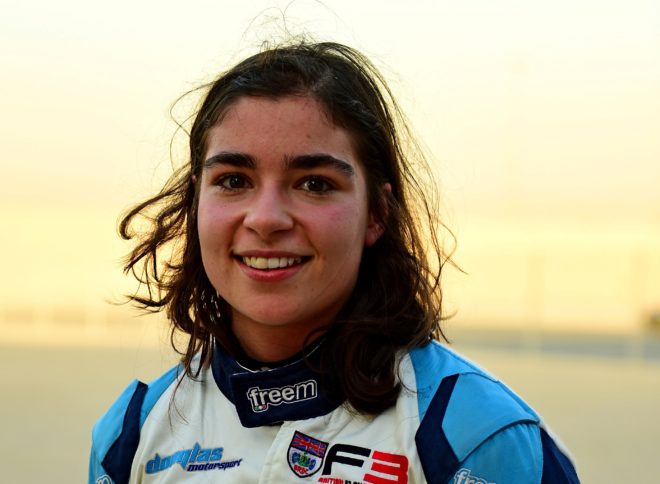
Jamie Chadwick, who topped the free practice sessions on Thursday . Photo: Aditya Bedre. Dubai, 15 Nov 2018: Jamie Chadwick, the only female driver on the 12-car grid, put the marker down for the first round of the MRF Challenge championship by topping both the Free Practice sessions at the Dubai Autodrome, here on Thursday.
Chadwick, 20, from Bath, England, came out on top in the two, 30-minute practice sessions, clocking a best of one minute, 59.218 in the first outing and 01:59.774 in the next around the 5.390 Kms circuit as she made her debut in the MRF Challenge on a high. She survived a tough battle with Czech Republic’s 16-year old Petr Ptaceck who was second fastest in both the sessions, clocking 01:59.581 (FP1)and 01:59.918 (FP2).
Jamie Chadwick. Photo: Aditya Bedre Chadwick, who created history in 2015 when she became the first female and youngest winner of the British GT Championship, and Ptacek exchanged fastest laps in the closing minutes of FP-2. However, Chadwick went quicker on last flying lap to top the time charts. Less than a second separated the top eight drivers.
“I learnt a lot today – new circuit, new car. I am happy with the way we ended up today in these conditions and I look forward to the races,” said Chadwick.
In the first free practice session this morning, one second covered 10 of the 12 drivers, promising a close contest over the five races scheduled for the first round of the championship.
Chadwick recorded her fastest lap of the session on her 14th and final lap as did the rest who all went quicker through the 30-minute practice. The top four, Chadwick, Ptacek, Defourny and Young, all posted sub-two-minute laps.
For the lone Indian entry, Chetan Korada, 32, from Chennai, it was his first run at the Dubai Autodrome and he focused more on learning the tricky track with its blind crests leading into corners.
Korada, who was 11th on the time sheets in both the sessions clocking his best laps of 02: 03.734 and 02:04.100, said: “It was my first run on this track and so, it was more about learning the circuit. However, with each lap, I managed to cut my timing. Overall, it was a reasonably good outing, all things considered. I hope to improve as we go along over the next couple of days.”
The results (Free Practice):
FP-1: 1. Jamie Chadwick (UK) (01min, 59.218secs); 2. Petr Ptacek (Czech Republic) (01:59.581); 3. Max Defourny (Belgium) (01:59.656); 4. Dylan Young (Australia) (01:59.697).
FP-2: 1. Jamie Chadwick (UK) (01:59.774); 2. Petr Ptacek (Czech Republic) (01:59.918); 3. Danial Frost (Singapore) (02:00.115); 4. Andreas Estner (Germany) (02:00.276).
-
What is Formula One H2O?
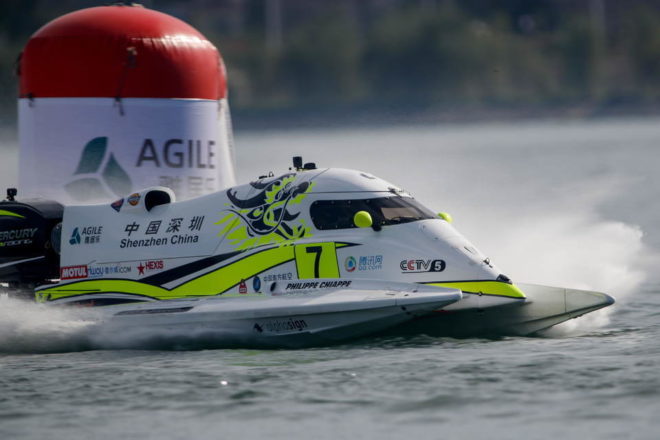
The UIM F1H2O World Championship is the ‘flagship’ international series of single-seater inshore circuit powerboat racing.
Highly competitive, intensely challenging, risky and entertaining, the F1H2O World Championship is the ultimate adrenalin rush and regarded as one of the most spectacular and exciting sports in the world.
The series attracts up to 20 of the world’s leading drivers and is a sport that has to be seen to be believed as these diminutive tunnel-hull catamarans enter hairpin turns at over 90mph and top 140mph on the straights.
Picture the scene; 18 to 20 sleek, powerful and lightweight catamarans lining up on the start pontoon. Inside each cockpit sits a lone individual peering through a tiny windscreen. One hand grasps the steering wheel, the other poised over the start button. The tension inside the cockpit is intense as the drivers wait for the crucial start. Beyond the cockpit, an eerie silence descends over the entire arena, all attention fixed on the start.
No sooner does the wait end when 10,000hp of highly tuned brute power bursts into life sending the fleet screaming towards the first corner leaving nothing but a glorious fountain of white spray in its wake.
Now in its 35th year the four decades of the World Championship have witnessed considerable change and evolution; the seventies and eighties saw multiple promoters and two giant corporations of the sport OMC and Mercury vying for supremacy to be the pinnacle of the sport.
OMC were touting their 3.5litre V8 package that became known as the OZ class, Mercury pushing their 2.0litre engine and called the ON class, the disparity in power would soon lead to bitter wrangling and infighting amongst competitors.
The split came in 1981, FONDA was formed running the ON class engine with the OMC backed PRO ONE run series running the OZ class engine, both rival championships claiming the right to use the title World Championship, a dispute settled by the sport’s governing body the UIM later that year awarding the OZ class the accolade.
1984 saw the beginning of yet another twist as safety became a major concern with engine development and increasing power of the V8s taking its tragic toll and signaled the slow demise of the OZ class internationally, ending in 1986.
The door was now opening for the existing FONDA World Grand Prix series to reinvent itself. From 1987 to 1989 there was no official UIM World Championship, and with no challenger, the UIM reinstated the World Championship status and in 1990 the FONDA World Grand Prix Series became the UIM F1H2O World Championship, Mercury’s 2.0litre engine the preferred power-plant of the time, the Mercury 2.5litre engine coming in in 2000 and used today.
Over the last 34 years the sport has played out 273 Grand Prix in 32 countries across five continents, 13 drivers have captured the World title, 47 becoming members of the illustrious Grand Prix winners club.
Of the 13 World Champions seven are multiple title winners; Italy’s Guido Cappellini is the most decorated winning 10, Italy’s Alex Carella and American Scott Gillman with four, France’s Philippe Chiappe and Italy’s Renato Molinari with three each, Finland’s Sami Selio and Wales’ Jonathan Jones with two apiece.
While today’s F1H2O catamarans bear a striking resemblance to those in action throughout the 1980’s there is a world of difference in terms of driver protection and general safety.
The early boats were constructed from thin plywood with drivers sitting in an open, exposed cockpit with the risk of injury a high probability in the case of an accident.
With safety at the forefront of boat development, British designer and racer Chris Hodges set about improving the situation and constructed a safety cell that was produced from an immensely strong composite material.
Instead of the cockpit being part of the main structure Hodges’ capsule was separate and was fitted to the hulls and centre section. For the first time drivers were actually strapped into their seats. The idea was that if a boat was involved in an accident, the timber hulls could break up and absorb the impact forces while the driver remained well protected inside his cell.
In the late 1990’s further developments saw the introduction of an airbag in the cockpit that would inflate in a crash to ensure the capsule wouldn’t sink before rescue crews could attend.
Over the years boat construction has been developed and today few if any are built of timber, now replaced by modern composites.
In 2018 nine teams and 19 drivers from 12 countries will compete at Grand Prix in Europe, the Middle East and Asia for the coveted World title, the prestigious number 1 plate will be carried by the defending four-time World Champion, Alex Carella.
-
F1H2O Powerboat racing World Championship returns to India
Powerboat World Championship returns to India after 14 years. File photo courtesy F1H2O Amaravathi (AP), 13 Nov 2018: Team Abu Dhabi is very much in control of proceedings as the championship heads into the business end of the season, kick-starting the crucial three-race run in to year-end and title honours with the Grand Prix of India, Amaravati on 16-18 November, round 5 of the UIM F1H2O World Championship – the penultimate and final rounds taking place in Abu Dhabi and Sharjah in December.
After 14 years and 99 Grand Prix since the first visit to India and Mumbai in 2004 the championship returns, this time to Amaravati and Vijayawada on the banks of the Krishna River in the State of Andhra Pradesh and time is fast running out for any remaining title hopefuls, other than Abu Dhabi’s imperious trio of Thani Al Qemzi, Erik Stark and Shaun Torrente.
The Abu Dhabi triumvirate lockout the top three spots in the title race with Al Qemzi perched on top on 54 points with just two points splitting all three teammates and Abu Dhabi a comfortable 42 points clear at the top in the Teams Championship.
The concern for those in the chasing pack and still in with a shot at the title is that Abu Dhabi has locked out the Grand Prix podium for the last two races; Stark and Torrente each have two poles and two GP wins this season with Al Qemzi picking up three runners-up slots and a fourth. And whilst the inter-team driver vibe is currently very much ‘all for one and one for all’ it may well soon be tested to the limit with all three bidding for a first world crown.
The CTIC F1 Shenzhen China duo of Philippe Chiappe and Peter Morin are the immediate challengers and best placed to mount a challenge, 20 and 24 points off top spot and if either still harbours any title aspirations the fightback must start in India and a win or at least a podium has to be the target to keep in touch.
Chiappe and Morin are the only drivers other than the Abu Dhabi trio to make the podium this season, Chiappe in Portimao and both in London and Chiappe, in particular, needs to rekindle all the elements that delivered him three world titles on the bounce if he is going to carry the fight to Abu Dhabi.
Heading the group of five that currently round out the top ten and split by just six points is Victory Team’s Ahmed Al Hameli who has battled hard for his 15 point tally with two top six slots his best results.
It has not proved an easy season for the Dubai outfit so far, trialling new boats at the beginning of the year and upgrading with two more at the last Grand Prix but with little reward for all the effort, especially for four-time and defending champion Alex Carella whose season and title defence started well with third in qualifying and fourth in the race, but has since derailed with two crashes and no points to show from the last three Grand Prix and is down in 10th place on nine points.
Jonas Andersson in seventh place on 14 points heads to India on great form and on the back of his best race weekend of the season after an excellent third in qualifying and fourth in the race in China last time out. The Team Amaravati lead driver is quick and a real fighter and will be optimistic that he can again seriously challenge Abu Dhabi. Keeping him on his toes and a place and a point behind him is teammate Erik Edin who is enjoying a very solid first full term in the championship delivering strong results in qualifying and a career-best fourth place finish in France.
Emirates Racing’s Marit Stromoy will be itching to get back out on the water and vent her frustrations after power issues in China in both qualifying and the race robbed her of the opportunity to reproduce the form and pace that she showed in practice and move up in the standings. The Norwegian enjoyed a thrilling middle order battle with teammate Bartek Marszalek for the majority of the race before her issues resurfaced and a spin dropped him back to the tenth spot.
Two-time champion Sami Selio and Filip Roms will be desperate for their fortunes to turn around in India after a season to forget so far, the Mad Croc BABA Racing duo blighted with season-long engines issues and Selio failing to get to the chequered flag last time out and rooted in 11th place with just 7 points. Roms did go the distance but a lack of acceleration and power saw him finish outside the points and he languishes in 17th place and is till to post his first points of the year.
F1 Atlantic duo Grant Trask and Duarte Benavente will be looking to bounce back after a double DNF in China, with Cedric Deguisne targeting a points’ finish after missing out in China, with rookie teammate Suttiphan Sookbuangbon making just his second start in the championship.
Both Francesco Cantando and Simone Schuft will have carried out repairs to their boats following a double dose of bad luck in practice in China, Cantando hitting debris out on the circuit and Schuft tipping her boat over, with Cantando heading back to India as the man who won there in 2004.
The race weekend gets underway with a first practice session on the 2.125km 5-pin circuit on the Krishna River on Friday afternoon, with a second session on Saturday morning and followed by BRM Official Qualifying at 15:30hrs [local]. A final practice session takes place on Sunday morning with the UIM F1H2O Grand Prix of India starting at 16:00hrs [local].
2018 UIM F1H2O WORLD CHAMPIONSHIP STANDINGS – after round 4:
- 5 Thani Al Qemzi (uae) 54pts
- 35 Erik Stark (swe/uae*) 53pts
- 6 Shaun Torrente (usa/uae*) 52pts
- 7 Philippe Chiappe (fra) 34pts
- 8 Peter Morin (fra) 30pts
- 3 Ahmed Al Hameli (uae) 15pts
- 14 Jonas Andersson (swe) 14pts
- 15 Erik Edin (swe) 13pts
- 50 Marit Stromoy (nor) 11pts
- 1 Alex Carella (ita/uae*) 9pts
- 11 Sami Selio (fin) 7pts
- 9 Grant Trask (aus) 5pts
- 10 Duarte Benavente (por) 5pts
- 51 Bartek Marszalek (pol) 4pts
- 73 Cedric Deguisne (fra) 3pts
- 37 Francesco Cantando (ita) 3pts
- 12 Filip Roms (fin) 0pts
- 36 Simone Schuft (ger) 0pts
- 70 Mette Brandt Bjerknaes (nor) 0pts
- 74 Suttiphan Sookbuangbon (tha/fra*) 0pts
- 35 Rashed Al Qemzi (uae) 0pts
-
MRF Challenge 2018-19 to be held in Dubai, Bahrain and Chennai
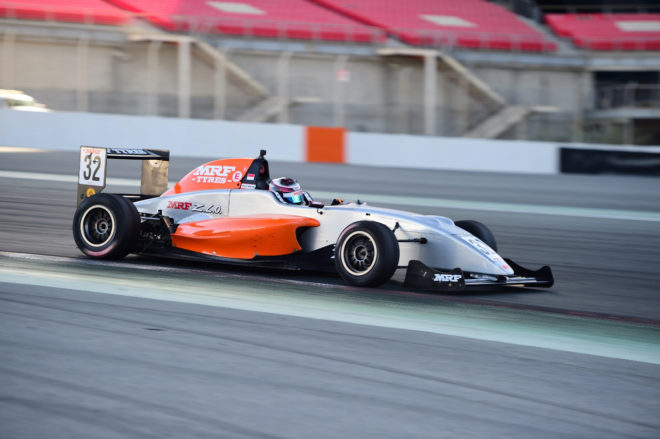
MRF Challenge file photo by Anand Philar/MRF Dubai, 13 Nov 2018: The MRF Challenge, one of Asia’s premier single-seater championships, and an FIA-approved series, is again set to light up the winter season with a clutch of young, exciting talent from Europe and elsewhere in the fray as the seventh edition commences at the Dubai Autodrome here, on Thursday, November 15.
The MRF Challenge 2018-19, organized by the Madras Motor Sports Club, will comprise three rounds, to be run in Dubai (Nov 15-17), Bahrain (Dec 6-8) and Chennai (Feb 8-10, 2019) with a total of 15 races, and offers cars powered by 2-litre engines producing 230 BHP while almost matching Formula 3 in speed and power
Mr. Arun Mammen, Vice-Chairman and Managing Director, MRF Tyres, said: “It has been an exciting journey for us as we present the seventh edition of the MRF Challenge which, among other things, offer young drivers a platform to showcase their racing talent. We provide identical cars to all the drivers and so, the key differentiating factor is the driving ability. It has also been our constant endeavour to develop the car which is now among the fastest single-seaters in Asia. The MRF Challenge also offers us rich data that in turn helps us to develop further the MRF Z.L.O. slicks and wet tyres.
“The positioning of the MRF Challenge in the winter months between November and February also offers an opportunity for drivers across the World to keep themselves race-fit during the off-season. As such, we have had some very exciting talent taking part in the MRF Challenge over the years and it will be no different this time around.”
Mr. J Anand, Managing Director, JA Motorsports, who built the car in technical collaboration with Dallara, said: “We carried out lot of improvements for last year. From the data we collected, we have only refined the aerodynamics package for this season. Apart from that, the car remains the same as last year.”
The MRF F2000 car with Dallara chassis, is powered by a 2-Litre Mountune Duratec engine producing 230 BHP with advanced aerodynamics. The car boasts of a Hewland six-speed sequential gearbox equipped with Integrated dash and paddle-shift system.
Europe is expected to have a strong representation as in the previous seasons of MRF Challenge. Several young hopefuls with exposure to junior Formula racing are likely to participate.
Chennai-based Chetan Korada is the lone Indian in the fray. A regular in the Indian National Championship and one of handful of racers in the World competing with a prosthesis leg, Korada is making his debut in the MRF Challenge. “I have been racing in India for over a decade now and I thought I should step outside to race in higher categories. The MRF Challenge car is far more comfortable in terms of space for leg movement than the F1600 I have been driving in India. My target for MRF Challenge is to be in in front. I am putting in lot of time on the simulator at home, besides daily gym work. So, I feel I am fit and ready for MRF Challenge,” said Korada.
This year’s MRF Challenge grid will have Australian Dylan Young who has been participating in the championship since its inception. Returning for a second season of MRF Challenge is Singapore’s Danial Nielsen Frost along with Belgian Michelangelo Amendola.
-
Hamilton wins as Ocon pulls Verstappen down: Brazilian GP; Mercedes win Constructors’ title
Hamilton wins on Sunday at Interlagos. An FIA image Sao Paulo, 11 Nov 2018: Max Verstappen was denied an almost certain Brazilian Grand Prix victory when he was taken out of the lead in a collision with Racing Point Force India’s Esteban Ocon. The dramatic incident gifted Lewis Hamilton the second career Brazilian Grand Prix victory that helped Mercedes to a fifth consecutive FIA Formula 1 Constructors’ title, with the Abu Dhabi round to spare in the FIA Formula One World Championship.
Though Verstappen called Esteban Ocon `such an Idiot’ in the post-race press conference, both Ocon and his Racing Point Force India team Principal, Szafnauer, defended their action and said that the Force India was much faster at that time and the rules permitted ` unlapping.
Esteban: “It’s disappointing not to score when we had a good pace. I had made some good overtakes throughout the race, but it all came to nothing after the contact with Max [Verstappen]. He came out of the pits, I stayed behind him for nearly two laps but I was much faster than him and the team advised me to unlap myself. I went on the outside at turn one – the same move I made on Fernando [Alonso] and on many others before, but Max didn’t give me any space. Once I was beside him I couldn’t just disappear, so we collided. But it was my corner and I had the right to the space. I was saddened by his behaviour after the race: he was very aggressive and the guys from the FIA had to intervene. That’s not the way to handle these things.”
Otmar Szafnauer, team Principal and CEO said: “Esteban had done a good job making up ground from the back of the grid and would have probably finished in P11 if it hadn’t been for the clash with Verstappen. The rules state that you’re allowed to unlap yourself and Esteban was much faster than Max at that stage. Unfortunately, he wasn’t left any space in the corner and that ruined the race for both.”
Earlier, Verstappen had stormed through from fifth on the grid to put pressure on polesitter and early race leader Hamilton and the Red Bull driver eventually seized the lead from the recently crowned champion on lap 39.
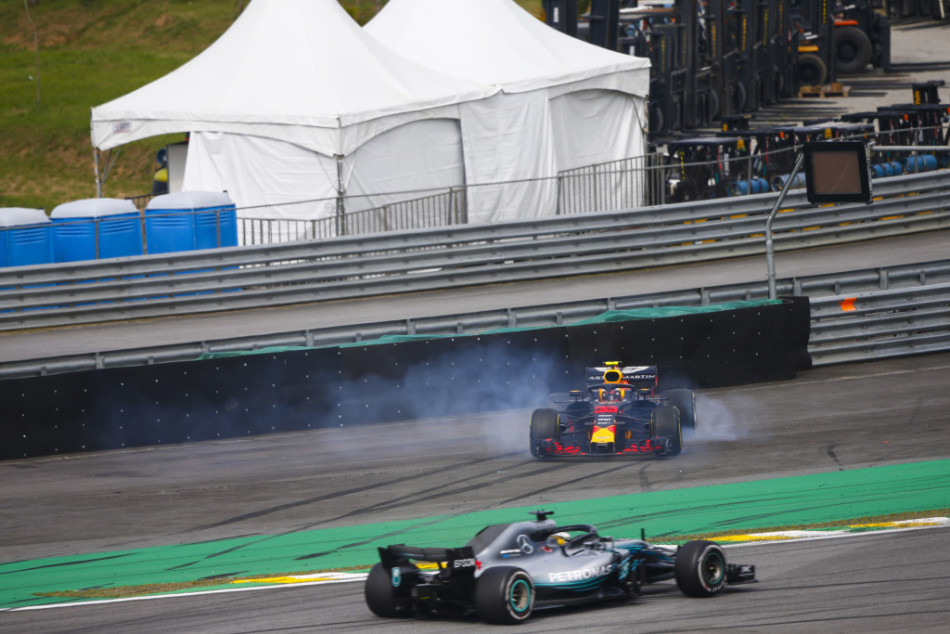
On lap 44, however, Verstappen went to lap 14th-placed Ocon, making a move down the inside of the French driver’s car in Turn 1. Ocon took a wide line but appeared to fight to hold his position, and when Verstappen turned in for the second corner the pair collided.
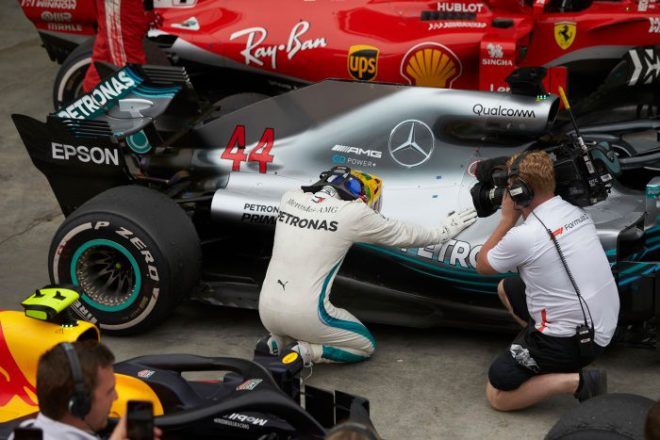
Hamilton kneels down in gratitude after his race win on Sunday. Mercedes Photo by Steve Etherington, Verstappen was pitched into a spin, and as the Dutchman recovered, Hamilton swept past to reclaim the lead. Despite significant floor damage, Verstappen fought back in the closing stages, but he was unable to reel in the Briton and Hamilton took his 10th victory of the season. That, allied to a fifth-place finish for Valtteri Bottas, handed Mercedes an unassailable lead over Ferrari in the Constructors’ Championship.
At the race start, Hamilton held his advantage from pole position to take the lead but a poor getaway by fellow front-row starter Vettel allowed Bottas, starting third, to get past the German through the opening two corners.
Verstappen, starting from fifth, was already beginning to work his way forward. He closed on Kimi Räikkönen and at the start of lap three, he went past the Finn around the outside into Turn 1. Vettel was the Dutchman’s next target and at the start of the next lap he again used DRS to close but this time he opted for a dive down the inside to claim P3.
Behind him, team-mate Daniel Ricciardo was also gaining places, and after passing Haas’ Kevin Magnussen on lap one he quickly began to pick off the cars ahead, rising to P6 on lap seven, ahead of Sauber’s Charles Leclerc.
On lap 10 Verstappen made another move, this time choosing the inside of Turn 1 to dive past Bottas and claim second place. Race leader Hamilton was now just 1.7s ahead.
Bottas was the first of the leaders to pit, the Mercedes man heading in for medium tyres at the end of lap 18. Hamilton then ceded the lead to Verstappen at the end of lap 19, with the Briton also stopping for medium compound rubber. Hamilton emerged in P6 behind Charles Leclerc but by lap 25 he was past the Monegasque and closing on fourth-placed Daniel, who was just under six seconds ahead.
Vettel then pitted at the end of lap 27 and the German also opted for medium tyres before rejoining in ninth place. Freed from behind the Ferrari, Daniel moved up to third and set the fastest lap of the race to that point, a 1:12.919. And when Räikkönen pitted the Australian was promoted to second place behind his team-mate.
The Red Bulls began to pull out a lead from those who have already pitted but Verstappen was unable to build a big enough margin before his own stop, and when he rejoined on lap 35 he was in third place, 3.0s behind Hamilton. Verstappen was armed with newer rubber and greater pace than the champion, however, and as the pair arrowed towards the start-finish line to begin lap 39 he eased past Hamilton.
The Dutchman’s lead wouldn’t last long, however. At the start of lap 44, he went to lap Ocon, making a move down the inside of the Force India. Despite being lapped, Ocon protected his position and tried to deny the pass. Verstappen turned in to take the second corner and the pair collided. Verstappen was sent into a spin and sustained serious floor damage in the incident, while Hamilton was allowed to sweep past into the lead. Ocon was later handed a 10-second stop/go penalty for causing the collision.
Ricciardo, meanwhile, was having his own close calls, twice banging wheels with Vettel as he tried to get past the Ferrari. At the second attempt the Australian won out and he climbed fifth place behind Bottas.
Both Red Bulls began to close on the cars ahead, with Verstappen edging to within two seconds of Hamilton and Ricciardo getting inside DRS range of Räikkönen but neither could make a move stick in the closing stages and after 71 laps Hamilton crossed the line to take the second Brazilian Grand Prix win of his career, ahead of Max, with Räikkönen third ahead of Daniel.
Bottas was left with fifth place ahead of Vettel, while Leclerc finished in a best-of-the-rest seventh place. Grosjean took eighth place for Haas ahead of team-mate Kevin Magnussen and the final point on offer went to Racing Point Force India’s Sergio Pérez.
2018 Formula 1 Brazilian Grand Prix – Race
1 Lewis Hamilton Mercedes –
2 Max Verstappen Red Bull Racing 1.469
3 Kimi Raikkonen Ferrari 4.764
4 Daniel Ricciardo Red Bull Racing 5.193
5 Valtteri Bottas Mercedes 22.943
6 Sebastian Vettel Ferrari 26.997
7 Charles Leclerc Sauber 44.199
8 Romain Grosjean Haas 51.230
9 Kevin Magnussen Haas 52.857
10 Sergio Perez Force India 1 L
11 Brendon Hartley Toro Rosso 1 L
12 Carlos Sainz Renault 1 L
13 Pierre Gasly Toro Rosso 1 L
14 Stoffel Vandoorne McLaren 1 L
15 Esteban Ocon Force India 1 L
16 Sergey Sirotkin Williams 2 L
17 Fernando Alonso McLaren 2 L
18 Lance Stroll Williams 2 L
Nico Hulkenberg Renault
Marcus Ericsson Sauber. -
Max is that go-getter guy and every now and then it bites you: Hamilton
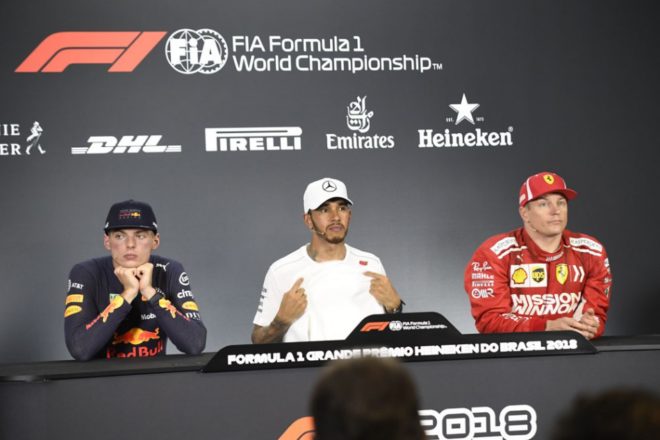
Hamilton at the Press Conference on Sunday. An FIA image Sao Paulo, 11 Nov 2018: Hamilton said that Max Verstappen is a go-getter and sometimes incidents happen that affect you. He was talking at the post-race FIA Press Conference at Interlagos on Sunday. Verstappen who ended up second after he was pulled down by Ocon, who is lapped, also was at the press meet with Kimi Raikkonen, who came third on Sunday.
The track interviews were conducted by the former F1 driver of Force India, Paul Di Resta.
Q: Max, can you tell us what happened?
Max Verstappen: I don’t know what to say, I mean, you do everything well, you go through the field, we had a great car, and then by such an idiot you get taken out while he is being lapped. I have no words.
Q: What a fight it was. I don’t think anyone quite expected that after yesterday. I mean, the moves you were making early on, very bold into Turn 1, pushing your way through and using everything you had.
MV: I think it was better than expected today. The car was working brilliantly today. The team also gave me the right strategy, we could be going quite well on the supersoft, so we did quite a long stint. But, yeah, I don’t know what to say. Still I’m happy with second, but we should have won today.
Q: Yeah, as you say, it was almost back-to-back victories, does it give you confidence going into next year that something is going to come of this machine?
MV: Well, we should have more power, so we’ll be even better.
Q: All the best. Kimi, late pressure from Daniel coming in, but a good race from you?
Kimi Raikkonen: Yeah, it was good. Not easy, but there was some battling, so it was fun. Obviously, we hoped for better but not the easiest.
Q: Ferrari’s tyres choice didn’t look like it worked out in the end, these guys looked very strong at the beginning, certainly Max on the supersoft. Do you think that was wrong?
KR: I don’t know. My tyre was good, but it was difficult to pass and it took too long to pass. You cannot replay on other tyres, so we don’t know.
Q: Lewis, that’s 2018 Constructors’ champion as well. And you can see what that means to Toto Wolff – the barriers have fallen over twice here in Parc Ferme, which is unusual. Lewis, what does that mean to the team?
Lewis Hamilton: Honestly, these guys have worked so hard the last six years and it’s been an incredible journey for them. This is what everyone works for the whole year, you know. Everyone wakes up and goes to work every day and tries to bring the best out of themselves and they really pull together as a unit. I’ve always told you how much of an honour it is to drive for them, and this was the best style we could do it, because we were struggling. We had problems with the engine. Also he passed us like we were a sitting duck at one stage, but obviously they made a mistake and that brought us back into contention. I’m just so proud of everyone. Everyone back home, thank you so much for your continued efforts. For all our partners, for all our sponsors, who without we would not be here, powering along to a win in Brazil. So, God bless you, thank you.
Q: What goes through your mind when you see Verstappen spin? Did you know he was going to be back on a charge and coming strong?
LH: I saw it happen and it wasn’t something that… I wasn’t surprised by it or anything like that. I saw them racing but they weren’t racing for the same position. In my mind, I would have been in a different frame of mind. Fortunately, he was able to keep going, no one got hurt, and they kept going, it’s a racing incident I guess. Max is that go-getter guy and every now and then it bites you. But I’m really, really proud; I don’t care about anyone else.
Q: I’ve got one last question for you. Big credit to you, that’s 49 wins in the turbo-hybrid era of Formula 1. That’s 50% of all the races. A lot of that’s owed to you, isn’t it?
LH: I keep telling you, I’m just a chink in the chain. They give me the tools and I try to do the best I can with it. I’m proud that I’m able to sometimes bring a little bit more than is needed or that it’s capable of, but that’s what I live for.
Press Conference: Questions from the floor:
Q: (Scott Mitchell – Autosport) Max, I can only imagine the frustration, the emotions at the end of the race for you. Can you just explain what happened between you and Esteban after the race? We saw your altercation. Did he do anything to antagonise you and will you try and speak to him at once when emotions have settled down later on?
MV: I don’t really have a lot to comment on that, except that he was being a pussy.
Q: (Rodrigo Franca – Revista VIP) From a drivers’ point of view, how do you see the future of Formula One to attract a young audience as self-driving cars and electric cars are being developed so quickly? And if you see a future better between Formula E and Formula One?
LH: It’s a difficult one because I’m conflicted. The gasses that we emit with our cars are not particularly helpful for the climate and for the world, so on one side that’s a concern for me but on the other side, as a racing fan, I’m a petrol head and I will always be a petrol head. There will never be a time when I’m an electric head. I hope, at least, in my period of time, it’s always going to be a fuelled car with at least some sort of V-shaped engine, with some sort of sound. I think it’s great what Formula E are doing and it’s a great start, it’s great to see all the top brands – Audi, BMW, Mercedes – are all getting heavily invested because, particularly on the roads – just coming here, for example – you see the traffic every single day, there are thousands and thousands of cars on the road. There’s the same in every country you go to so the sooner we can get rid of the majority of those cars and then turn them into hybrids, then I think that would be a massive difference, but there are a lot of other things we can do around the world with businesses to help with those emissions. But I don’t think you are ever going to compare Formula One and Formula E. Maybe in five, ten years maybe, but the technology that we have, it’s quite far advanced compared to what they would be having and they’re slower than Formula Ford at the moment so they’ve got a long way to catch the speed of a Formula One car. I don’t know if that’s their target but I think it’s really impressive. I’ve been watching their cars on social media and they look pretty cool, so I wish them all the best and looking forward to seeing it progress.
MV: I think the boss clearly said of Formula E already that they don’t want to compete or be seen competing against Formula One so I guess that says enough. It’s just a different category. It seems like it’s getting more interesting, of course, with all the big car manufacturers joining in but at the moment I’m happy where I am and I will probably be one of the last people in the world to try and buy the last barrels of oil.
KR: Nothing to add, really. Formula E looks nice but…
Q: (Livio Oricchio – Globoesporte.com) Max, you have more of an opportunity to talk about the incident with Ocon in a more extended way. Do you think that just one stop and go of ten seconds, against the work of 900 people in your team, that this punishment is enough?
MV: I think at the end of the day it doesn’t really matter what penalty he gets. I already have the penalty of not winning the race so even if you disqualify him, give him two drive-throughs or whatever, it’s not going to make a difference to our race. I don’t know what the right penalty would be but, like I said, of course they have the right to unlap themselves but you have to be careful. I think that has always been the case.
Q: Max, can you just tell us how badly damaged your car was after the incident with Ocon?
MV: So, you know all the cut-outs you have on the side of the floor, that whole area, so I guess that’s this wide(about 15-20cms) that was completely gone so it was pretty bad. I lost a lot of downforce. I had to lock a lot of tools on the steering wheel but that was still not enough. But still the car was quick. We could have been much faster, for sure.
Q: (Dario Coronel – Gran Premioweb) Lewis, today your celebration was very emotional. Why?
LH: I think it was probably an explosion of the last race in Mexico winning the World Championship… I didn’t really feel the celebration there because I knew that we still had another championship to win and I really needed to remain focused for the team and I really came here, to build up to here, just really focused on making sure that I could deliver for them. Naturally the will to want to win is so high for everyone and the stakes are high. Ultimately, you could make mistakes and all these different things but we didn’t or I didn’t on the track, for example, so to come in and see my guys who I’ve come along this great journey with and we’ve had a lot of success but we’ve still remained fierce and competitive and I think our relationship is better than it’s ever been so just that bond, it was just a great great moment, plus it was a really hard race. I was constantly, like, talking to the car: ‘come on, keep going, keep going’ because we had this engine problem and I knew I could see Max just in my mirrors so I was doing qualifying laps every lap to keep him behind, which is how racing should be really anyway. Unfortunately that’s not the case a lot of the time this year but… We’ve just won the World Championship for the fifth time so that’s real history in the making for the team and if I was to stop today, for example, Mercedes would always remember this day and that I was a part of it, and that’s cool.
Q: (Arjan Schouten – AD) Max, over the last days, you’ve told us a lot of times that this is not a circuit for Red Bull, winning was not an option. Ending 1.6s from the winner, with a spin, what does that say about your chances in Abu Dhabi in two weeks?
MV: I don’t know, because this was much better than expected to be honest. I expected to be good in the race but not this good. We will have to wait and see.
Q: (Mattheus Sacramento – ESPN Brazil) Max, there was a similar incident – not exactly the same – but in 2001 in Brazil with Jos Verstappen and Montoya. You’re too young, I’m not sure if you ever heard of it. Montoya was in first place and Jos was 16th I guess and they had a crash. I just wanted to know if you knew that or if that came back to your mind in some ways, that impacts the way you saw Ocon?
MV: Well, I think that was completely different but yeah, that happens. I don’t know what you want me to say, it’s always bad when you get taken out from the lead.
-
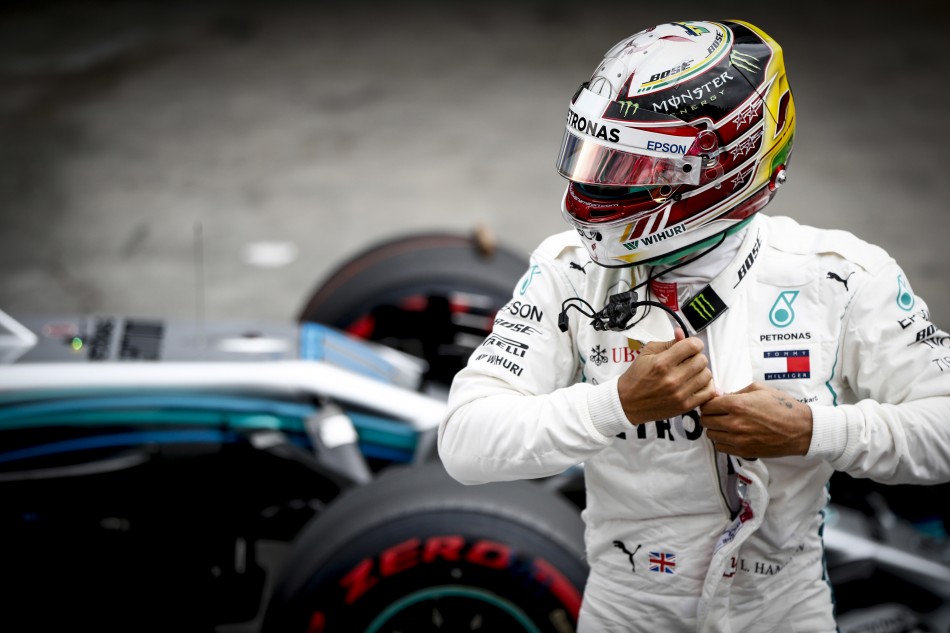
I have got Senna’s design on the back of my helmet and I am happy to be here, says Hamilton
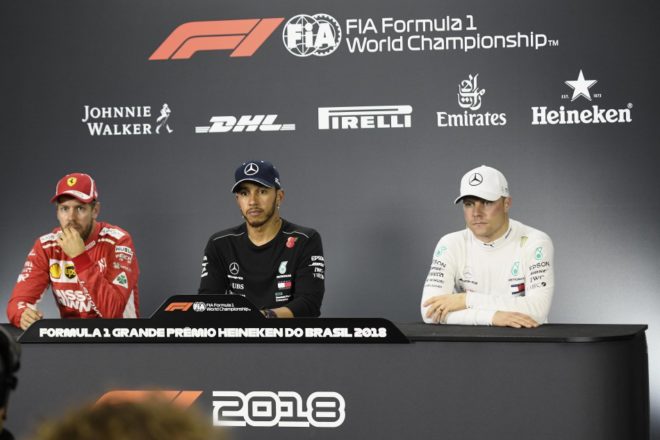
Lewis Hamilton (centre) at the Saturday Press Conference. An FIA image Sao Paulo, 10 Nov 2018: Lewis Hamilton who won the 100th pole for Mercedes AMG Petronas team edging Sebastian Vettel of Ferrari and third-placed teammate Valtteri Bottas attended the Saturday FIA press conference after the qualification. The Track Interviews were conducted by former Force India F1 driver Paul Di Resta.
Q: Lewis, another pole position, your 10th pole position of the year. What have you got to say?
Lewis Hamilton: That was a tough qualifying session. Obviously, the weather was going up and down and we didn’t really know what to expect. Obviously, Ferrari are incredibly quick this weekend a lot of work went on in the background with my engineers to make sure we got the car to be in the best place we could. I’m just really happy to be here in Brazil, you know, knowing I’ve got Senna’s design on the back of my helmet, so I mean… I didn’t know I had the pole, the last lap wasn’t that great if I’m honest, I had a bit of understeer in a few places but I was so grateful when I heard I got pole.
Q: This place means so much to you. You can see the tribute you do to Ayrton every year and the Brazilian fans love you as well?
LH: I just appreciate so much the love that I get here. It’s been a crazy journey with the Brazilian fans. Obviously, the first year I came here I was fighting against Felipe and I was almost the enemy when I left but over the years it’s really grown to I think adore each other. There’s a huge amount of respect I have for them and I love the country so it works hand in hand.
Q: What can we expect tomorrow. Obviously, Ferrari are doing a different tyres strategy. I think you guys were going to do it but the rain compromised Q2, can you still dominate this race?
LH: I don’t know, we’ll see. You’ve seen how quick the Ferrari’s are. I mean, they had a lot more blistering yesterday than we did on the supersoft tyre. I don’t know if it’s correct but we wanted to be on the soft and things kind of swung us the wrong way. Right or wrong we will see tomorrow but hopefully still, with the choice we have, I’ll make the best of it.
Q: Enjoy tonight, at least you’ve got that four-metre head start tomorrow. Sebastian, coming very close there – P2. A different tyre strategy as we just discussed with Lewis. Are you happy with today?
Sebastian Vettel: Yeah, I think it was good fun. In the end I had a tiny lock-up in Turn 8. I got a good start to the second attempt in Q3 and I thought I’d go for it, but it was a little bit too much, so I lost some time and didn’t improve. It was very close, so it was a fun session.
Q: I don’t know if you are aware but you have been called to the stewards for the scale incident. What do you have to say about that?
SV: I think it’s better if I don’t say anything… They shouldn’t call us, because when the conditions are changing like that I think it’s unfair if somebody gets called in and yeah, I wanted them to hurry up.
Q: How difficult is it for a driver and an engineer to read the conditions when it’s coming like that. Is it more the driver’s feel or do you have to stick to the weather systems on the computer?
SV: It’s a difficult one. Inside the garage we don’t really see much, you can’t see out. You have to trust the laps you did before. You have to trust the communication you are having with the pit wall on the conditions, what you see other cars are doing. But when it’s like this it can be anything, so I think in the end we all got lucky that we got more or less the same conditions for everyone, so as long as that’s the case then it’s fine.
Q: Well, I hope you put on a good show like you did in Mexico, show that fighting spirit. Valtteri, third today, not far away, but I guess you can’t be happy with that?
Valtteri BOTTAS: Yeah, not far away but here the margins are small. I knew this weekend I did have the pace to be on pole. I think it was there for me to grab but I couldn’t take it today. I was more than two tenths up in the second run but lost everything in the last corner on the back straight without any tow, so it was quite disappointing.
Q: When you see the rain falling what do you feel as a driver? Do you keep pushing or is there a bit of trepidation?
VB: Yeah, it really depends on the situation but once the rain really started to come down luckily we already had a good lap on the board, so there was no need to take risks. But sometimes you need to go for it and try.
PRESS CONFERENCE
Q: Lewis, that looked like an exciting session in tricky conditions. Just what were the conditions like?
LH: Well, the track was actually really good. There’s a lot of grip here and it’s a fantastic circuit. They don’t generally make circuits like this anymore. You’ve got the different… it’s quite hilly, but it’s a real challenge, even though it’s quite short. It’s very technical – but the grip felt quite good and obviously, the rain was popping in every now and then – but it was just spitting. It was difficult to really tell whether it was going to be slippery in the next corner or not – because when you’re travelling at the speeds we go at, on your visor, because you’re driving through all the rain, it looks like it’s raining more than it is. So, that was definitely tricky – but I think everyone did quite a good job with it – and luckily it held off so we could push at the end when the track was good.
Q: You mentioned the speeds you’re doing here at Interlagos. Valtteri’s pole position last year was a new track record – you have taken more than a second off that time. Just how quick does it feel around here now?
LH: With the new tyres, with the soft tyres, supersoft tyres and the updates that we have to our car… it’s a smaller circuit, shorter circuit, so therefore the difference usually… for example our car is a lot quicker than it was last year at this point – but it doesn’t show as much. At other circuits it’s three seconds-plus. Around here a second is still quite a lot. So, it does feel great though, around here. Into Six and Seven it’s a little lift through there basically and flat though… there’s no other corners where you’re flat out, or anything like that but you definitely do feel… the grip is what you feel, it’s just amazing. It’s better than ever.
Q: Sebastian, coming onto you, less than a tenth of a second behind pole position. How are you feeling after that session?
SV: Pretty good. I think it was fun. I think the track was good, as Lewis said, and obviously very close. I had a good start to my final attempt but yeah, tried a little bit too hard probably, going into Turn Eight in the middle sector and locked the front and then lost a little bit the rhythm. Tried something special in the last corner, didn’t work so… yeah. All in all pretty happy. I think we got the car where it is happiest, and the balance was good in qualifying throughout, so we’ll see. We’ll start with a different tyre tomorrow. Maybe that can make a difference.
Q: Just to elaborate on that point about the tyres, do you think that’ll be the crucial point in the race?
SV: Hmmm… might be. I mean, I think it’s the tyre that probably most of us probably wanted to start on but then with the conditions it was a bit tricky. Yeah, in the end it wasn’t really wet but there was some rain around the track, so yeah, happy that we got it done and now we start with a different tyre, so let’s see.
Q: Valtteri, fastest in Q2, you’re less than a tenth off pole position but starting third tomorrow. Just sum-up the session for us.
VB: I think the gap is a bit more than one-tenth but obviously, it’s a bit disappointing one red car got in-between us and the pace I had this weekend so far felt like I could definitely fight for the pole position, and I think it was there for me to grab it. But in the second run I was more than two-tenths up on my best lap but somehow Turn 12, just lost a little bit and then I think I was the first car out in the last run so I had no tow on the back straight and just kept losing time on the uphill. And I saw that it was not going to be an improvement, so for sure that’s disappointing but yeah, it was a strong qualifying for us as a team and another great pole for Lewis – but yeah, I think for tomorrow, we’ll see how our decision to go with the supersoft is going to… what’s going to happen.
QUESTIONS FROM THE FLOOR
Q: (Scott Mitchell – Autosport) Seb, could you just talk through the weighbridge incident please, just from your perspective – and are you now worried about getting a grid penalty for tomorrow’s race?
SV: No, I don’t want to talk through. I think it’s pretty clear what happened, so. I think we do qualifying, we should talk about qualifying.
Q: (Christian Menath – Motorsport-Magazin.com) Lewis, there was a situation between you and Sergey in Q2, I think. Can you talk us through that situation? It looked pretty scary from outside.
LH: Yeah, basically everyone was on an ‘out’ lap – me, Sergey and everyone in front of me – and when you’re on your ‘out’ lap, towards the end of the lap Valtteri was up ahead of me so he was backing off to get his gap so I had to make sure I kept a gap with him. As far as I was aware, no one behind was on a lap so I was making sure I had the gap but then all of a sudden, out of the last corner – sorry, out of turn 11 – I saw a car coming at high speed so I was like ‘oh my God, is that someone on a lap?’ so I went to move to the left and that’s where he decided to go but he wasn’t on a lap, so I don’t really know what his thinking was really, with it, because respectfully, between all the drivers, we all do respect… you know, I could have easily tried to overtake Valtteri or Valtteri whoever was in front of him. We all know to keep our space by that point so it was generally quite a disrespectful move in the sense of where it was dangerous between us both because I was not expecting it to happen that way, and so I was actually trying to get out of his way but he ended up going inside but then he got to the corner and then slowed up to utilise the gap but then also I don’t know whether to slow my lap up or not. It was kind of strange. It was completely unnecessary because we had a space behind, behind him there was a bit of a space so ultimately his lap and my lap weren’t great from that so hopefully he can learn from it.
Q: (Scott Mitchell – Autosport) Valtteri, you talked about having a moment at turn 12, what happened on the lap? The car snap away or was it just not as quick?
VB: No, I didn’t really have a moment, I just lost a few hundredths there, I think. I think at the beginning of the lap it was getting very good, then the middle of the lap was average and lost a tiny bit in the last corner, but the main time loss, I think it was more than a tenth, was just up the hill, just losing time on the straight. No drama, but definitely not a perfect lap but I think with a perfect lap pole would have been possible.
Q: (Michael Schmidt – Auto Motor und Sport) Seb, in Q2 you were almost as fast as the Mercedes on the soft tyre, so the harder tyre, have you been surprised that there wasn’t a bigger gap with the supersoft?
MS: Yes, the lap felt really good, the tyre felt really good. You go into the weekend, you have an estimation of what’s the difference between the tyres and then you do your Friday running and you might correct it but I was definitely surprised, the tyre felt really good. I don’t think it was much slower. Yeah, but it didn’t feel… usually we were expecting something like three or four tenths but it felt really good. I was surprised when I crossed the line in Q2 because I also kept some margin for the rain so could have gone faster on that tyre easily. So if it’s that good tomorrow, then happy days!
Q: (Christian Menath – Motorsport-Magazin.com) You’re starting on different tyre compounds. Lewis has been quite outspoken in Austin, I think, when you started on the harder compound, that it was quite a disadvantage there. What do you expect just from starting on different tyre compounds?
LH: I was told that there’s not a huge difference, but there’s always a difference of some sort. It will definitely be a little bit interesting. It’s not a massive run down to turn one but Ferrari are very good at their starts in general normally. However, we are actually quite even in terms of the overall year performance with Ferrari. We’re actually quite equal with them, so we’ve both had a similar amount of good starts so I’m excited to just have a battle, you know. But making that tyre last I think is going to be the interesting scenario but it is what it is. We’ll give it all we can tomorrow.
SV: Again, we have an estimation of what the penalty might be with the harder compound at the start but it’s a very short way to turn one so we’ll see. I have quite good memories from P2, starting P2 here so we will see. I think it depends a lot more on the job that you do at the start, to get everything right then a little bit of difference on the tyres.
Q: Are there similar grip levels on both sides of the track?
SV: I think so. The last years it was pretty even so, yeah. Usually the right side or the odd side here is a bit cleaner but I’m sure that with the other races across the weekend it should be fine, there should be plenty of rubber.
VB: Nothing to add.
Ends
-
Hamilton takes pole: Brazilian GP
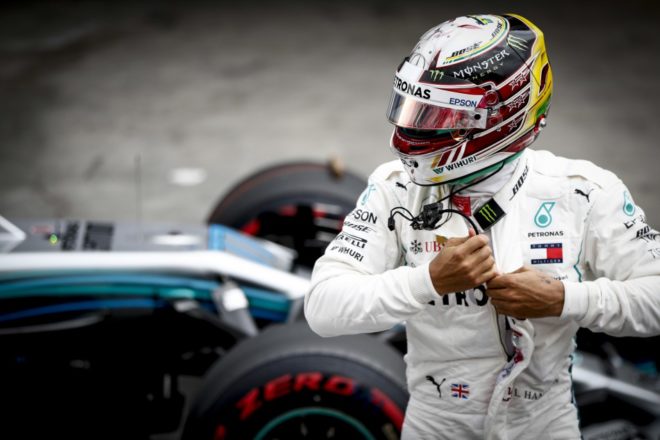
Hamilton after taking pole on Saturday. An FIA image Sao Paulo, 10 Nov 2018: Lewis Hamilton took the 82nd pole position of his career with the fastest lap in qualifying for the Brazilian Grand Prix, the 20th of the 21 races in the FIA Formula One World Championship calendar. The Mercedes driver edged out Sebastian Vettel by just under a tenths of a second. Vettel hit trouble during the session, however, being summoned to the stewards’ room following a mid-session incident at the weighbridge.
Race officials called the Ferrari driver to the weighbridge during Q2 but according to FIA Technical Delegate Jo Bauer’s report “the driver of car number 05, when called for weighing, refused to turn off the engine. The car was pushed onto the scales and weighed with running engine, which makes it difficult to get a stable result. After weighing the driver drove off the scales under its own power, and by doing so, he destroyed the scales.” Vettel was summoned to see the stewards at the end of Q3. vettel was later handed a reprimand and a €25,000 fine over the incident.
Earlier, ahead of Q1 circuit weather forecasters increased the likelihood of rain for the session from an earlier 40% to 60% and with ominous clouds moving towards the track a stream of cars took to the track in search of banker laps at the start of Q1.
Red Bull’s Max Verstappen set the early pace, with the Dutchman setting a time of 1:08.205. That put him more than two tenths clear of Ferrari’s Kimi Räikkönen, with Hamilton third ahead of Vettel, who eventually improved to steal third with a time identical to that of his team-mate.
At the lower end of the order the men in danger in the final minutes of the session were Renault’s Carlos Sainz, Toro Rosso’s Brendon Hartley, McLaren’s Fernando Alonso, Williams’ Lance Stroll and second McLaren driver Stoffel Vandoorne.
With rain falling in the closing moments of the segment, none was able to find the time needed to escape the danger zone and all five were eliminated in their pre-final final run positions.
Q2 proved to be a race against time as the rain closed in and after the first runs Bottas held top spot ahead of Hamilton, Verstappen and Ricciardo. Räikkönen, though, chose to abandon his supersoft tyres and drove back to the pits to take on soft tyres.
Vettel wanted to make a similar move but as he went to make the switch he was called to the weighbridge, leading to the incident with the FIA officials. He subsequently bolted on softs and jumped to P2, setting hbis best time on the yellow-banded compound.
Red Bull and Mercedes tried the same switch but none of their drivers could improve and thus they will start the race on supersofts, while Ferrari will start on softs.
In mixed and difficult to read conditions at the end of the session Sauber’s Charles Leclerc delivered a spectacular lap to rise from P11 and potential elimination to P8 and safety ahead of team-mate Marcus Ericsson and Toro Rosso’s Pierre Gasly, who was the last man through to Q3.
Eliminated at the end of Q2 were Haas’ Kevin Magnussen, Racing Point Force India’s Sergio Perez and Esteban Ocon, Renault’s Nico Hulkenberg and Williams’ Sergey Sirotkin.
In Q3 Hamilton seized control of proceedings, setting an opening time of 1:07.301 to sit 0.073s ahead of Vettel, with Bottas third ahead of Räikkönen. Max again took P5 ahead of Daniel, though by the incredibly small margin of just 0.002s.
And that was how the order remained. Hamilton improved marginally to 1:07.281 to claim his 82nd career pole position ahead of Vettel who made a small error on his final lap. Bottas took third ahead of Räikkönen and with no improvement forthcoming, Max ands Daniel qualified on row three of the grid. Seventh place went to Ericsson with Leclerc in eighth ahead of Grosjean and Gasly.
2018 Formula 1 Brazilian Grand Prix – Qualifying
1 Lewis Hamilton Mercedes 1:07.281 230.561
2 Sebastian Vettel Ferrari 1:07.374 0.093 230.243
3 Valtteri Bottas Mercedes 1:07.441 0.160 230.014
4 Kimi Raikkonen Ferrari 1:07.456 0.175 229.963
5 Max Verstappen Red Bull Racing 1:07.778 0.497 228.870
6 Daniel Ricciardo Red Bull 1:07.780 0.499 228.863
7 Marcus Ericsson Sauber 1:08.296 1.015 227.134
8 Charles Leclerc Sauber 1:08.492 1.211 226.484
9 Romain Grosjean Haas 1:08.517 1.236 226.402
10 Pierre Gasly Toro Rosso 1:09.029 1.748 224.722
11 Kevin Magnussen Haas 1:08.659 1.378 225.933
12 Sergio Perez Force India 1:08.741 1.460 225.664
13 Esteban Ocon Force India 1:08.770 1.489 225.569
14 Nico Hulkenberg Renault 1:08.834 1.553 225.359
15 Sergey Sirotkin Williams 1:10.381 3.100 220.406
16 Carlos Sainz Renault 1:09.269 1.988 223.944
17 Brendon Hartley Toro Rosso 1:09.280 1.999 223.908
18 Fernando Alonso McLaren 1:09.402 2.121 223.515
19 Lance Stroll Williams 1:09.441 2.160 223.389
20 Stoffel Vandoorne McLaren 1:09.601 2.320 222.876. -
FIA Friday press conference: Brazilian GP
Sao Paulo, 9 Nov 2018: The FIA Friday press conference was attended by team representatives Jonathan Eddolls of Toro Rosso, Nick Chester (Renault), Ayao Komatsu (Haas), Jock Clear (Ferrari) and Rob Smedley (Williams).
Nick, it’s been a great last couple of races for Renault and it looks like you’ve pretty much secured P4 in the Championship. That was your stated aim at the start of the year, but just talk us through how satisfied you’ve been with the development curve of this year’s car?
Nick CHESTER: Well firstly, it has been a pretty tight fight, we’ve had a fight all year and the last couple of races have been pretty good for us. We’ve developed the car pretty hard all year. We knew we were going to have to and that it would be a tight fight. But it’s pleasing and I think if we have another couple of decent races towards the end of the year – Brazil and Abu Dhabi – then we’ll be about there.
Q: These past couple of races, as we said, have been good. Have you made a step forward that has allowed you to be that competitive on every track or has it been track specific?
NC: It’s been a bit track specific. We know that there are some tracks that are better for us than others. We’re a little bit better in slow-speed corners than high-speed corners but also we have been working the development to try to bring the car on through the year.
Q: Thank you. Jock, it’s been a fantastic battle between yourselves and Ferrari this year but there can only be one winner. Where in your opinion did it start to slip away from Sebastian Vettel?
Jock CLEAR: Yeah, it has been a fantastic battle and that’s why we do this sport. It’s seasons like this that you just relish, Obviously when you are on the wrong end of it, it is frustrating. But specifically, we haven’t really looked back at what point, as you put it, things slipped away from us. The fact is a season is season and the points we score in Abu Dhabi are just as important as the points you score in Australia, and to win a championship you need to put together a full season and we haven’t done as good a job in that respect as our direct competitors and we are aware of that. We look back over the season, we look at the strengths of what is probably the strongest Ferrari season for 10 years and we build on those strengths. I think the win in Austin is a testament to the fact that the team does come back and does fight back and we did understand some of the issues we uncovered in the second third of the season. The fact is that over the course of 21 races you have to score more points than the opposition. We haven’t done that for Seb, we’re still in the hunt for the Constructors’ obviously and it’s going to be a tough battle here and hopefully to Abu Dhabi.
Q: Sebastian has been performing under a lot of pressure this year. How difficult do you think it’s been for him?
JC: It’s difficult to say really. The fact is drivers of his caliber relish the pressure. That’s again what I think, the top athletes pit themselves against the best and the pressure is the pressure. That’s part of the job. I think he has enjoyed the season. There have been highs and lows. I think he said recently that losing the championship in 2009 he found more frustrating. I think on the whole, he has come to this battle willing to take risks, willing to give it his all and we’re part of that. We’ve all done our part this year to the ups and downs. I think from Seb’s point of view it just gives him more strength to come back next year and say ‘this is unfinished business’.
Q: Thank you. Ayao, coming to you, Mexico aside, which was a bit of a blip for the team, it’s been a positive and consistent season fro Haas. In what areas have you improved the car since Melbourne?
Ayao KOMATSU: I think most of… all the areas. This is only the third year for us but this is also only the first year that we actually decided to develop the car throughout the season. The first year was all about operation. The second year we managed to focus a bit more on performance but third year we really focused on performance and improving the cars throughout the season. Of course last year we stopped development early to focus on this year, so that paid off. We are very happy with our baseline and how the team is operating, especially considering it is only our third season.
Q: So looking forward, there is a bit of a reset with the new aero rules. How are you guys dealing with that transition and how confident are you of retaining P5 in 2019?
AK: I think we are dealing with it as well as we can be. Obviously when the regulations changed from ’16 to ’17 that was a big change for us, that was going from first to second year. We were pretty aware of the challenge but we managed it. This year our understanding of the car, at least from an aerodynamics point of view, is reasonable, so yeah, I’m confident that our aero guys will do a good job again for next year. But if you ask me how confident am I to retain P5, of course it’s a competition, so we’ve got to do a better job than other people. So it’s not easy, I’m under no illusion and then going into our fourth again we need to look at ourselves, improving in every single department to have a chance of retaining fifth. So a huge challenge, but a challenge we will love to attack with our full capability.
Q: Thank you. Jonathan, we’ve talked about Haas’ development curve, we’ve talked Renault’s, can we talk to you about Honda? Specifically, where have they added performance and reliability over the year?
Jonathan EDDOLLS: Yeah, I think with Honda, honestly it was surprise at how good they were at the start of the year, given everything that we had seen in the press. They’d had a fairly… not a bad picture painted of them, but the expectation were lower than we experienced and they were already at a reasonable level. Through the year there have been two really big updates, the Spec 2 for Canada and then the Spec 3 fairly recently. The Spec 3 in particular saw a really big improvement in power, especially in qualifying, and that has really helped in some of the races and will help us for the next two races. Reliability has actually been relatively good. I think if you look at the number of PU penalties we have taken, it’s very high, and it doesn’t look like Honda has had such good reliability. However, many of those we have elected to take ourselves just to get Pus in the pool when we have had a bad qualifying for instance. Reliability has come on a long way and power is now looking good.
Q: Certainly is. Now while we’re talking progress, can we talk drivers as well, specifically Pierre Gasly? What has impressed you about him and in what areas have you seen him progress this year?
JE: Well, firstly he is very confident in his ability. He is a very fast driver and I think that confidence has grown throughout the year. Some the areas he has improved the most: tyres management. He was good already at the start of the year. As we know these Pirelli tyres are very difficult to understand in all of the conditions. Every race is different, every race presents a different challenge – graining, blistering, overheating. I think that’s one of the areas he’s worked on and developed the most. He’s still had a couple of races recently where it’s shown that we haven’t fully understood the tyres but the good thing with him is he’s happy to sit down after the race and go through everything – he’s massively keen to learn. The most recent races, he’s shown that in tyres management he has made big steps there. I think also his ability to track the grip in qualifying. Maybe at the start of the year, let’s say it was a surprise to him how much the grip would come up through qualifying and it can be quite difficult to track that run to run, but that’s another area that he has improved a lot.
Q: Thanks. Rob, some big news from you in recent days, you are going to leave Williams at the end of the year. Can you share with us why you are going to do that?
Rob SMEDLEY: Well, I don’t know if it’s big news, but it’s news I guess, on a quiet week. I think I joined Williams at a time when they were evolving from having a torrid time of it let’s say – the new regulations in 2014 and the part that I was going to play in the journey was to take on the vehicle science, the vehicle performance side of it, the race operations and to try to help out in that area and I think that if you look back at 2012, 2013 and from that point on, from 2014, with the huge effort that all of the guys that work in that department, we have been able to grow it, we’ve been able to improve it, and hopefully I leave it in better shape than it was. It’s a good group now, they’ve got good knowledge, good methodologies, we brought a lot of science into the way we use tyres, into the way we use the car in general, so that the team can go ahead and pretty much exploit any car that’s given to them, the race operations itself, the way the mechanics work. Hopefully it is in better shape than it was. It’s kind of time for a new challenge for me now, I think. Williams has got it’s own challenge in front it to come from where it is at the minute. I’m going to go away and take another challenge somewhere else. I’m going to spend some time at home – that’s first and foremost the thing I’m going to do. I’m going to spend some time with my family who have supported me for a long time. I’ve got to do that. I have no choice in that. But I’m very, very grateful that I can do that and spend some time being a normal husband, a normal dad and not going away every two weeks and not working until 9 or 10 in the office every night, so I’ll enjoy that to begin with and then we’ll go from there.
Q: Well, where do you go from there. Do you want to stay in Formula 1?
RS: Yeah, I definitely want to stay in Formula 1. Formula 1 is my passion. It’s been all my working life that I’ve been in Formula 1 and it’s still the pinnacle of motorsport. There are other series that are snapping at its heels but it’s still got a lot to offer. Formula 1, we’re working on it all the time, it’s not the complete package. It has so much more potential than what you actually see. So yeah, I do want to stay in Formula 1 on the technical side. I’m lucky, because I’m already talking to people and that’s a fortunate position to be in and we’ll just see where everything takes us.
Q: And just a final word on Williams? You know the team well, so what steps do you think the team needs to take next to regain performance and respectability in Formula 1?
RS: There’s never one magic bullet is there. I think in all areas really, you can never stop learning and improving. I think it would be a mistake to pinpoint one area and say that has to be the sole concentration or that’s the sole problem; it’s not. As with anything that’s not quite working as well as it should be, or as efficiently as it should be, with any business, with any organisation, it’s never one thing. What Williams need to do now… they’ve got strong leadership and Claire is at the front of that leadership and I think what they need to do at that leadership level, is they need a recovery plan and that has to attack all areas of the business. It has to be technical, but it has to be all the support structure of the business as well. There are areas that need modernisation, there are areas that need change and there are areas you should recognise that are strong compared to other Formula q1 teams but are not supported in other ways. It’s a long road, they’re a talented bunch there, there are some really good technical people, some really good engineers and a good management group and the trick now is they have to pull together and start to go in one direction.
QUESTIONS FROM THE FLOOR
Q: (Frederic Ferret – L’Equipe) Question to Jock Clear. You worked with Michael Schumacher and now you work with Sebastian Vettel. Can you tell us what are the similarities in the way they work and the differences between them?
JC: Yeah, obviously I’ve worked with a lot of drivers so this question comes up time and time again. Sorry to sort-of evade the question direction but direct comparisons just aren’t there, with any of these drivers, with any of the World Champions I’ve worked with. They are themselves, they are characters within themselves, they’ve got their own way of working. On the face of it, if you stand back and say, ‘well, would operating like Michael have made Seb more successful, or even would Michael operating like Seb have made him more successful, they are what they are. You get the rough with the smooth. We don’t get the opportunity to make the ideal driver. So they all attack it in a different way. The opposition and the competition of the hour of the year obviously varies, so with all sportsman it’s very difficult to make direct comparisons. All I can say is that the common theme that all of these top drivers have is that they are exceptionally focussed. They are exceptionally sensitive to everything around them. And that’s not just the car. That’s the support structure and the people around them. And they require a whole load of things lining up to get those championships in the bag. And that’s where the team comes in. That’s why it’s not just about the driver. It’s not just about Schumacher or Vettel or Hamilton. It’s about the whole team. So we, with Seb, will create victories and championships, hopefully, down the line and it won’t be in the same way as Michael did.
Q: (Scott Mitchell – Autosport) It’s a question to all five of you guys please. There’s a fair few people hoping that the rule changes on the front wing for next season will improve racing, make it easier to follow. The more you understand and learn about your respective 2019 challengers, how confident are you that this end goal will be met? And how much of a chance of there that this time next year we’re back and looking at the same things, same sort of numbers?
NC: OK, well, yeah, it is quite a big change for 2019. Big change to the front wing with wider span, different barge boards, different front drums, and I think the concept that the FIA have put forward to try and improve the wake to the following car is the right thing. Obviously in one year you couldn’t do all of the changes that are planned eventually for 2021. From what we’ve seen so far I think it’ll make a small difference. It’ll go in the right direction, so the following will be a little bit improved – but we’re probably going to have to wait until 2021 to see what the full package can deliver.
Jock, your thoughts?
JC: Yes, just to echo Nick really, on the face of it, it is going in the right direction. I think we’re all a little bit tentative about exactly what it’s going to look like and that is the fact of the matter. We’re going to have to wait until next year to actually see what the implications are – because of course ten teams will come up with ten solutions, some of which we won’t even have thought about and then that may well move the goalposts slightly. I think we are attacking the right areas. We are looking at the fact that close racing doesn’t necessarily mean everybody can overtake easily – but it does mean that cars can follow each-other and they can pressure each other – and I think that’s the thing we’re targeting. Just allowing cars to maybe be close battling in the future.
Rob?
RS: The only thing I would add to what Nick and Jock said is that yeah, I think Nik Tombazis summed it up quite well… I read an article last week and I think he said you’ll never get a Formula One car – which is essentially an aerodynamic formula – following like a touring car. It just won’t happen. Physics won’t allow that to happen. So you have to accept that cars are difficult to follow – especially with this generation of cars and the amount of downforce that they generate. So, y’know, it will be a little bit better, it will go in the right direction but we’ll all iterate to solutions to get us back to where we are in about six months.
Jonathan, anything to add?
JE: I think these guys have covered it. Obviously we haven’t ourselves done full overtaking simulations with the new regulations so I guess it would be unfair to say how much we think, as a team, it’s going to make a difference – but for sure, the start of next year will be a bit of a development race when we see all the different ideas and concepts that the teams come up with.
Ayao?
AK: A lot depends on other factors as well, such as tyres. So, we’ll see. I’ve got nothing to really add.
Q: (Nate Saunders – ESPN) A question for Jock. You mentioned at the beginning, looking at the season as a whole, and not pinpointing one position. It seemed that the common consensus around the middle of the season was that Ferrari had taken quite a decisive step ahead of Mercedes in terms of performance around Silverstone, Germany. Do you agree it was that significant? And if it was, how big a loss were those 25 points in Germany from Sebastian?
JC: Well, I can only say again that the value of points is the same throughout the year. Yes, I would say our car was at its strongest at around about that time and then we go on to Russia and Japan where we struggled in pure performance terms and we weren’t really in a position to take the fight to them. So, as I said, or as you’re saying, if you pinpoint specific areas, certainly you can highlight where they were stronger than us and we were stronger than them. But again, over the course of a season, we would like to now be in a position where we could win the next two races and win the championship for Seb. Or the Constructors’. Unfortunately, what’s gone before, the points are the points – but again, just to reiterate over the course of this season, we haven’t quite got it spot on at every race. The positive is we understand why. As I say, those couple of races where we did have a slump, we came back in Austin, we were brave enough to go back on some of the development, and that’s the kind of culture that we want to have now. That people are brave enough to say “OK, I think we’ve made a mistake.” We go back, we relearn what we thought we understood, and we come back in Austin and we win the race, and we were competitive again in Mexico. So that’s the positive to it. The championship position we all know.
Q: (Julien Billotte – AutoHebdo) Question to Jonathan, with James Key on gardening leave, how is next year’s Toro Rosso being designed and who is in charge of leading the process?
JE: Obviously within Toro Rosso, luckily we have very good succession planning across all departments, so already before James left, we had a deputy technical director, Jody, and for the minute, he’s the deputy technical director so he’s filling that gap for us at the moment.
Q: (Stuart Codling – F1 Racing) Apologies for pitching another one to the entire panel – but there you go. Calendar expansion. Looks like we’re going up again in size next season. The commercial rights holder has talked about maybe even going up to 25 in the future. For you guys as engineers, you thrive on creativity, attention to detail, all the types of factors that start to slip when fatigue creeps in. And you also have to deal with a travelling group of engineers and a group of permanent staff at home that are also looking at things. So, my question is, what is the effect of calendar expansion on your side of the business, and what sort of strategies can you come up with to mitigate those effects in the near-future?
AK: Yeah, obviously especially for small teams like us, increasing the number of races is quite tough. We don’t have so many people to substitute or rota in. And also in terms of process and procedure we’re still getting on top of what we’ve got now, so it’s not going to be easy – but it’s going to be the same of everyone. We’re happy to compete in this championship so whatever comes along we have to accept and take it. But yeah, it doesn’t really change what we try to put in place. But yeah, I expect the challenge for us to be a bit tougher than for bigger teams.
Jonathan?
JE: I think Ayao’s covered it. I think the key thing that we will need to do is look at more rotation. Some of the roles within the team, there is already a minimal amount of rotation. But I think that will need to expand to nearly all of the roles within the team. Probably the race engineer would stay the same throughout the season but almost all of the other positions, trying to do that many races with tests etc., just becomes too much. As you say, the fatigue is too high. It’s just not going to be possible. So I think we would have to cope.
Rob?
RS: Nothing to add really.
Jock – does it affect the big teams less than the smaller teams, the calendar expansion?
JC: Yeah, I would have to be honest and say it probably does. We have more strength in depth, we have more resource available to us. I think the only thing I would echo, as Jonathan said, we do have to actually look at how we’re using our people – because we want people to enjoy this. One of the great things about doing this sport, being involved in this sport is that it’s a passion for all of us. There’s very few people in this pitlane who wouldn’t be doing this on a Saturday and a Sunday if it was just their hobby. That’s the honesty of it. We would be doing this because we just love going racing with cars. And you want people to enjoy it. You don’t want people to be ground down after three years, saying, “it’s no good, I can’t do any more of this,” because people have come to this from six, seven, eight years old. They want to do it, and they’re passionate about it, and we don’t want to kill that passion. So, we’ll find ways to keep it enjoyable to keep it practically doable, and the racing will go on and hopefully it will continue to grow the sport.
Nick?
NC: Yeah, I think once you get towards 25 races you have to find a way to rotate a bit. People are already under pressure with 21 races. It’s a long season. The other thing is, it also puts pressure on the factory. You make bits for a lot longer through the year. So, there’s budget pressures and there’s factory pressure from making parts and obviously more freight to go with it.
Q: (Andrea Cremonesi – La Gazzetta dello Sport) Couple of questions, one for Jock, one for Rob. For Jock, I would like to ask you… we understood that you are changing the rules next year. I would like to know in which way that you are maybe working closer with Leclerc and how important is it for an experienced technician to work with a young guy? And for Rob, if one of your options on the table is to come back to Italy?
RS: Andrea, Andrea, Andrea…
JC: Do you want to answer yours first, Rob? Or have you?
RS: Go on, Jock.
JC: I think it’s no secret that with a change of driver line-up, we, as a team, are just going to cut our cloth accordingly, as we say in English, so I’m part of the team, I’ve recently made a longer term commitment to the team, and as such, I will use my skillset wherever we feel that’s best. I have a lot of experience with young drivers and a lot of experience with experienced drivers as well so with Charles coming in, I will help in any way I can to make his life easier, to ease some of the pressure and to make sure that we get the best out of Charles and out of the team as a whole over the next few years.
Q: Jock, just to be more specific on that, are you going to be Charles’s race engineer?
JC: It’s not all finalised at the moment but at the moment yes, I will certainly have a strong influence on his side of the garage and whether that is the job title or not we’ll finally decide upon but certainly I will be taking a closer attention to him than maybe I would have done on either of the individuals we’ve had – either Kimi or Seb – up to now.
RS: I’m going on holiday there (Italy) in January if that helps! I would say at this moment in time I’m not closing off any options. As I said earlier, I’m in a really fortunate lucky position that people want to talk to me so I’m talking and, as I said, there’s absolutely no avenues closed off. What I actually need to do is to at some point, towards the start of next year, is to get all the options on the table and after having spent a little bit of time away from it and being able to look at things with a clearer head, slightly less fatigued, then I will make a decision but until that point I will see what the options are as they come in and go from there.
Q: (Andreas Lopes – Motorlat) For Jock Clear: with Ferrari testing a new floor in previous races and then not used on Sunday in the race, can you explain what kind of problems you had or is it testing for next year?
JC: Well, there’s nothing really to explain. This is a process we go through at many events. I think we brought pretty much an aerodynamic upgrade to every race this year so we have various options open to us, depending on the circuit to circuit, we try and find the best combination. The positive is that we are producing these options, that the wind tunnel is continuing to produce effectively tools for us to use from race to race and that’s our job as race engineers on the operational side, is to make the most of the bits we’ve been given and that’s the process. For example, you’ve seen this morning, in FP1, we’ll do a comparison between two floors, two front wings, bargeboards, those sort of things and then from then on, we’ll decide which combination is giving us the best performance for this track. And that’s just a normal process for us.
Q: (Frederic Ferret – L’Equipe) Do you already have numbers for next year’s cars’ lap times and how much slower are they compared to this year’s ones?
NC: Well, we’ve got some initial estimates. Obviously we’re only part-way through the tunnel programme and we’ve taken a bit of a hit back with the new rules and it’s going to be a question of how fast we can develop. I’m not going to give you the actual number because obviously it’s more interesting for us but yeah, I think the key is going to be how teams come back and how they develop over the next few months and into next year.
JC: As Nick says, any change, whether it be big or small, tends to impact the programme because these cars are so highly developed around what you actually have on the car. As soon as you change one part it does take a step back so I think we’ve probably all taken a step back, when we look at the new regulations and then gradually we will recover. What the lap time is, what the numbers say is absolutely irrelevant at this point because it’s all relative. We will do our best, we will develop our best but if somebody else has done a better job it won’t be enough. If everybody else hasn’t, it will be enough and we simply don’t know. All we do is we go through our process which is what we can trust.
RS: It’s a reasonably big change, what we’ve done at the front end of the car that Nick talked about earlier. We’ve got rid of all the furniture on the front wing, it’s a wider span, the brake duct winglets have gone, the bargeboard area is very different and what that does is it gives you much worse wheel weight control essentially. What will be really interesting is that there will be… there’s some really clear directions with which to work and certainly we’ve found some really clear directions of where we need to work to recover the performance and it will be just very very interesting I think, at the start of the season, to see the different concepts that come out but then you’ll probably find that there’ll be a really quick convergence as usual as we take the best concepts from all the cars and blend that into the normal lookalike Formula One car.
JE: Nothing to add. I think these guys have summed it up very well already.
AK: No, not really. Nothing to add.
Q: (Scott Mitchell – Autosport) For Jock and Rob: Jock, how excited are you to work with someone like Charles next year? He’s going to be so highly rated and how important is it to manage him as an individual, not just a driver, when there’s so much expectation? And Rob, when you had the experience of working as Felipe’s race engineer when he started with Ferrari, how important was, that managing all of that expectation and getting to know him as a person and building that relationship?
JC: Obviously we’re very excited. We’ve known Charles for a while now. We’ve had a relationship with him over a few years, from his days in the Academy so he’s not an unknown entity for us, we’re not going into this completely blind and clearly in his first year in F1 he’s showed some great potential, he’s had some great races so I think everybody is excited about the prospect, everybody knows what kind of pressure he will come under, that racing at the very sharp end is going to be a very different prospect for him, but that’s a challenge for us as well. One of the comments that many people made was ‘is he ready?’ Well, we have to be ready as well, Ferrari have to be ready to take this step. It is a brave step that Ferrari has made and we’re all pleased about the fact that we’re willing to make that step but we have to be ready to give him the opportunity and support him in the right way and hopefully he’ll go on to great things and I think the relationship with Seb will be important. We need to manage that very positively and make sure the team as a whole grows, not just on Charles’s side and not just on Seb’s side.
RS: Well, we’re breaking the ten year rule now so it’s quite difficult for me to remember! I think that the world was probably a little bit different back then. We’re all so much more aware of exactly what Jock’s just talked about, that the expectations going from Sauber to Ferrari, which is exactly what Felipe did in fact, are enormous and even within the hierarchy of Formula One, the pressure increases as you go further up the grid. In Ferrari, to the Italian nation, Ferrari is a religion and therefore that just brings all its own issues, challenges, if you like, but I think we’re all so much more aware of that now. If you go back to 2006 when Felipe came in, it was just… we kind of pushed him through the door and said to him get on with it. And we realised very early on that that wasn’t going to work. We had a slight change of management on his car after about three races into the season and it was at that point trying to understand where the issues were and what we needed to do to solve them so we were being reactive if you like and trying to help him to integrate into this brand new environment. Even though he’d done some Formula One, he’d never done Formula One at Ferrari level. But again, to repeat myself, I think things have moved on so much now, we’re so much more aware and I can imagine that Ferrari already have quite a lot of plans to be entirely pro-active with Charles’s entry into the team and then how he goes through winter testing, how he gets through those first races. Expectation management is a big thing in Ferrari and I think that they’ve been, ultimately, really intelligent with the communications that they’ve made over that, that Charles is there to learn, he’s there to integrate himself well into the team and his future is not decided on 2019. He’s a guy with a great talent, he’s got a huge future in front of him, definitely probably the biggest talent we’ve had come into the sport in a while. It’s a pleasure to watch him and he deserves it. As long as Ferrari manage it correctly then it will be a huge success.
Ends