Your basket is currently empty!
Category: India In F1
-
SFI Academy’s Daruvala finishes second in German Championships
Sahara Force India Academy driver Jehan Daruvala went within a whisker of claiming an incredible German Karting Championship crown, finishing second in the standings in one of Europe’s top competitions.
The final race, on the Belgian track of Genk, was the perfect theatre for a thrilling finale. The closing round came at the end of a fiercely fought season that saw Jehan and Championship rival Martijn van Leeuwen stand in a class apart from the rest of the field: between them, the two racers had won seven of the eight finals disputed up to the Genk weekend, amassing podiums and building a huge gap over the remaining opponents. The young Indian racer, in particular, had impressed with four wins and one second place in his first season of senior karting – among some of the world’s best racers.
With all the elements for a brilliant showdown between the only two drivers with a shot at the title, the weather intervened to play a role in the proceedings. Rain on Sunday morning meant that, after a solid performance in qualifying on Saturday, Jehan was to face a completely different set of circumstances on the day of the finals.
A battling display in the first final wasn’t enough, however, to maintain the championship lead on van Leeuwen – the Dutchman finishing second to Jehan’s sixth place. And when everything was ready for a sizzling second final, with the standings hanging in the balance before the closing race of the weekend – the Sahara Force India driver requiring to comprehensively outscore his rival to win the title – controversy struck.
A botched start by van Leeuwen saw the Dutchman collide with guest driver Alessio Lorandi, resulting on them both falling off the track. With Jehan only needing to be in the top three to win the championship and having already secured second place in the race, Jehan was looking in good shape. Unexpectedly and without any apparent safety or track issues, the race officials threw a red flag, which resulted in the grid being reformed with the drivers in their original starting positions – nullifying Jehan’s advantage. After a further red flag and a dubious decision to commence the race in single file, Jehan’s fate was determined. Although he claimed fourth position, the advantage gained by van Leeuwen from the decision to restart the race in qualifying order could not be overcome.
Despite the obvious disappointment at the manner in which the final race unfolded, the Mumbaikar was very composed and took the events of the day in his stride. He outclassed a host of experienced racers to claim a very strong result, and runner-up spot in the German Championship, showing throughout the season a growing confidence with senior ka
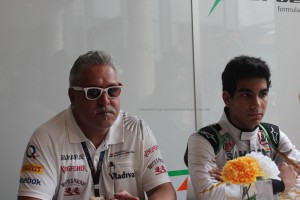
File photo of Dr Vijay Mallya (L) with Jehan Daruvala at Buddh International Circuit, during the Indian Grand Prix 2013. Photo: Chitra Subramanyam / RidingFastAndFlyingLow rting that will surely prove useful in his future career.
eom/SFI academy press release
-
To get first Constructors’ title for Mercedes Benz is amazing, so it a wonderful day!: Hamilton

Sochi Stadium through a fish eye. A Mercedes AMG Petronas image 1 – Lewis HAMILTON (Mercedes)
2 – Nico ROSBERG (Mercedes)
3 – Valtteri BOTTAS (Williams)
PODIUM INTERVIEWS
(Conducted by Alex Popov)
What a wonderful race guys. Thank you very much? I know Lewis you are a real fan of Russia, Russian racing. You were back in Moscow sometime and now you’ve won first ever Russian Grand Prix since 100 years exactly. How do you feel?
Lewis HAMILTON: So happy to be here. We’ve had an amazing week. The fans and really the organisers… Russia’s been so good to me and to the team. I’m so grateful for all the support and I’m really looking forward to coming here many, many more times. It’s not very far from where I live so I’m going to be hopping over for some holidays for sure.
I know you’re impressed by the ski resorts here. Look, 17 points now, you have. Seventeen points in front of Nico. You think it’s enough or not?
LH: Obviously Nico did a great job to recover from his mistake earlier on today but the car was performing really well. We did a great job as a team. It’s history for us, so I feel very proud to be a part of it – me and Nico and all the team members. To get the first Constructors’ Championship for Mercedes Benz is amazing, so it’s a beautiful day.
Nico, it was a really wonderful fight with Valtteri and you won it. Do you really think the tyres were gone or was it a bluff, like in poker?
Nico ROSBERG: No, it was a great strategy from the team. The thing is that our car is unbelievable. It’s so good; everybody has done such a great job building this car. That’s why half of me of course is extremely disappointed that I messed up today but the other half, I’m really, really happy, because everybody in the team deserves it so much. For them the most important title of the year is the Constructors’ Championship, that’s why I can even smile a bit, because I’m happy for everybody to have achieved that.
Ladies and gentlemen, 52 laps on the same set of tyres, what a great race.
Valtteri, on the last lap of the race, this man set the first ever in the history of Formula One fastest lap of the Russian Grand Prix. But you lost the fight with Nico, so are you happy or not?
Valtteri BOTTAS: Well, I need to be happy for us as a team. You know, what we have been doing since last year is amazing. Again on the podium, so a good amount of points. We were today ‘best of the rest’. Unfortunately, Mercedes is still quite a bit ahead but, you know, we did the best we could from where we started, so we need to be happy as a team.
This man is still in the fight for third [in the Drivers’ Championship] with Daniel Ricciardo. But we are back for one quick question [with Lewis] because we all know the Russian story: the evening after the race, we must celebrate. And you have three weeks…
LH: Is there vodka?
It’s OK for you?
LH: Yeah, I don’t mind. Thank you.
PRESS CONFERENCE
Q: Lewis, congratulations, tremendous win there. We could see you were pushing very hard by the number of fastest laps you did – but you seemed to have virtually no problems. Any problems with fuel consumption? Any problems with tyres? Just one little lock-up we saw from you.
LH: Yeah, it was a good, good day and an amazing weekend. Firstly, I’m just so proud to have contributed to have worked with this great team, to get the first Constructors’ Championship for Mercedes-Benz. I could have only dreamed of that when I joined this team. So, a great day for that. Huge congratulations to all the guys that are here and back home in the UK and also in Germany. But yeah, today, once I was out in the lead I was really just having to control, just looking after the tyres, managing the fuel was quite straightforward. And then, towards the end of the race the car felt great so I could push or not push. I wasn’t really having to push much and even when I was having to pick up the pace a little bit when I eventually found Nico was behind, it was easy to match the times. And the car’s been amazing this weekend and I really, really enjoyed the track. I tell you, Russia’s been one of my favourite places so far this year, so it’s very cool to have won the first race here.
Q: Nico, a fantastic drive through the field really – but what happened on the first lap? We heard you say you had a vibration. Did that go with the change of tyres? Tell us about that because that really governed your whole race.
NR: Yeah, of course. It was just a mistake on my side, braked too late and that’s it. Very unnecessary because it was my corner and should have been in the lead after that. So, obviously very disappointed with that. After that my tyres were just square. They were vibrating so much I couldn’t see where I was going so I knew that I had to pit. For me, I thought that was it. I thought that was the end of the day – but then of course, partly happy to get back all the way to second, passing Valtteri along the way and then… yeah, it’s just thanks to my car. My car was just unbelievable today and that’s what allowed me to come back through the field. That’s the main thing really. In hindsight really, even if it was a bit… I could have pushed more during the race, y’know? But it’s always easy to know afterwards but even at the end my tyres were fine. So, yeah, that’s a pity but anyway, it’s difficult to know that during the race.
Q: Valtteri, at one point the pace seemed to be really close to Mercedes, perhaps closer than we’ve seen in any race so far this year.
VB: Yeah, the beginning seemed to be very good and I was not far off from Lewis and everything was going into the plan. The tyres were feeling good and suddenly the rear tyres started to go, started to lose pace and was struggling more and more and Lewis was getting far a way. Then we stopped for the Prime and it took just a really long time to get the Prime tyre to work. It was just getting better towards the end. I did my best lap in the last lap of the race. It was really weird. And as it took so long to get the tyres to work, Nico got me in Turn One. It was a bit of a surprise for me, didn’t expect him to come inside. Luckily I saw him in time so there was no contact. Yeah, as a team I think we again did a good job. We’ve come so much forward from last season so it’s again, really good to be on the podium.
QUESTIONS FROM THE FLOOR
Q: (Michael Schmidt – Auto, Motor und Sport) Nico, when you tried to overtake Lewis at the first corner, you were on the inside line; is it because it’s not the racing line, is that line, let’s say, that you normally have to brake a little bit earlier to compensate?
NR: No, I don’t think so. It was definitely do-able and I just messed up, very simple, no explanation. Just braked too late and too hard.
Q: (Heikki Kulta – Turun Sanomat) Valtteri, last year you had your best result in Austin. Is it going to happen this year also?
VB: I really hope so. I got my first points in Formula One in Austin last year so it would be nice to have a good weekend there. I think the track should be OK for us so let’s aim for that.
Q: (Frederic Ferret – L’Equipe) Nico and Lewis: now that the Constructors’ title has been won, will you change your way of racing together or will it be the same?
LH: Same.
NR: It’s the same, you know. Up until now, it’s always been we can fight and it continues to be like that. We can fight, it doesn’t change.
Q: (Haoran Zhou – F1 Express) Lewis, can you describe your experience on the podium and especially when you were handed the trophy? Be as specific as possible.
LH: Well, it was kind of normal really. Kind of surreal for the president to be presenting the award. That was a great experience. The crowd have been amazing this weekend. I don’t know, I just never… I didn’t know that Formula One was something that people followed here in Russia. I didn’t know that there was actually a real love for it. To see the people turn out in their thousands yesterday and the grandstands full and then again today… They’re really enthusiastic, it looks like they’re really excited that we’re here and on top of that they did an amazing job with the track, the layout, with the surface, with the actual event. You would have thought they’d had this event many many times. I take my hat off to them.
Q: (Leonid Khayremdinov – Red Star) Lewis, you had a wonderful season with this ninth victory and your lead is now 17 points, but I remember this in 2007 and you had the same 17 points behind Kimi Raikkonen. Are you not afraid of repeating the situation as in 2007?
LH: I remember 2007 very well. I wasn’t afraid then either but I guess I was perhaps less experienced so I’m a completely different man today so I’m looking forward to the races coming up.
-
We are still a candidate for points and still looking competitive: Nico Hulkenberg
DRIVERS – Nico HULKENBERG (Force India), Jules BIANCHI (Marussia), Romain GROSJEAN (Lotus), Sebastian VETTEL (Red Bull Racing), Kamui KOBAYASHI (Caterham), Jenson BUTTON (McLaren)PRESS CONFERENCE
Kamui, as we’re at your home race, can we start with you? Last time we saw you here you were on the podium. Just tell us what that was like for you to be on the podium at your home grand prix?
Kamui KOBAYASHI: Well, first of all, thank you for this special seat! I think in 2012, my first podium ever, in Suzuka, it’s a great memory. After 2012 I break for a year and then come back in 2014. It’s a very difficult situation right now but still I’m back at Suzuka. Of course, I think we have a lot of rumour before coming here but at least we can announce that we are here and we will race this week. I’m very happy about that.
Indeed. In terms of the likelihood of being on the podium, it’s perhaps a different story this year, but what do you say to those who have supported you. You’ve got a huge amount of fans here and of course it’s a fantastic grand prix in terms of the home crowd?
KK: Yeah, I really appreciate all the support. I’m here because of only fan donation and these donations are very important for me and we show how the Japanese supporter is always supporting Formula One, also myself as well. Next year, Honda will be back and I think this will be helpful for all the Japanese fans and also maybe other Japanese companies as well. This could help one day. At least I’m here for this year and I think it will be really exciting and still it’s only Thursday so many fans try to get [things] signed and it’s still very nice to see for me.
Thanks very, I hope you have a great weekend. Jenson, you sometimes say that this is a home grand prix for you as well and I remember being told you’re very much a Honda driver as well, which we’ll talk about in a moment, but first tell us what you feel about this race. You’ve finished 14 out of 14 Japanese Grands Prix, plus one win, it’s a remarkable record.
Jenson BUTTON: Yeah, I think the one win stands out for me as a result, rather than just finishing 14 races. Winning here in 2011 was a very special victory for me and also being chased down by Fernando and Sebastian at the end of the race was a proper climax. Really stands out in my Formula One career.
But a little bit of a shadow on the horizon at the moment, in that we don’t know which way your career is going. What do you know? What can you tell us? Is it likely to be decided fairly soon?
JBu: I… I don’t know! As you know I can’t discuss anything to do with the contract.
It’s the same with your team-mate?
JBu: Exactly.
So, what are your hopes for the grand prix this weekend?
JBu: I hope that we can race on Sunday, that’s the first thing, I think. With a typhoon coming this way it’s always very tricky. Hopefully it will miss us. It’s going to be a mixed weekend in terms of weather; tomorrow there’s a good chance of rain as well. I think it’s really just thinking on your feet and staying on top of all the different weather forecasts. But this is a circuit I think we all love. It’s fast, it’s flowing, there’s a lot of support here from the fans, not just for Japanese drivers but for every driver in Formula One as a whole, so it’s always great coming here and I’m looking forward to getting out there tomorrow.
Nico, if I can come to you next. Since the summer break you’ve been beaten by your team-mate at every single race. What’s changed? What’s happened there?
Nico HULKENBERG: I think obviously race weekends didn’t go as flawlessly as before and for one or other reasons we didn’t always achieve our maximum on my side of the garage but nothing too concerning I think. Obviously Hungary was a mistake, technical issues in Monza, unlucky in Singapore, so there is always a story behind it. But overall, if we put it together we are still a candidate for points and still looking competitive.
And your team principal is full of praise for both drivers, so what does the future hold?
NH: We’ll see. I think there’s not much to report at the moment but everything is looking quite positive.
OK, Jules, just rate your season so far, how do you think it’s gone?
Jules BIANCHI: After the break it was a bit more difficult for us. In Spa I had an issues and in Monza we were not so competitive and then Singapore was a difficult race again. I think overall it was a good season and I’m quite happy. Now I hope we can do some good results again.
You’ve sort of served your apprenticeship, if you understand that expression, at Marussia. Do you think you have achieved all you need to achieve there to continue in Formula One and to move up?
JBi: Well, you can always do better for sure but it was a good season for me. I’m still trying to do my best in the next races we’re going to have and we will see. But for sure I have no regrets.
Q: Romain, also rate your season so far if you would.
Romain GROSJEAN: Kind of missed the podium. It’s a tough season for all of us. We started a little bit on the back foot and it takes time to recover but things are going slightly better since Singapore. I think we have seen that the car was a little bit more competitive and hopefully it will be the case until the end of the season. There are a few updates coming. Even though they are small pieces it makes a good difference in how you prepare for the future. I think the key now for Lotus is to get on top of issues to prepare as good as we can for next year.
Q: The frustrations clearly spilled over a little bit in Singapore, as we heard on the radio messages. How difficult a season has it been for you?
RG: Well, the season is difficult. Of course part of the frustration… part of that radio message was frustration from the beginning of the year. When you’re racing in Singapore it’s certainly one of the toughest tracks to race, qualifying lap, you give 120 per cent of everything you can, you take every single risk to get close to the walls without kissing them too much and the straight line your engine cuts – so I wasn’t very happy with that. I think it was clear. But we’ve found the issue with Renault, they solve it for the race and things were going better. I think it was just the fact that it was hot, humid and trying to get 100 per cent of everything and suddenly you get issues on the straight line where it’s easy not lose time.
Q: Sebastian, you’ve obviously had a remarkable record here, you’ve been on the podium the last five years plus the wins as well. And you’ve just had your best result of the year in Singapore. Has a corner been turned? Is it the new chassis? What’s made the difference?
Sebastian VETTEL: I think it’s all the small bits coming together. Obviously we hardly ran the first half of the season, we had lots of issues in winter to overcome and then a lot of issues on my side in the first half – which is never great to get the right feeling and get things lined up the way things should be lined up. I think now we had a little bit more consistent weekends, a bit more time to look at all the stuff and I think it’s coming our way – but there’s still huge potential which I feel we are getting closer but there’s a lot of work ahead of us to make sure we extract it in the next couple of races as well.
Q: You know the podium here very well – is there the possibility to be back on it?
SV: I think there always is. Yeah, there’s some discussions on the weather. Kamui just gave me a brief update on the Typhoon. I think chances are a bit 50:50 but there’s always a chance to do well, race well. This circuit suits me, suits our car so I think we should be a little bit closer this weekend again. Whether we are as strong as Singapore is difficult to say. It’s a different nature of track – but a track I definitely enjoy and an atmosphere that I really enjoy, so I’d love to be on the podium, yes.
Q: But there is a little bit of a shadow hanging over a lot of drivers at the moment with the possibility of penalties. How do you approach that?
SV: Well, I’m one of them! Yeah. The rules are as they are but surely at some stage we have to take some penalties, which penalties those will be is not entirely clear yet. We’re waiting for some parts, we’re hoping that we get as far as we can but it’s inevitable to go for an extra engine on my side – which is already ten positions after qualifying. Potentially there is more waiting for us – which is only a consequence of the poor season we had, first half of the season, in terms of reliability. But that’s something we knew back then. Now we have to figure out what is the smartest plan, let’s say, and the smartest track to come up with a penalty.
QUESTIONS FROM THE FLOOR
Q: (Anne Giuntini – l’Equipe) Question to Jules. Considering the many rumours developing at the moment, if it would occur that a seat would become available – vacant – at Ferrari, would you feel ready to go there? And why?
JBi: Well, yes of course I feel ready. I have been working for that since I’m in the Academy, end of 2009. So, now I did nearly two seasons in Formula One. I think I have good experience and I feel ready for that, for sure. It looks like the logical step for me if something happens like this. Obviously at the moment both drivers have a contract so it’s not the question but if there is the opportunity I feel it would be good for me and I feel good.
Q: (Paolo Ianieri – La Gazzetta dello Sport) Jenson, is it for you McLaren or nothing more for the future?
JBu: In Formula One I’m hoping you mean. It’s the best option.
Q: (John Westerby – The Times) Question for Sebastian. We have a 17 year-old driving here this week. I wonder if you could compare when you came into F1, perhaps with the cars in particular. Does this mean cars are easier to drive now then when you came into the sport?
SV: I think one of the biggest differences is that I was able to drive myself from the hotel to the track – which I think he isn’t. He doesn’t have a driver’s licence. I think Formula One has changed a lot, especially this year so it’s not a secret cars got slower. Different to drive to previous years, probably a little bit more technical but less demanding in terms of the corner speeds we are taking. Especially on a track like this. But, y’know, I’m as excited as you to see him running. Obviously he was only done half a year, three-quarters of a year in Formula3. I think he has a remarkable record in go-karting. So, yeah, I think he has the potential. On the other hand, you need to give him time, as much as he needs. When I was 19, joining Formula One, the first time. Of course, you always feel ready and you don’t say no if somebody gives you the opportunity to race or drive a Formula One car – but you have to take your time to get used to all the things. Not just the car but also working with the team, which is completely different in Formula One to all the other categories.
Q: (Daniel Johnson – The Telegraph) On that topic, Seb, you have a number of the records for youngest race winner, pole position, World Champion, I think. From what you’ve seen of Max so far and he’s part of the Red Bull family as it were, do you think he’s set to take those records from you?
SV: Well, I think records are there to be broken. Obviously he starts quite a bit younger than all the rest of us but it’s hard to say, but one day I think there will be somebody to break these numbers and one day there will be somebody again to break the numbers again, so I think that’s normal.
Q: (Anne Giuntini – L’Equipe) Romain, it’s the usual question yet I would like to know how can you keep motivated during such a hard season, to keep going?
RG: Well, because you wake up in the morning and you’re still a Formula One driver. It took me quite a long time to get to Formula One. I lost it once, at the end of 2009 and when I came back in 2012, I realised… you know, when you lose something, you realise how much you like it. So even though it’s a tough season, I still have mechanics that give 100 percent of themselves and I still love what I’m doing. Of course, it’s much more fun to fight at the front and for victories but it’s still a very good job.
Q: (Paolo Ianieri – La Gazzetta dello Sport) Sebastian, even if you say that your future next year is with Red Bull, your name still comes up a lot and it comes to Ferrari and Fernando, who might possibly leave. Anything to say to that?
SV: Well, I think there has always been rumours over the last couple of years, especially around this time of the season. I think probably more for Jenson; he already has 17 teammates for next year. I have been one of them, a couple of weeks ago, maybe next week I will be again. It’s not really in my head. As I said, coming from back… coming from the back at Singapore we made some progress and I hope that we can carry that momentum into this race and that’s really where the focus lies.
Q: (Ben Edwards – BBC TV Sport) Just a quick question for everybody following on the Max Verstappen question: what was the most powerful car/engine that you drove when you were 17 years old?
JBu: I’m trying to think. It was a long time ago now. At 17, I will still be racing in karts, I was racing in – as it was then – Formula Super A. I’d driven three Formula Ford cars before that, when I was 14 so 30 horsepower, I guess.
KK: I think I did Formula Renault but I think that’s it, and I don’t remember how much horsepower.
SV: I think I did a test, when I was 17, in ChampCar in America so around 750 horsepower.
NH: Same as Jenson, karts.
JBi: Yeah, I was racing go-karts. I think I did a test in Formula Renault, so 180 horsepower.
RG: Technically, in horsepower, I think it was my mother’s Subaru. On a race track, for the record.
Q: (Daniel Johnson – The Telegraph) Kamui, obviously your home race gives you lots of reasons to be cheery and look forward to the weekend but back in Oxfordshire, the team is going through its own troubles at the factory. I wonder if you could summarise what the mood is like in the team, has that affected it at all or is it as usual?
KK: Well, first of all, I won’t get the same information to the boss because I think that our boss is flying over here, so we are waiting what happens really. I think it’s very difficult to say. At the moment, I think we can still communicate with the UK so I think it looks as if the company is OK but I don’t know the rest really. Unfortunately.
eom
-
The actual influence of Pit-wall communication on the Driver is debatable: Vijay Mallya
TEAM REPRESENTATIVES – Franz TOST (Toro Rosso), Vijay MALLYA (Force India), Manfredi RAVETTO (Caterham), Monisha KALTENBORN (Sauber), Eric BOULLIER (McLaren), Claire WILLIAMS (Williams)
PRESS CONFERENCE
If I could I begin with a question to all of you? Obviously there have been changes today to the team radio ban. The FIA met with the media earlier today but I wonder if we could get a perspective from the teams: why the changes were needed and what it was like today to manage the relationship between the pits and the drivers? Monisha, maybe you would start?
Monisha KALTENBORN: The change comes from complaints that were raised by the fans that the drivers receive too many instructions and are just, in a way, carrying out whatever instructions they have been given. That’s something we as teams of course understand and that that’s not exciting for the event and for the show. So I think it was the right decision to say that we should try to stop these type of instructions and that the drivers do more on their own. As a team, we were a bit surprised to see what extremes the first clarification went to, because we felt that it went into areas that could have raised other concerns as well. So we’re quite happy that the FIA has now taken this position to really just cover areas that were meant to be covered, performance of the driver and not, as such, the entire car.
Franz, can I ask you, because obviously you’ve got a 20-year-old in your car and next year you’ve got a 17-year-old. So to what extent is it a disadvantage not being able to quote-unquote ‘coach them’?
Franz TOST: The changes are absolutely not necessary and I still don’t understand why because all these information are also entertainment for the people in front of TV, to hear a little about the communication between the team and the driver. And for us, of course the more inexperienced a driver is the more information you have to give him and it requires a lot of work during the week to work out the programme and we still have the possibility within the regulations to communicate in a proper. For me it’s absolutely nonsense what we are discussing here, because in all the other kinds of sport a coach gives some information, instructions to a footballer player on the sidelines or whatever. This does not mean that the sportsman is not able to do his job. He can do his job, he does do his job, but maybe he can do it in a better way. It’s just a performance improvement, therefore I don’t understand it.
Manfredi, what’s your view on this? You too have got a rookie in your car. Do you share Franz’s view?
Manfredi RAVETTO: First of all, I have to say, it’s remembers us a little bit of the good old days. I think so many nice pages of motor sport history have been written without pit to car communication. Having said this, we take it easy. It’s a decision from FIA and we have to accept and respect it.
Vijay, you’re active in many sports, you car a lot about the show. What do you think about this?
Vijay MALLYA: You know, the FIA rule has always existed: that the driver should drive unaided. But despite that rule being in existence, teams have taken pit wall to car communication to a certain level and now we have been asked to pull back. It’s as if we have been abusing the regulation in one form or another. This is not Playstation. Whatever you may say from the pit wall, the amount of influence it actually has on the driver and the excitement of the race and the race result is something that is highly debatable. But then, the FIA makes the rules and it’s the obligation of every team to abide the rules. So I guess we will abide by the rules that were fortunately clarified to a more practical extent this morning.
Claire, you’ve got one of the more experienced drivers in the field, how has it been for you?
Claire WILLIAMS: I think it’s been OK. I think it’s an adjustment for everybody, but as Vijay said, they are the new regulations, they have been put forward in an effort to make the show more exciting. But I’m pleased that the new directive that came out this morning has adjusted what is and what isn’t allowed to be said and it has clarified that. From our perspective, as long as we are able to communicate messages around safety and reliability to our drivers, that’s the most important thing. But we’re racers at heart and we want our drivers to be going out there and driving the cars.
And Eric, your feelings? You’ve obviously always been very involved in this side of things, do you have any concerns about what is and what isn’t allowed?
Eric BOULLIER: Yeah, obviously we had some different messages internally during both free practices, like ‘shall we say this’ or ‘shall we not say that’. So we had to police a little bit, or monitor what we wanted to say. In the end I think most has been said by my colleagues. The only thing which was worrying a little bit is to change the regulations during the course of the season, which is never a nice thing to do, even if we obviously listen to the fans and obviously respect the decision of the FIA. Happy as well that they clarified a little bit what can be said and not. And obviously happy that we can still say or deliver some message about safety or reliability of the cars.
Coming back to you Monisha. Can you give us an insight at the heart of the team at the moment? Do you need to shake the tree to break this cycle that you have got into this season? And also, can you tell us what the latest is about Sergey Sirotkin and whether he’ll run in free practice one?
MK: Well, we’re probably having the worst season we have had in the history of the team so far. We know the reasons for it. We’ve been trying to make changes, which not easy when you have certain limitations that you have work within. We’re step by step coming out of it. The steps in my view could be bigger sometimes, that they are a bit more measurable. But the direction is right. So, we have to be patient, focus on the right things and hopefully get out of it. Coming to Sergey, we have announced that he will be driving FP1 in Sochi. That’s one of the milestones we have agreed with him and then we’ll see where we go from there.
Thanks for that. Vijay, coming back to you, you’re neck-and-neck with McLaren for fifth in the Constructors’ Championship. How do you deploy the resources then from here for the rest of the season. Do you want to develop hard this year and try to beat or have you also got one eye also on 2015?
VM: As you rightly said, McLaren is just one point ahead – literally as well, as we sit. Having said that, it is my intention to reverse that. We will do everything possible to achieve that by the end of the season. I’m sure they are developing their car and so are we. Unlike previous years I think all developments done this year will, in fact, carry over to next year’s car. So whatever investment is made I think it’s not lost on 2014 alone. But we enjoy tough racing – I’m sure McLaren do too – and we’ll have some fun and let’s see in Abu Dhabi who’s ahead of whom.
Coming to you Manfredi. Changes again in the management structure at Caterham, the third different team boss in the course of the season. Can you tell us a bit about Christijan’s departure, the structure as it is now and your plans for the development of the team?
MR: First of all, I must say thank you to Christijan Albers, because he supported us, coming on board in a very crucial stage. His decision is a very private and personal one, but it is kind of a natural cut-off with the end of the European season, because he wanted to stay closer to his family and the flyaways are not the best option in this case. Having said that, there is a new structure in place. The main goal is to stabilise the company, on the financial side as well as on the technical side. We are very much focused on getting the best out of the current 2014 car but we are also working very hard on 2015. We are enjoying an excellent co-operation with Toyota and its wind tunnel in Cologne, where our next year’s car is already testing. Unfortunately we inherited… when I say we, I refer to new ownership and new management… a quite difficult situation. The situation was difficult to such an extent that previous ownership decided to pull the plug and therefore whatever we do we see it as an achievement.
Franz, last time you were with us in one of these Friday press conferences you were on a good roll of top-10 qualifying and race results. It seems to have thinned out a bit. I think you’ve had two top-10 finishes in the last four races. What’s been going on to cause that, and also can you give us an update on Max Verstappen’s development?
FT: I think here this weekend I expect a good performance and I expect that both cars are in qualifying three and I expect that we score points. Max Verstappen did, last week, a test in Adria. He finished by doing 396km without any problem. People were really impressed with his performance and now it’s in the hands of the FIA whether he gets a Superlicence to do the Friday P1 session in Suzuka and then we will see. We will prepare him step by step and I am convinced that he is the correct driver for us for 2015.
Do you know when you will get answer on the Superlicence?
FT: It must be soon as the next race is already in Suzuka.
Q: Claire, obviously now third in the Constructors’ Championship after that result in Monza, can you catch Red Bull, do you think, for second? And can you tell us what this renaissance for Williams has meant for the spirit inside the team?
CW: It would be lovely to catch Red Bull but as I was told by my team when I last said ‘we’re after Red Bull’ I got into a lot of trouble. I think now the position for us is very much to consolidate where we are in the Championship – which is obviously in P3 – to build hopefully that gap between us and Ferrari, I think. From where we were last year, obviously we finished in P9, it’s a really great turnaround for everybody at Williams. Probably not one, if you’d said to us last year, this is where you’re going to be this time next year, we would have believed you – but a lot of hard work has gone into that turnaround from changing our power unit, bringing in new personnel, bringing in Felipe Massa and obviously some new commercial partners to support us as well. That’s all contributed to a great new atmosphere at Williams. I think if you just come to our motorhome, you get a sense of revival and a refreshed spirit about what we’re doing. We’ve always been here to race. Obviously the past few years have been really challenging for us. It hasn’t necessarily dampened the spirit but there is a real galvanised effort now within the team. Everyone believes that we can win and we can go on to fight for a seventeenth world championship.
Q: Eric, in a little over four months from now by my calculations, you’ll be hitting the track with a McLaren-Honda in pre-season testing. It doesn’t sound like very long when you say it. Where are you in the development programme for that? And is it looking like the current drivers will be the ones driving that car.
EB: There is obviously a lot of work behind the scenes with our new partner for next year. We have not exactly defined when and where we will test first, to be clear about some discussions and rumours. There is a lot of work going through and, to be honest, as per the original schedule, everything is fine so far. Regarding the driver line-up, wait for the decision and the announcement.
QUESTIONS FROM THE FLOOR
Q: (Abhishek Takle – Midday) Bernie Ecclestone has once again raised the possibility of three car teams, perhaps as soon as next year. I wanted to ask you, how real is the danger that we might lose three teams before the start of next season and, specific to Monisha and Manfredi, how confident are you that your teams will be on the grid in Melbourne next year?
MK: Well, as I said, we are having the worst season of our history, of our team, and yet at the same time, we are more than 21 years in Formula One and we do get that question often and every time we say, ‘well we’ll be around’. I’m going to answer the same way, we’ll be around next year as well.
Manfredi, do you share Monisha’s confidence?
MR: All I can say is that we are very relaxed in this respect. I mean, everybody knows the situation in which we found this team, in which state it was and, well, we are just trying to keep it alive to improve and we are working, as I said before, also providing you with some details on the programme for next year. This is what we are targeting. Of course we want to be on the grid in Melbourne next year – that is definitely our goal.
Vijay, I guess you’re in the part of the grid that doesn’t like the idea of three-car teams too much?
VM: No. I’m a firm believer, as I’ve always said, that every effort should be made to make sure all teams, big and small, survive and race. That’s part of the DNA of Formula One. But the regulations and the agreements do provide that, if the grid is less than 20 cars, then participating teams will race a third car. That’s something everybody signed up to as well. I hope it never comes to that. As I said, I think the DNA of Formula One should be preserved. I will repeat once again that I will try to persuade the decision makers – the commercial rights holders – that they should look very seriously at a more fair and equitable revenue-share model so that we don’t have to answer such questions all the time.
Eric, I guess you would be one of the teams that would be looked at to provide a third car. What are you your thoughts on this situation?
EB: Well, it’s a little bit like Vijay said. We obviously all look for what will keep all the teams onboard. That’s the first priority. There are some mechanisms that, effectively, if some teams were not on the grid, we would maybe run three cars to keep the grid at a decent number. But I don’t think we are there yet, as I said before.
Claire, your views.
CW: Yeah, I agree with what everybody has said. I think that to be having this conversation now shows where we are as a sport. We need to be working harder to ensure that we protect the teams that we have on our grid to ensure that competition that I don’t necessarily think having three-car teams brings. I think we want to have a healthy grid of ten teams all fielding two cars. Not four teams fielding three cars. For Williams, that’s not the DNA of our sport.
Franz, what would it mean for you?
FT: I hope that all the teams which are now taking part in the Formula One World Championship will be on the starting grid next year in Melbourne, and then it’s not necessary to discuss a third car.
Q: (Ralf Bach – Sport-Bild) A question to Mr Ravetto. Can you give us some background to your financial situation at the moment, starting maybe from Silverstone to now, and the status quo now?
MR: Yeah. Thanks for asking this question. In reality I believe our team was not set-up to race in Silverstone. This is the truth. Since new ownership came on-board, since new management has been established, I think we managed not only to race in Silverstone but also to arrive to Singapore. I must say it’s not a very easy task. The financial situation is not one of the easiest. I only have to repeat myself when I said even before, we inherited a situation which was more than critical. I do not know what the reasons are for this, maybe you should ask the previous owners.
Q: (Dieter Rencken – Racing Lines) Another topic that’s reared its head this weekend is the possibility of an engine un-freeze for next year. I believe it was discussed this morning in the team bosses’ meeting. None of you produce your own engines. Accordingly you’re either customers or partners. Where do you stand on this issue, particularly where potential cost increases are concerned?
MK: If we look at this year’s season we’re seeing that there’s such a big disparity between the different engines. And Formula One is not just about different engines, engines do play a role there but the gap should not be that big. We do support the idea that development of an engine is allowed within certain given parameters but it not necessarily leads to the fact that we, as customers, should actually bear the costs for that. Because that’s something that is always taken for granted, that the moment we talk about engine development it’s just a logical step next to say ‘it’ll get more expensive’. As a customer we say ‘why should it?’ because actually the supplier is doing it first of all for his own team. Not for us. We are benefitting from it, of course. We are also paying a lot for the engines. Yes, we as a customer, support that – within the parameters. But we should be getting the same spec at the same cost.
Do you share that Vijay?
VM: Well, you know the engines for 2014 are already a lot more expensive than in previous years and if unlimited engine development in-season is allowed, I agree with Monisha, that that the teams, those sat around this table, shouldn’t be burdened with these additional costs. But on principle, maybe I would agree to support maybe one in-season update of the engine in a very controlled and limited way but I think it would not be appropriate to allow unfettered in-season development.
Claire, it’s one of the secrets of your 2014 success. Would you welcome teams being able to upgrade their engines?
CW: No! Because, as you say, we’ve got the Mercedes power unit and fortunately they’ve done a great job this year. I look back over history in Formula One when we have these kinds of conversations and, you have to enter the season with your race car and, if you haven’t done a good enough job, then why change the regulations? Why should teams be allowed to do that? However, if it is part of the conversation, then fine, we’ll be involved in that conversation and we’ll support it – but only based around what Monisha has already said: as a supplied team, we don’t believe those costs should be passed on to us. If the manufacturers want to spend that money developing their engines, then fine – but as a customer team we want to receive the same specification that the manufacturers provide, and at the same cost that we have now. The cost of changing to this year’s spec engine have been considerable. We’re paying about £20 million for our engine in a period when we’re trying to control costs in Formula One. We’re now looking at a period where engine development costs are going to increase significantly – and I’m not sure that’s the conversation this sport should be having.
What about you, Eric, because next year you go back to being a works engine team again, but it will be a first generation Honda hybrid turbo versus second generation Renaults, Ferraris and Mercedes, so where do you stand? Presumably you would like to be able to upgrade.
EB: No, we would like obviously to make sure there is a… I like to use as reference that first comment of Monisha, a regulation which makes the possibility for all engine manufacturers to have a fair, let’s say, trade, to make sure we can be as equal as possible. I think that’s very important for the show, obviously as well, as there was a lot of stories written about the engine since a long time, a lot of complaints as well about the fans, a lot of positive as well because the racing was good and it’s just a normal discussion, let’s say, going forward to make sure there is more equity between the engine powers.
MR: Regarding a lift of engine freeze, I believe that generally speaking everybody deserves a second chance in life so why not applying this to engine manufacturers? Having said this, I have to emphasise that the most important thing for a small team like Caterham is to keep costs under control. I remember times when we were using 60/70 engines per year instead of the number we are using now and the bill was very similar, so there must be something to readdress.
Q: Franz, you remember those times as well? Where do you stand on this?
FT: No, first of all I must say that the parity of the performance of the engines is fundamental to increase the show. It cannot be that two cars are one-to-two seconds ahead of the rest of the field. Fortunately and nevertheless we’ve had some very interesting races but the engine manufacturers should have the possibility – if they want – to come up with modifications but only if the additional costs will not come to the customers, because this is unacceptable, but generally, I think it’s good that Ferrari and Renault can come up with new modifications for next year.
Q: (Kate Walker – crash.net) I’ve got a question for Claire and Eric as members of the F1 Strategy Group. I know you can’t give us too much information about the meetings that you have; however, Charlie’s said that the radio decision was made at the Strategy Group meeting in Monza. What kind of pushback did the teams present give with regard to the rules, and why was it such a surprise that the recently-cancelled radio rules were quite so strict as they were?
CW: I think the conversation came out of a need to improve the show as we talked about earlier but I think our concerns were around the reliability and safety and so Charlie was asked to go away and have a look at that and obviously that’s what’s come out this week and the directive that came out this morning addressed and clarified what we were and weren’t allowed to say. So that was as much of the conversation as I would want to talk about.
EB: Yup, nothing to add. Just a discussion which we obviously had in Monza and as you say, it was raised and just based on the regulation, there was some adjustment that was proposed and just to make sure that in such a short term there was back and forth discussion.
Q: (Ian Parkes – Press Association) Vijay, over the past couple of months, we’ve read a lot about your financial troubles in India, court issues etc. How much is that impacting on you personally, at a personal level? How much is that impacting on your personal running of the team and is there any carry-over financially for the team? And secondly, Roy Sahara has his own personal issues; does he still play an active role with the team or are you now looking for other investors to take over from him?
VM: Sahara Group have problems relating to funds raised from the public which the Securities and Exchange Board of India have determined were not raised as per regulations and need to be refunded. Sahara claims that the investors have been refunded and claims to have provided the necessary proof of refund to the Securities and Exchange Board of India. They don’t seem to be able to verify the facts provided by Sahara, therefore the current situation. As far as my situation is concerned, I’m not a borrower, I have not borrowed any money from any bank and therefore all that you read about may contain my name but has to do with one of our companies which is Kingfisher Airlines but of course, if you continue to refer to me in my personal capacity, it conveys the wrong impression that I’m a debtor in a sense, which I’m not. The agreement between Sahara and myself is that they’re shareholders in the team, they continue to be shareholders in the team. I have asked them if they would like to change the situation and they said no, they want to stay in. I’ve always run and managed the team which is doing better than it ever has in its history and we’re going forward from here.
Q: (Chris Lyons – AP) It seems that the ban on messages about car performance – not driver coaching but car performance – will come in at the start of 2015. Is that your impression or is this something that is going to be argued and debated more between now and then?
EB: I think it’s going to be discussed further. There’s clearly been a pushback on part of the allowance for the messaging which has been postponed for now and the article 20.1 of the sporting regulations is quite clear, even if there is always some room for interpretation, so that’s why there will be some more debate.
Q: (Graham Harris – Motorsport Monday) Monisha, without going into the politics about whether we should or shouldn’t be going to Sochi, obviously Sergei is being backed by Russian money. Are any of the new sanctions that have been put in place by the EU and the US affecting that money coming into you or do you expect it to be affecting you, and any general questions about that?
MK: It’s not affecting it.
Q: (Graham Harris – Motorsport Monday) So it’s not Russian money coming to you.
MK: I never said that. You asked me if it’s affecting it and I said no.
Q: (Graham Harris – Motorsport Monday) And do you expect it to affect you in the future as sanctions get tighter?
MK: If you look at the sanctions which at least apply to Switzerland, it wouldn’t really affect us so we wouldn’t fall within that ambit. What happens in the future we don’t know.
Q: (Stuart Codling – F1 Racing) Manfredi, just to follow up from Ralf’s earlier question, there seems to be a new name on the nosecone of your car this weekend. Could you clarify whether that’s a change of your operating company or whether there’s a new company?
MR: No, no, no, definitely not, this has nothing to do… Basically, it’s not there is a new name. The team has always been identified by the abbreviation of CF1. You write it also in your comments. By the way, the entrant is and stays One Malaysia Racing team and One Malaysia Racing team is a conglomerate of companies which are working on different tasks and it stays like this.
Q: (Dieter Rencken – Racing Lines) Another question to you Manfredi, particularly about the structure of your team. I’d like to give you a second chance of answering this question: your investors, the Swiss-Middle Eastern investors, your team has consistently refused to identify them. In this paddock, one gets suspicious so is there a reason why they are keeping such a low profile?
MR: It’s impolite to answer with a question but who’s the beneficial owner or ownership of an investment fund? Who’s the owner of Blackstone, just to make an example? So the ownership behind our team is a group of investors, it’s a club of investors. They just want to make the best out of their investment and they don’t need to have any kind of personal visibility or publicity. By the way, it’s something they refuse. They are very much business-driven and investment-orientated. I hope it helps.
Q: (Kate Walker – crash.net) Another question for you, Manfredi. If you’re not able to tell us who the investors are, could you please tell us what other items might be in their investment portfolio?
File photo of Vijay Mallya courtesy Sahara Force India F1 team. MR: I’m not supposed to know this in detail. It’s a group of wealthy individuals and I’m just trying to make my best in running this team, together with a very nice group of people. That’s my main concern. All the rest, I’m really not supposed to go more in detail.
eom/FIA transcript of the Press Conference
-
We have fond memories at Spa and we look forward to Sunday: Andrew Green of Sahara Force India
TEAM REPRESENTATIVES – John ILEY (Caterham), Andrew GREEN (Force India), Dave GREENWOOD (Marussia), Robert SMEDLEY (Williams), Adrian NEWEY (Red Bull Racing), James ALLISON (Ferrari)PRESS CONFERENCE
John, can I start with you? Obviously, a new driver today, tell us how did he go and where do you go from here?
John ILEY: I think Andre’s been… possibly he should have been in Formula One 10 years ago. I think he subsequently proved in world sportscars and Japanese single-seaters that he would have been more than vindicated in being Formula One. He’s well known to the owners and the management of the team. They rely on good feedback and we’re basically getting his experience and feedback on the car during this weekend and he’s done a very solid job for us so far. It’s important to stress though that Kamui remains part of the Caterham team and they both worked together in the simulator in the week prior to Spa and gave us good assistance for this weekend.
Obviously there have been a lot of changes and restructuring, what’s it been like for you on the shop floor as it were, on the technical side of the team? Do you know, for example, what resources you have to work with going forward, that kind of thing?
JI: It has been a very, very challenging time. The last six weeks, if you include shutdown, has been a transitional period for us. We were struggling a lot prior to that period. We were non stop; we were unable to do what we wanted to do. Fundamentally, the new owners have come in and it’s been difficult on the human side – restructuring and various things – but you can see this weekend we’re starting to add performance and do upgrades to the car that frankly we’ve not been able to do for a long time. We’ve been wanting to do them, we know what we need to do, but we haven’t been able to do them. So whether it’s aero, mechanical, car characteristics, even some powertrain things, you’re starting to see this weekend the beginning of that process.
Thanks very much. Dave, sort of same first question to you as to John really. You had Alex Rossi in the car for FP1, Max Chilton back in the car for FP2. How did you as an operations group of engineers deal with that and what happens next in your situation?
Dave GREENWOOD: Well, clearly we had quite a lot going on yesterday as a team and I’m quite proud of the way we handled it and the guys in the garage have ultimately been very professional and got on with everything thrown at them during the course of yesterday and today. They’ve done a fantastic job. In terms of the drivers, all three have done a good job today. Alex’s first run out in FP1 went quite well for him. We subsequently had a few issues on the car in between the two sessions, which probably hampered him a little bit in terms of his overall performance. But he got right in touch with where the problems were and gave good feedback. From that point, overall it’s been a good day and credit to all three drivers and the team for dealing with what we’ve been thrown at.
Jules Bianchi said here yesterday in the drivers’ press conference that the target isn’t to try to catch Sauber as far as he’s concerned, it’s to stay ahead of Caterham, but what’s your objective?
DG: Well, catching Sauber obviously, but that’s going to be a little bit more tricky. I prefer to look forwards at all times. That’s not to say that we don’t respect Caterham. They occasionally get closer and we need to keep watching what they are doing as well. They’ve clearly got some upgrades on the car this weekend, but so have we. We’ve managed to come here with a few mechanical parts that actually have paid massive dividends to us today.
Thank you very much. Coming to you Rob: one of the notable features as far as Williams is concerned is that most, if not all, of the developments you’ve brought to the car have worked. Can you tell us a bit about what’s gone on to create that situation and your part in it?
Robert SMEDLEY: I think that we’ve had changes in process if you like, where we’ve looked at correlation between wind tunnel and track, how we improve the accuracy of the measurements that we take here at the track and the process of that whole thing. I think that being able to have accurate feedback from the start of the year from the track back to the tunnel, not only as to what the parts are doing in terms of correlation but also in terms of what we want from a car – not only from total downforce but from car characteristics as well, in high, medium and low speed – has ultimately paid dividends. That correlation has thankfully been very good, because even when you do all your homework you can’t take it for granted that it will be. But I think that the work that has been done by the people back in Grove in the wind tunnel, by the operations group in terms of the accuracy of the aero measurements. It’s an ongoing process. We’re still improving it and we’ve still got a way to go with it, but at the minute it’s working well and I think we’re quite pleased with it.
A few points have gone begging along the way, but on the other side pit stop times have improved a lot. Looking at the whole picture then, how far off being at the level you want to be are you operationally?
RS: Miles away! It’s an ongoing process. I’ve said before it’s an ongoing process. The team is on a bit of a journey. We’ve already made inroads as to where we need to get to but if the team wants to make good on its ambitions of eventually winning races and then going on to win world championships again, as it has done in the past, then we still have a way to go. But the good thing is, the encouraging thing is that there has been progress made already and the team, as a group of people, there’s great synergy there. Everybody’s on board with it and everybody is pushing forward with it and every new target that we set, however big or small, the team gets on with it and gets it done and that’s really encouraging.
Thanks for that. Coming to Andrew Green. Your team has always been a strong performer around this Spa-Francorchamps circuit, what do your prospects look like after today do you think?
Andrew GREEN: Yeah, we’ve always had fond memories of Spa, we’ve had some good results in the past. I think as a general rule we always look forward to Sunday more than we do Saturday. I think we’ve got a good race car and I think it will be the same here. I think come Sunday afternoon, regardless of where we are on the grid, we can score some good points and keep the pressure on the people around us. That will be the aim for this weekend.
We talked to Rob there about development steps. With your team it’s not quite so clear to read as the season’s gone on. What’s been happening behind the scene and in your mind are we reaching an important point in that Constructors’ battle with McLaren – only one point in it?
AG: Yeah, it’s going to be a tough with the likes of McLaren; they’ve got a huge amount of resource compared to us. We’ve obviously got next year’s car to think about, which is looming. But yeah, we’ll keep the fight with them as long as we can. It only needs a couple of good results and we can stay ahead of them. Like I said before, I think definitely on a Sunday afternoon we can race well. I think it’s going to be difficult, no doubt about it, but we’ll see what we can do.
Thank you. James, can you spell out for us what you and Marco Mattiacci have identified as the things that need to be done to make Ferrari win again?
James ALLISON: I don’t think Ferrari’s ever lacked for resource, it’s never lacked for quality of people, quality of drivers, so we have many of the key parts of being a successful team. What all of us are trying to do, and Marco is spearheading that, is to identify the areas where we are not championship-leading material and to put them right. Most of those weaknesses are organisational and a tendency to have worked a bit short-term in the past. That’s the main area where we are trying to make sure that we bring out the best from all the manifest good things that are there at Maranello.
You’ve worked with both the drivers that you’re with at the moment quite a lot through your career. Obviously what Fernando is doing this season is fairly clear but can you spell out or put your finger on what’s characterised Kimi’s season so far?
JA: Well, I would say that we have had a car that is not especially easy to drive – that’s certainly true. Particularly in Kimi’s case he doesn’t much like the front end of the car and Kimi’s a driver who likes to have a very strong and predictable front end to the car and then he’s able to make the most of the skill he had. That isn’t something he’s found yet in Ferrari and we haven’t yet provided for him. That’s, I think, what we’re looking at.
Thanks for that. And finally, Adrian: where are we now on the evolution of your new role with Red Bull Racing? For example, have you been involved in the early laying out of the 2015 car?
Adrian NEWEY: Very much so. At the moment I’m still full time at Red Bull Racing and will be certainly over the coming months as we finalise the general layout of the car, so it won’t be until Christmas that I start to really get into new roles let’s say. So at the moment it’s full concentrated.
Obviously two wins so far this season, the only team to break Mercedes’ stranglehold as far as that is concerned. What do you think are the chances of adding to that tally in the remaining races? Which ones do you target as being possibilities?
AN: Possibly Singapore we have a chance. Difficult to forecast. I think it goes without saying that the circuits that have the shorter straights are the ones that suit us best.
QUESTIONS FROM THE FLOOR
Q: (Heikki Kulta – Turun Sanomat) James, as Fernando and Kimi, they have different kinds of driving style. Is it possible to build a car that suits both of them next year?
JA: Yeah, I think so. There’s no reason why we shouldn’t, put it that way. Any driver responds to more downforce, any driver responds to more horsepower, any driver responds to more mechanical grip. We’re putting all of those things into next year’s car and I hope that both the drivers will be satisfied with the outcome.
Q: (Ted Kravitz – Sky Sports) Adrian, are you looking outside for somebody to take on your sort day-to-day chief technical officer responsibilities at the track – a sort of de facto technical director – or do you think you’ve got that talent within the team, that you can bring someone in to take over your responsibilities in terms of making those big technical calls at the track?
AN: I think that at the track in Paul Monaghan, ‘Rocky’ [Guillaume Roquelin] and Simon [Rennie] we have three very able technical people and I see no reason why they shouldn’t be able to take those decisions, no.
Q: (Edd Straw – Autosport) Question for James and Adrian please. Formula One cars aren’t as quick as they once were, not just looking at the very short term past but ten years ago. Is that right for Formula One? Should grand prix racing always be about ever-faster cars or is it OK that it’s about the fastest car within set regulatory parameters?
JA: I have to say I don’t spend a lot of time worrying about where they sit in the grand scheme of things. I’m mainly concerned with how fast mine is relative to these guys’. I think it’s important that Formula One cars are fast, it’s important that they look dramatic on the track, that the best drivers in the world find them exciting and challenging to drive. I think all those things are true. It’s easy to design a set of regulations that would allow them to be massively faster – but I think what we have at the moment is fast. I think it looks dramatic, I think it requires skill from the drivers and I think it’s producing fairly good races. So I don’t really see any big problems in that regard.
Adrian, do you share that view?
AN: I think lap time per se is not necessarily the be-all and end-all. I think, as James says, the critical thing is the cars should look fast and, if you’re sitting their watching television that it should be “wow, those guys are superheroes, I couldn’t do that.” If I’m honest I don’t think the current cars really do that. I think If you watch MotoGP then you certainly have that feeling, that those guys are superheroes, whereas the current crop of cars, their power-to-weight is not fantastic. Going back to the 1300hp in qualifying Formula One cars that were quite a bit lighter than they are now. Then those things, you had to bolt on some fairly special appendages to drive them in qualifying. I think the fact that young drivers – no disrespect to them at all – that they can jump in and instantly be at the front, or competitive certainly, is an interesting one. I don’t think there’s an easy answer but I think it would be good to make the cars a bit more difficult to drive in truth. I think the extra torque of the new engines is good in that respect – although there’s obviously lots of ways of producing more torque. I think the way the old regulations had gone was very much with a small capacity, high-revving normally aspirated is bound to be low on torque. That’s my personal opinion.
Q: (Rodrigo Franca – VIP Magazine) Question for James, Adrian and Rob please. Formula One technology is being used to improve performance and product innovations, not only in our road cars but also in our lifestyle and day-by-day. How important is this work in your teams? I know McLaren, for example, has McLaren Applied Technologies. I would like to know if Ferrari, Red Bull and Williams have this kind of work.
RS: Obviously with Williams we have the Advanced Engineering arm of the business. There are some crossovers to electrical hybrid power there. The vision of Williams at least is that, although you’ve got two standalone businesses, there should be cross-pollination of that knowledge between the two and there’s absolutely no reason why we shouldn’t do that. As to the wider range of a car manufacturer as Ferrari are, I’ll leave that up to James to answer – but certainly the vision of our business is that we grow both the Formula One team and the Advanced Engineering group together and we’re able to exploit both of those businesses from a knowledge point of view.
Adrian, is that important to Red Bull, and is that what you’ll be heading on to after this?
AN: I think to use the technology that’s developed in Formula One in other avenues, other applications is without doubt an interesting one and one which other teams have demonstrated the value of in all sorts of diverse areas. So, yes, it’s something that Red Bull are certainly looking at.
James, from a Ferrari perspective.
JA: From a Ferrari perspective, I’m fortunate that the F1 part of Ferrari is right next door to the road car part of Ferrari and that we have the opportunity to mix our ideas and we benefit a reasonable amount from some of the work they’ve done over the last few years and they certainly continue to benefit form some of our know how. It’s just a relationship that works both ways and long may it continue.
Q: (Dieter Rencken – Racing Lines) There’s a possibility that by 2016 Formula One will be racing on low profile tyres – be that 18, 19 or 20-inch. From your own teams’ perspectives and also given the relatively short timeframe, is it the right move that F1 should be making? Possibly from 2016 onwards?
JI: I think from my point of view, the aero aspects, as it’s close to my heart, is one of the key areas. The simulation of tyres in the wind tunnel and CFD environments has come on an awful long way and I think that’s a key aspect for us to adjust or adapt the F1 platform to that. It also begs the question, the legality areas around the much greater space within that rim and how that is managed going forwards. Going back quite a way now, it was brake duct area but it is now very much more aero performance area. So, how those regulations are drawn up and how quickly that’s implemented, and how soon we know enough information to come up with a good, solid platform around that format I think would be key.
Andrew?
AG: I think the key for us is just making sure we have enough time to adapt to the new regulation. It’s not something that we can move forward with over a short term. It needs quite a lot of development, a lot of work. Like John said, windtunnel; mechanical systems. It’s reasonable change, more than happy to go in that direction, to be honest it would suit the way that we’re set up, so yeah, more than happy.
Dave?
DG: Yeah, I think as engineers we’ll be very interested in it from the point of view of it being the next challenge, and everybody likes to be involved in changes like that in terms of just the engineering challenge, if you like and definitely as a team, so long as it’s properly managed when it’s introduced and not rushed in, then I’m sure with the right timescales and delivery of certain parts of the product from the supplier – whoever that is – at the right times then I’m sure we’ll all get used to it and it’ll be another step forward for Formula One.
James, your thoughts, and any thoughts on appropriate timescales?
JA: Well, we’re halfway through 2014, we’re talking about something to be introduced in 2017, so there’s certainly adequate time. The tender process for deciding on the new tyre supply is something the FIA looks after and have been taking the trouble to consult among the teams for what type of consideration should be built into the timing of that so that we can manage the engineering of it. So I think there is enough time and as long as the various inputs from the teams are heeded, it will all be fine – and it will be exciting and fun for us to have a change in the geometry.
Adrian?
AN: I agree with all those points. The only thing I’d add though is that I think, and maybe I’m ignorant of what’s been going on, but as far as I understand, then the only reason for proposing this is to suit… to make it look more like the road tyres that that particular tyre manufacturer makes. So it’s not being done for technical reasons, it’s not being done for performance reasons, it’s being done purely for styling and commercial reasons and I think that to me does not seem the right reason to make a technical change.
Rob?
RS: I think I’d probably second what Adrian just said to be honest. We have to really question the reasons for doing that, and what does it actually bring to the sport? As an engineering exercise then all the teams are big enough to be able to just get on with it. It’s not a great engineering challenge, it is an engineering challenge as most things in Formula One are – the question that Formula One has to ask itself is: what are the reasons that we’re doing it for, and are they the right reasons, does it bring anything to the sport?
Q: (Sven Heidinger – Sport Woche) Question for James. You had huge problems with the wind tunnel in the past, you revamped it. Are you happy with how it works and are you using the one in Cologne any more?
JA: No, we’ve not been using the one in Cologne for really quite some time and all the development work we’ve done on this year’s car, the in-season development has been done in our facility at Maranello. We’ve been pretty happy with the output from that. The stuff that we’ve been saying should be an improvement has been an improvement and that’s the main thing you want from a wind tunnel.
Q: (Nicolas Carpentiers – F1i.com) We are at the stage of the season where there is a balance to find between development and preparation of next year’s car. I would like to know if the reduction of the time you are allowed to spend in the wind tunnel, and CFD –so the 30:30 rule – will force you to switch on the preparation of next year’s cars sooner than previous years.
AN: No, I don’t think so. It means you’ve got to be more careful in the way that you use your runs, be it CFD or wind tunnel, but I think in terms of timing, that’s much more led by the manufacturing and design deadlines than it is by the aerodynamic research.
Rob, is it in any way a leveller between the bigger teams and the smaller teams?
RS: I’m not sure. Possibly is the answer but I couldn’t give you a definitive response. Possibly it helps the smaller and midfield teams with slightly less resource. And I think that’s the whole point of it, isn’t it? How effective it is, I think you’ve got to look at the spread of the grid over the last years with the old ratio and look at it with this one and see whether or not there’s been a change.
Q: (Silvia Arias – Parabrisas) To all of you: I would like to know how difficult you find it – or not – to explain this Formula One to a teenager of 16 or 17 years old?
DG: Well, most 16- or 17-year-old teenagers I’ve met are pretty bright so I’m sure they know plenty about technologies and they know the resource of the internet to go and look where you can find out about it. I think definitely as a sport, what we’ve done this year with the power trains is complicated for sure but that’s the way the future of hybrid road cars is going to go so clearly this is the technology of the future so from that point of view, then yes, we do need to make sure we explain to them but I’m not so sure we do as slightly older people. I’m sure they’ve already worked it out for themselves and they use the internet to find out exactly what it means.
Q: James, you have teenage children. Do you have trouble explaining it to them?
JA: I think probably the only 16-year-old people I talk to are my children so I don’t have a very broad span of experience there and they’ve had to put up with me all their lives so they’re probably better equipped than many to cope with any explanation I might give. But it’s not that complicated. We fill the things up with fuel and then we race them as hard as we can and then someone finishes in front and hopefully it’s fun along the way.
AG: I don’t tend to have an issue explaining to anybody to be honest. I explained it to my parents and they understand it and I think that’s harder than explaining to a 16-year-old who can probably Google most of it and understand it in a few seconds. So no, I don’t think so.
JI: I think there might be an opportunity to look at how Formula One’s portrayed maybe in your areas more, going forward, whether we’re attracting the youth market as much as we could be in an ever increasing market place for attention and opportunity for them to be looking at other things but so long as I think we provide a good show and something really interesting and exciting for them to watch, and I think that’s something going back to an earlier point, I think Formula One in any format needs to be exciting as well as being fast. MotoGP was mentioned and I think the racing and overtaking in MotoGP is probably one of the big attractions so I think giving entertainment and something that they want to watch in the right places where they want to watch it is probably key.
AN: I think that in terms of complication then I think it’s not a problem, in fact I think it makes it more interesting for the people who start to get into it. If you look at something like American football then despite having lived in America for a few years, I still have no clue how that works but a lot of people take the trouble to learn that and to become very involved in it and I think it’s a similar thing that very often the sports that are most rewarding to spectate are the ones where you take the trouble to understand the complications of how it works.
RS: Yeah, I personally don’t see the technology that we have at the minute with the power units as being particularly complicated to understand anyway, and especially not for 16/17-year-olds. I think that they are more apt and more equipped than anyone to understand that level of technology. Again, what you have to question is what does it bring to Formula One? What does it bring to the man who’s sat at home, not the 16/17-year-old but all age ranges, when they sit at home on a Sunday afternoon and they watch it, does it make it more exciting, does it bring a bigger audience, does it create a bigger interest? And if it does all of that then it’s good for the sport, because that’s what we have to do because they are, at the end of the day, the people who keep the sport alive.
AN: Just to interrupt, I think possibly we’re all talking in slightly different ways because in truth, when you watch it, then you’ve got all sorts of aspects: you’ve got the tyres, DRS, how the power units are used, etc, etc and if you really want to get into it, you’ve got break down which bits do you think are involving to understand and which bits, as Rob said, are probably actually in truth not relevant to the satisfaction of watching the show and I think clearly the tyres are working well this year, in terms of the degradation and the opportunities that offers with different strategies and so forth. So many other bits – how the K is used around a lap, is that really important or not? – I think that’s more debatable.
Q: (Angelique Belokopytov – AutoDigest) Adrian, as far as I know, you will leave Red Bull but in doing so, will you accept that Mercedes is stronger?
AN: Well, I’m not leaving Red Bull the family. I will be spending much less time – much less involvement in the Formula One team. I think our cars have been competitive in certain aspects this year, as we showed in Hungary. But to chose when you step away from something, based purely on where you are at the time, is a dangerous game. I made this decision some time ago. Yes, of course it would be nice if we were about to win the championship this year but that’s not going to happen but that’s the nature of timing. I’m looking forward to what I’m going to be doing next, not worrying about even where I am at the moment, if you like. It’s the future that’s the exciting bit.
Q: (Oana Popiou – F1 Zone) Adrian, will this weekend just be an exercise in damage limitation for Red Bull?
AN: Unfortunately, probably yes is the answer. I think it’s unlikely that it will be… certainly unless weather plays a part in the race and we manage to get that right or unless we are plain lucky, then given a sort of normal dry race, it seems very unlikely that we will be battling for the win, so as you put it, at that point it becomes damage limitation.
Q: (Ziv Knoll – F1i.com) Adrian, we’ve been talking about 16-year-olds; what are your thoughts about having a 16-year-old in the Red Bull stable?
AN: I don’t think age per se is particularly important. Over the years we’ve seen a huge spread in driver ages: Fernando is still one of the very top drivers but has been in it for many seasons. I think Nigel Mansell was 40 years old when he won. So Formula One as a sport – where actually drivers, providing their motivation, if you like, remains, can have a very long career so you could argue that when they enter is not that important. I think what is a much more concerning question personally is the effect on education that happens for these drivers to get there at that age. A lot of the drivers in karting and in junior formulas frankly just aren’t going to school. They don’t go to school at all. The parents then hide behind that by saying that they have private tutors but I think in many cases – not all, I’m sure, but in many cases – that’s actually a complete sham and I think if you asked a lot of those kids to sit their baccalaureat or GCSEs or whatever it might be that the results would tell a fairly depressing story which means that the few kids that do get through, fantastic. Being at a motor race and so forth, the kids do learn in a different way – not an academic way but they learn in other ways – but I think for many of those children that don’t quite make the grade, they have spent all that time not going to school, not having a proper tuition and then what happens to them afterwards is altogether another question. It’s something which motor racing as an industry urgently needs to look at, because personally I think we’re being irresponsible allowing that.
Q: (Alberto Antonini – Autosprint) James, as you’re probably aware, there were some remarks in the press from a former member of the team, saying that the power unit had to be compromised to accommodate the taper of the rear end and there is no adequate tail-off in terms of aero downforce. What is your comment on this?
JA: Well, I wasn’t actually at Ferrari during any of that period and I would prefer not to comment on that. What I would rather do is to look forward to what we’re trying to do at the moment which is to make sure that we’re getting absolutely the best possible result out of our vehicle, taking our power unit and our chassis development and trying to bind the two together in a way that gives us a good result. There are any number of compromises that need to be made when you’re making these cars and my focus is on trying to make the right ones together with our team for 2015.
Q: (Craig Scarborough – Scarbs F1) Adrian and James: looking at the development path between now and going into next year, you’ve got relatively stable aero regulations but you’ve all got the potential to reappraise your power unit layout. What opportunities have you got in apportioning your resource development between this year and looking into next year?
AN: Well in our case, well obviously we have an engine partner in Renault and therefore the division is very clear. We make requests in terms of what we’d like from the engine architecture point of view and how that would best install in the chassis. Renault are able to accommodate some of those requests – some of them. Others they say no they can’t do that in the time available or they don’t believe it’s the right thing to do anyway.
JA: Well, the aero regs are stable but they are also still young, relatively young. I would guess that there’s as much to be had out of – in the time between the ’14 and ’15 cars – there’s as much to be had out of making the aero better as there is out of making the power unit better and we’re throwing as much weight as we can behind both those things.
eom/uploaded from FIA transcript by Christina
-
Sahara Force India is up for a big fight: Nico Hulkenberg
Budapest, 18 Aug 2014: Nico Hülkenberg, the Sahara Force India Driver, looks forward to the challenge of Spa-Francorchamps at the Belgian Grand Prix as the F1 bandwagon moves to the second half of the F1 season after the summer break.Here are some excerpts from an interview:Nico, are you feeling refreshed after your holidays?“The summer break was a good opportunity to stay at home in Switzerland and relax. I’m feeling refreshed and ready to get back in the car because three weeks is a long time away from racing.”How are you approaching the second part of the season?“I’m feeling upbeat. There’s a lot at stake, but the team is up for the fight. We made the most of our opportunities in the first part of the season and we need to do the same in the final eight races. I expect a close battle in the championship until the end of the season so we need to be consistently picking up good points.”The Belgian Grand Prix is the next race – how much do you enjoy driving at Spa-Francorchamps?“It’s an amazing track and one of my favourites – as it probably is for everybody on the grid. There are so many iconic corners, such as Eau Rouge and Pouhon, which feel very special in a Formula One car. For the high and medium speed corners you obviously need downforce, but it’s a trade-off with top speed on the long straights so you need good efficiency.”eom -
Double retirement for the first time in the season for Sahara Force India
Flash:
Hungaroring, 27 July2014: Sahara Force India suffered their first double retirement of the F1 season this year at the Hungarian Grand Prix Formula One World Championship with both the cars crashing out of the race by lap 23 when Sergio Perez crashed into the concrete wall with Team Principal Vijay Mallya watching from the Pits on Sunday.Earlier, Nico Hulkenberg, who was one of the only two drivers who scored at every race this season along with Fernando Alonso of Ferrari, stopped at Turn 14 in his 16th lap. Replays showed that he actually made contact with his teammate Sergio Perez.
Force India are currently 5th in the Constructors’ Championship after 10 races.
ends
-
I keep nagging Bernie and trying to persuade him that F1 must come back to India: Vijay Mallya
TEAM REPRESENTATIVES – Monisha KALTENBORN (Sauber), Vijay MALLYA (Force India), Claire WILLIAMS (Williams), Eric BOULLIER (McLaren), Christian HORNER (Red Bull Racing), Marco MATTIACCI (Ferrari)
PRESS CONFERENCE
Claire, ladies first, if I can start with you. Phenomenal performances recently, everyone is asking can you take a win somewhere? Will it be on the fast circuits coming up after the break?
Claire WILLIAMS: I hope so. That’s why we’re here, to win grands prix. The team has done a great job this year to turn everything around. We’re building towards that. I think we’ve still got a lot of work to do. The Mercedes are quite far ahead at the moment. I think we closed that gap a little bit in Germany, so it will be exciting to see what we can do here this weekend and then obviously moving to Spa and Monza.
Do you think the faster circuits, the longer straights are going to be to your advantage? You’re quick in a straight line.
CW: Yeah, I’d like to think so. Obviously the Mercedes power unit has helped to drive our competitiveness this year, so it’s absolutely a factor.
Now, Susie Wolff made history history with, admittedly, a brief appearance at Silverstone. She did well at Hockenheim as well. Has that represented a step forward for women in motorsport do you think?
CW: I’d like to think so. Obviously Susie’s appearance at Silverstone was short-lived but she was the first female to take to the cockpit on a grand prix weekend in 22 years. I think she has set the standard in Formula One. It would be great to see more women coming into the sport in a racing driver capacity and I think she does act as a role model in that sense. She did a great job for the team and at the end of the day, for us, that was the most important thing.
Thank you. Vijay, welcome. The results keep coming for Sahara Force India but McLaren have made a little bit of progress, the gap is now just two points. Have you slipped a little bit, what’s happened there?
Vijay MALLYA: I don’t think we’ve slipped. We continue to do our best, we’ve scored points in every race. Williams have done an outstanding job. I think that was pretty clear in pre-season testing. The results are showing. But I think between Williams, McLaren, Sahara Force India, Ferrari, the gap is small and can be closed even in one race. Of course, the double points in the last race may change the equation completely and one never knows in whose favour. We feel quite confident that we can fight to stay where we are or maybe even get a little ahead. I think it’s realistic to be optimistic as well. As long as you have confidence in what you’re doing and the car is performing, no hard luck stories, there’s a lot to look forward to and many races to go.
Do you think you can keep up the development, stay ahead of let’s face it a bigger team, in many ways, McLaren?
VM: I don’t want to only set the benchmark as McLaren – they are a world championship-winning team. We obviously are ahead on merit. They have the propensity to catch up but equally we have the propensity to improve even further. As I said, it’s quite competitive between three or four teams and I think the final race will be the final result.
I’ll come to Eric on that question in a moment, but you must be very happy with your two drivers, they’re doing a great job. Do you want to keep them, can you keep them?
VM: We have options on both. I’m very happy with both of them and I see no reason why we should be looking at any change.
Eric, catching Force India, what’s made the difference?
Eric BOULLIER: It’s obviously, first, hard work back in Woking. Everybody is working definitely hard to get to the way we want them to go and the work is paying off in the end and you can see on track we are bringing upgrades every race and we start to be able to work a little bit in a higher position.
Will you carry on developing this car? When do you actually move over to working on next years, with particular reference to the challenge of a new power unit?
EB: I think it’s all in one if you want. We will keep developing this year’s car as far as possible and as long as possible and as long as we can carry over all the development in the next year’s car. Obviously we are preparing already for the arrival of our new engine partner for next year, yes.
Thank you. Christian, coming to you next. This time last year you made a massive step forward, through the summer break as it were, to win all the races after the remaining races thereafter. Can you compensate for the problem you perhaps have with your powertrain and make a big aero jump this year?
Christian HORNER: In all honesty it’s probably unlikely. If you look at the gap, it’s a significant gap. Last year was more of a level playing field on the power unit side. But obviously with the big regulation change it’s reshuffled things, Mercedes are doing a super job and they deserve to be in the position they are, they are in a position of real dominance, dominance we haven’t seen for a long, long time, where they keep scoring these one-two or one-three finishes and it’s a significant amount of performance to close down. But we’re keeping pushing, we’re keeping the hammer down and hopefully after the summer break we’ll have some circuits coming up that we will be able to get even closer to [them]. But I don’t think you’ll see a situation like we had last year.
Q: We’ve heard some speculation about Sebastian Vettel’s future. Is there any substance to it or is it silly-season nonsense?
CH: Well usually it’s the start of the silly season where he’s either going to Ferrari or Eric’s made him a big offer or maybe going to Mercedes. So, we just wait to see which team it’s going to be. But no, Sebastian’s absolutely committed to the team, there’s no doubt at all that he’ll be with Red Bull next year and he’s enjoyed so much success with the team, he’s happy in the team and the team are very happy with him. We know we’ve got a lot to do. None of us are comfortable or happy with the situation that we’re currently in – but, y’know, we’re in it together and we’ll work our way through it.
Q: Monisha, similarly, you made big advances in the second half of the season last year and you must be hoping that you can do the same. What are the chances?
Monisha KALTENBORN: Well you really can’t compare actually, last season to this one. We know the reasons why we are like this, this year. Of course it has to do with all the rule changes that came in. Last year we took a certain risk. We were well aware of it but if you allocate the resources you have more to last year’s car, this will have an effect on the new car. It’s good that we know the reasons but we clearly have to stop making the mistakes we have been making in the last races. So I do hope that we’ll make a step ahead but to be realistic I don’t expect we’ll take that kind of a jump.
Q: Yesterday there was confirmation of a future Mexican Grand Prix. What does that mean to you – and also the fact that Azerbaijan seems to be coming onto the calendar in a couple of years’ time as well. The calendar is expanding: what does that mean to a team principal?
MK: Well looking at Mexico, of course it’s very good news for us because we know that our partner Telmex and Carlos Slim particularly has had this long-term vision to establish motorsport in Mexico. He’s been pursuing this for many years and this has many elements to it, like the Escuderia Telmex, with the drivers, they then got their driver – Sergio – into Formula One and they’ve been working on this grand prix. And we also know how important that is for the other partners we have. So, such a race, which has so much heritage, returning now is fantastic for the sport and I’ll sure we’ll see how many fans we have. We were there a couple of years ago doing a show run and we couldn’t believe that 200,000 people came out to see that. That tells you what a strong fan base it is – and that’s a very positive sign.
Now, if you’re taking the races beyond 20, I think we’ve had that discussion as well, that I think we should be careful of not saturating the year with too many races. We know what it means on our personnel. We might have to restructure things again, so I think we should be careful before we take these kinds of steps, and also where we go to – because we want to establish Formula One in these countries, not lose heritage races. So it’s a difficult.
Q: Marco, we’ve seen Fernando Alonso drive some phenomenal races, the last couple of races. Real classic Formula One, wheel-to-wheel stuff. How does that reflect on the team? What’s the mood with the team when they see races like that?
Marco MATTIACCI: It’s very motivating.
Just motivating, or more than that?
MM: I think when you see your driver that is driving like that, that is very motivating for the team.
And do they want Kimi to be doing the same thing?
MM: Indeed.
Q: There’s been some harsh criticism of the car recently. What’s your response to that criticism?
MM: Which one are you referring to? Internal criticism or outside?
Outside.
MM: Everybody is free to make comments. I’m happy that they have time to think about our cars because I don’t have enough time to think about other teams’ cars. I know what you are referring to. I think it’s a statement taken out of context. He has a big title and, as I said, I have the utmost respect for Niki Lauda. For me he is an iconic figure of my childhood and in particular for Ferrari. Today he came to our pit to apologise and honestly I feel very uncomfortable for Marco Mattiacci or Ferrari in this case receiving an excuse from such a champion that I think has been put in middle of something. But I think it’s clear he is a friend of Ferrari and I have utmost respect for Niki. So chapter closed.
QUESTIONS FROM THE FLOOR
Q: (Péter Farkas – Autó-Motor) Question to all of you. Obviously it is very surprising to learn that the FIA has allowed a change of brake material in parc ferme. Have you got a clear explanation from the FIA yet, why did they let them do it and, do you think it’s acceptable? And do you think there is a danger that things you start to ask to change brake materials and even something else in parc ferme before the race after that.
CH: Look, from our perspective it was very interesting to see the way the FIA dealt with it. Theoretically it is a change in car specification and the interesting thing for us to observe was how the FIA dealt with it, the precedent it sets going forward. So should that circumstance occur again, the precedent is now extremely clear and I’m sure there will be further discussion on it and where does that stop? Obviously we’d like to change the engine in parc ferme but that’s not quite allowed. I’m sure there’ll be further discussion. It was intriguing to see the decisions that were made.
Eric?
EB: Well our position is quite similar to Christian’s one. It was a little bit of a surprise to see they could change their brakes obviously. And even if some specs were similar, the rule on parc ferme are very strict. So, as Christian says, it is a serious precedent and we’ll see how it develops in the future.
Marco?
MM: From me it’s a different perspective from my colleagues – even though I understand where they’re coming from. I think in Formula One where everybody is debating about the show, to see a driver from the 20 spot arrive to the podium, for me is a great thing to sell to people and honestly, to pull the trigger, because changing the brakes that are the same spec, probably they don’t have a great impact on the performance, honestly to go to ruin the day for Hamilton was not my principle about racing, so I don’t see the need. It is clear we need consistency in the approach of the FIA but I think we have seen a great race from a guy and we didn’t feel it was the case to ruin that show.
Claire?
CW: I don’t think I have anything to add to that.
Vijay?
VM: My concern is the precedent that it sets. The FIA rules basically say that if a component is similar in mass, inertia and function, I guess that’s the definition under which the change of brakes was allowed. Going forward, under parc ferme conditions, one could also argue that the rear wing settings could be changed because the same mass, inertia and function are retained. So long as this is not used as an unhealthy precedent going forward for changes under parc ferme conditions, that is the way I would look at it.
Monisha?
MK: Well, the FIA took probably a surprising decision here but I think more important is to see that they realise that they need to clarify the matter. I’m a bit less concerned about the precedent being set here because if you look at the cases that have gone through the FIA, different courts or tribunals, you very rarely see a certain consistency there because you can’t bring up cases from the past but every case is looked at individually, so I’m not that concerned. I tend to agree with Marco, that it just shows you no matter what would have happened, have you also given a penalty, still a driver can come up, right in front, and I think that’s the remarkable part about it and shows the dominance of the team.
Q: (Pablo Gorondi – AP) Two parts, the first part is concerning the upcoming race in Russia. Do you have concerns about it considering the fact that the conflict in Ukraine seems to be growing every day. My second question is about… we just heard about the new races in Mexico and Azerbaijan and the one thing that’s common to them is that they will both be street races, not on permanent circuits – does this pose a special kind of challenge to you?
Dealing with the first one first, Russia: does anyone want to comment on that? Claire?
CW: Obviously what’s going on in Russia and that part of the world at the moment is of huge concern to everybody – but we’ve always said as a support we try to disengage from taking a political angle on these things. Here the FIA is the governing body of our sport, they issue a calendar and we have to take our direction from them and at the moment, the race is still on the calendar.
Vijay?
VM: Well something similar occurred in Bahrain and we followed the FIA’s directive, or recommendation. I think I agree with Claire. It’s up to the FIA to guide us and we all follow what the FIA guidance is.
Monisha?
MK: I absolutely agree with that. We have to rely on the governing body and commercial rights holder. They’re the ones who have the responsibility and we will do as they say, like we’ve done in the past.
If we come to the business of… I think Mexico is going to be a permanent circuit, but Azerbaijan could well be a street circuit – what are the thoughts on those two new races? Marco, would you start?
MM: I think it is a great opportunity, first of all Mexico is one of the countries with the greatest tradition about racing. We have had amazing drivers in the history of Formula One. Is one of the upcoming economies in the Americas, probably the third largest economy after Canada, but it’s good that we keep promoting the brand. It is clear that, as Monisha was saying this week, there are big effort to be done to establish the culture of racing, particularly in upcoming country. So, but it’s good. Definitely a big effort but Formula One needs to reach new audiences so is going to be a another big effort. Let’s see what is the profile of the race we are going to have – but I think I would see this in a positive way. It is clear that stretching the championship to many races, it means more investment on our side so it opens another discussion – but I’m positive.
Christian?
CH: It’s great to be going back to Mexico. Certainly my memories of Mexico were Nigel Mansell’s move on the outside of Gerhard Berger into the last turn. I just hope that corner is left intact. I think it’s fantastic for Formula One to be going back to Mexico. Azerbaijan is an exciting new venue, new country to be visiting. Of course there’s only so many races that we can accommodate in a year and I think it’s very healthy for Formula One to have such competition for these places on the calendar. For new markets coming along like this, I think it’s great news for the teams, for the sport and will be of great interest.
Does it make a big difference Eric that it is potentially a street circuit?
EB: Yes it does in one way obviously but GT went to race in Baku already so they have a little bit of experience, at least how to judge the foundation of a track in the city. I know Tilke is in charge so we know he will do a very good job of it. I think it can be very exciting. Street racing obviously we know is a great show, there is more risk of a car breaking, crashing, anything like this, but today the safety is good enough and obviously we rely on everybody involved today to make a very, very good racing show there.
Vijay, your thoughts on that.
VM: We need to race under all conditions and on all surfaces and on all tracks. That’s part of the fun of Formula One, I guess, and part of the competitive spirit. Street races have their own unique character, as we’ve seen in Monaco and Singapore and other places and I’m sure none of us would object to a street race. As far as new countries are concerned, like Mexico and Azerbaijan, fantastic news. The more the Formula One canvas expands across the world, the better it is for the sport and the teams and the sponsors. And that’s why I keep nagging Bernie and trying to persuade him that India must come back.
Claire?
CW: I think everyone’s said it all. I think to have two new races on the calendar is really exciting for everybody.
Monisha, any more to add?
MK: I think just the aspect of the street race is probably a better approach to take in a country where there is not that much history of motorsport. You can probably attract more people, can be supported even by tourism activities as we’ve seen in Singapore, the Government backing. I think it’s a good idea.
Q: (Kate Walker – crash.net) I’ve got a question for Vijay. Looking ahead to 2015 it seems almost certain now that you’re going to inherit Lotus’ place on the Strategy Group. Now I was wondering, first, you’ve had a year’s experience of being out in the cold, and to what extent is that going to inform your input on the Strategy Group, and secondly, to what extent is your role in the WMSC going to inform your contributions to the Strategy Group?
VM: First of all, we’ve been out in the cold for more than one year. As part of the Strategy Group, if all goes well, yes, we have a best chance to be there, I think the fundamentals of our views will not change. We will represent our views and concerns within the Strategy Group but then the Strategy Group ultimately decides by majority the direction in which we all go. So, I will rest my case there and not speculate more about the Strategy Group or our potential role in it.
Q: (Luigi Perna – La Gazzetta dello Sport) Question for Mattiacci. Considering the gap from Mercedes at this point of the season and the big changes, technical changes, going on in your team, it will be possible to see a Ferrari fighting for a title in 2015 – or it is more realistic to consider 2016 as a goal?
MM: I think the more realistic thing is don’t take such kind of commitment at the moment. We need to work every race, definitely we are working for a medium/long-term plan to come back and be at the top, to be extremely competitive but at this stage I really don’t have any element to make commitment on when we’ll be back at the top.
Q: (Fredrik af Petersens – Honorary) You talked about Azerbaijan, fantastic to go to a new place, a new venue. Is it worth going to a new place with no tradition whatsoever of motorsport and lose, for example, a classical race like the Italian Grand Prix at Monza?
CH: I think it’s all about balance. It’s about keeping the historical events and also bringing new events. Of course, Monza is a very popular race on the calendar – hopefully it’ll be there for many years to come – but it’s finding that balance. I think Formula One has done a good job of that over the past few years. If there isn’t any interest in Formula One, like we saw last weekend, then why not go to a new market that is crying out for Formula One.
Vijay?
VM: I’ve always said that expansion of the canvas is good. If there’s no history of motorsport in Azerbaijan, well, one can always hope to create interest in Formula One with its attendant benefits but I would agree it would be sad if it were at the cost of a long-established historic race. But, yeah, the wider the canvas, the better for all of us.
Marco, anything on that?
MM: I agree with Christian and Vijay, we need to find the right balance. Formula One has a DNA and a race like Monza, I guess they’re extremely important. At the same time, we need to move forward, to look at the future, to bring the culture of racing and Formula One where it’s possible to do it. So, we need to have the right balance but definitely we need to move forward.
Q: (Dominik Scharef – Motorsport-Total.com) Last week in Hockenheim, only 50,000 fans came to the race track. Today we saw relatively empty grandstands again. How concerned are you about that?
EB: Good question. We can’t draw any conclusions obviously or be scared about what’s happening in a couple of venues. You also need to remember Silverstone, for example, was very crowded, having, the same weekend, three major sporting events in the world. There were some other venues – Austria was obviously a great success. I thought that Germany was maybe not as big as before. There are many reasons and to be honest, I’m not an expert, a specialist on that, so I will not comment on this. You were right. As we mentioned before about the new venues, it’s true that we need to make a balance so we need maybe more venues because there is a shift of interest on sport, about F1 in particular, in that case, to some other countries. I don’t have the answer and I don’t think it’s a concern now when you see some other venues getting crowds and being successful.
MK: It is, of course a concern because Germany has a strong history in motor sport and we have and have had some great drivers from there, so it’s an important market by all means and I think that that just shows that we really need to look at our product, our sport – which is a fantastic product, comparable to any big, global platform, comparable even to football or the Olympic Games – and see how we can connect better to the people outside. It’s not about the product itself. We’ve had some fantastic races and we’ve had some bad races and that you have in every sport. You can have a fantastic tennis match or a bad tennis match, but it’s how you connect to the fans out there or to the consumers and I think that’s where we need to improve.
VM: I don’t know whether one should be judgemental enough to say that just because attendance was a little lower than before, that it’s cause for alarm. As Eric rightly pointed out, Silverstone was a major success despite Wimbledon being on. To the English, these are really two very significant events but so long as the overall viewership and the interest in the sport and the sponsors are happy, we should preserve, as I said before, those races that have more than just a spectator value. Monisha referred to the fact that Germany has produced top class World Champion drivers. We have excellent German drivers in Formula One as I speak so I’m sure that the interest level in Germany hasn’t fallen to the extent of any alarm.
CW: I would agree with everything that’s been said and that maybe Germany was a slight anomaly but I do think that as a sport we need to look at what we are doing, look at our product and to make sure that it is the best that we can offer our fans. I think we have a great fan base and we have a significant fan base globally but I think we need to look at what we can do to engage a new generation of fans to watch our sport, a younger generation. This is a wonderful sport, it’s a great sport, people do want to come and watch us but I think that what we could potentially offer the people who pay a lot of money to come and watch us race every weekend, I think that if we could provide a better show and work together as a group of teams to do that, I think that it would stand us in really good stead for the future.
MM: This is the most frequently-asked question so I think that we still believe that Formula One is one of the most phenomenal platforms of sport. Definitely there are warning signs. I think now after that – I think I have been asked this question probably several times – what we are trying to do in a positive way, to bring all the stakeholders to converge within the right institution and at the right table, to discuss, to make concrete steps in order to have a clear view of where we want to go. I don’t think it’s positive that every time we have a press conference, we discuss about the issues of Formula One. We are all here to promote the sport. I think we need to do it in a smart way. Definitely, as I said, there are warning signs but I think that we need to move to the next step: that is to discuss, debate and find solutions.
CH: I think it’s obvious: that the Germans were obviously so hung over from the result they’d had the previous weekend that none of them could make it down to Hockenheim. If you look at the previous three races, they were all sell-outs: Montreal, sell-out; Austria, sell-out; Silverstone, sell-out. Massive crowds, great racing. So something’s got be wrong at Hockenheim for only 50-odd thousand people to turn up. But if you look at the ticket price, if you look at the way it was promoted or wasn’t promoted – that race. If we take a car to Sebastian’s home town which is 45 kilometers up the road and get 150,000 turn out for it, then it’s rather surprising that only half a crowd is in Hockenheim at a race that is Mercedes’ home race, Mercedes winning the World Championship – you would have expected a capacity crowd. So then you’ve got to ask the question ‘what’s wrong?’ Sebastian has been highlighted as one of the reasons to blame that people aren’t going there by the promoter of that race, which is rubbish. When the ticket price that they’re demanding is so high, you’ve got to get realistic and there are obviously issues around that race that need to be addressed and it’s worrying for all us to see so few people in Hockenheim when there’s so much German success in the sport at the moment.
Q: (Dieter Rencken – Racing Lines) At exactly the same time as you’re lamenting empty grandstand seats in Hockenheim, it became public knowledge that CVC, the owners of Formula One’s commercial rights, are planning to load the sport with a billion dollars’ worth of debt. Is this not concerning to all of you, collectively, as team owners and businessmen, particularly as it affects hosting fees, revenues etc going forward?
VM: CVC and other shareholders of Formula One, currently, have every reason to be delighted with the profits that they’re making and the returns that their investment is providing and of course, as a relatively small team, we have been representing to the commercial rights holder and to CVC that the distribution of income should be more equitable so that all teams are financially able to survive. But that is notwithstanding that they make huge profits. If those huge profits can service huge debt, it’s CVC’s business, not our business. I don’t think we as participants in Formula One should really be concerned about the financials of the commercial rights holder because it’s not going to get us anywhere. The fact that the commercial rights holder are now extremely well off doesn’t get us anywhere. That fact that debt may be loaded on, so long as it’s serviced, does not get us anywhere either. So it’s nice to know that somebody’s willing to provide a billion dollars of debt to Formula One. It only reinforces the financial success of the sport.
CW: I agree with Vijay. I don’t want to be dragged into comment around CVC and its business operations necessarily. Williams are here to go racing and love going racing and I would much rather sit here talking about that.
MM: I already answered before, so I don’t think this is the venue to discuss and I’m not going to answer about CVC issues of investment strategy.
CH: I fully support Williams’s position.
EB: Nothing to add.
MK: Nothing to say.
Q: (Ralf Bach – Sport Bild) So we learn now that we are going to Azerbaijan. We drove in Bahrain, everybody knows that Bahrain is killing their own people. We go to Russia and no comment. We drove in China, China is not very famous for democracy I heard. So my question is: all you guys say that you have a Formula One and drivers and everybody has to make a good example for young people. Do you think it’s a good example to follow Mr Ecclestone everywhere he wants? Next question is when he would go to North Korea, would you follow him?
VM: I think we’re racing people, more popularly known as petrolheads. We come here to race and to win and to enjoy it. The governance is an international organisation called the FIA. It is up to the FIA to decide where the sport is conducted. I don’t think that the teams, individual participants in the sport, should be holding their individual positions to determine social political issues that you have raised. The FIA is perfectly competent to determine where Formula One should be staged and not be staged.
Q: Anything more to add? Do you all agree with that? No more to add? So the question is you would follow Ecclestone to North Korea or you wouldn’t?
VM: You know, it’s a not question of following Bernie. I think the question has been wrongly framed. It’s the commercial rights holder, it’s the FIA. We race where they stage the events. It’s as simple as that.
Q: (Christoph Becker – Frankfurter Allgemeine Zeitung) Let’s put the question in a different way: do you think that as you’re talking about promoting the best possible product, do you think it does your product a lot of good going to Baku, given their human rights record, given the fact that they rank – I think – 160th on the list of Reporters Without Borders?
CH: This is becoming a very depressing press conference as we’re only focusing on the negativities. Look, there’s a calendar that comes out in October or November. We all have a choice whether we enter the World Championship or not. All the people sitting here are racers and they’re here because they’re passionate about the sport and they want to compete. When we sign up for that championship, we put our faith and trust in the promoter and the FIA and we will attend those races unless they deem it unnecessary for us to be there. All of you will be at those races, or the vast majority of you will be at those races and why, because you’re either passionate about the sport or because you earn a living out of covering the sport and I think it’s wrong to make Formula One a political statement or subject when we are a sport. We should be talking about the drivers in these conferences, we should be talking about the spectacular racing that happened between our drivers and his (MM’s) driver at the last Grand Prix. We should be talking about what a great race it was for Lewis Hamilton to come through the grid, yet all we do is focus on the negatives and it has to be said, it gets pretty boring for us to sit up here and field these questions. So how about asking some questions about what’s going to happen in the race on Sunday, what’s going to happen in qualifying tomorrow, because if you’ve got these questions, please point them at Mr Todt or Mr Ecclestone rather than the teams.
Q: (Graham Harris – Motorsport Monday) Talking about tomorrow’s race; Pirelli are very optimistic about the tyres, they’re not degrading, is it going to be one stop or two stops?
CH: I think it’s going to be a challenge, it’s going to be interesting whether it’s going to be a two stop or even a three stop and I think that was the interesting thing about last weekend’s race. The tyres were on the edge, some people ran two stops, some people ran three in it. It created some interested racing. I think the tyres that Pirelli are actually bringing to the races are producing good events, like we’ve seen at the last few Grands Prix.
EB: Well, the question is a bit early in the weekend, because I don’t know if it’s going to be one, two or three stops, even though here, obviously, it’s very difficult to overtake. So I don’t know, I don’t yet, to be honest.
Q: And the possibility of rain, Monisha, what about that?
MK: Well, we certainly wouldn’t mind that but we cannot rely on that. It is indeed a bit early so we will wait and see.
VM: Well, Monisha has the rain specialist in Sutil but no, it’s really too early to comment on tyre strategy on race day. It depends on so many things. I think we were caught out with the temperatures on Sunday in Hockenheim. You really cannot plan in advance. It’s a split second decision you have to take on the day.
CW: Yeah, I agree. We don’t know yet what strategy we’ll go for but our strategy this year has always been verging on the conservative in order to score the maximum amount of Constructors’ points and we took Ferrari’s very nice P3 in the championship in Germany and we want to just strengthen our position and go into the summer break in a strong position to finish the season off.
MM: I think that the Pirelli tyres have been better than expected today. We have some interesting elements but it’s too premature to define what is going to be the strategy but it’s going to be an interesting race again.
File photo of Vijay Mallya courtesy Sahara Force India F1 team. -
We still have work to do on our one-lap pace: Nico Hulkenberg
Hungaroring, 25 July 2014: Sahara Force India opened its Hungarian Grand Prix weekend with two productive sessions in the scorching Budapest heat.Nico Hulkenberg VJM07-04FP1: 1:28.101 (P12) 28 lapsFP2: 1:26.789 (P13) 39 lapsNico: “Today was fairly reasonable: it was a routine Friday and we did a lot of running with no big issues. We got through all the test items we had on our list, so from that point of view it was a very smooth day. We still have some work to do on our one lap pace, so we can find a little time there, but when we look at our long run pace we are in a good shape. The car felt okay, which is promising at this early stage in the weekend. The key factor come Sunday will be tyre management, as in almost every race. The weather is uncertain, but it will still be hot whatever happens and we will need to make the best of this situation.”Sergio Perez VJM07-02FP1: 1:28.376 (P16) 24 lapsFP2: 1:27.013 (P15) 39 lapsSergio: “It’s been a difficult day, especially during running with the prime tyres. We need to go through all the data we have gathered, every single lap, and analyse it to solve the few issues we have been having. On a more positive note, we seem to be more competitive when it comes to race pace. We just need to address a few set-up options to make the most of the very tight battle in the midfield. Grid position is crucial here in Hungary because it is very difficult to overtake, so it will be important to qualify well, and this will give us a good chance on Sunday, especially with the really hot temperatures we’re expecting.”Vijay Mallya, Team Principal & Managing Director“It has been a busy day on a track that has been constantly changing and improving. We have been trying different things on the two cars, working to achieve a good balance and we were happy to complete more than 120 laps with no problems. Our race balance is promising, but we still need to work a little on the qualifying side, especially because this is a track where a good starting position is crucial. Our tyres are performing very consistently so there is a good platform on which to build overnight.”eomNico Hulkenberg in a VJM07 during the Free Pactice on Friday. A Sahara Force India image -
FIA Thursday Press Conference: Hungarian GP
DRIVERS – Kamui KOBAYASHI (Caterham), Esteban GUTIERREZ (Sauber), Marcus ERICSSON (Caterham), Jean-Eric VERGNE (Toro Rosso), Sergio PEREZ (Force India), Pastor MALDONADO (Lotus)
PRESS CONFERENCE
Marcus can I start with you? Ten races into your first Formula One season, what have you learned about yourself and about your own racing, your own capabilities over these first 10 races?
Marcus ERICSSON: Obviously coming into Formula One there’s a lot to learn. I think this year it’s been a bit special as well with the new power units. For sure, the management of tyres, of energy during the races is something you’ve got to learn quickly, I think it’s not only for me but for everyone else as well. To be consistent over a race weekend; important steps during a whole race weekend and you need to be always be consistent in both the driving and the feedback to the engineers. So it’s quite a lot of things but I feel like I’m taking steps all the time and learning so that’s the main thing.
So it’s a work in progress, there’s more to come?
ME: Yeah, definitely.
Now, there’s been quite a lot of speculation at Caterham. How do you feel about your own position? Do you feel comfortable for next year as well?
ME: I feel good. I think the new owners are pushing really hard. Obviously they want to update the car during the season and keep doing that and that’s really positive for all of us. Hopefully now, in the second half, we can have a stronger car and we can be a bit more competitive and fight with the guys in front of us.
Esteban, you’ve been on the cusp of points, very close to points a few times, 12th in Australia. How close are you to getting into the points, or have you gone as far as you can with this car, is it not possible to go any further?
Esteban GUTIERREZ: At the moment we are doing our best, all the team are pushing really. Without bringing updates we don’t see it very different to what we had in Hockenheim. But it seems that step by step, every race we’ve been closing the gap a little bit and that is putting a lot of hope and also motivation into everyone in the team. From my side I’m trying to do things as consistent as possible and trying to get the most of the car that I have at the moment.
So the expectations for the second half of the season?
EG: Expectations are… I would put them really high! I really want to make a step and that’s what the team is looking for, because finishing a season on a high is really important and I think it’s a good chance now that we are starting the second half of the season.
Thanks very much, I’ll come back to you in a moment with something else but we’ll move on to Kamui. Kamui, a change of ownership at the Caterham and some uncertainty about what’s going to happen there I guess. What can you do to strengthen your position and at the same time strengthen the team as well, because you’ve been around a bit, you know exactly what’s required or a driver and you can gather the team yourself and be a bit of a team leader.
Kamui KOBAYASHI: Yeah, hello everyone. First of all, I was quite having these changes during the season with a new owner, but I think this is what we need, otherwise I think we couldn’t finish the season. It was the right move and straightaway I think… I mean, team, does it affect them a lot? As you see it in the news I think people left, quite a lot, straightaway, but I think we need to keep motivated because I think if we want to survive we need to change something. I think this is the right thing. I need really hope. Of course, it’s the same from my side. I think I need to always drive 100 per cent. This just gives motivation. The biggest things… if we want to change something, we need to change the biggest things not the small things. We have new guys coming and many people left, but I think we have responsible in each part and this is going to help everybody and let’s see what happens.
You’re known for your attacking style of driving. Does this car allow you to attack as much as you’d like?
KK: Not really! It’s not really happy but I need to hope that one day I’m going to make something, a really exciting race. Like a ‘train’ race is not really exciting for the spectators. I’m pretty happy last race, for example, at the German Grand Prix, we had a couple of pit stops and we saw some excitement during the race. But if it once again came back to one stop, for me it’s not really nice to watch the race, I’m pretty happy. Pirelli had a nice tyre decision and think this makes more fun. Even my car… I think Pastor was like Prime and I was supersoft and I could overtake him. It was a little surprising but it’s good it happens like that and it’s good for spectators.
Jean-Eric, we know that the car is capable of getting into the points, and the qualifying is there as well. But you’ve had problems in various; well, what seems like different areas, I don’t know if you would agree. Id it just one fix that is needed? What’s basically the problem?
Jean-Eric VERGNE: I don’t think we really have any problems at the moment. The only problem we have is to get the points at the end of the race. Obviously the first part of the season has been quite competitive, but unfortunately I couldn’t finish all the races – I think I had five DNFs, so that’s quite a few, all the time when we were in a position to score points. So, I will take only the positive and the positive is that we have great people working in the team, working really hard to improve the reliability, and we’ve got a good car. It’s not like if every time we had a problem we were not in the position to score the points. Now I think we just need to keep on working in the same way and the points should be there.
So what are the expectations for the second half of the season then?
J-EV: Ah, the expectation is to finish as many times in the points obviously. This is definitely possible. We have a quick, we still have some new updates to come. So I really believe in the team. I believe they can bring us a better car again and just to finish the races… in the points!
So you are confident that things will improve reliability-wise?
J-EV: Yeah, definitely. That’s not really my big concern… I’m not concerned about it. I’m more concerned about the speed that we need to have every race weekend. And then from there all I have to do is drive this car as quick as possible and do the best job possible. Not thinking there will be a problem happening or not. It’s not really in my mind.
Sergio, we heard a somewhat frustrated engineer talking to you in Germany, saying ‘fuel saving, fuel saving, fuel saving’. We won’t go into the details of the whole conversation but is it a problem for a driver that you don’t have some sort of fuel indicator or your own that you can manage, that you have to rely on hearing a message from the engineers. Would you prefer something in the car?
Sergio PEREZ: We have the capability as drivers to see how we are doing with the fuel. We get some target numbers and we have to give them back. Of course, Hockenheim was really tough on fuel for us, especially due to the race I was having. It was very difficult to keep temperatures in the tyres and by saving fuel of course you lose more temperature, so it was really a difficult race for myself, which I was not really expecting after the pace we had shown on Friday.
So you would prefer to have some kind of indicator or are you happy with what you’ve got?
SP: I’m happy with what I’ve got. We’re all clear on that. Obviously we get the message; we always get prepared of hour much fuel we have save and during the race we see how we’re doing with the engineer and they can tell us.
Now, a Mexican Grand Prix looks like a real reality for next year, I hope you agree. What are your feelings about it, and I’ll come back to Esteban about that as well?
SP: It’s great, I’m so happy. Since I left my home at 13, 14 years I never raced in Mexico. I never raced in my home country. Now to go back after so many years and race actually in Formula One is great. They’ve been really pushing for so many years, since I came to Formula One four years ago. The spirit of the fans is massive back home. It’s great for my country, for all the fans back home and I’m sure you all will be surprised at how good the event will be. I’m just very proud and excited. It’s great that we can confirm that we will have a Mexican GP next year.
I think there’s quite a lot to be done though isn’t there?
SP: Yeah, there are a lot of things to be changed. The circuit is quite old. I mean, the last time you raced there was 22 years ago. They already started to build a new circuit. It will be fantastic once again; you are all going to be surprised. I’m sure it will become a very popular grand very soon.
Esteban, your feelings about it?
EG: I have good feelings about it, because all these years that Mexico has been involved in Formula One with obviously first Checo getting to Formula One and now myself, we are two in Formula One and I think this is a great step to have a grand prix. It’s really a dream come true for many of us. I had the chance to race once in Mexico City, back in 2008, when we did the world finals of Formula BMW. It was a great experience. I think it was an introduction to what it can be, obviously very, very small by comparison but now we will be able to going into the biggest thing in Mexico and to really share with our fans, with our supporters, to share with them physically the sport.
Pastor, sorry to keep you waiting. First of all, of course, the inevitable question about your contract for next year. Where are you in terms of thoughts for next year?
Pastor MALDONADO: We’ve been confirmed from mid-season, which is good. It’s always good to know the future. It’s a great team; I always mention that. There are fantastic people working at the team and pushing very hard to improve the performance. We’ve been suffering a lot since the beginning of the season. Most of the problems have been down to reliability. We’ve been nearly… most of the races stopped and not finishing, which is not the best when you are looking for performance. We didn’t have the chance to test and explore 100 per cent of our package. But it’s looking quite good. It’s always been a great team in the past and for sure will be one of the good ones for the future.
Q: A lot of changes have been made – maybe just for reliabity’s sake but also from competition’s sake – are you feeling those changes, do you actually notice those changes, and also, do you feel that the car is a bit too track specific, that it only works on one type of track?
PM: It’s difficult to say because even in the last race, Romain, my teammate had a problem with his car and he needed to stop and to finish the race earlier than me. Unfortunately, we still have some problems. Most of the problems are due to the power unit but we’ve been working very hard with Renault to try to help them and to help each other to have a more stable car and at the same time, better reliability for the races and to approach the weekend in a different way. Sometimes we need to jump on the track just thinking about finishing the race and not thinking about exploring the full performance of the car which is not a great approach, but sometimes you need to maybe do one step back to recover the things in the team and it seems to be that now we have more the entire control of the car it’s getting better and better, so hopefully this weekend will be good for us and both cars in the points would be fantastic before the break.
QUESTIONS FROM THE FLOOR
Q: (Alan Baldwin – Reuters) Sergio, on the Mexican Grand Prix again, it was on the calendar before but it didn’t happen this year. Are you sure that it will now happen next year, that the problems of getting the track ready and everything else will be overcome and it will be done in time?
SP: Yeah, hundred percent sure that we will go to Mexico next year, no doubt about it. Everything s confirmed. Last year was a difficult situation due to the time that we had to build the circuit, but now there is no doubt and I think we can all think that we’re going there. Already they’re building the circuit, they’ve already started on the circuit, so yes, we’re definitely going there.
Q: (Graham Killoh – F1 Plus) Esteban, it looks to outsiders that the Sauber benefitted in Germany from the removal of FRIC up and down the field. Is that your feeling and the feeling within the team?
EG: Yes, it is the feeling and we tried to get that opportunity, to take advantage of this position. Maybe it was not a big thing but it gives us a few tenths per lap, probably, which may benefit a lot in the race, so that’s what we’re looking to and that’s our main focus, to extract that.
Q: (Peter Vamosi – Vas Nepe Kiadoi) Pastor, there are some rumours that John Player Special will be on board again with Lotus. Has this a special meaning for you?
PM: It’s difficult to say because I’m not getting involved in marketing and this part of the team. But for sure, it’s always welcome, a sponsor is always welcome and whoever can join the team, it’s always welcome. From my point of view, it’s a good team in terms of image, marketing, one of the best in Formula One, for sure.
Q: (Heinz Pruller – Honorary) Can I ask the Mexican gentlemen about the Mexican Grand Prix? I have been there in ’68 in the Magdalena Mixhuca park. I guess this will be a new circuit, they will change this circuit. How much will they change the circuit and how far advanced is the work on it and what is the date for the Grand Prix next year?
SP: We don’t have a date confirmed yet. I think once the calendar is released, I suspect that it might be towards the end of the year because that’s when we go back to America and also it gives more time to the circuit to rebuild, to make all the changes necessary for Formula One to host a Grand Prix. It will be totally different. I was so unlucky not to be in a Formula One race back in Mexico but I think it will be quite different, and as I said before, I’m really enthusiastic and I’m sure you’re all going to be surprised as to how well we can do this kind of event.
Q: (Heinz Pruller – Honorary) Will it be in the Magdalena Mixhuca park; will they keep Peraltada corner?
SP: I don’t know if they’re going to keep Peraltada. I suspect that they’re going to make some changes. It’s a very historic corner. Everybody I have been talking to in the park, they all tell me ‘how are we going to have the Peraltada?’ Everyone is really excited about Peraltada but we don’t really know if we’re going to have it because I think we’re also going to change the layout of the circuit.
Q: (Cristobal Rosaleny – Car and Driver) Esteban, Checo and Pastor, all of you come from Hispanic countries and now Mexico is going to be on the calendar next year which is very good news for your fans too, that they will have you closer than ever, but don’t you miss more Hispanic people in the paddock – mechanics, engineers and other professionals that maybe can help to really establish motor sport in your countries? And are you thinking about doing something about it from your experience, which has been tough, coming to Europe and growing into Formula One?
PM: Yes, I know that at Lotus they have a plan – especially for Venezuelan people – to join in various different areas in the team. That will be good. I know that there are some Venezuelans working in the factory. We have this plan and year after year I hope this will increase, but for sure, it will be very good to compensate the programme, not only with the drivers but even with the people who want to work with us and want to join the teams.
Q: Sergio, how do you think Mexicans would get on in Northamptonshire?
SP: Yeah, it’s a long way to travel and for us to come over to Europe is not so easy but for me, for example, I had to leave home when I was only 15 so I think that kind of thing, that kind of culture has to change so I’m sure getting back onto the calendar with the Mexican Grand Prix, that will definitely help. There is a lot of excitement about Formula One back in Mexico so I’m sure that the younger generation are all interested in Formula One and I will be really happy if this can open doors to have engineers, mechanics, drivers, people working in the media, more and more Mexican and more Hispanic overall. That would be great for Formula One and for the sport.
EG: I think the platform will start growing. Obviously when you have Mexican drivers, now we have a Grand Prix, it will even produce 3000 jobs back in Mexico related to that. When you build a platform in Mexico, then that platform starts to transfer to other areas, to Europe, to Asia and obviously into the top level. So I think it’s the way to go and it will be very pleasing to help and also to be part of opening the doors and all of these things, opportunities for more Hispanic people here.
Q: (Joo Gabor – Index) To you all, Felipe Massa just said in the paddock that Magnussen was to blame for the crash at Hockenheim and that the FIA made a mistake by not penalising him. What do you think about the FIA’s stance?
KK: It’s very difficult to say. For me, Magnussen looks very difficult to avoid. He’s keeping his line. For me, it looks as though Felipe is a bit too tight on his line, because I think if he gave a bit more space, I think he would not have had the accident, because it looks as though… Difficult to explain what Felipe’s going to do. It kind of looks like he suddenly dived into the corner. I think Magnussen could have avoided it by braking or whatever but it’s just after the start. He braked in that corner, I think he would lose a lot of positions so it’s a very difficult part. In the end, I don’t think we can see the mirrors. The mirrors are quite small and I think that at that angle it’s very difficult to see. I think that’s the biggest problem.
SP: I think it was really really close at the start of the race. Turn one at Hockenheim is… that kind of accident can happen. Kevin did everything to avoid Felipe. In the end, they touched and it was a really really bad accident for Felipe. Who to blame is difficult. I think they both collided but it’s difficult to blame someone from that accident.
Q: (David Croft – Sky Sports F1) Just on the subject of accidents – obviously we have Esteban and Pastor who have both been involved in a couple of incidents with each other this year – when you do have a crash, do you, as drivers, do you look to blame somebody? Do you look to find somebody at fault? Or is it easy to accept when you’re to blame? Do you ever talk to each other and in the case of Esteban and Pastor, have you had words since the last race? Just your personal thoughts on what you do after you’ve been involved after a crash.
PM: When you make a mistake for sure, it’s easy to accept. Before, you need to accept and learn from the mistake. We are not perfect sometimes. When we are racing each other, you can make some mistakes. We are racing, we are doing our best to take a position or to defend a position and sometimes, when it’s very tight, the contact happens.
EG: Well, I think it’s very simple, it comes down to having respect between all of us and as Pastor says, when you make a mistake, you just have to accept it and really the strong position to do it in public and as well to find the right compromise, because at the end, it’s not beneficial for any of us. If we both crash, we both end our races. It’s obviously not beneficial, so it doesn’t matter what happens afterwards. Already the effect and the problem is already done. We just need to look into more… It’s fun racing, this is what we enjoy, this is what we like and between Pastor and myself, for example, yes, we’ve been involved, but we’ve also spoken to each other and we find the right compromise and we keep a good relationship. It’s not a problem. In the end, we are here, we enjoy it and it’s our passion to race.
eom