Your basket is currently empty!
Category: India In F1
-
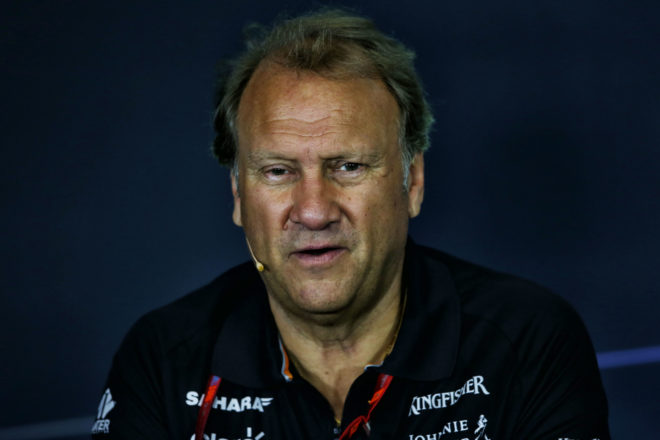
Disparities in FOM payouts, not acceptable but we will wait for liberty…: Bob Fernley

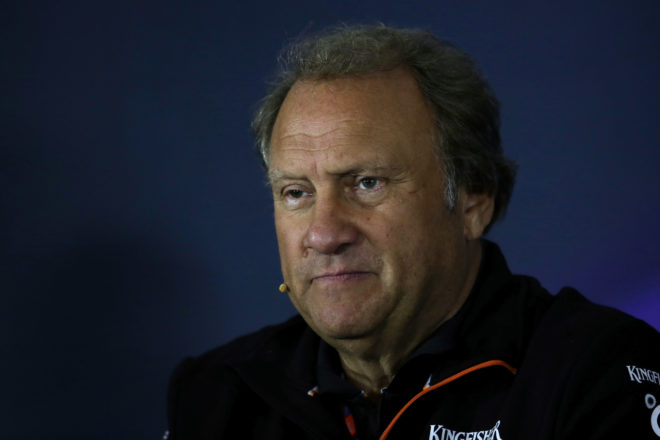
Bob Fernley at FIA press conference on Friday. A Sahara Force India image PART ONE: TEAM REPRESENTATIVES – Cyril ABITEBOUL (Renault), Robert FERNLEY (Force India), Toto WOLFF (Mercedes)
PRESS CONFERENCE
Q: Today is the FIA Volunteers’ Day and there will be a ceremony later this afternoon on the pit straight to honour their contribution to motor sport. Perhaps a word from you all on the work of the volunteers?
Toto WOLFF: Well, we wouldn’t be able to go racing without the volunteers and it’s something that isn’t so visible to the public that with the many devoted and engaged people, all around the world on the racetracks, they enable us to put on a show, so it’s definitely a good little exercise to do and honour them.
Cyril ABITEBOUL: Nothing much to add. Motor sport is a bit strange in that it’s just a few that get elected to race or even be in the garage but it’s a sport that involves a lot of people, whether in the garage, mechanics, at the factory, but also around the track and taking part with the federations around the world. Yeah, it’s a great opportunity to honour their ongoing commitment.
Robert FERNLEY: Yeah, without doubt they are the unsung heroes of motor racing across the board, not just for Formula One. We must remember that they do great work outside Formula One, which we’re very focused on. I think people forget that weekend-in, weekend-out they’re there, so great honour.
Q: Thank you. Moving back to you Cyril. Good qualifying pace so far this season, but perhaps not unlocking all the race results you might have hoped for. Why is that?
CA: Well, part of that is it’s still a year where we are still in a construction phase. So in talking about construction it’s easier to qualify and extract maximum performance off a given package on one lap, on a short run, which is what we are doing consistently since the start of the season. We know also that we have fragile reliability and that’s really our area of focus. It is hitting us regularly, during races and also during Fridays, in the preparation of the race typically. Usually we have a good group of people who is managing or setting up the car properly for qualifying but when it comes to really managing the car and fixing the issues for a longer run, that’s really down to how reliable we have been over the weekend. So that’s really something that is hitting, which is biting on regular occasions, so that is the area of focus for the time being. We also have a great qualifier in Nico. He’s also clearly leading the way on race pace. Jo has not been very favourite in the conditions… he’s had on many occasions adverse conditions in his weekend. The only weekend he had a clean weekend, which was in Bahrain, he managed to be in Q3. So that is what we are trying to repeat because we think that the car also has a better pace on Sundays, so that’s the target for this weekend.
Q: From which race onwards are you hoping to unlock the full potential of this 2017 Renault engine?
CA: The full potential of the engine is something that will take a number of races with the existing hardware. You know that constant development, that constant improvement… based on the existing hardware there is more to come in performance and that’s really down to how quickly we can fix the reliability issues. I guess that will be down to the introduction of power unit number three. We may or may not change the hardware to extract more power but irrespective of the hardware there will be more power coming that’s for sure. So it’s all down to the engine introduction plan.
Q: You mentioned Jolyon Palmer there, obviously he has had a few difficulties. What are you saying to him behind the scenes and what do you foresee for him for the rest of the season?
CA: Well, the main thing we have done is that we’ve been through what has happened since the start of the season, including the winter test, when we were in Barcelona and he already had difficult conditions to deal with. So, limited mileage over the winter, a number of reliability issues in preparation for the first four races, which has not been helpful, and clearly he has a very talented team-mate, which is clearly showing what the car is capable of. But having said, Nico is not a magician, and that’s what I’m telling him. He has shown that on occasion he has definitely the pace to match his team-mate, so it is on that we are focusing. And we are making sure that he now has a clean weekend so that he can build his confidence, that we can rebuild his confidence in himself.
Q: Robert, double points in every race so far, you’ve got to be happy with the way your 2017 season has started and with both of your drivers appearing to be well and truly on it?
RF: Yeah, from our point of view, after the testing in Barcelona we knew we had a slight performance deficit and it was always going to be down to making sure that we extracted the optimum from the races and the team, the drivers, fantastic job, absolutely superb.
Q: So the big question is can you keep it going? You’re up against some fairly tough opposition in this midfield, not least Cyril. Of course you’ve got Williams to think about, Toro Rosso as well. How important is the update pack you’ve brought here this weekend and what has it given you so far?
RF: I think like all teams we’re looking for direction more than physically upgrading at the moment. It’s the direction that we need to be able to develop for the rest of the season. I think what we have seen so far is very promising and we’ll take it through going forward for the next races. Hopefully Renault’s problems will remain large ones and we can keep going!
Q: Toto, first of all a word on this dramatic looking, updated car that you’ve brought here this weekend. Did it perform according to expectations during the practice sessions?
TW: Yes, so far we are happy with the correlation and the results of the two Friday sessions and the car certainly looks very sophisticated. But it’s the interaction of all those bits that overall should make us achieve a performance gain. But Friday is pretty early days in the weekend. Tomorrow afternoon you’re going to see whether there is a real effect.
Q: Valtteri Bottas won his first race last time out. You’ve had an interest in him for many years, what did you feel personally to see him winning a Formula One grand prix?
TW: I’ve known Valtteri for 10 years so it’s clear that achieving his target to win a race is something special but in my position it’s about the team’s interests and having a Mercedes winner is great. Having a Mercedes challenger for the world championship or even winning a world championship and I’m behind both of them and we’ll be cheering whoever wins.
Q: It was important that he won, with an all-Ferrari front row for that race in Russia. It could have been costly for you in the world championship, when Lewis was clearly having an off day. What did the debrief reveal?
TW: Valtteri had a very good day because he was able to exploit P3, which is probably the best starting position in Sochi and used the slipstream down to Turn One and from thereon controlled the race. Considering that a four-time world champion was close behind him in those last laps, he did a very good job. As for Lewis, he was in traffic. We were a bit marginal with the cooling and that’s why he had a car that was not able to deliver maximum performance at all times. We could see that there were glimpses of performance but if you run into hot air and the car is heating up too much there’s not a lot you can do. From there it’s a difficult situation for the driver and the team and there wasn’t a lot we could do.
QUESTIONS FROM THE FLOOR
Q: (Peter Windsor– Motorsport Network) Toto, what about Lewis’ problems in sector three? We heard talk of diff, traction that wasn’t that happy with. What were you able to look at after Russia? I presume there was nothing broken on the car or anything like that, but can you give us more insight into what the problem was for him?
TW: The interaction between the chassis, the suspension and the tyres is new ground for every team. And you need to understand how you make each of those various tyre compounds function. We tried to fix out, we tried to cure a problem that was created in the interaction of those two components by giving different diff settings or by trying to switch the brake balance back and forth. Just to give it a go or give it a try. It is a more fundamental issue. You need to have a car that is stable in the window, that has the basic performance and then translate that into qualifying performance and race performance and if you add to the equation a new compound or various new compounds it becomes a difficult exercise and that is one of the key topics we are looking at the moment.
Q: (Graham Harris – Motorsport Monday) The FIA has mandated that all driver numbers and driver names are clearly displayed on cars from this race onwards. Looking at it this morning it seems that some teams have embraced it wholly and included it in their new colour schemes and that others have perhaps paid lip service to it. Could all three of you give your opinion on it and whatever you think it’s a good move?
RF: I think it’s a good move from the FIA, probably overdue in all fairness. I think that perhaps some time out, when all the commercial agreements that we currently have, that’s across all the teams, come to an end they should standardize where the numbers go and make sure everything is clear for everybody going forward. At this point I think you have to do the best you can with whatever you have from a commercial agreement and I think all of the teams have tried their very best to embrace it.
TW: Bob just summarized it pretty well. It’s trial and error. We played around with various designs. Some of us like the look of it, some of us don’t. We took a little bit off after P1 and just have the number now. But with all aesthetics, it’s mixed feelings.
CA: Exactly the same. It’s a good move from the FIA. It’s something that maybe should have happened earlier and hopefully they will make sure to standardize. Just like in any other sport, where you know where to find the name and number of any player on the soccer field or anything. That’s the sort of thing where you want to have a standard position, so as mentioned as soon as the sponsorship contracts are falling out you want to make sure to seize the opportunity, that window, to impose what it is should be. Formula One. Formula One should be at the top of the sport in terms of presentation, the standard of presentation, so that’s what should happen sooner rather than later.
RF: Just to add to that, I think it’s the number that is more important element, because now that the drivers have got numbers throughout their career I think the promoters would ideally like to see the number prominent rather than worrying too much about the same, so I think that would be the right move going forward.
Q: (Sven Haidinger – motorsport-total.com) Toto, the Mercedes car is a little bit difficult in terms of the set-up to get it into the right window. Are you missing Nico Rosberg a little bit in terms of that, because Lewis has taken the set-up a couple of time from him and he’s one of the most experienced guys in the team or has been?
TW: Certainly if you have the experience of Nico who has been in the team for a long time it is always helpful, but Valtteri has filled those shoes pretty well. He’s similar to Nico, an engineering-minded driver, and it’s more in those early stages of the season to understand the basic product, the car, the architecture of the car, suspension, kinematics, so I wouldn’t see it as a deficit.
Q: (Sam Collins – Racecar Engineering) It looks like the UK is heading towards a so-called hard Brexit and that could have serious implications for the Formula One teams based in the UK, especially for the ones with engine suppliers who are based outside the UK, such as Cyril and his customers. With no single and no freedom of movement of EU citizens into and out of the UK, what implications do you forecast it having for you, what contingency plans have you put in place – that in respect of customs reflecting the lead times and recruitment going forward for the 2019 season?
CA: Thank you for the question! We will have to see, because there were already a number of forecasts when Brexit happened that a number of things would happen which have not happened so I don’t think it’s for me to comment on what’s going to happen or not. The main elements will be currency and it has had frankly a positive impact on all of the UK-based teams so in that respect that’s good news for us strangely. We have to see long-term how that evolves because that is not a situation that is sustainable. Then we will have to look at the movement of staff, because clearly we need to attract talent from everywhere around the world and we need to make that the UK remains a place that is welcoming talents from wherever they are. We have lots of movement of staff between France and the UK. That’s something we will look at carefully. When it comes to transfer or goods that is something that is not bothering us, in the sense that the engine, if that’s what you are referring to, are actually leased, the ownership is not passed on to the UK entity and that’s the same with all our customers, so VAT should be neutral in that respect. Obviously we have to be careful but when it comes to be contingency plans, no, we don’t really have a plan as we are building new buildings in Enstone in the UK, we don’t really have a plan to move that we are currently building somewhere else. We are still assuming that people will be reasonable and we trust the UK to protect their industry and motorsport is an important industry for the UK.
TW: Cyril has given us a 360˚ view. There’s nothing to add to that. We are monitoring it. Hopefully it will turn out well. I like to work in the UK and I’d like to continue to work there.
RF: Unfortunately I’m probably a little bit older than these two and I remember when we used to do it before we had the EU, so it’s not an issues and we still do an awful lot of races today where we still go through an awful lot of compliance issues so I don’t really see it as an issue at all.
Q: (Alan Baldwin – Reuters) A question for Bob really. Some projected figures came out during the week about FOM payouts to teams for 2017. There are no great surprises but yet again your team, despite finishing fourth, seems to be getting less than half than the top three and less than McLaren even. Just some comments on how you see things panning out with the new owners and whether you see any progress being made on redistribution in the future?
RF: I think my position on this is pretty clear. I have been very much a strong voice against these type of things for the last couple of years. But I think what we have to do now is support Liberty and the new owners as they are making noises and definitely looking into trying to address both costs and income distribution. Let’s give them an opportunity, the key thing is to support them going forward. The disparities are not acceptable as far as we are concerned, but as I say I think time will tell.
Q: (Sergio Alvarez – One Magazine) Question for Toto: do you believe the changes in your technical direction may have hindered your understanding of the car? How are you managing the transition in the technical department from Paddy to James Allison?
TW: There are figureheads that are present in the media: some more, some less, that represent the team – but it’s an organisation of 1,000 people – almost 1,000 people – that run a team and especially in the area of tyres, race delivery, race track engineering, the situation is unchanged. We have a great team that is there, that has been in place for many years, that is looking after these components – and I’m extremely happy with how they’ve tackled the situation until now.
Q: (Sef Harding – Xiro Xone News) This is for all three of you, since Fernando Alonso’s announcement to go to the Indy 500 there’s now a debate created between IndyCar and the comparison to F1 and the differences in terms of show, presentation, and as you Mr Fernley said earlier, the presentation, would you be willing to work in depth with the new owners to make a better show for the viewing audience as well as the fans in attendance that come from all over the world to watch the sport in terms of opening up the paddocks more, making it more accessible for the drivers, making it more accessible for the pits. We saw that they bought down a two-seater car and are giving tours now. Would you be willing to do the same for viewing fans that are coming to the race?
RF: Having done both IndyCars and Formula One I can speak from a reasonable amount of experience on that. IndyCars is a fantastic show, especially the Indy 500, there’s no question of that. Can we get more access? I think we can. I think we can learn a little bit from IndyCars but overall we are Formula One and we’ve got to keep that identity as well. I think that Liberty understand that. I think they’re working to getting it more inclusive but, on the other hand, keeping it where it needs to be – which is slightly exclusive as well. So it’s a balancing act and I’m sure they’ll do a great job. They have all the expertise to be able to look at that.
Toto?
TW: Yes, the Indy 500 is one of the great races and the concept is completely different to what we have. The oval, per se, gives different access and it’s a one-a-year event. If you look at the IndyCar series overall, they’re far away from where we are. Having said that, I think Fernando going to Indy is a great opportunity for him, it’s an opportunity to create some good news around the team again, and they need that, and it has given Formula One more exposure in the US, so overall I think it is a good exercise.
Cyril?
CA: Yeah, I would agree that there is definitely lots to learn from other sports. To a certain degree we tend to, y’know, we’re not necessarily all very old but we still spend quite a lot of time in Formula One, so having some people showing us what can done outside – whether it’s new owners, new management but also F1 drivers getting experience outside F1 and returning to Formula One, I think it’s great. We need to constantly benchmark. We are in a competition – not just in Formula One but Formula One is in a competition against other sports properties – whether motorsports or other forms of sports – because that’s where all sponsors, all carmakers, all fans will look. They are benchmarking us, even if they don’t realise they benchmark: they always have multiple choices when it comes to looking at a programme, buying tickets… they cannot follow all the sports so we have to make sure to remain at the top of the offer. And that’s great, to finally have the opportunity of a fresh breathe of new air coming and influencing us – but as mentioned by Bob, we need to keep our identity. I think this exercise will kick off under the influence of all these new sorts of people: what is the core identity of Formula One? That will be an exciting exercise to do, starting with, for instance, engine topics.
Q: (Dieter Rencken – Racing Lines) Primary question to Toto and then a follow-up question to the other two. Toto, there’s a very strong rumour, or suggestions, that Mercedes-Benz is going to offer some form of technical assistance to Honda. Would you care to comment on that please. And then to the other two, should such a concept of one winning engine manufacturer helping another one, should that be allowed in Formula One.
TW: At that stage I wouldn’t want to comment.
You’re not excluding it then?
TW: I’m not commenting.
Cyril?
CA: I cannot comment on a no comment.
Bob?
RF: I’ll comment! As a team that’s not only paid for its engines but contributed to the development of them I would certainly be very negative towards sharing that technology with another team that it a competitor of ours.
Q: (Ralf Bach – Autobild Motorsport) A question to Toto. Is there a possibility or, let me say, how big is the possibility that next year drivers, by example Fernando Alonso or Stoffel Vandoorne, driving a Mercedes engine without moving to your team?
TW: What are the options? They are driving a Honda engine like it is today and it looks like this is the current situation or different engines. I think it’s important for Formula One… Honda is important for Formula One. It’s a massive and very successful company and I have no doubt they will eventually be where they expect themselves to be. So, I don’t think they are going to drive a Mercedes engine.
Q: (Mike Doodson – Auto Action) This is for Toto. Bit more lighthearted. You and your fellow Austrian Niki Lauda seem to be the TV face of Mercedes AMG. You’ve known each other a long time. I wonder if ever you’ve ever had any disagreements with him on strategy or whatever – if you could let us in on any of the little disagreements you might have had in the course of your association.
TW: Well, we’ve been doing that for quite a while. We had a certain period at the beginning of our relationship where we were both thrown into the team, where we needed to find a way of making decisions in a committee and not alone like we’ve both done our whole lives. But since then our relationship has contributed in a good way, I believe. He’s a completely different personality. For me, he’s the personification of pressure – and pressure’s good sometimes. He certainly has a lot of experience and has been around for many years and I enjoy working with him. Niki says he has no friends – but when we won one of the last races, we were on a flight together and in the plane he had an emotional moment and said he hasn’t got any friends – but he has a half-friend now. So I consider myself our-performing some others. He’s somebody that I value and enjoy being around. Disagreements? Permanent disagreements for the benefits of the company. We are able to come into discussions with two different standpoints and walk out with one – and that’s good.
Q: (Jon McEvoy – The Daily Mail) Toto, just building on what Dieter said, in this new open world of disclosing things to the media, which Liberty Media say that they’re in favour of. Can you really not elaborate, in the name of openness, about what you’re doing with Honda? The work that I’m sure many thousands or millions of fans in Formula One would wish to know, which in a sense, strikes me as quite straightforward, to be upfront about the work that you guys might be doing with them in developing their engines.
TW: I understand your standpoint. We are not doing anything for Honda. That is the current status quo. So, unless that situation changes, I don’t want to contribute to rumours out there, that are false and I think are damaging for Honda and create hardened standpoints from teams or from other stakeholders. We’ll see what happens.
eom/FIA transcript of the press conference
-
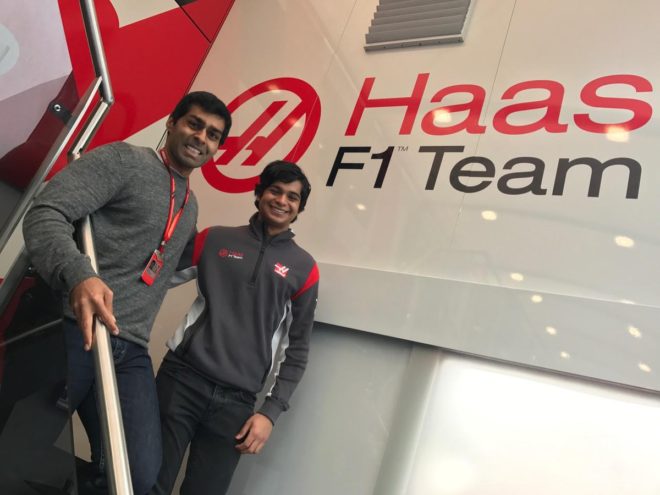
Arjun Maini takes a big step towards F1 seat, joins Haas team as Development Driver
Nineteen-Year-Old Racer born and brought up in Bengaluru will be the third Indian to race in Formula One, if he gets a drive, and the position as Development Driver is a right step in that direction
Bengaluru, 11 May 2017: Motorsports fans and aficionados got a breath of fresh air with the pleasant news this afternoon that Arjun Maini, an Indian GP3 racer, will make an entry into the world of Formula One. After a gap of five years, an Indian will become part of an F1 team again to fulfill the much-awaited dreams of many a racing fan.
Haas F1 Team announced from Barcelona on Thursday that it has signed Arjun Maini as a development driver ahead of the Spanish Grand Prix on Sunday. Maini will join the team alongside 18-year-old American Santino Ferrucci. Haas, the American team, has been racing in the F1 2017 season, with Kevin Magnussen and Romain Gorsjean as its main drivers.
Bengaluru boy, the 19-year-old Maini, is competing in the GP3 Series for Jenzer Motorsport after running 14 of the 18 GP3 Series races in 2016. Despite missing the first four races, Maini finished 10th in the championship standings with a best finish of second, the podium he earned on July 23 at the Hungaroring in Budapest.
Maini has interacted with the media today at the Haas F1 Team hospitality in the paddock at Circuit de Barcelona but was not immediately available for comments. However, he sent his quotes through an email through the team.
“It’s an honor to be a part of Haas F1 Team’s driver development program,” Maini said. “All of my racing to date has been with the focus of becoming a Formula One driver, and this opportunity puts me one step closer to my goal. I am eager to learn, understand and experience how a Formula One team operates. Everything I learn can be used immediately in GP3 while preparing for my ultimate goal of Formula One.”
Sponsors and big-finance plays a big role in getting a seat initially in F1, even for talented drivers and it is heart-warming to note that Maini made it without paying funds. But apart from the huge money required in the process of gaining an entry into F1, drivers face a huge challenges of different kinds.
To compete and develop as a competent driver of high standard in India has been a big challenge and the youngster and his supporters, especially his father Gautham Maini, have patiently and painstakingly endured the hardships to see his potential blossom into a development driver slot and the real battle begins now as he makes the last push for an F1 seat.
A few years back, India’s youngest F1 driver, Karun Chandhok was impressed by the talent and dedication of Arjun Maini and stated that he looks forward to helping the teenager become India’s next Formula One driver. And true to his promise, the current F1 commentator and Le Mans driver played a mentor’s role to get Arjun the break through.
To put Arjun’s qualities in right perspective, it is best to remember what Karun said when the youngster was just 15: “Arjun has no ego and he is ready to listen to advice from team and people like me who have been there and done it. A lot of drivers are out there, but the only thing that will set you apart in today’s world is the hard work you put in outside the car with the engineers and the dedication you show in fitness training. Arjun has worked sincerely in that direction and grasped the nuances fully and I can assure you that his work ethic is fantastic.”
In an email message from the Spanish paddock to www.INDIAinF1.com, Karun said: “I’ve been managing Arjun along with his father for the past few years. Since the back end of last year we were working on a link with an F1 te
Karun interviews Arjun in the paddock. A Haas image am and it took a few months for his dad and I to work with Guenther Steiner and the team at Haas F1 to get here. It’s a good first step into the F1 world and Arjun will learn a lot. How we convert this to a race seat in F1 will largely be down to his season in GP3 which starts this weekend.”
“Still, I feel very proud to be one of India’s only 2 F1 drivers thus far, and I hope to help him expand that club in the future,” he concluded.With a rich heritage in Indian Motorsports, J.K.Tyre has supported Arjun since the age of 9. The company seeks to promote and nurture young racing talent in India and have backed almost all the Indian drivers who have made a mark globally. Arjun is proud to continue his association with the company that has backed since his karting days into 2015, and has seen him race primarily across Europe.
Talking to this website, Sanjay Sharma, Head of Motorsport, JK Tyre Motorsport, said: “The kid is on the right track. A good opportunity has come his way. I only pray he proves his worth going forward and convert this prospect into a seat in the highest echelon of motor sports.”
Like Ferrucci, Maini will be embedded with Haas F1 Team at every opportunity, attending races and tests throughout the year while also participating in the team’s simulator program.
Haas F1 Team made its debut in 2016, becoming the first American Formula One team in 30 years. Now in its second season, Haas F1 Team is looking to build upon its impressive first year, where it finished eighth in the constructors standings with 29 points.
“As Haas F1 Team continues to mature, we must look toward our future and develop potential talent,” said Guenther Steiner, team principal, Haas F1 Team. “Arjun was successful in karting and has transitioned well to various Formula series and now GP3. We’ll keep a keen eye on his progress this year.”
The GP3 Series runs in conjunction with Formula One May 12-14 at Circuit de Barcelona – Catalunya, July 7-9 at the Red Bull Ring in Spielberg, Austria, July 14-16 at Silverstone Circuit in England, July 28-30 at the Hungaroring, Aug. 25-27 at Circuit de Spa-Francorchamps in Belgium, Sept. 1-3 at Autodromo Nazionale Monza in Italy and Nov. 24-26 at Yas Marina Circuit in Abu Dhabi, UAE. The only non-companion race weekend is the penultimate round Oct. 6-8 at Circuito de Jerez in Spain.
Maini earned his first title in 2007 when he won the Rotax Mini Max National Championship. Numerous wins and podiums followed before Maini began the transition to open-wheel machines. He won the 2013 Formula BMW Super Six Series in Asia and finished second overall in the 2014 BRDC Formula 4 championship with four wins, 10 podiums, five poles and six fastest laps. In 2015, Maini competed in the Toyota Racing Series New Zealand and finished fourth in the standings with two wins, five podiums, three poles and two fastest laps – a performance that led him to GP3 in 2016.
Haas F1 Team debuted in the Formula One World Championship in 2016, becoming the first American-led Formula One team since 1986. Founded by industrialist Gene Haas, Haas F1 Team is based in the United States on the same Kannapolis, North Carolina, campus as his championship-winning NASCAR team, Stewart-Haas Racing. Haas is the founder of Haas Automation, the largest CNC machine tool builder in North America, and he is chairman of Haas F1 Team.
eom/Haas press release
-
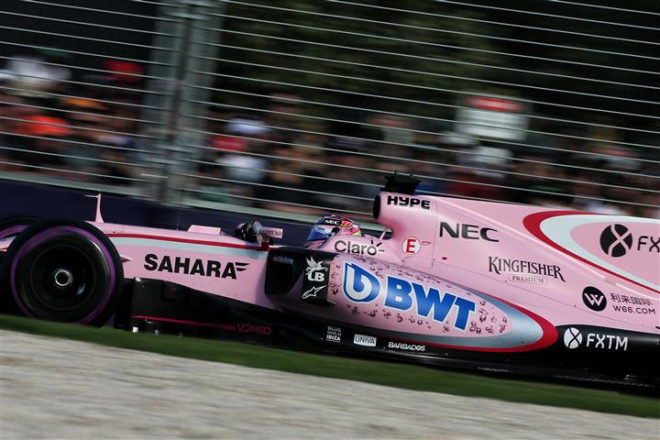
Our planned updates, will hopefully give us a bit more performance: Perez
Sahara Force India looks ahead to round five of the Formula One season in Barcelona, Spain.
Sergio: “Barcelona is a track that really tests a Formula One car. There are some quick corners that feel very special, such as turns three and nine, where you can appreciate the aero performance of these 2017 cars. It’s always a difficult track for overtaking and so there is extra emphasis on qualifying well.
“When you get to Europe, you feel that the season is in full flow. It’s race five – a quarter of the way through the season – and the year is flying by really quickly. I’m very proud of the team and what we have achieved so far. To be fourth in the championship as we arrive in Barcelona shows that we’ve done a really good job in the races so far. Russia was another example of a weekend where we maximised all the opportunities.
“It’s hard to know what to expect this weekend. I think all the teams will bring new things for their cars and it’s the same for us. We have planned updates, which will hopefully give us a bit more performance.”
Esteban: “I’m feeling positive after our performance in Sochi. It shows the results we can achieve when everything goes to plan because we improved the car during each session. The team did an awesome job because I felt comfortable in the car and could really push. It’s a good sign for the races to come and I feel we have lots more potential to find with the VJM10.
“Coming back to Barcelona is an opportunity to see how much we have improved the car since winter testing. It’s a track that shows your strengths and weaknesses because there is nowhere to hide. It’s all about aero performance and having confidence.
“I’m quite pleased to be back in Europe. It’s closer to home and it just feels a bit more familiar because I’ve raced at Barcelona so many times when I was younger. I really enjoy the flow of the lap and there are corners, such as one and two, where you can’t afford to make a mistake because it hurts your speed all the way through turn three. The final sector is also very technical and you need to be very precise with how you position the car to ensure you don’t lose any time.”
Vijay Mallya: “Ahead of the European leg of the season, we can look back on the start of the year feeling pretty happy. We continued our 100% points-scoring record by adding another 14 points in Sochi to consolidate our fourth place in the championship. I’m proud of the team and how we are performing. We’re taking our chances and racing intelligently. Sergio’s remarkable consistency continued with a fourteenth straight points finish, while Esteban secured his best ever result in Formula One with a seventh place. To have scored points with both cars in every race gives me confidence for the rest of the year. We want to hold on to fourth place. Our planned development programme will continue in Barcelona where hopefully we can take another step forward with the VJM10.”
Sahara Force India’s Technical Director, Andrew Green, shares his views about the Circuit de Catalunya and its challenges.
The Circuit de Catalunya is a track we know very well because of pre-season testing, but it’s very interesting to see the development in the car that took place since we were last here. Mid-May is also very different from February: the increased temperatures make it a very different track from the one we tackled back then. Compared to Russia, it’s a much harder test for the tyres and we expect wear and degradation to be much higher. It is one of the reasons we are using the three hardest compounds in the range – soft, medium and hard. As a circuit, it is a challenge from turn one to the final corner. Driver, car and tyres do not get much rest, although it is fairly easy on the brakes. You have medium- and high-speed corners making up most of the first two sectors, while the final one is mostly low-speed, meaning you have to find the right compromises when setting the car up. Overtaking is very difficult, so qualifying position is crucial: the Saturday afternoon session will be a very interesting fight.
Key Points:
- Combination of low, medium and high-speed corners making it an all-around test for the car
- High deg means we will see the harder compounds make an appearance
- Many teams bringing upgrades for the start of the European season so watch out for surprises.
eom/Sahara Force India press release
-
Smaller teams to take part in F1 Strategy Group meetings
Paris, 25 April 2017: Following a meeting of the F1 Strategy Group and Commission in Paris today (25 April), changes to the sporting and technical regulations have been agreed.
A constructive meeting of the F1 Strategy Group and F1 Commission took place today (25 April) in Paris, with all members in attendance including FIA President Jean Todt and, for the first time, Chase Carey, CEO of Formula One Group.
Below is a summary of what was discussed:
Sporting and technical changes
There have been some corrections and additions to the technical and sporting regulations for 2018, which will now be passed to the World Motor Sport Council for approval:- A number of more integrated solutions for additional frontal protection have been studied, and the decision has been taken to give priority to the transparent ‘shield’ family of systems. The FIA aims to carry out track tests of this system during this season in preparation for implementation in 2018
- Changes in the regulation boxes around the engine cover have been made so that designs incorporating the ‘t-wing’ and ‘shark fin’ will be strictly limited
- Measures will be taken to ensure that oil will not be used as fuel. In addition, only one specification of oil may be used for any given power unit during an event
- Pirelli will be allowed to develop 2018 wet weather tyre compounds using previous specifications of cars and wheel dimensions
- In the event of a red flag period during a race, the race will be resumed from a standing start
Driver names and numbers
Information was given to the teams that, from Barcelona (12-14 May 2017) onwards, the sporting regulations will be strictly enforced to ensure that visibility of drivers’ names and numbers on the cars will be clearer.Strategy Group
Representatives from the non-member teams will now be invited to meetings of the F1 Strategy Group to have access to the discussions, demonstrating the effective commitment of both the FIA and the Commercial Rights Holder to improve transparency in the sport.eom/FIA press release
-
Force India looks to continue the good run in Sochi
Sochi, 25 April 2017: Sahara Force India, after finishing in double points in all the three races till now and climbing to fourth place in the constructors, looks ahead of the 2017 Formula One season as it moves to Sochi, Russia for the fourth round of the FIA F1 World Championship.
Driver’s take: Sergio `Cheko’ Perez:
“I said after Bahrain that I was very proud of my team. We never gave up and dug deep to recover a great result. It was even more special because we continued our run of races in the points – it’s now thirteen consecutive races. When we qualified in P18, I thought it would be hard to do it, but we delivered a perfect race and really deserved this result.
“I think the start of the season has gone really well and we can be happy with the results we have achieved already. The team has done an excellent job to read the races, call the strategy and take the opportunities. That’s a real strength of this team.
“I have good memories from Sochi and our podium in 2015 shows that anything is possible. I think every driver enjoys turn four because it’s an unusual corner that puts high energies through the car. The rest of the lap is similar to a street circuit. Overtaking has never been easy so there’s extra pressure on getting high up the grid in qualifying.”
Esteban Ocon: “After three races in the points I’m feeling happy about my start to the season. At the same time, I feel a bit of disappointment that we haven’t achieved more. With a bit more luck on my side, I would have come away from China and Bahrain with even more points. Finishing tenth three times in a row isn’t enough for me – I want more!
“Sochi is quite a similar circuit to Bahrain with long straights and low-speed corners. It’s a track I know already, because I raced there in GP3, and it’s a nice challenge. I think turn four will feel really cool this year with the downforce we have in these cars and it’s going to be demanding for the front right tyre.
“Performance-wise it’s hard to predict where we will be. We had a good test in Bahrain after the race and we made some progress with the car, but the middle of the grid is very competitive. We have looked stronger in the races compared to qualifying and that’s why we have picked up points in all the races. Getting some more points remains the goal this weekend.”
Vijay Mallya: “Three races out of three with both cars in the points is a super start to our season. We’re up in fourth place in the championship and making the most of the opportunities. Races such as Bahrain showed our strengths as a team. We never gave up, even after a difficult Saturday, and we raced hard on Sunday. Sergio extended his points scoring run to thirteen races, which is a tremendous achievement and shows our consistency as a team. Esteban did well to score another point and we are pleased with his performance so far. It means we can head to Russia in good spirits and determined to pick up some more points.”
Brad Joyce, Esteban Ocon’s Race Engineer, talks about the technical challenges of the Sochi Autodrome.
The circuit in Sochi is very challenging for the car and very different from the tracks on which we have raced so far this year. There are a lot of low- and medium-speed corners that require heavy braking; at the same time, you have some very fast corners – turn three and 12 in particular – that can take the life out of the tyres. Fuel management is important as you spend a lot of time on full throttle: this track actually boasts the highest race fuel requirement in the whole calendar. The track surface is smooth and we expect lower tyre degradation compared to the first races of the year, so we are back to the softest compounds of the Pirelli range. Like in Bahrain, proximity to the coast can make this place very windy so we will need to be able to adapt to changing circumstances on Saturday and Sunday.
Key points:
- many low- and medium-speed 90 degree corners
- very high full throttle time, highest fuel requirements of the year in the race
- smooth tarmac with low tyre degradation.
Sahara Force India’s SOCHI TOP 5 – Wander around Olimpiyskiy Park in Adler and marvel at the stunning venues of the 2014 Winter Olympic Games.
– Stop over at the tiny Khachapuri cafe to try the eponymous Caucasus delicacy, a filled Georgian cheese bread.
– Have a bit of time after the race? Head inland to the Vorontsovskaya Cave to see stalactites and other formations. The drive to the caves is very scenic so keep your cameras ready.
– Visit the Park Riviera amusement and spot the palm trees – they have been planted by Russian cosmonauts!
– Enjoy a Black Sea sunset on the pedestrianised promenade overlooking Sochi’s rocky beach.eom/Sahara Force India press release
-
Celis Jr completes 71 laps for Force India
Bahrain, 18 April 2017: Unmindful of team principal Vijay Mallya’s arrest and subsequent release on bail, the Sahara Force India successfully completed the first day of testing at the Bahrain International Circuit, with Alfonso Celis Jr. behind the wheel.
With a best lap time of 1:33.939, Alfonso Celis Jr. finished tenth in the order but his 71 laps were very useful to the Force India programme.
Alfonso said: “It was a straightforward day for me and I completed more than a race distance. There have been a lot of changes since I last was in the car in Barcelona and the first few laps were a bit of a learning process. Fortunately the aero programme at the start of the day gave me some time to get used to the car again. We were able to complete some performance runs in the afternoon, but I ran into traffic each time so I couldn’t really take everything out of the car. The temperatures out there were much hotter than I’ve ever experienced on these tyres and it was useful for me to understand how to manage and look after them. All in all, I felt pretty comfortable in the car and I am happy with my performance”
Chief race engineer Tom McCullough said: “It was not a trouble-free day with our programme disrupted by the numerous red flags for other cars, which always seemed to come out at the worst possible times. Despite this, we managed to work through our priority test items and will try and catch up with the remaining tasks tomorrow. We had a busy programme with aerodynamic rakes fitted to the car carrying out mapping and correlation work, even though the windy conditions made the latter quite difficult. Alfonso quickly settled back into the VJM10 and drove very sensibly to help us get through our test programme. He didn’t make any mistakes and showed good improvement. Our race drivers will be back in the car tomorrow for the final day of testing.”
-
Marquez takes fourth consecutive pole in Argentina
Marc Marquez achieved another milestone in his career today, taking his fourth consecutive Argentinian pole position (out of four visits to the Termas de Rio Hondo Circuit), his 38th in MotoGP, and the 66th of his career, setting a new record across all classes of the Championship, at only 24 years of age.
Marc was the only rider who was able to get into the 1’47” range in the wet conditions that affected the qualifying session.
Dani Pedrosa also made the best of a tricky situation after a morning drizzle prevented him from getting a top 10 result in FP3. Forced to participate in QP1, he set the fastest lap in that wet session to join his teammate in the fight for the top positions, ultimately qualifying on the second row with the fifth-fastest lap time.
Weather forecasts indicate dry conditions for tomorrow’s MotoGP race, which will get underway at 4 p.m. local time
Pull&Bear Aspar team adds:
The Grand Prix of Argentina is set for its fourth edition tomorrow at the Autódromo de Termas del Río Hondo and for the fourth time it will be Marc Márquez who starts from pole position. The Spaniard produced a masterclass in wet conditions this afternoon to leave his closest rival trailing by some seven tenths of a second. That man is Pull&Bear Aspar rider Karel Abraham, who produced a stunning performance to clock a 1’48.275, narrowly holding off fellow front row starter Cal Crutchlow by 0.003 seconds to secure second place on the grid.
With the majority of factory riders missing out on Q2, Abraham made the most of his opportunity to record his best ever MotoGP qualifying result (his previous best was sixth at the British GP in 2011 when just sixteen riders started) and the best ever grid position for the Pull&Bear Aspar Team in this category.
His team-mate Álvaro Bautista had also qualified directly for Q2 thanks to his fifth best time in free practice but he wasn’t quite able to match his dry performance in the wet and will start from tenth. The Spaniard is hoping that the weather improves for tomorrow so that he can return to the sharp end of the field in the race.
2nd Karel Abraham 1:48.275 (7 laps): “”This feels amazing, it feels just great. The conditions today have been really bad since this morning but I really enjoyed qualifying. I love this circuit, which helped, and yesterday we made a strong start. I knew it would be difficult for us to prove that we could stay at the top today and tomorrow it will be even harder but our targets have not changed. We know what we want and what we need to achieve and we will work for that. This result puts us at a great advantage for tomorrow’s race.”
-
I am still positive about our weekend: Sergio Perez
Shanghai, 7 April 2017: Friday’s second practice session for the Chinese Grand Prix was cancelled due to poor weather conditions that prevented the medical helicopter from operating.
The first session at the Shanghai International Circuit had already been disrupted due to the helicopter not been able
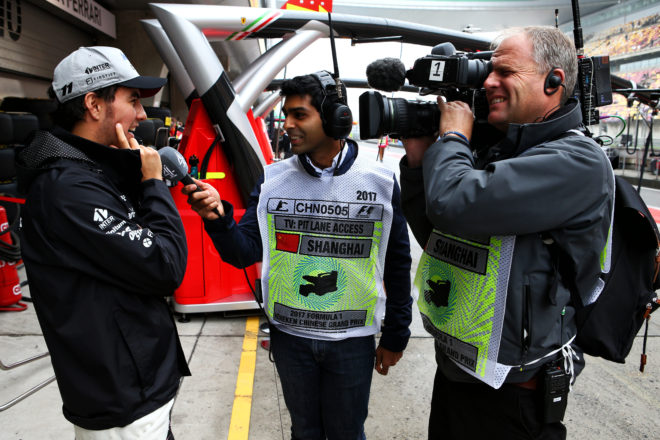
Karun Chandhok interviews Sergio Checo Perez on Friday. A Sahara Force India image to land at the hospital designated for the event, and with little improvement in conditions in the following hours, the start of the second practice period, scheduled for 2pm local time, was delayed. Eventually, with around 12 minutes remaning in the time allotted, the decision was taken to cancel the session.
Sergio Perez of Sahara of Force India who could just do three laps was seen talking to Karun Chandhok and later he said: “It’s always frustrating when you cannot do any running because it’s a lost chance to prepare for the weekend. It’s also a shame for the fans: the grandstand had a good crowd and they have been so supportive throughout the day. The hope is that the rest of the weekend will give them something to cheer about. Missing all today’s running is a challenge, not just for tomorrow, but also for Sunday because FP3 is a very short session to recover all the lost ground. I am still positive about our weekend: I think today’s lack of running can turn into an opportunity for us and I hope we can benefit from it and come away with a strong result.”
Verstappen quickest in truncated FP1
Max Verstappen set the fastest lap of opening practice for the Chinese Grand Prix in a session heavily disrupted by red flags.
In damp and cool conditions Verstappen found a gap between two lengthy stoppages to post a best time of 1:50.491 on intermediate tyres, a lap that put him almost 1.6s clear of Williams’ Felipe Massa.
The session got under way at the scheduled time but was halted soon after as weather conditions elsewhere in Shanghai made it impossible for the medical helicopter to land at the hospital designated for the event.
The first red flag period lasted for almost 45 minutes but once the green light appeared at the end of the pit lane the opportunity for teams to get their weekend preparations under way was brief.
With the track still damp most drivers appeared on the blue-banded wet Pirelli tyres before moving quickly to intermediates, with Williams rookie Lance Stroll establishing a benchmark of 1:52.507.
Verstappen thought was quickly into the groove on the green-banded tyres and as the track improved he moved ahead of Stroll with a lap of 1:52.266 before cutting almost two seconds off that time with a lap of 1:50.491. The Dutchman only turned four laps during the session however.
With Massa second and team-mate Stroll anchoring third place for Williams, fourth place in the session went to Toro Rosso’s Carlos Sainz, who in his five laps set a best time 2.349 adrift of former team-mate Verstappen.
Sainz was followed by Haas’ Romain Grosjean and then by Toro Rosso team-mate Daniil Kvyat who was the last man to finish within three seconds of Verstappen.
Fernando Alonso was seventh for McLaren ahead of Red Bull Racing’s Daniel Ricciardo and Mercedes’ Valtteri Bottas. The top ten order was completed by Haas driver Kevin Magnussen, 4.613 behind Verstappen.
With half an hour remaining Nico Hulkenberg spun his Renault into the gravel traps at Turn 3 and by the time his car had been recovered the red flags were being displayed again, as once more the helicopter could not operate. With no let up in the inclement weather conditions in sight, the decision was eventually taken to end the session early.
2017 Chinese Grand Prix – Free Practice 1
1 Max Verstappen Red Bull 1:50.491 – 4
2 Felipe Massa Williams 1:52.086 1.595s 7
3 Lance Stroll Williams 1:52.507 2.016s 7
4 Carlos Sainz Toro Rosso 1:52.840 2.349s 5
5 Romain Grosjean Haas 1:53.039 2.548s 6
6 Daniil Kvyat Toro Rosso 1:53.314 2.823s 4
7 Fernando Alonso McLaren 1:53.520 3.029s 5
8 Daniel Ricciardo Red Bull 1:54.038 3.547s 7
9 Valtteri Bottas Mercedes 1:54.664 4.173s 4
10 Kevin Magnussen Haas 1:55.104 4.613s 8
11 Nico Hulkenberg Renault 1:55.608 5.117s 6
12 Stoffel Vandoorne McLaren 1:57.445 6.954s 4
13 Marcus Ericsson Sauber 2:15.138 24.647s 4
14 Antonio Giovinazzi Sauber 2:15.281 24.790s 4
15 Jolyon Palmer Renault – – 3
16 Sebastian Vettel Ferrari – – 2
17 Kimi Raikkonen Ferrari – – 1
18 Esteban Ocon Force India – – 2
19 Sergio Perez Force India – – 3
20 Lewis Hamilton Mercedes – – -
We will fight to keep the fourth place, the whole season: Bob Fernley of Force India
Robert Fernley, Deputy Team Principal of Sahara Force India at the FIA Friday press conference. A Sahara Force India image TEAM REPRESENTATIVES – Cyril ABITEBOUL (Renault), Monisha KALTENBORN (Sauber), Robert FERNLEY (Force India), Franz TOST (Toro Rosso), Guenther STEINER (Haas)
PRESS CONFERENCE
Cyril, clearly you’ve made a lot of progress with your power unit over the winter,but it hasn’t all been plain sailing. Can you give us an insight into where it still needs a little bit of work and when you expect to have some solutions in place?
Cyril ABITEBOUL: Well, I think it’s fair to say we had a pretty good 2016 season from a power unit perspective, but we’ve made a bit of a brave decision to actually re-start from scratch again, because frankly in Formula One if you don’t move forward you just die. So we had no choice but to accept to take some risks by, again, starting with a whole new architecture, which we had to do from a performance perspective and we saw that a bit of short-term pain for a longer-term gain. So we are in that period of a bit of pain because we have some weakness related to the, I would say, the health of that power unit, but which on the positive sign is really delivering good promise and good results from a performance perspective. So there is much more to come but that will only come when the reliability is here and that will come in the very soon future.
Can you be a bit more specific about when that’s going to come. When can we expect you to be firing on all cylinders effectively?
CA: We don’t want to go too much into the specifics, because when you start to give planning, everyone is now expecting and in particular we have very demanding customers and they are right to be demanding customers, but we want to continue to control our destiny and our programme. What I can say is that we are making sure reliability is under control and is as transparent as possible for the customer teams. We will have some fixes in the next few races and there will be some performance upgrades with the introduction. But the problem is that with the new regulations, with fewer power units used during the season, obviously you need to sync up the performance, reliability upgrades and the introduction of new power units.
There was a recent meeting in Paris to discuss the future engine regulations in Formula One. What can you tell us about that meeting? How productive was it?
CA: It was a good meeting. It was a productive meeting, very functional, chaired by the FIA in Place de la Concorde, but with the attendance of current engine manufacturers, plus a number of people interested in becoming engine manufacturers in the future, plus also to get an answer of Ross – Ross Brawn. So it was good, a good meeting which has allowed us to share the diagnosis of the current engine regulation, what we think it was good, what we think is less good and what could be done in order to improve, and the associated process and timing. So I don’t think it’s my duty to communicate upon the result of that meeting. But in general, I believe, and that’s good, that it is a positive sign for where Formula One is going which is in my opinion is a bit more constructive and forward looking than it has been recently.
Monisha, that was some debut by Antonio Giovinazzi in Melbourne. How impressed were you?
Monisha KALTENBORN: Well, we were all very impressed, considering how quickly it happened. When we came to Melbourne with Pascal, there was no indication at all that we’d end up in this situation, because Pascal, being a very ambitious driver, really wanted to driver but when he realized he does have a responsibility to the team and if he is not 100 per cent fit he really needs to say that. We more or less overnight had to make this call and then to see Antonio, who drove the first test for us in Barcelona for, but that’s of course not in any way comparable with the car, what it is now, he still came in there, did a great session, did a good race, no major issues or dramas, so we’re very impressed by him.
What can you tell us about Pascal’s condition and when will he be back?
MK: Well, from a medical perspective he was declared fine to race, already at the tests. The rest is a question of his fitness to the extent that he wants to be able to deliver 100 per cent during the entire race. We’ve heard also now in between from doctors and all that, it is very challenging for the drivers. We heard that from the drivers themselves. He’s working flat out on his fitness. It is very difficult to say, because the body is not that logical or analytical in its development, on what day it’s going to be there but his target and our target is to have him as soon as possible in the car, ideally at the next race, but if not, it will the next one. But clear is that he is our second driver and that’s not going to change.
We’ve just heard from Cyril about the engine meeting that took place in Paris last week. As a privateer team, in what direction would you like to see the engine regulations go?
MK: Well, for a private team it’s extremely important for the costs to come down again. We had reached with the earlier engines a point where we were talking about $8m engines and it was meant to be coming down further and now we just went the totally opposite way. So we want them to come down to an affordable level. But more importantly there should be a certain parity amongst the powertrains. We wouldn’t want that the engine should be the main denominator or differentiator in performance. So what’s very important is the parity and the costs.
Q: Bob, coming on to you, the team was fourth last year, first of the privateers teams, if you like. Can you give us some insight into how difficult it has been to prepare for these new rules in 2017.
Robert FERNLEY: Well it’s not actually been hugely different than normal. We obviously look at the following year’s car very early on anyway. We had a very clear development programme for the ’16 car which the technical team delivered perfectly and, obviously, resulted with the fourth place – but we were also well ahead for the ’17 car. So I think, obviously there is a significant cost involved, simply because there is no carryover in the new regulations but like everything it’s an interesting challenge. We’re starting with a clean sheet of paper and you’d like to think that your technical team can build a car that can do exactly the same again.
Q: You’ve already raced this year’s car once. There’s quite a large gap from you to the front, how to you assess the pecking order at the minute?
RF: I don’t think there’s any question or doubt about that. You’ve got the three top teams that are spending significantly more than the rest of the field and I think that’s the difference.
Q: Is fourth in the Constructors’ Championship a realistic goal for you guys this year?
RF: Absolutely. Absolutely. I think we’ll be fighting, it will be very tough because there’s some very good competition around but that’s probably going to be one of the most exciting positions that’s going to be fought over for the whole season.
Q: Guenther. Melbourne. Positives and negatives for the team. How do you reflect on that race.
Guenther STEINER: The positives, for sure you try to think on the positives but then the negatives always come up. I think qualifying with Romain qualifying sixth on good speed, no luck or nothing, that was good. Kevin wasn’t so good because he struggled in all the practice sessions with one problem or another and he just wasn’t delivered but after qualifying we were pretty happy and pretty positive and then in the race we had the failure, the water leak and the turbo failure consequentially, and you go home empty-handed. You go away knowing that the car is there. We just need now always to get always the potential fulfilled and the potential out of the car in each race track. So, I think in the end it’s positive, even with a little bit of a sour taste.
Q: It’s a very tight midfield this year. Do you think the team has the development capacity to keep at the front of it?
GS: I don’t know. I don’t know what the other people are planning to do. It’s always trying to shoot a moving target here. So, I think I know what we are going to do. We are going to introduce developments. We have a good plan in place but I don’t know if the others have a better plan or if their updates are better. That I don’t know. Looking back in the past, I think our quantity and what we want to do is equal to the other midfield teams. For sure it’s nothing compared with the big three but let’s hope the quality we bring to the race track in development and updates is to be in the race with them.
Q: Franz, great start for the team in Melbourne. How much of a surprise was it to get both cars in the points given your lack of reliability during winter testing.
Franz TOST: Winter testing we were suffering a little bit in the first test with reliability issues but fortunately we could sort out most of the topics for the second test already. Therefore I was not so surprised by our performance – but of course it was good to have two cars in Q3 and then at the finish with both cars in the points. This is always a good start.
Q: You’ve got the most experienced driver line-up in the team’s history, you’ve got a stable technical team. What do you think you can achieve this year?
FT: The target is the fifth place in the Constructors’ Championship – but as my friends here around, they have nearly the same target and we will see. I think that we have a very competitive package, we have a very good car, we have to experienced drivers and the team is also making progress, we have also some development steps during the year and it will became a hard fight between Renault, Force India, Haas and ourselves.
Q: Do you think you can challenge Red Bull Racing?
FT: No. Red Bull Racing is not our target. Red Bull Racing is in another league. I am happy if we challenge successfully the teams which I just before mentioned.
QUESTIONS FROM THE FLOOR
Q: (Jia Hui Huang – Guangdong Television & Radio sports channel) To all of you. Someone says listening to F1 drivers is wrong, it’s bad for F1 racing. As we’ve seen in the first race the drivers are happy because they can push harder – but the fans are not. They are not satisfied. It’s boring. No overtaking. Standard one stop. What do you think. F1 should listen to who?
GS: I don’t fully agree with the comments, that the new cars are boring and everything negative. I’d rather see the glass half-full than half-empty. I think the race in Melbourne was by no means boring, in my opinion. We had a different winner than last year. I think that the fight between Ferrari and Mercedes and Red Bull will be very close. We have got an interesting midfield, there will be fights, the overtaking was not very good but I would not jump to a conclusion yet that this will be the whole year. Like this, it looks like it’s difficult but other elements will come in to overtake, so I wouldn’t say that all the fans are negative about it. There’s a lot of enthusiastic people out there that think the new cars are good – so I’m pretty… I don’t see it like this.
Franz, do you have anything to add?
FT: I agree with Guenther. For me, the race in Melbourne was quite an interesting race because it was a close race. There were many cars within a few tenths of a second and the overtaking manoeuvres in Melboure are always difficult, it was always in the past the case. We must wait now the first three races to get a clearer picture – but the cars are looking much better, much more aggressive and I think the direction was OK. The rest we will see during the season.
Cyril, anything to add?
CA: No, nothing much to add. I believe it’s a little bit too early to judge. We need to give a chance to the product. It’s an interesting formula in many aspects. I think strategy will play a different role, qualifying will play a different role. You will have in this new formula to execute everything perfectly well, so I think it puts the onus on the teams here at track to make sure you get also to the right setup, so everything is perfectly executed. It’s a different challenge, an interested challenge, certainly it is to live from inside. Obviously we also need to care about the fan out there, so answering your question about who we should listen to. We should also listen to the fans – but that’s one of the things I believe Liberty and FOM in its new format, which is also to look at surveys, trying to understand what the fan really wants. Not think for the fan but listen to the fan for themselves.
Bob?
RF: From our side, sitting on the pitwall, we had two drivers that did two incredible overtaking manoeuvres. Certainly it got my attention on both occasions. I think they were exceptional manoeuvres and, from a strategy point of view it’s actually quite interesting because it’s bought a new dynamic into it. We now have both the undercut and the overcut process and I think it’s going to be one of those things that’s going to prove very interesting as we move into the year.
Monisha, anything to add?
MK: Well, it’s all been said. You have to wait and see. It’s just the first race, it’s a very unique race and that’s always been the case. When these rules were bought in, we all knew what the negative sides would be and that the positives side was mainly to have more attractive cars, and I do think most of the fans actually like that. So we’ve achieved one target. And the other issues are to do overall with the competition. We should just take it from here and try to find other things, other rules that we can also target more at the other issues you raise. It’s an ongoing process but I think it’s kicked off very positively.
Q: (Dieter Rencken – Racing Lines) To the four independents or privateer teams and then a separate follow-up to Cyril. Could you see yourselves, given that there’s no clear guarantee of engine parity going forward regardless of regulation changes, could you see yourselves clear to retaining the current engine formula provided the price is dropped? And then to Cyril, given that the manufacturers have spent most of the money already on this particular engine formula, does it really make sense to consider dumping it just when it’s on the cusp of being reliable and highly competitive?
MK: Well, as a private team, we understand that from the engine manufacturer’s perspective you have to represent certain technologies and that doesn’t go against our businesses or our business models as such. Where it’s gone terribly wrong is on the costs. We certainly want a movement that is irrespective of the technology which is being used. The other aspect we – like all other teams, irrespective of if you’re private or not – have to consider is what it’s done to the show and that’s where a lot of criticism is coming from – all the discussions around the sound – and so as a private team, these are more important issues to us and we have to find a balance overall that what is necessary for manufacturers to stay in there, what do they want to showcase in here… but it has to be making the competition a good one, so that we all actually have certain chances in there; it has to be affordable and the fans should like it, because at the end of the day we’re doing this for the fans.
GS: I think, on the cost, sometimes what we were thinking is that the engine which is developed now it’s never finished being developed but it’s at a good level, so I think the cost should come down or you freeze the engine. Sometimes, keeping something you know – and like it was done with the V8s, to freeze the engine spec – that would make it cheaper, if we go for the cheap and a very high technology. So now, jumping to a potentially cheap version of some kind of engine, but starting development from new, could be more expensive than keeping this engine with the high technology just to freeze or to reduce investment, so that’s another idea which needs to be discussed, between the engine manufacturers, but I’m sure they will come up with some ideas and that will be one of the things I guess somebody will come up with, if we keep this. The technology in this engine is amazing for everybody involved in engines, this is an amazing technology, so now we go backwards and maybe invest more money to develop something which is actually not as sophisticated as this. So I think it needs to be evaluated as well, if maybe from a certain point on. All their engines are the same, we freeze the engine like we did with the V8s, that would be a possibility. But again, in the engine group, we as independents have not got a lot of influence so we can just voice our opinion outside of the group and say maybe that’s an option. So I hope they weigh up that option as well because I don’t know, just to go to a potentially cheaper engine, if that’s the right way, and reduce the technology. As Monisha said, there may be an issue with the noise but it will never be perfect whatever we do so there is some give and take and maybe we could live with that.
RF: I think there is a little bit of work which could perhaps be done to address some of the issues, particularly the noise and simplify the base technology, but I think I agree with everybody else. I think that the principle of the current engine shouldn’t just be abandoned, a lot of work has gone into it but I think it could be simplified a little bit. I think a lot of the things that we’re doing perhaps go beyond what even the most sophisticated of fans is understanding, so we could come back a little bit, get the cost right, obviously get the power and the noise right and move forward but you don’t have to throw the baby out with the bathwater.
FT: I nearly agree with what’s been said so far. For me the pillar for the new engine is the parity – there must be a chance that there is parity between the different manufacturers because without it they can’t contribute anything to the show and they do something. It cannot be that some cars are far ahead. We will see now what’s going on during the rest of the season. The second pillar is the costs. The current engine is simply far too expensive. From the technology side, it’s a fantastic engine, it’s extraordinary technology but it’s therefore also very very expensive. And the third point is the noise; we need to bring in some music and these are the criterias and I think, regarding the parity and the costs, this is now in the hands of the people who make the regulations and if the development is restricted from the beginning onwards with very strong regulations then I think we will achieve the goals with the parity and the costs and the sound, it should be able to find a solution that the fans are happy with, the music of this new engine.
Q: So let’s get the view of a manufacturer now? Cyril?
CA: I feel a bit under the spotlight. I think one thing is that we cannot be stubborn, or we cannot be deaf to what obviously we’ve been constantly hearing since we introduced those new engine regulations. I think fundamentally there were very good things introduced with that new engine formula. With the previous V8s, we believe that clearly Formula One had lost contact with the direction that automotive was taking so something had to be done. Maybe we’ve been a step too far, we’ve been a bit moving from something that was a bit too old-fashioned to something that is maybe too modern, too complex, too sophisticated, too expensive. We need to be a bit careful about solutions that seem to be easy like freezing current engines because if we freeze the current engine we will freeze something that is extremely expensive and costs will not go down. Development costs for manufacturers may go down but supply costs to the teams will not go down simply because the bill for material of the engine is extremely expensive because of its sophistication. So I think that again that it seems there is a common view about the diagnosis of the current regulations and what we would need in order to build from there, without starting again from scratch, over and over again, but I think the devil will be in the detail and it’s not going to be that easy to find a solution that satisfies everyone and achieves everything, so I think it will be about prioritising and that’s where I hope that the new process in partnership between the FIA and FOM with Ross Brawn – who has a fantastic understanding of all the complexity involved – will provide a good leadership for the discussion. I think everyone agrees that there should be some element of electrification. We don’t necessarily see some road relevance or contribution to the show to an element like MGU-H, so that this orientation for the future, I think the whole debate would be on the architecture of the internal combustion engine which will be an interesting debate and some things that I guess will keep us busy for the next few months.
Q: What would you like to see, how many cylinders?
CA: There is what I like and there is what we need. I don’t think that Formula One can afford to turn its back on some things that are relevant to the manufacturer, given the current business model of Formula One. Formula One could completely change to a different business model and go for something that is really different and not road-relevant but that would be a brave manoeuvre. As far as I’m concerned, I started with the sound of the V10 and that’s something that I will never forget obviously, but that’s just me. The new generation, the generation that we need to attract – because it’s not just about the current fans of Formula One, we also need to think about the fans that we do not have – those fans have never heard the sound of a V10 and maybe for those fans, getting back to a V10 or V8, is not so relevant. So it’s a complex debate and an interesting debate and I hope it’s going to be done in a constructive and also documented manner and again that’s where I believe all the surveys that are going on, all that will also go on in the course of this year will be instructive for the direction that we need to take.
eom/FIA transcript of the press conference
-
Sahara Force India looks forward to the Chinese GP
Vijay Mallya on Chinese GP: A file photo from Sahara Force India. “I was proud of our performance in Australia. We achieved our objective of getting both cars home in the points and we’ve got our season underway. Psychologically it’s an important boost to get points on the board at the first race.
“Our new livery certainly caught everybody’s attention in Melbourne. Sergio and Esteban were in the thick of the action and both drivers took their opportunities to overtake. Sergio’s experience showed as he delivered another fantastic drive, while our new recruit, Esteban, earned his first point in Formula One. To leave Melbourne with both cars in the top ten was a tremendous team effort.
“Our expectations for Shanghai are similar to Melbourne. The development curve is going to be steep for all the teams so it will be interesting to see the pecking order at the end of the weekend. The midfield pack is exceptionally close at the moment and we need to work hard to stay at the front of that fight.”
Sergio Perez on Chinese GP: “Every time I visit China I see big enthusiasm from the fans. They wait outside our hotel and make special gifts for us. It always gives me positive energy. The size of Shanghai impresses me too. It’s very international and there is so much to see and do. I always make an effort to try the local food. “Our seventh place finish in Melbourne was very satisfying. We beat some cars that had better pace because we made the right decisions with the strategy. Our performance in Melbourne showed that we have done a good job over the winter, but there are still areas where we need to improve. The upgrades we have coming during the next couple of races should help. It’s about improving the overall balance of the car.
“The seventh place in Melbourne represents my best ever start to a season with this team and I have a good feeling for the races to come. In the last few years we’ve shown that we can develop the car well and that’s going to be especially important this year. We’ve already made a big step forward since pre-season testing.
“I enjoyed racing with these new cars. Yes, overtaking is not easy, especially with the shorter braking distances, but Melbourne has always been a difficult track for overtaking. I was happy with my fitness, too. The cars are much more physical, but I felt strong after the race and I believe I’m in the best shape of my life.”
Esteban Ocon: “My first race weekend with Sahara Force India was a great experience. It was a very busy week and I had to learn a huge amount and get up to speed quickly. In Melbourne I said that I am on a big learning curve and the same will be true in China. I still need to build my speed with the VJM10 – it’s about exploring the limits of the car and understanding how to manage the tyres during qualifying and the race. What we learned in Melbourne will certainly make things a bit easier this weekend, but you never stop learning in this sport.
“I was happy to score my first point in Australia and it’s a great way for the team to start the season, especially with a strong result for Sergio as well. It shows that we have a solid base on which we can build. I’ve settled in nicely to this team and I’m working well with my engineers and my car crew. It’s important to feel comfortable and I like the way we do things. It’s a very open atmosphere and the team understands what I need from the car.
“I visited China last year but I’ve never driven at the Shanghai circuit. So it’s going to be another new track for me to learn on Friday. After the street circuit of Melbourne, it will be nice to go to a track which is the complete opposite with lots of open space. I think the car should be more suited to Shanghai, but it’s hard to know until we get there and drive. The goal, once again, is to score some points.”
Chief Race Engineer, Tom McCullough, analyses the challenge of the Chinese Grand Prix.
Shanghai is a proper, traditional race track – quite different from Melbourne. Set-up is a compromise because you need to find the sweet spot that allows you to maximise your performance in all sectors. High top speed is crucial on the long one kilometre back straight while the fast sequence of turns seven and eight tests the aerodynamic performance of the car. At the same time, there are several slow corners and big braking zones that offer overtaking opportunities. As a track, Shanghai is generally a tough test for the tyres, but wear and degradation are a lot lower this year so there will be a lot to learn during the practice sessions.
Key notes:
- The long straights require a slippery car with low drag
- Long corners are testing for tyres, but low tyre wear should compensate for it in 2017
- Great overtaking opportunities, especially in the big braking zones
eom/Sahara Force India press release