Your basket is currently empty!
Category: Formula 1
-
Top 10 finishes in opener puts McLaren team in positive frame for Bahrain

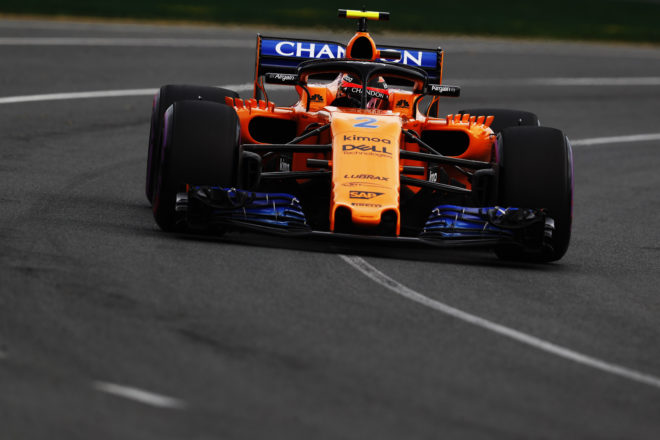
Photo – McLaren F1 team Bahrain, April 4: Having finished fifth after starting 10th on the grid at the Rolex Australian Formula One Grand Prix in Melbourne a fortnight ago, Fernando Alonso heads to Bahrain feeling positive, as also his McLaren team-mate Stoffel Vandoorne who made two places for a ninth place finish.
Fernando Alonso said: “After a positive start to the season I’m already really excited to head to Bahrain and get back in the car. Australia gave us a positive feeling and I hope we can continue that momentum as we head into these back-to-back races.
“I know the team is working hard back at the factory to push through the upgrades that are in the pipeline, as these, along with the development work we’re doing on the chassis and with the power unit, are what will be key to unlocking further performance from our car.
“We mustn’t get complacent – these two races in Bahrain and Shanghai are tough on the cars and it’s important that we maintain good reliability if we are to maximise our potential. The competition is very strong and we need to keep pushing forward for more points.”
Stoffel Vandoorne said: “I’m very happy to be heading to Bahrain on the back of a positive weekend for us in Australia. There’s a good feeling in the team and we’re all working hard to keep that going. We know there’s a lot to do and every race brings a new set of challenges.
“Bahrain is a great venue – it’s where I started my F1 career when I filled in for Fernando as reserve driver in 2016, and it’s an important race for us thanks to our shareholders. The weather is good and the later-than-usual programme for the weekend sets it apart from a lot of other tracks we visit.
“Racing from day to night always feels special and makes this grand prix so unique – it means it’s very different from Australia in terms of set-up so I’m keen to maximise track time to work on preparation with the engineers. Last year I had a lot of bad luck there reliability-wise so I’m hoping we can have better fortunes there this time around.”
Eric Boullier, Racing Director, said: “Bahrain is an exciting event for the whole team and a special venue for McLaren. It’s our second home due to the team’s ownership and we always receive a fantastic welcome from our Bahraini hosts. The facilities are world-class and it’s a very enjoyable venue at which to host a Grand Prix.
“The back-to-back races of Bahrain and China pose very different challenges, and, given that most of our personnel don’t travel back to the UK between them, both logistics and car development are two tricky issues that everyone needs to get on top of.
“Speaking of car development, we’re working hard to bring updates to the next two grands prix, which we hope will help our boys continue to put up a good fight. As we saw in Melbourne, our competition is tough. We can’t take anything for granted and we know that despite a stronger performance than we’ve seen in recent months, we also benefitted from circumstances around us. Our principal targets are further up the grid ahead of us, so we know there’s work to do and our focus is on the development race as well as the race on track.
“The result at Albert Park was a boost that we all needed, but now we must move on, look firmly ahead and keep pushing forward.”
A run-down on the race from McLaren team’s perspective:
The toughest corner is Turn 10, a downhill left-hander taken in second gear (85kmph/53mph). The cars are simultaneously turning left and braking, which makes it easy to lock the unloaded inside front wheel. The drivers need to drive in a progressive and controlled fashion because the second DRS zone follows and a good exit is vital.
Temperatures: In 2014, the time of the race was switched from day to night, from 14:00hrs to 18:00hrs. The race starts seven minutes after sunset, meaning the track and ambient temperatures drop as the race progresses. That alters the balance of the cars and affects tyrewear.
The Bahrain International Circuit is the only track on the calendar that is located in a desert. It is windy and sand from the surrounding wilderness gets blown onto the track surface, which affects grip levels and forces the teams to attach filters onto the brake and engine inlets.
Brakes: There are eight significant braking zones, the toughest of which are into Turns One and 14. It is also the first hot race of the year and the combination of high ambient temperatures and heavier cars (734kg) means brakes will need to be monitored closely during the race.
Fuel consumption: The cars use 1.8kg of fuel per lap, which is high. Without a Safety Car period, it will be difficult for the cars to make the end of the race without some degree of fuel saving. Fuel consumption is negatively affected by the large number of acceleration zones from low speed.
Aero balance: The cars run in a medium downforce configuration. The aero balance is slightly different to elsewhere on the calendar because the cars are set-up to under-steer in an effort to protect the rear tyres
McLaren Press Release
-
We made mistakes and did not perform to our maximum: Toto Wolff
Bahrain, April 4: Torger Christian “Toto” Wolff, Executive Director, Mercedes, AMG Petronas Formula One team, admitted to a few mistakes made during the season-opener Rolex Australian Formula One Grand Prix in Melbourne.
In his own words, “Toto” explains: “We suspected that the new season would be closely fought and the first race confirmed those suspicions. We made mistakes and did not perform to our maximum – and it reminded us that this is the toughest racing series in the world, where every error is punished. It hurt to leave all those points on the table, especially because we know we had the pace to win in Australia.”
“Back at base, we did what we always do after a tough weekend. We made sure that we understand what went wrong and put a process in place to make sure that we don’t see a similar issue in the future. These painful moments are the real learning experiences. Mistakes become training,” he added.
“We expect Bahrain to be another challenging weekend, although the challenges will be of a completely different nature. The race in the desert is tricky because the conditions change drastically between sessions. FP1 and FP3 take place in the heat of the day whereas Qualifying and the race itself take place after sunset so it’s much cooler. That makes it extremely difficult to find the right set-up with the car.
“Bahrain is also a power-sensitive race with the long straights. We saw in Melbourne that the Ferraris, in particular, were very quick, so I expect it to be a close battle. We’ve seen some great racing in Bahrain in recent years, particularly between our drivers back in 2014, so I think we can look forward to an exciting and competitive weekend.
Featured this Week: What Are Engine Modes?
Over a million working hours have gone into designing, developing and constructing our 2018 Formula One car. While the result of some of that engineering work can easily be spotted by the untrained eye – for example, the complex aerodynamic bodywork – other equally important areas are hidden from sight.
One of the all-important elements that lie underneath the bodywork is the Power Unit (PU). In this modern, 1.6-litre V6 Turbo era, it’s much more than just an engine. The Power Unit is made up of six different elements – the Internal Combustion Engine (ICE), Turbo, MGU-K, MGU-H, Control Electronics, and Energy Store.
These elements are combined together to deliver different Power Unit modes, which drivers and teams can utilise throughout a race weekend. Over the course of the 2018 season-opening Australian Grand Prix weekend, these proved to be a particularly hot topic and sparked plenty of debate. So, what are Power Unit modes and why are they necessary?
PU modes are a combination of settings that adjust the performance of the ICE as well as the flow of electrical energy. The ICE performance is changed, for example, by varying the amount of fuel that is injected into the combustion chamber or by changing the timing of the ignition. For the Hybrid side of the Power Unit, the modes will alter the interaction and scheduling of the electrical energy for both deployment of the 120kW (maximum) MGU-K and recovery of both the MGU-K and MGU-H.
The main task of PU modes is to balance performance and reliability. Formula One is all about performance, but with just three Power Units per driver in 2018 (and only two of some systems), reliability is increasingly important. This is why the drivers have reduced mileage allocations of the higher power modes.
At Mercedes-AMG Petronas Motorsport, we use three basic modes over the course of the weekend – one for the majority of the free practice sessions, one for the majority of Qualifying and one for the majority of the race.
All three can be altered with various sub-settings for different situations, which control whether electrical energy is being net deployed over a lap, recovered or used in a balanced manner (with energy deployment and recovery balancing each other out).
At the start of the race, for example, performance is particularly important, so drivers will choose full deployment to either defend a good position on the grid or try and gain positions in the opening laps. But F1 is about a blend of ballsy on-track passing and tactical strategy, so the drivers will later switch to a recovery energy management mode and charge the battery – just to make sure they can have more energy available for their next attack.
Both Lewis Hamilton and Valtteri Bottas switched their race mode to lower performance during the Australian GP when they were stuck in traffic and the turbulent air of the cars ahead, in order to cool the engines and prevent them from overheating. A Safety Car presents a similar challenge – drivers want to conserve energy and the Power Unit, so the engine mode is set to reduce the duty and cool the hardware.
Conserving damage and the reliability of the Power Unit is also important in free practice. Pushing the engines to the limit in practice just doesn’t make sense, as they need to last seven race weekends. There is one session, however, when the Power Unit is pushed to the absolute limit and gives the drivers everything it can: Qualifying.
In terms of engine modes, the setting for Qualifying will be the most powerful one. This mode is only required for a few laps each race weekend, and usage varies according to the competitive context – sometimes this Qualifying mode will be used throughout Qualifying, sometimes only in the final Q3 session.
The available mileage is dictated by what is termed the “phase document”, which defines the limits to which the Power Unit may be used during each race weekend, and which is the same for the works cars and the Mercedes customer teams.
PU modes are defined when the first set of hardware is tested in Brixworth and the mileage limit is determined by the success of the long-run programme. Some of these are circuit-specific, others are more general. Making the call on which mode to use can either be the driver’s decision or through the advice of the engineering team – who will communicate over the radio which settings to adjust and which mode to switch to.
If you hear some technical-sounding instructions over the team radio, it might well be the Power Unit mode being changed. The drivers will then change the mode through the switches on their steering wheel.
PU modes are particularly significant at power-sensitive circuits such as Spa-Francorchamps or Monza, which are dominated by long straights and acceleration zones. The first power-sensitive track on the 2018 F1 calendar is Round 4 in Baku.
It will be interesting to see how the storyline around engine modes develops as the season progresses, particularly when F1 reaches those more power-sensitive venues.
Mercedes AMG Petronas F1 Team Release
-
Sahara Force India prepares for the intense mid-field battle: Bahrain GP
Preview photo by Sahara Force India F1 team. Bahrain, April 3: After an unusually poor beginning to the season on the street circuit at Albert Park, Sahara Force India who are now famous for punching above their weight, are preparing for the Bahrain GP.
Acclaimed Indian racer and rallyist of yesteryears, Harish Samtani of `High Octane’ fame will bring forth his columns live from the Shakir circuit. Watch out for the `High Octane’ logo on the top right-hand corner of the home page.
In the curtain raiser, team Principal and liquor baron, Vijay Mallya, who is facing a deportation case reiterated from London that the team will continue to work hard and fight for better positions after both the cars finished outside points in the first race of 2018.
“Melbourne was a clear indicator that the competitiveness of the grid has closed up in 2018. We’ve got to work hard to maintain our fourth place in the championship and there’s going to be an intense development race at the front of the midfield. We are certainly up for the challenge and there are further changes to the car in Bahrain. We are a motivated team, with determined drivers and we will be targeting points this weekend,” said Mallya about the team which got a fighting fourth place for consecutive years by spending budgets that were a fraction of the huge amounts that the top three teams like Ferrari, Mercedes, and Red Bull spend.
But Chief Operating Officer Otmar Szafnauer retorted saying: “It’s where you end the season that counts.”
A brief interview with the COO:
Q: One race down, twenty to go. How is the mood in the camp…
“Melbourne is always a peculiar race. We came within a whisker of scoring a point with Sergio having caught Carlos Sainz, but overtaking was especially difficult at Albert Park and the tenth place remained out of reach. The race pace was stronger than our qualifying speed, but without track position, we couldn’t really show our true performance. Esteban’s front wing picked up some debris early in the race as well which compromised his pace, especially in the second stint.”Sergio Perez says: “Racing in Bahrain is good fun. It’s unusual because you’re in the desert and we also race under the lights. It’s actually one of my favourite tracks of the year and I’ve always gone well there. It’s where I had my first podium with Force India [in 2014] so I have those memories every time we go back there.
“The Bahrain track often creates good racing. I still remember the battle I had with my old teammate, Jenson Button, in 2013. The layout really allows you to race wheel-to-wheel at times. If you lose a position in turn one, you can fight back through turns two, three and four.
“It was difficult to overtake in Melbourne, but Bahrain should be a bit easier because it’s a more traditional track. We’ve got to be targeting points this weekend. Melbourne showed just how close all the teams are in the middle of the grid, so it’s especially important to have a clean weekend and maximise every session.
“The development race will be very intense this year, but I know we have good things coming. We need to do what we have done in the last few years by making improvements to the car at each race. We’ve already made a step forward since pre-season testing so we need to keep working in the same direction.”
Esteban Ocon, feeling good and ready, says: “When I think about Bahrain I always remember the beautiful paddock, which has so much space and looks amazing at night with all the trees lit up. Every year there’s a barbeque for the paddock and it’s nice that all the teams and media can come together before the racing begins.
“I love racing at night. It almost feels quicker under the lights and it looks better on television. Hopefully, the fans like it as much as the drivers. The track is good fun and there are a few good overtaking spots, such as turn one and turn four.
“It’s a track that feels very satisfying when your car is working well. I particularly enjoy turns five, six and seven because they are so quick and then you’re immediately into a big braking zone for turn eight. It’s tricky because you approach at really high speed and it’s easy to make a mistake and run wide.
“It’s a tough weekend physically because of the heat. The daytime practice sessions are the most difficult, but fortunately, it gets a bit cooler in the evenings for qualifying and the race. You need to drink lots to be hydrated and make sure you don’t lose concentration.”
Q: What can we expect from the next couple of races in Bahrain and China?
“It’s business as usual in terms of developing the car. We’ve got a new front wing coming for Bahrain, which will complement the upgrades we introduced in Melbourne. The car we have now is totally different from the spec we used during testing and we’re still on a learning curve. There is huge development potential with this new aerodynamic platform and we have things in the pipeline, which will bring performance steps in the first quarter of the season.”Q: How do you see the competitiveness of the 2018 grid? Were there any surprises?
“Testing showed us that the midfield has closed up considerably, so there were no big shocks in Melbourne. I think the points will be spread among the teams more evenly this year and retaining fourth place is going to be a big task. But we’ve only had one race and things can change very quickly in Formula One. The development race is only just beginning and it’s where you end the season that counts. Last year we out-developed the teams around us and we have to do the same this year. Our goal is to defend our fourth place and we will be fighting hard to get back up there.”Q: The pink livery continues to turn heads. It’s surely the most eye-catching car on the grid…
“The BWT pink identity is even stronger this year. I remember standing in the pit lane in Melbourne and thinking how much better this year’s paint scheme looks. Commercially it’s been another strong winter with Ravenol, DUO and PEMEX coming on board, whilst also developing our existing partnerships with NEC and Hype Energy. It was fantastic to unveil our partnership with Havaianas in Melbourne. The branding on the halo is very powerful and it’s great to see a young lifestyle brand supporting us and recognising the value of F1. We hope to have more news to announce over the coming weeks.” -
Stunning win for Vettel; Hamilton overcomes technical glitches to take 2nd: Rolex Aussie GP
Melbourne: Sebastian Vettel took a sensational Rolex
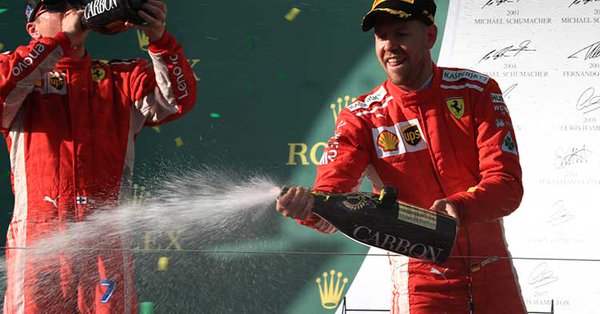
Vettel celebrates Aussie GP win on Sunday. Photo: Ferrari Australian Grand Prix victory, as the Formula One 2018 World Championship began at the traditional street circuit of Albert Park. Taking advantage of a mid-race safety car he beat arch-rival Lewis Hamilton, who suffered soft-ware glitches. The defending champion was forced to settle for second place ahead of the second Ferrari of Kimi “Räikkönen. Local hero Daniel Ricciardo finished fourth.
Sahara Force India duo of Sergio Perez and Esteban Ocon failed to finish in the points, thus ending a successful run of double points finish at the Rolex Australian GP.
“There could have been no better start for Ferrari in this Championship. Listening to Italy’s national anthem echo around Melbourne was an emotional moment for us all, and for every fan of the Scuderia. It’s the best possible reward for the team, which built a competitive car and used a perfect strategy to take advantage of the way the race evolved. Congratulations to Sebastian and Kimi, both drove a great race. Of course, there’s still a long way to go in the series, with 20 more Grands Prix. So it would be wrong to celebrate too much. We know that we still have a lot of work ahead of us, but the first step has been taken in the right direction,” said Ferrari Chairman Sergio Marchionne.
Hamilton led away comfortably at the start, dismissing a brief challenger from Raikkonen as they made their way through the first corners. Vettel held third place but behind Haas’ Kevin Magnussen got the jump on Verstappen who dropped to fifth ahead of Grosjean, Hulkenberg and Ricciardo.
At the back of the field, Toro Rosso’s Brendon Hartley had a major lock-up into Turn 1 and pitted at the end of lap one. The New Zealander took on soft tyres in a bid to reach the end of the race on the yellow-banded set.
Ricciardo was soon past Hulkenberg to take P7, but further ahead team-mate Verstappen was struggling to put pressure on Magnussen. The result was a rapidly degrading set of tyres and on lap 10 the Dutchman lost control into Turn 1 and spun. He dropped to eight behind Hulkenberg.
At the front Hamilton was attempting to build a gap, but both Raikkonen and Vettel were tenaciously hanging on and by the end of lap 15 Hamilton only had three seconds in hand over the Ferraris.
On lap 22 Magnussen made his first stop of the race, but almost immediately afterward he pulled over at the side of the track. The Dane reported an engine issue but Race Control later stated that the team had possibly released Magnussen unsafely.
That boosted team-mate Grosjean to fourth but under pressure from Ricciardo and on fading ultrasofts the Frenchman also pitted. Again though, as soon as he rejoined the circuit, he immediately pulled over and stopped in a mirror image of the Magnussen incident, this time with the front left wheel of Grosjean’s car not being properly attached.
With Grosjean’s car at the trackside on lap 24, the Virtual Safety Car was deployed. Ferrari seized the opportunity and pitted Vettel for soft tyres. Hamilton, though, lost a huge amount of time under the VSC and when Vettel emerged from the pit lane he swept into the lead.
The VSC was replaced by the real thing as Grosjean’s car was cleared and when racing resumed Vettel held his lead over Hamilton, with Raikkonen third and Ricciardo fourth. McLaren’s Fernando Alonso had vaulted up to fifth place under the SC and was being shadowed by Verstappen who had also recovered from his early woes.
The second half of the race became a cat and mouse battle between the Ferrari and Mercedes driver, with Hamilton regularly getting to within DRS range of the leader only for Vettel to drag the gap back out to beyond a second.
Six seconds further back, Raikkonen kept Ricciardo at bay in the same manner, with the Australian getting to within DRS range and the Finn pulling away as he carefully managed his defence of the final podium position.
Behind them, in the battle for fifth place, a little under two seconds covered three Renault-powered drivers in the closing stage, with Fernando Alonso leading Verstappen and Hulkenberg.
With 10 laps remaining Hamilton got on the radio to his team saying that he was going to attack for the lead. The attempt came to nothing, however, as the Briton suffered a heavy lock-up at Turn 9, losing almost two seconds to Vettel.
He clawed half that back over the next two laps and with seven laps remaining was 1.5s behind Vettel. A lap later and the deficit was just one second.
But there Hamilton’s charge ended. On the next tour, he was 1.3 slower than Vettel and then drifted to 4.4s off the Ferrari, and having been warned about high engine temperatures, Hamilton voted to save the engine on his car and settled for a safe second place.
A handful of laps later Vettel crossed the line to take his 48th career win ahead of the Briton. Raikkonen clung on to third place ahead of Ricciardo, while Alonso gave McLaren a positive start to life with Renault power by keeping Verstappen at bay to take fifth place. With the Dutchman sixth, Hulkenberg finished seventh ahead of Mercedes’ Valtteri Bottas, McLaren’s Stoffel Vandoorne. The final points position went to Renault’s Carlos Sainz, who battled to the finish despite suffering from nausea caused by the fluid in his drinks bottle during the race.
2018 Australian Grand Prix – Race
1 Sebastian Vettel Ferrari 1h29:33.283
2 Lewis Hamilton Mercedes 5.036
3 Kimi Raikkonen Ferrari 6.309
4 Daniel Ricciardo Red Bull 7.069
5 Fernando Alonso McLaren 27.886
6 Max Verstappen Red Bull 28.945
7 Nico Hulkenberg Renault 32.671
8 Valtteri Bottas Mercedes 34.339
9 Stoffel Vandoorne McLaren 34.921
10 Carlos Sainz Jr. Renault 45.722
11 Sergio Perez Force India 46.817
12 Esteban Ocon Force India 1’00.278
13 Charles Leclerc Sauber 1’15.759
14 Lance Stroll Williams 1’18.288
15 Brendon Hartley Toro Rosso 1 lap
16 Romain Grosjean Haas 34 laps
17 Kevin Magnussen Haas 36 laps
18 Pierre Gasly Toro Rosso 45 laps
19 Marcus Ericsson Sauber 53 laps
20 Sergey Sirotkin Williams 54 laps.Source: FIA
-
Halo blocks drivers’ vision, starting lights shifted: Season Opener
Melbourne: “After the winter debates, pro and against the protective device, all focus shifted away from the halo and on to the cars’ performance,” claimed an F1 release.
But it had to admit: …“the halo still managed to hold on to a bit of the limelight, as the starting lights were shifted under instruction from FIA Formula 1 Race Director Charlie Whiting. This because the drivers
could not see through the halo to the lights high above them, this problem being worse for the cars on the front row of the grid.”Now one can decide if that is a bit of the limelight. Read the High Octane Column by Harish Samtani here: F1 running out of fresh ideas to breathe life back into racing!
The 2018 season has finally got underway at Melbourne’s Albert Park circuit as the Friday practice sessions were run under a hot sun and blue skies. Mercedes posted the best times across the two sessions, confirming what was seen in the Barcelona tests a few weeks ago. Lewis Hamilton was the fastest in both practices, with Red Bull’s Max Verstappen managing to split the Mercedes drivers, pushing Valtteri Bottas into 3rd place in the second free practice. Fourth and 5th were the Ferrari, with Kimi Raikkonen ahead of Sebastian Vettel.
The Melbourne weekend also witnessed the debut of Brendon Hartley’s social media collaboration with Formula 1 as he takes us on a journey with him on his first full season as one of the top drivers in the world. Follow Toro Rosso’s Kiwi here:
Also, new this weekend is Brian Tyler’s newly-composed music for the Formula 1 starting sequence. Recorded with the London Philharmonic Orchestra, the score reflects the power and the fury of F1 cars as interpreted by one of Hollywood’s most successful film and game music
composers.F1 Release!
-
Formula One running out of fresh ideas to breathe life back into racing
Yay, it’s 2019 and we are going to get to witness F1 in its new avatar! Idiot! It’s still 2018, I had to remind myself and I wanted to crawl back into bed and continue watching Stranger things on Netflix! Anyway, being a petrol head too, zapped on the telly to watch F1 qualifying in Melbourne today and saw even more Stranger things!
A new fangled helmet covering a helmet?!!! Hmmm …..From the 70s era to now, the men and racing drivers have become boys in more ways than one! Men crashed and burnt alive during events that were more gladiatorial than it being a sport about ambitious drivers in fast cars. Then, as F1 evolved and Eccelstone, the creator of this magnum opus brought in 30 and 40 million and more as salaries for drivers, the current crop wanted to live a lot longer to enjoy this wealth!
The changes made in the 70s and 80s simply had to be done because the bloodshed was way too much and turning fans away. But this wussifying the sport by adding further fortification is the giddy limit.
The two examples of accidental death and disability can be understood from the unfortunate incidents of the two legends – Ayrton Senna and Michael Schumacher. Ayrton had crashed a wall at close to 200kmph and a simple bolt ejected from the damaged front suspension like a bullet and went through his visor that opened up just that half inch. The result was the same as that of a bullet wound. He died on the spot. Schumi is fighting a losing battle after an innocent skiing accident. Just a day out with the family. Both heroes and both with absolutely no reason to be in that situation.
So, if F1 thinks that they can save lives randomly and take away the no guts, no glory somewhat, should rethink.
The qualifying today at the Australian GP did prove that the top four teams will remain there. A Ferrari win will improve the telly viewership substantially. In any case, the results of the first few races will not have too much bearing on the championship.
With limited testing time in hand, teams will need to sort out their machines under competitive duress. The racing really begins once the circus moves to the traditional racing circuits in Europe. -
Hamilton powers to Melbourne pole ahead of Ferraris as Bottas crashes out
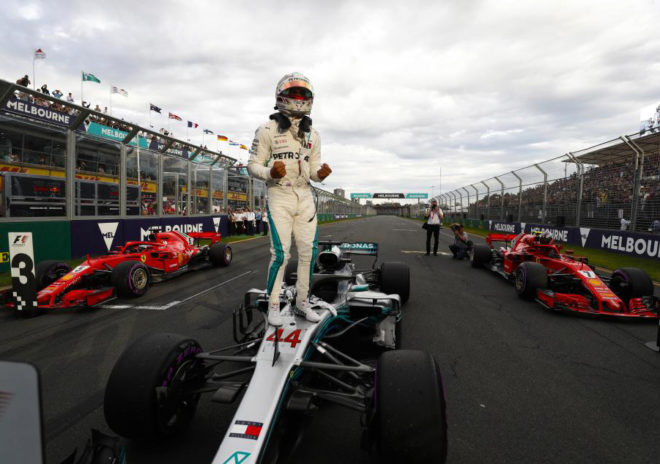
Lewis Hamilton celebrating pole position in Melbourne on Saturday. Photo: FIA Melbourne, March 24: Lewis Hamilton took his first pole position of the 2018 season in imperious fashion, beating Ferrari’s Kimi Räikkönen and third-placed Sebastian Vettel by nearly seven tenths of a second. It was a bittersweet session for Hamilton’s Mercedes team, however, as the defending team-mate, Valtteri Bottas, crashed out heavily at the start of the final session.
Räikkönen set the pace early in Q1, eventually rising to a time of 1:23.096s ahead of the Red Bulls of Daniel Ricciardo and Max Verstappen. The order changed when Hamilton began to put together laps and five minutes before the flag the defending champion jumped to the top of the order with a lap of 1:22.824.
That put him 0.272 ahead of Räikkönen who finished ahead of Sebastian Vettel and the Red Bulls Verstappen and Ricciardo.
At the lower end of the order, it looked like Toro Rosso’s Brendon Hartley was going to prop up the table, as he sat in P20 ahead of the final runs. The New Zealander rose to the challenge, though, and put in a superb final flyer to climb up the order. His time of 1:24.532 was only good for P16, however, and he missed out on progress to Q2 by just 0.029s, as Force India’s Esteban Ocon scraped through in P15.
Eliminated behind Hartley were the Saubers of Marcus Ericsson and Charles Leclerc in P17 and P18 respectively, while Williams’ Sergey Sirotkin went out in P19 ahead of the second Toro Rosso of Pierre Gasly who had an off on his final run.
Q2 saw Verstappen set the first quick lap on supersofts, but that of the ultra soft-shod Räikkönen quickly bypassed his lap of 1:22.830. This time top honours went to Vettel, with the Ferrari driving rising to P1 with a second-run time of 1:21.944. That put him a tenth clear of Hamilton, who stayed on his first-run time of 1:22.051. Bottas took third ahead of Verstappen and Ricciardo.
Alonso was the main driver to miss out. Ahead of the final runs the Spaniard sat in P7, but once the final times came in the McLaren driver had been edged out to P11, some 1500ths of a second behind 10th-placed Nico Hulkenberg of Renault.
Alonso’s McLaren team-mate Stoffel Vandoorne was meanwhile eliminated in P11 ahead of Force India’s Sergio Perez, Stroll and Ocon.
Q3 began in dramatic fashion, with the first runs being interrupted by a red flag being shown when Bottas crashed heavily in Turn 2. The Finn lost control on the approach to the corner and broadsided the wall, causing severe damage to his Mercedes.
When running resumed, Hamilton led the way, with a time identical to his Q2 best. That left him just three hundredths of a second clear of Vettel, with Verstappen third ahead of Räikkönen and Ricciardo.
In the second runs, though, Mercedes turned up the heat and Hamilton simply powered ahead, taking almost nine tenths of a second out of his first-run time to claim his 73rd career pole position with a time of 1:21.194.
Räikkönen took second place, though the Finn was 0.664s behind Hamilton. Vettel was third, just one hundredth of a second behind his Ferrari team-mate.
Ferrari were pushed hard, however, by Red Bull Racing who looked closer to the Italian team than last season. Verstappen qualified just four hundredths of a second behind Vettel, with Ricciardo fifth on a time of 1:22.152.
Behind them, Haas confirmed their dark horse status, with Kevin Magnussen taking sixth place ahead of team-mate Romain Grosjean. Hulkenberg was eighth ahead of Renault team-mate Sainz, while the unfortunate Bottas qualified 10th.
2018 Australian Grand Prix – Qualifying:
- Lewis Hamilton (Mercedes) 1:21.164
2. Kimi Raikkonen (Ferrari) 1:21.828
3. Sebastian Vettel (Ferrari) 1:21.838
4. Max Verstappen (Red Bull Racing) 1:21.879
5. Daniel Ricciardo (Red Bull Racing) 1:22.152
6. Kevin Magnussen (Haas) 1:23.187
7. Romain Grosjean (Haas) 1:23.339
8. Nico Hulkenberg (Renault) 1:23.532
9. Carlos Sainz Jr. (Renault) 1:23.577
10. Valtteri Bottas (Mercedes)
11. Fernando Alonso (McLaren) 1:23.692
12. Stoffel Vandoorne (McLaren) 1:23.853
13. Sergio Perez (Force India) 1:24.005
14. Lance Stroll (Williams) 1:24.230
15. Esteban Ocon (Force India) 1:24.786
16. Brendon Hartley (Toro Rosso) 1:24.532
17. Marcus Ericsson (Sauber) 1:24.556
18. Charles Leclerc (Sauber) 1:24.636
19. Sergey Sirotkin (Williams) 1:24.922
20. Pierre Gasly (Toro Rosso) 1:25.295
FIA News
- Lewis Hamilton (Mercedes) 1:21.164
-
Drivers’ safety: Biometric gloves make F1 debut
Melbourne, March 24: Starting from this weekend’s Australian Grand Prix, the FIA is introducing a new race glove into Formula One that sends potentially life-saving data from driver to medical crew.
The gloves will be worn by every F1 driver and monitor their vital signs during the race via a flexible 3mm sensor stitched into the palm area of the fabric. The FIA has worked closely with F1 glove manufacturers Puma, OMP, Alpinestars and Sparco to integrate these sensors into fire-resistant clothing for the first time.
Initially, the optical sensor will measure ‘pulse oximetry’, or the amount of oxygen in the blood, alongside the pulse rate, enabling the trackside medical team to receive important information as soon as there is an incident. This is potentially important in the context of a racing driver because if they have an injury that is affecting breathing, the oxygen content of the blood will diminish rapidly.
Drivers’ Safety is of paramount importance for the FIA, and together with its Research Body, Global Institute, alongside its doctors and engineers, it has been examining how state-of-the-art technology could help medical teams and drivers.
Biometric data helps to assess the driver’s conditions before, at the time of the crash and after the crash as far as the rescue operations are concerned. Further developments in this area are planned throughout the season to improve the device and set new benchmarks for motor sport safety.”
The project is the result of a partnership between the Global Institute and Signal Biometrics Ltd, the company set up by Dr Ian Roberts and the engineer Alain van der Merwe, who have both been involved in Formula One with the FIA for many years respectively as FIA F1 Deputy Medical Delegate and FIA F1 Medical Car Driver.
Ian Roberts said: “We know that the monitoring of people is essential in terms of their medical care and drivers in incidents are no different. We would like to start monitoring and assessing them as soon as we possibly can. There are also times when the driver isn’t immediately accessible to us, so if we can’t see him or we’re not actually next to him, there’s limited information that we can get.”
F1 driver Carlos Sainz’s accident during the 2015 Russian GP is a case in point. The Spaniard lost control of his Toro Rosso at Turn 13 during the third practice session and hit the barrier head-on at 153km/h. Fortunately, Sainz was unhurt, but it was difficult for the F1 medical team to know this, as the first row of the barrier came to rest on top of the driver. So when they arrived at the scene, they found that they had limited contact with him and had to wait until the barrier was removed from the car before a more direct medical assessment could begin.
With this new technology, the moment a driver has an incident, the trackside medical team will receive physiological readings and biometrics, so he is continually monitored from point zero right through to the initial response and on to the medical centre.
Alan van der Merwe added: “This will enable monitoring of the driver not only when still in the car, but also offer the benefit of continuous monitoring during patient transport.”
Going forward, there are already plans to implement sensors for respiratory rate and temperature. In addition to the safety benefits, these will help teams and drivers with performance monitoring. Respiratory rate gives a very good indication of a driver’s state of health and stress, while temperature is well known for affecting performance.
F1 is just the first step for the device in motor sport as the idea is to filter down the technology to other championships.
FIA News
-
Hamilton edges out Verstappen to dominate Friday’s practice session: Australian GP
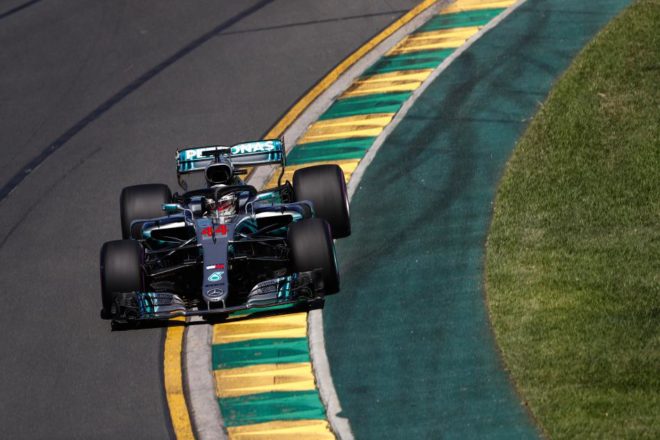
Lewis Hamilton who dominated the Free Practice sessions on Friday. Photo: FIA Melbourne, March 23: Lewis Hamilton remained in control of the Albert Park time sheets at the end of the second free practice session as the Formula One World Championship season began in Melbourne on Friday. However, the defending champion was closely by Red Bull Racing’s Max Verstappen, with the Dutch driver finishing just over a tenth of second behind his Mercedes rival.
After early sparring on the soft and supersoft tyres, the session’s qualifying simulations saw Hamilton charge to the front of the pack with a time of 1:23.931s set after had bolted on a set of Pirelli’s purple-banded ultrasoft tyres. Valtteri Bottas made it a Mercedes one-two, two tenths down on Hamilton, but Verstappen soon split the Silver Arrows duo with a lap of 1:24.058 to end the session just 0.127s behind the champion.
Ferrari’s Kimi Räikkönen finished to fourth, 0.283s off the pace with team-mate Sebastian Vettel a further 0.237s behind in fifth place.
Haas again looked in good shape, with Romain Grosjean sixth in the second session and seven tenths of a second off Hamilton’s pace.
Daniel Ricciardo in the second Red Bull might have challenged for the top spots on the timesheet but the home favourite’s qualifying run was interrupted by a brief red flag caused by loose cabling on the start-finish straight.
Fernando Alonso reprised his FP1 achievement of eighth place, with the Spaniard finishing 1.269s adrift of Hamilton and just under five hundredths of a second clear of the second Haas of Kevin Magnussen. Alonso’s team-mate Stoffel Vandoorne also matched his earlier efforts by taking 10th place in the session.
Elsewhere, the only real drama occurred right at the end of the session when Williams’ Lance Stroll was forced to stop on track after encountering trouble.
2018 Australian Grand Prix – Free Practice 2
1 Lewis Hamilton Mercedes 35 1:23.931
2 Max Verstappen Red Bull 34 1:24.058 0.127
3 Valtteri Bottas Mercedes 34 1:24.159 0.228
4 Kimi Raikkonen Ferrari 39 1:24.214 0.283
5 Sebastian Vettel Ferrari 38 1:24.451 0.520
6 Romain Grosjean Haas 34 1:24.648 0.717
7 Daniel Ricciardo Red Bull 28 1:24.721 0.790
8 Fernando Alonso McLaren 28 1:25.200 1.269
9 Kevin Magnussen Haas 30 1:25.246 1.315
10 Stoffel Vandoorne McLaren 34 1:25.285 1.354
11 Carlos Sainz Jr. Renault 35 1:25.390 1.459
12 Sergio Perez Force India 30 1:25.413 1.482
13 Nico Hulkenberg Renault 35 1:25.463 1.532
14 Lance Stroll Williams 32 1:25.543 1.612
15 Esteban Ocon Force India 33 1:25.888 1.957
16 Brendon Hartley Toro Rosso 41 1:25.925 1.994
17 Pierre Gasly Toro Rosso 39 1:25.945 2.014
18 Sergey Sirotkin Williams 37 1:25.974 2.043
19 Marcus Ericsson Sauber 31 1:26.814 2.883
20 Charles Leclerc Sauber 35 1:26.815 2.884. -
Hamilton sets pace and tops FP1: Aussie GP
Hamilton tops FP1 in Melbourne on Friday as the Formula One season began at the Albert Park street circuit. Photo: FIA Melbourne, March 23: Reigning champion Lewis Hamilton of Mercedes F1 team beat his team-mate Valtteri Bottas by over half a second as the season began with the first day of Free Practice of the first Grand Prix got underway at the Albert Park circuit here, with Max Verstappen a further two tenths of a second off the pace.
Meanwhile, Sahara Force India cars were off the pace with Esteban Ocon putting his VJM11 in 14th place ahead of a Williams and Sergio Perez in 16th place.
With the temporary circuit lacking grip, teams played a waiting game in the early stages and more than 20 minutes before Williams rookie set the first timed lap of the day with a time of 1:32.057s. The front runners then joined the action with Ferrari’s Kimi Räikkönen and Mercedes’ Bottas briefly topping the timesheet before red Bull Racing made its mark, with Verstappen and team-mate Daniel Ricciardo trading fastest times as the drivers began to explore the limits of the improving track.
Hamilton then vaulted to the top of the order, first with a time of 1:24.531 and later with a time of 1:24.026 set on ultrasofts that stood until the flag fell. Verstappen, meanwhile, used the supersofts to claim third.
Fourth place went to Räikkönen, who finished 0.849 off Hamilton’s pace, with team-mate Sebastian Vettel fifth ahead of Red Bull’s Ricciardo who was just over a second off Hamilton’s pace.
Dark horses from testing Haas finished seventh, with Romain Grosjean setting a time of 1:25.730 to finish seven tenths off the last of the top three teams’ drivers. Fernando Alonso was eighth for McLaren as the team used Renault power for the first time on a grand prix weekend.
The British team had a difficult spell in pre-season testing, suffering a number of mechanical problems and in Melbourne the session was again not without trouble. Alonso spent some time in the garage with an exhaust problem. Carlos Sainz was ninth for Renault, while Alonso’s team-mate Stoffel Vandoorne completed the top 10 order.
2018 Australian Grand Prix – Free Practice 1
1 Lewis Hamilton Mercedes 27 1:24.026
2 Valtteri Bottas Mercedes 29 1:24.577 0.551
3 Max Verstappen Red Bull 26 1:24.771 0.745
4 Kimi Raikkonen Ferrari 23 1:24.875 0.849
5 Sebastian Vettel Ferrari 22 1:24.995 0.969
6 Daniel Ricciardo Red Bull 25 1:25.063 1.037
7 Romain Grosjean Haas 24 1:25.730 1.704
8 Fernando Alonso McLaren 16 1:25.896 1.870
9 Carlos Sainz Jr. Renault 23 1:25.922 1.896
10 Stoffel Vandoorne McLaren 15 1:26.482 2.456
11 Pierre Gasly Toro Rosso 25 1:26.494 2.468
12 Sergey Sirotkin Williams 25 1:26.536 2.510
13 Nico Hulkenberg Renault 25 1:26.583 2.557
14 Esteban Ocon Force India 30 1:26.605 2.579
15 Lance Stroll Williams 30 1:26.636 2.610
16 Sergio Perez Force India 26 1:26.767 2.741
17 Kevin Magnussen Haas 13 1:27.035 3.009
18 Brendon Hartley Toro Rosso 16 1:27.745 3.719
19 Marcus Ericsson Sauber 28 1:27.964 3.938
20 Charles Leclerc Sauber 28 1:28.853 4.827.